Filtrations Indexed by Attracting Levels and their Applications
Pith reviewed 2026-05-19 08:30 UTC · model grok-4.3
The pith
Filtrations indexed by attracting levels quantify forward sensitivity of trajectories to attractors and backward perturbation thresholds where attraction breaks down.
A machine-rendered reading of the paper's core claim, the machinery that carries it, and where it could break.
Core claim
We introduce a new class of filtrations indexed by attracting levels in dynamical systems, providing novel inputs for persistent homology and related methods in topological data analysis. These filtrations quantify, in a forward direction, the sensitivity of trajectories with respect to attractors under perturbations and, in a backward direction, the perturbation magnitude at which attraction breaks down. The construction applies not only to maps on metric spaces but also to general partial maps with cost functions, yielding a filtration-theoretic framework with connections to algebraic topology. This generality ensures complementary filtrations when terminal states are good or bad, inducing
What carries the argument
The filtration indexed by attracting levels, which assigns values that track forward sensitivity of trajectories toward attractors and backward thresholds where attraction fails, for maps on metric spaces and general partial maps with cost functions.
If this is right
- The filtrations supply new inputs that can be fed directly into persistent homology pipelines for dynamical systems.
- Complementary good-state and bad-state filtrations produce a natural decomposition of the underlying space.
- The same construction identifies regions of heightened sensitivity in applications such as ensemble forecasts of tropical cyclones.
Where Pith is reading between the lines
- The cost-function formulation opens the possibility of treating optimization trajectories as dynamical systems and applying the filtrations to detect early sensitivity in gradient-based methods.
- Because the backward direction measures breakdown thresholds, the filtrations could be combined with existing stability criteria to produce joint topological-stability diagrams for attractors.
- The framework's generality suggests testing on discrete dynamical systems arising in cellular automata or agent-based models where partial maps appear naturally.
Load-bearing premise
That filtrations indexed by attracting levels can be rigorously defined for general partial maps with cost functions and that they induce natural decompositions of the space when terminal states are good or bad.
What would settle it
Construct the filtration explicitly on a low-dimensional system such as the logistic map with a chosen cost function, compute the resulting persistent homology, and check whether the decomposition into good and bad terminal regions matches the predicted attracting-level structure; inconsistent or undefined behavior on this example would refute the central construction.
Figures



read the original abstract
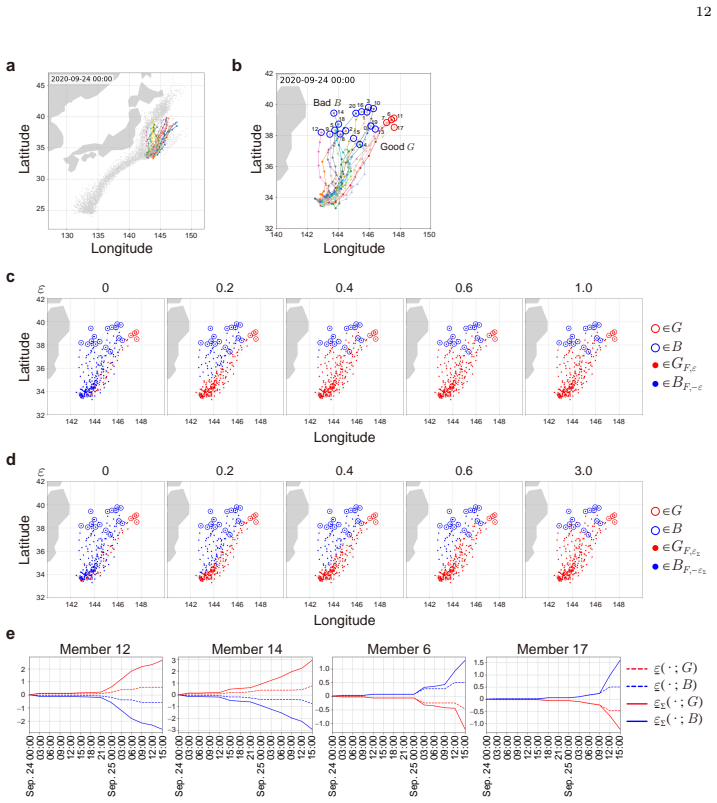
We introduce a new class of filtrations indexed by attracting levels in dynamical systems, providing novel inputs for persistent homology and related methods in topological data analysis. These filtrations quantify, in a forward direction, the sensitivity of trajectories with respect to attractors under perturbations and, in a backward direction, the perturbation magnitude at which attraction breaks down. The construction applies not only to maps on metric spaces but also to general partial maps with cost functions, yielding a filtration-theoretic framework with connections to algebraic topology. This generality ensures complementary filtrations when terminal states are good or bad, inducing natural decompositions of the underlying space. As an illustration, we apply the framework to ensemble forecasts of tropical cyclones, where the filtrations identify regions of heightened sensitivity, demonstrating the potential of our approach as a new tool for topological data analysis applied to dynamical systems.
Editorial analysis
A structured set of objections, weighed in public.
Referee Report
Summary. The manuscript introduces a new class of filtrations indexed by attracting levels in dynamical systems. These quantify forward sensitivity of trajectories to attractors under perturbations and backward the perturbation magnitude at which attraction breaks down. The construction is claimed to apply to maps on metric spaces as well as general partial maps with cost functions, yielding complementary filtrations for good or bad terminal states that induce natural decompositions of the space. The filtrations are positioned as novel inputs for persistent homology and topological data analysis, with an illustrative application to ensemble forecasts of tropical cyclones identifying regions of heightened sensitivity.
Significance. If the filtrations rigorously satisfy the nestedness axiom and other filtration properties for arbitrary cost functions, the framework could supply a useful new tool for sensitivity analysis via persistent homology in dynamical systems. The extension to partial maps with cost functions and the explicit link to decompositions for good/bad terminals represent potential strengths. The tropical cyclone application provides a concrete demonstration of utility in forecasting contexts. Credit is due for attempting a general filtration-theoretic approach connecting dynamics to algebraic topology, though the load-bearing properties require explicit verification.
major comments (2)
- [§2] §2 (Definition of attracting levels and forward/backward sensitivity): The central claim that these objects form filtrations for general partial maps with cost functions requires the attracting levels to be monotonically ordered so that the associated sets are nested. The forward sensitivity and backward perturbation constructions do not automatically enforce this when cost functions are arbitrary or when terminal states switch between good and bad; without an explicit monotonicity argument or counter-example check, the filtration property (essential for persistent homology inputs) remains unverified and load-bearing for the main theorem.
- [§3.1] §3.1 (Induced decompositions): The assertion that complementary filtrations for good and bad terminal states induce natural decompositions of the underlying space is stated at a high level but lacks a precise statement or derivation showing how the level sets combine to produce the claimed partition or direct sum decomposition; this step is central to the generality claim yet is not load-bearing only if the nested filtration property already holds.
minor comments (2)
- [Abstract] Abstract: The phrase 'connections to algebraic topology' is vague; a specific reference to the relevant functor or homology theory used would clarify the intended interface with persistent homology.
- Notation: The cost function and partial map symbols are introduced without an explicit comparison table to standard dynamical systems notation, which could aid readers familiar with classical attractors.
Simulated Author's Rebuttal
We thank the referee for the careful reading and constructive comments on our manuscript. We address each major comment below and indicate the specific revisions planned for the next version.
read point-by-point responses
-
Referee: [§2] §2 (Definition of attracting levels and forward/backward sensitivity): The central claim that these objects form filtrations for general partial maps with cost functions requires the attracting levels to be monotonically ordered so that the associated sets are nested. The forward sensitivity and backward perturbation constructions do not automatically enforce this when cost functions are arbitrary or when terminal states switch between good and bad; without an explicit monotonicity argument or counter-example check, the filtration property (essential for persistent homology inputs) remains unverified and load-bearing for the main theorem.
Authors: We agree that an explicit monotonicity argument is necessary to confirm the filtration axioms for arbitrary cost functions. The attracting levels are defined to be non-decreasing with respect to the cost or perturbation size, which by construction yields nested sublevel sets for both forward and backward sensitivities. We will add a short lemma in the revised Section 2 that proves this monotonicity in full generality, including the separate treatment of good and bad terminal states to preserve complementarity. A brief counter-example check for non-monotonic costs will also be included to illustrate the boundary of the construction. revision: yes
-
Referee: [§3.1] §3.1 (Induced decompositions): The assertion that complementary filtrations for good and bad terminal states induce natural decompositions of the underlying space is stated at a high level but lacks a precise statement or derivation showing how the level sets combine to produce the claimed partition or direct sum decomposition; this step is central to the generality claim yet is not load-bearing only if the nested filtration property already holds.
Authors: The referee correctly notes that the decomposition claim would benefit from a precise statement. In the revised manuscript we will insert a proposition in Section 3.1 that derives the partition explicitly: the space is the disjoint union of the attracting-level sets associated with good terminals and those associated with bad terminals, with the two families remaining disjoint by the mutual exclusivity of the terminal-state labels. This proposition will be stated after the nestedness lemma so that the argument relies only on already-established filtration properties. revision: yes
Circularity Check
No circularity: new filtration class is a definitional construction
full rationale
The paper introduces filtrations indexed by attracting levels as a novel mathematical framework for dynamical systems and persistent homology. The abstract describes a forward/backward sensitivity construction for general partial maps with cost functions, yielding complementary filtrations and natural decompositions. No equations, fitted parameters, or predictions are shown that reduce to inputs by construction. No self-citations are invoked as load-bearing for the central definition or uniqueness. The application to tropical cyclone forecasts is an illustration, not a statistical fit renamed as prediction. The derivation is self-contained as a new definition with stated properties; any verification of nestedness or monotonicity is a standard proof obligation, not a circular reduction.
Axiom & Free-Parameter Ledger
Lean theorems connected to this paper
-
IndisputableMonolith/Costwashburn_uniqueness_aczel unclear?
unclearRelation between the paper passage and the cited Recognition theorem.
Definition 3. Let X be a set and c: X² → [0, ∞] a function. The function c is a cost function if c(x, x) = 0 for any x ∈ X. ... we generalize the conventional framework of dynamical systems on metric spaces ... to a broader framework of dynamical systems based on iterations of partial maps on sets equipped with a cost function.
-
IndisputableMonolith/Foundation/AbsoluteFloorClosureabsolute_floor_iff_bare_distinguishability unclear?
unclearRelation between the paper passage and the cited Recognition theorem.
Theorem 2.5. ... The families (AF,εΣ)ε∈(−∞,−0]⊔[0,∞] and (AF,ε)ε∈(−∞,−0]⊔[0,∞] are filtrations.
What do these tags mean?
- matches
- The paper's claim is directly supported by a theorem in the formal canon.
- supports
- The theorem supports part of the paper's argument, but the paper may add assumptions or extra steps.
- extends
- The paper goes beyond the formal theorem; the theorem is a base layer rather than the whole result.
- uses
- The paper appears to rely on the theorem as machinery.
- contradicts
- The paper's claim conflicts with a theorem or certificate in the canon.
- unclear
- Pith found a possible connection, but the passage is too broad, indirect, or ambiguous to say the theorem truly supports the claim.
Reference graph
Works this paper leans on
-
[1]
JC Alexander, James A Yorke, Zhiping You, and Ittai Kan,Riddled basins, International Journal of Bifurcation and Chaos2 (1992), no. 04, 795–813. 4.2
work page 1992
-
[2]
Birkhoff, Dynamical systems, With an addendum by Jurgen Moser
George D. Birkhoff, Dynamical systems, With an addendum by Jurgen Moser. American Mathematical Society Colloquium Publications, Vol. IX, American Mathematical Society, Providence, R.I., 1966. 1 15
work page 1966
-
[3]
Rufus Bowen,Equilibrium states and the ergodic theory of Anosov diffeomorphisms, Lecture Notes in Mathematics, vol. Vol. 470, Springer-Verlag, Berlin-New York, 1975. 1
work page 1975
-
[4]
, ω-limit sets for axiom a diffeomorphisms, Journal of differential equations18 (1975), no. 2, 333–339. 1
work page 1975
-
[5]
, On axiom a diffeomorphisms, cbms regional conf, Series in Mathematics35 (1978). 1
work page 1978
-
[6]
Charles Conley,The gradient structure of a flow: I, IBM RC 3932 (# 17806), 1972; reprinted in Ergodic Theory Dynam. Systems8 (1988), no. Charles Conley Memorial Issue. 1, 2.1.1
work page 1972
-
[7]
38, American Mathematical Soc., 1978
Charles C Conley,Isolated invariant sets and the morse index, no. 38, American Mathematical Soc., 1978. 1
work page 1978
-
[8]
Claude Dellacherie and Paul-André Meyer,Probabilities and potential, volume 29 of mathe- matics studies, 1978. 16
work page 1978
-
[9]
Steven W McDonald, Celso Grebogi, Edward Ott, and James A Yorke,Fractal basin bound- aries, Physica D: Nonlinear Phenomena17 (1985), no. 2, 125–153. 4.2
work page 1985
-
[10]
Pascal Oettli and Shunji Kotsuki,An objective detection of separation scenario in tropical cyclone trajectories based on ensemble weather forecast data, Journal of Geophysical Research: Atmospheres 129 (2024), no. 14, e2024JD040830. 1, 4, 4.1
work page 2024
-
[11]
Pascal Oettli, Keita Tokuda, Yusuke Imoto, and Shunji Kotsuki,Meteorological landscape of tropical cyclone, EGUsphere 2025 (2025), 1–28. 1, 4
work page 2025
-
[12]
Tomoo Yokoyama,Coarse chain recurrence, morse graphs with finite errors, and persistence of circulations, arXiv preprint arXiv:2504.01325 (2025). 1 Institute for the Adv anced Study of Human Biology, Kyoto University, Yoshida Konoe-cho, Sakyo-ku, Kyoto, 606-8501, Japan Email address: imoto.yusuke.4e@kyoto-u.ac.jp Department of Mathematics, F aculty of Sci...
discussion (0)
Sign in with ORCID, Apple, or X to comment. Anyone can read and Pith papers without signing in.