REVIEW 3 major objections 5 minor 1 cited by
A New Pathway to Integrated Learning and Communication (ILAC): Large AI Model and Hyperdimensional Computing for Communication
T0 review · 3 major / 5 minor · reviewed 2026-08-06 · deepseek-v4-flash
Pith's one-line read This paper proposes a unified integrated learning and communication (ILAC) framework pairing large AI models with hyperdimensional computing, and argues through a cost-to-performance case study that jointly optimizing task assignment…
desk verdict Solid ILAC survey, but the case study's joint-optimization claim is unsupported: model size is decoupled from accuracy and the baselines are set up to lose. read the letter →
The pith
A machine-rendered reading of the paper's core claim, the machinery that carries it, and where it could break.
The reading
What carries the argument
The load-bearing object is the HDC model itself: each class is represented as a single high-dimensional random vector formed by summing per-sample hypervectors, so a trained model is just a small collection of hypervectors whose size equals the number of classes times the hypervector dimension D. Addition bundles items into sets, multiplication binds features to values, and cosine similarity or Hamming distance performs classification. Around this object the paper builds a compression stage, where a foundation model maps each HDC model to a smaller representation depending on channel state, and an aggregation stage, where a server-side foundation model fuses received models per task. The optimization machinery is the CPR objective, minimized by Dinkelbach's transform and alternating optimization, with per-iteration complexity O(MN + $N^{3}$) and overall complexity O(I1 I2 (MN + $N^{3}$)).
What would settle it
Run the proposed CPR optimization on a real HDC classification task with a public dataset, measuring classification accuracy after foundation-model compression and after noisy transmission. If the measured accuracy of compressed models is substantially lower than the assumed formula, or if the joint design no longer beats the communication-only baseline on measured CPR, the central claim fails.
Extended reading notes
Core claim
The paper claims that ILAC can be instantiated as a single optimization problem whose objective is the Cost-to-Performance Ratio (CPR): the total computational cost of compressing hyperdimensional models divided by a product of communication rate and HDC inference accuracy. Each client trains an HDC classifier on its assigned task, a foundation model compresses the resulting hypervectors before wireless transmission, and the central server aggregates the received models with another foundation model. The authors solve the CPR minimization problem with the Dinkelbach transformation plus alternating optimization, alternating between task assignment and model size on one side and bandwidth and power allocation on the other. Their reported result, across bandwidth budgets from 1 to 10 MHz, is that the joint design converges to a stationary point and consistently achieves lower CPR than both a communication-oriented baseline and a learning-oriented baseline.
Load-bearing premise
The optimization conclusions rest on assuming the classification accuracy of a compressed, wirelessly received hyperdimensional model follows a known formula and that a foundation model can shrink these models without meaningfully degrading that accuracy; the paper does not specify or validate either function.
Editorial extensions
If this is right
- If the case study is right, network designers should allocate bandwidth, power, task assignment, and model compression jointly rather than treating communication and learning as separate subsystems.
- Larger total bandwidth lowers the cost-to-performance ratio in the proposed design, so the framework gives a quantitative way to trade spectrum for learning quality.
- Because HDC models can be trained in a single pass without gradient backpropagation, the framework points to distributed learning systems that skip iterative fine-tuning and still adapt to new tasks over the air.
- The convergence result, a stationary point obtained in roughly 90 alternating-optimization iterations, suggests the joint problem is tractable at practical network scales with polynomial complexity in the number of clients and tasks.
Reading between the lines
- Extension: The paper treats HDC accuracy after compression and noisy transmission as a known function phi, but does not measure it; a natural next step is to fit phi empirically on real datasets and re-run the optimization, which would show how much of the reported CPR gain survives realistic compression loss.
- Extension: Since the objective is a ratio of cost to a product of rate and accuracy, the same framework could be extended to trace a full Pareto frontier between communication rate and inference accuracy instead of a single weighted ratio, giving operators a menu of operating points.
- Extension: The same task-assignment, compression, bandwidth, and power formulation could be applied to over-the-air aggregation or semantic communication, where multiple clients' hypervectors are combined in the channel itself, rather than only to digital transmission of compressed models.
Editorial analysis
A structured set of objections, weighed in public.
Referee Report
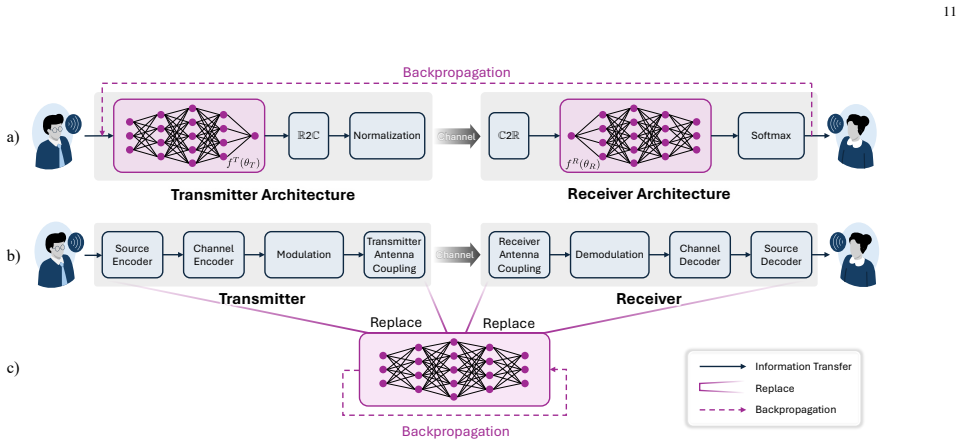
Summary. The paper is an invited survey of Integrated Learning and Communication (ILAC) for 6G networks, organized around a taxonomy of model distribution and data distribution architectures. It reviews split learning, aggregation learning, intelligent transceivers, federated learning, multi-agent reinforcement learning, CSI prediction, and resource allocation, and then proposes an enhanced framework combining large AI models with hyperdimensional computing (HDC). The paper's quantitative contribution is a case study in Section VI-C in which task assignment, compressed model size, bandwidth, and power are jointly optimized to minimize a Cost-to-Performance Ratio (CPR) defined in Eq. (21). The authors use Dinkelbach's transformation and alternating optimization, and report in Fig. 14 that the proposed joint design achieves lower CPR than communication-oriented and learning-oriented baselines. The abstract claims that this constitutes a 'practical and effective solution' to balance learning performance and communication constraints.
Significance. If the case study were fully specified and validated, it would provide a useful demonstration of joint learning-communication optimization in an ILAC setting, and the survey portion has clear value as a structured synthesis of recent work on model/data distribution, large AI models, and HDC. The algorithmic description of Dinkelbach and alternating optimization, including the complexity analysis O(I1 I2 (MN + N^3)), is a useful contribution. The paper does not, however, ship code, data, or concrete instances of the key functions that drive the case study; its central quantitative claim is therefore currently unsupported. The survey parts and the proposed framework are likely of interest to the journal's readership, but the case-study conclusions need substantial grounding before the abstract's 'practical and effective' claim can be accepted.
major comments (3)
- [Section VI-C.2, Eqs. (14), (19), (20)] The case study's quantitative results depend on three functions that are never specified: the HDC accuracy function phi(.), the compression-cost function eta(.), and the foundation-model preprocessing function f_p(.). The text only states that phi(.) 'can be determined by the accuracy on the validation set' and that eta(.) 'characterizes the processing capability of the client-side foundation model.' Because no concrete HDC encoder, dataset, foundation model, or functional form is given, the CPR curves in Fig. 14 cannot be reproduced, and the abstract's claim of a 'practical and effective solution' is not supported. The authors should either instantiate these functions from real HDC models and measurements, or explicitly present the case study as an illustrative abstraction with a sensitivity analysis over these functions.
- [Section VI-C.2, Eqs. (19)-(20) and constraints (21d)-(21e)] The compressed model size sc_j appears only in the cost function eta(s0_j/sc_j) in Eq. (19) and in constraints (21d)-(21e); it does not appear as an argument of the accuracy function phi(Pc_j) in Eq. (20). Consequently, the optimizer can reduce sc_j to lower the numerator of the CPR without any corresponding penalty to the HDC performance term Q. This means the formulation does not actually model the inference-accuracy-versus-communication-cost trade-off that is central to the ILAC concept; the claimed joint optimization of model size and accuracy is therefore not realized by the stated problem.
- [Section VI-C.4, Fig. 14(c)] The baselines are described as optimizing 'only the transmission rate' or 'only ... HDC performance,' while the proposed design minimizes the full CPR. Since CPR is the ratio of the total cost to the product in Eq. (20), optimizing a single factor of that product is unlikely to minimize the ratio, so the proposed design's lower CPR is largely a property of the comparison protocol rather than evidence of a superior joint trade-off. A meaningful comparison should optimize the same aggregate metric under the same functional forms for all designs, or report the full Pareto frontier between communication performance and learning performance.
minor comments (5)
- [Section VI-C.4] The simulation text says the 'channel fading coefficient' is '128.1 + 37.6 log10 dj', which is a path-loss expression in dB, whereas h_j in Eqs. (15) and (17) is used as a complex channel coefficient in |h_j|^2. The relation between the simulated value and the rate formula should be clarified.
- [Section VI-C.1] The notation T_c^j = sum_i A_ij T_i is an abuse of notation, since it sums task labels rather than defining a set of tasks; similar remarks apply to K_c^j. Using index sets would improve readability.
- [Abstract and Section VI-C.3] The abstract promises 'a practical and effective solution,' but Section VI-C.3 describes the case study as a 'preliminary investigation' serving as a 'foundational reference for future work.' These statements should be aligned to avoid overclaiming.
- [Section VI-C.2, Eq. (20)] The communication term in Q is a sum over all clients while the HDC term is an average over tasks; the asymmetry affects the scaling of the CPR and should be justified, since it influences the comparison across designs.
- [Throughout] There are minor copy-editing issues, including 'UA V' in Table II and 'the the number of iterations' in Section VI-C.3.
Circularity Check
The case-study 'dual-function wins' claim is built into the CPR objective: the joint design minimizes the very metric on which it is compared, and the model-size variable is decoupled from the accuracy term.
-
self definitional
[Section VI-C4, Fig. 14(c)]
"Two baseline designs are considered: a communication-oriented baseline that optimizes only the transmission rate in (20), and a learning-oriented baseline that focuses solely on enhancing HDC performance. ... Moreover, the proposed dual function design, which jointly optimizes communication and learning objectives, achieves lower CPR values for all bandwidths. It consistently outperforms both the communication-oriented and learning-oriented designs, thereby demonstrating the effectiveness of the proposed joint optimization strategy."
The proposed design solves problem (21), whose objective is exactly the CPR being reported, while the baselines maximize only one multiplicative factor inside the denominator Q of (20). Any feasible baseline point is feasible for (21), so a solver for (21) must return a CPR no larger than that baseline point by definition of minimization. The 'outperformance' in Fig. 14(c) therefore restates the objective rather than providing independent evidence about HDC, large-AI-model compression, or ILAC. The baselines are also not specified as solving constrained versions of (21), so the comparison is uncontrolled.
-
other
[Section VI-C2, Eqs. (19), (20), (21d)]
"the computational cost for each client Cj is related to the compression ratio, expressed as ec_j = η(s0_j/sc_j) ... Q = ... where ϕ(·) measures the accuracy of the HDC model and can be determined by the accuracy on the validation set. ... sc_j ≤ Σ_i A_ij KiD, ∀j."
In the formalized objective, the optimized compressed-model size sc_j enters only the cost function η(·) and the constraints (21d)-(21e); the accuracy term ϕ(˜Pc_j) in (20) is not written as a function of sc_j. As written, the optimizer can change sc_j without changing the HDC performance term, so the claimed joint 'optimal balance between learning performance and communication constraints' is not actually derived from a modeled trade-off. Neither η(·), ϕ(·), nor the compression map f_p(·) in Eq. (14) is specified or validated, so the quantitative CPR curves cannot support the conclusion that the dual-function design wins in practice.
full rationale
The survey portions of the paper (taxonomy of model/data distribution, reviews of SL/FL/MARL, HDC background) are not circular; they are expository. Self-citations such as [43] and [107] are used as survey references and are not load-bearing for the central case-study claim. The circularity is confined to Section VI-C. The abstract's claim of 'a practical and effective solution to achieve an optimal balance' rests on the case study, and that case study's quantitative conclusion is forced by construction: the joint design minimizes the CPR metric and is then compared on that same metric against baselines that optimize only one factor of it. Additionally, the model-size variable is decoupled from the accuracy function, so the optimization does not actually implement a learning-communication trade-off; the 'balance' is an artifact of an unspecified/decoupled formulation. The paper's own caveat that AO only guarantees a stationary point does not address this definitional issue. For these reasons, the central validation claim reduces by definition rather than by measurement, warranting a score of 8. If the case study had been framed only as a symbolic illustration without claiming quantitative superiority, the score would be lower.
Assumptions & free parameters
free parameters (4)
- accuracy function phi(.) =
unspecified
- compression cost function eta(.) =
unspecified
- foundation-model preprocessor fp(.) =
unspecified
- hypervector dimension D =
not stated in simulation
assumptions (4)
- standard math Dinkelbach and alternating optimization converge to a stationary point
- domain assumption Random hypervectors are nearly orthogonal in high dimension
- domain assumption Validation-set accuracy phi(.) represents true HDC inference accuracy
- ad hoc to paper Foundation model can compress HDC models without significant loss
invented entities (2)
-
Cost-to-Performance Ratio (CPR)
-
Foundation-model-based preprocessing function fp(.)
Cite this review
Pith. "Pith review of A New Pathway to Integrated Learning and Communication (ILAC): Large AI Model and Hyperdimensional Computing for Communication." pith.science (2026). https://pith.science/paper/6CKCVER2
@misc{pith2026250618432,
  author       = {Pith},
  title        = {Pith review of: A New Pathway to Integrated Learning and Communication (ILAC): Large AI Model and Hyperdimensional Computing for Communication},
  year         = {2026},
  howpublished = {\url{https://pith.science/paper/6CKCVER2}},
  note         = {Machine review of arXiv:2506.18432}
}
read the original abstract
The rapid evolution of forthcoming sixth-generation (6G) wireless networks necessitates the seamless integration of artificial intelligence (AI) with wireless communications to support emerging intelligent applications that demand both efficient communication and robust learning performance. This dual requirement calls for a unified framework of integrated learning and communication (ILAC), where AI enhances communication through intelligent signal processing and adaptive resource management, while wireless networks support AI model deployment by enabling efficient and reliable data exchanges. However, achieving this integration presents significant challenges in practice. Communication constraints, such as limited bandwidth and fluctuating channels, hinder learning accuracy and convergence. Simultaneously, AI-driven learning dynamics, including model updates and task-driven inference, introduce excessive burdens on communication systems, necessitating flexible, context-aware transmission strategies. Finally, we present a case study on a cost-to-performance optimization problem, where task assignments, model size selection, bandwidth allocation, and transmission power control are jointly optimized, considering computational cost, communication efficiency, and inference accuracy. Leveraging the Dinkelbach and alternating optimization algorithms, we offer a practical and effective solution to achieve an optimal balance between learning performance and communication constraints.
Figures


Figures from the paper (11 more)




Forward citations
Cited by 1 Pith paper
-
Energy Efficient Federated Learning with Hyperdimensional Computing over Wireless Communication Networks
Jointly optimizing the hypervector dimension together with bandwidth, power, transmission time, and CPU frequency can cut simulated federated-learning energy by up to 83.3% versus fixed allocations, at comparable accu...
Reference graph
Works this paper leans on
-
[1]
A vision of 6G wireless systems: Applications, trends, technologies, and open research problems,
W. Saad, M. Bennis, and M. Chen, “A vision of 6G wireless systems: Applications, trends, technologies, and open research problems,” IEEE Network, vol. 34, no. 3, pp. 134–142, May 2020
2020
-
[2]
Robust beamforming for RIS-aided communications: Gradient-based manifold meta learning,
F. Zhu, X. Wang, C. Huang, Z. Yang, X. Chen, A. Alhammadi et al., “Robust beamforming for RIS-aided communications: Gradient-based manifold meta learning,” IEEE Trans. Wireless Commun. , vol. 23, no. 11, pp. 15 945–15 956, Nov. 2024
2024
-
[3]
A joint communication and computation design for semantic wireless communication with probability graph,
Z. Zhao, Z. Yang, X. Gan, Q.-V . Pham, C. Huang, W. Xu et al. , “A joint communication and computation design for semantic wireless communication with probability graph,” J. Franklin Inst. , vol. 361, no. 13, p. 107055, Sep. 2024
2024
-
[4]
Robust deep learning-based physical layer communications: Strategies and approaches,
F. Zhu, X. Wang, C. Zhu, T. Gong, Z. Yang, C. Huang et al., “Robust deep learning-based physical layer communications: Strategies and approaches,” IEEE Network, early access, 2025
2025
-
[5]
Multi- sources fusion learning for multi-points NLOS localization in OFDM system,
B. Wang, Z. Shuai, C. Huang, Q. Yang, Z. Yang, R. Jin et al., “Multi- sources fusion learning for multi-points NLOS localization in OFDM system,” IEEE J. Sel. Topics Signal Process. , vol. 18, no. 7, pp. 1339– 1350, Sep. 2024. 24
2024
-
[6]
Robust beamforming with gradient-based liquid neural network,
X. Wang, F. Zhu, C. Huang, A. Alhammadi, F. Bader, Z. Zhang et al., “Robust beamforming with gradient-based liquid neural network,” IEEE Wireless Commun. Lett. , vol. 13, no. 11, pp. 3020–3024, Nov. 2024
2024
-
[7]
Robust continuous-time beam tracking with liquid neural network,
F. Zhu, X. Wang, C. Huang, R. Jin, Q. Yang, A. Alhammadi et al. , “Robust continuous-time beam tracking with liquid neural network,” in Proc. IEEE Global Commu. Conf. , Cape Town, South Africa, 2024, pp. 4878–4883
2024
-
[8]
Technique for recovering wavefront phase bad points by deep learning,
J. Wu, J. Liang, S. Fei, and X. Zhong, “Technique for recovering wavefront phase bad points by deep learning,” Chin. J. Electron. , vol. 32, no. 2, pp. 303–312, Mar. 2023
2023
Show all 145 references
-
[9]
A joint learning and communications framework for federated learning over wireless networks,
M. Chen, Z. Yang, W. Saad, C. Yin, H. V . Poor, and S. Cui, “A joint learning and communications framework for federated learning over wireless networks,” IEEE Trans. Wireless Commun., vol. 20, no. 1, pp. 269–283, Jan. 2021
2021
-
[10]
Com- pression ratio allocation for probabilistic semantic communication with RSMA,
Z. Zhao, Z. Yang, Y . Hu, C. Zhu, M. Shikh-Bahaei, W. Xuet al., “Com- pression ratio allocation for probabilistic semantic communication with RSMA,” IEEE Trans. Commun. , early access, 2025
2025
-
[11]
Beamforming inferring by conditional WGAN-GP for holographic antenna arrays,
F. Zhu, X. Wang, C. Huang, A. Alhammadi, H. Chen, Z. Zhang et al., “Beamforming inferring by conditional WGAN-GP for holographic antenna arrays,” IEEE Wireless Commun. Lett. , vol. 13, no. 7, pp. 2023–2027, Jul. 2024
2023
-
[12]
Energy- efficient probabilistic semantic communication over space-air-ground integrated networks,
Z. Zhao, Z. Yang, M. Chen, C. Zhu, W. Xu, Z. Zhang et al., “Energy- efficient probabilistic semantic communication over space-air-ground integrated networks,” IEEE Trans. Wireless Commun. , early access, 2025
2025
-
[13]
Data-importance-aware power allocation for adaptive real-time communication in computer vision applications,
C. Xu, Y . Ma, R. Tafazolli, and J. Wang, “Data-importance-aware power allocation for adaptive real-time communication in computer vision applications,” arXiv preprint arXiv:2504.08922, 2025. [Online]. Available: https://arxiv.org/abs/2504.08922
2025 arXiv
-
[14]
Radio resource allocation techniques for efficient spectrum access in cognitive radio networks,
G. I. Tsiropoulos, O. A. Dobre, M. H. Ahmed, and K. E. Baddour, “Radio resource allocation techniques for efficient spectrum access in cognitive radio networks,” IEEE Commun. Surveys Tuts., vol. 18, no. 1, pp. 824–847, 1st Quart. 2016
2016
-
[15]
Imperfect CSI: A key factor of uncertainty to over-the-air federated learning,
J. Yao, Z. Yang, W. Xu, D. Niyato, and X. You, “Imperfect CSI: A key factor of uncertainty to over-the-air federated learning,” IEEE Wireless Commun. Lett., vol. 12, no. 12, pp. 2273–2277, Dec. 2023
2023
-
[16]
An edge-enabled wireless split learning testbed: Design and implementation,
Z. Wang, L. Boccardo, and Y . Deng, “An edge-enabled wireless split learning testbed: Design and implementation,” IEEE Commun. Lett. , vol. 28, no. 6, pp. 1337–1341, Jun. 2024
2024
-
[17]
Similarity-based label inference attack against training and inference of split learning,
J. Liu, X. Lyu, Q. Cui, and X. Tao, “Similarity-based label inference attack against training and inference of split learning,” IEEE Trans. Inf. Forensics Secur., vol. 19, pp. 2881–2895, Jan. 2024
2024
-
[18]
State aggregation learning from markov transition data,
Y . Duan, T. Ke, and M. Wang, “State aggregation learning from markov transition data,” in Adv. Neural Inf. Process. Syst. , vol. 32, Vancouver, BC, Canada, 2019
2019
-
[19]
Software-defined transceivers in dy- namic access networks,
D. Hillerkuss and J. Leuthold, “Software-defined transceivers in dy- namic access networks,” J. Lightwave Technol. , vol. 34, no. 2, pp. 792–797, Jan. 2016
2016
-
[20]
Advanced modulation techniques for flexible optical transceivers: The rate/reach tradeoff,
G. Bosco, “Advanced modulation techniques for flexible optical transceivers: The rate/reach tradeoff,” J. Lightwave Technol. , vol. 37, no. 1, pp. 36–49, Jan. 2019
2019
-
[21]
Intelligent reflection enabling technologies for integrated and green Internet-of-Everything beyond 5G: Communication, sensing, and security,
W. Shi, W. Xu, X. You, C. Zhao, and K. Wei, “Intelligent reflection enabling technologies for integrated and green Internet-of-Everything beyond 5G: Communication, sensing, and security,” IEEE Wireless Commun., vol. 30, no. 2, pp. 147–154, Apr. 2023
2023
-
[22]
Big AI models for 6G wireless networks: Opportunities, challenges, and research directions,
Z. Chen, Z. Zhang, and Z. Yang, “Big AI models for 6G wireless networks: Opportunities, challenges, and research directions,” IEEE Wireless Commun., vol. 31, no. 5, pp. 164–172, Oct. 2024
2024
-
[23]
A survey on hyperdimensional computing aka vector symbolic architectures, part I: Models and data transformations,
D. Kleyko, D. A. Rachkovskij, E. Osipov, and A. Rahimi, “A survey on hyperdimensional computing aka vector symbolic architectures, part I: Models and data transformations,” ACM Comput. Surv., vol. 55, no. 6, pp. 1–40, Dec. 2022
2022
-
[24]
A survey on hyperdimensional computing aka vector symbolic architectures, part II: Applications, cognitive models, and challenges,
D. Kleyko, D. Rachkovskij, E. Osipov, and A. Rahimi, “A survey on hyperdimensional computing aka vector symbolic architectures, part II: Applications, cognitive models, and challenges,” ACM Comput. Surv., vol. 55, no. 9, pp. 1–52, Jan. 2023
2023
-
[25]
A joint communication and computation design for distributed RISs assisted probabilistic semantic communication in IIoT,
Z. Zhao, Z. Yang, C. Huang, L. Wei, Q. Yang, C. Zhong et al., “A joint communication and computation design for distributed RISs assisted probabilistic semantic communication in IIoT,” IEEE Internet Things J., vol. 11, no. 16, pp. 26 568–26 579, Aug. 2024
2024
-
[26]
Wireless federated learning over resource-constrained networks: Digital versus analog transmissions,
J. Yao, W. Xu, Z. Yang, X. You, M. Bennis, and H. V . Poor, “Wireless federated learning over resource-constrained networks: Digital versus analog transmissions,” IEEE Trans. Wireless Commun., vol. 23, no. 10, pp. 14 020–14 036, Oct. 2024
2024
-
[27]
Multi-hop RIS-empowered terahertz communications: A DRL- based hybrid beamforming design,
C. Huang, Z. Yang, G. C. Alexandropoulos, K. Xiong, L. Wei, C. Yuen et al., “Multi-hop RIS-empowered terahertz communications: A DRL- based hybrid beamforming design,” IEEE J. Sel. Areas Commun. , vol. 39, no. 6, pp. 1663–1677, Jun. 2021
2021
-
[28]
Split learning in 6G edge networks,
Z. Lin, G. Qu, X. Chen, and K. Huang, “Split learning in 6G edge networks,” IEEE Wireless Commun., vol. 31, no. 4, pp. 170–176, Aug. 2024
2024
-
[29]
GoMORE: Global model reuse for resource-constrained wireless federated learning,
J. Yao, Z. Yang, W. Xu, M. Chen, and D. Niyato, “GoMORE: Global model reuse for resource-constrained wireless federated learning,” IEEE Wireless Commun. Lett. , vol. 12, no. 9, pp. 1543–1547, Sep. 2023
2023
-
[30]
Empowering over- the-air personalized federated learning via RIS,
W. Shi, J. Yao, J. Xu, W. Xu, L. Xu, and C. Zhao, “Empowering over- the-air personalized federated learning via RIS,” Sci. China Inf. Sci. , vol. 67, no. 11, pp. 219 302:1–2, Nov. 2024
2024
-
[31]
Learning to communicate with deep multi-agent reinforcement learning,
J. Foerster, I. A. Assael, N. De Freitas, and S. Whiteson, “Learning to communicate with deep multi-agent reinforcement learning,” in Adv. Neural Inf. Process. Syst. , vol. 29, Barcelona, Spain, 2016
2016
-
[32]
Mobile edge computing: A survey on ar- chitecture and computation offloading,
P. Mach and Z. Becvar, “Mobile edge computing: A survey on ar- chitecture and computation offloading,” IEEE Commun. Surveys Tuts. , vol. 19, no. 3, pp. 1628–1656, 3rd Quart. 2017
2017
-
[33]
Context-aware com- puting, learning, and big data in internet of things: A survey,
O. B. Sezer, E. Dogdu, and A. M. Ozbayoglu, “Context-aware com- puting, learning, and big data in internet of things: A survey,” IEEE Internet Things J. , vol. 5, no. 1, pp. 1–27, Feb. 2018
2018
-
[34]
Application of machine learning in wireless networks: Key techniques and open issues,
Y . Sun, M. Peng, Y . Zhou, Y . Huang, and S. Mao, “Application of machine learning in wireless networks: Key techniques and open issues,” IEEE Commun. Surveys Tuts. , vol. 21, no. 4, pp. 3072–3108, 4th Quart. 2019
2019
-
[35]
Mobile edge intelligence and computing for the internet of vehicles,
J. Zhang and K. B. Letaief, “Mobile edge intelligence and computing for the internet of vehicles,” Proc. IEEE, vol. 108, no. 2, pp. 246–261, Feb. 2020
2020
-
[36]
Federated learning in mobile edge networks: A comprehensive survey,
W. Y . B. Lim, N. C. Luong, D. T. Hoang, Y . Jiao, Y .-C. Liang, Q. Yang et al., “Federated learning in mobile edge networks: A comprehensive survey,” IEEE Commun. Surveys Tuts. , vol. 22, no. 3, pp. 2031–2063, 3rd Quart. 2020
2020
-
[37]
Federated machine learning: Survey, multi-level classification, desirable criteria and future directions in communication and networking systems,
O. A. Wahab, A. Mourad, H. Otrok, and T. Taleb, “Federated machine learning: Survey, multi-level classification, desirable criteria and future directions in communication and networking systems,” IEEE Commun. Surveys Tuts., vol. 23, no. 2, pp. 1342–1397, 2nd Quart. 2021
2021
-
[38]
Communication-efficient and distributed learning over wireless networks: Principles and applications,
J. Park, S. Samarakoon, A. Elgabli, J. Kim, M. Bennis, S.-L. Kim et al., “Communication-efficient and distributed learning over wireless networks: Principles and applications,” Proc. IEEE, vol. 109, no. 5, pp. 796–819, May 2021
2021
-
[39]
Resource scheduling in edge computing: A survey,
Q. Luo, S. Hu, C. Li, G. Li, and W. Shi, “Resource scheduling in edge computing: A survey,” IEEE Commun. Surveys Tuts. , vol. 23, no. 4, pp. 2131–2165, 4th Quart. 2021
2021
-
[40]
Distributed learning in wireless networks: Recent progress and future challenges,
M. Chen, D. G ¨und¨uz, K. Huang, W. Saad, M. Bennis, A. V . Feljan et al., “Distributed learning in wireless networks: Recent progress and future challenges,” IEEE J. Sel. Areas Commun. , vol. 39, no. 12, pp. 3579–3605, Dec. 2021
2021
-
[41]
A survey on federated learning for resource-constrained IoT devices,
A. Imteaj, U. Thakker, S. Wang, J. Li, and M. H. Amini, “A survey on federated learning for resource-constrained IoT devices,” IEEE Internet Things J., vol. 9, no. 1, pp. 1–24, Jan. 2022
2022
-
[42]
Edge artificial intelligence for 6G: Vision, enabling technologies, and applications,
K. B. Letaief, Y . Shi, J. Lu, and J. Lu, “Edge artificial intelligence for 6G: Vision, enabling technologies, and applications,” IEEE J. Sel. Areas Commun., vol. 40, no. 1, pp. 5–36, Jan. 2022
2022
-
[43]
Edge learning for B5G networks with distributed signal processing: Semantic communication, edge computing, and wireless sensing,
W. Xu, Z. Yang, D. W. K. Ng, M. Levorato, Y . C. Eldar, and M. Debbah, “Edge learning for B5G networks with distributed signal processing: Semantic communication, edge computing, and wireless sensing,” IEEE J. Sel. Topics Signal Process. , vol. 17, no. 1, pp. 9–39, Jan. 2023
2023
-
[44]
Energy-efficient edge inference in integrated sensing, communication, and computation networks,
J. Yao, W. Xu, G. Zhu, K. Huang, and S. Cui, “Energy-efficient edge inference in integrated sensing, communication, and computation networks,” IEEE J. Sel. Areas Commun. , early access, May 2025
2025
-
[45]
Sum rate maximization for distributed RISs assisted probabilistic semantic communication,
Z. Zhao, Z. Yang, Q. Yang, C. Huang, M. Shikh-Bahaei, and Z. Zhang, “Sum rate maximization for distributed RISs assisted probabilistic semantic communication,” in Proc. IEEE Int. Workshop Mach. Learn. Signal Process., London, United Kingdom, 2024, pp. 1–6
2024
-
[46]
A joint communication and computation design for probabilistic semantic communications,
Z. Zhao, Z. Yang, M. Chen, Z. Zhang, and H. V . Poor, “A joint communication and computation design for probabilistic semantic communications,” Entropy, vol. 26, no. 5, p. 394, Apr. 2024
2024
-
[47]
Power- efficient transmission for user-centric networks with limited fronthaul capacity and computation resource,
J. Shi, X. Chen, N. Huang, H. Jiang, Z. Yang, and M. Chen, “Power- efficient transmission for user-centric networks with limited fronthaul capacity and computation resource,” IEEE Trans. on Commun., vol. 68, no. 9, pp. 5649–5660, 2020
2020
-
[48]
Bi-objective optimiza- tion of information rate and harvested power in RIS-aided SWIPT 25 systems,
A. Mohamed, A. Zappone, and M. Di Renzo, “Bi-objective optimiza- tion of information rate and harvested power in RIS-aided SWIPT 25 systems,” IEEE Wireless Commun. Lett. , vol. 11, no. 10, pp. 2195– 2199, Jan. 2022
2022
-
[49]
Robust secure beamforming in MISO full-duplex two-way secure communications,
R. Feng, Q. Li, Q. Zhang, and J. Qin, “Robust secure beamforming in MISO full-duplex two-way secure communications,” IEEE Trans. Veh. Technol., vol. 65, no. 1, pp. 408–414, Jan. 2016
2016
-
[50]
Overview of multi-objective optimization methods,
L. Xiujuan and S. Zhongke, “Overview of multi-objective optimization methods,” J. Syst. Eng. Electron., vol. 15, no. 2, pp. 142–146, Jun. 2004
2004
-
[51]
Weighted sum power maximization for STAR-RIS assisted SWIPT systems,
Y . Li, J. Wang, Y . Zou, W. Xie, and Y . Liu, “Weighted sum power maximization for STAR-RIS assisted SWIPT systems,” IEEE Trans. Wireless Commun., vol. 23, no. 12, pp. 18 394–18 408, 2024
2024
-
[52]
Fair resource allo- cation schemes for cooperative dynamic free-space optical networks,
A. S. Ghazy, H. A. I. Selmy, and H. M. H. Shalaby, “Fair resource allo- cation schemes for cooperative dynamic free-space optical networks,” J. Opt. Commun. Netw. , vol. 8, no. 11, pp. 822–834, Nov. 2016
2016
-
[53]
Privacy and efficiency of communications in federated split learning,
Z. Zhang, A. Pinto, V . Turina, F. Esposito, and I. Matta, “Privacy and efficiency of communications in federated split learning,” IEEE Trans. Big Data, vol. 9, no. 5, pp. 1380–1391, Oct. 2023
2023
-
[54]
Optimizing split points for error-resilient splitfed learning,
C. Shiranthika, P. Saeedi, and I. V . Baji ´c, “Optimizing split points for error-resilient splitfed learning,” 2024. [Online]. Available: https://arxiv.org/abs/2405.19453
2024 arXiv
-
[55]
Accelerating split federated learning over wireless communication networks,
C. Xu, J. Li, Y . Liu, Y . Ling, and M. Wen, “Accelerating split federated learning over wireless communication networks,” IEEE Trans. Wireless Commun., vol. 23, no. 6, pp. 5587–5599, Jun. 2023
2023
-
[56]
Splitfed: When federated learning meets split learning,
C. Thapa, P. C. M. Arachchige, S. Camtepe, and L. Sun, “Splitfed: When federated learning meets split learning,” in Proc. AAAI Conf. Artif. Intell., vol. 36, no. 8, virtual event, 2022, pp. 8485–8493
2022
-
[57]
Wireless distributed learning: A new hybrid split and federated learning approach,
X. Liu, Y . Deng, and T. Mahmoodi, “Wireless distributed learning: A new hybrid split and federated learning approach,” IEEE Trans. Wireless Commun., vol. 22, no. 4, pp. 2650–2665, Apr. 2022
2022
-
[58]
Joint opti- mization of model partition and resource allocation for split federated learning over vehicular edge networks,
M. Wu, R. Yang, X. Huang, Y . Wu, J. Kang, and S. Xie, “Joint opti- mization of model partition and resource allocation for split federated learning over vehicular edge networks,” IEEE Trans. Veh. Technol. , vol. 73, no. 10, pp. 15 860–15 865, Oct. 2024
2024
-
[59]
Federated split learning with joint personalization-generalization for inference-stage optimization in wireless edge networks,
D.-J. Han, D.-Y . Kim, M. Choi, D. Nickel, J. Moon, M. Chiang et al., “Federated split learning with joint personalization-generalization for inference-stage optimization in wireless edge networks,” IEEE Trans. Mob. Comput., vol. 23, no. 6, pp. 7048–7065, Jun. 2024
2024
-
[60]
Ef- ficient parallel split learning over resource-constrained wireless edge networks,
Z. Lin, G. Zhu, Y . Deng, X. Chen, Y . Gao, K. Huang et al. , “Ef- ficient parallel split learning over resource-constrained wireless edge networks,” IEEE Trans. Mob. Comput., vol. 23, no. 10, pp. 9224–9239, Oct. 2024
2024
-
[61]
Over- the-air split machine learning in wireless MIMO networks,
Y . Yang, Z. Zhang, Y . Tian, Z. Yang, C. Huang, C. Zhonget al., “Over- the-air split machine learning in wireless MIMO networks,” IEEE J. Sel. Areas Commun. , vol. 41, no. 4, pp. 1007–1022, Apr. 2023
2023
-
[62]
Adaptive split learning over energy-constrained wireless edge networks,
Z. Li, W. Wu, S. Wu, and W. Wang, “Adaptive split learning over energy-constrained wireless edge networks,” in Proc. IEEE Conf. Comput. Commun. Workshops, Vancouver, BC, Canada, 2024, pp. 1–6
2024
-
[63]
Adaptive layer splitting for wireless llm inference in edge computing: A model-based reinforcement learning approach,
Y . Chen, R. Li, X. Yu, Z. Zhao, and H. Zhang, “Adaptive layer splitting for wireless llm inference in edge computing: A model-based reinforcement learning approach,” Front. Inform. Technol. Electron. Eng., vol. 26, pp. 278–292, Mar. 2025
2025
-
[64]
Splitllm: Hierarchical split learning for large language model over wireless network,
S. Zhang, G. Cheng, Z. Li, and W. Wu, “Splitllm: Hierarchical split learning for large language model over wireless network,” arXiv preprint arXiv:2501.13318 , 2025. [Online]. Available: https: //arxiv.org/abs/2501.13318
2025 arXiv
-
[65]
Instance-conditional timescales of decay for non-stationary learning,
N. Jain and P. Shenoy, “Instance-conditional timescales of decay for non-stationary learning,” in Proc. AAAI Conf. Artif. Intell. , vol. 38, no. 11, Vancouver, BC, Canada, 2024, pp. 12 773–12 781
2024
-
[66]
Deep learning based mod- ulation recognition with multi-cue fusion,
T. Wang, Y . Hou, H. Zhang, and Z. Guo, “Deep learning based mod- ulation recognition with multi-cue fusion,” IEEE Wireless Commun. Lett., vol. 10, no. 8, pp. 1757–1760, Aug. 2021
2021
-
[67]
On ensemble learning- based secure fusion strategy for robust cooperative sensing in full- duplex cognitive radio networks,
Y . Zhang, Q. Wu, and M. R. Shikh-Bahaei, “On ensemble learning- based secure fusion strategy for robust cooperative sensing in full- duplex cognitive radio networks,” IEEE Trans. Commun. , vol. 68, no. 10, pp. 6086–6100, Oct. 2020
2020
-
[68]
Deep-ensemble- learning-based gps spoofing detection for cellular-connected uavs,
Y . Dang, C. Benza¨ıd, B. Yang, T. Taleb, and Y . Shen, “Deep-ensemble- learning-based gps spoofing detection for cellular-connected uavs,” IEEE Internet Things J. , vol. 9, no. 24, pp. 25 068–25 085, Dec. 2022
2022
-
[69]
A survey on neural network interpretability,
Y . Zhang, P. Ti ˇno, A. Leonardis, and K. Tang, “A survey on neural network interpretability,” IEEE Trans. Emerg. Top. Comput. Intell. , vol. 5, no. 5, pp. 726–742, Oct. 2021
2021
-
[70]
Deep learning- enabled semantic communication systems with task-unaware transmit- ter and dynamic data,
H. Zhang, S. Shao, M. Tao, X. Bi, and K. B. Letaief, “Deep learning- enabled semantic communication systems with task-unaware transmit- ter and dynamic data,” IEEE J. Sel. Areas Commun. , vol. 41, no. 1, pp. 170–185, Jan. 2023
2023
-
[71]
Deep learning-based end-to-end wireless communication systems with conditional gans as unknown channels,
H. Ye, L. Liang, G. Y . Li, and B.-H. Juang, “Deep learning-based end-to-end wireless communication systems with conditional gans as unknown channels,” IEEE Trans. Wireless Commun. , vol. 19, no. 5, pp. 3133–3143, May 2020
2020
-
[72]
End-to-end learning of communications systems without a channel model,
F. A. Aoudia and J. Hoydis, “End-to-end learning of communications systems without a channel model,” in Proc. Asilomar Conf. Signals Syst. Comput., Pacific Grove, CA, USA, Oct. 2018, pp. 298–303
2018
-
[73]
Adaptive spatial modulation MIMO based on machine learning,
P. Yang, Y . Xiao, M. Xiao, Y . L. Guan, S. Li, and W. Xiang, “Adaptive spatial modulation MIMO based on machine learning,” IEEE J. Sel. Areas Commun., vol. 37, no. 9, pp. 2117–2131, Sep. 2019
2019
-
[74]
Distributed machine learning based downlink channel estimation for RIS assisted wireless communications,
L. Dai and X. Wei, “Distributed machine learning based downlink channel estimation for RIS assisted wireless communications,” IEEE Trans. Commun., vol. 70, no. 7, pp. 4900–4909, Jul. 2022
2022
-
[75]
Learning-based massive beamforming,
S. Lu, S. Zhao, and Q. Shi, “Learning-based massive beamforming,” in Proc. IEEE Global Commun. Conf. , Taipei, China, 2020, pp. 1–6
2020
-
[76]
Power of deep learning for channel estimation and signal detection in OFDM systems,
H. Ye, G. Y . Li, and B.-H. Juang, “Power of deep learning for channel estimation and signal detection in OFDM systems,” IEEE Wireless Commun. Lett., vol. 7, no. 1, pp. 114–117, Feb. 2018
2018
-
[77]
Task-oriented low- label semantic communication with self-supervised learning,
R. Gu, W. Xu, Z. Yang, D. Niyato, and A. Yener, “Task-oriented low- label semantic communication with self-supervised learning,” IEEE Trans. Wireless Commun., pp. 1–1, early access, 2025
2025
-
[78]
On the doppler squint effect in otfs systems over doubly-dispersive channels: Modeling and evaluation,
X. Wang, X. Shi, J. Wang, and J. Song, “On the doppler squint effect in otfs systems over doubly-dispersive channels: Modeling and evaluation,” IEEE Trans. Wireless Commun., vol. 22, no. 12, pp. 8781– 8796, Dec. 2023
2023
-
[79]
Flexible delay-doppler domain multiple access for massive connectivity with high mobility,
X. Wang, H. Zhang, J. Wang, Z. Yang, H. Lin, and J. Song, “Flexible delay-doppler domain multiple access for massive connectivity with high mobility,” IEEE Trans. Wireless Commun. , early access, 2025
2025
-
[80]
Closer twins model: Consistent design of modem scheme and channel estimation under high-mobility scenarios,
H. Zhang, X. Wang, J. Tan, J. Wang, Z. Yang, and B. Ai, “Closer twins model: Consistent design of modem scheme and channel estimation under high-mobility scenarios,” IEEE Trans. Wireless Commun. , early access, 2025
2025
-
[81]
STAR-RIS integrated nonorthogonal multiple access and over-the-air federated learning: Framework, analysis, and optimization,
W. Ni, Y . Liu, Y . C. Eldar, Z. Yang, and H. Tian, “STAR-RIS integrated nonorthogonal multiple access and over-the-air federated learning: Framework, analysis, and optimization,”IEEE Internet Things J., vol. 9, no. 18, pp. 17 136–17 156, Sep. 2022
2022
-
[82]
Semi-federated learning for collabo- rative intelligence in massive IoT networks,
W. Ni, J. Zheng, and H. Tian, “Semi-federated learning for collabo- rative intelligence in massive IoT networks,” IEEE Internet Things J. , vol. 10, no. 13, pp. 11 942–11 943, Jul. 2023
2023
-
[83]
Byzantine-resilient over-the-air federated learning under zero-trust architecture,
J. Yao, W. Shi, W. Xu, Z. Yang, A. L. Swindlehurst, and D. Niyato, “Byzantine-resilient over-the-air federated learning under zero-trust architecture,” IEEE J. Sel. Areas Commun. , vol. 43, no. 6, pp. 1954– 1969, Apr. 2025
1954
-
[84]
Low-parameter federated learning with large language models,
J. Jiang, X. Liu, and C. Fan, “Low-parameter federated learning with large language models,” arXiv preprint arXiv:2307.13896 , 2023. [Online]. Available: https://arxiv.org/abs/2307.13896
2023 arXiv
-
[85]
pFedLoRA: Model-heterogeneous personalized federated learning with LoRA tuning,
L. Yi, H. Yu, G. Wang, X. Liu, and X. Li, “pFedLoRA: Model-heterogeneous personalized federated learning with LoRA tuning,” arXiv preprint arXiv:2310.13283 , 2023. [Online]. Available: https://arxiv.org/abs/2310.13283
2023 arXiv
-
[86]
Splitlora: A split parameter-efficient fine-tuning framework for large language models,
Z. Lin, X. Hu, Y . Zhang, Z. Chen, Z. Fang, X. Chen et al., “Splitlora: A split parameter-efficient fine-tuning framework for large language models,” arXiv preprint arXiv:2407.00952 , 2024. [Online]. Available: https://arxiv.org/abs/2407.00952
2024 arXiv
-
[87]
Fedsllm: Federated split learning for large language models over communication networks,
K. Zhao, Z. Yang, C. Huang, X. Chen, and Z. Zhang, “Fedsllm: Federated split learning for large language models over communication networks,” in Proc. Int. Conf. Ubiquitous Commun. , Xi’an, China, 2024, pp. 438–443
2024
-
[88]
Lyapunov-based optimization of edge resources for energy-efficient adaptive federated learning,
C. Battiloro, P. Di Lorenzo, M. Merluzzi, and S. Barbarossa, “Lyapunov-based optimization of edge resources for energy-efficient adaptive federated learning,” IEEE Trans. Green Commun. Netw. , vol. 7, no. 1, pp. 265–280, Jun. 2022
2022
-
[89]
Multi-agent reinforcement learning: Independent vs. cooper- ative agents,
M. Tan, “Multi-agent reinforcement learning: Independent vs. cooper- ative agents,” in Mach. Learn. Proc. , 1993, pp. 330–337
1993
-
[90]
Markov games as a framework for multi-agent reinforcement learning,
M. L. Littman, “Markov games as a framework for multi-agent reinforcement learning,” in Mach. Learn. Proc. , 1994, pp. 157–163
1994
-
[91]
Communication-efficient decentralized multi-agent reinforcement learning for cooperative adaptive cruise control,
D. Chen, K. Zhang, Y . Wang, X. Yin, Z. Li, and D. Filev, “Communication-efficient decentralized multi-agent reinforcement learning for cooperative adaptive cruise control,” IEEE Trans. Intell. Vehicles, early access, 2024
2024
-
[92]
Communication-efficient MARL for platoon stability and energy- efficiency co-optimization in cooperative adaptive cruise control of CA Vs,
M. Hua, D. Chen, K. Jiang, F. Zhang, J. Wang, B. Wang et al. , “Communication-efficient MARL for platoon stability and energy- efficiency co-optimization in cooperative adaptive cruise control of CA Vs,”arXiv preprint arXiv:2406.11653 , 2024. [Online]. Available: https://arxiv...
2024 arXiv
-
[93]
Hypercomm: Hypergraph- based communication in multi-agent reinforcement learning,
T. Zhu, X. Shi, X. Xu, J. Gui, and J. Cao, “Hypercomm: Hypergraph- based communication in multi-agent reinforcement learning,” Neural Netw., p. 106432, Oct. 2024. 26
2024
-
[94]
Federated learning for wireless communications: Motivation, opportunities, and challenges,
S. Niknam, H. S. Dhillon, and J. H. Reed, “Federated learning for wireless communications: Motivation, opportunities, and challenges,” IEEE Commun. Mag. , vol. 58, no. 6, pp. 46–51, Jun. 2020
2020
-
[95]
Emergent communication in multi-agent reinforcement learning for future wireless networks,
M. Chafii, S. Naoumi, R. Alami, E. Almazrouei, M. Bennis, and M. Debbah, “Emergent communication in multi-agent reinforcement learning for future wireless networks,” IEEE Internet Things Mag. , vol. 6, no. 4, pp. 18–24, Dec. 2023
2023
-
[96]
Interacting federated and transfer learning-aided CSI prediction for intelligent cellular networks,
J. Sun, Y . Zhang, G. Gui, H. Zhao, H. Gacanin, and H. Sari, “Interacting federated and transfer learning-aided CSI prediction for intelligent cellular networks,” IEEE Trans. Veh. Technol. , vol. 72, no. 12, pp. 15 776–15 787, Dec. 2023
2023
-
[97]
Multi- agent reinforcement learning resources allocation method using dueling double deep q-network in vehicular networks,
Y . Ji, Y . Wang, H. Zhao, G. Gui, H. Gacanin, H. Sari et al. , “Multi- agent reinforcement learning resources allocation method using dueling double deep q-network in vehicular networks,” IEEE Trans. Veh. Technol., vol. 72, no. 10, pp. 13 447–13 460, Oct. 2023
2023
-
[98]
Multiagent deep-reinforcement- learning-based resource allocation for heterogeneous qos guarantees for vehicular networks,
J. Tian, Q. Liu, H. Zhang, and D. Wu, “Multiagent deep-reinforcement- learning-based resource allocation for heterogeneous qos guarantees for vehicular networks,” IEEE Internet Things J. , vol. 9, no. 3, pp. 1683– 1695, Feb. 2021
2021
-
[99]
Scheduling pattern of time triggered ethernet based on reinforcement learning,
F. He, L. Xiong, X. Zhou, H. Li, and H. Xiong, “Scheduling pattern of time triggered ethernet based on reinforcement learning,” Chin. J. Electron., vol. 32, no. 5, pp. 1022–1035, Sep. 2023
2023
-
[100]
Reconfig- urable intelligent surface for Internet of Robotic Things,
W. Ni, R. Luo, X. Zhang, P. Wang, W. Wang, and H. Tian, “Reconfig- urable intelligent surface for Internet of Robotic Things,” IEEE Internet Things Mag., vol. 8, no. 2, pp. 78–86, Mar. 2025
2025
-
[101]
Secure outage analysis of RIS-assisted communications with discrete phase control,
W. Shi, J. Xu, W. Xu, M. Di Renzo, and C. Zhao, “Secure outage analysis of RIS-assisted communications with discrete phase control,” IEEE Trans. Veh. Technol., vol. 72, no. 4, pp. 5435–5440, Apr. 2023
2023
-
[102]
Integrating over-the- air federated learning and non-orthogonal multiple access: What role can RIS play?
W. Ni, Y . Liu, Z. Yang, H. Tian, and X. Shen, “Integrating over-the- air federated learning and non-orthogonal multiple access: What role can RIS play?” IEEE Trans. Wireless Commun. , vol. 21, no. 12, pp. 10 083–10 099, Dec. 2022
2022
-
[103]
On secrecy performance of RIS-assisted MISO systems over Rician channels with spatially random eavesdroppers,
W. Shi, J. Xu, W. Xu, C. Yuen, A. L. Swindlehurst, and C. Zhao, “On secrecy performance of RIS-assisted MISO systems over Rician channels with spatially random eavesdroppers,” IEEE Trans. Wireless Commun., vol. 23, no. 8, pp. 8357–8371, Aug. 2024
2024
-
[104]
Federated learning in multi-RIS-aided systems,
W. Ni, Y . Liu, Z. Yang, H. Tian, and X. Shen, “Federated learning in multi-RIS-aided systems,” IEEE Internet Things J. , vol. 9, no. 12, pp. 9608–9624, Jun. 2021
2021
-
[105]
Combating interference for over-the-air federated learning: A statistical approach via RIS,
W. Shi, J. Yao, W. Xu, J. Xu, X. You, Y . C. Eldar et al., “Combating interference for over-the-air federated learning: A statistical approach via RIS,” IEEE Trans. Signal Process., vol. 73, pp. 936–953, Jan. 2025
2025
-
[106]
Stratified federated learning-based beamforming design for heterogeneous IRSs-aided net- works,
H. Min, T. Zhou, T. Xu, Y . Huang, and H. Hu, “Stratified federated learning-based beamforming design for heterogeneous IRSs-aided net- works,” IEEE Wireless Commun. Lett. , vol. 12, no. 1, pp. 1–5, Jan. 2023
2023
-
[107]
Edge learning for B5G networks with distributed signal processing: Semantic communication, edge computing, and wireless sensing,
W. Xu, Z. Yang, D. W. K. Ng, M. Levorato, Y . C. Eldar, and M. Debbah, “Edge learning for B5G networks with distributed signal processing: Semantic communication, edge computing, and wireless sensing,” IEEE J. Sel. Top. Signal Process. , vol. 17, no. 1, pp. 9–39, Jan. 2023
2023
-
[108]
Energy efficient federated learning over wireless communication networks,
Z. Yang, M. Chen, W. Saad, C. S. Hong, and M. Shikh-Bahaei, “Energy efficient federated learning over wireless communication networks,” IEEE Trans. Wireless Commun. , vol. 20, no. 3, pp. 1935–1949, Mar. 2021
1935
-
[109]
Rcnet: Incorporating structural information into deep rnn for online MIMO-OFDM sym- bol detection with limited training,
Z. Zhou, L. Liu, S. Jere, J. Zhang, and Y . Yi, “Rcnet: Incorporating structural information into deep rnn for online MIMO-OFDM sym- bol detection with limited training,” IEEE Trans. Wireless Commun. , vol. 20, no. 6, pp. 3524–3537, Jan. 2021
2021
-
[110]
Distributed auto-learning gnn for multi-cell cluster-free noma communications,
X. Xu, Y . Liu, Q. Chen, X. Mu, and Z. Ding, “Distributed auto-learning gnn for multi-cell cluster-free noma communications,” IEEE J. Sel. Areas Commun., vol. 41, no. 4, pp. 1243–1258, Feb. 2023
2023
-
[111]
CSI-GPT: Integrating generative pre-trained transformer with federated-tuning to acquire downlink massive mimo channels,
Y . Zeng, L. Qiao, Z. Gao, T. Qin, Z. Wu, E. Khalaf et al., “CSI-GPT: Integrating generative pre-trained transformer with federated-tuning to acquire downlink massive mimo channels,” IEEE Trans. Veh. Technol., vol. 74, no. 3, pp. 5187–5192, 2025
2025
-
[112]
Edge-LLM: Enabling efficient large language model adaptation on edge devices via unified compression and adaptive layer voting,
Z. Yu, Z. Wang, Y . Li, R. Gao, X. Zhou, S. R. Bommu et al. , “Edge-LLM: Enabling efficient large language model adaptation on edge devices via unified compression and adaptive layer voting,” in ACM/IEEE Des. Autom. Conf. , San Francisco, CA, USA, 2024, pp. 1–6
2024
-
[113]
Federated learning for 6G: Applications, challenges, and opportunities,
Z. Yang, M. Chen, K.-K. Wong, H. V . Poor, and S. Cui, “Federated learning for 6G: Applications, challenges, and opportunities,” Engi- neering, vol. 8, pp. 33–41, Jan. 2022
2022
-
[114]
Adaptive federated learning in resource constrained edge computing systems,
S. Wang, T. Tuor, T. Salonidis, K. K. Leung, C. Makaya, T. He et al., “Adaptive federated learning in resource constrained edge computing systems,” IEEE J. Sel. Areas Commun. , vol. 37, no. 6, pp. 1205–1221, Jun. 2019
2019
-
[115]
A lite distributed semantic communication system for internet of things,
H. Xie and Z. Qin, “A lite distributed semantic communication system for internet of things,” IEEE J. Sel. Areas Commun. , vol. 39, no. 1, pp. 142–153, Jan. 2021
2021
-
[116]
Joint privacy enhancement and quantization in federated learning,
N. Lang, E. Sofer, T. Shaked, and N. Shlezinger, “Joint privacy enhancement and quantization in federated learning,” IEEE Trans. Signal Process., vol. 71, pp. 295–310, Feb. 2023
2023
-
[117]
Joint gradient sparsification and device scheduling for federated learning,
X. Lin, Y . Liu, F. Chen, X. Ge, and Y . Huang, “Joint gradient sparsification and device scheduling for federated learning,” IEEE Trans. Green Commun. Netw., vol. 7, no. 3, pp. 1407–1419, Sep. 2023
2023
-
[118]
Deep joint source- channel coding for wireless image transmission,
E. Bourtsoulatze, D. Burth Kurka, and D. G ¨und¨uz, “Deep joint source- channel coding for wireless image transmission,” IEEE Trans. on Cogn. Commun. Netw., vol. 5, no. 3, pp. 567–579, Sep. 2019
2019
-
[119]
Large language models empowered autonomous edge AI for connected intelligence,
Y . Shen, J. Shao, X. Zhang, Z. Lin, H. Pan, D. Liet al., “Large language models empowered autonomous edge AI for connected intelligence,” IEEE Commun. Mag. , vol. 62, no. 10, pp. 140–146, Oct. 2024
2024
-
[120]
Large ai model empowered multimodal semantic communications,
F. Jiang, L. Dong, Y . Peng, K. Wang, K. Yang, C. Pan et al., “Large ai model empowered multimodal semantic communications,” IEEE Commun. Mag., pp. 1–7, Sep. 2024
2024
-
[121]
Large generative AI models for telecom: The next big thing?
L. Bariah, Q. Zhao, H. Zou, Y . Tian, F. Bader, and M. Debbah, “Large generative AI models for telecom: The next big thing?” IEEE Commun. Mag., vol. 62, no. 11, pp. 84–90, Nov. 2024
2024
-
[123]
Unleashing the power of edge-cloud generative AI in mobile networks: A survey of AIGC services,
M. Xu, H. Du, D. Niyato, J. Kang, Z. Xiong, S. Mao et al., “Unleashing the power of edge-cloud generative AI in mobile networks: A survey of AIGC services,” IEEE Commun. Surveys Tuts. , vol. 26, no. 2, pp. 1127–1170, 2nd Quart. 2024
2024
-
[124]
Semantic communications: Overview, open issues, and future research directions,
X. Luo, H.-H. Chen, and Q. Guo, “Semantic communications: Overview, open issues, and future research directions,” IEEE Wireless Commun., vol. 29, no. 1, pp. 210–219, Feb. 2022
2022
-
[125]
WirelessLLM: Empowering large language models towards wireless intelligence,
J. Shao, J. Tong, Q. Wu, W. Guo, Z. Li, Z. Lin et al. , “WirelessLLM: Empowering large language models towards wireless intelligence,” arXiv preprint arXiv:2405.17053 , 2024. [Online]. Available: https://arxiv.org/abs/2405.17053
2024 arXiv
-
[126]
Generative semantic communications with foundation models: Perception-error analysis and semantic-aware power allocation,
C. Xu, M. B. Mashhadi, Y . Ma, R. Tafazolli, and J. Wang, “Generative semantic communications with foundation models: Perception-error analysis and semantic-aware power allocation,” IEEE J. Sel. Areas Commun., pp. 1–1, early access, 2025
2025
-
[127]
Llama: Open and efficient foundation language models,
H. Touvron, T. Lavril, G. Izacard, X. Martinet, M.-A. Lachaux, T. Lacroix et al. , “Llama: Open and efficient foundation language models,” arXiv preprint arXiv:2302.13971 , 2023
2023 arXiv
-
[128]
6G for vehicle-to-everything (V2X) communications: Enabling technologies, challenges, and opportunities,
M. Noor-A-Rahim, Z. Liu, H. Lee, M. O. Khyam, J. He, D. Pesch et al., “6G for vehicle-to-everything (V2X) communications: Enabling technologies, challenges, and opportunities,” Proc. IEEE , vol. 110, no. 6, pp. 712–734, Jun. 2022
2022
-
[129]
Integrating pre-trained language model with physical layer communications,
J.-H. Lee, D.-H. Lee, J. Lee, and J. Pujara, “Integrating pre-trained language model with physical layer communications,” IEEE Trans. Wireless Commun., vol. 23, no. 11, pp. 17 266–17 278, 2024
2024
-
[130]
Large language model enhanced multi-agent systems for 6g communications,
F. Jiang, Y . Peng, L. Dong, K. Wang, K. Yang, C. Pan et al., “Large language model enhanced multi-agent systems for 6g communications,” IEEE Wireless Commun., vol. 31, no. 6, pp. 48–55, 2024
2024
-
[131]
LLM4CP: Adapting large language models for channel prediction,
B. Liu, X. Liu, S. Gao, X. Cheng, and L. Yang, “LLM4CP: Adapting large language models for channel prediction,” J. Commun. Inf. Netw., vol. 9, no. 2, pp. 113–125, Jun. 2024
2024
-
[132]
Recent progress and development of hyperdimensional computing (HDC) for edge intelligence,
C.-Y . Chang, Y .-C. Chuang, C.-T. Huang, and A.-Y . Wu, “Recent progress and development of hyperdimensional computing (HDC) for edge intelligence,” IEEE J. Emerg. Sel. Topics Circuits Syst. , p. 119–136, Mar 2023
2023
-
[133]
Hypervector design for efficient hyperdimensional computing on edge devices,
T. Basaklar, Y . Tuncel, S. Y . Narayana, S. Gumussoy, and U. Y . Ogras, “Hypervector design for efficient hyperdimensional computing on edge devices,” in Proc. Int. Res. Symp. Tiny Mach. Learn. , Burlingame, CA, Mar. 2021, pp. 1–9
2021
-
[134]
Hyperdimensional computing: An introduction to com- puting in distributed representation with high-dimensional random vectors,
P. Kanerva, “Hyperdimensional computing: An introduction to com- puting in distributed representation with high-dimensional random vectors,” Cogn. Comput., vol. 1, no. 2, pp. 139–159, Jan. 2009
2009
-
[135]
A framework for collaborative learning in secure high-dimensional space,
M. Imani, Y . Kim, S. Riazi, J. Messerly, P. Liu, F. Koushanfar et al., “A framework for collaborative learning in secure high-dimensional space,” in Proc. IEEE Int. Conf. Cloud Comput. , Milan, Italy, 2019, pp. 435–446
2019
-
[136]
Collective communication for dense sensing environments,
P. Jakimovski, H. R. Schmidtke, S. Sigg, L. W. F. Chaves, and M. Beigl, “Collective communication for dense sensing environments,” J. Ambient Intell. Smart Environ., vol. 4, no. 2, pp. 123–134, May 2012. 27
2012
-
[137]
Dependable MAC layer architecture based on holographic data representation using hyper- dimensional binary spatter codes,
D. Kleyko, N. Lyamin, E. Osipov, and L. Riliskis, “Dependable MAC layer architecture based on holographic data representation using hyper- dimensional binary spatter codes,” in Proc. Multiple Access Commun. , Berlin, Heidelberg, 2012, pp. 134–145
2012
-
[138]
HDM: Hyper-dimensional modulation for robust low- power communications,
H.-S. Kim, “HDM: Hyper-dimensional modulation for robust low- power communications,” in Proc. IEEE Int. Conf. Commun. , Kansas City, MO, USA, May 2018, pp. 1–6
2018
-
[139]
Near- channel classifier: Symbiotic communication and classification in high- dimensional space,
M. Hersche, S. Lippuner, M. Korb, L. Benini, and A. Rahimi, “Near- channel classifier: Symbiotic communication and classification in high- dimensional space,” Brain Inform., vol. 8, no. 1, p. 16, Aug. 2021
2021
-
[140]
Hyper-dimensional modulation for robust short packets in massive machine-type communications,
C.-W. Hsu and H.-S. Kim, “Hyper-dimensional modulation for robust short packets in massive machine-type communications,” IEEE Trans. Commun., vol. 71, no. 3, pp. 1388–1402, Mar. 2023
2023
-
[141]
MulTa- HDC: A multi-task learning framework for hyperdimensional comput- ing,
C.-Y . Chang, Y .-C. Chuang, E.-J. Chang, and A.-Y . A. Wu, “MulTa- HDC: A multi-task learning framework for hyperdimensional comput- ing,” IEEE Trans. Comput., vol. 70, no. 8, pp. 1269–1284, Aug. 2021
2021
-
[142]
FL-HDC: Hyperdimen- sional computing design for the application of federated learning,
C.-Y . Hsieh, Y .-C. Chuang, and A.-Y . A. Wu, “FL-HDC: Hyperdimen- sional computing design for the application of federated learning,” in Proc. IEEE Int. Conf. Artif. Intell. Circuits Syst., Washington DC, USA, Jun. 2021, pp. 1–5
2021
-
[143]
FedHD: federated learning with hyperdimensional computing,
Q. Zhao, K. Lee, J. Liu, M. Huzaifa, X. Yu, and T. Rosing, “FedHD: federated learning with hyperdimensional computing,” in Proc. Annual Int. Conf. Mobile Comput. Netw., New York, USA, 2022, pp. 791–793
2022
-
[144]
HDFL: Private and robust federated learning using hyperdimensional computing,
H. Kasyap, S. Tripathy, and M. Conti, “HDFL: Private and robust federated learning using hyperdimensional computing,” in Proc. IEEE Int. Conf. Trust Secur. Privacy Comput. Commun. , Exeter, United Kingdom, 2023, pp. 214–221
2023
-
[145]
User association and resource allocation in large language model based mobile edge computing system over 6G wireless communications,
L. Qian and J. Zhao, “User association and resource allocation in large language model based mobile edge computing system over 6G wireless communications,” Singapore, Singapore, 2024, pp. 1–7
2024
-
[2023]
Available: https://arxiv.org/abs/2303.18223
[Online]. Available: https://arxiv.org/abs/2303.18223
Reviewed August 6, 2026 · model on record in the stance chip above.
Discussion (0). Continue with ORCID to comment.