REVIEW 3 major objections 6 minor 52 references
Preserving spreading dynamics and information flow in complex network reduction
T0 review · 3 major / 6 minor · reviewed 2026-08-06 · deepseek-v4-flash
Pith's one-line read This paper claims that removing low-centrality nodes and then pruning edges to match average degree yields a subgraph one-eighth the size that still reproduces SIR epidemic spreading and the Laplacian partition function.
desk verdict Useful empirical network-reduction method, but the claim that low-DC+ nodes are redundant is undercut by a missing ablation—pruning alone likely explains the preserved dynamics. read the letter →
The pith
A machine-rendered reading of the paper's core claim, the machinery that carries it, and where it could break.
The reading
What carries the argument
Two objects carry the argument. First, enhanced degree centrality $\mathrm{DC}^+(i)=k_i\times\bar{k}_{\mathrm{nn}}(i)$, the product of a node's degree and its average neighbor degree, orders node deletion: nodes are removed in ascending $\mathrm{DC}^+$ order, preferentially discarding low-centrality nodes while retaining hubs. Second, Algorithm 1 prunes edges: it repeatedly selects a node of degree above $k_{\min}$, removes the edge to its lowest-degree neighbor, restores the edge if connectivity breaks, and stops when the subgraph's average degree falls within $\delta=0.01$ of the original. The measured quantities are the SIR curves $r(t)$ and $i(t)$, the final-size curve $\rho_r(\beta)$, the normalized partition function $\bar{Z}_{\tau,l}=Z_{\tau,l}/N_l$ with $Z_{\tau,l}=\mathrm{Tr}(e^{-\tau L_l})$, and the overlap score $f_{\mathrm{overlap}}=1/(1+S_\Delta)$ comparing $\rho_r$ curves via Simpson integration.
What would settle it
Run the NRDC'+ method on the Metabolic network at $k_{\min}=2$ and at $k_{\min}=13$ and compare the SIR overlap $f_{\mathrm{overlap}}$: if the $k_{\min}=2$ subgraph scores below $0.9$ while the $k_{\min}=13$ subgraph scores near $0.95$, the claimed network-independent $k_{\min}=2$ setting fails. A held-out test on another scale-free network, locating the optimal $k_{\min}$ by a mean-absolute-error scan, would settle whether $k_{\min}=2$ lies on a flat plateau or must be tuned per network.
Extended reading notes
Core claim
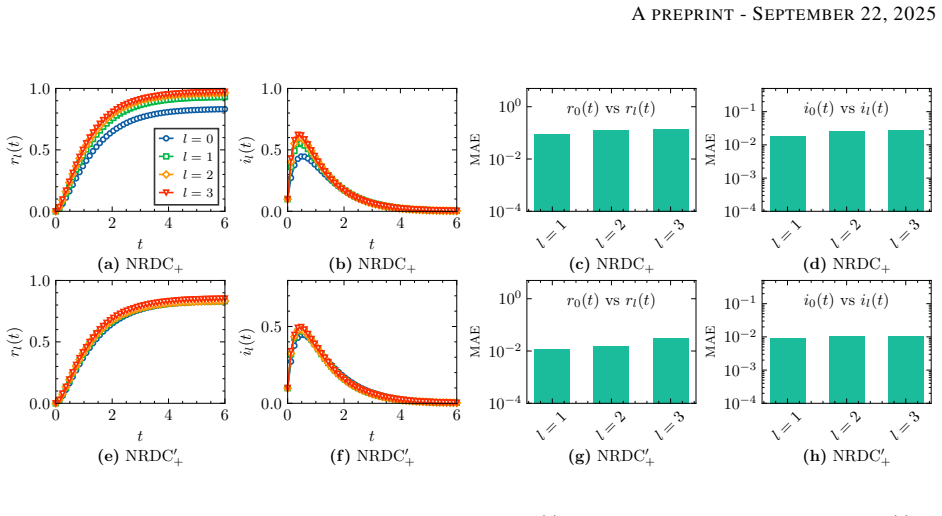
The central discovery is that preserving the average degree during node-removal-based reduction is enough to preserve both SIR spreading dynamics and the normalized Laplacian partition function $\bar{Z}_{\tau,l}=Z_{\tau,l}/N_l$ in heterogeneous networks, provided node removal is ordered by the enhanced degree centrality $\mathrm{DC}^+$. Merely removing low-$\mathrm{DC}^+$ nodes makes subnetworks spread faster than the original because their average degree rises; adding the edge-pruning step restores the average degree and brings the spreading curves and partition-function curves back onto the original network's. The paper reports $f_{\mathrm{overlap}}$ values computed from the $\beta$-dependence of the final epidemic size $\rho_r$, with most real networks above $0.9$ at $l=3$ ($1/8$ of nodes) and Enron still near $0.98$ at $l=5$ ($1/32$ of nodes). Because the same pruned subgraphs also reproduce $Z_\tau$, the method simultaneously preserves macroscopic information-flow properties, not just one epidemic observable.
Load-bearing premise
The load-bearing premise is that a single edge-pruning cutoff, the smallest node degree allowed to lose edges, set to $k_{\min}=2$, works across all real networks, even though the paper's own scan finds optimal values near 10 for the Metabolic network and uses $k_{\min}=13$ for Metabolic and Drosophila in the renormalization comparisons.
Editorial extensions
If this is right
- On twelve real heterogeneous networks and Barabási-Albert scale-free networks, subgraphs containing only $1/8$ of the nodes reproduce the original SIR spreading curves with $f_{\mathrm{overlap}} > 0.9$, so epidemic simulations can be run on the small subgraph instead of the full network.
- For the largest tested networks, Internet and Enron, the method stays accurate at $1/24$ and $1/32$ scales, so the reduction does not saturate at moderate compression.
- Because the partition function $Z_\tau$ is also preserved, the same reduced subgraph can stand in for the full network when computing spectral entropy and free-energy estimates of information diffusion.
- The human connectome application shows that reduction ratios $q=0.54$ to $0.92$ reproduce empirical multiscale spreading curves, suggesting the method transfers to hierarchically organized biological networks.
- The $O(N_0+M_0)$ node-removal complexity makes the method several orders of magnitude faster than spectral renormalization approaches, so it scales to networks with millions of nodes.
Reading between the lines
- Editorial inference: if average-degree matching is the operative mechanism, the method effectively pins the first moment of the degree distribution, and a testable prediction is that any two reductions with the same average degree will show similar early-time SIR growth even if their degree correlations differ.
- Editorial inference: the optimal $k_{\min}$ variation found by the authors, near 2 for Music, near 10 for Metabolic, and 13 used for two networks in the renormalization comparison, suggests that a fully parameter-free version should select $k_{\min}$ adaptively; the reported $k_{\min}=2$ results may understate the method's ceiling on some networks.
- Editorial inference: the connectome result invites a direct transfer test, applying the same reduction to other empirically multiscale systems such as parcellated brain atlases or layered transportation networks, to see whether the observed self-similarity is a general property of hierarchical real-world networks.
- Editorial inference: because $\mathrm{DC}^+$ depends on neighbor degrees, the removal order encodes degree assortativity, so on strongly disassortative networks low-$\mathrm{DC}^+$ nodes might be structural bridges; the connectivity-restoring pruning step would then be the load-bearing component, a behavior the current experiments do not isolate.
Editorial analysis
A structured set of objections, weighed in public.
Referee Report
Summary. The paper proposes a two-stage subgraph extraction method for complex networks. Stage 1 removes nodes in ascending order of an 'enhanced degree centrality' DC+ (degree × average neighbor degree) up to a preset removal ratio q. Stage 2 applies an edge-pruning algorithm (Algorithm 1) that deletes edges to low-degree neighbors while preserving connectivity, with the explicit objective of bringing the subgraph's average degree to within δ = 0.01 of the original average degree. The method, called NRDC′+, is evaluated on ER random graphs, BA scale-free networks, and twelve real-world networks by comparing SIR epidemic curves (via an foverlap measure) and normalized Laplacian partition functions Zτ/N between the original graph and the reduced subgraphs. The authors report that subgraphs retaining 1/8 (and in some cases 1/32) of the nodes preserve the dynamics with foverlap mostly above 0.9, and that NRDC′+ usually outperforms four sampling baselines and three renormalization methods.
Significance. The result is potentially valuable if it holds: it offers a computationally cheap way to obtain a small subgraph that reproduces SIR epidemic saturation curves and the normalized Laplacian partition function of much larger heterogeneous networks, with possible applications to epidemic forecasting and social-media intervention. The paper's strengths are its breadth (two synthetic families and twelve real networks spanning seven domains), the use of 100-run averages, a transparent overlap metric, and the comparison with four sampling baselines and three renormalization methods. The computational-speed claims are supported by the timing comparisons in Figure E11. However, the causal attribution of the method's success to the DC+ ordering is not yet supported because the edge-pruning stage is designed to enforce the average degree of the original network and no ablation isolates the ordering decision; moreover, the paper provides no theoretical argument for why low-DC+ nodes should be redundant. These issues are correctable with additional experiments rather than fundamental errors.
major comments (3)
- [Section 3 (Algorithm 1) and Table 2] The experiments do not isolate the contribution of DC+-ordered node removal. Table 2 shows that foverlap improves from roughly 0.63–0.83 under NRDC+ to roughly 0.91–0.97 under NRDC′+ once edge pruning is added, but no condition applies Algorithm 1 to subgraphs produced by random or plain-degree node removal. Since Algorithm 1 explicitly targets ⟨k⟩≈⟨k⟩0 with δ = 0.01, and since the SIR saturation curve and the leading-order small-τ expansion of the normalized partition function in Eq. (3) both depend on the average degree, the observed preservation could be produced by the pruning stage alone. Please add this ablation and report foverlap for random and plain-degree node removal followed by the same pruning algorithm; if those variants attain comparable foverlap, the conclusion that low-DC+ nodes are redundant is not supported by the current evidence.
- [Section 4.4 ("The setting of parameter kmin") and Figures E3–E10] The paper states that the optimal kmin varies by network (near 2 for Music, near 10 for Metabolic) yet fixes kmin = 2 for Table 2; the comparisons against renormalization methods in Figures E3–E10 use kmin = 3 for Blogs, kmin = 13 for Metabolic and Drosophila, and kmin = 2 for Music. The headline comparisons against RG methods are therefore run under network-specific tuning, while the abstract presents the method as a single algorithm. Please state clearly which claims use the fixed kmin = 2 configuration, provide a sensitivity analysis of foverlap versus kmin across all twelve networks, and reconcile the reported optimal value of about 10 for Metabolic with the value 13 used in Figures E4 and E8.
- [Section 5 and Abstract] The final conclusion that 'nodes and edges discarded during the subgraph extraction process play a redundant role in information transmission' goes beyond the evidence. The experiments show aggregate curve overlap for ρr and Zτ, not that individual low-DC+ nodes or pruned edges carry no information. Because the pruning step restores the average degree by construction, the redundancy interpretation depends on the missing ablation identified above. Until that ablation is provided, this statement should be rephrased as a hypothesis or restricted to the observed aggregate-level preservation.
minor comments (6)
- [Table 2 and Section 4.5] The phrase 'almost always achieves the highest accuracy' is not quantified. For l = 3, some baseline methods beat NRDC′+ on specific networks (e.g., CNARW 0.9834 vs. 0.9489 on Metabolic; MHRW 0.9530 vs. 0.9142 on Drosophila; MHRW 0.9391 vs. 0.9210 on USpowergrid). Please report the win rate and discuss these exceptions explicitly.
- [Figures E1–E10] The labels 'RNDC+' and 'RNDC′+' should be 'NRDC+' and 'NRDC′+' for consistency with the main text.
- [Figure 6 caption] The caption states 'the initial Internet network' but the figure shows the Metabolic network; please correct this mismatch.
- [Section 4.2 and Table 1] The name 'Uspowergrid' appears with inconsistent capitalization; use 'USpowergrid' consistently.
- [Section 4.3] The SIR dynamics are simulated on the network with EoN, but Eqs. (1) and (2) are written as mass-action ODEs; please clarify whether these equations are only illustrative or are actually used to generate the reported curves.
- [Reproducibility] The paper provides URLs for datasets and baseline implementations but not for the authors' own NRDC′+ implementation; please release the code to support reproducibility.
Circularity Check
Partial circularity: average-degree-matching pruning forces leading-order information-flow and epidemic-threshold agreement, and Appendix E tunes kmin to the target MAE before reporting it as predictive accuracy.
-
self definitional
[Section 3, Algorithm 1, lines 16-19 (edge-pruning termination condition); used for information-flow claims in Section 4.4, Eq. (3)]
"⟨k⟩i ← Calculate the average degree of the subgraph G′i; if ⟨k⟩i − ⟨k⟩0 < δ then flag ← True; /*In this paper, we set δ to 0.01*/"
Algorithm 1 stops only when the pruned subgraph's average degree is within 0.01 of the original network's average degree. From the paper's own Eq. (3), Zτ = Tr(e^{−τL}) and Tr(L) = 2M, so the normalized partition function obeys Zτ/N = 1 − ⟨k⟩τ + O(τ²). Thus the leading-order information-flow curves are matched by construction once ⟨k⟩ is forced equal; the reported small-τ overlap of Zτ/N is an identity imposed by the pruning criterion, not evidence that DC+-ordered node removal preserves information flow. Similarly, the SIR epidemic threshold near 1/⟨k⟩ is matched by construction, so part of the observed spreading-dynamics agreement is enforced rather than discovered. Higher-order and large-τ terms are not forced, which is why this is partial circularity rather than complete equivalence.
-
fitted input called prediction
[Section 4.4, 'The setting of parameter kmin'; Appendix E, Figures E4-E5 use kmin=13 for Metabolic and Drosophila]
"Ideally, the optimal value of kmin should be determined at the point where the MAE is minimized. As shown in Figure D13, we plotted the relationship between the MAE values and kmin for the Music network, revealing that the optimal value of kmin is near 2. We statistically analyzed the optimal kmin values for subnetworks at different resolutions, the results indicate that for most networks, the optimal kmin values are close to 2. However, a few networks, such as the Metabolic network, has larger optimal kmin value, and the optimal value for Metabolic network falls near 10."
The MAE in this passage is the discrepancy between the SIR spreading curves of the reduced subgraph and the original network—precisely the quantity the paper claims its method predicts. Selecting kmin to minimize that MAE (and then using kmin=13 for Metabolic and Drosophila in the Appendix E renormalization comparisons after reporting their optimal values near 10) fits the pruning parameter to the target dynamics. Reporting the resulting low MAE or high foverlap in those comparisons as evidence of predictive accuracy is therefore partially circular. The fixed-kmin=2 results in Table 2 avoid this specific fitting, which limits the circularity to the supplementary tuned comparisons.
full rationale
The paper's mechanism is unusually explicit: node removal raises the average degree of heterogeneous subgraphs, and the edge-pruning step then restores the average degree to the original value. Because the SIR final-size curve near threshold and the small-τ Taylor expansion of the normalized partition function Zτ/N both depend on average degree at leading order, part of the claimed preservation of spreading dynamics and information flow is guaranteed by Algorithm 1's termination condition ⟨k⟩i ≈ ⟨k⟩0. This is a real but partial reduction by construction: the full time series r(t), i(t), the ρr(β) curves, and the large-τ spectral content are not determined by the average degree alone, and the main Table 2 comparisons use a fixed kmin=2 across all networks without fitting to the target curves. A second, narrower circularity appears in the kmin discussion and Appendix E, where the parameter is chosen by minimizing the same MAE/foverlap that is later reported as evidence; the fixed-kmin main results are not affected by this. The self-citations in the paper ([5] for the DC+ definition, [39], [40] for prior reduction work) supply definitions and context but are not load-bearing for the central empirical claim, so they do not raise the score further. Overall, the central claim is not fully equivalent to its inputs—otherwise the ER networks and baseline sampling methods would also succeed—but the average-degree-matching construction and the tuned supplementary comparisons justify a partial-circularity score of 6 rather than a clean bill.
Assumptions & free parameters
free parameters (2)
- kmin =
2 in main experiments; 3, 13, 13, 2 in Figures E3-E10
- delta (δ) =
0.01
assumptions (4)
- ad hoc to paper DC+ (degree × average neighbor degree) ranks node redundancy appropriately for preserving spreading dynamics
- domain assumption Matching average degree and preserving connectivity/degree distribution is sufficient to preserve SIR spreading dynamics
- domain assumption The partition function Zτ = Tr(e^{-τL}) correctly quantifies information flow
- standard math SIR simulation on networks captures epidemic spreading dynamics; the mean-field ODEs (Eq. 1-2) are background only
Cite this review
Pith. "Pith review of Preserving spreading dynamics and information flow in complex network reduction." pith.science (2026). https://pith.science/paper/BIXPTXT3
@misc{pith2026250618641,
  author       = {Pith},
  title        = {Pith review of: Preserving spreading dynamics and information flow in complex network reduction},
  year         = {2026},
  howpublished = {\url{https://pith.science/paper/BIXPTXT3}},
  note         = {Machine review of arXiv:2506.18641}
}
read the original abstract
Effectively preserving both the structural and dynamical properties during the reduction of complex networks remains a significant research topic. Existing network reduction methods based on renormalization group or sampling often face challenges such as high computational complexity and the loss of critical dynamic attributes. This paper proposes an efficient network reduction framework based on subgraph extraction, which accurately preserves epidemic spreading dynamics and information flow through a coordinated optimization strategy of node removal and edge pruning. Specifically, a node removal algorithm driven by enhanced degree centrality is introduced to preferentially remove low-centrality nodes, thereby constructing a smaller-scale subnetwork. Subsequently, an edge pruning algorithm is designed to regulate the edge density of the subnetwork, ensuring that its average degree remains approximately consistent with that of the original network. Experimental results on Erd\"os-R\'enyi random graphs, Barab\'asi-Albert scale-free networks, and real-world social contact networks from various domains demonstrate that this proposed method can reduce the size of networks with heterogeneous structures by more than 85\%, while preserving their epidemic dynamics and information flow. More importantly, our method almost always achieves the highest accuracy compared to state-of-the-art techniques. These findings provide valuable insights for predicting the dynamical behavior of large-scale real-world networks, and also reveal that a large number of nodes and edges in real-world networks play redundant roles in information transmission.
Figures


Figures from the paper (6 more)



Reference graph
Works this paper leans on
- [1]
- [2]
-
[3]
Large-scale network reduction towards scale-free structure
Nicolas Martin, Paolo Frasca, and Carlos Canudas-de Wit. Large-scale network reduction towards scale-free structure. IEEE Trans Netw Sci Eng , 6(4):711–723, 2019
work page 2019
-
[4]
Coevolution spreading in complex networks
Wei Wang, Quan-Hui Liu, Junhao Liang, Yanqing Hu, and Tao Zhou. Coevolution spreading in complex networks. Phys Rep, 820:1–51, 2019
work page 2019
-
[5]
Identification of influential nodes in complex networks with degree and average neighbor degree
Dan Chen and Housheng Su. Identification of influential nodes in complex networks with degree and average neighbor degree. IEEE J Emerg Sel Topics Circuits Syst , 13(3):734–742, 2023
work page 2023
-
[6]
Synchronization in complex networks
Alex Arenas, Albert Díaz-Guilera, Jurgen Kurths, Yamir Moreno, and Changsong Zhou. Synchronization in complex networks. Phys Rep, 469(3):93–153, 2008
work page 2008
-
[7]
Self-similarity in explosive synchronization of complex networks
Alexey A Koronovskii, Maria K Kurovskaya, Olga I Moskalenko, Alexander Hramov, and Stefano Boccaletti. Self-similarity in explosive synchronization of complex networks. Phys Rev E, 96(6):062312, 2017
work page 2017
-
[8]
Reaction–diffusion processes and metapopulation models in heterogeneous networks
Vittoria Colizza, Romualdo Pastor-Satorras, and Alessandro Vespignani. Reaction–diffusion processes and metapopulation models in heterogeneous networks. Nat Phys, 3(4):276–282, 2007
work page 2007
Show all 52 references
-
[9]
Diffusion dynamics on multiplex networks
Sergio Gomez, Albert Diaz-Guilera, Jesus Gomez-Gardenes, Conrad J Perez-Vicente, Yamir Moreno, and Alex Arenas. Diffusion dynamics on multiplex networks. Phys Rev Lett, 110(2):028701, 2013
2013
-
[10]
Controllability of complex networks
Yang-Yu Liu, Jean-Jacques Slotine, and Albert-László Barabási. Controllability of complex networks. Nature, 473(7346):167–173, 2011
2011
-
[11]
Structure-free containment control for uncertain underactuated multiple euler-lagrange systems
Housheng Su, Yali Wu, Liren Zhang, and Xia Chen. Structure-free containment control for uncertain underactuated multiple euler-lagrange systems. Sci China Inf Sci , 66(11):212203, 2023
2023
-
[12]
Self-similarity of complex networks
Chaoming Song, Shlomo Havlin, and Hernan A Makse. Self-similarity of complex networks. Nature, 433(7024):392–395, 2005
2005
-
[13]
Ángeles Serrano, Dmitri Krioukov, and Marián Boguñá
M. Ángeles Serrano, Dmitri Krioukov, and Marián Boguñá. Self-similarity of complex networks and hidden metric spaces. Phys Rev Lett, 100:078701, Feb 2008
2008
-
[14]
Ángeles Serrano
Guillermo García-Pérez, Marián Boguñá, and M. Ángeles Serrano. Multiscale unfolding of real networks by geometric renormalization. Nat Phys, 14(6):583–589, 2018
2018
-
[15]
Mutual information, neural networks and the renormalization group
Maciej Koch-Janusz and Zohar Ringel. Mutual information, neural networks and the renormalization group. Nat Phys, 14(6):578–582, 2018
2018
-
[16]
Finite-size scaling of geometric renormalization flows in complex networks
Dan Chen, Housheng Su, Xiaofan Wang, Gui-Jun Pan, and Guanrong Chen. Finite-size scaling of geometric renormalization flows in complex networks. Phys Rev E, 104(3):034304, 2021
2021
-
[17]
Geometric renormalization reveals the self-similarity of weighted networks
Dan Chen, Housheng Su, and Zhigang Zeng. Geometric renormalization reveals the self-similarity of weighted networks. IEEE Trans Comput Social Syst , 10(2):426–434, 2023
2023
-
[18]
Multiscale network renormalization: scale-invariance without geometry
Elena Garuccio, Margherita Lalli, and Diego Garlaschelli. Multiscale network renormalization: scale-invariance without geometry. Phys Rev Res, 5(4):043101, 2023
2023
-
[19]
A zoom lens for networks
Konstantin Klemm. A zoom lens for networks. Nat Phys, 19(3):318–319, 2023
2023
-
[20]
Laplacian renormalization group for heterogeneous networks
Pablo Villegas, Tommaso Gili, Guido Caldarelli, and Andrea Gabrielli. Laplacian renormalization group for heterogeneous networks. Nat Phys, 19(3):445–450, 2023
2023
-
[21]
Laplacian coarse graining in complex networks
Matheus de C Loures, Alan Albert Piovesana, and José Antônio Brum. Laplacian coarse graining in complex networks. ArXiv:2302.07093, 2023
2023 arXiv
-
[22]
D. Chen, D. Cai, and H. Su. Scaling properties of scale-free networks in degree-thresholding renormalization flows. IEEE Trans Netw Sci Eng , 10(6):3519–3528, 2023
2023
-
[23]
Renormalization of networks with weak geometric coupling
Jasper Van Der Kolk, Marián Boguñá, and M Ángeles Serrano. Renormalization of networks with weak geometric coupling. Phys Rev E, 110(3):L032302, 2024
2024
-
[24]
Predicting long-term dynamics of complex networks via identifying skeleton in hyperbolic space
Ruikun Li, Huandong Wang, Jinghua Piao, Qingmin Liao, and Yong Li. Predicting long-term dynamics of complex networks via identifying skeleton in hyperbolic space. In Proceedings of the 30th ACM SIGKDD Conference on Knowledge Discovery and Data Mining , pages 1655–1666, 2024
2024
-
[25]
Networks with many structural scales: a renormalization group perspective
Anna Poggialini, Pablo Villegas, Miguel A Muñoz, and Andrea Gabrielli. Networks with many structural scales: a renormalization group perspective. Phys Rev Lett, 134(5):057401, 2025. 16 A PREPRINT - S EPTEMBER 22, 2025
2025
-
[26]
Coarse-graining network flow through statistical physics and machine learning
Zhang Zhang, Arsham Ghavasieh, Jiang Zhang, and Manlio De Domenico. Coarse-graining network flow through statistical physics and machine learning. Nat Commun, 16(1):1605, 2025
2025
-
[27]
Higher-order laplacian renormalization
Marco Nurisso, Marta Morandini, Maxime Lucas, Francesco Vaccarino, Tommaso Gili, and Giovanni Petri. Higher-order laplacian renormalization. Nat Phys, 21:661–668, 2025
2025
-
[28]
Network renormalization
Andrea Gabrielli, Diego Garlaschelli, Subodh P Patil, and M Ángeles Serrano. Network renormalization. Nat Rev Phys, 7:203–219, 2025
2025
-
[29]
Sampling from large graphs
Jure Leskovec and Christos Faloutsos. Sampling from large graphs. In Proceedings of the 12th ACM SIGKDD International Conference on Knowledge Discovery and Data Mining , pages 631–636, 2006
2006
-
[30]
Statistical properties of sampled networks
Sang Hoon Lee, Pan-Jun Kim, and Hawoong Jeong. Statistical properties of sampled networks. Phys Rev E , 73(1):016102, 2006
2006
-
[31]
Statistical properties of sampled networks by random walks
Sooyeon Yoon, Sungmin Lee, Soon-Hyung Yook, and Yup Kim. Statistical properties of sampled networks by random walks. Phys Rev E, 75(4):046114, 2007
2007
-
[32]
Metropolis algorithms for representative subgraph sampling
Christian Hübler, Hans-Peter Kriegel, Karsten Borgwardt, and Zoubin Ghahramani. Metropolis algorithms for representative subgraph sampling. In 2008 Eighth IEEE International Conference on Data Mining (ICDM) , pages 283–292, 2008
2008
-
[33]
Walking with perception: Efficient random walk sampling via common neighbor awareness
Yongkun Li, Zhiyong Wu, Shuai Lin, Hong Xie, Min Lv, Yinlong Xu, and John CS Lui. Walking with perception: Efficient random walk sampling via common neighbor awareness. In 2019 IEEE 35th International Conference on Data Engineering (ICDE) , pages 962–973, 2019
2019
-
[34]
Preserving minority structures in graph sampling
Ying Zhao, Haojin Jiang, Qi’an Chen, Yaqi Qin, Huixuan Xie, Yitao Wu, Shixia Liu, Zhiguang Zhou, Jiazhi Xia, and Fangfang Zhou. Preserving minority structures in graph sampling. IEEE Trans Visual Comput Graph, 27(2):1698–1708, 2021
2021
-
[35]
Drgraph: An efficient graph layout algorithm for large-scale graphs by dimensionality reduction
Minfeng Zhu, Wei Chen, Yuanzhe Hu, Yuxuan Hou, Liangjun Liu, and Kaiyuan Zhang. Drgraph: An efficient graph layout algorithm for large-scale graphs by dimensionality reduction. IEEE Trans Visual Comput Graph, 27(2):1666–1676, 2021
2021
-
[36]
Preserving the topological properties of complex networks in network sampling
Wentao Chen, An Zeng, and Xiaohua Cui. Preserving the topological properties of complex networks in network sampling. Chaos, 32(3), 2022
2022
-
[37]
Hierarchical sampling for the visualization of large scale-free graphs
Bo Jiao, Xin Lu, Jingbo Xia, Brij Bhooshan Gupta, Lei Bao, and Qingshan Zhou. Hierarchical sampling for the visualization of large scale-free graphs. IEEE Trans Visual Comput Graph, 29(12):5111–5123, 2023
2023
-
[38]
Cluster-preserving sampling algorithm for large-scale graphs
Jianpeng Zhang, Hongchang Chen, Dingjiu Yu, Yulong Pei, and Yingjun Deng. Cluster-preserving sampling algorithm for large-scale graphs. Sci China Inf Sci , 66(1):112103, 2023
2023
-
[39]
Self-similarity of complex networks under centrality-based node removal strategy
Dan Chen, Defu Cai, and Housheng Su. Self-similarity of complex networks under centrality-based node removal strategy. Chin Phys B, 32(9):098903, 2023
2023
-
[40]
Extracting high-fidelity smaller scale subgraphs of complex networks by edge- reinforced random walk
Dan Chen and Housheng Su. Extracting high-fidelity smaller scale subgraphs of complex networks by edge- reinforced random walk. IEEE Trans Comput Social Syst , 11(5):6181–6191, 2024
2024
-
[41]
Adamotif: Graph simplification via adaptive motif design
Hong Zhou, Peifeng Lai, Zhida Sun, Xiangyuan Chen, Yang Chen, Huisi Wu, and Yong Wang. Adamotif: Graph simplification via adaptive motif design. IEEE Trans Visual Comput Graph, 31(1):688–698, 2025
2025
-
[42]
Erdös and A
P. Erdös and A. Rényi. On random graphs. Pub Mathematicae Debrecen, 6(290-297), 1959
1959
-
[43]
Emergence of scaling in random networks
Albert-László Barabási and Réka Albert. Emergence of scaling in random networks. Science, 286(5439):509–512, 1999
1999
-
[44]
Epidemic processes in complex networks
Romualdo Pastor-Satorras, Claudio Castellano, Piet Van Mieghem, and Alessandro Vespignani. Epidemic processes in complex networks. Rev Mod Phys, 87(3):925–979, 2015
2015
-
[45]
Spectral entropies as information-theoretic tools for complex network comparison
Manlio De Domenico and Jacob Biamonte. Spectral entropies as information-theoretic tools for complex network comparison. Phys Rev X, 6(4):041062, 2016
2016
-
[46]
Diversity of information pathways drives sparsity in real-world networks
Arsham Ghavasieh and Manlio De Domenico. Diversity of information pathways drives sparsity in real-world networks. Nat Phys, 20(3):512–519, 2024
2024
-
[47]
Unified index to quantifying heterogeneity of complex networks
Hai-Bo Hu and Xiao-Fan Wang. Unified index to quantifying heterogeneity of complex networks. Phys A-Stat Mech Its Appl, 387(14):3769–3780, 2008
2008
-
[48]
Geometric renormalization unravels self-similarity of the multiscale human connectome
Muhua Zheng, Antoine Allard, Patric Hagmann, Yasser Alemán-Gómez, and M Ángeles Serrano. Geometric renormalization unravels self-similarity of the multiscale human connectome. Proc Nat Acad Sci, 117(33):20244– 20253, 2020. 17 A PREPRINT - S EPTEMBER 22, 2025
2020
-
[49]
Invited review: Determinants of farmers’ adoption of management-based strategies for infectious disease prevention and control
Caroline Ritter, Jolanda Jansen, Steven Roche, David F Kelton, Cindy L Adams, Karin Orsel, Ron J Erskine, Geart Benedictus, Theo JGM Lam, and Herman W Barkema. Invited review: Determinants of farmers’ adoption of management-based strategies for infectious disease prevention an...
2017
-
[50]
Inferring user profiles in social media by joint modeling of text and networks
Ruifeng Xu, Jiachen Du, Zhishan Zhao, Yulan He, Qinghong Gao, and Lin Gui. Inferring user profiles in social media by joint modeling of text and networks. Sci China Inf Sci , 62(11):219104, 2019
2019
-
[51]
Universality, criticality and complexity of information propagation in social media
Daniele Notarmuzi, Claudio Castellano, Alessandro Flammini, Dario Mazzilli, and Filippo Radicchi. Universality, criticality and complexity of information propagation in social media. Nat Commun, 13(1):1308, 2022
2022
-
[52]
Brain dynamics reflecting an intra-network brain state are associated with increased post-traumatic stress symptoms in the early aftermath of trauma
Mohammad SE Sendi, Zening Fu, Nathaniel G Harnett, Sanne JH van Rooij, Victor Vergara, Diego A Pizzagalli, Nikolaos P Daskalakis, Stacey L House, Francesca L Beaudoin, Xinming An, et al. Brain dynamics reflecting an intra-network brain state are associated with increased post-...
2025
Reviewed August 6, 2026 · model on record in the stance chip above.
Discussion (0). Continue with ORCID to comment.