FuGa3D: Fast full-sky analysis of Galaxy catalogs in 3D
Pith reviewed 2026-05-19 08:17 UTC · model grok-4.3
The pith
FuGa3D defines galaxy positions via two redshifts and angular separation to compute correlations and spectra without assuming a cosmology upfront.
A machine-rendered reading of the paper's core claim, the machinery that carries it, and where it could break.
Core claim
FuGa3D constructs the redshift-space correlation function (RCF) directly in the parameter space of two redshifts and angular separation. Under the assumption of isotropy, these parameters determine relative galaxy positions independently of any cosmological model. From the RCF one can derive the real-space clustering correlation function and its multipoles, while the redshift-space power spectrum follows as the harmonic counterpart and can be evaluated from the discrete galaxy coordinates.
What carries the argument
The redshift-space correlation function (RCF), which stores pair counts in the three-dimensional space of two redshifts and angular separation and serves as the common starting point for all derived correlation and power-spectrum statistics.
If this is right
- Real-space clustering correlation functions and multipoles follow directly once the RCF is available.
- The redshift-space power spectrum can be obtained efficiently as the harmonic transform of the RCF using the discrete galaxy positions.
- The same RCF construction applies to both galaxy clustering and cosmic-shear observables.
- Processing a 46-million-galaxy catalog requires only tens of node-minutes for clustering or a few node-hours when shear is included.
Where Pith is reading between the lines
- The cosmology-independent RCF step could simplify consistency checks across different assumed models in the same data set.
- The method may extend naturally to additional large-scale-structure statistics that can be expressed as functions of redshift pairs and angles.
- Because the intermediate representation separates geometry from cosmology, it offers a route to test isotropy assumptions directly from the catalog.
Load-bearing premise
There is no preferred direction in the sky, so two redshifts plus one angular separation fully specify the relative position of any galaxy pair independently of the cosmological model.
What would settle it
Run FuGa3D and a standard correlation-code pipeline on the same mock catalog and compare the resulting real-space correlation function and its multipoles at fixed separation scales.
Figures



read the original abstract
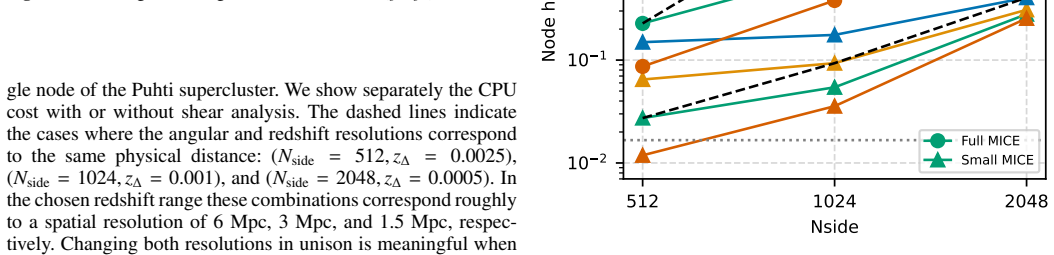
We present FuGa3D, a code for fast computation of correlation functions and power spectra for galaxy survey observables, including galaxy clustering and cosmic shear. We define the redshift-space correlation function (RCF) as the correlation function defined in the parameter space of two redshifts and an angular separation angle. Assuming that there is no preferred direction in the sky, these parameters fully define the relative position of two galaxies, independently of the assumed cosmological model. Once the RCF is constructed, it is easy to compute derived correlation metrics, such as the real-space clustering correlation function and its multipoles. We further define the redshift-space power spectrum as the harmonic counterpart of the RCF, and show that it can be computed efficiently using the discrete galaxy coordinates. We validate the code with simulated mock catalogs. Computing the RCF and the two-point correlation function at 1.5 Mpc (3 Mpc) resolution for a MICE simulation with 46 million galaxies, took 47 node-min for clustering only, and 7.3 node-hours with shear analysis included.
Editorial analysis
A structured set of objections, weighed in public.
Referee Report
Summary. The manuscript introduces FuGa3D, a computational code for fast full-sky analysis of galaxy catalogs. It defines a redshift-space correlation function (RCF) directly in the observable parameter space of two redshifts (z1, z2) and angular separation θ, which under the assumption of isotropy is claimed to fully specify relative galaxy positions independently of any cosmological model. From the RCF the authors derive the real-space two-point correlation function and its multipoles, as well as a redshift-space power spectrum via harmonic transform of the discrete galaxy coordinates. The method is validated on MICE mock catalogs containing 46 million galaxies, with reported wall-clock times of 47 node-minutes for clustering-only RCF and two-point function computation at 1.5–3 Mpc resolution and 7.3 node-hours when cosmic shear is included.
Significance. If the central construction truly permits extraction of standard real-space and multipole statistics without introducing hidden dependence on a fiducial cosmology, the approach could offer a practical advantage for model-independent analyses of upcoming wide-field surveys. The concrete performance numbers on a 46-million-galaxy mock constitute a verifiable strength, and the joint treatment of clustering plus shear broadens applicability. However, the overall significance remains conditional on resolving the cosmology-mapping step in the derivation of real-space quantities.
major comments (2)
- [Section describing derivation of real-space CF and multipoles from the RCF] The claim that the RCF parameters (z1, z2, θ) fully define relative positions independently of cosmology is load-bearing for the paper’s headline advantage. Deriving the real-space correlation function nevertheless requires mapping observed redshifts to comoving separations via the integral χ(z), which depends on Ωm, H0 and other parameters. The manuscript does not state whether a fiducial cosmology is adopted for this conversion or whether the final estimator is constructed to remain invariant under changes to that fiducial model. This step must be made explicit (ideally with an equation or pseudocode) before the independence assertion can be accepted.
- [Validation section (MICE mock results)] Validation is reported only via run times on the MICE mock; no quantitative error analysis, covariance estimation, or tests under realistic survey masks and selection functions are described. Because the central performance and utility claims rest on these numerical results, the absence of such diagnostics weakens the ability to judge robustness for actual survey data.
minor comments (2)
- [Abstract] The abstract states that the redshift-space power spectrum is the 'harmonic counterpart' of the RCF and is computed from discrete coordinates; a short sentence or reference to the underlying spherical-harmonic transform algorithm would improve immediate clarity.
- [Methods] Notation for the RCF and its derived quantities should be introduced with a compact table or equation block early in the methods to avoid later ambiguity when multipoles and power spectra are discussed.
Simulated Author's Rebuttal
We thank the referee for their careful reading and constructive comments. We address each major comment below and indicate the changes we will make to the manuscript.
read point-by-point responses
-
Referee: [Section describing derivation of real-space CF and multipoles from the RCF] The claim that the RCF parameters (z1, z2, θ) fully define relative positions independently of cosmology is load-bearing for the paper’s headline advantage. Deriving the real-space correlation function nevertheless requires mapping observed redshifts to comoving separations via the integral χ(z), which depends on Ωm, H0 and other parameters. The manuscript does not state whether a fiducial cosmology is adopted for this conversion or whether the final estimator is constructed to remain invariant under changes to that fiducial model. This step must be made explicit (ideally with an equation or pseudocode) before the independence assertion can be accepted.
Authors: We agree that this step requires explicit clarification. The RCF is defined directly in the observable space of (z1, z2, θ) and is therefore independent of cosmology by construction. Derivation of the real-space correlation function and multipoles does require mapping redshifts to comoving distances via χ(z) evaluated in a fiducial cosmology; the resulting quantities therefore depend on that choice, as is conventional. We will revise the manuscript to state this explicitly, adding the relevant equation for the χ(z) conversion together with pseudocode for the derivation from the RCF. This will distinguish the model-independent RCF from the fiducial-dependent derived statistics. revision: yes
-
Referee: [Validation section (MICE mock results)] Validation is reported only via run times on the MICE mock; no quantitative error analysis, covariance estimation, or tests under realistic survey masks and selection functions are described. Because the central performance and utility claims rest on these numerical results, the absence of such diagnostics weakens the ability to judge robustness for actual survey data.
Authors: We acknowledge that the validation would be strengthened by additional quantitative diagnostics. The current results focus on computational performance for a 46-million-galaxy catalog, but we agree that error analysis, covariance estimation, and tests with masks and selection functions are important for assessing robustness. We will expand the validation section in the revised manuscript to include these elements. revision: yes
Circularity Check
No circularity: direct computational procedure from observables
full rationale
The paper defines the redshift-space correlation function (RCF) directly from discrete galaxy coordinates in observable parameters (redshifts z1, z2 and angular separation θ). Derived quantities such as the real-space correlation function and multipoles are obtained from this RCF via standard transformations that do not rely on fitted parameters or self-referential assumptions within the paper. No equations or steps reduce the output to the input by construction, and validation uses external mock catalogs. The central claim of cosmology independence for the RCF rests on the isotropy assumption applied to observables, which is stated explicitly without circular reduction. This is a self-contained computational method with no load-bearing self-citations or ansatzes that presuppose the result.
Axiom & Free-Parameter Ledger
axioms (1)
- domain assumption There is no preferred direction in the sky, so two redshifts and one angle fully specify relative galaxy positions independently of cosmology.
Lean theorems connected to this paper
-
IndisputableMonolith/Foundation/AlexanderDuality.leanalexander_duality_circle_linking echoes?
echoesECHOES: this paper passage has the same mathematical shape or conceptual pattern as the Recognition theorem, but is not a direct formal dependency.
We define the redshift-space correlation function (RCF) as the correlation function defined in the parameter space of two redshifts and an angular separation angle. Assuming that there is no preferred direction in the sky, these parameters fully define the relative position of two galaxies, independently of the assumed cosmological model.
-
IndisputableMonolith/Cost/FunctionalEquation.leanwashburn_uniqueness_aczel unclear?
unclearRelation between the paper passage and the cited Recognition theorem.
Once the RCF is constructed, it is easy to compute derived correlation metrics, such as the real-space clustering correlation function and its multipoles... adopt a cosmological model to convert redshifts to physical distances
What do these tags mean?
- matches
- The paper's claim is directly supported by a theorem in the formal canon.
- supports
- The theorem supports part of the paper's argument, but the paper may add assumptions or extra steps.
- extends
- The paper goes beyond the formal theorem; the theorem is a base layer rather than the whole result.
- uses
- The paper appears to rely on the theorem as machinery.
- contradicts
- The paper's claim conflicts with a theorem or certificate in the canon.
- unclear
- Pith found a possible connection, but the passage is too broad, indirect, or ambiguous to say the theorem truly supports the claim.
Reference graph
Works this paper leans on
-
[1]
Abazajian, K. N. et al. 2009, Astrophys. J. Suppl., 182, 543
work page 2009
-
[2]
Abbott, T. et al. 2016, Mon. Not. Roy. Astron. Soc., 460, 1270 Abdul Karim, M. et al. 2025 [arXiv:2503.14745]
work page internal anchor Pith review Pith/arXiv arXiv 2016
-
[3]
Akeson, R. et al. 2019 [arXiv:1902.05569]
work page internal anchor Pith review Pith/arXiv arXiv 2019
- [4]
-
[5]
Ballinger, W. E., Peacock, J. A., & Heavens, A. F. 1996, Mon. Not. Roy. Astron. Soc., 282, 877
work page 1996
-
[6]
Bautista, J. E. et al. 2020, Mon. Not. Roy. Astron. Soc., 500, 736
work page 2020
- [7]
-
[8]
Brown, M. L., Castro, P. G., & Taylor, A. N. 2005, Mon. Not. Roy. Astron. Soc., 360, 1262
work page 2005
-
[9]
Camphuis, E., Benabed, K., Galli, S., Hivon, E., & Lilley, M. 2022, Astron. Astrophys., 668, A62
work page 2022
- [10]
-
[11]
Colless, M. et al. 2003 [arXiv:astro-ph/0306581]
work page internal anchor Pith review Pith/arXiv arXiv 2003
-
[12]
J., Gaztanaga, E., Fosalba, P., & Carretero, J
Crocce, M., Castander, F. J., Gaztanaga, E., Fosalba, P., & Carretero, J. 2015, Mon. Not. Roy. Astron. Soc., 453, 1513
work page 2015
-
[13]
Fosalba, P., Gaztañaga, E., Castander, F. J., & Crocce, M. 2015b, Mon. Not. Roy. Astron. Soc., 447, 1319 Górski, K. M., Hivon, E., Banday, A. J., et al. 2005, Astrophys. J., 622, 759
work page 2005
-
[14]
Guzzo, L. et al. 2008, Nature, 451, 541
work page 2008
-
[15]
Heymans, C. et al. 2021, Astron. Astrophys., 646, A140
work page 2021
-
[16]
Hivon, E., Gorski, K. M., Netterfield, C. B., et al. 2002, Astrophys. J., 567, 2
work page 2002
-
[17]
Hou, J. et al. 2018, Mon. Not. Roy. Astron. Soc., 480, 2521 Ivezi´c, v. et al. 2019, Astrophys. J., 873, 111
work page 2018
- [18]
- [19]
-
[20]
Landy, S. D. & Szalay, A. S. 1993, ApJ, 412, 64
work page 1993
-
[21]
Li, X. et al. 2023, Phys. Rev. D, 108, 123518
work page 2023
-
[22]
Mellier, E. C. Y . et al. 2025, Astronom. Astrophys., 697, A1
work page 2025
- [23]
-
[24]
Peacock, J. A. et al. 2001, Nature, 410, 169
work page 2001
-
[25]
Peebles, P. J. 1980, The Large-Scale Structure of the Universe (Princeton Uni- versity Press)
work page 1980
-
[26]
Reid, B. A. et al. 2012, Mon. Not. Roy. Astron. Soc., 426, 2719
work page 2012
-
[27]
Reinecke, M., Belkner, S., & Carron, J. 2023, Astron. Astrophys., 678, A165
work page 2023
-
[28]
Schneider, P., van Waerbeke, L., Kilbinger, M., & Mellier, Y . 2002, Astron. As- trophys., 396, 1
work page 2002
-
[29]
Schulten, K. & Gordon, R. G. 1975, Journal of Mathematical Physics, 16, 1961
work page 1975
- [30]
-
[31]
Tessore, N. et al. 2025, Astron. Astrophys., 694, A141
work page 2025
-
[32]
Varshalovich, D. A., Moskalev, A. N., & Khersonskii, V . K. 1988, Quantum The- ory of Angular Momentum: Irreducible Tensors, Spherical Harmonics, Vector Coupling Coefficients, 3nj Symbols (World Scientific Publishing Company)
work page 1988
-
[33]
York, D. G. et al. 2000, Astron. J., 120, 1579
work page 2000
-
[34]
Zarrouk, P. et al. 2018, Mon. Not. Roy. Astron. Soc., 477, 1639 Article number, page 14 of 18 Keihänen et al.: FuGa3D: Fast full-sky analysis of Galaxy catalogs in 3D Appendix A: From power spectrum to correlation function Here we derive the relation between the angular correlation function and power spectrum. We expand the desnity contrast and the shear ...
work page 2018
discussion (0)
Sign in with ORCID, Apple, or X to comment. Anyone can read and Pith papers without signing in.