Free boundary regularity and well-posedness of physical solutions to the supercooled Stefan problem
Pith reviewed 2026-05-19 08:03 UTC · model grok-4.3
The pith
Physical solutions to the supercooled Stefan problem have a free boundary that is C^1 in space and infinitely smooth except at isolated jump times.
A machine-rendered reading of the paper's core claim, the machinery that carries it, and where it could break.
Core claim
Physical solutions to the supercooled Stefan problem with only integrable initial temperature have a free boundary that is C^1 as a function of space and C^infty outside of a closed, countable set. The set of positive times when a jump occurs cannot have accumulation points. Short-time uniqueness of physical solutions implies global uniqueness, allowing uniqueness for very general initial data.
What carries the argument
A weighted obstacle problem satisfied by the physical solutions, used to establish regularity and non-degeneracy estimates and to classify the free boundary points.
If this is right
- The free boundary is C^1 in space under only integrability assumptions on initial temperature.
- Jump times in the free boundary cannot accumulate.
- Short-time uniqueness of physical solutions yields global uniqueness.
- Uniqueness holds for initial data outside the scope of prior well-posedness results.
Where Pith is reading between the lines
- The weighted obstacle problem technique might extend regularity results to other parabolic free boundary problems with jumps.
- The explicit classification of the countable set could support numerical methods that track singularity times in simulations.
- Backward propagation of oscillation may apply to long-time analysis in related solidification models.
- These uniqueness implications could guide stability studies for supercooled processes in materials science.
Load-bearing premise
The solutions are physical solutions that satisfy the weighted obstacle problem derived from the supercooled Stefan formulation.
What would settle it
A physical solution with integrable initial data whose free boundary fails to be C^1 in space or whose jump times accumulate would disprove the regularity and non-accumulation claims.
Figures
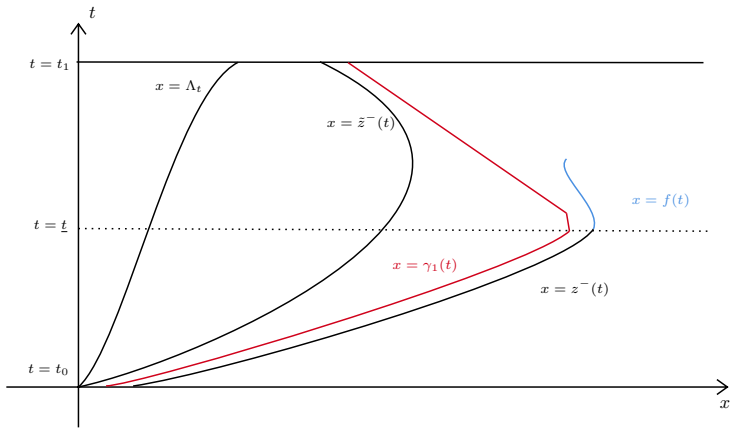


read the original abstract
We study the regularity and well-posedness of physical solutions to the supercooled Stefan problem. Assuming only that the initial temperature is integrable, we prove that the free boundary, known to have jump discontinuities as a function of the time variable, is $C^1$ as a function of the space variable, and is $C^{\infty}$ outside of a closed, countable set, which we describe explicitly. We also prove that, as conjectured in arXiv:1902.05174, the set of positive times when a jump occurs cannot have accumulation points. In addition, we prove that short-time uniqueness of physical solutions implies global uniqueness, which allows us to obtain uniqueness for very general initial data that fall outside the scope of the current well-posedness regime. In particular, we answer two questions left open in arXiv:1811.12356, arXiv:2302.13097, regarding the global uniqueness of solutions. We proceed by deriving a weighted obstacle problem satisfied by the solutions, which we exploit to establish regularity and non-degeneracy estimates and to classify the free boundary points. We also establish a backward propagation of oscillation property, which allows us to control the occurrence of future jumps in terms of the past oscillation of the solution.
Editorial analysis
A structured set of objections, weighed in public.
Referee Report
Summary. The manuscript claims that, for physical solutions to the supercooled Stefan problem with merely integrable initial temperature, the free boundary is C^1 as a function of the space variable and C^infty outside an explicitly described closed countable set. It further asserts that jump times cannot accumulate, that short-time uniqueness implies global uniqueness (resolving open questions from arXiv:1811.12356 and arXiv:2302.13097), and that these conclusions follow from deriving a weighted obstacle problem satisfied by the solutions together with a backward oscillation propagation property.
Significance. If the results hold, the work advances free-boundary regularity theory for the supercooled Stefan problem by obtaining C^1 spatial regularity and smoothness off a countable set under minimal L^1 data assumptions. The introduction of the weighted obstacle problem and the explicit classification of free-boundary points constitute concrete technical contributions that may apply to related parabolic obstacle problems. The global-uniqueness implication from short-time uniqueness is a useful structural observation.
major comments (2)
- [§2] §2 (derivation of the weighted obstacle problem): With initial temperature only in L^1, the temperature field is a priori merely integrable in space-time. The passage from the weak Stefan condition to the precise weighted obstacle formulation (involving specific test-function choices or integration by parts localized near the free boundary) is not obviously justified; additional approximation or density arguments appear necessary to avoid tacitly assuming continuity or boundedness that is recovered only later.
- [§4] §4 (non-degeneracy and classification): The C^1 regularity, C^infty regularity off the countable set, and the non-accumulation of jumps all rest on the weighted obstacle problem and the associated non-degeneracy estimates. If the derivation in §2 requires extra regularity not available from L^1 data alone, these estimates do not directly apply to the stated solution class.
minor comments (2)
- [Throughout] Notation for the free boundary and the weighted obstacle problem should be introduced once and used uniformly; occasional shifts between different symbols for the same object reduce readability.
- [§5] A short remark clarifying how the explicit description of the closed countable set follows from the oscillation propagation would help readers trace the countability argument.
Simulated Author's Rebuttal
We thank the referee for the careful reading and for the positive assessment of the significance of our results. We address the two major comments below, clarifying the technical justifications and indicating revisions to strengthen the exposition.
read point-by-point responses
-
Referee: [§2] §2 (derivation of the weighted obstacle problem): With initial temperature only in L^1, the temperature field is a priori merely integrable in space-time. The passage from the weak Stefan condition to the precise weighted obstacle formulation (involving specific test-function choices or integration by parts localized near the free boundary) is not obviously justified; additional approximation or density arguments appear necessary to avoid tacitly assuming continuity or boundedness that is recovered only later.
Authors: We agree that the derivation merits additional detail to be fully rigorous under L^1 data. In §2 we begin from the distributional form of the Stefan condition satisfied by physical solutions and approximate by mollification of the initial temperature. For the smoothed data the weighted obstacle problem follows by direct integration by parts against localized test functions. The limit passage is justified by the stability of physical solutions under L^1 convergence together with the fact that the free boundary has locally finite perimeter (already established from the weak formulation). This procedure uses only integrability and avoids any a priori continuity or boundedness. We will revise §2 to include an explicit subsection spelling out the approximation scheme, the choice of test functions, and the passage to the limit. revision: yes
-
Referee: [§4] §4 (non-degeneracy and classification): The C^1 regularity, C^infty regularity off the countable set, and the non-accumulation of jumps all rest on the weighted obstacle problem and the associated non-degeneracy estimates. If the derivation in §2 requires extra regularity not available from L^1 data alone, these estimates do not directly apply to the stated solution class.
Authors: Because the weighted obstacle problem is established for the L^1 class via the approximation argument outlined above, the non-degeneracy estimates and point classification in §4 apply directly. These estimates are obtained by testing the obstacle formulation with suitable cut-off functions and using only the L^1 integrability to control oscillations; the backward propagation of oscillation is likewise derived from the variational inequality without presupposing higher regularity. The C^1 and C^infty conclusions are obtained after the formulation is in place, so there is no circularity. We will add a short clarifying paragraph in §4 that explicitly ties the estimates back to the L^1 derivation in §2. revision: partial
Circularity Check
No circularity; derivation self-contained via new obstacle problem
full rationale
The paper derives a weighted obstacle problem directly from the supercooled Stefan formulation under L1 initial data and then applies it to obtain the stated regularity, non-degeneracy, and uniqueness results. No quoted step reduces a prediction or central claim to a fitted input, self-citation chain, or definitional tautology. Cited prior works address open questions or background but do not supply the target regularity statements or uniqueness theorems used here. The logical order (weak formulation to obstacle problem to estimates) is presented as forward and independent of the final conclusions.
Axiom & Free-Parameter Ledger
axioms (1)
- domain assumption Initial temperature belongs to L^1
Reference graph
Works this paper leans on
-
[1]
A. Blanchet, J. Dolbeault, R. Monneau.On the continuity of the time derivative of the solution to the parabolic obstacle problem with variable coefficients.J. Math. Pures Appl. (9) 85 (2006), no. 3, 371–414
work page 2006
-
[2]
L. A. Caffarelli,The obstacle problem revisited.J. Fourier Anal. Appl. 4 (1998), no. 4-5, 383–402
work page 1998
-
[3]
L. A. Caffarelli, A. Petrosyan, H. Shahgholian.Regularity of a free boundary in parabolic potential theory. J. Amer. Math. Soc. 17 (2004), no. 4, 827–869
work page 2004
-
[4]
Qualitative properties of solutions for the noisy integrate and fire model in computational neuroscience. Nonlinearity 28 (2015), no. 9, 3365–3388
work page 2015
-
[5]
S. Choi, I. C. Kim, Y.-H. Kim, Existence for the Supercooled Stefan Problem in General Dimensions. arXiv:2402.17154 (2024)
work page internal anchor Pith review Pith/arXiv arXiv 2024
-
[6]
C. Cuchiero, S. Rigger, S. Svaluto-Ferro,Propagation of minimality in the supercooled Stefan problem. Ann. Appl. Probab. 33 (2023), no. 2, 1388–1418
work page 2023
-
[7]
F. Delarue, S. Nadtochiy, M. Shkolnikov,Global solutions to the supercooled Stefan problem with blow-ups: regularity and uniqueness,Prob. Math. Phys. 3 (2022), no. 1, 171–213
work page 2022
-
[8]
F. Delarue, J. Inglis, S. Rubenthaler, E. Tanré,Particle systems with a singular mean-field self-excitation. Application to neuronal networks.Stochastic Process. Appl. 125 (2015), no. 6, 2451–2492. 24
work page 2015
-
[9]
Durrett,Probability—theory and examples.Camb
R. Durrett,Probability—theory and examples.Camb. Ser. Stat. Probab. Math., 49
-
[10]
Duvaut,Résolution d’un problème de Stefan (fusion d’un bloc de glace à zéro degré).C
G. Duvaut,Résolution d’un problème de Stefan (fusion d’un bloc de glace à zéro degré).C. R. Acad. Sci. Paris Sér. A-B 276 (1973), A1461–A1463
work page 1973
-
[11]
G. Nassib, Y.-H. Kim, A. Z. Palmer,PDE methods for optimal Skorokhod embeddings.Calc. Var. Partial Differential Equations 58 (2019), no. 3, Paper No. 113, 31 pp
work page 2019
- [12]
- [13]
-
[14]
A. Figalli, X. Ros-Oton, J. Serra.The singular set in the Stefan problem.J. Amer. Math. Soc. 37 (2024), no. 2, 305–389
work page 2024
- [15]
-
[16]
B. F. Jones, Jr.,A Class of Singular Integrals.Amer. J. Math. 86 (1964), 441–462
work page 1964
-
[17]
I. C. Kim, Y.-H. Kim,The Stefan problem and free targets of optimal Brownian martingale transport. Ann. Appl. Probab. 34 (2024), no. 2, 2364–2414
work page 2024
-
[18]
O. A. Ladyženskaja, V. A. Solonnikov, N. N. Ural’ceva.Linear and quasilinear equations of parabolic type. Translated from the Russian by S. Smith Transl. Math. Monogr., Vol. 23, American Mathematical Society, Providence, RI, 1968. xi+648 pp
work page 1968
- [19]
- [20]
-
[21]
G. M. Lieberman, Second order parabolic differential equations.World Scientific Publishing Co., Inc., River Edge, NJ, 1996. xii+439 pp
work page 1996
-
[22]
V. P. Mikha˘ ılov,Partial differential equations.Translated from the Russian by P. C. Sinha “Mir”, Moscow; distributed by Imported Publications, Chicago, IL, 1978. 397 pp
work page 1978
-
[23]
S. Nadtochiy, M. Shkolnikov,Particle systems with singular interaction through hitting times: application in systemic risk modeling.Ann. Appl. Probab. 29 (2019), no. 1, 89–129
work page 2019
-
[24]
S. Nadtochiy, M. Shkolnikov,Mean field systems on networks, with singular interaction through hitting times. Ann. Probab. 48 (2020), no. 3, 1520–1556
work page 2020
- [25]
-
[26]
Sherman,A general one-phase Stefan problem.Quart
B. Sherman,A general one-phase Stefan problem.Quart. Appl. Math. 28 (1970), 377–382. MR 0282082
work page 1970
-
[27]
S. Mustapha, M. Shkolnikov, Well-posedness of the supercooled Stefan problem with oscillatory initial conditions. Electron. J. Probab. 29 (2024), Paper No. 193, 21 pp
work page 2024
-
[28]
Wang,On the Regularity Theory of Fully Nonlinear Parabolic Equations I.Comm
L. Wang,On the Regularity Theory of Fully Nonlinear Parabolic Equations I.Comm. Pure Appl. Math. 45 (1992), 27–76. 25
work page 1992
discussion (0)
Sign in with ORCID, Apple, or X to comment. Anyone can read and Pith papers without signing in.