REVIEW 5 major objections 7 minor 59 references
Towards Modelling AR Sco: Calibration -- Reproducing High-Energy Pulsar Emission and Testing Convergence to Aristotelian Electrodynamics
T0 review · 5 major / 7 minor · reviewed 2026-08-07 · deepseek-v4-flash
Pith's one-line read A gyro-phase-resolved pulsar emission code reproduces the trajectories, curvature-radiation maps, and spectra of an established gyro-centric model for a Vela-like pulsar, and it converges to the Aristotelian electrodynamics…
desk verdict A solid calibration paper whose 'reproduction' of BH22 is partly built on BH22's own outputs, but whose SCR and AE comparisons stand independently and are worth a referee's time. read the letter →
The pith
A machine-rendered reading of the paper's core claim, the machinery that carries it, and where it could break.
The reading
What carries the argument
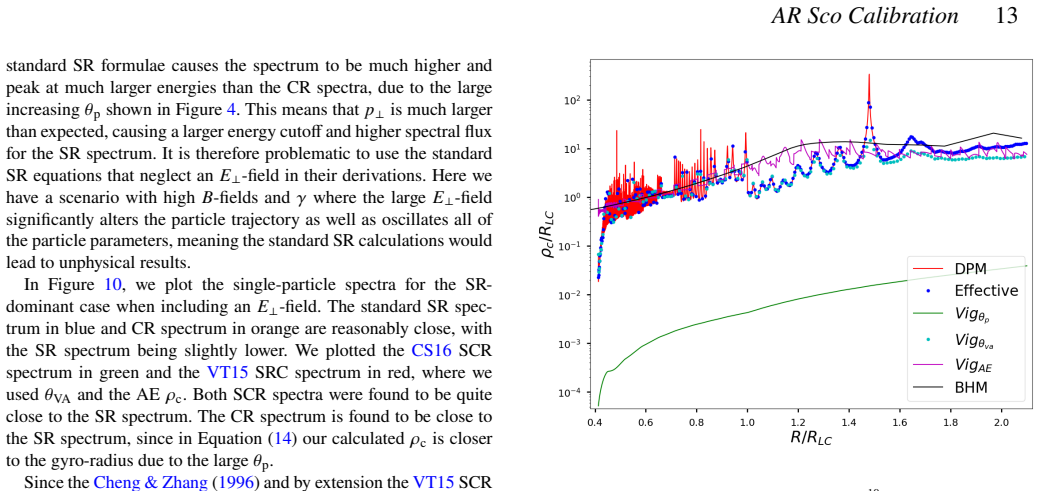
The load-bearing object is the pair of descriptions being compared: the gyro-resolved solver, which integrates the full Lorentz equation plus the classical Landau-Lifshitz radiation-reaction force with a higher-order adaptive-step scheme, and the gyro-centric description, which evolves only the guiding-center trajectory via the drift formula $\mathbf{v} = c\,\mathbf{E}\times\mathbf{B}/(B^2+E_0^2) + f\mathbf{B}$ and separately transports $\gamma$ and $p_\perp$. The bridge between them is the general pitch angle $\theta_{VA}$ between the particle velocity and the local Aristotelian velocity, together with the radius of curvature $\rho_c$: the gyro-resolved model yields an oscillating effective $\rho_c$ that matches the KP15 $\rho_{\rm eff}$ and hovers around the smoothed gyro-centric $\rho_c$ of the gyro-centric models. Convergence to the Aristotelian limit is measured through $\theta_{VA}$ and through the force balance between the Lorentz force and the radiation reaction, with the critical Lorentz factor $\gamma_c = [3E_0\rho_c^2/(2|e|)]^{1/4}$ as the target equilibrium value.
What would settle it
Take the same Vela-like case at $B_S = 8\times10^{11}$ G but initialize particles at the stellar surface with low $\gamma$, or with a quantum-electrodynamic radiation reaction that avoids the classical runaway, and re-run the curvature-radiation maps and spectra: if the caustic positions and spectral cutoffs shift away from the BH22 results, the reported calibration is an artifact of seeding with BH22 outputs. A cheaper check is to initialize twice at $0.65\,R_{\rm LC}$, once with the BH22 $\gamma$ and once with $\gamma_0 = 4$, and demand that the eventual spectra coincide; the paper already shows these two runs differ in $\gamma$ near injection, so the tolerance on this discrepancy is what the claim rests on.
Extended reading notes
Core claim
The paper's central claim is that resolving the full particle gyration with the classical Landau-Lifshitz radiation-reaction force yields the same physical answers as the gyro-centric models in the curvature-radiation regime: particle positions and directions agree across the magnetosphere, the observer-corrected emission phases match, and the curvature-radiation caustics and spectra are reproduced when the smoothed gyro-centric radius of curvature is used. It further claims that the solved trajectories converge to the Aristotelian-Electrodynamics drift velocities, with the general pitch angle stabilizing near 0.1 degrees, so the radiation-reaction limit is the correct equilibrium description for outflowing particles accelerated by a strong parallel electric field. A third claim is that standard synchrotron formulas become unphysical when the perpendicular electric field is a sizable fraction of the magnetic field, because the $\mathbf{E}\times\mathbf{B}$ drift inflates the pitch angle and pushes photon cutoffs beyond the particle energy, so emission must be computed as synchro-curvature radiation along the drifting trajectory; on that basis the CS16/KP15 synchro-curvature method is found more reliable than the VT15 method.
Load-bearing premise
The comparison is anchored by initial conditions taken from the gyro-centric model itself: particles start at $0.4$–$0.65\,R_{\rm LC}$ with positions and directions from the drift formula and $\gamma$ values from the BH22 transport output, so the close agreement with BH22 trajectories and spectra may be partly inherited from the seed rather than generated by the solver's physics.
Editorial extensions
If this is right
- Gyro-centric codes are validated for the curvature-radiation regime, so their cheap phase-averaged treatment of pulsar high-energy emission can be used with more confidence where small general pitch angles hold.
- The Aristotelian-electrodynamics limit is confirmed as the correct equilibrium description of outflowing, radiation-reaction-dominated particles, justifying AE-based trajectory models for pulsar light-curve work.
- Standard synchrotron formulas should be avoided whenever $E_\perp$ is a significant fraction of $B$; synchro-curvature radiation along the $\mathbf{E}\times\mathbf{B}$ drift path, via the CS16/KP15 expressions, is the reliable choice and is also cheaper than the VT15 route.
- Numerical codes that cap the Lorentz factor at $\gamma_c$, or rescale the radiation reaction, risk unphysical velocities above $c$; the capping approach should be replaced by higher-order adaptive integrators or quantum-electrodynamic reaction terms.
- The AE drift formulas fail for magnetic-mirror geometries, so sources with inward-moving or mirroring particles, the AR Sco case motivating this code, require the full equations of motion.
Reading between the lines
- The strongest reading of the calibration is partly circular: because the particles are seeded with the gyro-centric model's positions, directions, and $\gamma$ values, the trajectory agreement largely confirms that the solver and the gyro-centric drift formula integrate the same field structure, rather than that the two physical descriptions independently agree; an end-to-end test from surface inj
- If the KP15 effective radius of curvature matches the gyro-resolved $\rho_c$ even out of equilibrium, the CS16/KP15 synchro-curvature prescription may be portable to transient or non-equilibrium settings, such as current sheets or flaring magnetospheres, without waiting for radiation-reaction balance.
- The demonstrated numerical failure of $\gamma$-capping suggests that other pulsar particle-in-cell codes using Lorentz-factor or radiation-reaction caps may be inheriting artefacts; a systematic audit of such caps against adaptive higher-order integration would be a concrete follow-up.
- Extending the same calibration to inverse-Compton-dominated and pair-production regimes, where the AH21 model includes physics this code currently omits, would test whether the gyro-centric approach also holds when curvature radiation is not the dominant loss channel.
Signed reviews
Editorial analysis
A structured set of objections, weighed in public.
Referee Report
Summary. This paper calibrates a gyro-phase-resolved particle dynamics code (DPM) against the gyro-centric pulsar emission models AH15/AH21/BH22. The DPM integrates the full Lorentz-force equations with classical radiation reaction and is compared with the BH22 model for a Vela-like pulsar with B_S = 8e11 G (10% of Vela's surface field). The authors report agreement in trajectories, observer emission phases, and CR emission maps and spectra, under stated limitations: injection at higher altitude, use of BH22's smoothed curvature radius for some maps, and only the 10%-field case being accessible. They further test convergence to the Aristotelian Electrodynamics (AE) radiation-reaction limit, finding small deviation angles in the main case and good convergence for a surface-injection case with B_S = 8e8 G. They compare two synchro-curvature radiation (SCR) formalisms (VT15 vs CS16/KP15) and recommend the CS16 method. The paper is positioned as a calibration step for future modelling of AR Sco.
Significance. If the calibration is robust, the DPM provides a useful first-principles check on gyro-centric pulsar models and a tool for sources requiring full gyro-motion, such as AR Sco. The paper's strengths include solving the full Landau-Lifshitz radiation reaction with an adaptive higher-order scheme, showing that surface injection with generic parameters converges to the AE limit (Appendix Figure 18), and explicitly identifying where standard SR formulae fail when E_perp is significant. The comparison of two SCR models with quantitative power budgets (Table 1) is a useful practical contribution. The manuscript is also honest about several limitations. However, the central calibration claim is weakened by the seeded initialization from the reference model and by the partial use of the reference model's curvature radius in the emission-map comparison, as detailed below.
major comments (5)
- [2.3, Figs 2-5] The calibration's independence is partly compromised by the initialization. Section 2.3 states that the DPM initial position and direction are obtained from Eq. (1) — the same FFE/AE trajectory equation used by BH22 — and that the initial gamma at 0.4R_LC or 0.65R_LC is taken directly from BH22 output. The early trajectory is therefore the reference solution by construction, and the agreement shown in Figs 2-5 tests only whether the DPM integration remains on that solution for the remaining ~1.3-1.6 R_LC. The paper acknowledges the resulting initial oscillation but does not quantify how much of the trajectory, phase, map, or spectrum agreement is inherited from this seeding. To make the calibration claim convincing, the authors should either show convergence from generic, non-seeded initial conditions (as in Appendix Fig. 18 for B_S=8e8 G) or quantify the basin of initial conditions that reproduce the BH22 trajectories at B_S=8e11 G.
- [3.4, Fig. 12] The emission-map reproduction is partly achieved by substituting the reference model's curvature radius. Panels b and c of Fig. 12 reproduce the BH22 CR caustics only after inserting the BH22-smoothed rho_c into the DPM radiation calculation; panel d, which uses DPM's own gyro-resolved rho_c, shows additional extended emission near the injection altitude. Since rho_c is one of the quantities the calibration is supposed to validate, the claim 'we can reproduce ... CR emission maps' (Section 4) is overstated unless the authors demonstrate caustic reproduction with DPM's own rho_c (e.g., using the higher-E_parallel case of Fig. 21 or a lower-altitude start) or explicitly restrict the claim to the case where the reference rho_c is adopted.
- [3.5, Fig. 14] The spectral comparison is weakened by an unidentified hump. All DPM spectra in Fig. 14 show a hump feature that the authors attribute, speculatively, to the two-step E_parallel field or to gamma-limiting numerical artifacts, but no diagnostic test distinguishes these causes. Since the spectral reproduction is one of the two headline calibration results, the hump must be understood or eliminated; otherwise the spectra are matched only up to an unmodeled spectral distortion. A run with a smooth E_parallel profile and a run without gamma-limiting would discriminate between the proposed explanations.
- [2.2, 3.1] The calibration is restricted to a parameter corner an order of magnitude below the target source. The paper states that B_S=8e12 G (realistic Vela) cannot be simulated because the RRF enters the non-classical regime (Section 2.2), and even the B_S=8e11 G case requires injection at 0.65R_LC with gamma0=4 to stay below the Schwinger limit. The abstract is honest about the 10% field strength, but the paper should discuss explicitly whether the reproduction at 10% field is expected to transfer to Vela/AR Sco, given that the radiation-reaction regime and the gyro-radius scaling change with B_S. Without such a scaling argument, the calibration remains a demonstration in a scaled environment rather than a validation at the target parameters.
- [3.2, Fig. 6] The reported AE convergence (theta_VA ~ 0.1 deg) in the main B_S=8e11 G case is partly built into the initialization, because the particle's initial velocity direction is taken from Eq. (1), which is the same AE trajectory equation. The independent AE-convergence evidence is Appendix Fig. 18, where particles are injected at the stellar surface with generic parameters (B_S=8e8 G, gamma0=10^4) and still relax to the AE limit. The paper should attribute the main-case convergence to the consistency of the seeded initial conditions and reserve the 'convergence' claim for the surface-injection case, or present a B_S=8e11 G surface-injection run.
minor comments (7)
- [Eq. (13)] Equation (13) writes the CR spectrum with exp(epsilon/epsilon_CR); it should be exp(-epsilon/epsilon_CR) to decay at high energy, consistent with Eq. (16). Please correct the sign.
- [Fig. 21 caption] The caption refers to 'Figure 12 panel h)', but Figure 12 has only panels a-d; this should be panel d).
- [2.1] The statement that the B-fields are 'significantly divergent' at the ramp region should be quantified, e.g., the magnitude of div B relative to B/R_LC, so the reader can assess the severity.
- [3.3, Table 1] The CR-case relative errors (0.43 for CS16, 0.92 for Vigano-AE, 59.1 for Vigano-p) are described as 'a bit high' in Section 3.3; this understates the magnitude, especially the factor-of-59 error, and should be discussed in terms of which approximation breaks down in the CR-dominated high-field limit.
- [3.4] The text notes that one division per degree is used in Figure 12 whereas Figure 1 used 0.5 divisions per degree; please clarify whether the changed map resolution affects the visual comparison of caustic positions and intensities.
- [2.3] The sentence 'Using the particle gamma from Equation (2) at the specified altitude from the output results of BH22' should specify how the initial perpendicular momentum (or pitch angle) is set, in addition to the position and direction from Eq. (1), so the initial conditions are fully defined.
- [References] The paper relies on Du Plessis (2025, DP25) for the divergence analysis and the emission-map implementation details; please confirm the preprint status of DP25 or summarize the key results in the main text, since the current manuscript's reproducibility depends on that unpublished work.
Circularity Check
Calibration is partly seeded: DPM initializes position, direction, and γ from BH22 outputs, and key CR maps use BH22's ρc; agreement reflects inherited reference inputs rather than fully independent dynamics.
-
self definitional
[Section 2.3 (Particle Trajectory Calibration); Figs. 2-3 and Fig. 6]
"To solve the problem of having to start implementing our equations of motion at a higher altitude, we used Equations (1) to trace out the particle trajectories up to a specified altitude (~0.4 R_LC, after the ramp function where the fields are FF), which gives the particle position and direction needed for initialising our equations. Using the particle γ from Equation (2) at the specified altitude from the output results of BH22, we then had the missing momentum needed for solving our equations of motion, which we used to simulate the rest of the particle trajectory."
The DPM is launched on the BH22/AE solution: Equation (1) is the gyro-centric trajectory equation used by BH22, and the paper states it is equivalent to the AE trajectory in Equation (3). The initial γ is read from BH22 output. Therefore the early trajectory, the corrected observer phases, and the small θ_VA at injection are inherited from the reference model by construction; only the segment after ~0.4-0.65 R_LC is an independent test of DPM's equations of motion. The paper acknowledges the initial oscillation caused by this seeding but does not quantify how much of the reported trajectory and phase agreement is already encoded in the initial conditions.
-
fitted input called prediction
[Section 3.4 (Emission maps, Fig. 12 panels b-d) and Section 3.5 (Fig. 14)]
"In panel b) we plot the CR map with excluded RRF and using the ρc from the BH22 model, while in panel c) we plot the CR map including RRF and using the ρc from the BH22 model, while in panel d) we plot the CR maps including RRF and using our model ρc. We investigated using the BH22 model ρc, since as mentioned in Section 3.1 our ρc is initially lower than their ρc because our model yields the ρeff due to resolving the particle gyrations and their model yields the AE gyro-centric ρc."
Equation (13) makes the CR spectrum and power depend on ρc through both the prefactor and the cutoff exponent. Feeding BH22's smoothed ρc into the DPM radiation routine directly inserts the reference model's curvature-radius history into the 'predicted' maps and spectra. The agreement of Fig. 12 panels b-c and of the green CR spectrum in Fig. 14 is therefore largely forced by this input, not produced by DPM's own gyro-resolved ρc. The paper's own Fig. 12d, using DPM's ρc, shows extra extended emission, confirming that the reproduction depends on the substituted reference ρc.
full rationale
The headline calibration claim is partially circular. The DPM's initial position and direction are taken from Equation (1), which is the same equation BH22 uses and which the paper equates with the AE trajectory; its initial γ is read directly from BH22 output. Hence the early trajectory and the small θ_VA are seeded by the very model the paper claims to reproduce. The CR map and spectrum reproduction is further aided by inserting BH22's smoothed ρc into the DPM radiation calculation, directly encoding the reference spectral cutoff. These are construction-based reductions, so the score is 6 rather than a lower value. However, the paper is not wholly circular: the DPM integrates its own equations of motion from the seeded state and the agreement persists over the remaining magnetosphere; the AE comparison uses externally derived analytic trajectories (Gruzinov 2012; Kelner et al. 2015); and Appendix Fig. 18 injects at the stellar surface with B_S=8e8 G and γ0=10^4, converging to AE without copied initial conditions. The benchmark models are from the same collaboration, but that shared authorship alone is not load-bearing: the field grids and model outputs are concrete external inputs, and the central derivation stands or falls on the independent integration tests. The construction-based reductions above, not the self-citation, drive the score.
Assumptions & free parameters
free parameters (5)
- E_parallel acceleration rate inside light cylinder (R_min_acc) =
4.0e-2 cm^-1 (reference), 4.0e-3 cm^-1 (lower, no RRF), 4.0e-4 cm^-1 (lower, with RRF)
- E_parallel acceleration rate outside light cylinder (R_max_acc) =
2.5e-1 cm^-1 (reference), 2.5e-2 cm^-1 (lower, no RRF), 2.5e-3 cm^-1 (lower, with RRF)
- Particle injection altitude =
0.4 R_LC (no RRF), 0.65 R_LC (with RRF)
- Initial Lorentz factor gamma_0 =
6e6 (no RRF), 4 (with RRF)
- Slot gap boundaries r_ovc =
0.9 to 0.96
assumptions (5)
- domain assumption Force-free (FF) fields from the FIDO model, with a ramp transition from retarded dipole fields, represent the pulsar magnetosphere.
- domain assumption The classical Landau-Lifshitz radiation reaction force, with the first term neglected, is valid when the particle's effective field is below the Schwinger limit.
- domain assumption A constant E_parallel field can emulate the slot-gap accelerating field.
- domain assumption Northern hemisphere emission can be mirrored to the southern hemisphere.
- standard math The asymptotic Bessel-function approximations for CR and SR spectra are valid.
Cite this review
Pith. "Pith review of Towards Modelling AR Sco: Calibration -- Reproducing High-Energy Pulsar Emission and Testing Convergence to Aristotelian Electrodynamics." pith.science (2026). https://pith.science/paper/VCLRIH26
@misc{pith2026250618917,
  author       = {Pith},
  title        = {Pith review of: Towards Modelling AR Sco: Calibration -- Reproducing High-Energy Pulsar Emission and Testing Convergence to Aristotelian Electrodynamics},
  year         = {2026},
  howpublished = {\url{https://pith.science/paper/VCLRIH26}},
  note         = {Machine review of arXiv:2506.18917}
}
abstract
In recent years, kinetic simulations have been crucial to further our understanding of pulsar electrodynamics. Yet, due to the large-scale separation between the gyro-period vs the stellar rotation period, resolving the particle gyration has been computationally unfeasible for realistic pulsar parameters. The main aim of this work is comparing our gyro-phase-resolved model with a gyro-centric pulsar model, where our model solves the general equations of motion with included radiation reaction using a higher-order numerical solver with adaptive time steps. Specifically, we aim to (i) reproduce a pulsar's high-energy emission maps, namely one with $10\%$ the surface $B$-field strength of Vela, and spectra produced by an independent gyro-centric pulsar emission model; (ii) test convergence of these results to the radiation-reaction limit of Aristotelian Electrodynamics. (iii) Additionally, we identify the effect that a large $E_{\parallel}$-field has on the trajectories and radiation calculations. We find that we can reproduce the curvature radiation emission maps and spectra well, using $10\%$ field strengths of the Vela pulsar and injecting our particles at a higher altitude in the magnetosphere. Using sufficiently large $E_{\parallel}$-fields, our numeric results converge to the analytic radiation-reaction limit trajectories. Additionally, we illustrate the importance of accounting for the $\mathbf{E}\times \mathbf{B}$-drift in the particle trajectories and radiation calculations, validating the Harding and collaborators' model approach. Lastly, we found that our model deals very well with the high-radiation-reaction and high-field regimes present in pulsars.
Figures


Figures from the paper (18 more)




Reference graph
Works this paper leans on
-
[1]
write newline
" write newline "" before.all 'output.state := FUNCTION fin.entry write newline FUNCTION new.block output.state before.all = 'skip after.block 'output.state := if FUNCTION new.sentence output.state after.block = 'skip output.state before.all = 'skip after.sentence 'output.state := if if FUNCTION not #0 #1 if FUNCTION and 'skip pop #0 if FUNCTION or pop #1...
-
[2]
Arons J., 1983, @doi [ ] 10.1086/160771 , https://ui.adsabs.harvard.edu/abs/1983ApJ...266..215A 266, 215
doi:10.1086/160771 1983
-
[3]
K., Kalapotharakos C., Johnson T
Barnard M., Venter C., Harding A. K., Kalapotharakos C., Johnson T. J., 2022, @doi [ ] 10.3847/1538-4357/ac2a3d , https://ui.adsabs.harvard.edu/abs/2022ApJ...925..184B 925, 184
-
[4]
Belyaev M. A., 2015, @doi [ ] 10.1093/mnras/stv468 , https://ui.adsabs.harvard.edu/abs/2015MNRAS.449.2759B 449, 2759
-
[5]
Poynting flux transport channels formed in polar cap regions of neutron star magnetospheres
Ben \'a c ek J., Timokhin A., Mu \ n oz P. A., Jessner A., Rievajov \'a T., Pohl M., B \"u chner J., 2024, @doi [arXiv e-prints] 10.48550/arXiv.2405.20866 , https://ui.adsabs.harvard.edu/abs/2024arXiv240520866B p. arXiv:2405.20866
work page Pith review arXiv doi:10.48550/arxiv.2405.20866 2024
-
[6]
Blumenthal G. R., Gould R. J., 1970, @doi [Reviews of Modern Physics] 10.1103/RevModPhys.42.237 , https://ui.adsabs.harvard.edu/abs/1970RvMP...42..237B 42, 237
-
[7]
Brambilla G., Kalapotharakos C., Timokhin A. N., Harding A. K., Kazanas D., 2018, @doi [ ] 10.3847/1538-4357/aab3e1 , https://ui.adsabs.harvard.edu/abs/2018ApJ...858...81B 858, 81
-
[8]
Burger R. A., Moraal H., Webb G. M., 1985, @doi [ ] 10.1007/BF00649278 , https://ui.adsabs.harvard.edu/abs/1985Ap&SS.116..107B 116, 107
Show all 59 references
-
[9]
E., Paschalidis V., 2023, @doi [ ] 10.1103/PhysRevD.108.063018 , https://ui.adsabs.harvard.edu/abs/2023PhRvD.108f3018C 108, 063018
Cai Y., Gralla S. E., Paschalidis V., 2023, @doi [ ] 10.1103/PhysRevD.108.063018 , https://ui.adsabs.harvard.edu/abs/2023PhRvD.108f3018C 108, 063018
2023 doi
-
[10]
A., Begelman M
Cerutti B., Uzdensky D. A., Begelman M. C., 2012, @doi [ ] 10.1088/0004-637X/746/2/148 , https://ui.adsabs.harvard.edu/abs/2012ApJ...746..148C 746, 148
2012 doi
-
[11]
R., Uzdensky D
Cerutti B., Werner G. R., Uzdensky D. A., Begelman M. C., 2013, @doi [ ] 10.1088/0004-637X/770/2/147 , https://ui.adsabs.harvard.edu/abs/2013ApJ...770..147C 770, 147
2013 doi
-
[12]
Cerutti B., Philippov A., Parfrey K., Spitkovsky A., 2015, @doi [ ] 10.1093/mnras/stv042 , https://ui.adsabs.harvard.edu/abs/2015MNRAS.448..606C 448, 606
2015 doi
-
[13]
A., Spitkovsky A., 2016, @doi [ ] 10.1093/mnras/stw124 , https://ui.adsabs.harvard.edu/abs/2016MNRAS.457.2401C 457, 2401
Cerutti B., Philippov A. A., Spitkovsky A., 2016, @doi [ ] 10.1093/mnras/stw124 , https://ui.adsabs.harvard.edu/abs/2016MNRAS.457.2401C 457, 2401
2016 doi
-
[14]
Y., Beloborodov A
Chen A. Y., Beloborodov A. M., 2014, @doi [ ] 10.1088/2041-8205/795/1/L22 , https://ui.adsabs.harvard.edu/abs/2014ApJ...795L..22C 795, L22
2014 doi
-
[15]
F., et al., 1984, Springer, @doi 10.1007/978-3-319-22309-4
Chen F. F., et al., 1984, Springer, @doi 10.1007/978-3-319-22309-4
1984 doi
-
[16]
S., Zhang J
Cheng K. S., Zhang J. L., 1996, @doi [ ] 10.1086/177239 , https://ui.adsabs.harvard.edu/abs/1996ApJ...463..271C 463, 271
1996 doi
-
[17]
Contopoulos I., Kazanas D., Fendt C., 1999, @doi [The Astrophysical Journal] 10.1086/306652 , 511, 351
1999 doi
- [18]
- [19]
-
[20]
K., Wadiasingh Z., Kalapotharakos C., Els P., 2024, @doi [ ] 10.1093/mnras/stae1791 , https://ui.adsabs.harvard.edu/abs/2024MNRAS.532.4408D 532, 4408
Du Plessis L., Venter C., Harding A. K., Wadiasingh Z., Kalapotharakos C., Els P., 2024, @doi [ ] 10.1093/mnras/stae1791 , https://ui.adsabs.harvard.edu/abs/2024MNRAS.532.4408D 532, 4408
2024 doi
-
[21]
K., 2004, @doi [ ] 10.1086/423707 , https://ui.adsabs.harvard.edu/abs/2004ApJ...614..869D 614, 869
Dyks J., Harding A. K., 2004, @doi [ ] 10.1086/423707 , https://ui.adsabs.harvard.edu/abs/2004ApJ...614..869D 614, 869
2004 doi
-
[22]
K., Rudak B., 2004, @doi [ ] 10.1086/383121 , https://ui.adsabs.harvard.edu/abs/2004ApJ...606.1125D 606, 1125
Dyks J., Harding A. K., Rudak B., 2004, @doi [ ] 10.1086/383121 , https://ui.adsabs.harvard.edu/abs/2004ApJ...606.1125D 606, 1125
2004 doi
-
[23]
H., 1969, @doi [ ] 10.1086/150119 , https://ui.adsabs.harvard.edu/abs/1969ApJ...157..869G 157, 869
Goldreich P., Julian W. H., 1969, @doi [ ] 10.1086/150119 , https://ui.adsabs.harvard.edu/abs/1969ApJ...157..869G 157, 869
1969 doi
-
[24]
Grismayer T., Vranic M., Fonseca R., Silva L., 2016, in APS Division of Plasma Physics Meeting Abstracts. p. TP10.062
2016
-
[25]
Gruzinov A., 2008, @doi [ ] 10.1088/1475-7516/2008/11/002 , https://ui.adsabs.harvard.edu/abs/2008JCAP...11..002G 2008, 002
2008 doi
- [26]
-
[27]
K., Kalapotharakos C., 2015, @doi [ ] 10.1088/0004-637X/811/1/63 , https://ui.adsabs.harvard.edu/abs/2015ApJ...811...63H 811, 63
Harding A. K., Kalapotharakos C., 2015, @doi [ ] 10.1088/0004-637X/811/1/63 , https://ui.adsabs.harvard.edu/abs/2015ApJ...811...63H 811, 63
2015 doi
-
[28]
K., Lai D., 2006, @doi [Reports on Progress in Physics] 10.1088/0034-4885/69/9/R03 , https://ui.adsabs.harvard.edu/abs/2006RPPh...69.2631H 69, 2631
Harding A. K., Lai D., 2006, @doi [Reports on Progress in Physics] 10.1088/0034-4885/69/9/R03 , https://ui.adsabs.harvard.edu/abs/2006RPPh...69.2631H 69, 2631
2006 doi
-
[29]
K., Preece R., 1987, @doi [ ] 10.1086/165510 , https://ui.adsabs.harvard.edu/abs/1987ApJ...319..939H 319, 939
Harding A. K., Preece R., 1987, @doi [ ] 10.1086/165510 , https://ui.adsabs.harvard.edu/abs/1987ApJ...319..939H 319, 939
1987 doi
-
[30]
K., Usov V
Harding A. K., Usov V. V., Muslimov A. G., 2005, @doi [ ] 10.1086/427840 , https://ui.adsabs.harvard.edu/abs/2005ApJ...622..531H 622, 531
2005 doi
-
[31]
K., Venter C., Kalapotharakos C., 2021, @doi [ ] 10.3847/1538-4357/ac3084 , https://ui.adsabs.harvard.edu/abs/2021ApJ...923..194H 923, 194
Harding A. K., Venter C., Kalapotharakos C., 2021, @doi [ ] 10.3847/1538-4357/ac3084 , https://ui.adsabs.harvard.edu/abs/2021ApJ...923..194H 923, 194
2021 doi
-
[32]
V., Cary J
Higuera A. V., Cary J. R., 2017, @doi [Physics of Plasmas] 10.1063/1.4979989 , https://ui.adsabs.harvard.edu/abs/2017PhPl...24e2104H 24, 052104
2017 doi
-
[33]
Kalapotharakos C., Contopoulos I., 2009, @doi [ ] 10.1051/0004-6361:200810281 , https://ui.adsabs.harvard.edu/abs/2009A&A...496..495K 496, 495
2009 doi
-
[34]
Kalapotharakos C., Kazanas D., Harding A., Contopoulos I., 2012, @doi [ ] 10.1088/0004-637X/749/1/2 , https://ui.adsabs.harvard.edu/abs/2012ApJ...749....2K 749, 2
2012 doi
-
[35]
K., Kazanas D., 2014, @doi [ ] 10.1088/0004-637X/793/2/97 , https://ui.adsabs.harvard.edu/abs/2014ApJ...793...97K 793, 97
Kalapotharakos C., Harding A. K., Kazanas D., 2014, @doi [ ] 10.1088/0004-637X/793/2/97 , https://ui.adsabs.harvard.edu/abs/2014ApJ...793...97K 793, 97
2014 doi
-
[36]
K., Kazanas D., 2018, @doi [ ] 10.3847/1538-4357/aab550 , https://ui.adsabs.harvard.edu/abs/2018ApJ...857...44K 857, 44
Kalapotharakos C., Brambilla G., Timokhin A., Harding A. K., Kazanas D., 2018, @doi [ ] 10.3847/1538-4357/aab550 , https://ui.adsabs.harvard.edu/abs/2018ApJ...857...44K 857, 44
2018 doi
-
[37]
K., Kazanas D., Wadiasingh Z., 2019, @doi [ ] 10.3847/2041-8213/ab3e0a , https://ui.adsabs.harvard.edu/abs/2019ApJ...883L...4K 883, L4
Kalapotharakos C., Harding A. K., Kazanas D., Wadiasingh Z., 2019, @doi [ ] 10.3847/2041-8213/ab3e0a , https://ui.adsabs.harvard.edu/abs/2019ApJ...883L...4K 883, L4
2019 doi
-
[38]
K., Kazanas D., 2023, @doi [ ] 10.3847/1538-4357/ace972 , https://ui.adsabs.harvard.edu/abs/2023ApJ...954..204K 954, 204
Kalapotharakos C., Wadiasingh Z., Harding A. K., Kazanas D., 2023, @doi [ ] 10.3847/1538-4357/ace972 , https://ui.adsabs.harvard.edu/abs/2023ApJ...954..204K 954, 204
2023 doi
-
[39]
R., Prosekin A
Kelner S. R., Prosekin A. Y., Aharonian F. A., 2015, @doi [ ] 10.1088/0004-6256/149/1/33 , https://ui.adsabs.harvard.edu/abs/2015AJ....149...33K 149, 33
2015 doi
-
[40]
D., Lifshitz E
Landau L. D., Lifshitz E. M., 1975, The classical theory of fields
1975
-
[41]
Li J., Spitkovsky A., Tchekhovskoy A., 2012, @doi [ ] 10.1088/0004-637X/746/1/60 , https://ui.adsabs.harvard.edu/abs/2012ApJ...746...60L 746, 60
2012 doi
-
[42]
Mottez F., 2024, @doi [ ] 10.1051/0004-6361/202347692 , https://ui.adsabs.harvard.edu/abs/2024A&A...684A.115M 684, A115
2024 doi
-
[43]
G., Harding A
Muslimov A. G., Harding A. K., 2003, @doi [The Astrophysical Journal] 10.1086/368162 , 588, 430
2003 doi
-
[44]
P \'e tri J., 2023, @doi [ ] 10.1051/0004-6361/202346515 , https://ui.adsabs.harvard.edu/abs/2023A&A...677A..72P 677, A72
2023 doi
-
[45]
A., Spitkovsky A., 2014, @doi [ ] 10.1088/2041-8205/785/2/L33 , https://ui.adsabs.harvard.edu/abs/2014ApJ...785L..33P 785, L33
Philippov A. A., Spitkovsky A., 2014, @doi [ ] 10.1088/2041-8205/785/2/L33 , https://ui.adsabs.harvard.edu/abs/2014ApJ...785L..33P 785, L33
2014 doi
-
[46]
A., Spitkovsky A., 2018, @doi [ ] 10.3847/1538-4357/aaabbc , https://ui.adsabs.harvard.edu/abs/2018ApJ...855...94P 855, 94
Philippov A. A., Spitkovsky A., 2018, @doi [ ] 10.3847/1538-4357/aaabbc , https://ui.adsabs.harvard.edu/abs/2018ApJ...855...94P 855, 94
2018 doi
-
[47]
A., Spitkovsky A., Cerutti B., 2015, @doi [ ] 10.1088/2041-8205/801/1/L19 , https://ui.adsabs.harvard.edu/abs/2015ApJ...801L..19P 801, L19
Philippov A. A., Spitkovsky A., Cerutti B., 2015, @doi [ ] 10.1088/2041-8205/801/1/L19 , https://ui.adsabs.harvard.edu/abs/2015ApJ...801L..19P 801, L19
2015 doi
-
[48]
W., Yadigaroglu I
Romani R. W., Yadigaroglu I. A., 1995, @doi [ ] 10.1086/175076 , https://ui.adsabs.harvard.edu/abs/1995ApJ...438..314R 438, 314
1995 doi
-
[49]
B., 2020, The Astrophysical Journal, 889, 123
Schlegel L., Frie A., Eichmann B., Reichherzer P., Tjus J. B., 2020, The Astrophysical Journal, 889, 123
2020
-
[50]
V., Nees J
Sokolov I. V., Nees J. A., Yanovsky V. P., Naumova N. M., Mourou G. A., 2010, @doi [ ] 10.1103/PhysRevE.81.036412 , https://ui.adsabs.harvard.edu/abs/2010PhRvE..81c6412S 81, 036412
2010 doi
- [51]
-
[52]
Spitkovsky A., 2006, @doi [ ] 10.1086/507518 , https://ui.adsabs.harvard.edu/abs/2006ApJ...648L..51S 648, L51
2006 doi
-
[53]
S., 2017, @doi [Astrophys
Takata J., Yang H., Cheng K. S., 2017, @doi [Astrophys. J] 10.3847/1538-4357/aa9b33 , http://adsabs.harvard.edu/abs/2017ApJ...851..143T 851, 143
2017 doi
-
[54]
H., Macchi A., 2010, @doi [New Journal of Physics] 10.1088/1367-2630/12/12/123005 , https://ui.adsabs.harvard.edu/abs/2010NJPh...12l3005T 12, 123005
Tamburini M., Pegoraro F., Di Piazza A., Keitel C. H., Macchi A., 2010, @doi [New Journal of Physics] 10.1088/1367-2630/12/12/123005 , https://ui.adsabs.harvard.edu/abs/2010NJPh...12l3005T 12, 123005
2010 doi
-
[55]
N., 2006, @doi [ ] 10.1111/j.1365-2966.2006.10192.x , https://ui.adsabs.harvard.edu/abs/2006MNRAS.368.1055T 368, 1055
Timokhin A. N., 2006, @doi [ ] 10.1111/j.1365-2966.2006.10192.x , https://ui.adsabs.harvard.edu/abs/2006MNRAS.368.1055T 368, 1055
2006
-
[56]
A., Silva L
Torres R., Grismayer T., Cruz F., Fonseca R. A., Silva L. O., 2024, @doi [ ] 10.1016/j.newast.2024.102261 , https://ui.adsabs.harvard.edu/abs/2024NewA..11202261T 112, 102261
2024
-
[57]
F., Hirotani K., Pessah M
Vigan \`o D., Torres D. F., Hirotani K., Pessah M. E., 2015, @doi [ ] 10.1093/mnras/stu2456 , https://ui.adsabs.harvard.edu/abs/2015MNRAS.447.1164V 447, 1164
2015 doi
-
[58]
L., Fonseca R
Vranic M., Martins J. L., Fonseca R. A., Silva L. O., 2016, @doi [Computer Physics Communications] 10.1016/j.cpc.2016.04.002 , https://ui.adsabs.harvard.edu/abs/2016CoPhC.204..141V 204, 141
2016 doi
-
[59]
A., Silva L
Vranic M., Grismayer T., Fonseca R. A., Silva L. O., 2017, @doi [Plasma Physics and Controlled Fusion] 10.1088/0741-3335/59/1/014040 , https://ui.adsabs.harvard.edu/abs/2017PPCF...59a4040V 59, 014040
2017 doi
Reviewed August 7, 2026 · model on record in the stance chip above.
Discussion (0). Continue with ORCID to comment.