REVIEW 3 major objections 4 minor 248 references
Search for an Anomalous Excess of Single Photons in the MicroBooNE Neutrino Experiment
T0 review · 3 major / 4 minor · reviewed 2026-08-15 · deepseek-v4-flash
Pith's one-line read MicroBooNE finds no excess of single photons from neutrino-induced Delta radiative decays, but cannot rule out photon sources with no visible proton.
desk verdict A solid, honest MicroBooNE doctoral thesis with a genuinely new single-photon selection and a null result whose visible-proton leg is robust and whose 0p leg is explicitly model-dependent. read the letter →
The pith
A machine-rendered reading of the paper's core claim, the machinery that carries it, and where it could break.
The reading
What carries the argument
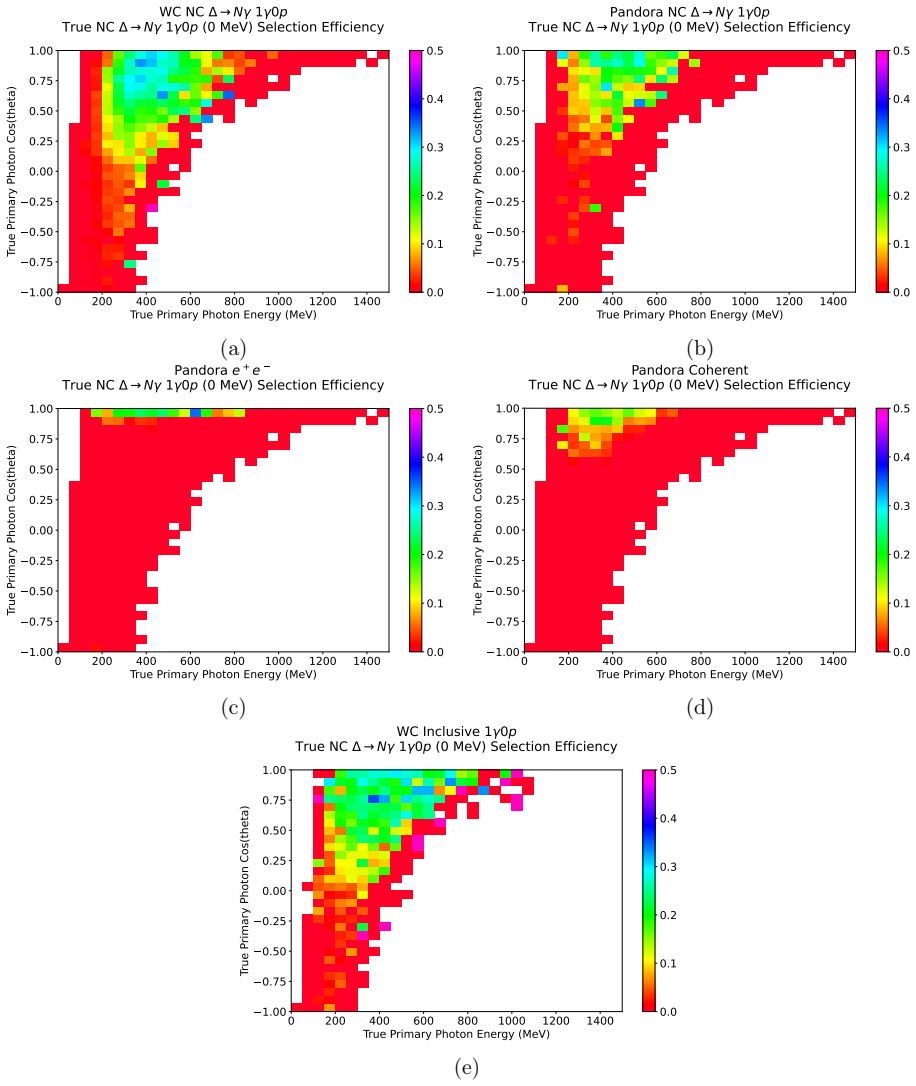
The load-bearing object is the $NC\Delta\to N\gamma$ single-photon selection, built by combining two independent LArTPC reconstructions: Wire-Cell 3D imaging and Pandora pattern recognition. The selection isolates events with one electromagnetic shower and uses electron-photon discrimination (a gap between vertex and shower, and the $dE/dx$ at the shower stem) to identify photons; the hypothesis tests then scan the scaling factor $x_\Delta$ (multiplying the nominal NC $\Delta$ radiative rate) and the fraction $x_{0p}$ of single photons with no visible proton, a parameter introduced because the data cannot constrain the true-0p efficiency. The machinery also includes the true-0p efficiency maps and the systematic covariance, which carry the analysis from reconstructed kinematics to the exclusion contours.
What would settle it
A dedicated re-analysis of the same data that tags single-photon events with no reconstructed proton—for example by using a control sample of $e^+e^-$ pairs to measure the true-0p efficiency—and finds a significant low-energy excess would directly contradict the paper's claim of consistency with expectation. Concretely, recomputing the one-bin count with the true-0p efficiency doubled and photonuclear absorption reduced by 30% would show whether the nominal prediction is robust.
Extended reading notes
Core claim
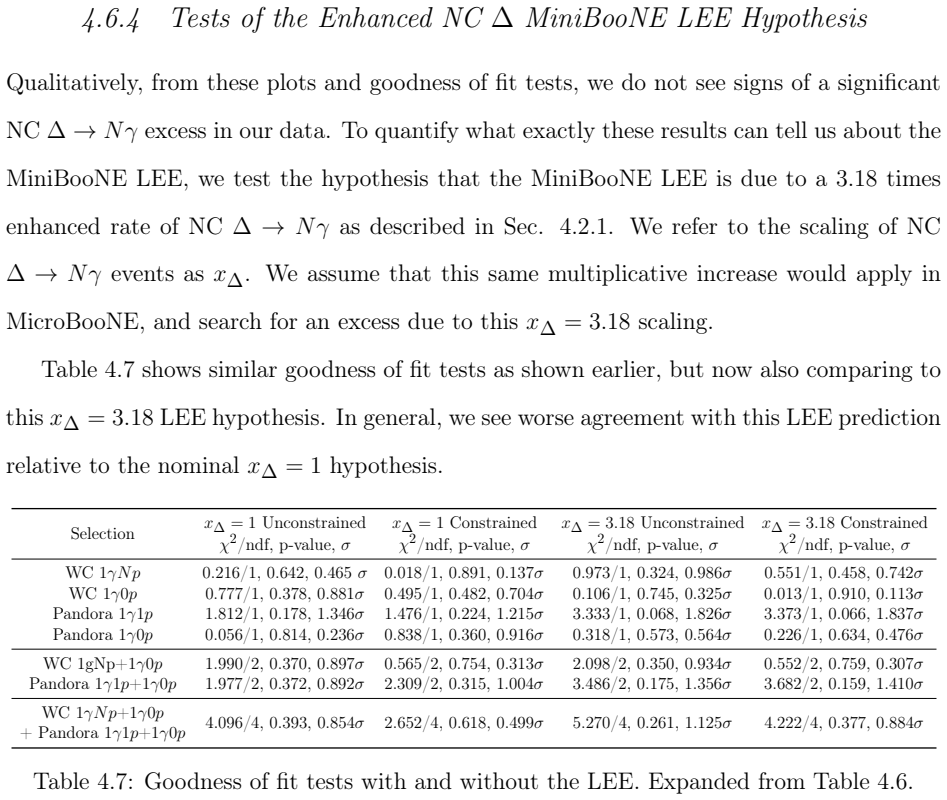
The central claim is that the joint Wire-Cell + Pandora selection for neutral-current $\Delta$ radiative decays ($NC\Delta\to N\gamma$) in MicroBooNE finds data consistent with the nominal background prediction, with no significant excess of single-photon events. The analysis quantifies this by testing the 'enhanced NC $\Delta$' version of the MiniBooNE LEE hypothesis, in which the NC $\Delta$ radiative decay rate is scaled by a factor $x_\Delta$, and a more general two-parameter hypothesis in which a fraction $x_{0p}$ of the photons have no visible proton. The data exclude large regions of the ($x_\Delta$, $x_{0p}$) plane, particularly where the photons are accompanied by visible protons, but cannot exclude the $x_{0p}$-only axis. In the author's words, the data are consistent with expectation but cannot rule out all potential sources of additional single photons, especially those with no visible proton activity.
Load-bearing premise
The null result rests on the simulation's prediction for single photons that leave no visible proton—the topology the thesis explicitly says it cannot constrain—so if GENIE's photon production or photonuclear absorption, or the 0p reconstruction efficiency, is wrong, the apparent consistency could hide a real photon excess.
Editorial extensions
If this is right
- If the central claim is right, the enhanced NC Delta radiative decay explanation of the MiniBooNE LEE is disfavored whenever the photon is accompanied by a visible proton at MicroBooNE's energies.
- The two-parameter exclusion in ($x_\Delta$, $x_{0p}$) means any NC Delta-like LEE model that requires a large visible-proton fraction is ruled out, while models living on the no-visible-proton axis survive.
- The result demonstrates that joint Wire-Cell + Pandora single-photon selections can constrain photon-like LEE explanations and provides a reusable framework for such searches.
- Data being consistent with nominal expectation implies no new single-photon source is needed to describe the current MicroBooNE sample, within the untested 0p region.
- The 0p channel is the clear next target: the analysis's own efficiency maps show where future sensitivity must improve.
Reading between the lines
- I read the 0p axis as the place where a photon-like LEE could still be hiding; a natural next step would be a selection that sacrifices visible-proton purity to recover low-energy 0p showers and uses the measured 0p efficiency as a fit parameter.
- The same ($x_\Delta$, $x_{0p}$) scaling-plane technique could be applied to other single-photon searches, such as coherent or inclusive single photons, to map out which photon production mechanisms are compatible with the null result.
- Because GENIE's photonuclear absorption is a leading modeling uncertainty, a data-driven measurement of photon survival in argon would strengthen or overturn the conclusion; the thesis's own Geant4 EM modifications show this modeling is not settled.
- If a future liquid-argon experiment with lower proton thresholds finds a 0p single-photon excess, it would revive the photon interpretation of the MiniBooNE LEE that this result leaves open.
Signed reviews
Editorial analysis
A structured set of objections, weighed in public.
Referee Report
Summary. The dissertation reports a search for an anomalous excess of single photons in MicroBooNE, targeting neutral-current Delta radiative decays (NC Delta to N gamma). It develops a joint Wire-Cell plus Pandora selection, evaluates backgrounds with GENIE simulation and a MicroBooNE tune, constrains systematic uncertainties with nu-mu-CC and NC-pi0 sidebands, and tests the MiniBooNE LEE under scaled NC Delta-like hypotheses characterized by parameters x_Delta and x_0p. The observed data are reported as consistent with the nominal prediction, and the analysis excludes parts of the (x_Delta, x_0p) plane while leaving the zero-visible-proton (0p) axis open, as stated in the abstract.
Significance. If the result holds, it disfavors photon-like explanations of the MiniBooNE LEE that would produce NC Delta radiative single photons accompanied by a visible proton, and it provides a detailed experimental template for single-photon searches in LArTPCs. The analysis has notable strengths: selection development on a small blinded subset (Sec. 3.3.3), nine detector systematic universes (Sec. 2.4), conditional constraints from nu-mu-CC and NC-pi0 sidebands (Sec. 4.5.3), fake-data closure tests (Appendix A), and a combination of two independent reconstruction chains. The external benchmark built from MiniBooNE's measured excess is not derived from MicroBooNE's own fit, so the exclusion test is not circular. The principal weakness is that the 0p topology, on which the thesis explicitly concedes no constraint, is also the place where the simulation-dependent prediction is least tested.
major comments (3)
- [Sec. 4.5.1, Fig. 4.35; Secs. 5.2.2-5.2.3; Secs. 4.39-4.43; Sec. 5.3.1] The central null statement 'data consistent with our nominal expectation' includes the 0p channel, but the true-0p efficiency and 0p shower efficiencies are presented as simulation-only quantities with no data closure test for that topology. The thesis itself documents a GENIE branching-ratio bugfix, material differences between GENIE FSI models for single photons (Figs. 4.39-4.43), and ad hoc Geant4 electromagnetic model modifications (Sec. 5.3.1). As written, the quoted consistency with expectation for the 0p component is therefore not robust: a genuine 0p photon excess could be absorbed into the simulated prediction if the true 0p efficiency or photonuclear absorption differs from the model. Please either add a data-driven 0p validation/sideband constraint or explicitly rescope the consistency claim to the visible-proton topology and quantify how large a 0p excess could be hidden within the quoted uncertainties.
- [Sec. 4.6.5, Figs. 4.73 and 4.75] Section 4.6.5 introduces x_0p precisely because data cannot pin down the zero-proton fraction, and the resulting exclusion leaves the x_0p axis open. The conclusions should therefore always carry the qualifier 'with visible proton activity' when describing excluded NC Delta-like LEE hypotheses. The abstract already states this caveat, but the chapter-level summary and the captions of Figs. 4.73-4.75 should be equally explicit so that a reader does not walk away with the impression that 0p-only models are tested.
- [Sec. 4.5.3, Table 4.4] The conditional constraint uses nu-mu-CC and NC-pi0 sidebands. These channels share flux and cross-section systematics with the single-photon signal, but they do not directly constrain the 0p single-photon reconstruction efficiency or the photonuclear-absorption model for 0p photons. The post-constraint uncertainties in Table 4.4 may therefore be underestimated for the 0p channel. The text should state this limitation explicitly and either provide an unconstrained 0p systematic or demonstrate a quantitative correlation between the sideband channels and the 0p acceptance.
minor comments (4)
- [Acknowledgments and throughout] Several typographical errors should be corrected, including 'instutitions', 'componentns', 'descripancy', and 'decomissioning'.
- [Fig. 2.7 caption] The caption reads 'tob, left, right, and bottom panels'; this should be 'top, left, right, and bottom panels'.
- [Sec. 2.4.4] The phrase 'We finished finished processing' contains a duplicated word and should be revised.
- [Chapters 4-5] The notation for the signal process is inconsistent (NC Delta, NC Delta radiative decay, NC Delta to N gamma). Define the notation once and use it consistently throughout.
Circularity Check
No significant circularity: the tested LEE hypotheses are fixed by external MiniBooNE data, the MicroBooNE null result is compared to an externally benchmarked prediction, and the 0p gap is a stated limitation rather than a self-referential input.
full rationale
The paper's central claim is a null result: data are consistent with the nominal expectation for NC Delta radiative single-photon events, with the explicit caveat that no-visible-proton (0p) sources cannot be ruled out (abstract). The hypotheses tested in Chapter 4 are defined from the MiniBooNE low-energy excess, an external dataset, not from a fit to MicroBooNE's own signal region; the eLEE model in Sec. 3.4.1 is explicitly an unfolding of the MiniBooNE LEE into true neutrino energy, and the NC Delta LEE scaling parameters are likewise external benchmarks whose values MicroBooNE data are used to constrain rather than to define. The conditional constraint procedure uses MicroBooNE sidebands for nuisance parameters, which is disclosed and standard practice, and it does not fit the signal-strength parameter being tested. The thesis's reliance on prior MicroBooNE/collaboration work for reconstruction and detector modeling is a normal use of shared experimental infrastructure, not a load-bearing self-citation that defines the physics result; the quoted model dependence of the 0p efficiency and GENIE photon modeling is an acknowledged uncertainty and a limitation, not a circular reduction. No step was found in which a prediction is equivalent by construction to an input, a fitted parameter is renamed as a prediction, or a uniqueness claim is imported from the authors' prior work.
Assumptions & free parameters
free parameters (4)
- x_Δ (enhanced NC Delta LEE scaling) =
not stated in available excerpt; exclusion ranges quoted in §4.6.4
- x_0p (zero-proton fraction of LEE) =
not stated in available excerpt; exclusion in (x_Δ, x_0p) plane in §4.6.5
- eLEE x strength =
x=1 median unfolding; fractional scalings considered
- BDT cut thresholds =
νeCC BDT cut 7, νμCC BDT cut 0.9 (Chapter 3 selections)
assumptions (5)
- domain assumption GENIE v3.0.6 with the MicroBooNE tune G18_10a_02_11a provides an adequate model of neutrino-argon interactions, including photon and π0 production rates.
- domain assumption The nine detector-variation universes (space charge, recombination, wire response, light yield, etc.) span the true detector response uncertainty.
- domain assumption NC Delta to N gamma is the largest expected source of single photons in MicroBooNE, so a search targeting it can bound photon-like LEE hypotheses.
- ad hoc to paper The MiniBooNE LEE can be represented as a scaled NC Delta-like signal, and the zero-proton fraction x_0p is a meaningful, transferable parameter.
- domain assumption Photonuclear absorption cross sections and the modified Geant4 electromagnetic model describe photon propagation in argon correctly.
Cite this review
Pith. "Pith review of Search for an Anomalous Excess of Single Photons in the MicroBooNE Neutrino Experiment." pith.science (2026). https://pith.science/paper/ZTVFXSSR
@misc{pith2026250618956,
  author       = {Pith},
  title        = {Pith review of: Search for an Anomalous Excess of Single Photons in the MicroBooNE Neutrino Experiment},
  year         = {2026},
  howpublished = {\url{https://pith.science/paper/ZTVFXSSR}},
  note         = {Machine review of arXiv:2506.18956}
}
read the original abstract
Neutrinos are some of the most elusive particles in the standard model, being incredibly common throughout the universe, but interacting with detectors incredibly rarely. Certain properties of neutrinos remain difficult to measure, including their masses, their CP violation properties, and whether or not they are their own antiparticles. Additionally, there have been several anomalous results in neutrino experiments which remain unexplained. MicroBooNE was built in order to study these anomalous results using a more capable detector technology, the Liquid Argon Time Projection Chamber. Specifically, MicroBooNE is able to search for an anomalous excess of low energy electromagnetic showers, which was previously observed by the MiniBooNE experiment. In particular, MicroBooNE is able to study whether the excess could consist of electron showers or photon showers. In this thesis, I describe a search for this anomalous excess by targeting neutral current Delta radiative decays, the largest expected source of single photons in MicroBooNE. We observe data consistent with our nominal expectation, but cannot rule out all potential sources of additional single photon events, particularly those with no visible proton activity. There remains significant potential to probe this channel in even more detail using MicroBooNE and other experiments in the near future.
Figures


Figures from the paper (220 more)






















Reference graph
Works this paper leans on
-
[1]
O. v. Baeyer, O. Hahn, and L. Meitner,Magnetische Spektren derβ-Strahlen des Radiums,Physikalische Zeitschrift12, 1099 (1911), (German) [Magnetic spectra ofβ rays of radium]
1911
-
[2]
A. F. Kovárík and L. W. McKeehan,The Magnetic Spectra of theβ-Rays of Radium De and of Radium and Its Products, Determined by the Statistical Method,Phys. Rev. 8, 574 (1916)
1916
-
[3]
Pauli, Open Letter to the Group of Radioactive People at the Gauverein Meeting in Tübingen, Letter (1930), translation of a machine-typed copy dated Dec
W. Pauli, Open Letter to the Group of Radioactive People at the Gauverein Meeting in Tübingen, Letter (1930), translation of a machine-typed copy dated Dec. 15, 1956
1930
-
[4]
Fermi,An attempt to aβrays theory,Il Nuovo Cimento1, 1 (1934)
E. Fermi,An attempt to aβrays theory,Il Nuovo Cimento1, 1 (1934)
1934
-
[5]
Neutrino
H. Bethe and R. Peierls,The “Neutrino”,Nature133, 532 (1934)
1934
-
[6]
C. L. Cowan, F. Reines, F. B. Harrison, H. W. Kruse, and A. D. McGuire,Detection of the Free Neutrino: a Confirmation,Science124, 103 (1956)
1956
-
[7]
Hasertet al.,Observation of neutrino-like interactions without muon or electron in the gargamelle neutrino experiment,Physics Letters B46, 138 (1973)
F. Hasertet al.,Observation of neutrino-like interactions without muon or electron in the gargamelle neutrino experiment,Physics Letters B46, 138 (1973)
1973
-
[8]
Haidt, The Discovery of Weak Neutral Currents, in60 Years of CERN Experiments and Discoveries(World Scientific, 2015) pp
D. Haidt, The Discovery of Weak Neutral Currents, in60 Years of CERN Experiments and Discoveries(World Scientific, 2015) pp. 165–183
2015
Show all 248 references
-
[9]
Pontecorvo,MESONIUM AND ANTIMESONIUM,Zhur
B. Pontecorvo,MESONIUM AND ANTIMESONIUM,Zhur. Eksptl’. i Teoret. Fiz.33 (1957)
1957
-
[10]
S. M. Bilenky,Bruno Pontecorvo and Neutrino Oscilla- tions,Advances in High Energy Physics2013, 873236 (2013), https://onlinelibrary.wiley.com/doi/pdf/10.1155/2013/873236 . 319
2013 doi
-
[11]
Davis, D
R. Davis, D. S. Harmer, and K. C. Hoffman,Search for Neutrinos from the Sun,Phys. Rev. Lett.20, 1205 (1968)
1968
-
[12]
Q. R. Ahmadet al.(SNO Collaboration),Measurement of the Rate ofν e +d→ p+p+e − Interactions Produced by 8BSolar Neutrinos at the Sudbury Neutrino Observatory,Phys. Rev. Lett.87, 071301 (2001), arXiv:nucl-ex/0106015
2001 arXiv
-
[13]
Fukudaet al.(Super-Kamiokande Collaboration),Evidence for Oscillation of At- mospheric Neutrinos,Phys
Y. Fukudaet al.(Super-Kamiokande Collaboration),Evidence for Oscillation of At- mospheric Neutrinos,Phys. Rev. Lett.81, 1562 (1998), arXiv:hep-ex/9807003
1998 arXiv
-
[14]
Giganti, S
C. Giganti, S. Lavignac, and M. Zito,Neutrino oscillations: The rise of the PMNS paradigm,Prog. Part. Nucl. Phys.98, 1 (2018), arXiv:1710.00715 [hep-ex]
2018 arXiv
-
[15]
Wolfenstein,Neutrino oscillations in matter,Phys
L. Wolfenstein,Neutrino oscillations in matter,Phys. Rev. D17, 2369 (1978)
1978
-
[16]
Davidson, E
S. Davidson, E. Nardi, and Y. Nir,Leptogenesis,Physics Reports466, 105 (2008), arXiv:0802.2962 [hep-ph]
2008 arXiv
-
[17]
Abiet al.,Volume I
B. Abiet al.,Volume I. Introduction to DUNE,Journal of Instrumentation15, T08008 (2020), arXiv:2002.02967 [physics.ins-det]
2020
-
[18]
P. S. B. Dev, K. S. Babu, P. B. Denton, P. A. N. Machado, C. A. Argüelles, J. L. Barrow, S. S. Chatterjee, M.-C. Chen, A. de Gouvêa, B. Dutta, D. Gonçalves, T. Han, M. Hostert, S. Jana, K. J. Kelly, S. W. Li, I. Martinez-Soler, P. Mehta, I. Mocioiu, Y. F. Perez-Gonzalez, J. Sa...
2019 arXiv
-
[19]
Tanimoto and T
M. Tanimoto and T. T. Yanagida, Prediction of the CP Phaseδ CP in the Neu- trino Oscillation and an Axion-less Solution to the Strong CP Problem, (2024), arXiv:2410.01224 [hep-ph] . 320
2024 arXiv
-
[20]
Chacko, P
Z. Chacko, P. S. B. Dev, R. N. Mohapatra, and A. Thapa,Predictive Dirac and Majorana neutrino mass textures fromSU(6)grand unified theories,Phys. Rev. D 102, 035020 (2020), arXiv:2005.05413 [hep-ph]
2020 arXiv
-
[21]
G. Ghosh,Non-zeroθ 13 andδ CP phase withA4 flavor symmetry and deviations to tri- bi-maximal mixing viaZ2×Z 2 invariant perturbations in the neutrino sector,Nuclear Physics B979, 115759 (2022), arXiv:2106.12503 [hep-ph]
2022 arXiv
-
[22]
D. N. Dinh, N. A. Ky, P. Q. Văn, and N. T. H. Vân,A prediction ofδCP for a normal neutrino mass hierarchy in an extended standard model with an A4 flavour symmetry, Journal of Physics: Conference Series627, 012003 (2015)
2015
-
[23]
Lampe, Analytic and Parameter-Free Formula for the Neutrino Mixing Matrix, (2024), arXiv:2308.08498 [hep-ph]
B. Lampe, Analytic and Parameter-Free Formula for the Neutrino Mixing Matrix, (2024), arXiv:2308.08498 [hep-ph]
2024 arXiv
-
[24]
Lampe,Determination of Quark and Lepton Masses and Mixings in the Microscopic Model,PoSEPS-HEP2023, 373 (2024), arXiv:2401.10301 [hep-ph]
B. Lampe,Determination of Quark and Lepton Masses and Mixings in the Microscopic Model,PoSEPS-HEP2023, 373 (2024), arXiv:2401.10301 [hep-ph]
2024 arXiv
-
[25]
G.-J. Ding, S. F. King, and C.-C. Li,Lepton mixing predictions fromS4 in the tridirect CPapproach to two right-handed neutrino models,Phys. Rev. D99, 075035 (2019), arXiv:1811.12340 [hep-ph]
2019 arXiv
-
[26]
Antusch, P
S. Antusch, P. Huber, S. F. King, and T. Schwetz,Neutrino mixing sum rules and oscillation experiments,Journal of High Energy Physics2007, 060 (2007), arXiv:hep- ph/0702286
2007
-
[27]
Thaler and S
J. Thaler and S. Trifinopoulos,Flavor patterns of fundamental particles from quantum entanglement?Phys. Rev. D111, 056021 (2025), arXiv:2410.23343 [hep-ph]
2025 arXiv
-
[28]
Petcov,Predicting the values of the leptonic CP violation phases in theories with discrete flavour symmetries,Nuclear Physics B892, 400 (2015), arXiv:1405.6006 [hep- ph]
S. Petcov,Predicting the values of the leptonic CP violation phases in theories with discrete flavour symmetries,Nuclear Physics B892, 400 (2015), arXiv:1405.6006 [hep- ph] . 321
2015 arXiv
-
[29]
K. Asai,Predictions for the neutrino parameters in the minimal model extended by linear combination ofU(1) Le−Lµ,U(1) Lµ−Lτ andU(1) B−L gauge symmetries,The European Physical Journal C80, 76 (2020), arXiv:1907.04042 [hep-ph]
2020 arXiv
-
[30]
Xing and Z.-H
Z.-Z. Xing and Z.-H. Zhao,A review ofµ−τflavor symmetry in neutrino physics, Reports on Progress in Physics79, 076201 (2016), arXiv:1512.04207 [hep-ph]
2016 arXiv
-
[31]
S. N. Ahmedet al.(SNO Collaboration),Measurement of the Total Active 8BSolar Neutrino Flux at the Sudbury Neutrino Observatory with Enhanced Neutral Current Sensitivity,Phys. Rev. Lett.92, 181301 (2004), arXiv:nucl-ex/0309004
2004 arXiv
-
[32]
Abeet al.(The KamLAND Collaboration),Precision Measurement of Neu- trino Oscillation Parameters with KamLAND,Phys
S. Abeet al.(The KamLAND Collaboration),Precision Measurement of Neu- trino Oscillation Parameters with KamLAND,Phys. Rev. Lett.100, 221803 (2008), arXiv:0801.4589 [hep-ex]
2008 arXiv
-
[33]
Esteban, M
I. Esteban, M. C. Gonzalez-Garcia, M. Maltoni, I. Martinez-Soler, J. P. Pinheiro, and T. Schwetz,NuFit-6.0: updated global analysis of three-flavor neutrino oscillations, Journal of High Energy Physics2024, 216 (2024), arXiv:2410.05380 [hep-ph]
2024 arXiv
-
[34]
NuFIT Collaboration, NuFIT 6.0, (2024),http://www.nu-fit.org
2024
-
[35]
F. P. Anet al.(Daya Bay Collaboration),Precision Measurement of Reactor Antineu- trino Oscillation at Kilometer-Scale Baselines by Daya Bay,Phys. Rev. Lett.130, 161802 (2023), arXiv:2211.14988 [hep-ex]
2023
-
[36]
Abe, K.et al.(T2K Collaboration),Measurements of neutrino oscillation parameters from the T2K experiment using3.6×10 21 protons on target,Eur. Phys. J. C83, 782 (2023), arXiv:2303.03222 [hep-ex]
2023
-
[37]
M. A. Aceroet al.(NOvA Collaboration),Expanding neutrino oscillation parameter measurements in NOvA using a Bayesian approach,Phys. Rev. D110, 012005 (2024), arXiv:2311.07835 [hep-ex] . 322
2024 arXiv
-
[38]
Westeret al.(The Super-Kamiokande Collaboration),Atmospheric neutrino os- cillation analysis with neutron tagging and an expanded fiducial volume in Super- Kamiokande I–V,Phys
T. Westeret al.(The Super-Kamiokande Collaboration),Atmospheric neutrino os- cillation analysis with neutron tagging and an expanded fiducial volume in Super- Kamiokande I–V,Phys. Rev. D109, 072014 (2024), arXiv:2311.05105 [hep-ex]
2024 arXiv
-
[39]
Abbasiet al.(IceCube Collaboration),Measurement of Atmospheric Neutrino Os- cillation Parameters Using Convolutional Neural Networks with 9.3 Years of Data in IceCube DeepCore,Phys
R. Abbasiet al.(IceCube Collaboration),Measurement of Atmospheric Neutrino Os- cillation Parameters Using Convolutional Neural Networks with 9.3 Years of Data in IceCube DeepCore,Phys. Rev. Lett.134, 091801 (2025), arXiv:2405.02163 [hep-ex]
2025 arXiv
-
[40]
Hagaman, Neutrino Mixing Plots,https://github.com/leehagaman/neutrino_m ixing_plots(2025)
L. Hagaman, Neutrino Mixing Plots,https://github.com/leehagaman/neutrino_m ixing_plots(2025)
2025
-
[41]
K. J. Kelly, I. Esteban, and J. Kopp, The MiniBooNE Anomaly, Mini SBN-TH Work- shop Slides (2021),https://indico.ph.ed.ac.uk/event/107/contributions/146 0/attachments/930/1259/KJK_SBNTH_Dec21.pdf
2021
-
[42]
P. B. Denton, M. Friend, M. D. Messier, H. A. Tanaka, S. Böser, J. A. B. Coelho, M. Perrin-Terrin, and T. Stuttard, Snowmass Neutrino Frontier: NF01 Topical Group Report on Three-Flavor Neutrino Oscillations, (2022), arXiv:2212.00809 [hep-ph]
2022 arXiv
-
[43]
Smolsky, K
J. Smolsky, K. G. Leach, R. Abells, P. Amaro, A. Andoche, K. Borbridge, C. Bray, R. Cantor, D. Diercks, S. Fretwell, S. Friedrich, A. Gillespie, M. Guerra, A. Hall, C. N. Harris, J. T. Harris, L. M. Hayen, P.-A. Hervieux, C. Hinkle, G.-B. Kim, I. Kim, A. Lamm, A. Lennarz, V. L...
2025 arXiv
-
[44]
C. A. Argüelles, T. Bertólez-Martínez, and J. Salvado,Impact of wave packet sep- 323 aration in low-energy sterile neutrino searches,Phys. Rev. D107, 036004 (2023), arXiv:2201.05108 [hep-ph]
2023 arXiv
-
[45]
E. K. Akhmedov,Do charged leptons oscillate?Journal of High Energy Physics2007, 116 (2007), arXiv:0706.1216 [hep-ph]
2007 arXiv
-
[46]
M. A. Karimet al.(DESI Collaboration), DESI DR2 Results II: Measurements of Baryon Acoustic Oscillations and Cosmological Constraints, (2025), arXiv:2503.14738 [astro-ph.CO]
2025 arXiv
-
[47]
Akeret al.(KATRIN Collaboration),Direct neutrino-mass measurement based on 259 days of KATRIN data,Science388, 180 (2025), arXiv:2406.13516 [nucl-ex]
M. Akeret al.(KATRIN Collaboration),Direct neutrino-mass measurement based on 259 days of KATRIN data,Science388, 180 (2025), arXiv:2406.13516 [nucl-ex]
2025
-
[48]
Acharyaet al.(KATRIN Collaboration), Sterile-neutrino search based on 259 days of KATRIN data, (2025), arXiv:2503.18667 [hep-ex]
H. Acharyaet al.(KATRIN Collaboration), Sterile-neutrino search based on 259 days of KATRIN data, (2025), arXiv:2503.18667 [hep-ex]
2025 arXiv
-
[49]
Abeet al., Search for Majorana Neutrinos with the Complete KamLAND-Zen Dataset, (2024), arXiv:2406.11438 [hep-ex]
S. Abeet al., Search for Majorana Neutrinos with the Complete KamLAND-Zen Dataset, (2024), arXiv:2406.11438 [hep-ex]
2024
-
[50]
P.B.DentonandJ.Gehrlein,Survey of neutrino flavor predictions and the neutrinoless double beta decay funnel,Phys. Rev. D109, 055028 (2024), arXiv:2308.09737 [hep-ph]
2024 arXiv
-
[51]
Cortina Gilet al.(NA62 Collaboration),Searches for lepton number violating K+ decays,Physics Letters B797, 134794 (2019), arXiv:1905.07770 [hep-ex]
E. Cortina Gilet al.(NA62 Collaboration),Searches for lepton number violating K+ decays,Physics Letters B797, 134794 (2019), arXiv:1905.07770 [hep-ex] . [52]Precision electroweak measurements on the Z resonance,Physics Reports427, 257 (2006), arXiv:hep-ex/0509008
2019 arXiv
-
[53]
Aguilaret al.(LSND Collaboration),Evidence for neutrino oscillations from the observation ofνe appearance in aνµ beam,Phys
A. Aguilaret al.(LSND Collaboration),Evidence for neutrino oscillations from the observation ofνe appearance in aνµ beam,Phys. Rev. D64, 112007 (2001), arXiv:hep- ex/0104049 . 324
2001
-
[54]
Mention, M
G. Mention, M. Fechner, T. Lasserre, T. A. Mueller, D. Lhuillier, M. Cribier, and A. Letourneau,Reactor antineutrino anomaly,Phys. Rev. D83, 073006 (2011), arXiv:1101.2755 [hep-ex]
2011 arXiv
-
[55]
Huber,Determination of antineutrino spectra from nuclear reactors,Phys
P. Huber,Determination of antineutrino spectra from nuclear reactors,Phys. Rev. C 84, 024617 (2011), arXiv:1106.0687 [hep-ph]
2011 arXiv
-
[56]
T. A. Mueller, D. Lhuillier, M. Fallot, A. Letourneau, S. Cormon, M. Fechner, L. Giot, T. Lasserre, J. Martino, G. Mention, A. Porta, and F. Yermia,Improved predictions of reactor antineutrino spectra,Phys. Rev. C83, 054615 (2011), arXiv:1101.2663 [hep-ex]
2011 arXiv
-
[57]
Schreckenbach, G
K. Schreckenbach, G. Colvin, W. Gelletly, and F. Von Feilitzsch,Determination of the antineutrino spectrum from 235U thermal neutron fission products up to 9.5 MeV, Physics Letters B160, 325 (1985)
1985
-
[58]
Estienne, M
M. Estienne, M. Fallot, A. Algora, J. Briz-Monago, V. M. Bui, S. Cormon, W. Gel- letly, L. Giot, V. Guadilla, D. Jordan, L. Le Meur, A. Porta, S. Rice, B. Rubio, J. L. Taín, E. Valencia, and A.-A. Zakari-Issoufou,Updated Summation Model: An Improved Agreement with the Daya Bay...
2019 arXiv
-
[59]
Achkar, R
B. Achkar, R. Aleksan, M. Avenier, G. Bagieu, J. Bouchez, R. Brissot, J.-F. Cavaignac, J. Collot, M.-C. Cousinou, J. Cussonneau, Y. Declais, Y. Dufour, J. Favier, F. Garciaz, E. Kajfasz, H. de Kerret, D. Koang, B. Lefièvre, E. Lesquoy, J. Mallet, A. Metref, E. Nagy, H. Pessard...
1995
-
[60]
Y. J. Koet al.(NEOS Collaboration),Sterile Neutrino Search at the NEOS Experi- ment,Phys. Rev. Lett.118, 121802 (2017), arXiv:1610.05134 [hep-ex]
2017 arXiv
-
[61]
Danilov and N
M. Danilov and N. Skrobova (DANSS Collaboration), New results from the DANSS experiment, (2021), arXiv:2112.13413 [hep-ex]
2021 arXiv
-
[62]
J. H. Choiet al.(RENO Collaboration),Search for Sub-eV Sterile Neutrinos at RENO, Phys. Rev. Lett.125, 191801 (2020), arXiv:2006.07782 [hep-ex]
2020
-
[63]
Almazánet al.(STEREO Collaboration),STEREO neutrino spectrum of 235U fission rejects sterile neutrino hypothesis,Nature613, 257 (2023), arXiv:2210.07664 [hep-ex]
H. Almazánet al.(STEREO Collaboration),STEREO neutrino spectrum of 235U fission rejects sterile neutrino hypothesis,Nature613, 257 (2023), arXiv:2210.07664 [hep-ex]
2023 arXiv
-
[64]
Andriamiradoet al.(PROSPECT Collaboration), Final Search for Short- Baseline Neutrino Oscillations with the PROSPECT-I Detector at HFIR, (2024), arXiv:2406.10408 [hep-ex]
M. Andriamiradoet al.(PROSPECT Collaboration), Final Search for Short- Baseline Neutrino Oscillations with the PROSPECT-I Detector at HFIR, (2024), arXiv:2406.10408 [hep-ex]
2024
-
[65]
K. Bora, D. Dutta, and P. Ghoshal,Probing sterile neutrino parameters with Dou- ble Chooz, Daya Bay and RENO,Journal of High Energy Physics2012, 25 (2012), arXiv:1206.2172 [hep-ph]
2012 arXiv
-
[66]
Zhang, X
C. Zhang, X. Qian, and M. Fallot,Reactor antineutrino flux and anomaly,Progress in Particle and Nuclear Physics136, 104106 (2024), arXiv:2310.13070 [hep-ph]
2024 arXiv
-
[67]
A. P. Serebrov, R. M. Samoilov, V. G. Ivochkin, A. K. Fomin, V. G. Zinoviev, P. V. Neustroev, V. L. Golovtsov, S. S. Volkov, A. V. Chernyj, O. M. Zherebtsov, M. E. Chaikovskii, A. L. Petelin, A. L. Izhutov, A. A. Tuzov, S. A. Sazontov, M. O. Gromov, V. V. Afanasiev, M. E. Zayt...
2021 arXiv
-
[68]
Giunti, Y
C. Giunti, Y. Li, C. Ternes, and Y. Zhang,Neutrino-4 anomaly: Oscillations or fluctuations?Physics Letters B816, 136214 (2021), arXiv:2101.06785 [hep-ph]
2021 arXiv
-
[69]
Kaether, W
F. Kaether, W. Hampel, G. Heusser, J. Kiko, and T. Kirsten,Reanalysis of the Gallex solar neutrino flux and source experiments,Physics Letters B685, 47 (2010), arXiv:1001.2731 [hep-ex]
2010 arXiv
-
[70]
J. N. Abdurashitovet al.(SAGE Collaboration),Measurement of the solar neutrino capture rate with gallium metal. III. Results for the 2002–2007 data-taking period, Phys. Rev. C80, 015807 (2009), arXiv:0901.2200 [nucl-ex]
2009 arXiv
-
[71]
V. V. Barinov, B. T. Cleveland, S. N. Danshin, H. Ejiri, S. R. Elliott, D. Frekers, V. N. Gavrin, V. V. Gorbachev, D. S. Gorbunov, W. C. Haxton, T. V. Ibragimova, I. Kim, Y. P. Kozlova, L. V. Kravchuk, V. V. Kuzminov, B. K. Lubsandorzhiev, Y. M. Malyshkin, R. Massarczyk, V. A....
2022 arXiv
-
[72]
Elliott, V
S. Elliott, V. Gavrin, and W. Haxton,The gallium anomaly,Progress in Particle and Nuclear Physics134, 104082 (2024), arXiv:2306.03299 [nucl-ex]
2024 arXiv
-
[73]
A. A. Aguilar-Arevaloet al.(MiniBooNE Collaboration),Updated MiniBooNE neu- trino oscillation results with increased data and new background studies,Phys. Rev. D 103, 052002 (2021), arXiv:2006.16883 [hep-ex]
2021 arXiv
-
[74]
Foppiani, Testing Explanations of Short Baseline Neutrino Anomalies, (2022), arXiv:2209.13455 [hep-ex]
N. Foppiani, Testing Explanations of Short Baseline Neutrino Anomalies, (2022), arXiv:2209.13455 [hep-ex] . 327
2022 arXiv
-
[75]
A. A. Aguilar-Arevaloet al.(MiniBooNE Collaboration),MiniBooNE and Micro- BooNE Combined Fit to a3 + 1Sterile Neutrino Scenario,Phys. Rev. Lett.129, 201801 (2022), arXiv:2201.01724 [hep-ex]
2022 arXiv
-
[76]
Abbasiet al.(IceCube Collaboration),Search for a light sterile neutrino with 7.5 years of IceCube DeepCore data,Phys
R. Abbasiet al.(IceCube Collaboration),Search for a light sterile neutrino with 7.5 years of IceCube DeepCore data,Phys. Rev. D110, 072007 (2024), arXiv:2407.01314 [hep-ex]
2024
-
[77]
Abeet al.(Super-Kamiokande Collaboration),Limits on sterile neutrino mixing using atmospheric neutrinos in Super-Kamiokande,Phys
K. Abeet al.(Super-Kamiokande Collaboration),Limits on sterile neutrino mixing using atmospheric neutrinos in Super-Kamiokande,Phys. Rev. D91, 052019 (2015), arXiv:1410.2008 [hep-ex]
2015 arXiv
-
[78]
Abbasiet al.(IceCube Collaboration),Search for an eV-Scale Sterile Neutrino Using Improved High-Energyνµ Event Reconstruction in IceCube,Phys
R. Abbasiet al.(IceCube Collaboration),Search for an eV-Scale Sterile Neutrino Using Improved High-Energyνµ Event Reconstruction in IceCube,Phys. Rev. Lett. 133, 201804 (2024), arXiv:2405.08070 [hep-ex]
2024
-
[79]
R.Abbasiet al.(IceCubeCollaboration),Methods and stability tests associated with the sterile neutrino search using improved high-energyνµ event reconstruction in IceCube, Phys. Rev. D110, 092009 (2024), arXiv:2405.08077 [hep-ex]
2024
-
[80]
M. Ross-Lonergan, Short-Baseline Anomalies and Sterile Neutrinos: where we stand and where we’re going, (2024), talk presented at the 23rd International Workshop on Next Generation Nucleon Decay and Neutrino Detectors (NNN24), Campinas, Brazil, October 31, 2024. Available at:h...
2024
-
[81]
Giunti, Y
C. Giunti, Y. Li, C. Ternes, and Z. Xin,Reactor antineutrino anomaly in light of recent flux model refinements,Physics Letters B829, 137054 (2022), arXiv:2110.06820 [hep-ph] . 328
2022 arXiv
-
[82]
Hagstotz, P
S. Hagstotz, P. F. de Salas, S. Gariazzo, S. Pastor, M. Gerbino, M. Lattanzi, S. Vagnozzi, and K. Freese,Bounds on light sterile neutrino mass and mixing from cosmology and laboratory searches,Phys. Rev. D104, 123524 (2021), arXiv:2003.02289 [astro-ph.CO]
2021 arXiv
-
[83]
Dentler, Á
M. Dentler, Á. Hernández-Cabezudo, J. Kopp, P. Machado, M. Maltoni, I. Martinez- Soler, and T. Schwetz,Updated global analysis of neutrino oscillations in the pres- ence of eV-scale sterile neutrinos,Journal of High Energy Physics2018, 10 (2018), arXiv:1803.10661 [hep-ph]
2018 arXiv
-
[84]
A. M. Abdullahi, J. H. Zink, M. Hostert, D. Massaro, and S. Pascoli, A panorama of new-physics explanations to the MiniBooNE excess, (2025), arXiv:2308.02543 [hep-ph]
2025 arXiv
-
[85]
Bertuzzo, S
E. Bertuzzo, S. Jana, P. A. N. Machado, and R. Zukanovich Funchal,Dark Neu- trino Portal to Explain MiniBooNE Excess,Phys. Rev. Lett.121, 241801 (2018), arXiv:1807.09877 [hep-ph]
2018 arXiv
-
[86]
Ballett, S
P. Ballett, S. Pascoli, and M. Ross-Lonergan,U(1)′ mediated decays of heavy sterile neutrinos in MiniBooNE,Phys. Rev. D99, 071701 (2019), arXiv:1808.02915 [hep-ph]
2019 arXiv
-
[87]
Abdullahi, M
A. Abdullahi, M. Hostert, and S. Pascoli,A dark seesaw solution to low energy anoma- lies: MiniBooNE, the muon (g−2), and BaBar,Physics Letters B820, 136531 (2021), arXiv:2007.11813 [hep-ph]
2021 arXiv
-
[88]
Ballett, M
P. Ballett, M. Hostert, and S. Pascoli,Dark neutrinos and a three-portal connection to the standard model,Phys. Rev. D101, 115025 (2020), arXiv:1903.07589 [hep-ph]
2020 arXiv
-
[89]
Hammad, A
A. Hammad, A. Rashed, and S. Moretti,The dark Z’ and sterile neutrinos behind current anomalies,Physics Letters B827, 136945 (2022), arXiv:2110.08651 [hep-ph] . 329
2022 arXiv
-
[90]
Abdallah, R
W. Abdallah, R. Gandhi, and S. Roy,Two-Higgs doublet solution to the LSND, Mini- BooNE and muong−2anomalies,Phys. Rev. D104, 055028 (2021), arXiv:2010.06159 [hep-ph]
2021 arXiv
-
[91]
Dutta, S
B. Dutta, S. Ghosh, and T. Li,Explaining(g−2) µ,e, the KOTO anomaly, and the MiniBooNE excess in an extended Higgs model with sterile neutrinos,Phys. Rev. D 102, 055017 (2020), arXiv:2006.01319 [hep-ph]
2020 arXiv
-
[92]
Datta, S
A. Datta, S. Kamali, and D. Marfatia,Dark sector origin of the KOTO and Mini- BooNE anomalies,Physics Letters B807, 135579 (2020), arXiv:2005.08920 [hep-ph]
2020 arXiv
-
[93]
Abdallah, R
W. Abdallah, R. Gandhi, T. Ghosh, N. Khan, S. Roy, and S. Roy,A 17 MeV pseu- doscalar and the LSND, MiniBooNE and ATOMKI anomalies,Journal of High Energy Physics2024, 86 (2024), arXiv:2406.07643 [hep-ph]
2024 arXiv
-
[94]
S. N. Gninenko,Resolution of puzzles from the LSND, KARMEN, and MiniBooNE experiments,Phys. Rev. D83, 015015 (2011), arXiv:1009.5536 [hep-ph]
2011 arXiv
-
[95]
S. N. Gninenko,MiniBooNE Anomaly and Heavy Neutrino Decay,Phys. Rev. Lett. 103, 241802 (2009), arXiv:0902.3802 [hep-ph]
2009 arXiv
-
[96]
Alvarez-Ruso and E
L. Alvarez-Ruso and E. Saul-Sala, Radiative decay of heavy neutrinos at MiniBooNE and MicroBooNE, (2017), arXiv:1705.00353 [hep-ph]
2017 arXiv
-
[97]
Masip, P
M. Masip, P. Masjuan, and D. Meloni,Heavy neutrino decays at MiniBooNE,Journal of High Energy Physics2013, 106 (2013), arXiv:1210.1519 [hep-ph]
2013 arXiv
-
[98]
A. A. Radionov,Constraints on electromagnetic properties of sterile neutrinos from MiniBooNE results,Phys. Rev. D88, 015016 (2013), arXiv:1303.4587 [hep-ph] . 330
2013 arXiv
-
[99]
Magill, R
G. Magill, R. Plestid, M. Pospelov, and Y.-D. Tsai,Dipole portal to heavy neutral leptons,Phys. Rev. D98, 115015 (2018), arXiv:1803.03262 [hep-ph]
2018 arXiv
-
[100]
N. W. Kamp, M. Hostert, A. Schneider, S. Vergani, C. A. Argüelles, J. M. Conrad, M. H. Shaevitz, and M. A. Uchida,Dipole-coupled heavy-neutral-lepton explanations of the MiniBooNE excess including constraints from MINERvA data,Phys. Rev. D 107, 055009 (2023), arXiv:2206.07100 [hep-ph]
2023 arXiv
-
[101]
Vergani, N
S. Vergani, N. W. Kamp, A. Diaz, C. A. Argüelles, J. M. Conrad, M. H. Shaevitz, and M. A. Uchida,Explaining the MiniBooNE excess through a mixed model of neutrino oscillation and decay,Phys. Rev. D104, 095005 (2021), arXiv:2105.06470 [hep-ph]
2021 arXiv
-
[102]
Abdallah, R
W. Abdallah, R. Gandhi, and S. Roy,Understanding the MiniBooNE and the muon and electron g-2 anomalies with a light Z’ and a second Higgs doublet,Journal of High Energy Physics2020, 188 (2020), arXiv:2006.01948 [hep-ph]
2020 arXiv
-
[103]
C.-H. V. Chang, C.-R. Chen, S.-Y. Ho, and S.-Y. Tseng,Explaining the MiniBooNE anomalous excess via a leptophilic ALP-sterile neutrino coupling,Phys. Rev. D104, 015030 (2021), arXiv:2102.05012 [hep-ph]
2021 arXiv
-
[104]
Fischer, A
O. Fischer, A. Hernández-Cabezudo, and T. Schwetz,Explaining the MiniBooNE excess by a decaying sterile neutrino with mass in the 250 MeV range,Phys. Rev. D 101, 075045 (2020), arXiv:1909.09561 [hep-ph]
2020 arXiv
-
[105]
Dutta, D
B. Dutta, D. Kim, A. Thompson, R. T. Thornton, and R. G. Van de Water,Solutions to the MiniBooNE Anomaly from New Physics in Charged Meson Decays,Phys. Rev. Lett.129, 111803 (2022), arXiv:2110.11944 [hep-ph]
2022 arXiv
-
[106]
A. A. Aguilar-Arevaloet al.,Testing meson portal dark sector solutions to the Mini- BooNE anomaly at the Coherent CAPTAIN Mills experiment,Phys. Rev. D109, 095017 (2024), arXiv:2309.02599 [hep-ph] . 331
2024 arXiv
-
[107]
Rubbia,The Liquid Argon Time Projection Chamber: A New Concept for Neu- trino Detectors,(1977), available at https://cds.cern.ch/record/117852/files/CERN- EP-INT-77-8.pdf
C. Rubbia,The Liquid Argon Time Projection Chamber: A New Concept for Neu- trino Detectors,(1977), available at https://cds.cern.ch/record/117852/files/CERN- EP-INT-77-8.pdf
1977
-
[108]
S. A. Hertel, A. Biekert, J. Lin, V. Velan, and D. N. McKinsey,Direct detection of sub-GeV dark matter using a superfluid4Hetarget,Phys. Rev. D100, 092007 (2019), arXiv:1810.06283 [physics.ins-det]
2019 arXiv
-
[109]
Geological Survey, Helium Statistics and Information, (2025), accessed: 2025-03- 17
U.S. Geological Survey, Helium Statistics and Information, (2025), accessed: 2025-03- 17
2025
-
[110]
Business Analytiq, Argon Price Index, (2025), accessed: 2025-03-17
2025
-
[111]
The Economist,How rare gas supply adapted to Russia’s war,The Economist (2023)
2023
-
[112]
Acciarriet al.,Design and construction of the MicroBooNE detector,Journal of Instrumentation12, P02017 (2017), arXiv:1612.05824 [physics.ins-det]
R. Acciarriet al.,Design and construction of the MicroBooNE detector,Journal of Instrumentation12, P02017 (2017), arXiv:1612.05824 [physics.ins-det]
2017 arXiv
-
[113]
S. Amerioet al.,Design, construction and tests of the ICARUS T600 detector,Nuclear Instruments and Methods in Physics Research Section A: Accelerators, Spectrometers, Detectors and Associated Equipment527, 329 (2004)
2004
-
[114]
Curioni, B
A. Curioni, B. T. Fleming, M. Soderberg, G. P. Zeller, J. G. Morfin, and F. Cavanna, The Yale LAr TPC, AIP Conference Proceedings,967, 76 (2007), arXiv:0708.0875 [physics.ins-det]
2007 arXiv
-
[115]
Fleming,Mini Liquid Argon TPC in the NuMI Beam,(2007), 10.2172/1985112
B. Fleming,Mini Liquid Argon TPC in the NuMI Beam,(2007), 10.2172/1985112
2007 doi
-
[116]
Chenet al.(MicroBooNE),Proposal for a New Experiment Using the Booster and NuMI Neutrino Beamlines: MicroBooNE,(2007)
H. Chenet al.(MicroBooNE),Proposal for a New Experiment Using the Booster and NuMI Neutrino Beamlines: MicroBooNE,(2007)
2007
-
[117]
Fermi National Accelerator Laboratory,MicroBooNE experiment’s first results show no hint of a sterile neutrino,(2021), accessed: 2025-03-17. 332
2021
-
[118]
P. Abratenkoet al.(MicroBooNE Collaboration),Demonstration of new MeV-scale capabilities in large neutrino LArTPCs using ambient radiogenic and cosmogenic ac- tivity in MicroBooNE,Phys. Rev. D111, 032005 (2025), arXiv:2410.18419 [hep-ex]
2025 arXiv
-
[119]
Abratenkoet al.(MicroBooNE Collaboration),First demonstration ofO(1 ns) timing resolution in the MicroBooNE liquid argon time projection chamber,Phys
P. Abratenkoet al.(MicroBooNE Collaboration),First demonstration ofO(1 ns) timing resolution in the MicroBooNE liquid argon time projection chamber,Phys. Rev. D108, 052010 (2023), arXiv:2304.02076 [hep-ex]
2023 arXiv
-
[120]
Schrott, M
J. Schrott, M. Sakai, S. Naugle, G. Orebi Gann, S. Kravitz, D. McKinsey, and R. Smith,Measurement of the angular distribution of wavelength-shifted light emitted by TPB,Journal of Instrumentation16, P12013 (2021), arXiv:2108.08239 [physics.ins- det]
2021 arXiv
-
[121]
Kravitz, R
S. Kravitz, R. J. Smith, L. Hagaman, E. P. Bernard, D. N. McKinsey, L. Rudd, L. Tvrznikova, G. D. O. Gann, and M. Sakai,Measurements of angle-resolved reflec- tivity of PTFE in liquid xenon with IBEX,The European Physical Journal C80, 262 (2020), arXiv:1909.08730 [physics.ins-det]
2020 arXiv
-
[122]
P. Abratenkoet al.(MicroBooNE Collaboration),Measurement of the atmospheric muon rate with the MicroBooNE Liquid Argon TPC,Journal of Instrumentation16, P04004 (2021), arXiv:2012.14324 [physics.ins-det]
2021 arXiv
-
[123]
Adamset al.,Design and construction of the MicroBooNE Cosmic Ray Tagger system,Journal of Instrumentation14, P04004 (2019), arXiv:1901.02862 [physics.ins- det]
C. Adamset al.,Design and construction of the MicroBooNE Cosmic Ray Tagger system,Journal of Instrumentation14, P04004 (2019), arXiv:1901.02862 [physics.ins- det]
2019 arXiv
-
[124]
C. Adamset al.(MicroBooNE Collaboration),A method to determine the electric field of liquid argon time projection chambers using a UV laser system and its applica- 333 tion in MicroBooNE,Journal of Instrumentation15, P07010 (2020), arXiv:1910.01430 [physics.ins-det]
2020 arXiv
-
[125]
Adamowski, B
M. Adamowski, B. Carls, E. Dvorak, A. Hahn, W. Jaskierny, C. Johnson, H. Jostlein, C. Kendziora, S. Lockwitz, B. Pahlka, R. Plunkett, S. Pordes, B. Rebel, R. Schmitt, M. Stancari, T. Tope, E. Voirin, and T. Yang,The Liquid Argon Purity Demonstrator, Journal of Instrumentation9...
2014 arXiv
-
[126]
P. Abratenkoet al.(MicroBooNE Collaboration),Measurement of space charge effects in the MicroBooNE LArTPC using cosmic muons,Journal of Instrumentation15, P12037 (2020), arXiv:2008.09765 [physics.ins-det]
2020 arXiv
-
[127]
P. Abratenkoet al.(ICARUS Collaboration),Angular dependent measurement of electron-ion recombination in liquid argon for ionization calorimetry in the ICARUS liquid argon time projection chamber,Journal of Instrumentation20, P01033 (2025), arXiv:2407.12969 [physics.ins-det]
2025 arXiv
-
[128]
C. Adamset al.(MicroBooNE Collaboration),Calibration of the charge and energy loss per unit length of the MicroBooNE liquid argon time projection chamber using muons and protons,Journal of Instrumentation15, P03022 (2020), arXiv:1907.11736 [physics.ins-det]
2020 arXiv
-
[129]
P. Abratenkoet al.(MicroBooNE Collaboration),Wire-cell 3D pattern recognition techniques for neutrino event reconstruction in large LArTPCs: algorithm description and quantitative evaluation with MicroBooNE simulation,Journal of Instrumentation 17, P01037 (2022), arXiv:2110.13...
2022 arXiv
-
[130]
P. Abratenkoet al.(MicroBooNE Collaboration),Novel approach for evaluating detector-related uncertainties in a LArTPC using MicroBooNE data,The European Physical Journal C82, 454 (2022), arXiv:2111.03556 [hep-ex] . 334
2022 arXiv
-
[131]
MicroBooNE Collaboration,Light Yield Calibration in MicroBooNE, Tech. Rep. MicroBooNE-Note-1120 (2022)
2022
-
[132]
MicroBooNE Collaboration,Measuring Light Yield with Isolated Protons in Micro- BooNE, Tech. Rep. MicroBooNE-Note-1119 (2022)
2022
-
[133]
Abratenko, Data-Driven Light Model for the MicroBooNE Experiment, Slide pre- sentation at Neutrino Physics and Machine Learning 2024, ETH Zurich (2024)
P. Abratenko, Data-Driven Light Model for the MicroBooNE Experiment, Slide pre- sentation at Neutrino Physics and Machine Learning 2024, ETH Zurich (2024)
2024
-
[134]
M. Lei, K. V. Tsang, S. Gasiorowski, C. Li, Y. Nashed, G. Petrillo, O. Piazza, D. Rat- ner, and K. Terao, Implicit Neural Representation as a Differentiable Surrogate for Photon Propagation in a Monolithic Neutrino Detector, (2022), arXiv:2211.01505 [physics.ins-det]
2022 arXiv
-
[135]
Santorelli, A
R. Santorelli, A. I. B. Olmedo, E. C. Vilda, M. F. Diaz, V. Pesudo, and L. Romero, Measurement of the Argon Purity by ICP-MS and Results of the Analysis of the Gas Used for the MicroBooNE Experiment, (2023), arXiv:2303.00816 [physics.ins-det]
2023 arXiv
-
[136]
Babicz, S
M. Babicz, S. Bordoni, A. Fava, U. Kose, M. Nessi, F. Pietropaolo, G. Raselli, F. Resnati, M. Rossella, P. Sala, F. Stocker, and A. Zani,A measurement of the group velocity of scintillation light in liquid argon,Journal of Instrumentation15, P09009 (2020), arXiv:2002.09346 [ph...
2020 arXiv
-
[137]
Fermilab Operations Department,Rookie Book: RIL Chapter(2015), accessed: 2025- 03-19
2015
-
[138]
Orwig,Cockcroft-Walton’s Successor: A Peep Inside the New RFQ and How it Works,Fermilab Today (2012)
J. Orwig,Cockcroft-Walton’s Successor: A Peep Inside the New RFQ and How it Works,Fermilab Today (2012)
2012
-
[139]
Biron,Beams off, hardhats on,Fermilab News (2018)
L. Biron,Beams off, hardhats on,Fermilab News (2018). 335
2018
-
[140]
Wikimedia Commons contributors, Booster ring at Fermilab, (2011), available at https://commons.wikimedia.org/wiki/File:Booster_ring_at_Fermilab.jpg
2011
-
[141]
Hesla,Fermilab Booster delivers record-intensity beams for neutrino and muon ex- periments,Fermilab News (2018)
L. Hesla,Fermilab Booster delivers record-intensity beams for neutrino and muon ex- periments,Fermilab News (2018)
2018
-
[142]
Z. Pavlovic, Physics application: Booster Neutrino Beam, Talk presented at NA61/SHINE at Low Energy workshop (2021), available athttps://indico.cer n.ch/event/973899/contributions/4130256/
2021
-
[143]
T. Kobilarcik, Neutrino Production at Accelerators: How the Sausage is Made, Slides presented at Neutrino University 2018 (2018), available athttps://mod.fnal.gov/m od/w1/Lectures/NSL2018/presentations/180719Kobilarcik.pdf
2018
-
[144]
P. Abratenkoet al.(MicroBooNE Collaboration), Measurements of the differential charged-current cross section on argon for electron neutrinos with final-state protons in MicroBooNE, (2025), in preparation
2025
-
[145]
MicroBooNE Collaboration,Booster Neutrino Flux Prediction at MicroBooNE, Tech. Rep. MicroBooNE-Note-1031-PUB (2018)
2018
-
[146]
A. A. Aguilar-Arevaloet al.(MiniBooNE Collaboration),First Measurement of Mo- noenergetic Muon Neutrino Charged Current Interactions,Phys. Rev. Lett.120, 141802 (2018), arXiv:1801.03848 [hep-ex]
2018 arXiv
-
[147]
Abratenkoet al.(MicroBooNE Collaboration),Search for long-lived heavy neutral leptons and Higgs portal scalars decaying in the MicroBooNE detector,Phys
P. Abratenkoet al.(MicroBooNE Collaboration),Search for long-lived heavy neutral leptons and Higgs portal scalars decaying in the MicroBooNE detector,Phys. Rev. D 106, 092006 (2022), arXiv:2207.03840 [hep-ex]
2022 arXiv
-
[148]
Abratenkoet al.(MicroBooNE Collaboration),Search for Heavy Neutral Leptons in Electron-Positron and Neutral-Pion Final States with the MicroBooNE Detector, Phys
P. Abratenkoet al.(MicroBooNE Collaboration),Search for Heavy Neutral Leptons in Electron-Positron and Neutral-Pion Final States with the MicroBooNE Detector, Phys. Rev. Lett.132, 041801 (2024), arXiv:2310.07660 [hep-ex] . 336
2024 arXiv
-
[149]
Abratenkoet al.(MicroBooNE Collaboration),Search for a Higgs Portal Scalar Decaying to Electron-Positron Pairs in the MicroBooNE Detector,Phys
P. Abratenkoet al.(MicroBooNE Collaboration),Search for a Higgs Portal Scalar Decaying to Electron-Positron Pairs in the MicroBooNE Detector,Phys. Rev. Lett. 127, 151803 (2021), arXiv:2106.00568 [hep-ex]
2021 arXiv
-
[150]
P. Abratenkoet al.(MicroBooNE Collaboration), Search for the production of Higgs- portal scalar bosons in the NuMI beam using the MicroBooNE detector, (2025), arXiv:2501.08052 [hep-ex]
2025 arXiv
-
[151]
MicroBooNE Collaboration,Updates to the NuMI Flux Simulation at MicroBooNE, Tech. Rep. MicroBooNE-Note-1129-PUB (2024)
2024
-
[152]
C. Buongiorno,Fermilab receives DOE funding to develop machine learning for particle accelerators,Fermilab News (2021), available athttps://news.fnal.gov/2021/01/ fermilab-receives-doe-funding-to-develop-machine-learning-for-particl e-accelerators/
2021
-
[153]
P. Adamsonet al.,The NuMI neutrino beam,Nuclear Instruments and Methods in Physics Research Section A: Accelerators, Spectrometers, Detectors and Associated Equipment806, 279 (2016), arXiv:1507.06690 [physics.acc-ph]
2016 arXiv
-
[154]
S. Agostinelliet al.,Geant4—a simulation toolkit,Nuclear Instruments and Methods in Physics Research Section A: Accelerators, Spectrometers, Detectors and Associated Equipment506, 250 (2003)
2003
-
[155]
MicroBooNE Collaboration,PMT Gain Calibration In MicroBooNE, Tech. Rep. MicroBooNE-Note-1064-TECH (2019)
2019
-
[156]
Luo and F
X. Luo and F. Cavanna,Ion transport model for large LArTPC,Journal of Instrumen- tation15, C03034 (2020)
2020
-
[157]
Adamset al.(MicroBooNE Collaboration),Ionization electron signal processing in single phase LArTPCs
C. Adamset al.(MicroBooNE Collaboration),Ionization electron signal processing in single phase LArTPCs. Part II. Data/simulation comparison and performance 337 in MicroBooNE,Journal of Instrumentation13, P07007 (2018), arXiv:1804.02583 [physics.ins-det]
2018 arXiv
-
[158]
R. Acciarriet al.(MicroBooNE Collaboration),Noise Characterization and Filtering in the MicroBooNE Liquid Argon TPC,Journal of Instrumentation12, P08003 (2017), arXiv:1705.07341 [physics.ins-det]
2017 arXiv
-
[159]
Adamset al.(MicroBooNE Collaboration),Ionization electron signal processing in single phase LArTPCs
C. Adamset al.(MicroBooNE Collaboration),Ionization electron signal processing in single phase LArTPCs. Part I. Algorithm Description and quantitative evalua- tion with MicroBooNE simulation,Journal of Instrumentation13, P07006 (2018), arXiv:1802.08709 [physics.ins-det]
2018 arXiv
-
[160]
R. Acciarriet al.(MicroBooNE Collaboration),The Pandora multi-algorithm approach to automated pattern recognition of cosmic-ray muon and neutrino events in the Mi- croBooNE detector,The European Physical Journal C78, 82 (2018), arXiv:1708.03135 [hep-ex]
2018 arXiv
-
[161]
X. Qian, C. Zhang, B. Viren, and M. Diwan,Three-dimensional imaging for large LArTPCs,Journal of Instrumentation13, P05032 (2018), arXiv:1803.04850 [physics.ins-det]
2018 arXiv
-
[162]
P. Abratenkoet al.(MicroBooNE Collaboration),Neutrino event selection in the Mi- croBooNE liquid argon time projection chamber using Wire-Cell 3D imaging, clus- tering, and charge-light matching,Journal of Instrumentation16, P06043 (2021), arXiv:2011.01375 [physics.ins-det]
2021 arXiv
-
[163]
P. Abratenkoet al.(MicroBooNE Collaboration),Search for an anomalous excess of inclusive charged-currentνe interactions in the MicroBooNE experiment using Wire- Cell reconstruction,Phys. Rev. D105, 112005 (2022), arXiv:2110.13978 [hep-ex] . 338
2022 arXiv
-
[164]
Graham, M
B. Graham, M. Engelcke, and L. van der Maaten,3D Semantic Segmentation with Submanifold Sparse Convolutional Networks,CVPR (2018), arXiv:1711.10275 [cs.CV]
2018 arXiv
-
[165]
P. Abratenkoet al.(MicroBooNE Collaboration),Determination of muon momentum in the MicroBooNE LArTPC using an improved model of multiple Coulomb scattering, Journal of Instrumentation12, P10010 (2017), arXiv:1703.06187 [physics.ins-det]
2017 arXiv
-
[166]
Abratenkoet al.(MicroBooNE Collaboration),Improving neutrino energy estima- tion of charged-current interaction events with recurrent neural networks in Micro- BooNE,Phys
P. Abratenkoet al.(MicroBooNE Collaboration),Improving neutrino energy estima- tion of charged-current interaction events with recurrent neural networks in Micro- BooNE,Phys. Rev. D110, 092010 (2024), arXiv:2406.10123 [hep-ex]
2024 arXiv
-
[167]
Abratenkoet al.(MicroBooNE Collaboration),Cosmic Ray Background Rejection with Wire-Cell LArTPC Event Reconstruction in the MicroBooNE Detector,Phys
P. Abratenkoet al.(MicroBooNE Collaboration),Cosmic Ray Background Rejection with Wire-Cell LArTPC Event Reconstruction in the MicroBooNE Detector,Phys. Rev. Appl.15, 064071 (2021), arXiv:2101.05076 [physics.ins-det]
2021 arXiv
-
[168]
MicroBooNE Collaboration,Measurement of Charged-Currentνµ andν e Interactions Towards a Search for Low-Energyνe Events Using Wire-Cell in MicroBooNE, Tech. Rep. MicroBooNE-Note-1100-PUB (2025)
2025
-
[169]
Hockeret al.(TMVA),TMVA - Toolkit for Multivariate Data Analysis,(2007), arXiv:physics/0703039 [physics.data-an]
A. Hockeret al.(TMVA),TMVA - Toolkit for Multivariate Data Analysis,(2007), arXiv:physics/0703039 [physics.data-an]
2007 arXiv
-
[170]
B. Marsh,Multivariate Analysis of the Vector Boson Fusion Higgs Boson,(2016), https://www.researchgate.net/publication/306054843_Multivariate_Analys is_of_the_Vector_Boson_Fusion_Higgs_Boson
2016
-
[171]
Chen and C
T. Chen and C. Guestrin, inProceedings of the 22nd ACM SIGKDD Interna- tional Conference on Knowledge Discovery and Data Mining, KDD ’16 (ACM, New York, NY, USA, 2016) pp. 785–794, XGBoost: A Scalable Tree Boosting System, arXiv:1603.02754 [cs.LG] . 339
2016 arXiv
-
[172]
Y. Wang, Z. Pan, J. Zheng, L. Qian, and L. Mingtao,A hybrid ensemble method for pulsar candidate classification,Astrophysics and Space Science364(2019), 10.1007/s10509-019-3602-4, arXiv:1909.05303 [astro-ph.IM]
2019 arXiv
-
[173]
C. A. Argüelles, I. Esteban, M. Hostert, K. J. Kelly, J. Kopp, P. A. N. Machado, I. Martinez-Soler, and Y. F. Perez-Gonzalez,MicroBooNE and theν e Interpreta- tion of the MiniBooNE Low-Energy Excess,Phys. Rev. Lett.128, 241802 (2022), arXiv:2111.10359 [hep-ph]
2022 arXiv
-
[174]
MicroBooNE Collaboration,MicroBooNE low-energy excess signal prediction from un- folding MiniBooNE Monte-Carlo and data, Tech. Rep. MicroBooNE-Note-1043-PUB (2025)
2025
-
[175]
X. Ji, W. Gu, X. Qian, H. Wei, and C. Zhang,Combined Neyman-Pearson chi-square: An improved approximation to the Poisson-likelihood chi-square,Nuclear Instruments and Methods in Physics Research Section A: Accelerators, Spectrometers, Detectors and Associated Equipment961, 163...
2020 arXiv
-
[176]
Alvarez-Rusoet al.(GENIE Collaboration),Recent highlights from GENIE v3,Eur
L. Alvarez-Rusoet al.(GENIE Collaboration),Recent highlights from GENIE v3,Eur. Phys. J.: Spec. Top.230, 4449 (2021), arXiv:2106.09381 [hep-ph]
2021 arXiv
-
[177]
Abratenkoet al.(MicroBooNE Collaboration),NewCC0πGENIE model tune for MicroBooNE,Phys
P. Abratenkoet al.(MicroBooNE Collaboration),NewCC0πGENIE model tune for MicroBooNE,Phys. Rev. D105, 072001 (2022), arXiv:2110.14028 [hep-ex]
2022 arXiv
-
[179]
Calcutt, C
J. Calcutt, C. Thorpe, K. Mahn, and L. Fields,Geant4Reweight: a framework for evaluating and propagating hadronic interaction uncertainties in Geant4,Journal of Instrumentation16, P08042 (2021), arXiv:2105.01744 [physics.data-an] . 340
2021 arXiv
-
[180]
G.J.FeldmanandR.D.Cousins,Unified approach to the classical statistical analysis of small signals,Phys. Rev. D57, 3873 (1998), arXiv:physics/9711021 [physics.data-an]
1998 arXiv
-
[181]
Abratenkoet al.(MicroBooNE Collaboration),Inclusive cross section measurements in final states with and without protons for charged-currentνµ-Ar scattering in Micro- BooNE,Phys
P. Abratenkoet al.(MicroBooNE Collaboration),Inclusive cross section measurements in final states with and without protons for charged-currentνµ-Ar scattering in Micro- BooNE,Phys. Rev. D110, 013006 (2024), arXiv:2402.19216 [hep-ex]
2024 arXiv
-
[182]
P. Abratenkoet al.(MicroBooNE Collaboration),First Simultaneous Measurement of Differential Muon-Neutrino Charged-Current Cross Sections on Argon for Final States with and without Protons Using MicroBooNE Data,Phys. Rev. Lett.133, 041801 (2024), arXiv:2402.19281 [hep-ex]
2024 arXiv
-
[183]
Abratenkoet al.(The MicroBooNE Collaboration),Search for an anomalous excess of charged-currentνe interactions without pions in the final state with the MicroBooNE experiment,Phys
P. Abratenkoet al.(The MicroBooNE Collaboration),Search for an anomalous excess of charged-currentνe interactions without pions in the final state with the MicroBooNE experiment,Phys. Rev. D105, 112004 (2022), arXiv:2110.14065 [hep-ex]
2022 arXiv
-
[184]
Abratenkoet al.(MicroBooNE Collaboration),Search for an Excess of Electron Neutrino Interactions in MicroBooNE Using Multiple Final-State Topologies,Phys
P. Abratenkoet al.(MicroBooNE Collaboration),Search for an Excess of Electron Neutrino Interactions in MicroBooNE Using Multiple Final-State Topologies,Phys. Rev. Lett.128, 241801 (2022), arXiv:2110.14054 [hep-ex]
2022 arXiv
-
[185]
Abratenkoet al.(The MicroBooNE Collaboration),Semantic segmentation with a sparse convolutional neural network for event reconstruction in MicroBooNE,Phys
P. Abratenkoet al.(The MicroBooNE Collaboration),Semantic segmentation with a sparse convolutional neural network for event reconstruction in MicroBooNE,Phys. Rev. D103, 052012 (2021), arXiv:2012.08513 [physics.ins-det]
2021 arXiv
-
[186]
Abratenkoet al.(MicroBooNE Collaboration),Convolutional neural network for multiple particle identification in the MicroBooNE liquid argon time projection cham- ber,Phys
P. Abratenkoet al.(MicroBooNE Collaboration),Convolutional neural network for multiple particle identification in the MicroBooNE liquid argon time projection cham- ber,Phys. Rev. D103, 092003 (2021), arXiv:2010.08653 [hep-ex]
2021 arXiv
-
[187]
P. Abratenkoet al.(The MicroBooNE Collaboration),Search for an anomalous excess of charged-current quasielasticν e interactions with the MicroBooNE experi- 341 ment using Deep-Learning-based reconstruction,Phys. Rev. D105, 112003 (2022), arXiv:2110.14080 [hep-ex]
2022 arXiv
-
[188]
P. Abratenkoet al.(MicroBooNE Collaboration), Search for an Anomalous Production of Charged-Currentνe Interactions Without Visible Pions Across Multiple Kinematic Observables in MicroBooNE, (2024), arXiv:2412.14407 [hep-ex]
2024 arXiv
-
[189]
P. Abratenkoet al.(MicroBooNE Collaboration),First Constraints on Light Sterile Neutrino Oscillations from Combined Appearance and Disappearance Searches with the MicroBooNE Detector,Phys. Rev. Lett.130, 011801 (2023), arXiv:2210.10216 [hep-ex]
2023 arXiv
-
[190]
A. L. Read,Presentation of search results: the CLs technique,Journal of Physics G: Nuclear and Particle Physics28, 2693 (2002)
2002
-
[191]
O. B. Rodrigues, M. Hostert, K. J. Kelly, B. Littlejohn, P. A. N. Machado, I. Safa, and T. Zhou, Towards a Robust Exclusion of the Sterile-Neutrino Explanation of Short- Baseline Anomalies, (2025), arXiv:2503.13594 [hep-ph]
2025 arXiv
-
[192]
MicroBooNE Collaboration,Search for a Sterile Neutrino in a 3+1 Framework using Wire-Cell Inclusive Charged-Currentνe Selection with the BNB and NuMI beamlines in MicroBooNE, Tech. Rep. MicroBooNE-Note-1132-PUB (2025)
2025
-
[193]
Alibranet al.(Gargamelle Collaboration),Observation and study of theν µe−→ νµe− reaction in gargamelle at high energy,Physics Letters B74, 422 (1978)
P. Alibranet al.(Gargamelle Collaboration),Observation and study of theν µe−→ νµe− reaction in gargamelle at high energy,Physics Letters B74, 422 (1978)
1978
-
[194]
S. S. Gershtein, Y. Y. Komachenko, and M. Y. Khlopov,Single Photon Production in Exclusive Neutrino ProcessνN→νγN,Sov. J. Nucl. Phys.33, 860 (1981)
1981
-
[195]
Isiksal, D
E. Isiksal, D. Rein, and J. G. Morfín,Evidence for Neutrino- and Antineutrino-Induced Coherentπ 0 Production,Phys. Rev. Lett.52, 1096 (1984). 342
1984
-
[196]
C. Adamset al.(MicroBooNE Collaboration),Reconstruction and measurement of O(100) MeV energy electromagnetic activity fromπ0→γγdecays in the MicroBooNE LArTPC,Journal of Instrumentation15, P02007 (2020), arXiv:1910.02166 [hep-ex]
2020 arXiv
-
[197]
Navaset al.(Particle Data Group),Review of particle physics,Phys
S. Navaset al.(Particle Data Group),Review of particle physics,Phys. Rev. D110, 030001 (2024)
2024
-
[198]
Rönchen, M
D. Rönchen, M. Döring, U. G. Meißner, and C. W. Shen,Light baryon resonances from a coupled-channel study includingKΣphotoproduction,The European Physical Journal A58, 229 (2022), arXiv:2208.00089 [nucl-th]
2022 arXiv
-
[199]
The GDH and A2 Collaborations,Helicity dependence of theγp→Nπchannels and multipole analysis in the∆region,The European Physical Journal A - Hadrons and Nuclei21, 323 (2004)
2004
-
[200]
M. Ross-Lonergan, Search for anomalous single-photon production in MicroBooNE as a first test of the MiniBooNE low-energy excess, Fermilab Joint Experimental- Theoretical Physics (Wine & Cheese) seminar (2021),https://indico.fnal.gov/ev ent/55600/
2021
-
[201]
Kullenberget al.(NOMAD Collaboration),A search for single photon events in neutrino interactions,Physics Letters B706, 268 (2012), arXiv:1111.3713 [hep-ex]
C. Kullenberget al.(NOMAD Collaboration),A search for single photon events in neutrino interactions,Physics Letters B706, 268 (2012), arXiv:1111.3713 [hep-ex]
2012 arXiv
-
[202]
K. Abeet al.(T2K Collaboration),Search for neutral-current induced single photon production at the ND280 near detector in T2K,Journal of Physics G: Nuclear and Particle Physics46, 08LT01 (2019), arXiv:1902.03848 [hep-ex]
2019 arXiv
-
[203]
E. Wang, L. Alvarez-Ruso, and J. Nieves,Photon emission in neutral-current inter- actions at intermediate energies,Phys. Rev. C89, 015503 (2014), arXiv:1311.2151 [nucl-ph] . 343
2014 arXiv
-
[204]
P.Abratenkoet al.(MicroBooNECollaboration),Search for Neutrino-Induced Neutral- Current∆Radiative Decay in MicroBooNE and a First Test of the MiniBooNE Low Energy Excess under a Single-Photon Hypothesis,Phys. Rev. Lett.128, 111801 (2022), arXiv:2110.00409 [hep-ex]
2022 arXiv
-
[205]
K. J. Kelly and J. Kopp,More ingredients for an Altarelli cocktail at MiniBooNE, Journal of High Energy Physics2023, 113 (2023), arXiv:2210.08021 [hep-ph]
2023 arXiv
-
[206]
K. Sutton,MicroBooNE’s First Search for the MiniBooNE Anomalous Excess Under a Photon-Like Hypothesis with High-Sensitivity Search for Neutrino-Induced Neutral Current Delta Production and Radiative Decay, Ph.D. thesis, Columbia U. (2021)
2021
-
[207]
Brdar and J
V. Brdar and J. Kopp,Can standard model and experimental uncertainties resolve the MiniBooNE anomaly?Phys. Rev. D105, 115024 (2022), arXiv:2109.08157 [hep-ph]
2022 arXiv
-
[208]
Abratenkoet al.(MicroBooNE Collaboration), First Search for Neutral Current Coherent Single-Photon Production in MicroBooNE, (2025), arXiv:2502.06091 [hep- ex]
P. Abratenkoet al.(MicroBooNE Collaboration), First Search for Neutral Current Coherent Single-Photon Production in MicroBooNE, (2025), arXiv:2502.06091 [hep- ex]
2025 arXiv
-
[209]
R. W. Fast, P. A. Flournoy, R. S. Tickle, and W. D. Whitehead,Photoneutron Cross Sections of Li, N, and A,Phys. Rev.118, 535 (1960)
1960
-
[210]
Ahrens, H
J. Ahrens, H. Borchert, K. Czock, H. Eppler, H. Gimm, H. Gundrum, M. Kröning, P. Riehn, G. Sita Ram, A. Zieger, and B. Ziegler,Total nuclear photon absorption cross sections for some light elements,Nuclear Physics A251, 479 (1975). [211]Handbook on Photonuclear Data for Applic...
1975
-
[212]
Angeli and K
I. Angeli and K. Marinova,Table of experimental nuclear ground state charge radii: An update,Atomic Data and Nuclear Data Tables99, 69 (2013). 344
2013
-
[213]
B40, 2445 (2009)
S.Dytman,Final state interactions in neutrino-nucleus experiments,ActaPhys.Polon. B40, 2445 (2009)
2009
-
[214]
Mancusi, A
D. Mancusi, A. Boudard, J. Carbonell, J. Cugnon, J.-C. David, and S. Leray,Im- proving the description of proton-induced one-nucleon removal in intranuclear-cascade models,Phys. Rev. C91, 034602 (2015), arXiv:1411.4562 [nucl-th]
2015 arXiv
-
[215]
D.WrightandM.Kelsey,The Geant4 Bertini Cascade,NuclearInstrumentsandMeth- ods in Physics Research Section A: Accelerators, Spectrometers, Detectors and Asso- ciated Equipment804, 175 (2015)
2015
-
[216]
P. Abratenkoet al.(MicroBooNE Collaboration), First double-differential cross sec- tion measurement of neutral-currentπ0 production in neutrino-argon scattering in the MicroBooNE detector, (2024), arXiv:2404.10948 [hep-ex]
2024 arXiv
-
[217]
Abratenkoet al.(MicroBooNE Collaboration), Inclusive Search for Anomalous Single-Photon Production in MicroBooNE, (2025), arXiv:2502.06064 [hep-ex]
P. Abratenkoet al.(MicroBooNE Collaboration), Inclusive Search for Anomalous Single-Photon Production in MicroBooNE, (2025), arXiv:2502.06064 [hep-ex]
2025 arXiv
-
[218]
A. M. Abdullahiet al.(MicroBooNE Collaboration), First Search for Dark Sectore+e− Explanations of the MiniBooNE Anomaly at MicroBooNE, (2025), arXiv:2502.10900 [hep-ex]
2025 arXiv
-
[219]
Indukaev, supervenn: precise and easy-to-read multiple sets visualization in Python, https://github.com/gecko984/supervenn(2021)
F. Indukaev, supervenn: precise and easy-to-read multiple sets visualization in Python, https://github.com/gecko984/supervenn(2021)
2021
-
[220]
Geant4 Collaboration,Geant4 Physics Reference Manual, CERN (2024), version 11.3, https://geant4-userdoc.web.cern.ch/UsersGuides/PhysicsReferenceManual/ fo/PhysicsReferenceManual.pdf
2024
-
[221]
C. R. Qi, H. Su, K. Mo, and L. J. Guibas,PointNet: Deep Learning on Point Sets for 3D Classification and Segmentation,(2016), arXiv:1612.00593 [cs.CV] . 345
2016 arXiv
-
[222]
MicroBooNE Collaboration,Reconstruction and Selection of Neutrino Interactions in MicroBooNE using Deep Convolutional Neural Networks, Tech. Rep. MicroBooNE- Note-1123-PUB (2024)
2024
-
[223]
Aurisano, V
A. Aurisano, V. Hewes, G. Cerati, J. Kowalkowski, C. S. Lee, W. Liao, D. Grzenda, K. Gumpula, and X. Zhang,Graph neural network for neutrino physics event recon- struction,Phys. Rev. D110, 032008 (2024), arXiv:2403.11872 [physics.data-an]
2024 arXiv
-
[224]
Abratenkoet al.(MicroBooNE Collaboration),First Measurement of Energy- Dependent Inclusive Muon Neutrino Charged-Current Cross Sections on Argon with the MicroBooNE Detector,Phys
P. Abratenkoet al.(MicroBooNE Collaboration),First Measurement of Energy- Dependent Inclusive Muon Neutrino Charged-Current Cross Sections on Argon with the MicroBooNE Detector,Phys. Rev. Lett.128, 151801 (2022), arXiv:2110.14023 [hep-ex]
2022 arXiv
-
[225]
P. Abratenkoet al.(MicroBooNE Collaboration), Measurement of three-dimensional inclusive muon-neutrino charged-current cross sections on argon with the MicroBooNE detector, (2024), arXiv:2307.06413 [hep-ex]
2024
-
[226]
Golan, J
T. Golan, J. Sobczyk, and J. Żmuda,NuWro: the Wrocław Monte Carlo Generator of Neutrino Interactions,Nuclear Physics B - Proceedings Supplements229-232, 499 (2012), neutrino 2010
2012
-
[227]
Abratenkoet al.(MicroBooNE Collaboration), Data-driven model validation for neutrino-nucleus cross section measurements, (2024), arXiv:2411.03280 [hep-ex]
P. Abratenkoet al.(MicroBooNE Collaboration), Data-driven model validation for neutrino-nucleus cross section measurements, (2024), arXiv:2411.03280 [hep-ex]
2024 arXiv
-
[228]
W. Tang, X. Li, X. Qian, H. Wei, and C. Zhang,Data Unfolding with Wiener- SVD Method,Journal of Instrumentation12, P10002 (2017), arXiv:1705.03568 [physics.data-an]
2017 arXiv
-
[229]
Abratenkoet al.(MicroBooNE Collaboration),Multidifferential cross section mea- surements ofνµ-argon quasielasticlike reactions with the MicroBooNE detector,Phys
P. Abratenkoet al.(MicroBooNE Collaboration),Multidifferential cross section mea- surements ofνµ-argon quasielasticlike reactions with the MicroBooNE detector,Phys. Rev. D108, 053002 (2023), arXiv:2301.03700 [hep-ex] . 346
2023 arXiv
-
[230]
A. A. Abudet al.(DUNE Collaboration),Deep Underground Neutrino Experiment (DUNE) Near Detector Conceptual Design Report,Instruments5(2021), 10.3390/in- struments5040031, arXiv:2103.13910 [physics.ins-det]
2021
-
[231]
Rogozhnikov, hep_ml,https://github.com/arogozhnikov/hep_ml(2017)
A. Rogozhnikov, hep_ml,https://github.com/arogozhnikov/hep_ml(2017)
2017
-
[232]
P. Abratenkoet al.(MicroBooNE Collaboration),Measurement of nuclear effects in neutrino-argon interactions using generalized kinematic imbalance variables with the MicroBooNE detector,Phys. Rev. D109, 092007 (2024), arXiv:2310.06082 [nucl-ex]
2024 arXiv
-
[233]
Perdrisat, V
C. Perdrisat, V. Punjabi, and M. Vanderhaeghen,Nucleon electromagnetic form fac- tors,Progress in Particle and Nuclear Physics59, 694 (2007), arXiv:hep-ph/0612014
2007 arXiv
-
[234]
V.Bernard, L.Elouadrhiri, andU.-G.Meissner,Axial structure of the nucleon: Topical Review,J. Phys. G28, R1 (2002), arXiv:hep-ph/0107088
2002 arXiv
-
[235]
A. S. Meyer, M. Betancourt, R. Gran, and R. J. Hill,Deuterium target data for preci- sion neutrino-nucleus cross sections,Phys.Rev.D93,113015(2016),arXiv:1603.03048 [hep-ph]
2016 arXiv
-
[236]
Bodek, S
A. Bodek, S. Avvakumov, R. Bradford, and H. S. Budd,Extraction of the axial nucleon form-factor from neutrino experiments on deuterium,J. Phys. Conf. Ser.110, 082004 (2008), arXiv:0709.3538 [hep-ex]
2008 arXiv
-
[237]
Lyubushkinet al.(NOMAD),A Study of quasi-elastic muon neutrino and an- tineutrino scattering in the NOMAD experiment,Eur
V. Lyubushkinet al.(NOMAD),A Study of quasi-elastic muon neutrino and an- tineutrino scattering in the NOMAD experiment,Eur. Phys. J. C63, 355 (2009), arXiv:0812.4543 [hep-ex]
2009 arXiv
-
[238]
J. G. Morfin, J. Nieves, and J. T. Sobczyk,Recent Developments in Neutrino/An- tineutrino - Nucleus Interactions,Adv. High Energy Phys.2012, 934597 (2012), arXiv:1209.6586 [hep-ex] . 347
2012 arXiv
-
[239]
Alvarez-Ruso, Y
L. Alvarez-Ruso, Y. Hayato, and J. Nieves,Progress and open questions in the physics of neutrino cross sections at intermediate energies,New J. Phys.16, 075015 (2014), arXiv:1403.2673 [hep-ph]
2014 arXiv
-
[240]
I. D. Kakorin, K. S. Kuzmin, and V. A. Naumov,A Unified Empirical Model for Quasielastic Interactions of Neutrino and Antineutrino with Nuclei,Physics of Parti- cles and Nuclei Letters17, 265 (2020)
2020
-
[241]
Running Axial Mass
I. D. Kakorin, V. A. Naumov, and O. B. Samoylov,Test of the Model of “Running Axial Mass” Using NOvA Near Detector Data on Muon Neutrino Scattering on Nuclei, JETP Letters119, 813 (2024)
2024
-
[242]
Granet al.(K2K),Measurement of the quasi-elastic axial vector mass in neutrino- oxygen interactions,Phys
R. Granet al.(K2K),Measurement of the quasi-elastic axial vector mass in neutrino- oxygen interactions,Phys. Rev. D74, 052002 (2006), arXiv:hep-ex/0603034
2006 arXiv
-
[243]
Espinal and F
X. Espinal and F. Sanchez,Measurement of the axial vector mass in neutrino-carbon interactions at K2K,AIP Conf. Proc.967, 117 (2007)
2007
-
[244]
Abeet al.(T2K Collaboration),Measurement of theνµ charged-current quasielastic cross section on carbon with the ND280 detector at T2K,Phys
K. Abeet al.(T2K Collaboration),Measurement of theνµ charged-current quasielastic cross section on carbon with the ND280 detector at T2K,Phys. Rev. D92, 112003 (2015), arXiv:1411.6264 [hep-ex]
2015 arXiv
-
[245]
Adamsonet al.(MINOS),Study of quasielastic scattering using charged-current νµ-iron interactions in the MINOS near detector,Phys
P. Adamsonet al.(MINOS),Study of quasielastic scattering using charged-current νµ-iron interactions in the MINOS near detector,Phys. Rev. D91, 012005 (2015), arXiv:1410.8613 [hep-ex]
2015 arXiv
-
[246]
A. A. Aguilar-Arevaloet al.(MiniBooNE),First measurement of the muon neutrino charged current quasielastic double differential cross section,Phys. Rev. D81, 092005 (2010), arXiv:1002.2680 [hep-ex]
2010 arXiv
-
[247]
Martini, M
M. Martini, M. Ericson, G. Chanfray, and J. Marteau,Unified approach for nucleon 348 knock-out and coherent and incoherent pion production in neutrino interactions with nuclei,Phys. Rev. C80, 065501 (2009), arXiv:0910.2622 [nucl-ph]
2009 arXiv
-
[248]
Lin,Nucleon helicity generalized parton distribution at physical pion mass from lattice QCD,Physics Letters B824, 136821 (2022), arXiv:2112.07519 [hep-lat]
H.-W. Lin,Nucleon helicity generalized parton distribution at physical pion mass from lattice QCD,Physics Letters B824, 136821 (2022), arXiv:2112.07519 [hep-lat]
2022 arXiv
-
[249]
T. Cai, M. Moore, A. Olivier,et al.(MINERvA Collaboration),Measurement of the axial vector form factor from antineutrino–proton scattering,Nature614, 48 (2023)
2023
-
[250]
A. Abed Abudet al.(DUNE Collaboration),Performance of a Modular Ton- Scale Pixel-Readout Liquid Argon Time Projection Chamber,Instruments8(2024), 10.3390/instruments8030041, arXiv:2403.03212 [physics.ins-det]
2024
-
[251]
Zambelli, Vertical Drift dans le Module-0 et sur les prototypes de CRPs pour DUNE, Talk presented at the IRN Neutrino meeting (2023), june 19-20, 2023
L. Zambelli, Vertical Drift dans le Module-0 et sur les prototypes de CRPs pour DUNE, Talk presented at the IRN Neutrino meeting (2023), june 19-20, 2023. 349
2023
Reviewed August 15, 2026 · model on record in the stance chip above.
Discussion (0). Continue with ORCID to comment.