REVIEW 4 major objections 5 minor 1 cited by
Smart Glasses for CVI: Co-Designing Extended Reality Solutions to Support Environmental Perception by People with Cerebral Visual Impairment
T0 review · 4 major / 5 minor · reviewed 2026-08-06 · deepseek-v4-flash
Pith's one-line read Head-mounted 'smart glasses' with visual overlays can help adults with cerebral visual impairment handle everyday tasks like locating objects, reading text, and recognizing people, an eight-month co-design study argues.
desk verdict First working smart-glasses prototypes for CVI, honestly reported, but the abstract's 'demonstrate' overstates evidence that rests on two co-author co-designers' qualitative self-reports. read the letter →
The pith
A machine-rendered reading of the paper's core claim, the machinery that carries it, and where it could break.
The reading
What carries the argument
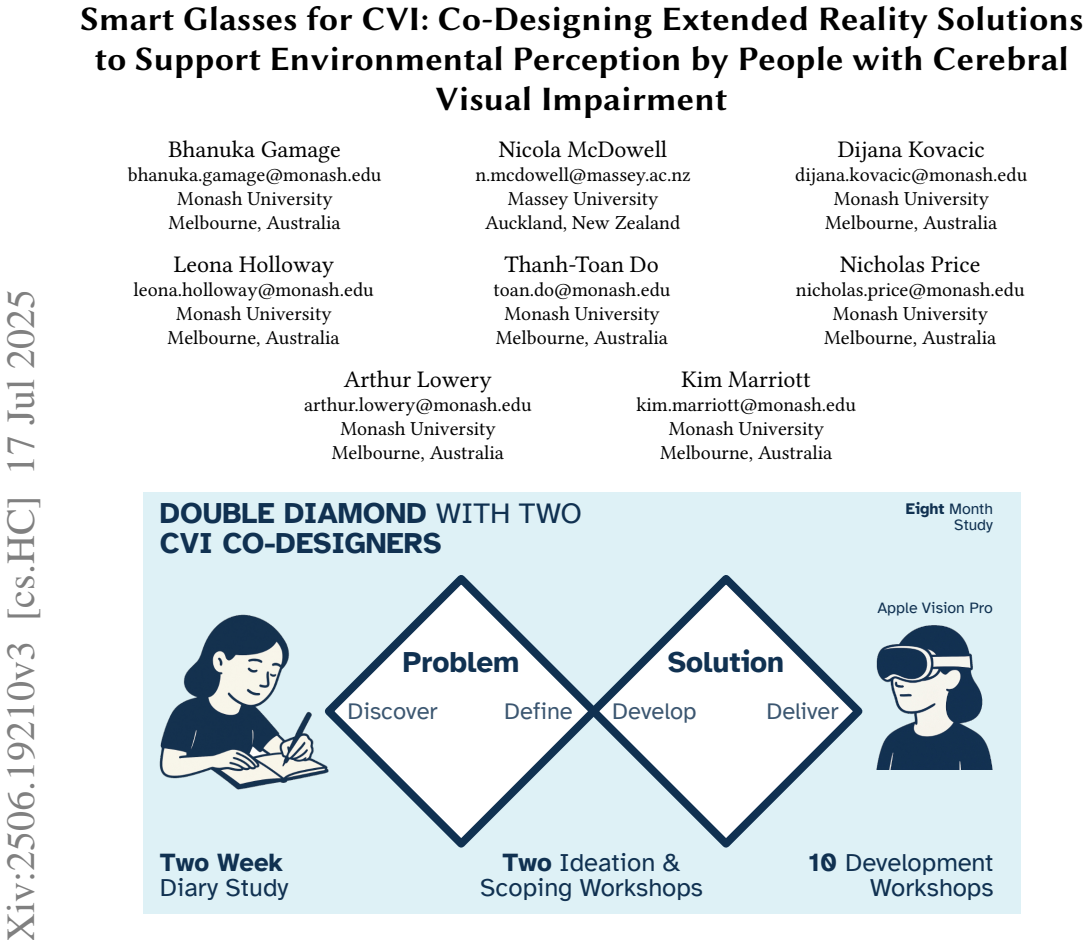
The carrying mechanism is the co-design loop itself: a two-week diary study surfaced everyday challenges, ideation workshops turned them into a rated menu of possible augmentations, and ten iterative home workshops let the two co-designers try, reject, and refine prototypes on an Apple Vision Pro, a video see-through head-mounted display that composites digital overlays onto camera pass-through imagery. Within that loop, the operative design elements were spatially anchored visual overlays: highlighting or outlining the exact shape of a target object, darkening the environment around it, a large arrow offset to the periphery to point toward out-of-view objects, a text overlay with tap-to-hear text-to-speech plus gaze-triggered subtle scaling of the line being read, a virtual name tag that enlarges on glance and fades after viewing, a fixed frame around a conversation partner's upper body, and immersive virtual environments used as a 'calm space' for sensory overload. The paper maps every preference to the individual's visual profile — for example, name tags were placed low because one co-designer has hemianopsia, and overlay colors were chosen per person — which is why the authors argue hyper-personalization is a core requirement rather than a refinement. The device's inability to modify the pass-through video itself, only to overlay content on it, is noted as a platform constraint that blocked direct filtering of the real-world scene.
What would settle it
A study with a larger and more diverse CVI cohort — including people without simultanagnosia, with different ages of onset and different field deficits — who carry a similar prototype through uncontrolled everyday settings and are measured on objective task outcomes such as time-to-locate, reading speed and comprehension, face-naming accuracy, and physiological stress markers would settle the generalization question. If, in such a study, audio guidance outperformed visual highlighting for locating, or dynamic overlays were preferred over static ones, or the dimming effect increased rather than reduced reported cognitive load outside the home setting, the paper's central claim as shaped by its two co-designers would fail to extend beyond them.
Extended reading notes
Core claim
On the paper's own terms, the central discovery is that CVI-specific challenges can be translated into functioning smart-glass prototypes, and that people with CVI respond to environmental information presented as visual augmentations embedded directly in their field of view. The co-designers consistently preferred stable, static visual cues — an outline or highlight around a target object, a fixed rectangular frame around a speaker, a name tag just below the chin — over moving, flashing, or dynamically tracking elements, which they found distracting or overwhelming. They reported that dimming the surrounding scene had a calming effect and improved focus. Two nuances qualify the visual-preference result: for language-based tasks, reading and conversation, the co-designers wanted information presented in both text and speech rather than in one modality, and features that deliberately directed visual attention (markers, peripheral-vision reduction, a 'wagon wheel' scanning aid) were judged ineffective or uncomfortable as real-time tools but promising as training devices for learning attentional strategies. The paper also reports that both co-designers, each diagnosed with simultanagnosia, felt the strongest augmentations helped alleviate aspects of that condition.
Load-bearing premise
The central claim rests on the assumption that the self-reported preferences and perceived benefits of two co-designers — who are also co-authors, were already familiar with the research team, chose the difficulties themselves, and tested the prototypes at home with researchers present — represent how the broader, heterogeneous community of people with CVI would experience the technology in real-world settings.
Editorial extensions
If this is right
- Smart glasses address four of the seven high-level CVI challenge categories — locating, reading, identifying, and sensory overload — which means a single wearable device could replace several separate aids.
- Augmentation design for CVI should favor stable, static, personalized-color visual cues with dimmed surroundings, and should avoid moving, flashing, or audio-based guidance, which these users found unreliable or aggravating.
- Language tasks should default to dual presentation — text and speech together — rather than visual-only or audio-only output.
- Attention-directing features should be positioned as rehabilitation or training tools rather than real-time assistance, because they caused discomfort when used continuously but were valued for teaching attentional strategies.
- A small set of augmentation primitives, such as edge highlighting and dimming, transfers across multiple challenge categories, suggesting that the same overlays could be configured to serve different difficulties for different users.
Reading between the lines
- The reported calming effect of dimming and the strong dislike of dynamic overlays suggest the active ingredient may be reduction of cognitive load rather than enhancement of visibility; this could be tested by comparing task performance with dimmed augmentation against equal-visibility non-dimmed views while measuring cognitive load.
- Because both co-designers share a simultanagnosia diagnosis, the design preferences most plausibly transfer to people with similar higher-order visual processing profiles; validating them for other CVI sub-types such as akinetopsia or visual snow would require trials with those groups.
- The asymmetry between the two co-designers — one with lifelong CVI who valued the conversation aid, one with acquired CVI who had already built mental strategies — suggests the technology's perceived value may peak soon after diagnosis, which would make targeted deployment to newly diagnosed adults a promising test case.
- The co-designers' proposal to detect stress from heart-rate variability before a 'CVI meltdown' implies a concrete product path: smart glasses paired with a wearable sensor, but the causal link between HRV drops and impending sensory overload is a testable empirical claim that would need longitudinal physiological data.
Editorial analysis
A structured set of objections, weighed in public.
Referee Report
Summary. The paper reports an eight-month co-design study with two adults with cerebral visual impairment (CVI), both of whom are co-authors, using the Apple Vision Pro as a video see-through head-mounted display. Guided by the Double Diamond framework, the study comprises a two-week diary study, two ideation and scoping workshops, and ten iterative development workshops in the participants' homes. The authors develop and refine prototype augmentations for six difficulties: locating items in cluttered environments, reading text, face-to-face conversations, recognizing people, visual attention, and stress from sensory overload. The paper's central claim, stated in the abstract and contributions, is that the findings 'demonstrate that smart glasses can meaningfully address key challenges' in locating objects, reading text, recognizing people, engaging in conversations, and managing sensory stress. The manuscript also derives design considerations including hyper-personalisation, context-aware adaptation, and managing cognitive load.
Significance. If the central claim were fully supported, this would be a valuable first step in an underserved area of assistive technology: translating CVI-specific challenges into functioning smart-glass prototypes through participatory design. The paper's strengths include its unusually detailed reporting of the iterative co-design process, explicit documentation of participant preferences and dislikes, honest reporting of negative results (for example, visual-attention guidance being rejected as a real-time aid), and candid disclosure of device limitations. The work also makes a useful methodological contribution by demonstrating a long-term co-design engagement with two adults with CVI. However, the evidence presented is qualitative self-report from two self-selected co-author participants, and it does not include objective task-performance measures, control conditions, or independent assessment. As an exploratory design study, the paper is informative and publishable in principle; as a demonstration that smart glasses 'can meaningfully address' the stated challenges, the current evidence is under-supported.
major comments (4)
- [Abstract and Section 1 (Contributions)] The abstract and the second contribution bullet claim that the findings 'demonstrate that smart glasses can meaningfully address key challenges' in locating objects, reading text, recognizing people, engaging in conversations, and managing sensory stress. The reported evidence, however, consists of the two co-designers' qualitative preferences, interview quotes, and researcher-facilitated discussions during home workshops. Sections 6.1 and 6.2 describe liked/disliked ratings and anecdotal statements but no task completion time, accuracy, error counts, or before-after comparisons, and there is no independent or blinded assessor. Section 8 acknowledges the small sample but does not acknowledge that no objective evaluation layer exists. I recommend either softening the claim to 'participants reported that...' or 'the study provides preliminary qualitative evidence that...' or adding a structured task-based evaluation.
- [Section 4.2 (Data Analysis)] The diary entries are categorized using the seven high-level challenges 'identified in [31]', which is the authors' own prior publication based on a larger cohort. Because the same research team performed the deductive coding, the subsequent finding that all entries map to those seven categories is partly circular: it confirms the prior taxonomy rather than independently testing it. The paper should acknowledge this and ideally report an inductive analysis or show that the categories were not imposed on the data.
- [Section 6.1 (Procedure) and Section 6.2 (Design Exploration)] The evaluation phase is described as recreating 'specific scenarios reflecting actual usage', but no outcome metrics are reported for these scenarios. The claims in Section 6.2 that solutions were 'effective', 'successful', or 'found effective' are based on self-report and researcher observation. For example, the locating-items subsection concludes 'the smart glasses were effective' after reporting preferences for static highlighting and peripheral arrows, while the reading subsection states 'Smart glasses was identified as a powerful tool for reading' based on positive reactions. These conclusions require either objective performance data or careful phrasing as perceived usefulness rather than demonstrated effectiveness.
- [Section 7.1 (For which challenges are smart glasses useful?)] The discussion states 'Our findings show that smart glasses can successfully support people with CVI to manage challenges...' and later suggests that the smart glasses 'helped alleviate some aspects of their simultanagnosia' based on subjective reports such as Dijana's 'Something in my visual pathway falls into place.' These statements go beyond what the data can support given the absence of controlled conditions and the confounding factors of co-authorship, prior familiarity with the research team, and researcher presence during evaluation. The neurological interpretation should be flagged as speculative, which the paper partially does later in the same section, but the earlier sentences should be tempered to match the evidence level.
minor comments (5)
- [Abstract] The first sentence contains an apparent typo: 'CVI is the set to be the leading cause of vision impairment' should likely read 'CVI is set to be the leading cause' or 'CVI is the leading cause'.
- [Section 3.1 (Co-designers)] The final sentence of the section reads 'Table 1 summaries demographic details.' The verb should be 'summarises' or 'summarizes'.
- [Section 4.3 (Challenges)] The phrase 'a key consideration previous discussed in AR research' should be 'previously discussed'.
- [Section 5.2 (Identified Difficulties)] The paragraph describing visual attention and the wagon wheel is helpful, but the reference to 'the following entries' in Section 4.4 appears before the quoted diary entries rather than after; consider repositioning the introductory phrase for clarity.
- [Figure 11 (Appendix A)] The usefulness ratings are on a 3-point scale and the selection filter ('at least one solution rated as very useful') is reasonable, but the figure legend could state explicitly which difficulties were excluded because no solution received a 'very useful' rating, to make the selection path fully transparent.
Circularity Check
Positive findings are partly pre-selected by the participants' own usefulness ratings; the 'demonstrate' claim re-states an input filter rather than an independent outcome.
-
fitted input called prediction
[Section 5.1 (Selecting Difficulties to Explore Further) and Section 7.1 (For which challenges are smart glasses useful?)]
"We then filtered the original list of difficulties—identified during the workshop phase—to include only those that had at least one associated solution rated as ‘very useful’. ... Our findings show that smart glasses can successfully support people with CVI to manage challenges such as locating items in cluttered environments, reading text, recognising people, and facilitating face-to-face conversations."
The difficulties taken into development were chosen because the same two co-designer participants had already rated at least one associated solution as 'very useful' on the study's own 3-point scale. The later headline finding that smart glasses 'can meaningfully address' those very challenges is therefore a restatement, in the participants' own terms, of the inclusion criterion used to shape the study. Because the evaluators are the same people who selected the difficulties and co-created the solutions, the positive outcome is not independent of the input filter: the study was deliberately focused on challenges the participants already believed smart glasses could address.
full rationale
This is a qualitative co-design study rather than a formal derivation, so most 'circularity' concerns reduce to whether the reported findings are independent of the study's own selection and evaluation process. The clearest partial circularity is in the selection filter: challenges were carried forward only if participants had already rated an associated solution as 'very useful', and the headline conclusion then reports that smart glasses support those same challenges. That makes the positive claim partly a reflection of the inclusion criterion. However, the paper is not wholly circular: the iterative workshops produced specific, non-obvious design outcomes, several options were disliked or rejected, and negative results (e.g., visual attention tools causing discomfort) are reported. The self-citation to the authors' prior taxonomy [31] is used as a coding scaffold and a source of design opportunities, but [31] is a separately published empirical study and the current diary data were coded independently by three researchers, so this is not a load-bearing circularity. The paper's own Section 8 acknowledges the small sample (n=2) and calls for quantitative task-based measures, which supports reading the 'demonstrate' claim as exploratory rather than as an established general result. Overall, the central claim is partially pre-fitted to the participants' prior usefulness judgments but retains independent qualitative content, giving a moderate circularity score of 5 rather than a higher score.
Assumptions & free parameters
assumptions (4)
- domain assumption The two co-designers' self-reports are a valid source of evidence about how smart glasses affect daily functioning for people with CVI.
- domain assumption Findings from two adults with simultanagnosia can inform design for the broader CVI population.
- domain assumption The Apple Vision Pro, a video see-through headset, is a suitable platform for evaluating the target augmentations.
- domain assumption The Double Diamond co-design process with iterative feedback produces design insights that transfer to everyday use.
Cite this review
Pith. "Pith review of Smart Glasses for CVI: Co-Designing Extended Reality Solutions to Support Environmental Perception by People with Cerebral Visual Impairment." pith.science (2026). https://pith.science/paper/VSEQLG22
@misc{pith2026250619210,
  author       = {Pith},
  title        = {Pith review of: Smart Glasses for CVI: Co-Designing Extended Reality Solutions to Support Environmental Perception by People with Cerebral Visual Impairment},
  year         = {2026},
  howpublished = {\url{https://pith.science/paper/VSEQLG22}},
  note         = {Machine review of arXiv:2506.19210}
}
read the original abstract
Cerebral Visual Impairment (CVI) is the set to be the leading cause of vision impairment, yet remains underrepresented in assistive technology research. Unlike ocular conditions, CVI affects higher-order visual processing-impacting object recognition, facial perception, and attention in complex environments. This paper presents a co-design study with two adults with CVI investigating how smart glasses, i.e. head-mounted extended reality displays, can support understanding and interaction with the immediate environment. Guided by the Double Diamond design framework, we conducted a two-week diary study, two ideation workshops, and ten iterative development sessions using the Apple Vision Pro. Our findings demonstrate that smart glasses can meaningfully address key challenges in locating objects, reading text, recognising people, engaging in conversations, and managing sensory stress. With the rapid advancement of smart glasses and increasing recognition of CVI as a distinct form of vision impairment, this research addresses a timely and under-explored intersection of technology and need.
Figures


Figures from the paper (9 more)


Forward citations
Cited by 1 Pith paper
-
Static or Temporal? Semantic Scene Simplification to Aid Wayfinding in Immersive Simulations of Bionic Vision
In simulated prosthetic vision, semantic edge highlighting improved wayfinding success while time-staggered semantic rastering reduced collisions, both outperforming a plain edge-detection baseline.
Reference graph
Works this paper leans on
-
[1]
Leila Aflatoony and Siniša Kolarić. 2022. One Size Doesn’t Fit All: On the Adaptable Universal Design of Assistive Technologies. Proceedings of the Design Society 2 (2022), 1209–1220. https://doi.org/10.1017/pds.2022.123
-
[2]
Gunilla Almgren Bäck, Emma Lindeblad, Carina Elmqvist, and Idor Svensson
-
[3]
Apple Inc. 2023. Introducing Apple Vision Pro: Apple’s first spatial computer. https://www.apple.com/au/newsroom/2023/06/introducing-apple-vision-pro/
2023
-
[4]
Apple Inc. 2024. Building Spatial Experiences for Business Apps with Enterprise APIs. https://developer.apple.com/documentation/visionOS/building-spatial- experiences-for-business-apps-with-enterprise-apis Accessed: 2025-04-13
2024
-
[5]
Apple Inc. 2024. Introducing Enterprise APIs for visionOS. https://developer. apple.com/videos/play/wwdc2024/10139/. WWDC24 Session 10139, Accessed: 2025-04-13
2024
-
[6]
Apple Inc. 2025. ARKit. https://developer.apple.com/documentation/arkit Accessed: 2025-04-13
2025
-
[7]
Shiri Azenkot and Nicole B. Lee. 2013. Exploring the Use of Speech Input by Blind People on Mobile Devices. In Proceedings of the 15th International ACM SIGACCESS Conference on Computers and Accessibility (Bellevue, Washington) (ASSETS ’13). Association for Computing Machinery, New York, NY, USA, Article 11, 8 pages. https://doi.org/10.1145/2513383.2513440
arXiv 2013
-
[8]
Ronald Azuma and Chris Furmanski. 2003. Evaluating label placement for augmented reality view management. InThe Second IEEE and ACM International Symposium on Mixed and Augmented Reality, 2003. Proceedings. IEEE and ACM, IEEE, Tokyo, Japan, 66–75. https://doi.org/10.1109/ISMAR.2003.1240689
arXiv 2003
Show all 156 references
-
[9]
Bela H. Banathy. 1996. Designing Social Systems in a Changing World (1 ed.). Plenum Press, New York. xv, 372 pages. https://doi.org/10.1007/978-1-4757- 9981-1
1996 doi
-
[10]
G. C. Baylis, J. Driver, L. L. Baylis, and R. D. Rafal. 1994. Reading of letters and words in a patient with Bálint’s syndrome. Neuropsychologia 32, 10 (Oct. 1994), 1273–1286. https://doi.org/10.1016/0028-3932(94)90109-0
1994 doi
-
[11]
Bennett, Corinna M
Christopher R. Bennett, Corinna M. Bauer, Emma S. Bailin, and Lotfi B. Mer- abet. 2020. Neuroplasticity in cerebral visual impairment (CVI): Assessing functional vision and the neurophysiological correlates of dorsal stream dys- function. Neuroscience & Biobehavioral Reviews 1...
2020 doi
-
[12]
Carlos Bermejo, Tristan Braud, Ji Yang, Shayan Mirjafari, Bowen Shi, Yu Xiao, and Pan Hui. 2020. VIMES: A Wearable Memory Assistance System for Au- tomatic Information Retrieval. In Proceedings of the 28th ACM International Conference on Multimedia (Seattle, WA, USA) (MM ’20)....
2020
-
[13]
Birnbaum, Steven A
Faith A. Birnbaum, Steven A. Hackley, and Lenworth N. Johnson. 2015. Enhanc- ing visual performance in individuals with cortical visual impairment (homony- mous hemianopsia): Tapping into blindsight. Journal of Medical Hypotheses and Ideas 9, 2 (2015), S8–S13. https://doi.org/...
2015 doi
-
[14]
Daniëlle G. M. Bosch, F. Nienke Boonstra, Michèl A. A. P. Willemsen, Frans P. M. Cremers, and Bert de Vries. 2014. Low vision due to cerebral visual impairment: Differentiating between acquired and genetic causes. BMC Ophthalmology 14, 1 (2014), 1–9. https://doi.org/10.1186/14...
2014 doi
-
[15]
Sally Byrne and Melanie Porter. 2025. Rehabilitation and intervention of devel- opmental and acquired prosopagnosia: A systematic review. Neuropsychological Rehabilitation (2025), 1–44. https://doi.org/10.1080/09602011.2024.2449068 Smart Glasses for CVI ASSETS ’25, October 26–...
2025
-
[16]
Scott Carter and Jennifer Mankoff. 2005. When participants do the capturing: the role of media in diary studies. In Proceedings of the SIGCHI Conference on Human Factors in Computing Systems (Portland, Oregon, USA) (CHI ’05). Association for Computing Machinery, New York, NY, ...
2005
-
[17]
Matteo Ciman, Luisa Pinello, Teresa Maria Sgaramella, Ombretta Gaggi, Nicola Riparelli, and Laura Nota. 2013. HelpMe!: A Serious Game for Rehabilitation of Children Affected by CVI. In Proceedings of the 9th International Conference on Web Information Systems and Technologies ...
2013 doi
-
[19]
Ovidiu Daescu, Hongyao Huang, and Maxwell Weinzierl. 2019. Deep learning based face recognition system with smart glasses. In Proceedings of the 12th ACM International Conference on PErvasive Technologies Related to Assistive Envi- ronments (Rhodes, Greece) (PETRA ’19). Associ...
2019
-
[20]
Dalrymple, Alan Kingstone, and Jason J
Kirsten A. Dalrymple, Alan Kingstone, and Jason J. S. Barton. 2007. Seeing trees OR seeing forests in simultanagnosia: Attentional capture can be local or global. Neuropsychologia 45, 4 (2007), 871–875. https://doi.org/10.1016/j. neuropsychologia.2006.07.013
2007 doi
-
[21]
Anna Delay, Melissa Rice, Erin Bush, and Kimberly Harpster. 2022. Interventions for children with cerebral visual impairment: A scoping review. Developmental Medicine & Child Neurology 65, 4 (Oct. 2022), 469–478. https://doi.org/10.1111/ dmcn.15431
2022
-
[22]
Design Council. 2005. The Double Diamond. https://www.designcouncil.org. uk/our-resources/the-double-diamond/ Accessed: 2025-04-13
2005
-
[23]
Mustafa Doga Dogan, Eric J Gonzalez, Karan Ahuja, Ruofei Du, Andrea Colaço, Johnny Lee, Mar Gonzalez-Franco, and David Kim. 2024. Augmented Object Intelligence with XR-Objects. In Proceedings of the 37th Annual ACM Symposium on User Interface Software and Technology (Pittsburg...
2024
-
[24]
Huiyu Duan, Xiongkuo Min, Yucheng Zhu, Guangtao Zhai, Xiaokang Yang, and Patrick Le Callet. 2022. Confusing Image Quality Assessment: Toward Better Augmented Reality Experience. IEEE Transactions on Image Processing 31 (2022), 7206–7221. https://doi.org/10.1109/TIP.2022.3220404
2022
-
[25]
Duckett and Rebekah Pratt
Paul S. Duckett and Rebekah Pratt. 2001. The Researched Opinions on Research: Visually impaired people and visual impairment research. Disability & Society 16, 6 (2001), 815–835. https://doi.org/10.1080/09687590120083976
2001 doi
-
[26]
Gordon N. Dutton. 2003. Cognitive vision, its disorders and differential diagnosis in adults and children: knowing where and what things are. Eye 17, 3 (April 2003), 289–304. https://doi.org/10.1038/SJ.EYE.6700344
2003 doi
-
[27]
Sandra Fernando, Chiemela Ndukwe, Bal Virdee, and Ramzi Djemai. 2025. Image Recognition Tools for Blind and Visually Impaired Users: An Emphasis on the Design Considerations. ACM Transactions on Accessible Computing 18, 1, Article 1 (Jan. 2025), 21 pages. https://doi.org/10.11...
2025 doi
-
[28]
Friedman-Hill, Linda C
Sarah R. Friedman-Hill, Linda C. Robertson, and Anne Treisman. 1995. Parietal contributions to visual feature binding: Evidence from a patient with bilateral lesions. Science 269, 5225 (Aug. 1995), 853–855. https://doi.org/10.1126/science. 7638604
1995 doi
-
[29]
Phillips
Melody Zagami Furze and John P. Phillips. 2018. Integrating Functional MRI Information into the Educational Plan of a Child with Cerebral Visual Impair- ment: A Case Study. Journal of Visual Impairment & Blindness 112, 5 (2018), 532–540. https://doi.org/10.1177/0145482X1811200510
2018 doi
-
[30]
Bhanuka Gamage, Thanh-Toan Do, Nicholas Seow Chiang Price, Arthur Lowery, and Kim Marriott. 2023. What do Blind and Low-Vision People Really Want from Assistive Smart Devices? Comparison of the Literature with a Focus Study. In Proceedings of the 25th International ACM SIGACCE...
2023
-
[32]
Bhanuka Gamage, Leona Holloway, Nicola McDowell, Thanh-Toan Do, Nicholas Seow Chiang Price, Arthur James Lowery, and Kim Marriott. 2024. Broadening Our View: Assistive Technology for Cerebral Visual Impairment. In Extended Abstracts of the CHI Conference on Human Factors in Co...
2024
-
[33]
Franziska Geringswald, Eleonora Porracin, and Stefan Pollmann. 2016. Im- pairment of visual memory for objects in natural scenes by simulated central scotomata. Journal of Vision 16, 2 (Jan. 2016), 6. https://doi.org/10.1167/16.2.6
2016 doi
-
[34]
Karkhanis, Aishwaryadev Baner- jee, Erfan Pourshaban, Md
Chayanjit Ghosh, Adwait Deshpande, Mohit U. Karkhanis, Aishwaryadev Baner- jee, Erfan Pourshaban, Md. Rabiul Hasan, Amirali Nikeghbal, Md. Golam Dastgir, Hanseup Kim, and Carlos H. Mastrangelo. 2023. Artificial Iris on Smart Con- tact Lens using Twisted Nematic Cell for Photop...
2023
-
[35]
Trudy Goodenough, Anna Pease, and Cathy Williams. 2021. Bridging the Gap: Parent and Child Perspectives of Living With Cerebral Visual Impairments. Frontiers in Human Neuroscience 15 (2021), 689683. https://doi.org/10.3389/ fnhum.2021.689683
2021
-
[36]
Google LLC. 2025. Use Live View on Google Maps. https://support.google.com/ maps/answer/9332056?hl=en&co=GENIE.Platform=Android Accessed: 2025-04- 16
2025
-
[37]
Uwe Gruenefeld, Lars Prädel, and Wilko Heuten. 2019. Locating nearby physical objects in augmented reality. In Proceedings of the 18th International Conference on Mobile and Ubiquitous Multimedia (Pisa, Italy) (MUM ’19). Association for Computing Machinery, New York, NY, USA, ...
2019
-
[38]
Anhong Guo, Xiang ’Anthony’ Chen, Haoran Qi, Samuel White, Suman Ghosh, Chieko Asakawa, and Jeffrey P. Bigham. 2016. VizLens: A Robust and Interactive Screen Reader for Interfaces in the Real World. InProceedings of the 29th Annual Symposium on User Interface Software and Tech...
2016
-
[39]
Hatton, Eric Schwietz, Burt Boyer, and Paul Rychwalski
Deborah D. Hatton, Eric Schwietz, Burt Boyer, and Paul Rychwalski. 2007. Babies Count: the national registry for children with visual impairments, birth to 3 years. Journal of American Association for Pediatric Ophthalmology and Strabismus 11, 4 (Aug. 2007), 351–355. https://d...
2007 doi
-
[40]
Tenelle Hodson, Louise Gustafsson, Michelle Bissett, Christy Hogan, Camila Shirota, and Amelia Di Tommaso. 2025. Understanding the experiences and needs of assistive technology users in Queensland. Disability and Rehabilitation: Assistive Technology 20, 4 (2025), 823–832. http...
2025
-
[41]
Katsuya Hommaru and Jiro Tanaka. 2020. Walking Support for Visually Impaired Using AR/MR and Virtual Braille Block. In Universal Access in Human-Computer Interaction. Design Approaches and Supporting Technologies , Margherita Antona and Constantine Stephanidis (Eds.). Springer...
2020 doi
-
[43]
Xiaodan Hu. 2022. [DC] Designing and Optimizing Daily-wear Photophobic Smart Sunglasses. In 2022 IEEE Conference on Virtual Reality and 3D User In- terfaces Abstracts and Workshops (VRW) . IEEE, Christchurch, New Zealand, 934–935. https://doi.org/10.1109/VRW55335.2022.00318
2022
-
[44]
Xiaodan Hu, Yan Zhang, Hideaki Uchiyama, Naoya Isoyama, Nobuchika Sakata, and Kiyoshi Kiyokawa. 2024. Smart dimming sunglasses for photophobia using spatial light modulator. Displays 81 (2024), 102611. https://doi.org/10.1016/j. displa.2023.102611
2024
-
[45]
Kim Hye-Geum, Cheon Eun-Jin, Bai Dai-Seg, Lee Young Hwan, and Koo Bon- Hoon. 2018. Stress and Heart Rate Variability: A Meta-Analysis and Review of the Literature. Psychiatry Investigation 15, 3 (2018), 235–245. https://doi.org/10. 30773/pi.2017.08.17
2018
-
[46]
Hyper AR Ltd. 2025. Hyper: Indoor Location that Actually Works. https: //www.hyperar.com/ Accessed: 2025-04-16
2025
-
[47]
Teferra, Mathias Baumert, and Niranjan Bidargaddi
Sarah Immanuel, Meseret N. Teferra, Mathias Baumert, and Niranjan Bidargaddi
-
[48]
Robert J. K. Jacob. 1990. What you look at is what you get: eye movement- based interaction techniques. In Proceedings of the SIGCHI Conference on Human Factors in Computing Systems (Seattle, Washington, USA) (CHI ’90). Association for Computing Machinery, New York, NY, USA, 1...
1990
-
[49]
Dhruv Jain, Bonnie Chinh, Leah Findlater, Raja Kushalnagar, and Jon Froehlich
-
[50]
Dhruv Jain, Rachel Franz, Leah Findlater, Jackson Cannon, Raja Kushalnagar, and Jon Froehlich. 2018. Towards Accessible Conversations in a Mobile Context for People who are Deaf and Hard of Hearing. InProceedings of the 20th International ACM SIGACCESS Conference on Computers ...
2018
-
[51]
Wen-Hau Jain, Bing-Gang Jhong, and Mei-Yung Chen. 2025. A Social Assis- tance System for Augmented Reality Technology to Redound Face Blindness with 3D Face Recognition. Electronics 14, 7 (2025). https://doi.org/10.3390/ electronics14071244
2025
-
[52]
Joseph E. Jan, M. Groenveld, and D. P. Anderson. 1993. Photophobia and cortical visual impairment. Developmental Medicine & Child Neurology 35, 6 (June 1993), 473–477. https://doi.org/10.1111/j.1469-8749.1993.tb11677.x
1993
-
[53]
Jarosław Jankowski, Juho Hamari, and Jarosław Wątróbski. 2019. A gradual approach for maximising user conversion without compromising experience with high visual intensity website elements. Internet Research 29, 1 (Feb. 2019), 194–217. https://doi.org/10.1108/intr-09-2016-0271
2019 doi
-
[54]
Mohammad Hossein Jarrahi et al. 2021. Digital Diaries as a Research Method for Capturing Practices in Situ. In Research Methods for Digital Work and Organization: Investigating Distributed, Multi-Modal, and Mobile Work , Gillian Symon, Katrina Pritchard, and Christine Hine (Ed...
2021
-
[55]
Dawoon Jeong and Sung H Han. 2020. Diary methods used in research on visually impaired people. In International Conference on Applied Human Factors and Ergonomics. Springer, 103–109. https://doi.org/10.1007/978-3-030-51194- 4_14
2020 doi
-
[56]
Apostolos Kalatzis, Saidur Rahman, Vishnunarayan Girishan Prabhu, Laura Stanley, and Mike Wittie. 2023. A Multimodal Approach to Investigate the Role of Cognitive Workload and User Interfaces in Human-robot Collaboration. In Proceedings of the 25th International Conference on ...
2023
-
[57]
Kamath, Aziz Zeidieh, Omar Khan, Dhruv Sethi, and JooYoung Seo
Sanchita S. Kamath, Aziz Zeidieh, Omar Khan, Dhruv Sethi, and JooYoung Seo
-
[58]
Farra, Guillaume Alinier, and H
Suzan (Suzie) Kardong-Edgren, Sharon L. Farra, Guillaume Alinier, and H. Michael Young. 2019. A Call to Unify Definitions of Virtual Reality. Clinical Simulation in Nursing 31 (2019), 28–34. https://doi.org/10.1016/j.ecns.2019.02. 006
2019 doi
-
[59]
Hans-Otto Karnath and Marie-Thérèse Perenin. 2005. Cortical Control of Vi- sually Guided Reaching: Evidence from Patients with Optic Ataxia. Cerebral Cortex 15, 10 (02 2005), 1561–1569. https://doi.org/10.1093/cercor/bhi034
2005 doi
-
[60]
Johnson, Ryan Neydavood, Anvitha Akkaraju, and Michael Beyeler
Justin Kasowski, Byron A. Johnson, Ryan Neydavood, Anvitha Akkaraju, and Michael Beyeler. 2023. A systematic review of extended reality (XR) for un- derstanding and augmenting vision loss. Journal of Vision 23, 5 (2023), 5–5. https://doi.org/10.1167/jov.23.5.5
2023 doi
-
[61]
Dawon Kim and Yosoon Choi. 2021. Applications of Smart Glasses in Applied Sciences: A Systematic Review. Applied Sciences 11 (2021), 4956. https://doi. org/10.3390/APP11114956
2021 doi
-
[62]
InProceedings of the 26th International ACM SIGACCESS Conference on Computers and Accessibility (St
Playing Without Barriers: Crafting Playful and Accessible VR Table- Tennis with and for Blind and Low-Vision Individuals. InProceedings of the 26th International ACM SIGACCESS Conference on Computers and Accessibility (St. John’s, NL, Canada) (ASSETS ’24). Association for Comp...
-
[63]
Jinhyuk Kim, Jerome Clifford Foo, Taiga Murata, and Fumiharu Togo. 2024. Reduced heart rate variability is related to fluctuations in psychological stress levels in daily life. Stress and Health 40, 5 (2024), e3447. https://doi.org/10.1002/ smi.3447
2024
-
[64]
Christian Koch, Matthias Neges, Markus König, and Michael Abramovici. 2014. Natural markers for augmented reality-based indoor navigation and facility maintenance. Automation in Construction 48 (2014), 18–30. https://doi.org/10. 1016/j.autcon.2014.08.009
2014
-
[65]
Kran, Linda Lawrence, D
Barry S. Kran, Linda Lawrence, D. Luisa Mayer, and Gena Heidary. 2019. Cere- bral/Cortical Visual Impairment: A Need to Reassess Current Definitions of Visual Impairment and Blindness. Seminars in Pediatric Neurology 31, 25–29. https://doi.org/10.1016/j.spen.2019.05.005
2019 doi
-
[66]
Sari Kujala. 2003. User involvement: A review of the benefits and challenges. Behaviour & Information Technology 22, 1 (2003), 1–16. https://doi.org/10.1080/ 01449290301782
2003
-
[67]
Kim, Sung H
Hyun K. Kim, Sung H. Han, Jaehyun Park, and Joohwan Park. 2016. The interaction experiences of visually impaired people with assistive technology: A case study of smartphones. International Journal of Industrial Ergonomics 55 (2016), 22 – 33. https://doi.org/10.1016/j.ergon.20...
2016 doi
-
[68]
Eduard Gröller, and Hsiang-Yun Wu
Thomas Köppel, M. Eduard Gröller, and Hsiang-Yun Wu. 2021. Context- Responsive Labeling in Augmented Reality. In2021 IEEE 14th Pacific Visualization Symposium (PacificVis). 91–100. https://doi.org/10.1109/PacificVis52677.2021. 00020
2021
-
[69]
Fook Chang Lam, Fiona Lovett, and Gordon N Dutton. 2010. Cerebral visual impairment in children: a longitudinal case study of functional outcomes beyond the visual acuities. Journal of Visual Impairment & Blindness 104, 10 (2010), 625–635. https://doi.org/10.1177/0145482X101040100
2010 doi
-
[70]
Katie Lane-Karnas. 2023. A Case Study on Cerebral Visual Impairment, Reading, and Braille. Journal of Visual Impairment & Blindness 117, 6 (2023), 498–504. https://doi.org/10.1177/0145482X231218069
2023 doi
-
[71]
Florian Lang and Tonja Machulla. 2021. Pressing a Button You Cannot See: Evaluating Visual Designs to Assist Persons with Low Vision through Aug- mented Reality. In Proceedings of the 27th ACM Symposium on Virtual Reality Software and Technology (Osaka, Japan) (VRST ’21). Asso...
2021
-
[72]
Y. R. Sanjay Kumar, T. Nivethetha, P. Priyadharshini, and U. Jayachandiran
-
[74]
Chan-Su Lee, Jae-Ik Lee, and Han Eol Seo. 2021. Deep Learning Based Mobile As- sistive Device for Visually Impaired People. In2021 IEEE International Conference on Consumer Electronics-Asia (ICCE-Asia). 1–3. https://doi.org/10.1109/ICCE- Asia53811.2021.9641925
2021
-
[75]
Tjahjadi, Jiho Kim, Junpu Yu, Minji Park, Jiawen Zhang, Jon E
Jaewook Lee, Andrew D. Tjahjadi, Jiho Kim, Junpu Yu, Minji Park, Jiawen Zhang, Jon E. Froehlich, Yapeng Tian, and Yuhang Zhao. 2024. CookAR: Affordance Augmentations in Wearable AR to Support Kitchen Tool Interactions for People with Low Vision. In Proceedings of the 37th Annu...
2024
-
[76]
Jingya Li. 2023. Augmented reality visual-captions: enhancing captioning ex- perience for real-time conversations. In International Conference on Human- Computer Interaction. Springer, 380–396. https://doi.org/10.1007/978-3-031- 34609-5_28
2023 doi
-
[77]
Yifan Li, Kangsoo Kim, Austin Erickson, Nahal Norouzi, Jonathan Jules, Gerd Bruder, and Gregory F. Welch. 2022. A Scoping Review of Assistance and Therapy with Head-Mounted Displays for People Who Are Visually Impaired. ACM Transactions on Accessible Computing 15, 3, Article 2...
2022 doi
-
[78]
Tobias Langlotz, Jonathan Sutton, and Holger Regenbrecht. 2024. A Design Space for Vision Augmentations and Augmented Human Perception using Digital Eyewear. In Proceedings of the 2024 CHI Conference on Human Factors in Computing Systems (Honolulu, HI, USA) (CHI ’24). Associat...
2024
-
[79]
Weiquan Lu, Been-Lirn Henry Duh, and Steven Feiner. 2012. Subtle cueing for visual search in augmented reality. In 2012 IEEE International Symposium on Mixed and Augmented Reality (ISMAR) . 161–166. https://doi.org/10.1109/ ISMAR.2012.6402553
2012
-
[80]
Dutton (Eds.)
Amanda Hall Lueck and Gordon N. Dutton (Eds.). 2015. Vision and the Brain: Understanding Cerebral Visual Impairment in Children (1 ed.). American Printing House for the Blind, Louisville, KY. 720 pages
2015
-
[81]
Amanda H Lueck, Gordon N Dutton, and Sylvie Chokron. 2019. Profiling chil- dren with cerebral visual impairment using multiple methods of assessment to aid in differential diagnosis. In Seminars in Pediatric Neurology , Vol. 31. Elsevier, Elsevier, 5–14. https://doi.org/10.101...
2019 doi
-
[82]
Marta Lupón, Manuel Armayones, and Genís Cardona. 2018. Quality of life among parents of children with visual impairment: A literature review.Research in Developmental Disabilities 83 (2018), 120–131. https://doi.org/10.1016/j.ridd. 2018.08.013
2018 doi
-
[83]
Manley, Christopher R
Claire E. Manley, Christopher R. Bennett, and Lotfi B. Merabet. 2022. Assessing Higher-Order Visual Processing in Cerebral Visual Impairment Using Natu- ralistic Virtual-Reality-Based Visual Search Tasks. Children 9, 8 (2022), 1114. https://doi.org/10.3390/children9081114
2022 doi
-
[84]
Marie-Céline Lorenzini and Walter Wittich. 2021. Personalized telerehabilitation for a head-mounted low vision aid: a randomized feasibility study.Optometry and Vision Science 98, 6 (2021), 570. https://doi.org/10.1097/OPX.0000000000001704
2021 doi
-
[85]
Matsuba and James E
Carey A. Matsuba and James E. Jan. 2006. Long-term outcome of children with cortical visual impairment. Developmental Medicine and Child Neurology 48, 6 (2006), 508–512. https://doi.org/10.1017/S0012162206001071
2006 doi
-
[86]
Nicola McDowell. 2019. A Personal Perspective on CVI. In The Routledge Handbook of Visual Impairment (1 ed.), Clare Watson and Justin A. Haegele (Eds.). Routledge, London and New York. https://doi.org/10.4324/9781315111353-6
2019 doi
-
[87]
Nicola McDowell. 2020. The CVI Practice Framework: An Effective Approach to Supporting Children With Cerebral Visual Impairment (CVI) . Ph. D. Dissertation. Massey University, Manawat¯u, Aotearoa New Zealand, Palmerston North, New Smart Glasses for CVI ASSETS ’25, October 26–2...
2020 doi
-
[88]
Nicola McDowell. 2021. Wagon Wheel Approach (Methodological Visual Search Approach). https://cviscotland.org/mem_portal.php?article=220. Accessed: 12 April 2025
2021
-
[89]
Nicola McDowell. 2023. A review of the literature to inform the development of a practice framework for supporting children with Cerebral Visual Impairment (CVI). International Journal of Inclusive Education 27, 6 (2023), 718–738. https: //doi.org/10.1080/13603116.2020.1867381
2023
-
[90]
Maria B. C. Martín, Alejandro Santos-Lozano, Juan Martín-Hernández, Alberto López-Miguel, Miguel Maldonado, Carlos Baladrón, Corinna M. Bauer, and Lotfi B. Merabet. 2016. Cerebral versus Ocular Visual Impairment: The Impact on Developmental Neuroplasticity. Frontiers in Psycho...
2016
-
[91]
Anna Charlotte Morris, Stephen Douch, Teodora Popnikolova, Chris McGinley, Faith Matcham, Edmund Sonuga-Barke, and Johnny Downs. 2024. A framework for remotely enabled co-design with young people: its development and appli- cation with neurodiverse children and their caregiver...
2024
-
[92]
Cecily Morrison, Edward Cutrell, Martin Grayson, Anja Thieme, Alex Taylor, Geert Roumen, Camilla Longden, Sebastian Tschiatschek, Rita Faia Marques, and Abigail Sellen. 2021. Social Sensemaking with AI: Designing an Open-ended AI Experience with a Blind Child. In Proceedings o...
2021
-
[93]
Naef, Stephan M
Aileen C. Naef, Stephan M. Gerber, Michael Single, René M. Müri, Matthias Haenggi, Stephan M. Jakob, Marie-Madlen Jeitziner, and Tobias Nef. 2023. Effects of immersive virtual reality on sensory overload in a random sample of critically ill patients. Frontiers in medicine 10 (...
2023
-
[94]
Sandra Ohly. 2024. Diary Study. Edward Elgar Publishing Ltd. 151 – 152 pages. https://doi.org/10.4337/9781803921761.00031
2024
-
[95]
Yi-Hao Peng, Ming-Wei Hsi, Paul Taele, Ting-Yu Lin, Po-En Lai, Leon Hsu, Tzu-chuan Chen, Te-Yen Wu, Yu-An Chen, Hsien-Hui Tang, and Mike Y. Chen
-
[96]
Erick Mendez, Steven Feiner, and Dieter Schmalstieg. 2010. Focus and context in mixed reality by modulating first order salient features. In International Symposium on Smart Graphics . Springer, 232–243. https://doi.org/10.1007/978- 3-642-13544-6_22
2010 doi
-
[97]
Pitt and John W
Kevin M. Pitt and John W. McCarthy. 2023. Strategies for highlighting items within visual scene displays to support augmentative and alternative communi- cation access for those with physical impairments. Disability and Rehabilitation: Assistive Technology 18, 8 (2023), 1319–1...
2023
-
[98]
Marc Pomplun and Sindhura Sunkara. 2003. Pupil dilation as an indicator of cognitive workload in human–computer interaction. In Human–Computer Inter- action: Interactive System Perspectives, Bertram Kuipers and Matthias Rauterberg (Eds.). CRC Press, Mahwah, NJ, 542–546. https:...
2003 doi
-
[99]
Accessibility Came by Accident
Alisha Pradhan, Kanika Mehta, and Leah Findlater. 2018. "Accessibility Came by Accident": Use of Voice-Controlled Intelligent Personal Assistants by People with Disabilities. In Proceedings of the 2018 CHI Conference on Human Factors in Computing Systems (Montreal QC, Canada)(...
2018
-
[100]
Khyati Priya and Pankaj Upadhyay. 2021. Assistive Devices for One-Handed People Using Desktop Manufacturing Methods. Smart Innovation, Systems and Technologies 223 (2021), 439 – 448. https://doi.org/10.1007/978-981-16-0084- 5_35
2021 doi
-
[101]
Zhiwen Qiu, Armin Mostafavi, and Saleh Kalantari. 2023. Use of Aug- mented Reality in Human Wayfinding: A Systematic Review. arXiv preprint arXiv:2311.11923 (2023)
2023 arXiv
-
[102]
In Proceedings of the 2018 CHI Conference on Human Factors in Computing Systems (Montreal QC, Canada) (CHI ’18)
SpeechBubbles: Enhancing Captioning Experiences for Deaf and Hard- of-Hearing People in Group Conversations. In Proceedings of the 2018 CHI Conference on Human Factors in Computing Systems (Montreal QC, Canada) (CHI ’18). Association for Computing Machinery, New York, NY, USA,...
2018
-
[103]
Swetha Sara Philip and Gordon N. Dutton. 2014. Identifying and characterising Cerebral Visual Impairment in children: a review. Clinical and Experimental Optometry 97, 3 (April 2014), 196–208. https://doi.org/10.1111/cxo.12155
2014 doi
-
[104]
Ajani Restianty, Suwandi Sumartias, Purwanti Hadisiwi, and Hanny Hafiar
-
[105]
Rizzo and S
M. Rizzo and S. P. Vecera. 2002. Psychoanatomical substrates of Balint’s syn- drome. Journal of Neurology, Neurosurgery & Psychiatry 72, 2 (2002), 162–178. https://doi.org/10.1136/jnnp.72.2.162
2002 doi
-
[106]
Rogowsky, Barbara M
Beth A. Rogowsky, Barbara M. Calhoun, and Paula Tallal. 2016. Does Modality Matter? The Effects of Reading, Listening, and Dual Modality on Comprehension. SAGE Open 6, 3 (Sept. 2016), 1–9. https://doi.org/10.1177/2158244016669550
2016 doi
-
[107]
Roman-Lantzy
Christine A. Roman-Lantzy. 2007. Cortical Visual Impairment: An Approach to Assessment and Intervention. American Foundation for the Blind, New York, NY. 211 pages
2007
-
[108]
Rowe, John Sibert, and Don Irwin
Dennis W. Rowe, John Sibert, and Don Irwin. 1998. Heart rate variability: indicator of user state as an aid to human-computer interaction. In Proceedings of the SIGCHI Conference on Human Factors in Computing Systems (Los Angeles, California, USA) (CHI ’98). ACM Press/Addison-...
1998
-
[109]
Chris Racey, Anna Franklin, and Chris M. Bird. 2019. The processing of color preference in the brain. Neuroimage 191 (2019), 529–536. https://doi.org/10. 1016/j.neuroimage.2019.02.041
2019
-
[110]
Puja Rai, Jolly Rohatgi, and Upreet Dhaliwal. 2019. Coping strategy in persons with low vision or blindness-an exploratory study. Indian Journal of Ophthal- mology 67, 5 (2019), 669–676. https://doi.org/10.4103/ijo.IJO_1655_18
2019 doi
-
[111]
Lisbeth Sandfeld Nielsen, Liselotte Skov, and Hanne I. Jensen. 2007. Visual dysfunctions and ocular disorders in children with developmental delay. I. prevalence, diagnoses and aetiology of visual impairment. Acta Ophthalmolog- ica Scandinavica 85, 2 (March 2007), 149–156. htt...
2007
-
[112]
ASEAN Journal of Science and Engineering 4, 3 (2024), 445 – 470
Digital Applications as Assistive Technology for Students with Disabilities. ASEAN Journal of Science and Engineering 4, 3 (2024), 445 – 470. https://doi. org/10.17509/ajse.v4i3.74413
2024 doi
-
[113]
A. M. Schröder and M. Ghajargar. 2021. Unboxing the Algorithm: Designing an Understandable Algorithmic Experience in Music Recommender Systems. In Proceedings of the Perspectives on the Evaluation of Recommender Systems Workshop 2021, co-located with the 15th ACM Conference on...
2021
-
[114]
Tanja Schultz and Alexander Maedche. 2023. Biosignals meet Adaptive Systems. SN Applied Sciences 5, 9 (Sept. 2023), 234. https://doi.org/10.1007/s42452-023- 05412-w
2023 doi
-
[115]
Adele Smolansky, Miranda Yang, and Shiri Azenkot. 2024. Towards Designing Digital Learning Tools for Students with Cortical/Cerebral Visual Impairments: Leveraging Insights from Teachers of the Visually Impaired. InProceedings of the 26th International ACM SIGACCESS Conference...
2024
-
[116]
Riecke, and Betty J
Florian Soyka, Markus Leyrer, Joe Smallwood, Chris Ferguson, Bernhard E. Riecke, and Betty J. Mohler. 2016. Enhancing stress management techniques using virtual reality. InProceedings of the ACM Symposium on Applied Perception (Anaheim, California) (SAP ’16). Association for C...
2016
-
[117]
Hanna E. A. Sakki, Naomi J. Dale, Jenefer Sargent, Teresa Perez-Roche, and Richard Bowman. 2018. Is there consensus in defining childhood Cerebral Visual Impairment? A systematic review of terminology and definitions.British Journal of Ophthalmology 102, 4 (2018), 424–431. htt...
2018 doi
-
[118]
Sanders and Pieter J
Elizabeth B.-N. Sanders and Pieter J. Stappers. 2008. Co-Creation and the New Landscapes of Design. Co-Design 4, 1 (2008), 5–18. https://doi.org/10.1080/ 15710880701875068
2008
-
[119]
Woźniak, Johannes Schöning, Yvonne Rogers, and Jasmin Niess
Evropi Stefanidi, Nadine Wagener, Dustin Augsten, Andy Augsten, Leon Re- icherts, Paweł W. Woźniak, Johannes Schöning, Yvonne Rogers, and Jasmin Niess. 2024. TeenWorlds: Supporting Emotional Expression for Teenagers with their Parents and Peers through a Collaborative VR Exper...
2024
-
[120]
Philip Schmidt, Attila Reiss, Robert Duerichen, and Kristof Van Laerhoven
-
[121]
arXiv (Nov
Wearable affect and stress recognition: A review. arXiv (Nov. 2018). https://arxiv.org/abs/1811.08854
2018 arXiv
-
[122]
Jonathan Sutton, Tobias Langlotz, Alexander Plopski, Stefanie Zollmann, Yuta Itoh, and Holger Regenbrecht. 2022. Look over there! Investigating Saliency Modulation for Visual Guidance with Augmented Reality Glasses. InProceedings of the 35th Annual ACM Symposium on User Interf...
2022
-
[123]
Hwei Lan Tan, Tammy Aplin, Hannah Gullo, and Tomomi McAuliffe. 2022. An exploration of smartphone use by, and support for people with vision impair- ment: a scoping review. Disability and Rehabilitation: Assistive Technology 19, 2 (July 2022), 407–432. https://doi.org/10.1080/...
2022
-
[124]
Cibu Thomas, Galia Avidan, Kate Humphreys, Kwan-jin Jung, Fuqiang Gao, and Marlene Behrmann. 2009. Reduced structural connectivity in ventral visual cortex in congenital prosopagnosia. Nature Neuroscience 12, 1 (2009), 29–31. https://doi.org/10.1038/nn.2224
2009 doi
-
[125]
Cibu Thomas, Kestutis Kveraga, Elisabeth Huberle, Hans -Otto Karnath, and Moshe Bar. 2012. Enabling global processing in simultanagnosia by psy- chophysical biasing of visual pathways. Brain 135, Pt 5 (May 2012), 1578–1585. https://doi.org/10.1093/brain/aws066
2012 doi
-
[126]
Dutton, John Ravenscroft, Isobel Hay, and Andrew Blaikie
Helen St Clair Tracy, Nicola McDowell, Gordon N. Dutton, John Ravenscroft, Isobel Hay, and Andrew Blaikie. 2024. Emulation of the subjective experience of visual dorsal stream dysfunction: a description of three in-depth case studies. Frontiers in Human Neuroscience 18 (June 2...
2024
-
[127]
Marc Steen, Menno Manschot, and Nicole De Koning. 2011. Benefits of co-design in service design projects. International Journal of Design 5, 2 (2011)
2011
-
[128]
Gomez, Łukasz Kaiser, and Illia Polosukhin
Ashish Vaswani, Noam Shazeer, Niki Parmar, Jakob Uszkoreit, Llion Jones, Aidan N. Gomez, Łukasz Kaiser, and Illia Polosukhin. 2017. Attention is all you need. In Proceedings of the 31st International Conference on Neural Information Processing Systems (Long Beach, California, ...
-
[129]
Renée Stevens. 2019. Social Augmented Reality. Frameless 1, 1 (2019), Article 25. https://doi.org/10.14448/Frameless.01.012
2019 doi
-
[130]
Jonathan Sutton, Tobias Langlotz, Alexander Plopski, and Kasper Hornbæk. 2024. Flicker Augmentations: Rapid Brightness Modulation for Real-World Visual Guidance using Augmented Reality. InProceedings of the 2024 CHI Conference on Human Factors in Computing Systems (Honolulu, H...
2024
-
[131]
Jonathan Waddington and Tom Hodgson. 2017. Review of rehabilitation and habilitation strategies for children and young people with homonymous visual field loss caused by Cerebral Vision Impairment. British Journal of Visual Impairment 35, 3 (2017), 197–210. https://doi.org/10....
2017 doi
-
[132]
Fengyusheng Wang, Chia-Ming Chang, and Takeo Igarashi. 2023. Flying Names: Manipulating Name Tags in XR Social Environments for Target Se- lection Tasks. In Extended Abstracts of the 2023 CHI Conference on Human Factors in Computing Systems (Hamburg, Germany) (CHI EA ’23) . As...
2023
-
[133]
Kathleen Weden, Dawn DeCarlo, and Beth Barstow. 2022. What evidence exists on intervention for pediatric Cerebral Visual Impairment: A review. Archives of Physical Medicine and Rehabilitation 103, 12 (2022), e128. https://doi.org/10. 1016/j.apmr.2022.08.773
2022
-
[134]
Stephen Wey. 2004. One size does not fit all: person-centred approaches to the use of assistive technology. Perspectives on Rehabilitation and Dementia. (2004), 202–210
2004
-
[135]
Varjo Technologies. 2025. Video Post-Processing API. Varjo Technologies. https: //developer.varjo.com/docs/native/video-post-processing
2025
-
[136]
The Smart Vision Glasses
Ankit S. Varshney, Maryam E. Chougle, Chetna V. Patel, and Mahendrasinh D. Chauhan. 2024. Evaluating usability of “The Smart Vision Glasses” for individu- als who are visually impaired and totally blind. Saudi Journal of Ophthalmology 38 (2024). https://doi.org/10.4103/sjopt.s...
2024 doi
-
[137]
Wikipedia contributors. 2025. ARKit. https://en.wikipedia.org/wiki/ARKit
2025
-
[138]
Veas, Erick Mendez, Steven K
Eduardo E. Veas, Erick Mendez, Steven K. Feiner, and Dieter Schmalstieg. 2011. Directing attention and influencing memory with visual saliency modulation. In Proceedings of the SIGCHI Conference on Human Factors in Computing Systems (Vancouver, BC, Canada) (CHI ’11). Associati...
2011
-
[139]
Maria Velana, Sabrina Sobieraj, Jan Digutsch, and Gerhard Rinkenauer. 2022. The Advances of Immersive Virtual Reality Interventions for the Enhancement of Stress Management and Relaxation among Healthy Adults: A Systematic Review. Applied Sciences 12, 14 (July 2022), 7309. htt...
2022 doi
-
[140]
Jiayang Wu, Wensheng Gan, Zefeng Chen, Shicheng Wan, and Philip S. Yu
-
[141]
Bergmann, and Wen Hu
Weitao Xu, Yiran Shen, N. Bergmann, and Wen Hu. 2018. Sensor-Assisted Multi- View Face Recognition System on Smart Glass. IEEE Transactions on Mobile Computing 17 (2018), 197–210. https://doi.org/10.1109/TMC.2017.2702634
2018
-
[142]
Ming Yin, Jennifer Wortman Vaughan, and Hanna Wallach. 2019. Understanding the Effect of Accuracy on Trust in Machine Learning Models. In Proceedings of the 2019 CHI Conference on Human Factors in Computing Systems (Glasgow, Scotland Uk) (CHI ’19). Association for Computing Ma...
2019
-
[143]
Shukang Yin, Chaoyou Fu, Sirui Zhao, Ke Li, Xing Sun, Tong Xu, and Enhong Chen. 2024. A survey on multimodal large language models. National Science Review 11, 12 (Nov. 2024). https://doi.org/10.1093/nsr/nwae403
2024 doi
-
[144]
Wikipedia contributors. 2025. AirPods Pro. https://en.wikipedia.org/wiki/ AirPods_Pro
2025
-
[145]
Wikipedia contributors. 2025. Apple Vision Pro. https://en.wikipedia.org/wiki/ Apple_Vision_Pro
2025
-
[146]
Yuhang Zhao, Elizabeth Kupferstein, Brenda Veronica Castro, Steven Feiner, and Shiri Azenkot. 2019. Designing AR Visualizations to Facilitate Stair Navigation for People with Low Vision. In Proceedings of the 32nd Annual ACM Symposium on User Interface Software and Technology ...
2019
-
[147]
Wikipedia contributors. 2025. Ray-Ban Meta. https://en.wikipedia.org/wiki/Ray- Ban_Meta
2025
-
[148]
World Health Organization. 2024. Assistive Technology. https://www.who.int/ news-room/fact-sheets/detail/assistive-technology. Accessed April 14, 2025
2024
-
[149]
Yuhang Zhao, Sarit Szpiro, Jonathan Knighten, and Shiri Azenkot. 2016. CueSee: exploring visual cues for people with low vision to facilitate a visual search task. In Proceedings of the 2016 ACM International Joint Conference on Pervasive and Ubiquitous Computing (Heidelberg, ...
2016
-
[150]
arXiv:2311.13165 [cs.AI] https://arxiv.org/abs/2311.13165
Multimodal Large Language Models: A Survey. arXiv:2311.13165 [cs.AI] https://arxiv.org/abs/2311.13165
-
[154]
Baoyi Zhang, Zongsheng Wang, and Zhe Li. 2024. Mobility Aid Design for the Elderly (MADE): a design thinking approach using a smart walker as a case study. Humanities and Social Sciences Communications 11, 1 (2024). https: //doi.org/10.1057/s41599-024-04007-z
2024 doi
-
[155]
Yuchong Zhang, Adam Nowak, Andrzej Romanowski, and Morten Fjeld. 2022. An Initial Exploration of Visual Cues in Head-Mounted Display Augmented Reality for Book Searching. In Proceedings of the 21st International Conference on Mobile and Ubiquitous Multimedia (Lisbon, Portugal)...
2022
-
[157]
Yuhang Zhao, Elizabeth Kupferstein, Hathaitorn Rojnirun, Leah Findlater, and Shiri Azenkot. 2020. The Effectiveness of Visual and Audio Wayfinding Guidance on Smartglasses for People with Low Vision. In Proceedings of the 2020 CHI Conference on Human Factors in Computing Syste...
2020
-
[158]
Yuhang Zhao, Sarit Szpiro, and Shiri Azenkot. 2015. ForeSee: A Customizable Head-Mounted Vision Enhancement System for People with Low Vision. In Proceedings of the 17th International ACM SIGACCESS Conference on Computers & Accessibility (Lisbon, Portugal) (ASSETS ’15) . Assoc...
2015 doi
-
[160]
Yuhang Zhao, Shaomei Wu, Lindsay Reynolds, and Shiri Azenkot. 2018. A Face Recognition Application for People with Visual Impairments: Understanding Use Beyond the Lab. In Proceedings of the 2018 CHI Conference on Human Factors in Computing Systems (Montreal QC, Canada)(CHI ’1...
2018
-
[202]
https://doi.org/10.1159/000530376
-
[2018]
InProceedings of the 2018 ACM Conference Companion Publication on Designing Interactive Systems (Hong Kong, China) (DIS ’18 Companion)
Exploring Augmented Reality Approaches to Real-Time Captioning: A Preliminary Autoethnographic Study. InProceedings of the 2018 ACM Conference Companion Publication on Designing Interactive Systems (Hong Kong, China) (DIS ’18 Companion) . Association for Computing Machinery, N...
2018
-
[2022]
In 2022 International Conference on Communication, Computing and Internet of Things (IC3IoT)
Smart glasses for visually impaired people with facial recognition. In 2022 International Conference on Communication, Computing and Internet of Things (IC3IoT). Institute of Electrical and Electronics Engineers (IEEE), Chennai, India, 1–4. https://doi.org/10.1109/IC3IOT53935....
2022
-
[2023]
Neuropsychobiology 82, 4 (June 2023), 187–
Heart Rate Variability for Evaluating Psychological Stress Changes in Healthy Adults: A Scoping Review. Neuropsychobiology 82, 4 (June 2023), 187–
2023
-
[2024]
Disability and Rehabilitation: Assistive Technology 19, 4 (2024), 1217 – 1227
Dyslexic students’ experiences in using assistive technology to support written language skills: a five-year follow-up. Disability and Rehabilitation: Assistive Technology 19, 4 (2024), 1217 – 1227. https://doi.org/10.1080/17483107. 2022.2161647
2024
Reviewed August 6, 2026 · model on record in the stance chip above.
Discussion (0). Sign in to comment.