REVIEW 3 major objections 5 minor 1 cited by
Tracing cosmic voids with fast simulations
T0 review · 3 major / 5 minor · reviewed 2026-08-15 · deepseek-v4-flash
Pith's one-line read Fast simulations match N-body void statistics within 2σ.
desk verdict A careful and useful first validation of PINOCCHIO for void statistics, but the blanket 'better than 2σ' claim in the abstract overstates what the error-bracketing argument actually supports. read the letter →
The pith
A machine-rendered reading of the paper's core claim, the machinery that carries it, and where it could break.
The reading
What carries the argument
The argument runs on four coupled pieces. PINOCCHIO is a fast halo-catalog code that combines ellipsoidal collapse, computed with third-order Lagrangian perturbation theory, with a fragmentation algorithm that builds halo merger histories; it converts an initial density field directly into a halo catalog without full gravitational evolution. OpenGADGET3 is the TreePM N-body code used as the benchmark, with halos found by SUBFIND and masses converted to a Friends-of-Friends definition via a low-particle-count mass correction. VIDE is a watershed void finder that tessellates the halo field with Voronoi cells, groups cells into basins around local density minima, and outputs each void's volume-weighted center, effective radius $R_{\rm eff}$, inertia-tensor ellipticity $\epsilon=1-(J_1/J_3)^{1/4}$, and core density $\hat n_C$. The comparison machinery is the number-density matching step: after a mass cut on the OpenGADGET3 catalog, the same number of the most massive PINOCCHIO halos is selected, so both codes trace the density field with statistically comparable tracer sets before void statistics are measured.
What would settle it
Repeat the same initial-condition comparison without the number-density matching step: if the void size and core density functions then differ by more than 2σ between PINOCCHIO and OpenGADGET3, the claimed agreement is an artifact of the calibration rather than an intrinsic property of PINOCCHIO's void modeling.
Extended reading notes
Core claim
The paper's central claim is that when PINOCCHIO and OpenGADGET3 are run from the same initial conditions and their halo catalogs are matched in number density above a $10^{13}\,M_\odot/h$ mass cut, the void populations they produce are statistically indistinguishable. For the void size function, ellipticity function, core density function, and stacked radial density profiles, the residuals between the two codes stay within 10% for most scales and within 2σ across all bins and redshifts from 0.0 to 2.0, with no systematic redshift-dependent bias. The one statistic where the match is weakest is the core density function at high core densities, where PINOCCHIO overproduces voids; the paper attributes this to its fragmentation algorithm boosting low-mass halo counts, and notes that the agreement improves with resolution. The paper interprets the overall agreement as evidence that PINOCCHIO's quasi-linear treatment is adequate for the underdense regions where voids live, making it a candidate fast simulator for void surveys.
Load-bearing premise
The load-bearing premise is that matching the two halo catalogs to the same number density after a mass cut is a fair and sufficient calibration, so the measured void agreement reflects PINOCCHIO's intrinsic accuracy rather than the calibration itself.
Editorial extensions
If this is right
- Void size functions, ellipticity functions, core density functions, and radial density profiles can be generated from PINOCCHIO instead of N-body simulations for survey forecasts and covariance estimates in the tested mass and resolution regime.
- Because the agreement holds at every redshift without a systematic trend, PINOCCHIO can track the growth and tidal evolution of voids over cosmic time at a fraction of the cost.
- The match improves with resolution, so applications should favor higher-resolution PINOCCHIO runs; the large-box test shows the core density function degrades when mass resolution drops.
- Any residual difference between PINOCCHIO and N-body void statistics can be treated as a calibratable bias, to be folded into parameter inference rather than eliminated by expensive simulations.
- The method is tuned to halo mass definitions and number-density matching; direct application to galaxy tracers such as luminous red galaxies requires the same calibration steps.
Reading between the lines
- Inference: if PINOCCHIO also reproduces the covariance of void statistics, as it already does for halo statistics, then survey covariance matrices for void cosmology could be generated thousands of times cheaper; the paper explicitly leaves this validation to future work.
- Inference: the 2σ agreement is partly downstream of the number-density matching calibration, so an uncalibrated run would isolate PINOCCHIO's intrinsic void accuracy; this is a direct, cheap test of the paper's load-bearing assumption.
- Inference: the redshift-dependent core-density mismatch at large box and low mass resolution suggests a resolution floor for void-core modeling; interpolating between the tested resolutions would map where PINOCCHIO's void cores stop tracking N-body results.
- Inference: because the paper's calibration is cosmology-independent within standard cosmology, the same matching procedure could be ported to modified-gravity simulations, but only after recalibration, which the paper flags as future work.
Signed reviews
Editorial analysis
A structured set of objections, weighed in public.
Referee Report
Summary. This paper presents a validation study of the fast halo-catalog generator PINOCCHIO against the full N-body code OpenGADGET3 for the purpose of producing cosmic void statistics. The authors run two resolutions (512^3 and 1024^3 particles) in a 512 h^-1 Mpc box with identical initial conditions, identify voids with the VIDE watershed finder applied to halo catalogs, and compare four void statistics: the void size function, the void ellipticity function, the core density function, and stacked radial density profiles, over five redshifts. After matching halo number densities between the two codes, they find that most bins agree within 2 sigma, with deviations typically within 10%, and conclude that PINOCCHIO reliably reproduces void statistics at a fraction of the computational cost of N-body simulations. An appendix reports a larger-box test with a higher mass cut.
Significance. If the central claim holds, this work would establish PINOCCHIO as a computationally efficient tool for generating mock void catalogs for survey forecasts and covariance estimation, which is of practical importance for upcoming large-volume surveys such as Euclid and DESI. The study is carefully designed in several respects: it uses identical initial conditions, a fixed external N-body benchmark, matched halo number densities, jackknife errors, and a large-box robustness check. The comparison is measured, not fitted, and therefore has the character of a genuine validation. However, the abstract's unconditional 'better than 2 sigma for all void statistics' is stronger than the body's own repeated 'most bins fall within 2 sigma', and the statistical bracketing argument used to avoid computing the paired covariance is not just unproven but can fail in the very regime of strong positive correlation that shared initial conditions are expected to produce. The significance of the paper is real, but the quantitative headline claim needs to be either substantiated with a proper covariance treatment or restated in a more cautious form.
major comments (3)
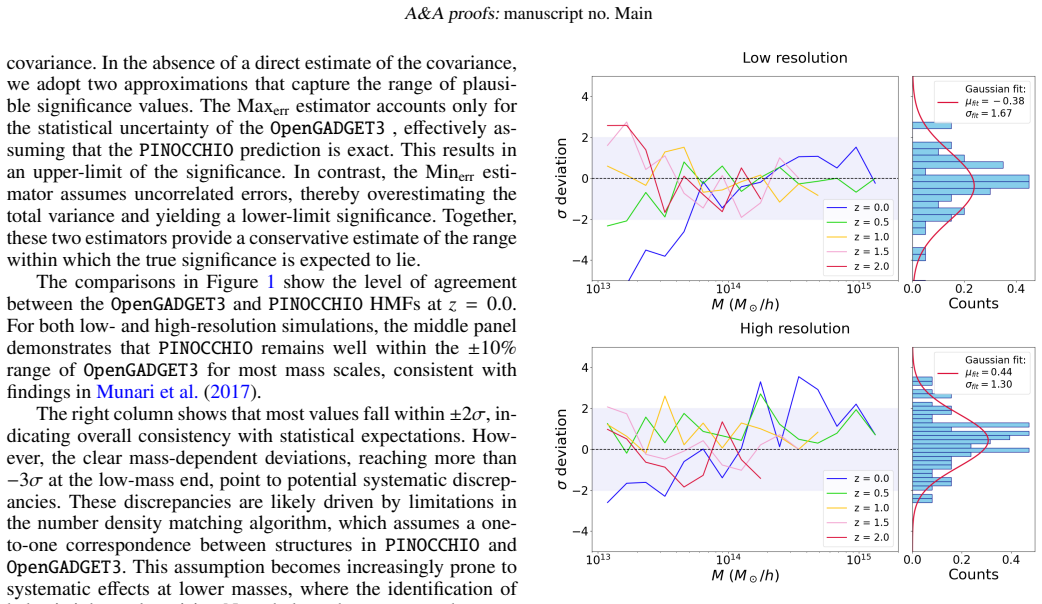
- [Abstract and Sections 3.1-3.4] The abstract states 'agreement for all void statistics at better than 2sigma between PINOCCHIO and OpenGADGET3, with no systematic difference in redshift trends.' This is contradicted by the body's own qualified language: Section 3.1 says 'most values fall within +/-2sigma' for the VSF, Section 3.3 notes a systematic overestimation in the CDF at higher core densities, and Appendix B reports that the CDF agreement 'worsens, particularly at redshifts z>0' for the large box. The claim should be softened to 'mostly within 2sigma' or the specific exceptions (large-size VSF bins, high core-density CDF bins, low-resolution low-mass HMF bins) should be explicitly characterized as statistically consistent but with localized systematic deviations.
- [Section 2.3.3, Eqs. (12)-(13)] The claim that the Maxerr and Minerr estimators bracket the true significance is not established. For paired simulations sharing initial conditions, the variance of the difference is Var(G)+Var(P)-2Cov. The Maxerr denominator, sigma_G, is smaller than the true error only if Cov < Var(P)/2; if the positive correlation is stronger (plausible for shared ICs, and likely when sigma_P is comparable to sigma_G), Maxerr can underestimate the significance of the difference. Similarly, Minerr is not a guaranteed lower bound for all covariance values. The paper either needs to compute the paired covariance (e.g., by paired jackknife resampling across both codes) or explicitly restrict its claims to the Maxerr statistic and avoid saying the true significance is bracketed. As written, the 'better than 2sigma' conclusion rests on an estimator whose conservativeness is assumed rather than derived.
- [Section 2.3.3, Number Density Matching] The halo number-density matching procedure (selecting from PINOCCHIO the same number of halos as found in OpenGADGET3 above a fixed mass cut) removes the HMF normalization difference before voids are measured. The paper should state more explicitly that the validation is therefore conditional on a calibrated halo abundance: it tests whether PINOCCHIO's spatial clustering, given the same tracer number density as the N-body run, yields the same void population. This is a meaningful and standard comparison, but it does not validate PINOCCHIO's absolute prediction of void abundances, which would inherit any HMF systematics. A sentence clarifying this scope would prevent the 'reliably produce void statistics' claim from being over-interpreted.
minor comments (5)
- [Introduction] There is a typo in 'enviroments' in the first paragraph of the introduction; also, 'V oid' and 'V oronoi' appear with stray spaces in several places (e.g., Section 2.1).
- [Section 3.1] The word 'resdshifts' appears instead of 'redshifts' in the first sentence after Figure 4.
- [Eq. (7)] The second Heaviside step function is written as theta[-(r_j - delta r)^3]; the exponent 3 appears to be a typo, since the radial shell condition should involve theta[-(r_j - (r - delta r))] or an equivalent form without a cubic exponent.
- [Section 2.3.3 and Figures 1-10] The paper does not state how many jackknife resamplings were used or how the jackknife regions were defined; specifying this would improve reproducibility, since the error bars are central to the significance statements.
- [Appendix B] The large-box test uses a different halo mass cut (10^14 M_sun/h) and only three redshifts; this is appropriately acknowledged, but the caption or text should make clearer that the CDF discrepancy at z>0 is a resolution effect rather than a redshift effect, to avoid tension with the abstract's 'no systematic difference in redshift trends.'
Circularity Check
No significant circularity: the void statistics are measured from an independent N-body benchmark, and the only calibration step matches tracer number density without fitting any void observable.
full rationale
The paper's derivation chain is self-contained against an external benchmark. The void statistics (VSF, VEF, CDF, RDP) are measured directly from halo catalogs produced by PINOCCHIO and OpenGADGET3 using the VIDE void finder; no void observable is fitted or used as an input to the comparison. The only calibration step, the halo number-density matching in Section 2.3.3, selects the same number of halos after a mass cut so that the tracer populations are statistically comparable. This calibration adjusts the halo sample, not the void size, ellipticity, core-density, or radial-profile values, and it is applied before void identification. The agreement claim is therefore not a restatement of the calibration. The shared initial conditions, generated with PINOCCHIO at z=50 using 3LPT, are a controlled comparison setup that lets both codes evolve the same linear density field; this does not inject the target void statistics into either code. Self-citations to Monaco et al. (2013), Munari et al. (2017), and Monaco et al. (2025) are used as background support for PINOCCHIO's halo accuracy and for expectations about the halo mass function; they are not invoked to define or force the void results, and no uniqueness theorem from the authors' prior work is used to exclude alternatives. Concerns raised in the manuscript and in the skeptical reading about the Maxerr/Minerr significance brackets in Section 2.3.3, and about Appendix B reporting worsened CDF agreement at z>0, are statistical-robustness and wording-accuracy issues, not circularity: they do not make the derivation equivalent to its inputs. No equation in the paper reduces to a fitted value, no fitted parameter is renamed as a prediction, and the central claim is tested against an external N-body code. Verdict: no significant circularity.
Assumptions & free parameters
free parameters (1)
- Halo mass threshold for tracer selection =
10^13 M_sun/h (main runs); 10^14 M_sun/h (large box)
assumptions (4)
- domain assumption The Planck15 flat Lambda CDM cosmology is assumed.
- domain assumption Initial conditions generated by PINOCCHIO with 3LPT at z=50 are unbiased and adequate for both simulations.
- ad hoc to paper Halo number density matching provides a fair comparison without biasing void statistics.
- domain assumption Void statistics measured from halo tracers are representative of the underlying cosmic web, and VIDE outputs are reliable for both codes.
Cite this review
Pith. "Pith review of Tracing cosmic voids with fast simulations." pith.science (2026). https://pith.science/paper/AAPO6DCN
@misc{pith2026250619506,
  author       = {Pith},
  title        = {Pith review of: Tracing cosmic voids with fast simulations},
  year         = {2026},
  howpublished = {\url{https://pith.science/paper/AAPO6DCN}},
  note         = {Machine review of arXiv:2506.19506}
}
read the original abstract
Context. Cosmic voids are vast underdense regions in the cosmic web that encode crucial information about structure formation, the composition of the Universe, and its expansion history. Due to their lower density, these regions are less affected by non-linear gravitational dynamics, making them suitable candidates for analysis using semi-analytic methods. Aims. We assess the accuracy of the PINOCCHIO code, a fast tool for generating dark matter halo catalogs based on Lagrangian Perturbation Theory, in modeling the statistical properties of cosmic voids. We validate this approach by comparing the resulting void statistics measured from PINOCCHIO to those obtained from N-body simulations. Methods. We generate a set of simulations using PINOCCHIO and OpenGADGET3, assuming a fiducial cosmology and varying the resolution. For a given resolution, the simulations share the same initial conditions between the different simulation codes. Snapshots are saved at multiple redshifts for each simulation and post-processed using the watershed void finder VIDE to identify cosmic voids. For each simulation code, we measure the following statistics: void size function, void ellipticity function, core density function, and the void radial density profile. We use these statistics to quantify the accuracy of PINOCCHIO relative to OpenGADGET3 in the context of cosmic voids. Results. We find agreement for all void statistics at better than 2{\sigma} between PINOCCHIO and OpenGADGET3, with no systematic difference in redshift trends. This demonstrates that the PINOCCHIO code can reliably produce void statistics with high computational efficiency compared to full N-body simulations.
Figures


Figures from the paper (7 more)


Forward citations
Cited by 1 Pith paper
-
Why Cosmic Voids Matter: Pristine Evolution
Cosmic voids traced by halos become stable at late times, and the matter around them evolves linearly, supporting their use as clean dark-energy probes.
Reference graph
Works this paper leans on
-
[1]
Ade, P. A. R. et al. 2016, A&A, 594, A13
work page 2016
-
[2]
& Paczynski, B
Alcock, C. & Paczynski, B. 1979, Nature, 281, 358
1979
-
[3]
& Hut, P
Barnes, J. & Hut, P. 1986, Nature, 324, 446
1986
-
[4]
R., Cole, S., Efstathiou, G., & Kaiser, N
Bond, J. R., Cole, S., Efstathiou, G., & Kaiser, N. 1991, ApJ, 379, 440
1991
-
[5]
Bos, E. G. P., van de Weygaert, R., Dolag, K., & Pettorino, V . 2012, MNRAS, 426, 440
work page 2012
-
[6]
Castro, T. et al. 2023, A&A, 671, A100
work page 2023
-
[7]
2021, MNRAS, 504, 5021
Contarini, S., Marulli, F., Moscardini, L., et al. 2021, MNRAS, 504, 5021
2021
- [8]
Show all 53 references
-
[9]
2019, MNRAS, 488, 3526
Contarini, S., Ronconi, T., Marulli, F., et al. 2019, MNRAS, 488, 3526
2019
-
[10]
T., Cautun, M., Giblin, B., et al
Davies, C. T., Cautun, M., Giblin, B., et al. 2021, MNRAS, 507, 2267
2021
-
[11]
T., Cautun, M., & Li, B
Davies, C. T., Cautun, M., & Li, B. 2019, MNRAS, 490, 4907
2019
-
[12]
2009, MNRAS, 399, 497
Dolag, K., Borgani, S., Murante, G., & Springel, V . 2009, MNRAS, 399, 497
2009
-
[13]
J., Levison, H
Duncan, M. J., Levison, H. F., & Lee, M. H. 1998, AJ, 116, 2067
1998
-
[14]
S., & White, S
Efstathiou, G., Davis, M., Frenk, C. S., & White, S. D. M. 1985, ApJS, 57, 241
1985
-
[15]
2025, A&A, 697, A140
Fumagalli, A., Castro, T., Borgani, S., & Valentini, M. 2025, A&A, 697, A140
2025
-
[16]
Fumagalli, A. et al. 2021, A&A, 652, A21
2021
-
[17]
M., et al
Hamaus, N., Pisani, A., Sutter, P. M., et al. 2016, PRL, 117, 091302
2016
-
[18]
M., & Wandelt, B
Hamaus, N., Sutter, P. M., & Wandelt, B. D. 2014, PRL, 112, 251302
2014
-
[19]
Hamaus, N. et al. 2022, A&A, 658, A20
2022
-
[20]
2013, A&A, 556, A51
Ilic, S., Langer, M., & Douspis, M. 2013, A&A, 556, A51
2013
-
[21]
2013, MNRAS, 434, 2167 Kovács, A
Jennings, E., Li, Y ., & Hu, W. 2013, MNRAS, 434, 2167 Kovács, A. 2018, MNRAS, 475, 1777
2013
-
[22]
& Park, D
Lee, J. & Park, D. 2009, ApJL, 696, L10
2009
-
[23]
2025, arXiv e-prints, arXiv:2502.05262
Lehman, K., Schuster, N., Lucie-Smith, L., et al. 2025, arXiv e-prints, arXiv:2502.05262
2025
-
[24]
1997, MNRAS, 287, 753
Monaco, P. 1997, MNRAS, 287, 753
1997
-
[25]
2013, MNRAS, 433, 2389
Monaco, P., Sefusatti, E., Borgani, S., et al. 2013, MNRAS, 433, 2389
2013
-
[26]
2002, MNRAS, 331, 587
Monaco, P., Theuns, T., & Taffoni, G. 2002, MNRAS, 331, 587
2002
-
[27]
Monaco, P. et al. 2025, A&A, in press [arXiv:2507.12116]
2025
-
[28]
Moresco, M. et al. 2022, LRR, 25, 6
2022
-
[29]
2017, MNRAS, 465, 4658
Munari, E., Monaco, P., Sefusatti, E., et al. 2017, MNRAS, 465, 4658
2017
-
[30]
Neyrinck, M. C. 2008, MNRAS, 386, 2101
2008
-
[31]
& Lee, J
Park, D. & Lee, J. 2007, PRL, 98, 081301
2007
-
[32]
Perico, E. L. D., V oivodic, R., Lima, M., & Mota, D. F. 2019, A&A, 632, A52
2019
-
[33]
M., Hamaus, N., et al
Pisani, A., Sutter, P. M., Hamaus, N., et al. 2015, PRD, 92, 083531
2015
-
[34]
Pisani, A. et al. 2019 [arXiv:1903.05161]
2019 arXiv
-
[35]
Platen, E., van de Weygaert, R., & Jones, B. J. T. 2007, MNRAS, 380, 551
2007
-
[36]
Press, W. H. & Schechter, P. 1974, ApJ, 187, 425
1974
-
[37]
Radinovic, S. et al. 2023, A&A, 677, A78
2023
-
[38]
Sachs, R. K. & Wolfe, A. M. 1967, ApJ, 147, 73
1967
-
[39]
2023, JCAP, 2023, 031
Schuster, N., Hamaus, N., Dolag, K., & Weller, J. 2023, JCAP, 2023, 031
2023
-
[40]
2024, JCAP, 2024, 065
Schuster, N., Hamaus, N., Dolag, K., & Weller, J. 2024, JCAP, 2024, 065
2024
-
[41]
2019, JCAP, 2019, 055
Schuster, N., Hamaus, N., Pisani, A., et al. 2019, JCAP, 2019, 055
2019
-
[42]
2025, arXiv e- prints, arXiv:2509.07092
Schuster, N., Hamaus, N., Pisani, A., Dolag, K., & Weller, J. 2025, arXiv e- prints, arXiv:2509.07092
2025 arXiv
-
[43]
Shandarin, S. F. & Zeldovich, Y . B. 1989, RMP, 61, 185
1989
-
[44]
Sheth, R. K. & Tormen, G. 1999, MNRAS, 308, 119
1999
-
[45]
Sheth, R. K. & van de Weygaert, R. 2004, MNRAS, 350, 517
2004
-
[46]
2005, MNRAS, 364, 1105
Springel, V . 2005, MNRAS, 364, 1105
2005
-
[47]
Springel, V ., White, S. D. M., Tormen, G., & Kauffmann, G. 2001, MNRAS, 328, 726
2001
-
[48]
M., Lavaux, G., Hamaus, N., et al
Sutter, P. M., Lavaux, G., Hamaus, N., et al. 2015, A&C, 9, 1
2015
-
[49]
M., Pisani, A., Wandelt, B
Sutter, P. M., Pisani, A., Wandelt, B. D., & Weinberg, D. H. 2014, MNRAS, 443, 2983
2014
-
[50]
S., Abazajian, K., Holz, D
Warren, M. S., Abazajian, K., Holz, D. E., & Teodoro, L. 2006, ApJ, 646, 881
2006
-
[51]
A., Iliev, I
Watson, W. A., Iliev, I. T., D’Aloisio, A., et al. 2013, MNRAS, 433, 1230
2013
-
[52]
1995, ApJS, 98, 355 Article number, page 12 of 16 Lepinzan et al.: Cosmic voids with fast simulations Fig
Xu, G.-H. 1995, ApJS, 98, 355 Article number, page 12 of 16 Lepinzan et al.: Cosmic voids with fast simulations Fig. A.1.Same as Figure 3 for VSFs across different resolutions. Fig. A.2.Same as Figure 7 for CDFs across different resolutions. Appendix A: Resolution comparison I...
1995
-
[53]
low-resolution
Similarly, Figure A.2 shows the same measurement as in Fig- ure 7, again comparing resolutions within each code. The reso- lution dependence of the discrepancy supports the interpretation above: agreement between the two codes improves at higher res- olution, where theFRAGMENT...
Reviewed August 15, 2026 · model on record in the stance chip above.
Discussion (0). Continue with ORCID to comment.