REVIEW 4 major objections 5 minor 56 references
CORMO-RAN: Lossless Migration of xApps in O-RAN
T0 review · 4 major / 5 minor · reviewed 2026-08-15 · deepseek-v4-flash
Pith's one-line read CORMO-RAN is a data-driven orchestrator that jointly decides which RIC compute nodes stay on and how to migrate xApps without losing state, and the paper claims it cuts cluster energy by up to 64 percent against a standard load balancer.
desk verdict Genuinely useful SM-vs-SDL measurements for O-RAN xApps, but the headline 64% energy saving is an artifact of a downtime budget that contradicts the paper's own near-RT deadline. read the letter →
The pith
A machine-rendered reading of the paper's core claim, the machinery that carries it, and where it could break.
The reading
What carries the argument
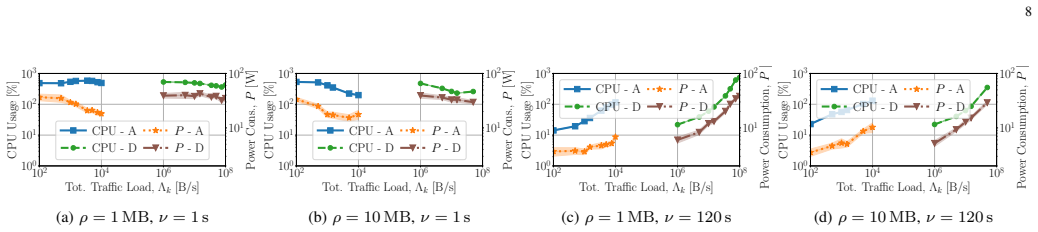
The load-bearing machinery is the SAL (Server Activation and Lossless migration) problem, a mixed-integer quadratic program whose objective sums per-server energy from idle power, per-xApp load, and migration-strategy overhead. The models that feed it are linear fits derived from the testbed measurements: migration downtime and duration grow linearly with the number of xApps for both SM variants, SDL migration duration is independent of state size and xApp class, the SDL backend's maintenance downtime grows linearly with total offered load and state size, and per-xApp CPU and power consumption are linear in the number of xApps per class. These fitted slopes and intercepts convert the engineering trade-off between SM's downtime and SDL's backend cost into numeric parameters that the optimizer can respect while enforcing the near-real-time 1-second deadline constraints.
What would settle it
Run the CORMO-RAN optimizer end-to-end on a production RIC cluster with more than a hundred real, non-emulated stateful xApps of different AI architectures and state sizes, then compare measured energy against a load-balanced always-on baseline; if the saving falls far short of 64% or any migration exceeds the 1-second near-real-time loop deadline, the central claim fails. A cheaper check is to refit the linear slopes from a second, architecturally different xApp and see whether the SAL solution still predicts measured energy within a small error.
Extended reading notes
Core claim
CORMO-RAN's central contention is that the two established ways to move a stateful xApp—Stateful Migration (SM), which moves the container with its memory, and the O-RAN Shared Data Layer (SDL), which keeps state in an external key-value store such as etcd—have complementary failure modes: SM violates the 1-second near-real-time control deadline whenever downtime matters, while SDL's zero-downtime migration is bounded by backend database maintenance outages that grow linearly with load and state size. The paper's contribution is a working reconciliation: it fits linear models of downtime, migration duration, maintenance outage, and per-xApp resource and energy use from testbed experiments, encodes them as a mixed-integer quadratic program called the SAL (Server Activation and Lossless migration) problem, and solves it with branch-and-bound to choose both which nodes to power on and which migration strategy to use. Solving this problem in under a second for up to about 120 xApps, CORMO-RAN is claimed to achieve up to 64% energy savings over a load-balanced baseline while keeping xApp state intact and migration downtime within permitted bounds.
Load-bearing premise
The load-bearing premise is that linear relationships measured with one reinforcement-learning xApp and an emulated RAN interface on a four-node cluster continue to hold when hundreds of diverse AI xApps run on a larger production cluster; the 64% saving is computed from those extrapolated fits, not from a measured deployment.
Editorial extensions
If this is right
- Operators can power down RIC nodes during low-traffic periods and move stateful xApps between nodes without dropping near-real-time control loops, shifting cluster energy use to track actual xApp demand.
- SDL is the right choice only when state is small and load moderate; for large state sizes or high load, the paper's feasibility analysis shows SDL cannot meet the 1-second deadline, so SM becomes the fallback even though its downtime exceeds the deadline.
- The SAL problem, though NP-hard, is solvable optimally in under a second for realistic cluster sizes (up to about 120 xApps), so hourly re-optimization from the non-real-time RIC is practical.
- Under the paper's model, energy gains approach zero when all nodes must stay on; at high traffic the system matches the baseline, so the benefit is concentrated in off-peak hours.
- The best migration strategy depends on the dominant xApp class, state size, and backend maintenance period, and the paper supplies a feasibility map for choosing a viable strategy before solving the allocation.
Reading between the lines
- The same SAL machinery could be applied beyond xApps, for example to rApp placement or to any stateful microservice on a Kubernetes cluster, since the fitted KPI/resource models are only tied to O-RAN through the deadline constraints.
- Because the fitted models come from a single reinforcement-learning xApp and an emulator, the 64% figure is best read as an upper bound; refitting with heterogeneous AI xApps would likely lower achievable savings in practice.
- The feasibility maps imply a hybrid policy the authors do not explore: use SDL for small-state xApps during peak hours for zero-downtime migration, and switch to SM for large-state xApps at night when whole nodes can be freed.
- Operators could test sensitivity by varying the backend maintenance period online: the model predicts that rarer maintenance cuts SDL energy but shrinks the feasible region, so an adaptive maintenance schedule might capture most of the energy gain without risking deadline violations.
Signed reviews
Editorial analysis
A structured set of objections, weighed in public.
Referee Report
Summary. The paper proposes CORMO-RAN, an rApp-based orchestrator that jointly decides which compute nodes of a near-RT RIC cluster to activate and how to migrate stateful xApps among them, using three strategies: stateful migration minimizing resources (SM-MR), stateful migration minimizing downtime (SM-MD), and the O-RAN Shared Data Layer (SDL). The authors build a testbed on Red Hat OpenShift with an open-source near-RT RIC, a DRL-based xApp, an E2 emulator, Prometheus/Kepler monitoring, and etcd as the SDL backend. They measure migration downtime/duration, resource usage, energy consumption, and etcd maintenance disruptions, then fit linear models to these measurements. These fits are used in a mixed-integer optimization problem (SAL) solved with Gurobi. The paper reports up to 64% energy saving compared with an OpenShift-style baseline and provides feasibility regions for the three migration strategies.
Significance. The experimental characterization of SM versus SDL migration in a realistic O-RAN cluster is a useful and timely contribution, and the paper is careful in several respects: measurements are averaged over 50 repetitions with 95% confidence intervals, the testbed uses commercial components and open-source tools, and the feasibility analysis explicitly highlights the scalability limits of SDL. If the model-based energy results are properly qualified, the framework could be a valuable aid for operators choosing migration strategies. However, the headline quantitative claim is not an end-to-end measured saving; it is the optimum of an objective built from the same fitted data, and it is obtained under a migration-downtime threshold that conflicts with the paper's own near-RT deadline finding. These issues must be resolved before the central claim can be accepted.
major comments (4)
- [Sec. V-B (Finding 2) and Sec. VII (constraint (20))] Finding 2 states that SM-MD downtime is on the order of 5 s even for the smallest state size and is 'incompatible with the near-RT RIC control loop deadline of 1 s.' Nevertheless, Section VII sets T_max_Dk = 300 s in constraint (20), calling it an 'arbitrary maximum stateful migration downtime that can be tolerated,' and Figs. 14 and 16 compute SM energy gains and feasibility under this relaxed threshold. If the paper's own 1 s near-RT deadline is enforced, constraint (20) makes SM infeasible in every reported configuration, so the headline up-to-64% saving is obtained in a regime that violates the availability requirement asserted in the abstract. The authors must either justify a 300 s downtime as an explicit availability trade-off (and revise the abstract accordingly) or re-evaluate the optimization with a per-xApp downtime constraint of 1 s, in which case SM cannot contribute to the reported energy saving.
- [Sec. VI-B (Eq. (11)) and Sec. VII (Fig. 14)] The 'up to 64% energy saving' is not an end-to-end measured result. The objective Es in Eq. (11) and the KPI constraints in Eqs. (1)-(4) and (20)-(22) use slopes and intercepts fitted from the experimental measurements in Figs. 6-12, and Fig. 14 is obtained by minimizing that same fitted objective with Gurobi. The reported saving therefore reduces to the fitted linear coefficients rather than providing independent confirmation of the system's performance. Moreover, the linear fits are measured for at most 15 migrated xApps (Fig. 6) and 50 xApps (Fig. 7), while Fig. 14 evaluates up to 400 xApps and Figs. 15-16 up to 150 xApps; the linear extrapolation to these scales is an unsupported assumption. Please reframe the 64% figure as a scenario analysis under the fitted model, and either validate the linearity at the evaluated scales or restrict the claims to the measured range.
- [Sec. VI-A (Eq. (10)) and Table II] The SDL energy model in Eq. (10) uses slopes delta_SDL_E,k from Table II that are negative for all xApp classes (e.g., -0.18 W for class A). For large N_k this makes the term (delta_SDL_E,k * N_k + b_SDL_E,k) negative, so the objective rewards hosting additional SDL xApps with negative energy. For example, with 400 class-A xApps the per-class term becomes -0.18*400 + 32.35 = -39.65, and Eq. (10) then contributes a negative energy cost. This is an artifact of the etcd saturation behavior described in Sec. V-C and should not enter the optimization as a physical cost; the authors should use nonnegative fitted models or explicitly restrict the load range over which the linear fit is valid.
- [Sec. VI-C (Theorem 1)] The proof of Theorem 1 is logically inverted. The paper argues that because SAL is an MIQP and the general decision version of MIQP is NP-complete, SAL is NP-hard by reduction. A reduction from SAL to the general MIQP only shows that SAL is no harder than the general MIQP; NP-hardness requires a polynomial-time reduction from a known NP-hard problem to SAL. Please replace this with a valid reduction (e.g., from bin packing or partition) or remove the theorem.
minor comments (5)
- [Sec. VII (Fig. 14 discussion)] The bullets after Fig. 14 cite constraint (20) for resource usage and constraint (19) for the maximum downtime; these should refer to constraint (18) and constraint (20), respectively.
- [Sec. VI-B (constraint (20))] The text says constraint (20) limits 'the downtime due to xApps being migrated to s,' but Eq. (1) defines T^tau_Dk,s in terms of the xApps leaving source s. The wording should match the equation.
- [Sec. V (global)] The paper states that all results have 95% confidence intervals from 50 repetitions, but most figures do not show error bars or confidence bands; please indicate where the intervals were omitted and why.
- [Abstract and Sec. III] The term 'lossless migration' is used for both SM (state-preserving but with service downtime) and SDL (zero-downtime by design); define it explicitly at first use to avoid conflating state preservation with service availability.
- [Sec. VII (baseline definition)] The baseline 'OpenShift default scheduler' is described only verbally as resource-based load balancing; specify whether the energy gain in Fig. 14 is computed against a modeled baseline or against a baseline measured on the testbed.
Circularity Check
No significant circularity: the 64% figure is a scenario projection of an experimentally fitted optimization model, not a fitted parameter renamed as a prediction.
full rationale
The paper's derivation chain is empirical rather than definitional. Equations (1)-(4), (5)-(11) use linear forms whose slopes and intercepts are measured on the testbed (Figs. 6, 7a, 8-12; Tables II-IV), not quantities defined in terms of the target energy saving. The SAL objective (11) is minimized by Gurobi; Fig. 14's energy gain is the difference between that optimized objective and the same fitted model under an always-on/OpenShift allocation baseline. That is a model-based scenario projection, and while it is extrapolative (fits from one exemplary DRL xApp are reused for hundreds of xApps and for classes A-D), extrapolation is not circularity. The self-citations to PAM [5] and MOSE [24] supply the migration framework and KPI model, but the paper re-measures the KPI slopes in Fig. 6 rather than importing them, so these citations are not load-bearing as unverified premises. The NP-hardness proof in Sec. VI-B is mathematically misdirected (it reduces SAL to a general MIQP, the reverse of a hardness reduction), and Sec. VII's choice of T_max_Dk = 300 s conflicts with Finding 2's statement that SM downtime is incompatible with the 1 s near-RT deadline; these are correctness/consistency concerns, not circular steps. No fitted parameter is renamed as a prediction, no result is assumed by construction, and no load-bearing claim reduces to a self-citation. Hence the paper is self-contained against its own experimental measurements and merits a circularity score of 0.
Assumptions & free parameters
free parameters (7)
- Migration KPI slopes delta_tau_D and delta_tau_M =
e.g., delta_SM-MR_D=10.55 s, delta_SM-MD_D=5.74 s, delta_SM-MD_M=20.28 s for rho=1 MB
- Defrag downtime slopes sigma_k =
sigma_A=16.62 ms, sigma_B=17.07 ms, sigma_C=7.71 ms, sigma_D=11.62 ms
- Per-xApp resource slopes p_E,k, p_CPU,k, p_MEM,k =
e.g., p_E,A=3.43 W, p_E,B=16.48 W, p_CPU,A=0.47, p_MEM,A=0.52 GB
- Idle resource consumption q_chi,s =
q_E=120 W, q_CPU=0.1, q_MEM=5.7 GB, q_DISK=3.2 GB
- SDL etcd resource slopes and intercepts delta_SDL_chi,k and b_SDL_chi,k =
e.g., delta_SDL_E,A=-0.18 W, b_SDL_E,A=32.35 W
- SM energy constants b_SM-MR_E and b_SM-MD_E =
17.87 W and 27.56 W
- Maximum tolerable migration downtime T_max_Dk =
300 s
assumptions (7)
- domain assumption The PAM model from [5] accurately characterizes SM downtime and duration as functions of memory usage and dirty-page rate.
- domain assumption Kepler pod-level power estimates, including idle power, are accepted as ground truth for energy.
- domain assumption The DRL-based xApp from [49] and the E2 emulator represent general AI-based xApp workloads.
- domain assumption Linear relationships measured in Figs. 6-12 continue to hold outside the measured range up to hundreds of xApps.
- domain assumption Raft-based etcd provides strong consistency sufficient for correct concurrent xApp state access.
- standard math The virtual server with infinite resources and zero energy is a harmless modeling device.
- domain assumption The 1 s near-RT RIC control-loop deadline is the correct availability target.
Cite this review
Pith. "Pith review of CORMO-RAN: Lossless Migration of xApps in O-RAN." pith.science (2026). https://pith.science/paper/CA77UCIE
@misc{pith2026250619760,
  author       = {Pith},
  title        = {Pith review of: CORMO-RAN: Lossless Migration of xApps in O-RAN},
  year         = {2026},
  howpublished = {\url{https://pith.science/paper/CA77UCIE}},
  note         = {Machine review of arXiv:2506.19760}
}
read the original abstract
Open Radio Access Network (RAN) is a key paradigm to attain unprecedented flexibility of the RAN via disaggregation and Artificial Intelligence (AI)-based applications called xApps. In dense areas with many active RAN nodes, compute resources are engineered to support potentially hundreds of xApps monitoring and controlling the RAN to achieve operator's intents. However, such resources might become underutilized during low-traffic periods, where most cells are sleeping and, given the reduced RAN complexity, only a few xApps are needed for its control. In this paper, we propose CORMO-RAN, a data-driven orchestrator that dynamically activates compute nodes based on xApp load to save energy, and performs lossless migration of xApps from nodes to be turned off to active ones while ensuring xApp availability during migration. CORMO-RAN tackles the trade-off among service availability, scalability, and energy consumption while (i) preserving xApps' internal state to prevent RAN performance degradation during migration; (ii) accounting for xApp diversity in state size and timing constraints; and (iii) implementing several migration strategies and providing guidelines on best strategies to use based on resource availability and requirements. We prototype CORMO-RAN as an rApp, and experimentally evaluate it on an O-RAN private 5G testbed hosted on a Red Hat OpenShift cluster with commercial radio units. Results demonstrate that CORMO-RAN is effective in minimizing energy consumption of the RAN Intelligent Controller (RIC) cluster, yielding up to 64% energy saving when compared to existing approaches.
Figures


Figures from the paper (10 more)




Reference graph
Works this paper leans on
-
[1]
Red Hat OpenShift Platform Plus,
Red Hat, “Red Hat OpenShift Platform Plus,” https://www.redhat.com/en/resources/openshift-platform-plus-datasheet and https://github.com/openshift, 2011-2025
work page 2011
-
[2]
O-RAN WhitePaper - Building the Next Generation RAN,
O-RAN Alliance, “O-RAN WhitePaper - Building the Next Generation RAN,” https://www.o-ran.org/resources, October 2018
work page 2018
-
[3]
Under- standing O-RAN: Architecture, Interfaces, Algorithms, Security, and Research Challenges,
M. Polese, L. Bonati, S. D’Oro, S. Basagni, and T. Melodia, “Under- standing O-RAN: Architecture, Interfaces, Algorithms, Security, and Research Challenges,” IEEE Communications Surveys & Tutorials , vol. 25, no. 2, pp. 1376–1411, 2023
work page 2023
-
[4]
ScalO-RAN: Energy-aware Network Intelligence Scaling in Open RAN,
S. Maxenti, S. D’Oro, L. Bonati, M. Polese, A. Capone, and T. Melo- dia, “ScalO-RAN: Energy-aware Network Intelligence Scaling in Open RAN,” in Proceedings of International Conference on Computer Com- munications (INFOCOM). Vancouver, Canada: IEEE, 2024
work page 2024
-
[5]
Design, Mod- eling, and Implementation of Robust Migration of Stateful Edge Mi- croservices,
A. Calagna, Y . Yu, P. Giaccone, and C. F. Chiasserini, “Design, Mod- eling, and Implementation of Robust Migration of Stateful Edge Mi- croservices,” IEEE Transactions on Network and Service Management , vol. 21, no. 2, pp. 1877–1893, 2024. 13
work page 2024
-
[6]
A survey of green mobile networks: Opportunities and challenges,
X. Wang, A. V . Vasilakos, M. Chen, Y . Liu, and T. T. Kwon, “A survey of green mobile networks: Opportunities and challenges,” Mobile Networks and Applications, vol. 17, pp. 4–20, 2012
work page 2012
-
[7]
Green mobile networks for 5g and beyond,
M. Masoudi, M. G. Khafagy, A. Conte, A. El-Amine, B. Françoise, C. Nadjahi, F. E. Salem, W. Labidi, A. Süral, A. Gati, D. Bodéré, E. Arikan, F. Aklamanu, H. Louahlia-Gualous, J. Lallet, K. Pareek, L. Nuaymi, L. Meunier, P. Silva, N. T. Almeida, T. Chahed, T. Sjölund, and C. Cavdar, “Green mobile networks for 5g and beyond,” IEEE Access, vol. 7, pp. 107 27...
work page 2019
-
[8]
D. López-Pérez, A. De Domenico, N. Piovesan, G. Xinli, H. Bao, S. Qitao, and M. Debbah, “A survey on 5g radio access network energy efficiency: Massive mimo, lean carrier design, sleep modes, and machine learning,” IEEE Communications Surveys & Tutorials, vol. 24, no. 1, pp. 653–697, 2022
work page 2022
Show all 56 references
-
[9]
Toward sustainable o-ran deployment: An in-depth analysis of power consumption,
G. Baldini, R. Bolla, R. Bruschi, A. Carrega, F. Davoli, C. Lombardo, and R. Rabbani, “Toward sustainable o-ran deployment: An in-depth analysis of power consumption,” IEEE Transactions on Green Commu- nications and Networking , pp. 1–1, 2024
2024
-
[10]
Toward greener 5g and beyond radio access networks—a survey,
L. M. P. Larsen, H. L. Christiansen, S. Ruepp, and M. S. Berger, “Toward greener 5g and beyond radio access networks—a survey,” IEEE Open Journal of the Communications Society , vol. 4, pp. 768–797, 2023
2023
-
[11]
Energy consumption of machine learning enhanced open ran: A comprehensive review,
X. Liang, Q. Wang, A. Al-Tahmeesschi, S. B. Chetty, D. Grace, and H. Ahmadi, “Energy consumption of machine learning enhanced open ran: A comprehensive review,”IEEE Access, vol. 12, pp. 81 889–81 910, 2024
2024
-
[12]
The evolution of mobile network operations: A comprehensive analysis of open ran adoption,
L. M. Larsen, H. L. Christiansen, S. Ruepp, and M. S. Berger, “The evolution of mobile network operations: A comprehensive analysis of open ran adoption,” Computer Networks, vol. 243, p. 110292, 2024. [Online]. Available: https://www.sciencedirect.com/science/article/pii/S1389...
2024
-
[13]
Towards energy efficient ran: From industry standards to trending practice,
L. Kundu, X. Lin, and R. Gadiyar, “Towards energy efficient ran: From industry standards to trending practice,” arXiv preprint arXiv:2402.11993, 2024
2024 arXiv
-
[14]
Intelligent zero trust architecture for 5g/6g networks: Principles, challenges, and the role of machine learning in the context of o-ran,
K. Ramezanpour and J. Jagannath, “Intelligent zero trust architecture for 5g/6g networks: Principles, challenges, and the role of machine learning in the context of o-ran,” Computer Networks, vol. 217, p. 109358, 2022. [Online]. Available: https://www.sciencedirect.com/science...
2022
-
[15]
Pandora: Automated design and compre- hensive evaluation of deep reinforcement learning agents for open ran,
M. Tsampazi, S. D’Oro, M. Polese, L. Bonati, G. Poitau, M. Healy, M. Alavirad, and T. Melodia, “Pandora: Automated design and compre- hensive evaluation of deep reinforcement learning agents for open ran,” IEEE Transactions on Mobile Computing, vol. 24, no. 4, pp. 3223–3240, 2025
2025
-
[16]
O-ran-enabled intelligent network slicing to meet service-level agreement (sla),
J. Dai, L. Li, R. Safavinejad, S. Mahboob, H. Chen, V . V . Ratnam, H. Wang, J. Zhang, and L. Liu, “O-ran-enabled intelligent network slicing to meet service-level agreement (sla),” IEEE Transactions on Mobile Computing, vol. 24, no. 2, pp. 890–906, 2025
2025
-
[17]
Toward modular and flexible open ran implementations in 6g networks: Traffic steering use case and o-ran xapps,
M. Dryja ´nski, Ł. Kułacz, and A. Kliks, “Toward modular and flexible open ran implementations in 6g networks: Traffic steering use case and o-ran xapps,” Sensors, vol. 21, no. 24, 2021. [Online]. Available: https://www.mdpi.com/1424-8220/21/24/8173
2021
-
[18]
Begreen intelligent plane for ai-driven energy efficient o-ran management,
M. Catalan-Cid, J. Pueyo, J. Sanchez-Gonzalez, J. Gutierrez, and M. Ghoraishi, “Begreen intelligent plane for ai-driven energy efficient o-ran management,” in Joint European Conference on Networks and Communications (EuCNC) & 6G Summit . Antwerp, Belgium: IEEE, 2024, pp. 1–6
2024
-
[19]
O-ran intelligence orchestration framework for quality-driven xapp deployment and sharing,
F. Mungari, C. Puligheddu, A. Garcia-Saavedra, and C. F. Chiasserini, “O-ran intelligence orchestration framework for quality-driven xapp deployment and sharing,” IEEE Transactions on Mobile Computing , vol. 24, no. 6, pp. 4811–4828, 2025
2025
-
[20]
A survey on service migration in mobile edge computing,
S. Wang, J. Xu, N. Zhang, and Y . Liu, “A survey on service migration in mobile edge computing,” IEEE Access, vol. 6, pp. 23 511–23 528, 2018
2018
-
[21]
Application agnostic container migration and failover,
M. Terneborg, J. K. Rönnberg, and O. Schelén, “Application agnostic container migration and failover,” inProceedings of Conference on Local Computer Networks (LCN). Edmonton, Canada: IEEE, 2021, pp. 565– 572
2021
-
[22]
Live migration of video analytics applications in edge computing,
C. Rong, J. H. Wang, J. Wang, Y . Zhou, and J. Zhang, “Live migration of video analytics applications in edge computing,” IEEE Transactions on Mobile Computing , vol. 23, no. 3, pp. 2078–2092, 2024
2024
-
[23]
Seamless cross-edge service migration for real-time rendering applications,
Y . Li, S. Wang, Y . Li, A. Zhou, M. Xu, X. Ma, and Y . Liu, “Seamless cross-edge service migration for real-time rendering applications,” IEEE Transactions on Mobile Computing, vol. 23, no. 6, pp. 7084–7098, 2024
2024
-
[24]
Mose: A novel orchestration framework for stateful microservice migration at the edge,
A. Calagna, Y . Yu, P. Giaccone, and C. F. Chiasserini, “Mose: A novel orchestration framework for stateful microservice migration at the edge,” IEEE Transactions on Network and Service Management, pp. 1–1, 2025
2025
-
[25]
Dynamic service migration in mobile edge computing based on markov decision process,
S. Wang, R. Urgaonkar, M. Zafer, T. He, K. Chan, and K. K. Leung, “Dynamic service migration in mobile edge computing based on markov decision process,” IEEE/ACM Transactions on Networking , vol. 27, no. 3, pp. 1272–1288, 2019
2019
-
[26]
Migration-aware net- work services with edge computing,
A. Mukhopadhyay, G. Iosifidis, and M. Ruffini, “Migration-aware net- work services with edge computing,” IEEE Transactions on Network and Service Management , vol. 19, no. 2, pp. 1458–1471, 2022
2022
-
[27]
5g-edge relocator: A framework for application relocation in edge- enabled 5g system,
G. Panek, P. Matysiak, N. E.-h. Nouar, I. Fajjari, and H. Tarasiuk, “5g-edge relocator: A framework for application relocation in edge- enabled 5g system,” in Proceedings of International Conference on Communications. Rome, Italy: IEEE, 2023, pp. 4885–4891
2023
-
[28]
Efficient mi- croservice deployment in the edge-cloud networks with policy-gradient reinforcement learning,
K. Afachao, A. M. Abu-Mahfouz, and G. P. Hanke, “Efficient mi- croservice deployment in the edge-cloud networks with policy-gradient reinforcement learning,” IEEE Access , vol. 12, pp. 133 110–133 124, 2024
2024
-
[29]
A distributed database system for event-based microservices,
R. Laigner, Y . Zhou, and M. A. V . Salles, “A distributed database system for event-based microservices,” in Proceedings of the 15th ACM International Conference on Distributed and Event-Based Systems, ser. DEBS ’21. New York, NY , USA: Association for Computing Machinery, 20...
2021
-
[30]
Data management in microservices: state of the practice, challenges, and research directions,
R. Laigner, Y . Zhou, M. A. V . Salles, Y . Liu, and M. Kalinowski, “Data management in microservices: state of the practice, challenges, and research directions,” Proc. VLDB Endow. , vol. 14, no. 13, p. 3348–3361, Sep. 2021. [Online]. Available: https://doi.org/10.14778/34842...
2021
-
[31]
Enabling efficient collection and usage of network performance metrics at the edge,
A. Calagna, S. Ravera, and C. F. Chiasserini, “Enabling efficient collection and usage of network performance metrics at the edge,” Computer Networks , vol. 262, p. 111158, 2025. [Online]. Available: https://www.sciencedirect.com/science/article/pii/S1389128625001264
2025
-
[32]
Odesa: Load-dependent edge server activation for lower energy footprint,
B. Gómez, S. Bayhan, E. Coronado, J. Villalón, and A. Garrido, “Odesa: Load-dependent edge server activation for lower energy footprint,” in Proceedings of Wireless Communications and Networking Conference (WCNC). Dubai, United Arab Emirates: IEEE, 2024, pp. 1–6
2024
-
[33]
Enerdge: Distributed energy-aware resource allocation at the edge,
M. Avgeris, D. Spatharakis, D. Dechouniotis, A. Leivadeas, V . Karyotis, and S. Papavassiliou, “Enerdge: Distributed energy-aware resource allocation at the edge,” Sensors, vol. 22, no. 2, 2022. [Online]. Available: https://www.mdpi.com/1424-8220/22/2/660
2022
-
[34]
The cost of stateless network functions in 5g,
U. Kulkarni, A. Sheoran, and S. Fahmy, “The cost of stateless network functions in 5g,” in Proceedings of the Symposium on Architectures for Networking and Communications Systems , ser. ANCS ’21. New York, NY , USA: Association for Computing Machinery, 2022, p. 73–79. [Online]...
2022
-
[35]
Erl, Service-Oriented Architecture: Analysis and Design for Services and Microservices, 2nd ed
T. Erl, Service-Oriented Architecture: Analysis and Design for Services and Microservices, 2nd ed. USA: Prentice Hall Press, 2016
2016
-
[36]
A distributed, reliable key-value store for the most critical data of a distributed system,
etcd team, “A distributed, reliable key-value store for the most critical data of a distributed system,” https://etcd.io, 2013-2024
2013
-
[37]
Raft: In search of an understandable consensus algorithm,
D. Ongaro and J. Ousterhout, “Raft: In search of an understandable consensus algorithm,” in Proceedings of the 2014 USENIX Conference on USENIX Annual Technical Conference, ser. USENIX ATC’14. USA: USENIX Association, 2014, p. 305–320
2014
-
[38]
Perspectives on the cap theorem,
S. Gilbert and N. A. Lynch, “Perspectives on the cap theorem,” Com- puter, vol. 45, no. 02, pp. 30–36, 2012
2012
-
[39]
An in-memory database that persists on disk,
Redis team, “An in-memory database that persists on disk,” https://redis.io and https://github.com/redis/redis, 2020-2024
2020
-
[40]
RIC Platform GitHub Repository,
O-RAN Software Community, “RIC Platform GitHub Repository,” https://github.com/o-ran-sc/ric-plt-ric-dep, 2024
2024
-
[41]
NeutRAN: An Open RAN Neutral Host Architecture for Zero-Touch RAN and Spectrum Sharing,
L. Bonati, M. Polese, S. D’Oro, S. Basagni, and T. Melodia, “NeutRAN: An Open RAN Neutral Host Architecture for Zero-Touch RAN and Spectrum Sharing,” IEEE Transactions on Mobile Computing , vol. 23, no. 5, pp. 1–13, August 2023
2023
-
[42]
Open-source systems monitoring and alerting toolkit,
Prometheus, “Open-source systems monitoring and alerting toolkit,” https://prometheus.io and https://github.com/prometheus/prometheus, 2015-2025
2015
-
[43]
Kubernetes-based Efficient Power Level Exporter,
Kepler, “Kubernetes-based Efficient Power Level Exporter,” https://sustainable-computing.io/ and https://github.com/sustainable- computing-io/kepler, 2015-2025
2015
-
[44]
Idle Power Matters: Kepler Metrics for Public Cloud Energy Ef- ficiency,
Cloud Native Computing Foundation (CNCF): Environmental Sustain- ability, “Idle Power Matters: Kepler Metrics for Public Cloud Energy Ef- ficiency,” https://tag-env-sustainability.cncf.io/blog/2024-06-idle-power- matters-kepler-metrics-for-public-cloud-energy-efficiency/, 2024
2024
-
[45]
Kepler: A framework to calculate the energy consumption of containerized applications,
M. Amaral, H. Chen, T. Chiba, R. Nakazawa, S. Choochotkaew, E. K. Lee, and T. Eilam, “Kepler: A framework to calculate the energy consumption of containerized applications,” in 2023 IEEE 16th Interna- tional Conference on Cloud Computing (CLOUD) , 2023, pp. 69–71
2023
-
[46]
Impact of power consumption in containerized clouds: A comprehensive analysis of open-source power measurement tools,
C. Centofanti, J. Santos, V . Gudepu, and K. Kondepu, “Impact of power consumption in containerized clouds: A comprehensive analysis of open-source power measurement tools,” Computer 14 Networks, vol. 245, p. 110371, 2024. [Online]. Available: https://www.sciencedirect.com/sci...
2024
-
[47]
A monitoring, observability and analytics framework to improve the sustainability of b5g technologies,
M. Akbari, R. Bolla, R. Bruschi, F. Davoli, C. Lombardo, and B. Sic- cardi, “A monitoring, observability and analytics framework to improve the sustainability of b5g technologies,” in 2024 IEEE International Conference on Communications Workshops (ICC Workshops), 2024, pp. 969–975
2024
-
[48]
Colosseum O-RAN COMMAG Dataset GitHub Repository,
WiNES Lab, “Colosseum O-RAN COMMAG Dataset GitHub Repository,” https://github.com/wineslab/colosseum-oran-commag- dataset, 2021
2021
-
[49]
Intelli- gence and learning in O-RAN for data-driven NextG cellular networks,
L. Bonati, S. D’Oro, M. Polese, S. Basagni, and T. Melodia, “Intelli- gence and learning in O-RAN for data-driven NextG cellular networks,” IEEE Communications Magazine , vol. 59, no. 10, pp. 21–27, 2021
2021
-
[50]
Estimating GPU memory consumption of deep learning models,
Y . Gao, Y . Liu, H. Zhang, Z. Li, Y . Zhu, H. Lin, and M. Yang, “Estimating GPU memory consumption of deep learning models,” in Proceedings of the 28th ACM Joint Meeting on European Software Engineering Conference and Symposium on the Foundations of Software Engineering, ser....
2020
-
[51]
Power provisioning for a warehouse-sized computer,
X. Fan, W.-D. Weber, and L. A. Barroso, “Power provisioning for a warehouse-sized computer,” SIGARCH Comput. Archit. News, vol. 35, no. 2, p. 13–23, 2007. [Online]. Available: https://doi.org/10.1145/1273440.1250665
2007
-
[52]
Mixed-integer quadratic programming is in np,
A. D. Pia, S. S. Dey, and M. Molinaro, “Mixed-integer quadratic programming is in np,” Mathematical Programming, vol. 162, pp. 225– 240, 2017
2017
-
[53]
An approximation algorithm for indefinite mixed integer quadratic programming,
A. D. Pia, “An approximation algorithm for indefinite mixed integer quadratic programming,” Mathematical Programming, vol. 201, no. 1, pp. 263–293, 2023
2023
-
[54]
Dynamically scaling applications in the cloud,
L. M. Vaquero, L. Rodero-Merino, and R. Buyya, “Dynamically scaling applications in the cloud,” SIGCOMM Comput. Commun. Rev., vol. 41, no. 1, p. 45–52, Jan. 2011. [Online]. Available: https://doi.org/10.1145/1925861.1925869
2011
-
[55]
Chamulteon: Coordinated auto-scaling of micro-services,
A. Bauer, V . Lesch, L. Versluis, A. Ilyushkin, N. Herbst, and S. Kounev, “Chamulteon: Coordinated auto-scaling of micro-services,” in 2019 IEEE 39th International Conference on Distributed Computing Systems (ICDCS). IEEE, 2019, pp. 2015–2025
2019
-
[56]
Cloud scale resource management: Challenges and techniques,
A. Gulati, G. Shanmuganathan, A. Holler, and I. Ahmad, “Cloud scale resource management: Challenges and techniques,” in 3rd USENIX Workshop on Hot Topics in Cloud Computing (HotCloud 11) , 2011. Antonio Calagna is a Post-Doc Researcher at Politecnico di Torino, Italy. He recei...
2011
Reviewed August 15, 2026 · model on record in the stance chip above.
Discussion (0). Continue with ORCID to comment.