REVIEW 4 major objections 7 minor 19 references
Thermodynamic free energy map for the non-oxidative glycolysis pathways
T0 review · 4 major / 7 minor · reviewed 2026-08-15 · deepseek-v4-flash
Pith's one-line read An exhaustive free-energy search of the non-oxidative glycolysis network finds new thermodynamically favorable pathways, including a seven-reaction route via xylulose-1,5-bisphosphate.
desk verdict A useful enumeration of new non-oxidative glycolysis routes, but the thermodynamic favorability claims rest on near-zero xTB energies with no error bars and the abstract overstates what the analysis shows. read the letter →
The pith
A machine-rendered reading of the paper's core claim, the machinery that carries it, and where it could break.
The reading
What carries the argument
The argument runs on the thermodynamic free-energy profile: the ordered list of Gibbs free energy changes for the individual reactions of a pathway, each computed as the difference between the standard chemical potentials of products and reactants. These chemical potentials come from a pipeline that turns molecular graphs into optimized three-dimensional structures and then into thermostatistical free energies, so each reaction's sign is the criterion for favorability. The enumeration side is an integer linear program over a reaction network generated by applying enzyme reaction templates to a starting set of sugar phosphates; the integer linear program imposes mass balance and fixes one fructose 6-phosphate inflow and three acetylphosphate outflows. The profile is what turns an enumerated stoichiometric path into a thermodynamic claim.
What would settle it
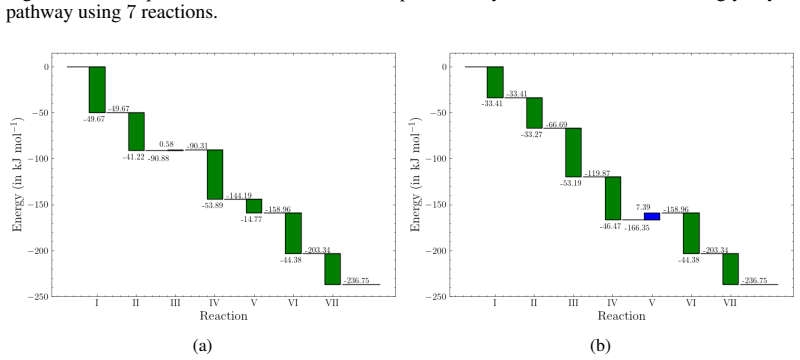
Measure the standard Gibbs energy of hydrolysis of xylulose-1,5-bisphosphate in buffer at pH 7; if it comes out negative rather than the reported +7.39 kJ/mol, the claimed thermodynamic bottleneck of the seven-reaction xylulose pathway disappears and its favorability ranking must be revised.
Extended reading notes
Core claim
The central claim is that the reaction network for non-oxidative glycolysis contains previously unnoticed thermodynamically favorable pathways, and that their favorability can be read off a per-reaction Gibbs free-energy profile computed from standard chemical potentials. On the paper's own terms, the discovery is a family of energy landscapes: for each enumerated mass-balanced pathway, each reaction has a computed Gibbs free energy change, and a pathway is judged feasible when every step is negative, or only mildly positive and correctable by concentration control. The shortest routes use only four enzyme activities—aldolase, aldose-ketose isomerase, phosphohydrolase, and phosphoketolase—and one of them, through xylulose-1,5-bisphosphate, avoids the sedoheptulose-7-phosphate accumulation that limited an earlier reported pathway. The paper also reports six seven-step routes from fructose 6-phosphate and water to two molecules of 3-hydroxypropionic acid, and argues that with only those four enzymes this product could dominate. Because the net reaction is fixed, all non-oxidative glycolysis pathways share one overall free-energy change of about −236.75 kJ/mol; what distinguishes them is the intermediate profile, and the paper claims the ranking of practical candidates is governed by where the positive-free-energy bottlenecks sit.
Load-bearing premise
The whole ranking rests on the computed standard chemical potentials being accurate enough to fix the sign of each reaction's free-energy change, and several decisive values are within a few kilojoules per mole of zero, so if those signs are wrong the claimed favorable pathways and bottlenecks change.
Editorial extensions
If this is right
- If the computed profiles are correct, a bioreactor running the seven-reaction xylulose-1,5-bisphosphate pathway would need only four enzyme activities and would never accumulate sedoheptulose-7-phosphate, the intermediate that bottlenecks an earlier reported route.
- The hydrolysis of the biphosphate is the recurring thermodynamic bottleneck: fructose-1,6-bisphosphate hydrolysis is barely downhill, while sedoheptulose-1,7-bisphosphate and xylulose-1,5-bisphosphate hydrolysis are uphill, so those steps set the concentration gradients a reactor must maintain.
- Pathways to 3-hydroxypropionic acid require fewer enzyme types than full non-oxidative glycolysis and are computed to be thermodynamically downhill overall, making 3-hydroxypropionic acid a plausible dominant product when only those four enzymes are present.
- Shortest pathways are not the only viable ones: an eight-reaction route using fructose-1,6-bisphosphate has just one mildly unfavorable step, so reaction count alone does not determine feasibility.
Reading between the lines
- If the near-zero free-energy values are sensitive to the estimation method, the ranking of the sedoheptulose-1,7-bisphosphate and xylulose-1,5-bisphosphate seven-reaction pathways could flip under realistic metabolite concentrations; the paper itself flags estimation errors as a concern, so this is an extension, not a claim.
- The xylulose-1,5-bisphosphate pathway's practicality hinges on one uncharacterized reaction—phosphoketolase acting on erythrulose-4-phosphate—so a targeted screen of phosphoketolase variants for that substrate is the direct experimental next step.
- A similar exhaustive free-energy map could be drawn for any fixed net transformation in the same expanded network, meaning the method is not limited to non-oxidative glycolysis; the paper does not make this generalization.
Signed reviews
Editorial analysis
A structured set of objections, weighed in public.
Referee Report
Summary. The paper constructs a reaction network for non-oxidative glycolysis by recursively applying graph-transformation rules for seven enzyme classes to starting metabolites, restricting the space to molecules with fewer than eight carbons (81 molecules, 414 reactions). It then formulates an integer linear program that enforces steady-state mass balance to enumerate pathways converting one fructose-6-phosphate and two phosphate molecules into three acetylphosphate molecules, and analogous routes to 3-hydroxypropionic acid. Standard chemical potentials are assigned by generating 3D structures with OpenBabel and UFF, optimizing them with GFN2-xTB, and computing thermochemical corrections with ALPB water; these are combined into ΔrG profiles. The paper reports two 7-reaction pathways (using SBP and XBP), an 8-reaction FBP pathway, and six 7-step routes to 3-HPA, labels certain reactions as thermodynamic bottlenecks (notably bisphosphate hydrolysis), and claims that several enumerated pathways are thermodynamically favorable alternatives to the experimentally reported routes. The text explicitly acknowledges several limitations: stereochemistry is omitted, concentrations are not modeled except in two illustrative ratios, and errors in estimated chemical potentials could change conclusions.
Significance. If the underlying ΔrG values are reliable, the paper offers a systematic and reproducible resource: the graph-grammar expansion and ILP enumeration are well defined, the search is independent of the thermodynamic scoring (so the favorability ranking is not fitted to the results), and the GitHub repository makes the enumeration checkable. The concrete predictions, including the 7-reaction XBP route and the 3-HPA pathways, are falsifiable in principle and explicitly flagged as contingent on an uncharacterized phosphoketolase activity. The main significance is therefore as a computational screen. Its value is currently limited because the decisive thermodynamic labels rest on xTB-computed signs with no uncertainty quantification, and the paper's own profiles show that every pathway has at least one positive-ΔrG step, which is a weaker notion of favorable than the abstract implies.
major comments (4)
- [§2.3–2.4, §3.2, Figs. 5–8] The thermodynamic classification is not robust to the accuracy of the xTB method, yet the near-zero values are used as decisive signs. In Section 3.2, fructose-1,6-bisphosphate hydrolysis is reported as −0.0322 kJ mol−1, sedoheptulose-1,7-bisphosphate hydrolysis as +0.576 kJ mol−1, and xylulose-1,5-bisphosphate hydrolysis as +7.386 kJ mol−1. The first two values are far below typical errors of semiempirical methods for phosphate reaction energies in water, and Section 2.4 itself states that 'errors in these estimations could lead to incorrect conclusions.' No error bars, benchmark against experimental reaction energies, conformer sampling, or solvent-model sensitivity analysis is provided. Since the sign of ΔrG determines which steps are called bottlenecks and which pathways are presented as favorable, the central claim of the abstract is not established at the stated precision. I request a quantitative sensitivity analysis and a rephrasing of the favorability conclusions.
- [Abstract, §§3.1–3.3] Every enumerated pathway contains at least one positive-ΔrG reaction; e.g., Section 3.1 reports SBP hydrolysis at +0.58 kJ mol−1 and XBP hydrolysis at +7.39 kJ mol−1, and Section 3.3 reports a +4.27 kJ mol−1 transaldolase step. The abstract's phrase 'thermodynamically favorable pathways' therefore cannot mean that all steps are spontaneous; it appears to mean only that the net overall reaction is negative. The paper should define the favorability criterion explicitly and reword the claim, otherwise the reader may infer a stronger result than the data support.
- [Fig. 2, §2.3] The command `xTB --uhf 1 --tight` shown in Figure 2 requests one unpaired electron. All metabolites listed in Tables 5 and 6 are closed-shell species, so this is either a typo (probably `--uhf 0`) or a systematic error in the electronic-structure calculation that would affect every ΔrG value. Please clarify and correct the command, and state the charge and spin multiplicity used for each molecule.
- [§2.1, §3.2, Fig. 6] Stereochemistry is omitted, so ribulose-5-phosphate and xylulose-5-phosphate have the same graph and the experimentally reported R5P→Ru5P→X5P sequence is compressed into a single isomerization. The paper acknowledges this in Section 2.1, but the thermodynamic profiles in Figure 6 and the comparison of the four reported pathways in Section 3.2 inherit this approximation. Please state explicitly where the missing stereochemical step enters the profiles and assess whether the bottleneck ranking could change if the two stereoisomers were distinguished.
minor comments (7)
- [§4 (Conclusion)] The sentence 'The larger Gibbs free energy difference makes the product, acetyl phosphate, e−236.75/−114.28 ∼8 times more likely to be observed' is not a valid calculation; the exponential of a ratio of ΔrG values in kJ/mol without RT is dimensionally wrong. Please replace it with the correct Boltzmann ratio at the relevant temperature.
- [§2.3 and §3.2] The text defines standard conditions as 273.15 K, but xTB's default thermostatistical temperature is 298.15 K and Section 3.2 uses 300 K for the concentration ratios. State the temperature used in the xTB calculations and make the notation consistent.
- [§2.2 and Table 2] The distinction between 'number of reactions' and 'number of unique reactions' is central to the enumeration counts, but Table 2 is difficult to parse; reformat it so that total-length and unique-reaction counts are unambiguous.
- [§3.4.1] The heading contains a typo: '3-hydroxypropioic acid' should be '3-hydroxypropionic acid.'
- [§2.4] The text 'frustose 6-phosphate' should be 'fructose 6-phosphate.'
- [§3.2] The sentence 'fructose-1,6-biphosphate hydrolysis has a negative Gibbs free energy difference of 0.0322 kJ mol−1' is easy to misread; use an explicit sign (−0.0322) and consider a table of all hydrolysis values.
- [Figs. 5, 6, 8, 10] The color coding of the bars (green versus blue) is described only in the text; please include the color legend in the figure captions for accessibility.
Circularity Check
No significant circularity: thermodynamic labels are computed from an external semiempirical method and the pathway enumeration is independent of the thermodynamics.
full rationale
The derivation chain is: (1) graph-grammar expansion of the molecular space using explicit reaction templates (Table 4), which are not fitted to pathway outcomes; (2) ILP search for mass-balanced pathways with F6P inflow and AcP outflow (Eqs. 4-8), independent of thermodynamic data; (3) assignment of standard chemical potentials via the external parameterized xTB/ALPB method (Section 2.3, Figure 2), with no parameters fitted to the non-oxidative glycolysis network; and (4) post-hoc evaluation of the enumerated pathways by computing ΔrG (Section 2.4). The claimed new pathways (the XBP route and the HPA routes) emerge from this pipeline and are not encoded as targets in the inputs. Comparisons to experimentally reported pathways from Bogorad et al. and Hellgren et al. provide an external benchmark. Self-citations to Pal et al. (2024, 2025) and Pal (2024) are contextual, pointing to alternative ILP formulations or supplementary data, and they are not load-bearing for the computed ΔrG values. No step reduces to its own inputs by construction. Caveats about xTB accuracy and near-zero ΔrG values (0.03-7.4 kJ/mol) are uncertainty and robustness concerns, not circularity.
Assumptions & free parameters
free parameters (2)
- xTB semiempirical parameter set (GFN2-xTB) =
External training set, GFN2-xTB parameters (Bannwarth et al. 2021)
- UFF force field parameters =
Universal force field (Rappe et al. 1992)
assumptions (4)
- domain assumption xTB at the GFN2 level gives accurate enough standard chemical potentials for phosphorylated sugars and small metabolites to determine Delta_rG signs.
- domain assumption The reactions occur in a well-stirred bioreactor at standard physical conditions with unit activities and no active transport or concentration gradients.
- domain assumption The seven graph transformation rules in Table 4 faithfully represent the enzymatic reaction chemistry, including phosphoketolase promiscuity, and stereochemistry can be ignored.
- ad hoc to paper Restricting the molecular space to molecules with fewer than eight carbon atoms does not exclude any relevant non-oxidative glycolysis pathway.
invented entities (1)
-
Phosphoketolase variant active on erythrulose-4-phosphate
Cite this review
Pith. "Pith review of Thermodynamic free energy map for the non-oxidative glycolysis pathways." pith.science (2026). https://pith.science/paper/ZYATB24B
@misc{pith2026250619841,
  author       = {Pith},
  title        = {Pith review of: Thermodynamic free energy map for the non-oxidative glycolysis pathways},
  year         = {2026},
  howpublished = {\url{https://pith.science/paper/ZYATB24B}},
  note         = {Machine review of arXiv:2506.19841}
}
read the original abstract
Designing reaction pathways that maximize the production of a target compound in a given metabolic network is a fundamental problem in systems biology. In this study, we systematically explore the non-oxidative glycolysis metabolic network, guided by the principle that reactions with negative Gibbs free energy differences are thermodynamically favored. We enumerate alternative pathways that implement the net non-oxidative glycolysis reaction, categorized by their length. Our analysis reveals several alternative thermodynamically favorable pathways beyond those reported in experiments. In addition, we identify molecules within the network, such as 3-hydroxypropionic acid, that may have significant potential for further investigation.
Figures


Figures from the paper (7 more)



Reference graph
Works this paper leans on
-
[5]
doi: 10.1038/nature12575. URL https://doi.org/10. 1038/nature12575. Joseph J. Bozell and Gene R. Petersen. Technology development for the production of biobased products from biorefinery carbohydrates—the US Department of Energy’s “Top 10” revisited.Green Chem., 12:539–554,
-
[8]
URLhttps://doi.org/10.1038/s41467-023-41135-7
doi: 10.1038/ s41467-023-41135-7. URLhttps://doi.org/10.1038/s41467-023-41135-7. John Hellgren, Alexei Godina, Jens Nielsen, and Verena Siewers. Promiscuous phosphoketolase and metabolic rewiring enables novel non-oxidative glycolysis in yeast for high-yield production of acetyl-coa derived products.Metabolic Engineering, 62:150–160,
-
[12]
URL https://doi.org/10.1038/ nature19769
doi: 10.1038/nature19769. URL https://doi.org/10.1038/ nature19769. Adittya Pal. supplementary data repository on github. https://github.com/AdittyaPal/PathwaysInNOG. git,
-
[19]
URL https://doi.org/10.1186/ s13321-019-0372-5
doi: 10.1186/s13321-019-0372-5. URL https://doi.org/10.1186/ s13321-019-0372-5. 18
-
[1992]
URLhttps://doi.org/10.1021/ja00051a040
doi: 10.1021/ja00051a040. URLhttps://doi.org/10.1021/ja00051a040. Ralf Steuer, Thilo Gross, Joachim Selbig, and Bernd Blasius. Structural kinetic modeling of metabolic networks.Proceedings of the National Academy of Sciences, 103(32):11868–11873,
-
[2004]
URL https: //doi.org/10.1007/s00253-003-1497-y
doi: 10.1007/s00253-003-1497-y. URL https: //doi.org/10.1007/s00253-003-1497-y. N. Yoshikawa and G.R. Hutchison. Fast, efficient fragment-based coordinate generation for open babel.J Cheminform, 11(49), August
-
[2006]
doi: 10.1073/pnas. 0600013103. URLhttps://www.pnas.org/doi/abs/10.1073/pnas.0600013103. Linh M. Tran, Matthew L. Rizk, and James C. Liao. Ensemble modeling of metabolic networks.Biophysical Journal, 95(12):5606–5617,
-
[2008]
doi: https://doi.org/10.1529/biophysj.108.135442
ISSN 0006-3495. doi: https://doi.org/10.1529/biophysj.108.135442. URL https://www.sciencedirect.com/science/article/pii/S0006349508819790. S. V ollenweider and C. Lacroix. 3-hydroxypropionaldehyde: applications and perspectives of biotechnological production.Appl Microbiol Biotechnol, 64:16–27,
Show all 19 references
-
[2010]
URLhttp://dx.doi.org/10.1039/B922014C
doi: 10.1039/B922014C. URLhttp://dx.doi.org/10.1039/B922014C. John Forrest, Ted Ralphs, Stefan Vigerske, Haroldo Gambini Santos, John Forrest, Lou Hafer, Bjarni Krist- jansson, jpfasano, EdwinStraver, Miles Lubin, Jan-Willem, rlougee, jpgoncal1, Samuel Brito, h-i gassmann, Cri...
-
[2013]
URLhttps://doi.org/10.1186/1759-2208-4-4
doi: 10.1186/1759-2208-4-4. URLhttps://doi.org/10.1186/1759-2208-4-4. Jakob L. Andersen, Christoph Flamm, Daniel Merkle, and Peter F. Stadler.A Software Package for Chemically Inspired Graph Transformation, pages 73–88. Springer International Publishing, Cham,
-
[2014]
URLhttps://journals.asm.org/doi/abs/10.1128/aem.02361-14
doi: 10.1128/AEM.02361-14. URLhttps://journals.asm.org/doi/abs/10.1128/aem.02361-14. Christoph Bannwarth, Eike Caldeweyher, Sebastian Ehlert, Andreas Hansen, Philipp Pracht, Jakob Seibert, Sebastian Spicher, and Stefan Grimme. Extended tight-binding quantum chemistry methods.W...
-
[2016]
doi: 10.1007/978-3-319-40530-8_5
ISBN 978-3-319-40530-8. doi: 10.1007/978-3-319-40530-8_5. Jakob L. Andersen, Christoph Flamm, Daniel Merkle, and Peter F. Stadler. Rule composition in graph transfor- mation models of chemical reactions.MATCH, Communications in Mathematical and in Computer Chem- 16 istry, 80(3...
-
[2018]
URL https://febs.onlinelibrary.wiley.com/doi/abs/10.1111/febs.14682
doi: https://doi.org/10.1111/febs.14682. URL https://febs.onlinelibrary.wiley.com/doi/abs/10.1111/febs.14682. W. Liebermeister and E. Klipp. Bringing metabolic networks to life: convenience rate law and thermodynamic constraints.Theor Biol Med Model, 41, 2006a. doi: 10.1186/17...
-
[2019]
URL https://doi.org/10.1038/s42004-019-0224-2
doi: 10.1038/s42004-019-0224-2. URL https://doi.org/10.1038/s42004-019-0224-2. Jan L. Krüsemann, Steffen N. Lindner, Marian Dempfle, Julian Widmer, Stephanie Arrivault, Marine Debacker, Hai He, Armin Kubis, Romain Chayot, Macha Anissimova, Philippe Marlière, Charles A. R. Cott...
-
[2020]
doi: https://doi.org/10.1016/j.ymben
ISSN 1096-7176. doi: https://doi.org/10.1016/j.ymben. 2020.09.003. URL https://www.sciencedirect.com/science/article/pii/S1096717620301373. Jos J. A. G. Kamps, Richard J. Hopkinson, Christopher J. Schofield, and Timothy D. W. Claridge. How formaldehyde reacts with amino acids....
2020 doi
-
[2021]
URL https://wires.onlinelibrary.wiley.com/doi/abs/10.1002/wcms.1493
doi: https://doi.org/10.1002/wcms.1493. URL https://wires.onlinelibrary.wiley.com/doi/abs/10.1002/wcms.1493. Igor W. Bogorad, Tzu-Shyang Lin, and James C. Liao. Synthetic non-oxidative glycolysis enables complete carbon conservation.Nature, 502:693–697,
-
[2023]
Likun Guo, Min Liu, Yujia Bi, Qingsheng Qi, Mo Xian, and Guang Zhao
URLhttps://doi.org/10.5281/zenodo.10041724. Likun Guo, Min Liu, Yujia Bi, Qingsheng Qi, Mo Xian, and Guang Zhao. Using a synthetic machinery to improve carbon yield with acetylphosphate as the core.Nature Communications, 14,
-
[2024]
Adittya Pal, Rolf Fagerberg, Jakob Lykke Andersen, Peter Dittrich, and Daniel Merkle
URLhttps://arxiv.org/abs/2411.15900. Adittya Pal, Rolf Fagerberg, Jakob Lykke Andersen, Peter Dittrich, and Daniel Merkle. Finding pathways in reaction networks guided by energy barriers using integer linear programming,
-
[2025]
URL https: //arxiv.org/abs/2504.10609. 17 A. K. Rappe, C. J. Casewit, K. S. Colwell, W. A. III Goddard, and W. M. Skiff. Uff, a full periodic table force field for molecular mechanics and molecular dynamics simulations.Journal of the American Chemical Society, 114 (25):10024–10035,
Reviewed August 15, 2026 · model on record in the stance chip above.
Discussion (0). Continue with ORCID to comment.