Pith. sign in

REVIEW 3 major objections 5 minor 4 references

Cluster structures in mixed Grassmanianns

T0 review · 3 major / 5 minor · reviewed 2026-08-06 · deepseek-v4-flash

Pith's one-line read Every d-admissible mixed Plücker ring, odd d and n>d^2, is a cluster algebra.

desk verdict A serious, detailed construction of cluster structures on mixed Grassmannians for odd d that deserves a careful referee, with the main external-input risk concentrated in the marked-boundary variant of Demazure weaves. read the letter →

arxiv 2506.20038 v1 pith:J26IRQ2G submitted 2025-06-24 math.CO math.ACmath.RT

classification math.COmath.ACmath.RT MSC 13F6005E9913A5014M1515A7215A75
keywords clusteralgebramixedGrassmannianPlückerringDemazureweavesignatureLusztigcycleamalgamationinvarianttheory
verification ladder T0 review T1 audit T2 compute T3 formal

The pith

A machine-rendered reading of the paper's core claim, the machinery that carries it, and where it could break.

The reading

The paper aims to prove that every mixed Grassmannian — the configuration space of a vectors and b covectors in a d-dimensional complex vector space, modulo the special linear group — has a natural cluster algebra structure whenever the cyclic ordering of the entries (the signature) is d-admissible. The main theorem states that for odd d and n = a + b > $d^{2}$, the mixed Plücker ring R_σ is exactly the explicit cluster algebra A_σ built from an amalgamated pair of Demazure weaves. This matters because cluster structures organize the invariant ring's generators and relations into mutation dynamics, and earlier constructions covered only dimension 3 or separated signatures; the result extends them to all odd dimensions and all admissible orderings. The construction is natural in a strong sense: every Weyl generator (the Plücker coordinates, dual Plücker coordinates, and pairings that generate R_σ) appears as a cluster or frozen variable, and the structure specializes to the classical Grassmannian, tensor-diagram, and mixed plabic graph cases.

What carries the argument

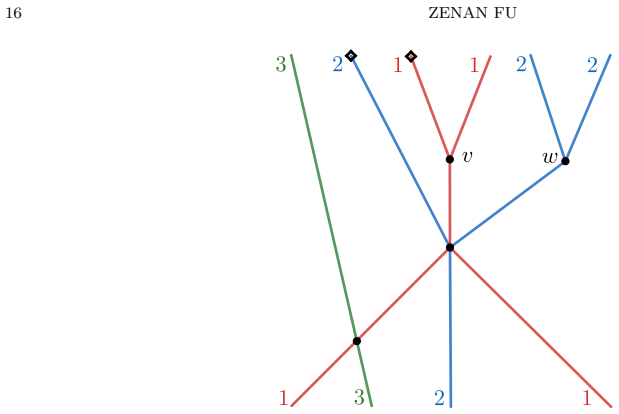
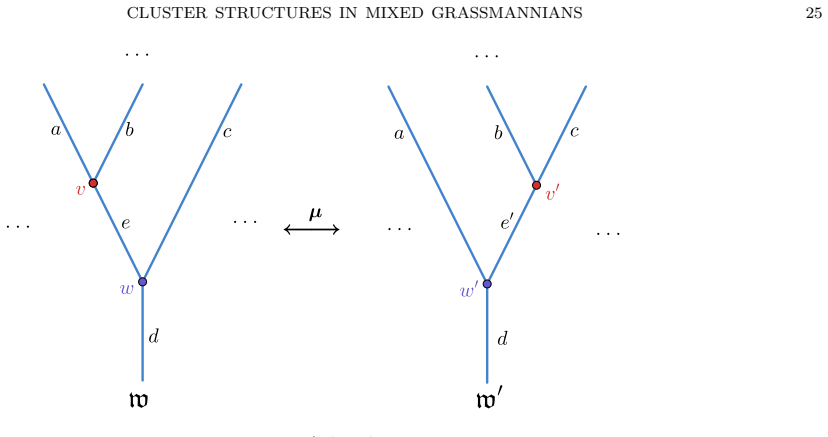
The central machinery is the Demazure weave: a planar graph in a rectangle, with edges colored by 1,...,d−1, oriented from top to bottom, whose only allowed internal vertices are trivalent, 4-valent, and 6-valent configurations. A reduced Demazure weave yields a seed whose vertices are Lusztig cycles (certain oriented weighted subgraphs), whose arrows are intersection pairings between cycles, and whose cluster variables are cycle weights; a classification theorem ensures that any two reduced weaves with the same top and bottom words are mutation equivalent. To reach mixed Grassmannians, the paper cuts the signature word into two halves, forms two such weaves, and stitches them along reversed bottom words, amalgamating the seeds; odd d is exactly what makes the frozen variables match without a sign error. A supporting algebraic device is the mixed wedge operator, which is a wedge or an intersection depending on total degree and simplifies the cluster-variable formulas and exchange relations.

What would settle it

Compute all algebraic relations among the claimed cluster and frozen variables for a small d-admissible signature with odd d and n > $d^{2}$, and check whether the extended cluster has full transcendence degree d(n−d)+1 and whether its generated ring equals R_σ; a single nontrivial relation among the initial cluster variables, or a Weyl generator that never appears in any mutated seed, would refute the theorem.

Watch

Extended reading notes

Core claim

At the center of the paper is the equality R_σ = A_σ. For a d-admissible signature σ with d odd and n > $d^{2}$, the paper defines A_σ by cutting the cyclic word β_σ at any valid cut (p,q), choosing two reduced Demazure weaves whose bottom words are reverses of each other, amalgamating their seeds along common frozen variables, and declaring the resulting cluster algebra independent of the choices. The paper proves that the amalgamated seed is well defined, counts its cluster variables, computes all exchange relations, shows that every Weyl generator occurs among cluster and frozen variables, and then argues by two routes, one via a factorial-subalgebra criterion and one via the Starfish lemma, that the cluster variables generate all of R_σ. Thus the mixed Plücker ring carries an explicit, signature-dependent cluster structure, not merely a birational one.

Load-bearing premise

The proof rests on the cited classification of Demazure weaves, that any two reduced weaves with the same top and bottom words are mutation equivalent, and on the lemmas that the two halves can be amalgamated with algebraically independent cluster variables; if that classification or those lemmas fail for the weaves used here, the cluster algebra A_σ would not be well defined.

Editorial extensions

If this is right

  • For every odd d and n > d^2 with d-admissible σ, the invariant ring R_σ is generated by an explicit cluster seed, so all its generators and relations are controlled by quiver mutation.
  • The same construction recovers the standard Grassmannian cluster structure when b = 0, the d = 3 tensor-diagram cluster structures, and the mixed plabic graph cluster structures for separated signatures.
  • The cluster structure is independent of arbitrary choices: different valid cuts and different reduced weaves give mutation-equivalent seeds, and the structure is invariant under cyclic shifts of the signature.
  • For separated signatures with a, b ≥ d−1 and n ≥ 2d, an analogous cluster structure exists, relaxing the n > d^2 bound.
  • The extended cluster of the initial seed has d(n−d)+1 elements, matching the dimension of the mixed Grassmannian.

Reading between the lines

Editorial extensions of the paper, not claims the author makes directly.

  • The n > d^2 hypothesis looks like a proof-technical bound rather than a structural boundary; the paper's own d = 3 example with n = 8 works below d^2, so a plausible next step is lowering the bound for all d by finding the Weyl generators more efficiently.
  • The reliance on odd d is tied to a sign in cyclic symmetry; a sign-curve adaptation, mentioned in the paper as a possibility, would be the natural route to extend the theorem to even d.
  • If seed independence holds generally, the amalgamated-weave method could be pushed to the conjectural setting of invariant rings of extensors of arbitrary levels, where the paper proposes a parallel cluster structure.
  • A concrete robustness test is whether the exchange relations computed in the paper, together with the once-mutated variables, generate R_σ without invoking the full Demazure classification theorem.
Share X Bluesky LinkedIn Reddit HN

Editorial analysis

A structured set of objections, weighed in public.

Desk editor's note, referee report, and a circularity audit.

Referee Report

3 major / 5 minor

Summary. The paper constructs, for any odd d, any d-admissible signature σ of type (a,b), and n = a+b > d^2, an explicit cluster algebra A_σ inside the fraction field of the mixed Plücker ring R_σ(V), and proves that R_σ(V) = A_σ. The construction cuts the cyclic word β_σ at a valid cut (p,q), builds two reduced Demazure weaves with reversed bottom words, amalgamates their seeds along common frozen variables, and shows the resulting cluster algebra is independent of the cut. The proof combines the classification of Demazure weaves (Theorem 2.62), a detailed analysis of an initial weave and its quiver, and two applications of results from [GLS13], including the Starfish lemma. The paper also recovers Scott's Grassmannian cluster structure, Fomin–Pylyavskyy's tensor-diagram structures for d = 3, and Carde's mixed plabic graph structures for separated signatures.

Significance. If the central result is correct, it settles the Fomin–Pylyavskyy conjecture for all odd dimensions and all d-admissible signatures under the mild size condition n > d^2, and it gives a unified weave-theoretic framework for previously disparate cluster structures. The paper is remarkable for its explicitness: the initial seed, the cluster and frozen variables, and the exchange relations are written down in closed form in Propositions 4.33 and 4.40, and the quiver mutations are described locally. The two proofs of the main theorem, one via [GLS13, Theorem 1.4] and one via the Starfish lemma, are conceptually clean. The manuscript does not ship machine-checked proofs, but the combinatorial arguments are organized so that the remaining verification is largely local and checkable.

major comments (3)
  1. [§2.4, Remark 2.38; §3.3–3.4, Theorems 2.62 and 3.54, Definitions 3.58 and 3.66] The well-definedness of A_σ depends on the claim that any two reduced Demazure weaves with the same marked top word and reversed bottom words give mutation-equivalent seeds. This is Theorem 3.54, whose proof is entirely delegated to the external classification theorem Theorem 2.62, cited from [Cas+24, Theorem 4.12]. However, Remark 2.38 explicitly states that the paper's notion of Demazure weave differs from the literature by allowing a designated set of marked boundary vertices on the top boundary, which generate extra frozen cycles. If [Cas+24, Theorem 4.12] is proved only for the unmarked or differently marked weaves of that paper, then the mutation equivalence of the two weaves w1 and w2 in Definition 3.58 has not been established for the objects actually used here. Since Proposition 3.65 and Definition 3.66 both rest on this equivalence, the central object A_σ may not be well-defined unless a marked-boundary version of the classification theorem is supplied. The manuscript should either prove that version or give a precise statement of where [Cas+24] treats marked boundary vertices and how the marking is transported.
  2. [§3.4, Definition 3.59, Lemma 3.63; §4.4, Lemma 4.52] Definition 3.59 defines the amalgamated seed Σ_σ(p,q) only after Lemma 3.63, which asserts that the two seeds Σ_1 and Σ_2 can be amalgamated along z0, and Lemma 4.52, which asserts that the resulting extended cluster is algebraically independent. Both lemmas are deferred to later sections, and Remark 3.48 explicitly concedes that Σ(w) is not yet known to be a seed at that point. This is acceptable only if the later proofs do not themselves rely on Theorem 3.67 or on the well-definedness of A_σ. The paper should state the dependency graph explicitly and indicate the exact place where algebraic independence of the amalgamated cluster is proved without circularity.
  3. [§4.3, after Proposition 4.40] The text states that for r = d−1 and i ∈ [2, m1−r−1] the local pictures are analogous to Propositions 4.39 and 4.40 and that their explicit examination is omitted. This family is not a negligible special case: the second proof of Theorem 3.67 invokes the once-mutated cluster variables calculated in Section 4.3 to apply the Starfish lemma, and the initial seed for the amalgamated cluster algebra includes the bottom strip. If the exchange relations for this family are not written down, the claim that all once-mutated cluster variables lie in R_σ is not fully verified. Please include the missing local pictures and exchange relations, or give a precise reduction showing that the omitted cases are covered verbatim by the formulas already proved.
minor comments (5)
  1. [Title and Abstract] The title contains a typo: 'Grassmanianns' should presumably be 'Grassmannians' or 'Grassmannian'.
  2. [§2.4, Definition 2.57] In the 0-Hecke monoid relation, 'τ^2_i = τ' is missing a subscript; it should be 'τ_i^2 = τ_i'.
  3. [Acknowledgment] The name 'Casals Roger' should be 'Roger Casals'.
  4. [§2.5, proof of Lemma 2.55] The word 'troplicalizing' in the computation is a typo for 'tropicalizing'.
  5. [§2.2, Definition 2.21] The isomorphism R_σ(V) ≅ R_{a,b}(V) is stated but not proved; a one-line argument identifying the permutation of factors would help the reader.

Circularity Check

0 steps flagged · score 0.0 of 10

No circularity: the central equality R_sigma = A_sigma is established by independent two-way containment, with external classification theorems as inputs rather than restatements.

full rationale

The derivation is self-contained in the relevant sense. The cluster algebra A_sigma is defined from purely combinatorial Demazure-weave data (quivers from Lusztig cycles and variables Delta_gamma as SL(V)-invariant rational functions on the decorated flag moduli space M(beta_sigma)), not from the mixed Plucker ring R_sigma itself. The isomorphism M(beta_sigma) = V_sigma \ {f = 0} (Theorem 3.38) gives a birational identification of the ambient fields, but the cluster variables are then independently shown to lie in R_sigma (Corollary 4.36), the Weyl generators are shown to be cluster or frozen variables in A_sigma (Section 4.4), giving R_sigma subset of A_sigma, and the reverse inclusion is obtained via the cited GLS13 theorem and the Starfish lemma (Section 4.5). This is a genuine two-way containment proof, not a definitional identity. The main external inputs, especially the classification theorem for reduced Demazure weaves (Theorem 2.62, cited from Casals-Gorsky-Gorsky-Simental), are results from other authors and do not themselves assert R_sigma = A_sigma; they are used to guarantee mutation equivalence of seeds and hence well-definedness of the cluster structure. The deferred algebraic-independence lemmas (Lemma 3.63 and Lemma 4.52) are internal postponements explicitly flagged in Remark 3.48, where the paper states that 'strictly speaking we cannot call Sigma(w) a seed' until independence is proved and defines mutation equivalence combinatorially in the meantime; this is a proof organizational device, not circularity. The skeptical concern about the marked-boundary variant of Demazure weaves possibly not being covered by the cited classification theorem is a correctness or applicability risk, not a circularity: even if that theorem does not apply verbatim, the paper would have an unproved hypothesis, but it would not be reducing the conclusion to its own assumptions by construction. There is no fitted parameter renamed as a prediction, no self-citation chain carrying the argument, and no known result merely relabeled as a new structure. Consequently the circularity score is 0.

Assumptions & free parameters 0 free parameters · 7 assumptions · 0 invented entities

The paper introduces combinatorial gadgets such as d-admissible signatures, marked boundary vertices, and amalgamated Demazure weaves, but these are not new physical entities. There are no free numerical parameters fitted to data; the cluster structures are constructed explicitly from the chosen signature and weave data.

assumptions (7)
  • domain assumption The dimension d is odd.
    Requirement ensures that cyclic shifts of the signature preserve the set of Plücker variables up to a consistent sign, as explained in Section 1.2 and Remark 3.61.
  • domain assumption The size condition n > d^2 holds.
    Used in Section 4.4 to prove that all Weyl generators for R_sigma appear as cluster or frozen variables; the author notes this can be relaxed for separated signatures.
  • domain assumption The signature sigma is d-admissible.
    Definition 2.5 ensures that the contiguous subsequences defining the decorated flags F_j^k exist and terminate; this is used throughout Section 3.1 and later.
  • domain assumption Classification of reduced Demazure weaves (Theorem 2.62, from [Cas+24]).
    Guarantees that any two reduced Demazure weaves with the same top and bottom words are mutation equivalent, which the paper uses to show A_sigma is independent of weave choices.
  • standard math GLS13 Theorem 1.4 relates cluster algebras to factorial subalgebras.
    Used in Section 4.5 as one of the two final steps to prove R_sigma = A_sigma.
  • standard math Starfish Lemma (Proposition 2.31, from [FP16]).
    Provides sufficient conditions, including coprime cluster variables, to identify a cluster algebra with a normal domain.
  • standard math R_sigma is a finitely generated UFD (Lemma 2.24, from [VP89]).
    Needed to apply the Starfish lemma and GLS13 in the proof of the main theorem.

how reviews work

0 comments
Cite this review

Pith. "Pith review of Cluster structures in mixed Grassmanianns." pith.science (2026). https://pith.science/paper/J26IRQ2G

@misc{pith2026250620038,
  author       = {Pith},
  title        = {Pith review of: Cluster structures in mixed Grassmanianns},
  year         = {2026},
  howpublished = {\url{https://pith.science/paper/J26IRQ2G}},
  note         = {Machine review of arXiv:2506.20038}
}
read the original abstract

Generalizing the results by Fomin-Pylyavskyy and Carde, we construct a family of natural cluster structures in the coordinate ring of a mixed Grassmannian, the configuration space of tuples of several vectors and covectors in a finite-dimensional complex vector space. We describe and explore these cluster structures using the machinery of weaves introduced by Casals and Zaslow.

Figures

Figures reproduced from arXiv: 2506.20038 by the authors.

Figure 1
Figure 1. Example of a (cyclic) signature with six vertices. Definition 2.4. Let σ be a signature. For j ∈ Z and k ∈ [0, d − 1], let j ′ ≥ j be the smallest integer (if exists) such that j X′ i=j σ(i) ≡ k mod d. We define j ′ := ∞ if no such j ′ exists. Let ℓ(σ, j, k, d) := j ′ − j + 1. In other words, ℓ(σ, j, k, d) is the minimal length of a contiguous subsequence starting at j whose partial sums of σ modulo d equal k (and ℓ… view at source ↗
Figure 2
Figure 2. Example of a quiver. Definition 2.26. Let z be a mutable vertex in a quiver Q. The quiver mutation is a transformation that turns Q into new quiver Q′ = µz(Q) defined as follows: for each pair of directed edges x → z → y, add a new edge x → y; then reverse all the edges incident to z; finally, remove all oriented 2-cycles until we are not able to do so. An example of quiver mutation is given in [PITH_FULL_IMAGE:fig… view at source ↗
Figure 3
Figure 3. Example of a quiver mutation at z [PITH_FULL_IMAGE:figures/full_fig_p011_3.png] view at source ↗
Figures from the paper (52 more)
Figure 4
Figure 4. Figure 4: u z v u z ′ v x y x y µz 7−→ [PITH_FULL_IMAGE:figures/full_fig_p012_4.png]
Figure 5
Figure 5. Figure 5: Quivers Q1 (left) and Q2 (right). Then Σ1 and Σ2 can be amalgamated along z0 = z1 ∩ z2 = {x7, x8}. The amalgamated seed Σ = Σ1 ⨿z0 Σ2 = (Q, z), where Q is shown in [PITH_FULL_IMAGE:figures/full_fig_p013_5.png]
Figure 6
Figure 6. Figure 6: The quiver of the amalgamated seed. Remark 2.34. Amalgamation has the following important properties. • Commutation with mutations. With the same notation as in Definition 2.32, let z ∈ z1 be a cluster variable. Then µz(Σ1) ⨿z0 Σ2 = µz(Σ1 ⨿z0 Σ2). • Associativity. Let …
Figure 7
Figure 7. Figure 7: Allowable vertex types in a weave. For a 3-valent vertex, all labels must be of the same color. For a 4-valent vertex, the labels must alternate between two non-adjacent different colors. For a 6-valent vertex, the labels must alternate between two adjacent colors. Exa…
Figure 8
Figure 8. Figure 8: An example of a 4-weave. Weaves can be used to construct cluster structures in algebraic varieties. While for general weaves, there is no known procedure for doing this, there is a special family of weaves, called Demazure weaves, that allow this kind of construction. …
Figure 9
Figure 9. Figure 9: A Demazure 4-weave homeomorphic to the weave in [PITH_FULL_IMAGE:figures/full_fig_p016_9.png]
Figure 10
Figure 10. Figure 10: Row word transformations via vertex crossings. Dashed lines: scanning lines. The last two transformations are called braid moves. Let β, β′ be two words. We say that they are braid equivalent, denoted by β ∼ β ′ , if they are related by a sequence of braid moves. Noti…
Figure 11
Figure 11. Figure 11: Edge labelings around trivalent, 4-valent and 6-valent vertices. Such a (Lusztig) cycle γ can be interpreted as an oriented weighted subgraph Gγ of w. An edge e in w belongs to Gγ if γ(e) ̸= 0; its weight is equal to γ(e). Graphically cycles follow the rules shown in …
Figure 12
Figure 12. Figure 12: Local rules for a cycle. A thickened edge indicates that the value of the cycle on that edge is 1; otherwise the value is 0. Definition 2.45. A cycle is frozen if it meets with a boundary vertex. Otherwise it is mutable. Notice that there are two types of frozen cycle…
Figure 13
Figure 13. Figure 13: Cycles in the Demazure 4-weave from [PITH_FULL_IMAGE:figures/full_fig_p018_13.png]
Figure 14
Figure 14. Figure 14: Trivalent and 6-valent vertices with edges labeled. Definition 2.47 ([Cas+23, Definition 2.28]). Let Vw denote the set of internal vertices in a weave w. For any two cycles γ, γ′ , their intersection pairing is defined by (2.3) ⟨γ, γ′ ⟩ := X v∈Vw ⟨γ, γ′ ⟩v, where we u…
Figure 15
Figure 15. Figure 15: Quiver interpretation of intersection pairing of cycles at trivalent and 6-valent vertices [PITH_FULL_IMAGE:figures/full_fig_p019_15.png]
Figure 16
Figure 16. Figure 16: The quiver Q(w) associated with the Demazure weave w shown in [PITH_FULL_IMAGE:figures/full_fig_p020_16.png]
Figure 17
Figure 17. Figure 17: Equivalence moves with only 4-valent and 6-valent vertices. (ii) [Pushthrough from below.] Suppose that |i − j| = 1. Then the partial weaves ijij ⇒ jijj ⇒ jij and ijij ⇒ iiji ⇒ iji ⇒ jij (cf [PITH_FULL_IMAGE:figures/full_fig_p021_17.png]
Figure 18
Figure 18. Figure 18: Pushthrough from below, |i − j| = 1. (ii′ ) [Pushthrough from above.] Suppose that |i−j| = 1. Then the partial weaves ijii ⇒ iji ⇒ jij and ijii ⇒ jiji ⇒ jjij ⇒ jij (cf [PITH_FULL_IMAGE:figures/full_fig_p021_18.png]
Figure 19
Figure 19. Figure 19: Pushthrough from above, |i − j| = 1. (iii) Suppose that |i − j| > 1. Then the partial weaves iji ⇒ iij ⇒ ij ⇒ ji and iji ⇒ jii ⇒ ji (cf [PITH_FULL_IMAGE:figures/full_fig_p022_19.png]
Figure 20
Figure 20. Figure 20: ) are equivalent. In other words, one can move a j-colored strand through an i-colored trivalent vertex [PITH_FULL_IMAGE:figures/full_fig_p022_20.png]
Figure 21
Figure 21. Figure 21: Local mutation move [PITH_FULL_IMAGE:figures/full_fig_p022_21.png]
Figure 22
Figure 22. Figure 22: Two Demazure weaves related by a Pushthrough from below. Using the definition of (Lusztig) cycles (cf. 2.44), we have γ ′ (h) = min{γ ′ (g), γ′ (f)} = min{min{γ ′ (a), γ′ (e)}, γ′ (c) + γ ′ (b) − min{γ ′ (b), γ′ (d)}} = min{γ(a), γ′ (e), γ(c) + γ(b) − min{γ(b), γ(d)}}…
Figure 23
Figure 23. Figure 23: A local mutation move. Definition 2.57. Let d ∈ Z>0. The 0-Hecke monoid Hd 0 has generators τi , i ∈ [1, d − 1] and relations τ 2 i = τ ; τiτj = τjτi , |i − j| > 1; τiτi+1τi = τi+1τiτi+1. (2.4) A reduced word for an element δ ∈ Hd 0 is defined to be the shortest seque…
Figure 24
Figure 24. Figure 24: Decoration around a 4-valent vertex (left) and at a 6-valent vertex (right). • If v is 6-valent. By duality (cf. Remark 3.25), we may assume that it is the case of i(i + 1)i ⇒ (i + 1)i(i + 1), cf [PITH_FULL_IMAGE:figures/full_fig_p042_24.png]
Figure 25
Figure 25. Figure 25: Two decorated Demazure weaves related by a single local move Pushthrough from below. dynamics, see Example 3.64. This step-by-step walkthrough demonstrates how a decorated De￾mazure weave explicitly determines a cluster seed, bridging the combinatorial topology of wea…
Figure 26
Figure 26. Figure 26: A local mutation move. Now we need to show that the seeds associated with mutation equivalent Demazure weaves are mutation equivalent. Since equivalence move does not change seeds, we only need to show that under a single mutation move (cf [PITH_FULL_IMAGE:figures/fu…
Figure 27
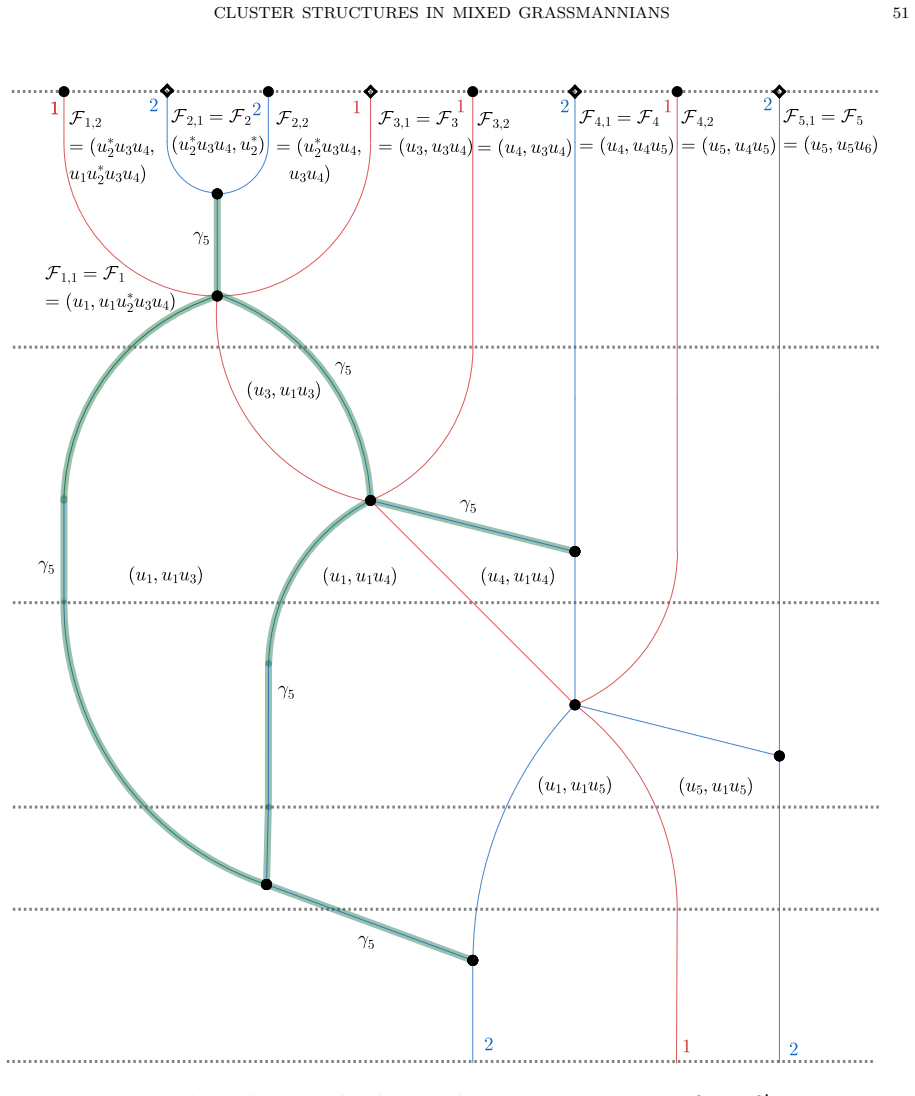
Figure 27. Figure 27: A decorated Demazure weave w1 : β1 ⇒ β ′ 1 = 212. The mixed wedge operators are omitted. For example, u1u ∗ 2u3u4 stands for u1 ⋏ u ∗ 2 ⋏ u3 ⋏ u4 [PITH_FULL_IMAGE:figures/full_fig_p049_27.png]
Figure 28
Figure 28. Figure 28: Cycles γ1, γ2, γ3, γ4, γ6, γ7, γ8, γ9 for the decorated Demazure weave w1 : β1 ⇒ β ′ 1 = 212 from [PITH_FULL_IMAGE:figures/full_fig_p050_28.png]
Figure 29
Figure 29. Figure 29: The cycle γ5 in the decorated Demazure weave w1 : β1 ⇒ β ′ 1 = 212 from Figures 27 and 28. We next construct the seed Σ(w1) = (Q1, z1) associated with w1, as described in Definition 3.47. Let i denote the vertex of the quiver corresponding to the cycle γi , and let ∆i…
Figure 30
Figure 30. Figure 30: The quiver Q1 = Q(w1) associated with w1. The extended cluster z1 is computed by Definition 3.41: ∆1 = u ∗ 2 (u1), ∆2 = u ∗ 2 (u3), ∆3 = det(u3, u4, u5), ∆4 = det(u4, u5, u6), ∆5 = det(u1, u3, u4), ∆6 = det(u1, u4, u5), ∆7 = det(u1, u5, u6), ∆8 = u ∗ 2 (u4), ∆9 = (u1 …
Figure 31
Figure 31. Figure 31: The quiver Q2 = Q(w2) associated with w2. The exchange relations are ∆14∆′ 14 = ∆10 + ∆11∆15, where ∆′ 14 = det(u6, u8, u1); ∆15∆′ 15 = ∆13∆14∆18 + ∆10∆16, where ∆′ 15 = u5 ⋏ u6 ⋏ u ∗ 7 ⋏ u1 ⋏ u ∗ 2 ⋏ u3 ⋏ u4; ∆17∆′ 17 = ∆10 + ∆12∆18, where ∆′ 17 = u ∗ 7 (u1). Similar…
Figure 32
Figure 32. Figure 32: The quiver Q amalgamated from Q1 and Q2 along the subset {7 = 18, 9 = 16}. Proposition 3.65. The cluster algebra Aσ(p, q) does not depend on the choice of the valid cut (p, q). Proof. See Section 4.1. □ Definition 3.66. The cluster algebra Aσ associated with σ is defi…
Figure 33
Figure 33. Figure 33: A (local) weave w : I i d−2 I i d−1 ⇒ I i d−1 I i+1 d−1 , 1 ≤ i ≤ d − 2 [PITH_FULL_IMAGE:figures/full_fig_p056_33.png]
Figure 34
Figure 34. Figure 34: A (local) weave w : I i k I i d−1 ⇒ I i d−1 I i+1 k+1, 1 ≤ i ≤ k < d − 2 [PITH_FULL_IMAGE:figures/full_fig_p056_34.png]
Figure 35
Figure 35. Figure 35: A (local) weave w : I j−1 i I i j ⇒ I i+1 j I j i . Combining with the rest of the interval words, we get a Demazure weave T ⇒ I d−k d−k I d−k d−k+1 · · · I d−k d−1 I d−1 d−k−1 I d−1 d−k−2 · · · I d−1 1 ⇒ I d−1 d−1 I d−1 d−2 · · · I d−1 d−k I d−1 d−k−1 I d−1 d−k−2 · ·…
Figure 36
Figure 36. Figure 36: A decorate Demazure 4-weave w : T +ρ ⇒ T +. It can be interpreted as a decorated Demazure weave in two different ways, one is viewing T +ρ as the top and T + as the bottom; the other is viewing ρ ←− T +as the top and ←− T + as the bottom. They correspond to the weave …
Figure 37
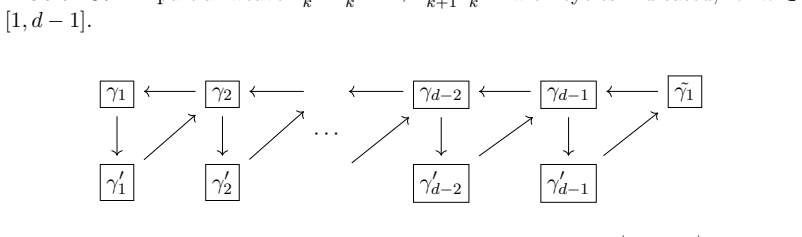
Figure 37. Figure 37: A partial weave I d−1 k I d−1 k ⇒ I d−1 k+1 I d−1 k with cycles indicated, for k ∈ [1, d − 1]. γ1 γ2 γd−2 γd−1 γ˜1 γ ′ 1 γ ′ 2 γ ′ d−2 γ ′ d−1 · · · [PITH_FULL_IMAGE:figures/full_fig_p062_37.png]
Figure 38
Figure 38. Figure 38: Quiver Q associated with the weave w : T +ρ ⇒ T +. The following lemma is needed for Lemma 4.12, and will be proved in Section 4.2. Lemma 4.11. Let (p, q) be a valid cut of σ (cf. Definition 3.56). Let w(p, q) : β(p, q) ⇒ T + be a Demazure weave as in Definition 3.58.…
Figure 39
Figure 39. Figure 39: Concatenating w(p, q) with w(p, q, q + 1). i.e., we have (4.1) Σ(w(p, q + 1)) ∼ Σ(w(p, q)) ⨿z0 Σ(p, q, q + 1). Here Σ(w(p, q)) (resp. Σ(w(p, q + 1))) is the seed associated with the Demazure weave w(p, q) : β(p, q) ⇒ T + (resp. w(p, q + 1) : β(p, q + 1) ⇒ T +) as in D…
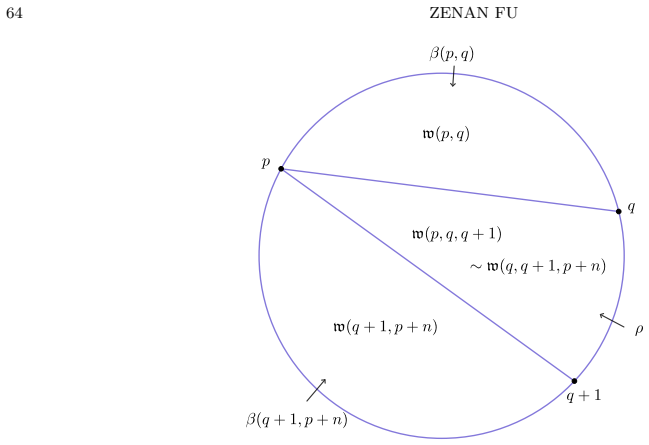
Figure 40
Figure 40. Figure 40: Amalgamating three decorated Demazure weaves in two different ways. They result in the same seeds. Similarly we can show that (4.2) Σ(w(q, p + n)) ∼ Σ(w(q + 1, p + n)) ⨿z ′ 0 Σ(q, q + 1, p + n), where z ′ 0 = {F1 p ∧ Fd−1 q+1 , F 2 p ∧ Fd−2 q+1 , . . . , F d−1 p ∧ F1 …
Figure 41
Figure 41. Figure 41: X-patches I j i I i j ⇒ I i+1 j I j i (left) and I i j I j i ⇒ I j−1 i I i j (right). Finally, notice that A(p, q) = A(p + 1, q + 1) and A(p, q) = A(p, q′ ) implies that A(p, q) does not depend on the choice of the cut (p, q). □ 4.2. An initial weave for Aσ. In this s…
Figure 42
Figure 42. Figure 42: An H-patch I j i I j i ⇒ I j i+1I j i and Y -patch I i j I i j ⇒ I j−1 i I i j [PITH_FULL_IMAGE:figures/full_fig_p066_42.png]
Figure 43
Figure 43. Figure 43: An H-patch I i j I i j ⇒ I i j−1 I i j and Y -patch I i j I j i ⇒ I i+1 j I j i . We note that the nested word TsTs+1 · · · Tm is not necessarily complete (cf. Definition 4.1). Definition 4.16 (Construction of Strip(β)). Let β = T1T2 · · · TsTs+1 · · · Tm be a weakly …
Figure 44
Figure 44. Figure 44: An example of the initial weave w1 [PITH_FULL_IMAGE:figures/full_fig_p069_44.png]
Figure 45
Figure 45. Figure 45: Local picture at γ(r, i), case (HX). Here either r ′ ∈ [1, r−1] is such that Strip(r ′ ) is the closest strip above Strip(r) that is of the same BW-type as Strip(r); or r ′ = 0 if no such strip exists. In the latter case, we need to remove γ(r ′ , i′ + 1) from the loc…
Figure 46
Figure 46. Figure 46: Local picture at γ(r, i), case (XH). Here r ′′ ∈ [r + 1, d−1] is such that Strip(r ′′) is the closest strip below Strip(r) that is of the same BW-type as Strip(r); and i ′′ is chosen so that r ′′ + i ′′ = r + i. The dashed arrow from γ(0, r + i) appears only when Stri…
Figure 47
Figure 47. Figure 47: Local picture at γ(r, i), case (HH). Here r ′ ∈ [1, r − 1] (resp., r ′′ ∈ [r+1, d−1]) is such that Strip(r ′ ) is the closest strip above (resp., below) Strip(r) that is of the same BW-type as Strip(r); and i ′ , i′′ are chosen so that r ′+i ′ = r ′′+i ′′ = r+i. (Simi…
Figure 48
Figure 48. Figure 48: Local picture around γ(r, i), case (XX). Here r ′ ∈ [1, r − 1] (resp., r ′′ ∈ [r + 1, d − 1]) is such that Strip(r ′ ) is the closest strip above (resp., below) Strip(r) that is of the same BW-type as Strip(r); and i ′ , i′′ is chosen so that r ′+i ′ = r ′′ + i ′′ = r…
Figure 49
Figure 49. Figure 49: Local picture at γ(r, 1), type (Y ). The dashed arrow appears only when Strip(r − 1) is the first X-strip. (X) Suppose that Strip(r) is of type X. Let r ′ ∈ [r + 1, d − 1] be such that Strip(r ′ ) is the next X-strip. Then the local picture at γ(r, 1) is as shown in …
Figure 50
Figure 50. Figure 50: Local picture at γ(r, 1), type (X). The dashed arrow from γ(0, x) appears only when Strip(r) is the first X-strip. The dashed arrow from γ(0, r + 2) appears only when Strip(r) is the first strip of its BW-type. (HH) Suppose that Strip(r) is of type H and the second pa…
Figure 51
Figure 51. Figure 51: Local picture at γ(r, 1), type (HH) [PITH_FULL_IMAGE:figures/full_fig_p087_51.png]
Figure 52
Figure 52. Figure 52: Local picture at γ(r, 1), type (HX). Proof. These statements follow from the description of the cycles in the proof of Proposition 4.22. □ Proposition 4.43. Let r ∈ [1, d − 1] and i = 1. Then the exchange relation for γ(r, 1) is described as follows, depending the typ…
Figure 53
Figure 53. Figure 53 [PITH_FULL_IMAGE:figures/full_fig_p089_53.png]
Figure 53
Figure 53. Figure 53: Local picture of the quiver at the defrosted cluster variables. The frozen variables are ∆ γ˜′ = F 1 q−1 ∧ Fd−1 q and ∆ γ˜′′ = F 1 p−1 ∧ Fd−1 p . The cluster variables are ∆γk = F d−k p ∧ Fk q , ∆γ ′ k = F d−k p ∧ Fk q−1 and ∆γ ′′ k = F d−k p−1 ∧ Fk q . for k ∈ [1, d …
Figure 54
Figure 54. Figure 54: The “zig-zag” weave for a = b = 5. • the construction recovers – the standard cluster structure on Grassmannians (cf. [Sco06]) when b = 0; – cluster structures built from tensor diagrams for d = 3, cf. [FP16]; – cluster structures built from mixed plabic graphs of sep…

Discussion (0). Continue with ORCID to comment.

Reference graph

Works this paper leans on

4 extracted references · 2 canonical work pages

  1. [479]

    Microlocal Theory of Legendrian Links and Cluster Algebras

    issn: 0894-0347,1088-6834. doi: 10.1090/jams/1048 . url: https://doi.org/ 10.1090/jams/1048. [CW23] Roger Casals and Daping Weng. Microlocal Theory of Legendrian Links and Cluster Algebras. 2023. arXiv: 2204.13244 [math.SG]. url: https://arxiv.org/abs/2204. 13244. [CZ22] Roger Casals and Eric Zaslow. “Legendrian weaves: N -graph calculus, flag moduli and ...

  2. [1297]

    Cluster structures in Schubert varieties in the Grassmannian

    doi: 10.1007/s00222-019-00857-6 . url: https://doi.org/10.1007/s00222- 019-00857-6. [SSW19] K. Serhiyenko, M. Sherman-Bennett, and L. Williams. “Cluster structures in Schubert varieties in the Grassmannian”. In: Proc. Lond. Math. Soc. (3) 119.6 (2019), pp. 1694–

  3. [1744]

    Weighted Cycles on Weaves

    issn: 0024-6115,1460-244X. doi: 10.1112/plms.12281. url: https://doi.org/ 10.1112/plms.12281. REFERENCES 113 [Stu08] Bernd Sturmfels. Algorithms in invariant theory . Second. Texts and Monographs in Symbolic Computation. SpringerWienNewYork, Vienna, 2008, pp. vi+197. isbn: 978- 3-211-77416-8. [SW21] Linhui Shen and Daping Weng. “Cluster structures on doub...

  4. [2023]

    Cluster structures on braid varieties

    arXiv: 2308.06184 [math.CO]. url: https://arxiv.org/abs/2308.06184. [Cas+24] Roger Casals, Eugene Gorsky, Mikhail Gorsky, and Jos´ e Simental. Algebraic Weaves and Braid Varieties. 2024. arXiv: 2012.06931 [math.RT]. url: https://arxiv.org/ abs/2012.06931. [Cas+25] Roger Casals, Eugene Gorsky, Mikhail Gorsky, Ian Le, Linhui Shen, and Jos´ e Simental. “Clus...

Pith tools

Reviewed August 6, 2026 · model on record in the stance chip above.