REVIEW 3 major objections 5 minor 2 references
RaRa Clipper: A Clipper for Gaussian Splatting Based on Ray Tracer and Rasterizer
T0 review · 3 major / 5 minor · reviewed 2026-08-06 · deepseek-v4-flash
Pith's one-line read A hybrid rasterization-and-ray-tracing method for clipping Gaussian Splatting scenes computes a per-Gaussian opacity decay from the visible ray length through each clipped ellipsoid, giving smooth clipped boundaries at real-time frame…
desk verdict A genuinely useful clipping heuristic for Gaussian Splatting, well-presented, but the central opacity-weight claim is unvalidated and the only quantitative ablation is vacuous; deserves review with a validation requirement. read the letter →
The pith
A machine-rendered reading of the paper's core claim, the machinery that carries it, and where it could break.
The reading
What carries the argument
The load-bearing machinery is the ray-ellipsoid intersection solved in the Gaussian's local space: the ellipsoid is mapped to a unit sphere by $\mathbf{M}=\mathbf{R}\mathbf{S}$, the ray is transformed accordingly, and a quadratic gives the entry and exit parameters $t_{e1}, t_{e2}$; the clip-plane intersection $t_p$ then decides whether the ray is actually cut. The decay function $w(\hat{\mathbf{x}})$ of Eq. 11 converts those intersection lengths into an opacity multiplier, and the final opacity $\alpha^{\mathrm{new}}_k = \alpha_k(\hat{\mathbf{x}})\, w(\hat{\mathbf{x}})$ is blended with the standard Gaussian Splatting compositing formula. The design keeps ray tracing confined to the cutoff class, so the rasterization path, sorting, and compositing remain unchanged.
What would settle it
Render a synthetic scene containing one partially clipped Gaussian and compare RaRa's weight-adjusted opacity to a brute-force numerical integration of Eq. 9 restricted to the visible half-space, pixel by pixel; large per-pixel differences near the clipping plane would falsify the claim that the length ratio accurately models partial occlusion.
Extended reading notes
Core claim
The paper's central claim is that the visual contribution of a partially clipped Gaussian can be estimated by a 1D length ratio: for a viewing ray that enters and exits the Gaussian ellipsoid, the surviving opacity is multiplied by $w(\hat{\mathbf{x}})=L_{\mathrm{vis}}/(L_{\mathrm{vis}}\cup L_{\mathrm{invis}})$, where $L_{\mathrm{vis}}$ is the ray segment on the visible side of the clip plane and $L_{\mathrm{invis}}$ the segment on the hidden side. This decay weight is computed only for Gaussians whose center lies within three maximum standard deviations of the clipping plane; all other Gaussians keep their original rasterized opacity. The paper argues that this selective ray tracing preserves the fidelity of unclipped regions and removes popping, aliasing, and spiky boundary artifacts of hard clipping, and reports real-time performance and consistent user preferences across general, strand-based, and multi-layer anatomical Gaussian datasets.
Load-bearing premise
The load-bearing premise is that the length of the visible ray segment inside the Gaussian ellipsoid faithfully measures how much of that Gaussian's opacity survives clipping, even though the Gaussian's density is not uniform along the segment.
Editorial extensions
If this is right
- Existing Gaussian Splatting renderers can adopt the method as an add-on without retraining or restructuring the representation.
- Clipping remains interactive even on dense scenes: the paper reports frame rates of about 81 FPS on a scene with roughly four million Gaussians and about 145 FPS on a scene with roughly three million.
- The same scheme works for general surface-like Gaussians, highly anisotropic hair-strand Gaussians, and layered anatomical Gaussian fields.
- Fully visible and fully invisible Gaussians bypass ray tracing entirely, so unclipped regions stay exactly as the original renderer produced them.
- Smooth, temporally stable transitions during plane motion replace the popping and spiky distortions produced by center-based hard clipping, which is the main perceptual gain measured in the user study.
Reading between the lines
- A natural refinement outside the paper would replace the length ratio by a numerical or analytic integral of the 1D Gaussian density over the visible chord; that would test how much accuracy the uniform-density assumption costs.
- The same selective-tracing classification extends beyond planes to curved clipping surfaces or volumetric clip masks, as long as a ray-primitive intersection test is available.
- If the decay weight survives a ground-truth comparison, it could be inserted into differentiable Gaussian pipelines so that clipping boundaries are learned or baked into the Gaussian parameters rather than existing only at render time.
Editorial analysis
A structured set of objections, weighed in public.
Referee Report
Summary. The paper proposes RaRa Clipper, a hybrid rendering framework for clipping 3D Gaussian Splatting scenes with a plane. A rasterization pass classifies Gaussians as fully visible, fully invisible, or cutoff; for cutoff Gaussians, ray tracing computes ray-ellipsoid and ray-plane intersections, and the per-pixel Gaussian opacity is scaled by a decay weight w(xhat) = L_vis/(L_vis ∪ L_invis), the ratio of the visible chord length to the total chord length inside the ellipsoid. The method is evaluated on general, hair-strand, and multi-layer Gaussian datasets, with user studies comparing perceptual quality against hard clipping and FPS measurements showing real-time performance. The paper claims accurate and physically consistent modeling of partial occlusion.
Significance. If the central accuracy claim held, the method would be a practical, plugin-compatible tool for interactive clipping of Gaussian Splatting scenes, with a clean integration of rasterization and ray tracing. The paper has clear strengths: the ray-ellipsoid intersection math in Section 3.3 is standard and correctly presented; the method is deterministic and introduces no trainable parameters; the user study is reasonably controlled, with matched stimuli, balanced participant groups, and statistical testing; and the authors explicitly state limitations regarding planar clipping and rendering-level-only operation. However, the paper's load-bearing claim of 'accurate modeling of partial occlusion' rests on the heuristic Eq. (11), which is not derived from the opacity integral and is not validated against any ground-truth partially clipped render. The only quantitative ablation is vacuous because it exercises no cutoff Gaussians. The perceptual user study supports the method as a useful heuristic over hard clipping, but it does not substantiate the physical-consistency claim.
major comments (3)
- The decay weight w(xhat) = L_vis/(L_vis ∪ L_invis) is asserted as an estimate of the visible fraction of a Gaussian's contribution, but it is not derived from the opacity integral in Eq. (9). After clipping, the correct per-Gaussian pixel contribution is the integral of the Gaussian density over the visible portion of the ray; replacing that integral by a chord-length ratio assumes the density is constant along the chord. For the anisotropic Gaussians used in 3D Gaussian Splatting this is false: a ray through the high-density center and a ray through a low-density tail can have identical length ratios while contributing very different opacity fractions. The paper should validate Eq. (11) against a reference computed by numerical integration of Eq. (9) over the visible half-space, or against a synthetic ground-truth render with known truncation. Without such validation, the phrase 'physically-consistent decaying opacity function' in the contributions is not supported.
- The ablation study is vacuous as a test of the central claim. Placing the clipping plane at infinity means no Gaussian is actually cut, so the w=1 branch of Eq. (11) is the only branch exercised; L1=0 and SSIM=1 are then trivially guaranteed by construction. The paper itself acknowledges in Section 4.3 that 'the exact ground truth of a scene after partial clipping is hard to define,' but this is precisely the missing experiment. The authors should provide a reference in a scenario where Gaussians are genuinely intersected by the clipping plane, for example by comparing against per-Gaussian truncated opacity integration, Monte Carlo rendering of the clipped volume, or a synthetic scene with known analytic opacity. The current Table 2 does not support the claim that RaRa 'accurately models partial occlusion.'
- The branch `if IsVisible(x1,n,d) AND IsVisible(x2,n,d) AND t_e1 < t_p < t_e2 then w <- 1.0` is logically impossible as written: if the plane intersection parameter lies strictly between the two ellipsoid intersection parameters, the two points x1 and x2 lie on opposite sides of the clipping plane, so they cannot both be visible. This is likely a typo, but as written it means a fully visible Gaussian whose ray happens to have t_p between t_e1 and t_e2 would never enter the 1.0 branch and could instead be attenuated. The condition should be corrected and the possible visibility configurations enumerated explicitly.
minor comments (5)
- The formula for t_p is undefined when the ray is parallel to the clipping plane (nd = 0); this degenerate case should be handled explicitly, for example by treating such rays as fully visible or fully invisible based on the plane-side test.
- The paper states 'for simplicity, here we only consider the case of two intersection points,' but rays can also miss the ellipsoid or be tangent to it. The algorithm should specify how the discriminant cases B^2-4AC < 0 and =0 are handled, especially because the cutoff classification by center distance does not guarantee that every pixel ray actually intersects the ellipsoid.
- The notation in Eq. (9) is confusing: the integrand is written as G(x, mu_k, J W V_k W^T J^T) while the differential is dx_z, and the relationship between the 3D point x and the integration variable x_z is not defined. The equation should be restated with an explicit parametrization of the ray and the Jacobian terms clearly associated with the projection.
- The caption and text should clarify the orientation and distance of the 'infinite clipping plane,' since the direction toward 'infinity' determines whether all Gaussians are classified as visible or invisible. It is also unexplained why the 'wo RaRa' variant produces large L1 error (8.5359 on 360bonsai) when no Gaussian is clipped; the experimental setup for this row should be described.
- The caption says 'Error visualization for the hard clipping strategy,' but the figure appears in the ablation section where the compared strategies are 'wo RaRa' and 'w RaRa,' not hard clipping. The caption and the surrounding text should be harmonized.
Circularity Check
No significant circularity: Eq. (11) is an openly stated heuristic approximation, not a derived result, and the paper's only quantitative check is transparently a sanity check rather than a circular validation.
full rationale
The derivation chain does not reduce to its own inputs. In Section 3.4, the paper introduces w(x_hat) as an approximation: 'To approximate the residual visible contribution, we propose a 1D length-ratio-based decay function.' It does not claim that Eq. (11) is derived from Eq. (9); it explicitly replaces the analytic opacity integral with a length-ratio estimate. The subsequent multiplication alpha_new = alpha * w (Eq. 12) is a defined heuristic, not a derivation, so there is no self-definitional reduction. The ablation in Section 4.3 is weak evidence for the central claim, but it is not circular: the paper openly states that placing the clipping plane at infinity 'ensures that no Gaussians are clipped' and reports zero error 'because no cutoff Gaussians exist.' That is a sanity check of the w=1 branch, not a validation of the partial-occlusion weight, and the paper acknowledges the missing ground truth: 'the exact ground truth of a scene after partial clipping is hard to define.' The remaining quantitative claims rest on user studies and visual comparisons, which are independent of the method's internal construction. There are no load-bearing self-citations: the key cited foundation, Zwicker et al. (2001), is an external, independent source for the opacity integral in Eq. (9), and no uniqueness theorem or prior result from the present authors is invoked to force the choice of Eq. (11). The main weakness is that Eq. (11) is an unvalidated approximation with questionable physical fidelity for anisotropic Gaussians, but that is a correctness or validation concern, not circularity.
Assumptions & free parameters
free parameters (1)
- Cutoff radius factor (3 times the maximum standard deviation) =
3
assumptions (3)
- domain assumption Gaussian support can be represented by a bounded ellipsoid at three standard deviations
- ad hoc to paper The visible ray segment length ratio w = L_vis / (L_vis U L_invis) equals the fraction of opacity contributed by the visible portion of a cutoff Gaussian
- ad hoc to paper Only rays with two positive intersections with the ellipsoid need to be handled
Cite this review
Pith. "Pith review of RaRa Clipper: A Clipper for Gaussian Splatting Based on Ray Tracer and Rasterizer." pith.science (2026). https://pith.science/paper/GEXC4HQS
@misc{pith2026250620202,
  author       = {Pith},
  title        = {Pith review of: RaRa Clipper: A Clipper for Gaussian Splatting Based on Ray Tracer and Rasterizer},
  year         = {2026},
  howpublished = {\url{https://pith.science/paper/GEXC4HQS}},
  note         = {Machine review of arXiv:2506.20202}
}
read the original abstract
With the advancement of Gaussian Splatting techniques, a growing number of datasets based on this representation have been developed. However, performing accurate and efficient clipping for Gaussian Splatting remains a challenging and unresolved problem, primarily due to the volumetric nature of Gaussian primitives, which makes hard clipping incapable of precisely localizing their pixel-level contributions. In this paper, we propose a hybrid rendering framework that combines rasterization and ray tracing to achieve efficient and high-fidelity clipping of Gaussian Splatting data. At the core of our method is the RaRa strategy, which first leverages rasterization to quickly identify Gaussians intersected by the clipping plane, followed by ray tracing to compute attenuation weights based on their partial occlusion. These weights are then used to accurately estimate each Gaussian's contribution to the final image, enabling smooth and continuous clipping effects. We validate our approach on diverse datasets, including general Gaussians, hair strand Gaussians, and multi-layer Gaussians, and conduct user studies to evaluate both perceptual quality and quantitative performance. Experimental results demonstrate that our method delivers visually superior results while maintaining real-time rendering performance and preserving high fidelity in the unclipped regions.
Figures
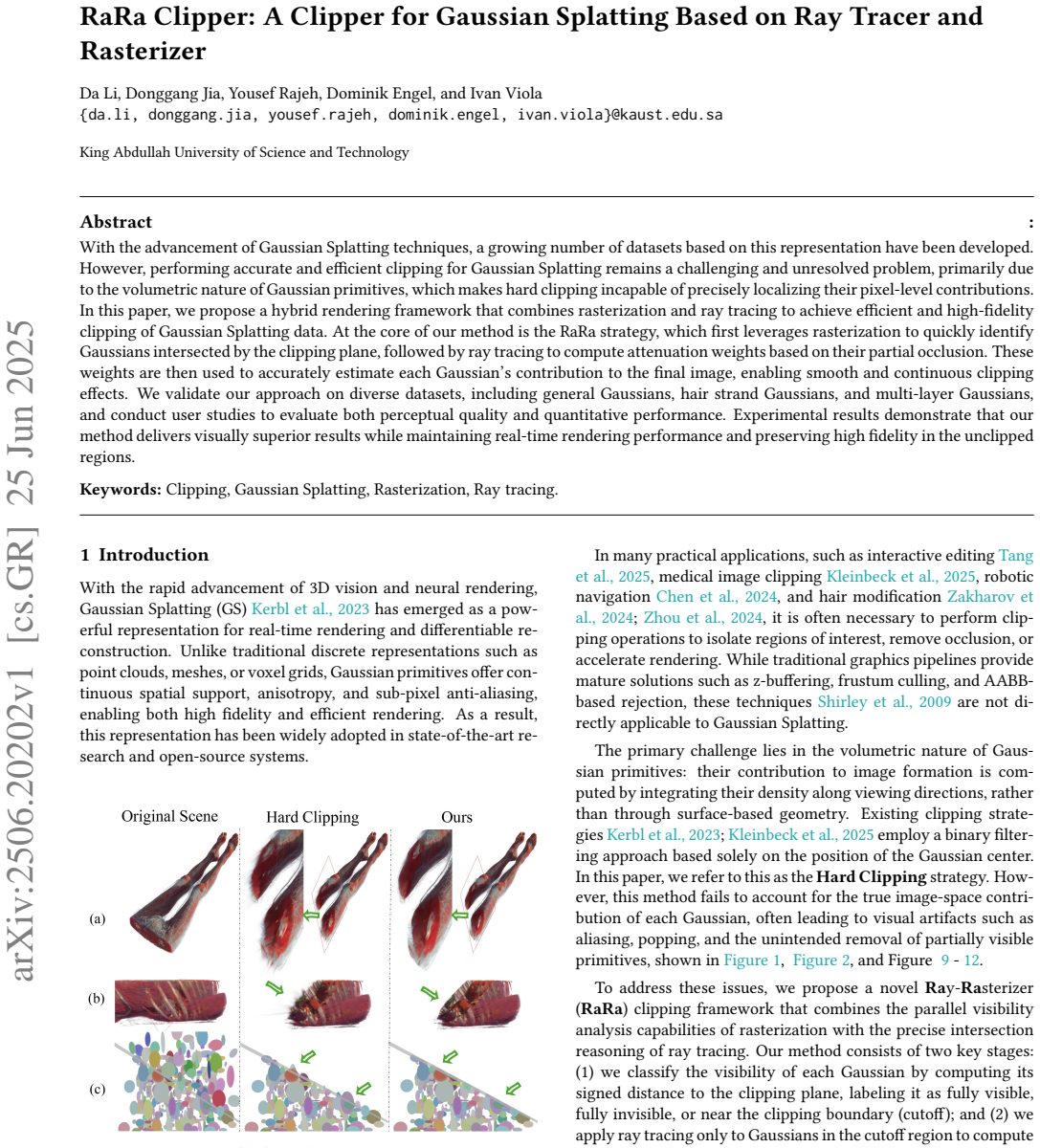


Figures from the paper (8 more)


Reference graph
Works this paper leans on
-
[1]
Gaussian Splatting Decoder for 3D-aware Generative Adversarial Networks
Barron, Jonathan T et al. (2021). “Mip-nerf: A multiscale representation for anti- aliasing neural radiance fields”. In:Proceedings of the IEEE/CVF international confer- ence on computer vision, pp. 5855–5864. Barthel, Florian et al. (2024).Gaussian Splatting Decoder for 3D-aware Generative Ad- versarial Networks. arXiv:2404.10625 [cs.CV]. Byrski, Krzyszt...
work page Pith review arXiv 2021
-
[215]
Gaussianhair: Hair modeling and rendering with light- aware gaussians
Luo, Haimin et al. (2024). “Gaussianhair: Hair modeling and rendering with light- aware gaussians”. In:arXiv preprint arXiv:2402.10483. Mai, Alexander et al. (2024). “Ever: Exact volumetric ellipsoid rendering for real-time view synthesis”. In:arXiv preprint arXiv:2410.01804. Mildenhall, Ben et al. (2021). “Nerf: Representing scenes as neural radiance fie...
arXiv 2024
Reviewed August 6, 2026 · model on record in the stance chip above.
Discussion (0). Continue with ORCID to comment.