REVIEW 3 major objections 4 minor 89 references
Symbiotic star candidates in Gaia Data Release 3
T0 review · 3 major / 4 minor · reviewed 2026-08-06 · deepseek-v4-flash
Pith's one-line read A machine-learning search of Gaia Data Release 3 yields 1,674 new symbiotic star candidates, 25 with X-ray emission.
desk verdict Useful matched-filter catalog, but the machine-learning validation is circular, so the 1,674 count and the 25 X-ray picks are not out-of-sample tested. read the letter →
The pith
A machine-rendered reading of the paper's core claim, the machinery that carries it, and where it could break.
The reading
What carries the argument
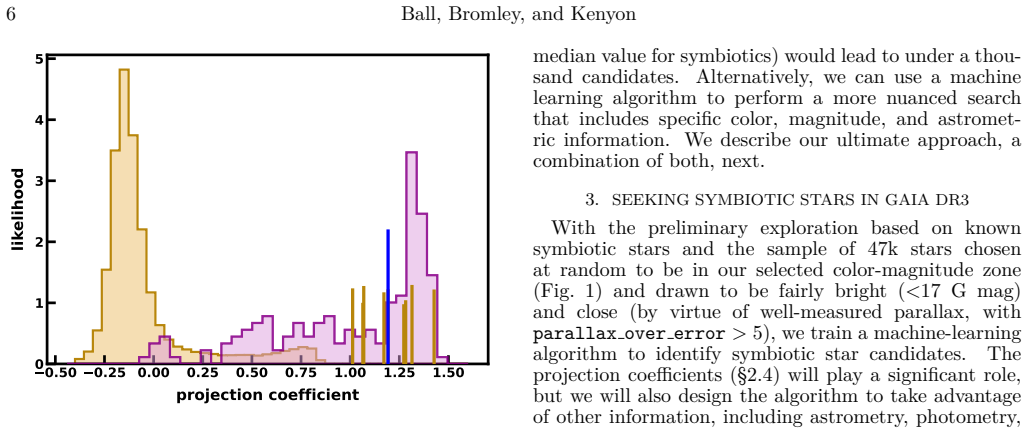
The load-bearing object is the spectral projection coefficient S of Eq. (3). Each source's BP/RP spectrum is normalized to unit total flux, continuum-subtracted with a smoothing filter, and scaled to unit pointwise standard deviation; S is then the inner product of that residual spectrum with the catalog-average residual spectrum over 600–775 nm, the window containing Hα and the TiO bands. Values S>1 couple more strongly to the symbiotic template than the average training star, and the paper uses S>1 as a pre-cut before classification. The random-forest classifier combines S with $bp-rp$, $G$-band magnitude, parallax and its signal-to-noise, astrometric goodness-of-fit, the renormalized unit weight error (ruwe), total proper motion, and absolute magnitude $M_G$; these features encode the cool-giant locus in the color-magnitude plane and the astrometric jitter expected from binary orbital motion at a few astronomical units. The classifier's role is to reject the many red giants, subgiants, and reddened Be or O stars that pass the S>1 cut but are not true symbiotics.
What would settle it
Take medium-resolution optical spectra of the 25 X-ray-matched candidates; if a majority show no Hα emission, no TiO absorption, and no blue excess from a hot companion, the claim that these are symbiotic stars is falsified. A sharper control is to run the same classifier on random GDR3 red giants that pass S>1 but lie outside the red-giant zone; a similar confirmation rate would show the selection zone, not the symbiotic template, is driving the identifications.
Extended reading notes
Core claim
The central claim is that the defining spectral signature of symbiotic stars—Hα emission from ionized wind material, TiO absorption from the cool giant, and a blue excess from the hot component—can be compressed into a single projection coefficient S, the normalized overlap between an individual Gaia BP/RP spectrum and the mean spectrum of 171 known symbiotics. A random-forest classifier trained on S together with Gaia colors, magnitudes, parallax, proper motion, and astrometric quality indicators separates symbiotics from the general red-giant population; on the paper's test set it recovers all known symbiotics with very few false positives. When the classifier is run on the full Gaia archive under explicit brightness, parallax-signal-to-noise, color-magnitude, and S>1 selection, it yields 1,674 candidates after removing known symbiotics. Twenty-five of these candidates also appear in X-ray catalogs, and the paper presents them, along with a few high-S, high-astrometric-jitter stars, as the most promising discoveries for spectroscopic confirmation.
Load-bearing premise
The 171 known symbiotic stars used to construct the spectral template and train the classifier must be representative of all symbiotic stars that Gaia can see, including dusty, heavily reddened, and D-type systems; if that sample is biased, then the S>1 cut and the machine-learning decision boundary inherit the bias and the 1,674 count will reflect selection choices rather than the true population.
Editorial extensions
If this is right
- If even a fraction of the 1,674 candidates are confirmed, the known symbiotic population would grow several-fold, narrowing the long-standing gap between the ~300 confirmed systems and predicted Milky Way populations of $10^3$–$10^5$.
- The 25 X-ray-matched candidates are concrete, prioritized targets: follow-up spectroscopy on them directly tests both the machine-learning selection and the link between accretion and X-ray emission in symbiotics.
- The method shows that one carefully chosen spectral summary statistic, combined with public astrometry and photometry, can mine rare binaries from a billion-star archive without dedicated high-resolution spectra.
- The classifier's ranking recovers known symbiotics among the candidates (48 known systems, with the first 30 judged true symbiotics), so the probability ranking can be used to schedule observations from most to least promising.
- The high-probability subset—182 candidates at P>90%, 36 at P≥95%—provides an immediate shortlist for deeper follow-up before the full catalog is examined.
Reading between the lines
- If the X-ray candidates confirm as symbiotics, their space density in the Gaia-selected volume could recalibrate population-synthesis rates for the symbiotic channel to Type Ia supernovae, a link the paper raises but does not quantify.
- The same template-and-classifier pipeline could be rerun on future Gaia releases with longer astrometric baselines; the longer baseline should sharpen the ruwe signal for the roughly two-year orbital periods that presently sit near the 34-month sensitivity window.
- A testable extension is to drop the S>1 pre-cut and feed the full spectral coefficients to the classifier; this would reveal whether dusty D-type or heavily reddened symbiotics, which may not match the mean S-type-dominated template, are being lost at the pre-selection stage.
- The paper notes candidates skew bluer and fainter than known symbiotics and that 60% lie within 100 pc of the Galactic plane; a plausible inference is that reddened Be and young O-type stars contaminate the fainter tail, so lower-probability candidates should show a lower spectroscopic confirmation rate than the X-ray-selected subset.
Editorial analysis
A structured set of objections, weighed in public.
Referee Report
Summary. The paper uses Gaia DR3 astrometry, photometry, and low-resolution BP/RP spectra to construct a catalog of symbiotic star candidates. From 248 known symbiotics identified in SIMBAD, the authors define an HR-diagram selection zone, build a mean spectral template, and introduce a projection coefficient S (Eq. 3). They draw a random comparison sample of 47,693 field stars, train a Random Forest classifier on 1,500 positive rows generated by duplicating the 171 in-zone known symbiotics and 1,500 field-star negatives, and then mine the full GDR3 archive for sources with S > 1. The pipeline yields 1,674 candidates, of which 25 have X-ray counterparts and are presented as particularly compelling targets. The authors state clearly that spectroscopic follow-up is required and acknowledge that many candidates may be subgiants or reddened Be/O stars.
Significance. If the candidate list is reliable, it would be a substantial expansion of the known symbiotic population and would provide a useful set of prioritized targets for spectroscopic confirmation. The paper is honest in framing the output as a candidate catalog, it makes the full table available as an ancillary file, and it documents the main heuristic choices (selection zone, projection wavelength range, S threshold) in a reproducible way. However, the quantitative performance claims rest on a validation procedure that is compromised by direct overlap between the training and test rows, so the stated 1.0 accuracy and the ML probability ranking are not yet established. The central catalog, stripped of the ML-validation language, may still be a useful starting point, but the current presentation overstates what has been demonstrated.
major comments (3)
- [Section 3.1, Figure 6] The reported classifier performance is not a valid out-of-sample measurement. The 1,500 positive rows are produced by duplicating the same 171 known symbiotics with replacement, and the positive and negative rows are then mixed and split in half. Roughly 750 of the positive test rows are therefore exact feature-vector duplicates of positive training rows, and the feature set includes RA, Dec, and proper motions, which makes row-level memorization trivial for a Random Forest. The 1.0 accuracy, zero false negatives, and three false positives in Figure 6 therefore measure memorization of training instances, not generalization to new sources. Since the ML probability P is used to rank the 1,674 candidates and to define the 25 high-promise X-ray candidates in Section 4.1 and Table 3, this defect is load-bearing for the abstract's central claim.
- [Section 4, paragraph 1] The check using the 48 known symbiotics that appear in the mined S > 1 list is also an in-sample check. These 48 sources come from the same 171-star catalog used to build the template and train the classifier, so their high ranking only shows that the classifier recognizes training material. It does not demonstrate accuracy on genuinely new objects. The authors should provide an object-level out-of-sample evaluation, for example by withholding a random subset of the 171 known symbiotics from both the template construction and the classifier training, or by training on one independent symbionic catalog and testing on another, and then reporting contamination and completeness on the withheld objects.
- [Section 2.4 and Section 3.2] The final candidate count is almost entirely determined by the S > 1 matched-filter cutoff rather than by the machine-learning step: of 1,790 S > 1 sources, the classifier rejects only 68. Because S is defined as a projection onto the mean spectrum of the very same 171 known symbiotics, the 1,674 number is the tail of a matched-filter distribution whose center was constructed from the input catalog. This makes the catalog's completeness and contamination sensitive to how representative those 171 stars are of the full symbiotic population. The paper itself notes in Section 4 that most candidates are bluer and fainter than known symbiotics and may be subgiants or reddened Be/O stars with H-alpha emission, which is exactly the population that an out-of-sample test must separate. The authors should quantify the false-positive rate using a clean test sample of non-symbiotic stars drawn from the same selection zone, and should report how the candidate list changes when the template is built from a subset of the known symbiotics or from S-type and D-type stars separately.
minor comments (4)
- [Section 3.1] The description of the train/test construction is confusing: the text first calls the 1,500 field stars a 'test dataset' and then says the combined 3,000-row set is mixed and split in half. Please clarify that the split is row-level, not object-level, and define which rows are used for training versus testing.
- [Section 3.1 feature list] Including RA, Dec, and proper motions as classifier features is physically questionable for identifying symbiotic status and makes positional memorization easier. Please justify these features or remove them from the classifier and show that the results do not change.
- [Section 4, Section 5] There are several typographical errors: 'coeffecient' in Section 5, 'emcompasses' and 'fortuitiously' in Sections 4 and 3.1, and 'Savitsky-Golay' in Section 2.4 should be 'Savitzky-Golay'. Figure 1's caption also contains 'GRD3' instead of 'GDR3'.
- [Table 3 and Figure 10] The X-ray luminosities in Table 3 and Figure 10 are derived from three surveys with different energy bands and are said to be order-of-magnitude estimates; please state the assumed distances and band corrections explicitly in the table note or figure caption so that the values can be reproduced.
Circularity Check
The reported 1.0 classifier accuracy is an artifact of same-star train/test duplication, so the ML-based ranking and the 1,674-candidate catalog rest on an in-sample matched filter rather than out-of-sample prediction.
-
fitted input called prediction
[Section 3.1, 'A machine-learning classifier' and Fig. 6 confusion matrix]
"In creating the training set, we use the 171 known symbiotic stars within our selected region. ... we copied the full 171 over into a new dataset at least once, from there we randomly selected from the 171, allowing duplicates, to add up to a list of 1500 total stars. ... The combined test/train sets totals to 3000 sources. This list was then randomly mixed and split in half (1500 sources) to be tested by the classifier. ... Overall, the matrix reflects perfect recall (no missed symbiotics) and high precision, with a 1.0 accuracy."
The positive rows are generated by duplicating the same 171 known symbiotics, then randomly mixed and split in half; therefore roughly half of the positive test rows are exact duplicate feature vectors of positive training rows. A Random Forest can memorize these exact rows, especially with RA, Dec, and proper motions as features, so the reported 1.0 accuracy, zero false negatives, and only three false positives are forced by construction rather than measuring out-of-sample generalization. The later 'test' on 48 known symbiotics found in the mined list is also in-sample, because those 48 come from the same 171-star training catalog. The classifier probability P used to rank the 1,674 candidates and to define the 25 high-promise X-ray sources is thereby unvalidated for new Gaia sources.
-
self definitional
[Section 2.4, Eq. (3); Section 3.2, mining cut; Section 4, candidate count]
"Si≡β(f i, ¯f)=∑j fij ¯fj, (3) ... The angular braces denote the catalog average. ... we further limit our operation to sources with S >1, thus focusing on the peak of the projection coefficient distribution for known symbiotic stars. As roughly anticipated from the 47k stars, this selection nets us 1,790 candidates ... After removing the known symbiotics, the ML classifier identified 1,674 stars as candidates with a formal probability P>50% of being a symbiotic star."
S is defined as the dot product of each source's spectrum with the mean spectrum of the very same 171 known symbiotics that define the catalog and train the classifier. The candidate cut S>1 therefore selects the tail of a matched-filter distribution whose kernel was fit to the input sample; the 1,674-source catalog is not an independent prediction but a thresholded projection of the known-sample template. The ML step is nearly a pass-through (1,790 S>1 sources minus 48 known leaves 1,742, and the classifier rejects only 68), so the central 'prediction' reduces to the S>1 matched filter built from the training sample itself.
full rationale
The paper is transparent that its method is template matching and supervised classification, and it does not rely on self-citations as load-bearing evidence. However, the circularity lies in the validation and in the construction of the candidate metric. The reported 1.0 classifier accuracy is a tautology because the positive test rows are duplicates of positive training rows drawn from the same 171 known symbiotics. The S>1 selection criterion is defined as projection onto the mean spectrum of that same 171-star sample, so the resulting 1,674-candidate catalog is the tail of a matched-filter distribution whose kernel was fit to the input, not an independent out-of-sample prediction. The X-ray cross-matches provide some external information for the 25 high-promise sources, but those sources are pre-selected by the unvalidated classifier probability P>=80, so the selection ranking remains unvalidated. These factors make the central claims partially circular: the ML performance claim reduces by construction, and the candidate count is essentially a thresholded projection of the training template. Absent clean out-of-sample validation, the 1.0 accuracy and the P-based rankings should not be presented as evidence of generalization. Score 6 reflects one or more predictions reducing by construction while the underlying template-matching idea retains some independent content.
Assumptions & free parameters
free parameters (6)
- Selection zone boundaries =
1 < BP-RP < 7 mag; -6 < M_G < min(1.8*BP-RP - 3.4) mag
- Projection coefficient wavelength range =
600 to 775 nm
- Mining threshold on projection coefficient =
S > 1
- Red giant zone boundary =
M_G < 2.1*BP-RP - 5 mag
- Positive training sample size =
1500 (from 171 sources with duplication)
- Random Forest hyperparameters =
grid-tuned, values not reported
assumptions (5)
- domain assumption The 171 known symbiotic stars with Gaia BP/RP spectra within the selection zone are representative of the full symbiotic star population in GDR3.
- domain assumption The 47,693 random Gaia sources in the selection zone are a representative sample of non-symbiotic field stars.
- domain assumption Gaia BP/RP low-resolution spectra, after continuum subtraction and normalization, retain enough information to distinguish symbiotic stars through the projection coefficient S.
- domain assumption Astrometric ruwe >1.3 is a useful binarity indicator for symbiotic stars with orbital periods comparable to the 34-month Gaia baseline.
- domain assumption Positional cross-matches with ROSAT (30 arcsec), XMM-Newton (5 arcsec), and eROSITA (20 arcsec) correctly associate X-ray sources with the optical counterparts.
Cite this review
Pith. "Pith review of Symbiotic star candidates in Gaia Data Release 3." pith.science (2026). https://pith.science/paper/L2FKXW5Y
@misc{pith2026250620505,
  author       = {Pith},
  title        = {Pith review of: Symbiotic star candidates in Gaia Data Release 3},
  year         = {2026},
  howpublished = {\url{https://pith.science/paper/L2FKXW5Y}},
  note         = {Machine review of arXiv:2506.20505}
}
abstract
Symbiotic stars, binary pairs with a cool giant fueling accretion onto a hot compact companion, offer unique insights to our understanding of stellar evolution. Yet, only a few hundred symbiotic stars are confirmed. Here, we report on a new search for symbiotic star candidates in Gaia Data Release 3 (GDR3), based entirely on the archive's astrometric, photometric, and spectroscopic information. To begin our search, we identified known symbiotic stars in GDR3 and assessed their absolute magnitude and colors, which are dominated by the cool giant. We also considered measures of astrometric quality that might be affected by binary motion in these systems. Finally, from those sources with Gaia spectroscopic data, we built a low-resolution spectral template that characterizes the unique features of these systems, including H$\alpha$ emission from interaction with the giant's wind and radiation from the hot star. We then queried the full GDR3 archive for sources with spectroscopic data that are bright (< 17 mag in G-band), have modest relative parallax uncertainties (< 20%), and fall within a region of color-magnitude space characteristic of red giants, keeping only sources with spectra that quantitatively match our template. A machine-learning algorithm, trained on known symbiotic stars, produced a new catalog of 1,674 sources. From cross-matches with infrared and X-ray surveys, we present 25 of these sources as particularly compelling candidates for new symbiotic stars.
Figures


Figures from the paper (5 more)


Reference graph
Works this paper leans on
-
[1]
2023, MNRAS, 519, 6044, doi:10.1093/mnras/stad096
Akras, S. 2023, MNRAS, 519, 6044, doi:10.1093/mnras/stad096
-
[2]
R., Alvarez-Candal, A., & Pereira, C
Akras, S., Gon¸ calves, D. R., Alvarez-Candal, A., & Pereira, C. B. 2021, MNRAS, 502, 2513, doi:10.1093/mnras/stab195
-
[3]
2019a, ApJS, 240, 21, doi:10.3847/1538-4365/aaf88c
Ramos-Larios, G. 2019a, ApJS, 240, 21, doi:10.3847/1538-4365/aaf88c
-
[4]
2019b, MNRAS, 483, 5077, doi:10.1093/mnras/sty3359
Ramos-Larios, G. 2019b, MNRAS, 483, 5077, doi:10.1093/mnras/sty3359
-
[5]
Allen, D. A. 1978, MNRAS, 184, 601, doi:10.1093/mnras/184.3.601 —. 1980, MNRAS, 192, 521, doi:10.1093/mnras/192.3.521 —. 1984, PASA, 5, 369, doi:10.1017/S1323358000017215
-
[6]
Aschenbach, B., Br¨ auninger, H., Briel, U., et al. 1981, Space Sci. Rev., 30, 569, doi:10.1007/BF01246075
-
[7]
2023, A&A, 674, A32, doi:10.1051/0004-6361/202243790
Babusiaux, C., Fabricius, C., Khanna, S., et al. 2023, A&A, 674, A32, doi:10.1051/0004-6361/202243790
-
[8]
Bailer-Jones, C. A. L., Rybizki, J., Fouesneau, M., Demleitner, M., & Andrae, R. 2021, AJ, 161, 147, doi:10.3847/1538-3881/abd806
Show all 89 references
-
[9]
Bath, G. T. 1977, MNRAS, 178, 203, doi:10.1093/mnras/178.2.203 Belczy´ nski, K., Miko/suppress lajewska, J., Munari, U., Ivison, R. J., &
1977 doi
-
[10]
2000, A&AS, 146, 407, doi:10.1051/aas:2000280
Friedjung, M. 2000, A&AS, 146, 407, doi:10.1051/aas:2000280
2000 doi
-
[11]
J., Espey, B
Birriel, J. J., Espey, B. R., & Schulte-Ladbeck, R. E. 2000, ApJ, 545, 1020, doi:10.1086/317851
2000 doi
-
[12]
Blind, N., Boffin, H. M. J., Berger, J. P., et al. 2011, A&A, 536, A55, doi:10.1051/0004-6361/201118036
2011 doi
-
[13]
V., & Bajkova, A
Bobylev, V. V., & Bajkova, A. T. 2016, Baltic Astronomy, 25, 261, doi:10.1515/astro-2017-0128
2016 doi
-
[14]
2000, A&AS, 143, 33, doi:10.1051/aas:2000331
Bonnarel, F., Fernique, P., Bienaym´ e, O., et al. 2000, A&AS, 143, 33, doi:10.1051/aas:2000331
2000 doi
-
[15]
Boyarchuk, A. A. 1969, Commmunications of the Konkoly Observatory Hungary, 65, 395
1969
-
[16]
2022, ApJ, 938, 110, doi:10.3847/1538-4357/ac8e04
Brout, D., Scolnic, D., Popovic, B., et al. 2022, ApJ, 938, 110, doi:10.3847/1538-4357/ac8e04
2022 doi
-
[17]
2018, A&A, 616, L3, doi:10.1051/0004-6361/201833633
Bujarrabal, V., Alcolea, J., Miko/suppress lajewska, J., Castro-Carrizo, A., & Ramstedt, S. 2018, A&A, 616, L3, doi:10.1051/0004-6361/201833633
2018 doi
-
[18]
H., & Snow, Jr., T
Buss, Jr., R. H., & Snow, Jr., T. P. 1988, ApJ, 335, 331, doi:10.1086/166931
1988 doi
-
[19]
R., et al
Castro-Ginard, A., Penoyre, Z., Casey, A. R., et al. 2024, A&A, 688, A1, doi:10.1051/0004-6361/202450172
2024 doi
- [20]
-
[21]
M., Wright, E
Cutri, R. M., Wright, E. L., Conrow, T., et al. 2013, Explanatory Supplement to the AllWISE Data Release Products, Explanatory Supplement to the AllWISE Data Release Products, by R. M. Cutri et al. De Angeli, F., Weiler, M., Montegriffo, P., et al. 2023, A&A, 674, A2, doi:10.1...
2013 doi
-
[22]
2023, A&A, 674, A13, doi:10.1051/0004-6361/202244242
Eyer, L., Audard, M., Holl, B., et al. 2023, A&A, 674, A13, doi:10.1051/0004-6361/202244242
2023 doi
-
[23]
2024, A&A, 684, A121, doi:10.1051/0004-6361/202348278 Gaia Collaboration, Vallenari, A., Brown, A
Freund, S., Czesla, S., Predehl, P., et al. 2024, A&A, 684, A121, doi:10.1051/0004-6361/202348278 Gaia Collaboration, Vallenari, A., Brown, A. G. A., et al. 2023a, A&A, 674, A1, doi:10.1051/0004-6361/202243940 Gaia Collaboration, Montegriffo, P., Bellazzini, M., et al. 2023b, ...
2024 doi
-
[24]
N., Frankel, N., Zari, E., Xiang, M., & Rix, H.-W
Garzon, D. N., Frankel, N., Zari, E., Xiang, M., & Rix, H.-W. 2024, ApJ, 972, 155, doi:10.3847/1538-4357/ad61e8
2024 doi
-
[25]
Gilmore, G., Wyse, R. F. G., & Kuijken, K. 1989, ARA&A, 27, 555, doi:10.1146/annurev.aa.27.090189.003011
1989
-
[26]
A., et al
Godoy-Rivera, D., Mathur, S., Garc´ ıa, R. A., et al. 2025, A&A, 696, A243, doi:10.1051/0004-6361/202348735
2025 doi
-
[27]
2019, ApJ, 887, 93, doi:10.3847/1538-4357/ab5362
Finkbeiner, D. 2019, ApJ, 887, 93, doi:10.3847/1538-4357/ab5362
2019 doi
- [28]
-
[29]
A., Vasquez-Torres, D
Guerrero, M. A., Vasquez-Torres, D. A., Rodr´ ıguez-Gonz´ alez, J. B., Toal´ a, J. A., & Ortiz, R. 2025, A&A, 693, A203, doi:10.1051/0004-6361/202451715
2025 doi
-
[30]
1999, ApJ, 522, 487, doi:10.1086/307608
Hachisu, I., Kato, M., & Nomoto, K. 1999, ApJ, 522, 487, doi:10.1086/307608
1999 doi
-
[31]
2024, Monthly Notices of the Royal Astronomical Society, 529, 3630, doi:10.1093/mnras/stae738
Healy, S., Horiuchi, S., Colomer Molla, M., et al. 2024, Monthly Notices of the Royal Astronomical Society, 529, 3630, doi:10.1093/mnras/stae738
2024 doi
-
[32]
2021, ApJ, 915, 105, doi:10.3847/1538-4357/ac03b1
Heo, J.-E., Lee, H.-W., Angeloni, R., Palma, T., & Di Mille, F. 2021, ApJ, 915, 105, doi:10.3847/1538-4357/ac03b1
2021 doi
-
[33]
Hunsch, M., Schmitt, J. H. M. M., & Voges, W. 1998, A&AS, 127, 251, doi:10.1051/aas:1998347
1998 doi
- [34]
-
[35]
2001, A&A, 365, L1, doi:10.1051/0004-6361:20000036
Jansen, F., Lumb, D., Altieri, B., et al. 2001, A&A, 365, L1, doi:10.1051/0004-6361:20000036
2001 doi
-
[36]
2023, Research in Astronomy and Astrophysics, 23, 105012, doi:10.1088/1674-4527/ace9b2
Jia, Y., Guo, S., Zhu, C., et al. 2023, Research in Astronomy and Astrophysics, 23, 105012, doi:10.1088/1674-4527/ace9b2
2023 doi
-
[37]
Kenyon, S. J. 1986, The symbiotic stars (Cambridge University Press)
1986
-
[38]
J., & Fernandez-Castro, T
Kenyon, S. J., & Fernandez-Castro, T. 1987, AJ, 93, 938, doi:10.1086/114379
1987 doi
-
[39]
J., Livio, M., Mikolajewska, J., & Tout, C
Kenyon, S. J., Livio, M., Mikolajewska, J., & Tout, C. A. 1993, ApJ, 407, L81, doi:10.1086/186811
1993 doi
- [40]
- [41]
-
[42]
2022, A&A, 657, A7, doi:10.1051/0004-6361/202142146
Kervella, P., Arenou, F., & Th´ evenin, F. 2022, A&A, 657, A7, doi:10.1051/0004-6361/202142146
2022 doi
-
[43]
R., Rocha-Pinto, H
Laversveiler, M., Gon¸ calves, D. R., Rocha-Pinto, H. J., & Merc, J. 2025, A&A, 698, A155, doi:10.1051/0004-6361/202451548
2025 doi
-
[44]
2016, ApJ, 833, 75, doi:10.3847/1538-4357/833/1/75
Lee, Y.-M., Lee, D.-S., Chang, S.-J., et al. 2016, ApJ, 833, 75, doi:10.3847/1538-4357/833/1/75
2016 doi
-
[45]
2023, ApJ, 956, 26, doi:10.3847/1538-4357/aced8a
Li, L., Wang, S., Chen, X., & Jiang, Q. 2023, ApJ, 956, 26, doi:10.3847/1538-4357/aced8a
2023 doi
-
[46]
K., & Han, Z
Liu, Z.-W., R¨ opke, F. K., & Han, Z. 2023, Research in Astronomy and Astrophysics, 23, 082001, doi:10.1088/1674-4527/acd89e L¨ u, G., Yungelson, L., & Han, Z. 2006, MNRAS, 372, 1389, doi:10.1111/j.1365-2966.2006.10947.x
2023
- [47]
-
[48]
Luna, G. J. M., Sokoloski, J. L., Mukai, K., & Nelson, T. 2013, A&A, 559, A6, doi:10.1051/0004-6361/201220792 Symbiotic star candidates 13
2013 doi
-
[49]
Magrini, L., Corradi, R. L. M., & Munari, U. 2003, in Astronomical Society of the Pacific Conference Series, Vol. 303, Symbiotic Stars Probing Stellar Evolution, ed. R. L. M
2003
- [50]
- [51]
-
[52]
Merc, J., & Boffin, H. M. J. 2025, A&A, 695, A61, doi:10.1051/0004-6361/202553789
2025 doi
-
[53]
2019, Research Notes of the American Astronomical Society, 3, 28, doi:10.3847/2515-5172/ab0429
Merc, J., G´ alis, R., & Wolf, M. 2019, Research Notes of the American Astronomical Society, 3, 28, doi:10.3847/2515-5172/ab0429
2019 doi
-
[54]
A., Toal´ a, J
Merc, J., Guerrero, M. A., Toal´ a, J. A., & Ortiz, R. 2025, A&A, 699, A117, doi:10.1051/0004-6361/202554671
2025 doi
-
[55]
2020, A&A, 644, A49, doi:10.1051/0004-6361/202039132
Merc, J., Miko/suppress lajewska, J., Gromadzki, M., et al. 2020, A&A, 644, A49, doi:10.1051/0004-6361/202039132
2020 doi
- [56]
-
[57]
Mikolajewska, J., & Kenyon, S. J. 1992, MNRAS, 256, 177, doi:10.1093/mnras/256.2.177
1992 doi
-
[58]
2025, A&A, 695, A227, doi:10.1051/0004-6361/202453359
Mulato, L., Merc, J., Charbonnel, S., et al. 2025, A&A, 695, A227, doi:10.1051/0004-6361/202453359
2025 doi
- [59]
-
[60]
1992a, ApJ, 397, L87, doi:10.1086/186551 —
Munari, U., & Renzini, A. 1992a, ApJ, 397, L87, doi:10.1086/186551 —. 1992b, ApJ, 397, L87, doi:10.1086/186551
-
[61]
2021, MNRAS, 505, 6121, doi:10.1093/mnras/stab1620
Munari, U., Traven, G., Masetti, N., et al. 2021, MNRAS, 505, 6121, doi:10.1093/mnras/stab1620
2021 doi
-
[62]
2000, A&AS, 143, 23, doi:10.1051/aas:2000169
Ochsenbein, F., Bauer, P., & Marcout, J. 2000, A&AS, 143, 23, doi:10.1051/aas:2000169
2000 doi
-
[63]
1946, ApJ, 104, 362, doi:10.1086/144866 —
Payne-Gaposchkin, C. 1946, ApJ, 104, 362, doi:10.1086/144866 —. 1964, The galactic novae (Dover, New York)
1946 doi
-
[64]
A., Males, J
Pearce, L. A., Males, J. R., Weinberger, A. J., et al. 2022, MNRAS, 515, 4487, doi:10.1093/mnras/stac2056
2022 doi
-
[65]
Penoyre, Z., Belokurov, V., & Evans, N. W. 2022, MNRAS, 513, 5270, doi:10.1093/mnras/stac1147
2022 doi
-
[66]
2006, in Society of Photo-Optical Instrumentation Engineers (SPIE) Conference
Predehl, P., Hasinger, G., B¨ ohringer, H., et al. 2006, in Society of Photo-Optical Instrumentation Engineers (SPIE) Conference
2006
-
[67]
6266, Space Telescopes and Instrumentation II: Ultraviolet to Gamma Ray, ed
Series, Vol. 6266, Space Telescopes and Instrumentation II: Ultraviolet to Gamma Ray, ed. M. J. L. Turner & G. Hasinger, 62660P, doi:10.1117/12.670249
-
[68]
L., Wright, N
Quintana, A. L., Wright, N. J., & Garc´ ıa, J. M. 2025, Monthly Notices of the Royal Astronomical Society, 538, 1367, doi:10.1093/mnras/staf083
2025 doi
-
[69]
C., Oudmaijer, R
Radley, I. C., Oudmaijer, R. D., Vioque, M., & Dodd, J. M. 2025, MNRAS, 539, 1964, doi:10.1093/mnras/staf618
2025 doi
-
[70]
G., Filippenko, A
Riess, A. G., Filippenko, A. V., Challis, P., et al. 1998, AJ, 116, 1009, doi:10.1086/300499
1998 doi
-
[71]
2023, A&A, 674, A14, doi:10.1051/0004-6361/202245591
Rimoldini, L., Holl, B., Gavras, P., et al. 2023, A&A, 674, A14, doi:10.1051/0004-6361/202245591
2023 doi
-
[72]
Schmid, H. M. 1989, A&A, 211, L31
1989
-
[73]
M., Bazzon, A., Milli, J., et al
Schmid, H. M., Bazzon, A., Milli, J., et al. 2017, A&A, 602, A53, doi:10.1051/0004-6361/201629416
2017 doi
-
[74]
Schmitt, J. H. M. M., H¨ unsch, M., Schneider, P. C., et al. 2024, A&A, 688, A9, doi:10.1051/0004-6361/202449181
2024 doi
-
[75]
1923, Harvard College Observatory Bulletin, 783, 3
Shapley, H. 1923, Harvard College Observatory Bulletin, 783, 3
1923
-
[76]
G., & Torres, G
Stassun, K. G., & Torres, G. 2021, ApJ, 907, L33, doi:10.3847/2041-8213/abdaad
2021 doi
-
[77]
2011, A&A, 529, A152, doi:10.1051/0004-6361/201015967
Sturm, R., Haberl, F., Greiner, J., et al. 2011, A&A, 529, A152, doi:10.1051/0004-6361/201015967
2011 doi
-
[78]
1941, ApJ, 93, 356, doi:10.1086/144272
Swings, P., & Struve, O. 1941, ApJ, 93, 356, doi:10.1086/144272
1941 doi
-
[79]
2019, ApJ, 878, 21, doi:10.3847/1538-4357/ab1ea5
Ting, Y.-S., & Rix, H.-W. 2019, ApJ, 878, 21, doi:10.3847/1538-4357/ab1ea5
2019 doi
-
[80]
A., Coriat, M., Traulsen, I., et al
Webb, N. A., Coriat, M., Traulsen, I., et al. 2020, A&A, 641, A136, doi:10.1051/0004-6361/201937353
2020 doi
-
[81]
F., Livio, M., Truran, J
Webbink, R. F., Livio, M., Truran, J. W., & Orio, M. 1987, ApJ, 314, 653, doi:10.1086/165095
1987 doi
-
[82]
L., & Allen, D
Webster, B. L., & Allen, D. A. 1975, MNRAS, 171, 171, doi:10.1093/mnras/171.1.171
1975 doi
-
[83]
2000, A&AS, 143, 9, doi:10.1051/aas:2000332
Wenger, M., Ochsenbein, F., Egret, D., et al. 2000, A&AS, 143, 9, doi:10.1051/aas:2000332
2000 doi
-
[84]
E., Giommi, P., & Angelini, L
White, N. E., Giommi, P., & Angelini, L. 2000, VizieR Online Data Catalog: The WGACAT version of ROSAT sources (White+ 2000), VizieR On-line Data Catalog: IX/31. Originally published in: Laboratory for High Energy Astrophysics (LHEA/NASA), Greenbelt (2000)
2000
-
[85]
L., Hill, J
Whiting, M. L., Hill, J. B., Bromley, B. C., & Kenyon, S. J. 2023, AJ, 165, 193, doi:10.3847/1538-3881/acc526
2023 doi
-
[86]
L., Eisenhardt, P
Wright, E. L., Eisenhardt, P. R. M., Mainzer, A. K., et al. 2010, AJ, 140, 1868, doi:10.1088/0004-6256/140/6/1868
2010 doi
-
[87]
2024, ApJ, 962, 126, doi:10.3847/1538-4357/ad20ec Yungel’son, L., Livio, M., Tutukov, A., & Kenyon, S
Xu, X.-j., Shao, Y., & Li, X.-D. 2024, ApJ, 962, 126, doi:10.3847/1538-4357/ad20ec Yungel’son, L., Livio, M., Tutukov, A., & Kenyon, S. J. 1995, ApJ, 447, 656, doi:10.1086/175908
2024 doi
-
[88]
2023, ApJS, 264, 14, doi:10.3847/1538-4365/ac9dfa
Zhang, R., & Yuan, H. 2023, ApJS, 264, 14, doi:10.3847/1538-4365/ac9dfa
2023 doi
-
[89]
K., Speagle, J
Zucker, C., Saydjari, A. K., Speagle, J. S., et al. 2025, arXiv e-prints, arXiv:2503.02657, doi:10.48550/arXiv.2503.02657 This paper was built using the Open Journal of As- trophysics LATEX template. The OJA is a journal which provides fast and easy peer review for new papers ...
2025 doi
Reviewed August 6, 2026 · model on record in the stance chip above.
Discussion (0). Sign in to comment.