REVIEW 4 major objections 4 minor 65 references
Detectors and Electronics for the CBM experiment at FAIR
T0 review · 4 major / 4 minor · reviewed 2026-08-06 · deepseek-v4-flash
Pith's one-line read The CBM detector systems have passed their validation phase: series production is underway, key subsystems were commissioned under beam conditions in mCBM, and the full triggerless readout chain ran end to end.
desk verdict Useful status report from the CBM collaboration; the readiness claim rests on an extrapolation from mCBM that should be either quantified or softened before publication. read the letter →
The pith
A machine-rendered reading of the paper's core claim, the machinery that carries it, and where it could break.
The reading
What carries the argument
The load-bearing mechanism is the free-streaming, self-triggered readout architecture, which replaces the hardware trigger of traditional experiments. Front-end ASICs—SMX for the silicon tracker and muon chambers, GET4 for fast timing detectors, and SPADIC for the transition-radiation detector—continuously digitise and time-stamp every hit; readout boards aggregate the data and send it over optical links to the First-Level Event Selector, which builds and filters events by timestamp in real time. This architecture is what makes interaction rates up to 10 MHz possible, and it is paired with a modular, reconfigurable detector suite of low-mass silicon tracking, MRPC time-of-flight walls, and GEM/RPC muon stations, each tuned for high rate and radiation tolerance.
What would settle it
Run a representative slice of the final CBM detector—tracking stations, a time-of-flight module, a muon-chamber module, and the full triggerless readout chain—with heavy-ion beams at an occupancy matching 10 MHz central Au+Au collisions; if any subsystem shows efficiency, timing, or throughput degradation beyond its design curve, such as time-of-flight resolution worse than 80 ps or readout throughput below the 1 TB/s target, the readiness claim fails.
Extended reading notes
Core claim
In the paper's own terms, the central statement is an engineering verdict rather than a new physics measurement: the CBM detector systems have passed their validation phase. After extensive prototyping, beam testing, and integration into running experiments, more than a third of the silicon tracking modules are already produced and characterised, the MVD's MIMOSIS pixel sensors show in-beam performance, the time-of-flight prototypes reach about 50 ps single-counter resolution, the muon-chamber GEM modules sustained inner-zone digi rates up to 200 kHz per square centimetre, and the full readout chain with the First-Level Event Selector ran in free-streaming mode at the mCBM testbed. The author's conclusion is that this readiness demonstrates the maturity of the detector concept and its implementation, placing CBM to deliver results on the QCD phase structure at high baryon density.
Load-bearing premise
The claim rests on the assumption that performance measured in prototype and reduced-scale beam tests, at lower energies and rates, transfers unchanged to the full CBM detector at FAIR with its final geometry, occupancy, and radiation environment.
Editorial extensions
If this is right
- CBM can move from subsystem validation to full commissioning at FAIR, targeting the designed 10 MHz interaction rates.
- At those rates, rare probes such as multi-strange hyperons, hypernuclei, and di-leptons become statistically accessible, enabling the search for a first-order phase transition and the QCD critical point.
- The triggerless readout removes the hardware-trigger bottleneck and lets the online computing farm select rare events in real time, reducing the stored data volume by orders of magnitude.
- The modular ELEHAD, MUON, and HADR configurations allow the physics program to start at 0.1–1 MHz interaction rates and scale up as the accelerator and detectors mature.
Reading between the lines
- The paper's readiness verdict is per-subsystem, so the decisive remaining test is an integrated full-system run at final occupancy, which no single test described here constitutes.
- The rate-capability figures were obtained at lower beam energies and in short spill runs, so the extrapolation to continuous 10 MHz Au+Au running in the final geometry remains an open question that only full-scale commissioning can settle.
- If the triggerless data-acquisition architecture performs as claimed at scale, it could become a reference design for other high-rate fixed-target and medical-imaging experiments that currently discard much of their data before reconstruction.
- A direct comparison of mCBM digit rates with full-geometry simulations of the final detector would provide an early, quantitative check of the extrapolation before FAIR beams are available.
Editorial analysis
A structured set of objections, weighed in public.
Referee Report
Summary. This conference proceedings contribution (arXiv:2506.20545, physics.ins-det) by M. Teklishyn on behalf of the CBM Collaboration summarizes the current status of detector development, series production, and validation for the CBM experiment at FAIR. It describes the detector concept, the ELEHAD/MUON/HADR configurations, and subsystem-by-subsystem status for the MVD, STS, FSD, BMON/T0, RICH, TRD, ToF, and MuCh, together with the free-streaming DAQ architecture and the FLES online processing. The stated central claim, also in the conclusion, is that extensive prototyping, beam tests at SIS18, and deployment in STAR, HADES, and E16 demonstrate the maturity and readiness of the detector concept and its implementation for the final CBM configuration at interaction rates up to 10 MHz.
Significance. If the readiness claim is correct, the paper provides a useful snapshot of a large detector project moving into series production and commissioning. The strength of the manuscript is its explicit linkage to external validation: the MIMOSIS sensor tests at CERN SPS, STS modules deployed in E16, the eTOF system at STAR, and the mCBM commissioning at SIS18 are concrete, checkable evidence that key components have operated in real beam environments. The paper also helpfully identifies which items are still proposals or prototypes (e.g., TRD-2D, LGAD alternative for BMON). However, several headline performance numbers appear without error bars, measurement conditions, or in-paper derivation, and the extrapolation from prototype/mCBM measurements to the final 10 MHz CBM environment is asserted rather than quantitatively demonstrated. The paper is therefore not a self-contained technical validation, but it is a credible status summary if its claims are read with appropriate caveats.
major comments (4)
- [Section 5.5 and Section 7] The central readiness claim is load-bearing and rests on an unquantified extrapolation. Section 5.5 states that MuCh GEM digi rates of up to 200 kHz/cm2 observed in mCBM 'confirm the rate capability for the final CBM configuration,' but no quantitative comparison is given between the prototype environment (SIS18 beam energy up to 1.23 AGeV, 10-second spill structure, small acceptance, pre-series modules) and the final CBM environment (up to 10 MHz central Au+Au collisions, full MuCh station geometry, segmented absorbers, final magnetic field and occupancy). A measured per-area digi rate in a prototype does not by itself confirm the final-zone rate capability unless the particle flux, energy spectrum, and occupancy per unit area are shown to match or exceed the final design values. Please either add such a quantitative mapping or soften the claim to state that the prototypes demonstrate the rate capability in a realistic but not final configuration. The conclusion in Section 7 should be revised accordingly.
- [Section 4.1 (FSD)] The FSD event plane resolution of 'approximately 70% for the x-component and about 40% for the y-component' is stated as established by simulation studies, citing only a poster ([42]). No simulation conditions, definition of resolution, statistical uncertainty, or comparison with data are given. Since the FSD's ability to reconstruct the event plane at interaction rates up to 10 MHz is part of the subsystems' readiness claim, this number needs either a citable peer-reviewed source with the full simulation setup or an explicit statement that it is a preliminary estimate from a poster.
- [Section 6.2 (FLES)] The statement that 'Data throughput tests have shown that the system can sustain up to 1 TByte/s input bandwidth across subsystems' is a headline performance claim with no citation, no test conditions, and no definition of what 'input bandwidth' means (raw front-end data, zero-suppressed data, or aggregate link speed). Given the paper's emphasis on the free-streaming DAQ as a paradigm shift and the 10 MHz design goal, this claim is important for the readiness assessment. Please add a reference to a test report or publication, or specify the configuration and the measured sustained throughput with uncertainties.
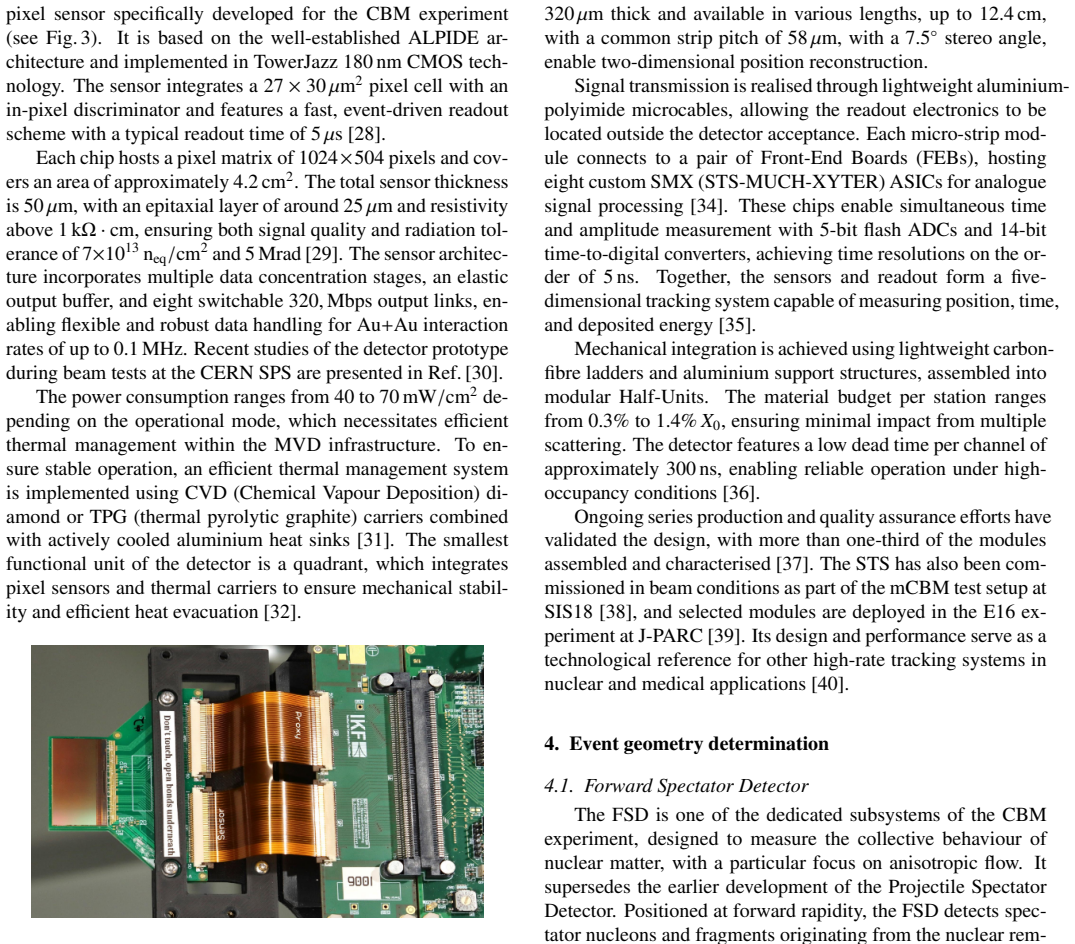
- [Section 3.1 (MVD)] The MVD status relies on 'recent studies of the detector prototype during beam tests at the CERN SPS' with reference [30], but the paper does not state what was measured or what performance was achieved. As written, the reader cannot judge whether the MVD prototype meets the 50 µm vertex resolution or the 0.1 MHz rate requirement. Please either summarize the key measured values (efficiency, resolution, radiation tolerance) or explicitly state that the MVD is still in prototype validation and not yet fully demonstrating final readiness.
minor comments (4)
- [Section 2] Typographical errors: 'complimented by the T0 time reference detector' should be 'complemented', and '1 Tm superconductive dipole magnet' should use 'T·m' or 'T m' with a multiplication dot.
- [Section 5.5] The beam species are given as '69Au or 73U beams'; these mass numbers are almost certainly typos (e.g., 197Au and 238U). Please correct or replace with 'Au or U beams'.
- [Section 6.2] The phrase 'reconstruction latencies on the order of milliseconds' is ambiguous: it is unclear whether this is the latency for a single event, for a time slice, or for the full online event building. Please clarify.
- [General] Several numbers are quoted without explicit error bars or measurement conditions, e.g., T0 '≤50 ps resolution', ToF 'single-counter time resolution of around 50 ps', and TRD 'electron detection efficiency of about (98.5±2.0)%'. For a proceedings summary this is acceptable if the references are given, but please ensure each such number points to a specific reference; otherwise the reader cannot distinguish simulated and measured values.
Circularity Check
Status report with no circular derivation: readiness claims rest on external beam tests and integration at STAR, HADES, E16, and mCBM; the mCBM-to-CBM rate extrapolation is an unproven inference, not a self-referential fit.
full rationale
This paper is a collaboration status report and does not contain a derivation chain that reduces to its inputs. No fitted parameters are renamed as predictions, no quantity is defined in terms of another quantity it is supposed to predict, and no load-bearing conclusion is justified solely by a self-citation. The subsystem performance claims are anchored in independent, external validation: MIMOSIS beam tests at CERN SPS (Ref. [30]), STS modules in E16 at J-PARC (Ref. [39]), CBM ToF detectors deployed as STAR eTOF (Refs. [56,57]), and mCBM runs at SIS18 with real heavy-ion beams (Refs. [38,58]). The strongest extrapolation, Section 5.5's statement that digi rates up to 200 kHz/cm2 observed in the mCBM inner zone 'confirm[] the rate capability for the final CBM configuration,' is an inductive leap from a prototype environment to the final 10 MHz Au+Au environment without a quantitative flux/occupancy mapping. That is a validation or correctness gap, not circularity: the observed 200 kHz/cm2 is not constructed from, nor equivalent to, the claimed final-configuration rate capability. The many CBM-internal references are self-citations, but they support engineering history and component specifications rather than serving as the sole evidence for a derived result, and they are accompanied by externally falsifiable beam-test data. Therefore no step in the paper's reasoning is circular, and the appropriate score is 0.
Assumptions & free parameters
assumptions (2)
- domain assumption The QCD phase diagram at high baryon densities exhibits a first-order phase transition and/or a critical point whose signatures are accessible via the CBM observables (flow, fluctuations, dileptons).
- domain assumption Beam-test results from prototype subsystems at SIS18 and from deployments in STAR/HADES/E16 extrapolate to the full CBM environment at FAIR with interaction rates up to 10 MHz.
Cite this review
Pith. "Pith review of Detectors and Electronics for the CBM experiment at FAIR." pith.science (2026). https://pith.science/paper/QOWMYCD5
@misc{pith2026250620545,
  author       = {Pith},
  title        = {Pith review of: Detectors and Electronics for the CBM experiment at FAIR},
  year         = {2026},
  howpublished = {\url{https://pith.science/paper/QOWMYCD5}},
  note         = {Machine review of arXiv:2506.20545}
}
read the original abstract
The Compressed Baryonic Matter (CBM) experiment is a next-generation heavy-ion experiment under development at the future FAIR facility in Darmstadt, Germany. It is designed to explore the QCD phase diagram at high net-baryon densities with unprecedented precision. Operating in fixed-target mode with a continuous beam of up to 11 AGeV for heavy ions and 26 GeV for protons, CBM will investigate rare probes such as multi-strange hyperons, hypernuclei, and dileptons, aiming to identify signatures of a first-order phase transition and the QCD critical point. To achieve these goals, CBM employs a free-streaming, self-triggered readout architecture and a suite of radiation-hard, low-mass detectors capable of operating at interaction rates up to 10 MHz. The experimental set-up consists of several detector subsystems optimised for precise vertexing, tracking, particle identification, and event reconstruction. These subsystems have undergone extensive prototyping and validation campaigns, with many components already tested and integrated into existing experiments such as STAR/RHIC, HADES/SIS18, and E16/J-PARC. These efforts culminated in the realisation of the mCBM test set-up at the SIS18 accelerator, where key systems were successfully commissioned under realistic beam conditions. This contribution provides a concise overview of the current status of detector development, series production, and validation efforts through both simulations and measurements.
Figures


Figures from the paper (1 more)

Reference graph
Works this paper leans on
-
[42]
R. Dvo ˇrák, Forward Spectator Detector for CBM, EPJ Featured Poster, Quark Matter 2025, Goethe University 8 Frankfurt, Germany, poster session 1, Detectors & Future Experiments (Apr. 2025)
work page 2025
-
[30]
In beam performances of the MIMOSIS-2.1 CMOS Monolithic Active Pixel Sensor
M. Deveaux, A.-M. Altingun, J. Andary, et al., In beam performances of the MIMOSIS-2.1 CMOS Monolithic Active Pixel Sensor (Feb. 2025). arXiv:2502.05303, doi:10.48550/ARXIV .2502.05303
work page Pith review arXiv doi:10.48550/arxiv.2502.05303 2025
-
[1]
Leifels, Status and physics perspectives of FAIR, Il Nuovo Cimento C 48 (2025) 1–9
Y . Leifels, Status and physics perspectives of FAIR, Il Nuovo Cimento C 48 (2025) 1–9. doi:10.1393/ncc/i2025- 25059-4
-
[2]
P. Senger, Probing the equation of state of dense nu- clear matter by heavy ion collision experiments, Symme- try 16 (9) (2024) 1162. doi:10.3390/sym16091162
-
[3]
Höhne, Status of the CBM experiment at FAIR, EPJ Web of Conferences 296 (2024) 08004
C. Höhne, Status of the CBM experiment at FAIR, EPJ Web of Conferences 296 (2024) 08004. doi:10.1051/epjconf/202429608004
arXiv 2024
-
[4]
J. Ritman, The fopi detector at sis/gsi, Nuclear Physics B - Proceedings Supplements 44 (1–3) (1995) 708–715. doi:10.1016/s0920-5632(95)80107-3
-
[5]
S. Harabasz, Highlights from the hades experiment, Acta Physica Polonica B Proceedings Supplement 16 (1) (2023) 1. doi:10.5506/aphyspolbsupp.16.1-a5
-
[6]
G. Rai, N. Ajitanand, J. Alexander, M. Anderson, D. Best, F. Brady, T. Case, W. Caskey, D. Cebra, J. Chance, P. Chung, B. Cole, K. Crowe, A. Das, J. Draper, M. Gilkes, S. Gushue, M. Heffner, A. Hirsch, E. Hjort, L. Huo, M. Justice, M. Kaplan, D. Keane, J. Kintner, J. Klay, D. Krofcheck, R. Lacey, M. Lisa, H. Liu, Y . Liu, R. McGrath, Z. Milosevich, G. Ody...
1999
Show all 65 references
-
[7]
Q. Yang, The STAR BES-II and forward rapidity physics and upgrades, Nuclear Physics A 982 (2019) 951– 954, the 27th International Conference on Ultrarelativis- tic Nucleus-Nucleus Collisions: Quark Matter 2018. doi:https://doi.org/10.1016/j.nuclphysa.2018.10.029
2019 doi
-
[8]
K. C. Meehan, The fixed-target experiment at star, Jour- nal of Physics: Conference Series 742 (2016) 012022. doi:10.1088/1742-6596/742/1/012022
2016 doi
-
[9]
Okawa, Status and performance of sphenix exper- iment, EPJ Web of Conferences 276 (2023) 05004
H. Okawa, Status and performance of sphenix exper- iment, EPJ Web of Conferences 276 (2023) 05004. doi:10.1051/epjconf/202327605004
2023
-
[10]
Brzychczyk, Na61/shine experiment at cern sps: Re- cent results, current status and perspectives, Journal of Physics: Conference Series 1390 (1) (2019) 012022
J. Brzychczyk, Na61/shine experiment at cern sps: Re- cent results, current status and perspectives, Journal of Physics: Conference Series 1390 (1) (2019) 012022. doi:10.1088/1742-6596/1390/1/012022
2019 doi
-
[11]
N. Valle, Performance of the alice inner tracking sys- tem 2, Nuclear Instruments and Methods in Physics Re- search Section A: Accelerators, Spectrometers, Detec- tors and Associated Equipment 1079 (2025) 170596. doi:10.1016/j.nima.2025.170596
2025
-
[12]
M. Slupecki, Fast interaction trigger for alice up- grade, Nuclear Instruments and Methods in Physics Re- search Section A: Accelerators, Spectrometers, Detec- tors and Associated Equipment 1039 (2022) 167021. doi:10.1016/j.nima.2022.167021
2022
-
[13]
A. S. Triolo, Operation and Performance of the Upgraded ALICE Inner Tracking System, PoS VERTEX2023 (2024) 006. doi:10.22323/1.448.0006
2024 doi
-
[14]
O. B. Garcia, G. Bregliozzi, D. Calegari, V . Carassiti, G. Ciullo, V . Coco, P. Collins, P. C. Pinto, C. De Ange- lis, P. Di Nezza, R. Dumps, M. Ferro-Luzzi, F. Fleuret, G. Graziani, S. Kotriakhova, P. Lenisa, Q. Lu, C. Lu- carelli, E. Maurice, S. Mariani, K. Mattioli, M. Mil...
2024
-
[15]
Aaij, et al.,J/ψandD 0 production in√sNN =68.5 GeV PbNe collisions, Eur
R. Aaij, et al.,J/ψandD 0 production in√sNN =68.5 GeV PbNe collisions, Eur. Phys. J. C 83 (7) (2023) 658. arXiv:2211.11652, doi:10.1140/epjc/s10052-023-11674- w
2023 arXiv
-
[16]
Agarwal, The compressed baryonic matter (CBM) ex- periment at FAIR – physics, status and prospects, Physica Scripta (feb 2023)
K. Agarwal, The compressed baryonic matter (CBM) ex- periment at FAIR – physics, status and prospects, Physica Scripta (feb 2023). doi:10.1088/1402-4896/acbca7
2023 doi
-
[17]
Lubynets, I
O. Lubynets, I. Selyuzhenkov, V . Klochkov, CBM Perfor- mance forΛHyperon Directed Flow Measurements in Au +Au Collisions at 12AGeV/c, Particles 4 (2) (2021) 288–
2021
-
[18]
S. Khan, V . Klochkov, O. Lavoryk, et al., Machine Learning Application forΛHyperon Reconstruction in CBM at FAIR, EPJ Web Conf. 259 (2022) 13008. arXiv:2109.02435, doi:10.1051/epjconf/202225913008
2022 arXiv
-
[19]
Golosov, V
O. Golosov, V . Klochkov, E. Kashirin, et al., CBM Performance for Multi-Differential Measurements of Proton and Charged Kaon Directed Flow, Physics of Particles and Nuclei 53 (2) (2022) 207–211. doi:10.1134/s1063779622020320
2022 doi
-
[20]
V ovchenko, O
V . V ovchenko, O. Savchuk, R. V . Poberezhnyuk, et al., Connecting fluctuation measurements in heavy-ion collisions with the grand-canonical sus- ceptibilities, Physics Letters B 811 (2020) 135868. doi:10.1016/j.physletb.2020.135868. 7
2020
-
[21]
Reichert, J
T. Reichert, J. Steinheimer, M. Bleicher, Charmed hadron production from secondary anti-proton+pro- ton annihilations in p+A reactions at FAIR (3 2025). arXiv:2503.01613
2025 arXiv
-
[22]
A. K. Sharma, P. P. Bhaduri, T. Galatyuk, et al.,J/ΨRe- construction Via Dimuon Dacay Channel For CBM Ex- periment At FAIR, DAE Symp. Nucl. Phys. 68 (2025) 975–976
2025
-
[23]
A. W. R. Jorge, T. Song, Q. Zhou, et al., Electromag- netic emission from strongly interacting hadronic and partonic matter created in heavy-ion collisions (3 2025). arXiv:2503.05253
2025 arXiv
-
[24]
Kasinski, R
K. Kasinski, R. Szczygiel, W. Zabolotny, et al., A protocol for hit and control synchronous transfer for the front-end electronics at the CBM experiment, Nuclear Instruments and Methods in Physics Research Section A: Accelera- tors, Spectrometers, Detectors and Associated Equi...
2016 doi
-
[26]
Vassiliev, P
I. Vassiliev, P. Senger, I. Kisel, et al., Hypernuclei program at the cbm experiment, in: Proceedings of the 12th Inter- national Conference on Hypernuclear and Strange Parti- cle Physics (HYP2015), Journal of the Physical Society of Japan, 2017. doi:10.7566/jpscp.17.092001
2017 doi
-
[27]
Kisel, I
P. Kisel, I. Kisel, P. Senger, et al., Strange parti- cle reconstruction by the missing mass method, EPJ Web of Conferences 173 (2018) 04009. doi:10.1051/epjconf/201817304009
2018
-
[28]
Klaus, M
P. Klaus, M. Koziel, O. Artz, et al., Status of the vertex detector program of the cbm experiment at fair, Nuclear Instruments and Methods in Physics Re- search Section A: Accelerators, Spectrometers, Detec- tors and Associated Equipment 936 (2019) 705–706. doi:10.1016/j.nima....
2019 doi
-
[29]
Darwish, J
H. Darwish, J. Andary, B. Arnoldi-Meadows, et al., Toler- ance of the mimosis-1 cmos monolithic active pixel sensor to ionizing radiation, Journal of Instrumentation 18 (06) (2023) C06013. doi:10.1088/1748-0221/18/06/c06013
2023 doi
-
[31]
Matejcek, K
F. Matejcek, K. Agarwal, Lightweight thermal man- agement strategies for the silicon detectors of CBM at FAIR, Nuclear Instruments and Methods in Physics Re- search Section A: Accelerators, Spectrometers, Detec- tors and Associated Equipment 1069 (2024) 169924. doi:10.1016/j.n...
2024
-
[32]
Matejcek, et al., Integration Concept of the CBM Mi- cro Vertex Detector, in: 11th International Workshop on Semiconductor Pixel Detectors for Particles and Imaging,
F. Matejcek, et al., Integration Concept of the CBM Mi- cro Vertex Detector, in: 11th International Workshop on Semiconductor Pixel Detectors for Particles and Imaging,
-
[33]
URLhttps://www.hamamatsu.com/
Hamamatsu Photonicshttps://www.hamamatsu.com/. URLhttps://www.hamamatsu.com/
-
[34]
Kasinski, A
K. Kasinski, A. Rodriguez-Rodriguez, J. Lehnert, et al., Characterization of the sts/much-xyter2, a 128-channel time and amplitude measurement ic for gas and silicon microstrip sensors, Nuclear Instruments and Methods in Physics Research Section A: Accelerators, Spectrometers,...
2018
-
[35]
Teklishyn, A
M. Teklishyn, A. Rodríguez Rodríguez, K. Agarwal, et al., From 3D to 5D tracking: SMX ASIC-based double-sided micro-strip detectors for comprehensive space, time, and energy measurements, Journal of Instrumentation 19 (07) (2024) C07002. doi:10.1088/1748-0221/19/07/c07002
2024 doi
-
[36]
Teklishyn, L
M. Teklishyn, L. Collazo Sánchez, U. Frankenfeld, J. Heuser, O. Kshyvanskyi, J. Lehnert, D. R. Zaldivar, D. R. Garcés, A. R. Rodríguez, C. Schmidt, P. Seme- niuk, M. Shiroya, A. Sharma, A. Toia, O. Vasylyev, Min- imal material, maximum coverage: Silicon tracking sys- tem for h...
2025
-
[37]
A. Rodríguez Rodríguez, Advancements in the sili- con tracking system of the cbm experiment: mod- ule series production, testing, and operational insights, Journal of Instrumentation 20 (03) (2025) C03020. doi:10.1088/1748-0221/20/03/c03020
2025 doi
-
[38]
Agarwal, et al., Performance of the prototype Sili- con Tracking System of the CBM experiment tested with heavy-ion beams at SIS18 (5 2025)
A. Agarwal, et al., Performance of the prototype Sili- con Tracking System of the CBM experiment tested with heavy-ion beams at SIS18 (5 2025). arXiv:2505.20517
2025 arXiv
-
[39]
K. Aoki, S. Ashikaga, W.-C. Chang, et al., Ex- perimental investigation of vector mesons in medium through dielectron decay at J-PARC, Journal of Sub- atomic Particles and Cosmology 3 (2025) 100019. doi:10.1016/j.jspc.2024.100019
2025
-
[40]
Hymers, S
D. Hymers, S. Schroeder, O. Bertini, et al., A high-rate, highly-segmented charged particle tracker, Presented at DPG Spring Meeting 2025, Cologne, Germany, accessed: September 22, 2025(2025)
2025
-
[41]
A. M. Poskanzer, S. A. V oloshin, Methods for an- alyzing anisotropic flow in relativistic nuclear colli- sions, Physical Review C 58 (3) (1998) 1671–1678. doi:10.1103/physrevc.58.1671
1998 doi
-
[43]
A. Rost, T. Galatyuk, V . Kedych, M. Kis, W. Krüger, J. Pietraszko, A. Senger, J. Thaufelder, F. Ulrich-Pur, Beam-diagnostic and t0 system for the mcbm and cbm experiments at gsi and fair (2023). doi:10.18429/JACOW- IBIC2023-MOP018
2023 doi
-
[44]
Ciobanu, N
M. Ciobanu, N. Herrmann, K. D. Hildenbrand, M. Kis, A. Schuttauf, H. Flemming, H. Deppe, S. Lochner, J. Fruhauf, I. Deppner, P. A. Loizeau, M. Trager, Padi, an ultrafast preamplifier - discriminator asic for time-of-flight measurements, IEEE Transac- tions on Nuclear Science 6...
2014
-
[45]
Deppe, H
H. Deppe, H. Flemming, The gsi event-driven tdc with 4 channels get4, in: 2009 IEEE Nuclear Science Sym- posium Conference Record (NSS/MIC), IEEE, 2009, pp. 295–298. doi:10.1109/nssmic.2009.5401741
2009
-
[46]
W. M. Zabołotny, A. P. Byszuk, D. Emschermann, M. Gu- mi´nski, D. Hutter, G. H. Kasprowicz, K. T. Po´ zniak, R. Romaniuk, CRI board for CBM experiment: prelimi- nary studies, in: R. S. Romaniuk, M. Linczuk (Eds.), Pho- tonics Applications in Astronomy, Communications, In- dust...
2018 doi
-
[47]
Krüger, T
W. Krüger, T. Bergauer, T. Galatyuk, A. Hirtl, V . Kedych, M. Kis, S. Linev, J. Michel, J. Pietraszko, F. Pit- ters, A. Rost, C. Schmidt, V . Svintozelskyi, M. Träger, M. Traxler, F. Ulrich-Pur, C. Wendisch, Lgad tech- nology for hades, accelerator and medical applica- tions, ...
2022
-
[48]
Adamczewski-Musch, P
J. Adamczewski-Musch, P. Akishin, K.-H. Becker, et al., The rich detector of the cbm experiment, Nuclear Instru- ments and Methods in Physics Research Section A: Accel- erators, Spectrometers, Detectors and Associated Equip- ment 876 (2017) 65–68. doi:10.1016/j.nima.2017.01.052
2017 doi
-
[49]
Adamczewski-Musch, P
J. Adamczewski-Musch, P. Akishin, J. Bendarouach, et al., Status of the cbm and hades rich projects at fair, Nuclear Instruments and Methods in Physics Re- search Section A: Accelerators, Spectrometers, Detec- tors and Associated Equipment 952 (2020) 161970. doi:10.1016/j.nima...
2020 doi
-
[50]
Becker, M
M. Becker, M. Beyer, M. Dürr, et al., Status of the de- velopment of the rich detector for cbm including a mrich prototype in mcbm, Nuclear Instruments and Methods in Physics Research Section A: Accelerators, Spectrom- eters, Detectors and Associated Equipment 1059 (2024) 1688...
2024
-
[51]
Armbruster, P
T. Armbruster, P. Fischer, I. Peric, SPADIC - A self- triggered pulse amplification and digitization ASIC, in: 2010 IEEE Nuclear Science Symposium, Medical Imag- ing Conference, and 17th Room Temperature Semi- conductor Detectors Workshop, 2010, pp. 1358–1362. doi:10.1109/NSSM...
2010
-
[52]
Schledt, U
D. Schledt, U. Kebschull, C. Blume, Developing a cluster-finding algorithm with vitis hls for the cbm- trd, Nuclear Instruments and Methods in Physics Re- search Section A: Accelerators, Spectrometers, Detec- tors and Associated Equipment 1047 (2023) 167797. doi:10.1016/j.nima...
2023
-
[53]
Kähler, F
P. Kähler, F. Roether, The transition radiation detector in the cbm experiment at fair, Nuclear Instruments and Methods in Physics Research Section A: Accelerators, Spectrometers, Detectors and Associated Equipment 958 (2020) 162727. doi:10.1016/j.nima.2019.162727
2020
-
[54]
Bercuci, M
A. Bercuci, M. Petrovici, V . Aprodu, D. Barto¸ s, G. Caragheorgheopol, V . C ˘at˘anescu, M. Petri¸ s, L. Pro- dan, A. Radu, L. R ˘adulescu, C. ¸ Schiaua, M. Târzil˘a, An enhanced tracking device for the inner region of the trd wall, Technical report, CBM TRD Collaboration, Da...
2021
-
[55]
Deppner, N
I. Deppner, N. Herrmann, The CBM Time-of-Flight sys- tem, Journal of Instrumentation 14 (09) (2019) C09020– C09020. doi:10.1088/1748-0221/14/09/c09020
2019 doi
-
[56]
arXiv:1609.05102
Physics Program for the STAR/CBM eTOF Upgrade (9 2016). arXiv:1609.05102
2016 arXiv
-
[57]
Weidenkaff, The etof project at star: Character- ization, calibration and data validation of a large- scale multi-gap resistive plate chamber system (2025)
P. Weidenkaff, The etof project at star: Character- ization, calibration and data validation of a large- scale multi-gap resistive plate chamber system (2025). doi:10.11588/HEIDOK.00036072
2025 doi
-
[58]
Kumar, et al., Commissioning and testing of pre-series triple GEM prototypes for CBM-MuCh in the mCBM experiment at the SIS18 facility of GSI, JINST 16 (09) (2021) P09002
A. Kumar, et al., Commissioning and testing of pre-series triple GEM prototypes for CBM-MuCh in the mCBM experiment at the SIS18 facility of GSI, JINST 16 (09) (2021) P09002. arXiv:2108.05646, doi:10.1088/1748- 0221/16/09/P09002
2021 arXiv
-
[59]
Ghosh, J
C. Ghosh, J. Saini, V . Singhal, A. Agarwal, A. Dubey, V . Negi, S. Chattopadhyay, High intensity results of MuCh-GEM in mini-CBM, June 2022 beamtime at GSI, Germany, DAE Symp. Nucl. Phys. 67 (2024) 1265–1266
2024
-
[60]
Ghosh, A
C. Ghosh, A. K. Dubey, J. Saini, A. Agrawal, P. K. Sharma, V . Singhal, V . S. Negi, C. Sturm, D. Em- schermann, A. Bandyopadhyay, Installation and commis- sioning of pre-production series MuCh-GEM modules in mini-CBM, June 2024 beamtime at GSI, Germany, DAE Symp. Nucl. Phys. ...
2025
-
[61]
Sidorenko, I
V . Sidorenko, I. Fröhlich, W. F. J. Müller, D. Emscher- mann, S. Bähr, C. Sturm, J. Becker, Prototype design of a timing and fast control system in the CBM experi- ment, JINST 17 (05) (2022) C05008. arXiv:2110.12738, doi:10.1088/1748-0221/17/05/C05008
2022 arXiv
-
[62]
W. M. Zabołotny, G. H. Kasprowicz, A. P. Byszuk, D. Em- schermann, M. Gumi ´nski, K. T. Po´ zniak, R. Romaniuk, Selection of hardware platform for CBM Common Read- out Interface, Proc. SPIE Int. Soc. Opt. Eng. 10445 (2017) 1044549. doi:10.1117/12.2280938
2017 doi
-
[63]
Akishina, I
V . Akishina, I. Kisel, I. Kulakov, M. Zyzak, FLES - First Level Event Selection Package for the CBM Experiment, in: GPU Computing in High-Energy Physics, 2015, pp. 23–29. doi:10.3204/DESY-PROC-2014-05/4
2015 doi
-
[64]
Kisel, Real-Time Event Reconstruction and Analysis in CBM and STAR Experiments, J
I. Kisel, Real-Time Event Reconstruction and Analysis in CBM and STAR Experiments, J. Phys. Conf. Ser. 1602 (1) (2020) 012006. doi:10.1088/1742-6596/1602/1/012006. 10
2020 doi
-
[235]
doi:10.1016/j.nima.2018.08.076
2018 doi
-
[295]
doi:10.3390/particles4020025
Reviewed August 6, 2026 · model on record in the stance chip above.
Discussion (0). Sign in to comment.