Endogenous Feedback in Coevolutionary Games Reshapes the Stability of Cooperation
Pith reviewed 2026-05-22 01:06 UTC · model grok-4.3
The pith
Endogenous feedback in games creates stable cooperation even where fixed payoffs predict collapse.
A machine-rendered reading of the paper's core claim, the machinery that carries it, and where it could break.
Core claim
By letting the payoff matrix coevolve directly with the instantaneous level of cooperation, the model generates feedback-induced regimes termed chimera games in which stable cooperation arises despite being incompatible with the predictions of standard fixed-game dynamics. Delayed feedback destabilizes these equilibria and produces sustained oscillations, while nonlinear feedback reshapes equilibrium structure and introduces path dependence. The results demonstrate that cooperation can be promoted, suppressed, or destabilized by incentives generated endogenously by the collective behavior itself.
What carries the argument
The endogenous feedback rule that makes the payoff matrix a direct, time-dependent function of the instantaneous population cooperation level.
If this is right
- Cooperation can persist in games that are dominated by defection when payoffs adjust with the population state.
- Time delays in feedback convert stable cooperation points into limit-cycle oscillations.
- Nonlinear feedback creates multiple coexisting equilibria whose selection depends on initial conditions.
- The same population can generate either pro-cooperation or anti-cooperation incentives depending on the form of its own feedback.
Where Pith is reading between the lines
- The framework could be tested by letting experimental subjects' payoffs update in real time according to observed cooperation rates.
- Similar feedback structures appear in opinion dynamics and norm evolution where collective behavior alters individual incentives.
- The model suggests that policy interventions might work by modulating how strongly payoffs respond to observed behavior rather than setting fixed rules.
Load-bearing premise
The payoff matrix changes directly and instantaneously as a function of the current cooperation level without any external variables or delays.
What would settle it
Numerical integration or stability analysis of the replicator dynamics with linear feedback on a prisoner's dilemma payoff matrix that yields a stable interior equilibrium with positive cooperation instead of convergence to zero.
Figures


read the original abstract
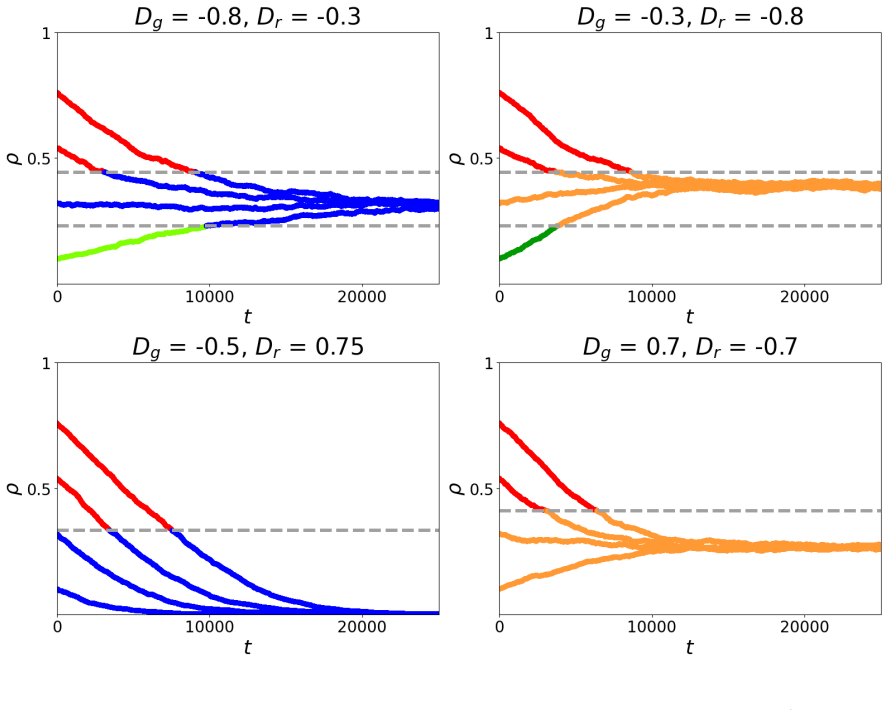
In Evolutionary game theory the payoffs are typically fixed or shaped by external environmental variables. Here, we introduce an endogenous-feedback model in which the game played coevolves directly with the population state: the payoff matrix is a time-dependent function of the level of cooperation. This allows strategic incentives to be continuously modified by the collective behavior they generate. Even in the simplest case of linear and instantaneous feedback, the model reveals feedback-induced regimes, termed chimera games, in which stable cooperation arises despite being incompatible with the predictions of standard fixed-game dynamics. We further show that delayed feedback can destabilize these equilibria and generate sustained oscillations, while nonlinear feedback reshapes equilibrium structure and introduces path dependence. Our results show how cooperation can be promoted, suppressed, or destabilized by incentives generated endogenously by the very same population's collective behavior. We conclude by outlining how our framework connects to real-world systems shaped by endogenous feedback.
Editorial analysis
A structured set of objections, weighed in public.
Referee Report
Summary. The paper introduces an endogenous-feedback model in evolutionary game theory where the payoff matrix coevolves directly with the population state x (cooperation level). For the linear instantaneous case this produces the autonomous ODE dx/dt = x(1-x)(a + b x). Equilibria and stability are obtained by standard phase-line analysis, revealing 'chimera games' in which stable high-cooperation states exist that have no counterpart under any fixed-matrix replicator dynamics with the same parameters. The analysis is extended to delayed feedback (which can destabilize equilibria and produce oscillations) and nonlinear feedback (which introduces path dependence). The framework is offered as a way to understand how population-generated incentives can promote, suppress, or destabilize cooperation.
Significance. If the central derivations hold, the work supplies a mathematically tractable extension of replicator dynamics that generates qualitatively new stability regimes for cooperation. The explicit construction of the autonomous ODE, the direct contrast with fixed-game predictions, and the clean treatment of delay and nonlinearity are strengths that could stimulate both theoretical follow-up and empirical tests in systems where behavior modifies the rules of interaction.
minor comments (3)
- The abstract introduces the term 'chimera games' without a one-sentence definition; adding a brief parenthetical characterization would improve immediate accessibility for readers outside the subfield.
- The transition from the general time-dependent payoff matrix to the specific linear ODE form would benefit from an explicit intermediate equation showing how the payoff difference becomes the affine function a + b x.
- A small comparison table (or figure panel) juxtaposing the stability regions of the endogenous model against the corresponding fixed-matrix replicator dynamics would make the central 'incompatible' claim visually immediate.
Simulated Author's Rebuttal
We thank the referee for the careful and accurate summary of our manuscript, for recognizing its potential significance, and for recommending minor revision. We appreciate the positive evaluation of the endogenous-feedback framework, the chimera-game regimes, and the extensions to delay and nonlinearity.
Circularity Check
No significant circularity detected
full rationale
The manuscript defines an endogenous linear feedback making the payoff difference an affine function of instantaneous cooperation x, which directly yields the autonomous ODE dx/dt = x(1-x)(a + b x) by standard substitution into the replicator equation. Equilibria and stability follow from ordinary phase-line analysis of this ODE; the comparison to fixed-matrix replicator dynamics is constructed explicitly as a contrast rather than a fit. Extensions to delayed and nonlinear feedback are obtained by the same direct substitution without parameter tuning or self-referential closure. No load-bearing step reduces to a fitted input renamed as prediction, a self-citation chain, or an ansatz smuggled via prior work by the same authors. The derivation chain is self-contained against external benchmarks and uses only standard dynamical-systems methods.
Axiom & Free-Parameter Ledger
free parameters (1)
- feedback strength parameter
axioms (1)
- domain assumption Payoff matrix is a time-dependent function of cooperation level
Lean theorems connected to this paper
-
IndisputableMonolith/Foundation/ArithmeticFromLogic.leanLogicNat recovery and J-cost orbit unclear?
unclearRelation between the paper passage and the cited Recognition theorem.
the payoff matrix is a time-dependent function of the level of cooperation... G(ρ, Dg, Dr, DTg, DTr) = [1 − f(ρ)]GB + f(ρ)GT ... dρ/dt = ρ(1 − ρ)∆Π(ρ)
-
IndisputableMonolith/Foundation/BranchSelection.leanbranch_selection (coupling combiner forces bilinear J) unclear?
unclearRelation between the paper passage and the cited Recognition theorem.
Chimera games... stable cooperation level reached at equilibrium would be unstable under standard evolutionary principles
What do these tags mean?
- matches
- The paper's claim is directly supported by a theorem in the formal canon.
- supports
- The theorem supports part of the paper's argument, but the paper may add assumptions or extra steps.
- extends
- The paper goes beyond the formal theorem; the theorem is a base layer rather than the whole result.
- uses
- The paper appears to rely on the theorem as machinery.
- contradicts
- The paper's claim conflicts with a theorem or certificate in the canon.
- unclear
- Pith found a possible connection, but the passage is too broad, indirect, or ambiguous to say the theorem truly supports the claim.
Reference graph
Works this paper leans on
- [1]
-
[2]
Maynard Smith, American scientist 64, 41 (1976)
J. Maynard Smith, American scientist 64, 41 (1976)
work page 1976
-
[3]
P. D. Taylor and L. B. Jonker, Mathematical biosciences 40, 145 (1978)
work page 1978
-
[4]
M. A. Nowak, Evolutionary dynamics: exploring the equations of life (Harvard university press, 2006)
work page 2006
-
[5]
J. M. Smith and G. R. Price, Nature 246, 15 (1973)
work page 1973
-
[6]
J. M. Smith, Evolution and the Theory of Games (Cambridge University Press, 1982)
work page 1982
-
[7]
M. A. Nowak and R. M. May, nature 359, 826 (1992)
work page 1992
-
[8]
J. W. Weibull, Evolutionary game theory , 1st ed. (MIT Press, 2004)
work page 2004
-
[9]
J. Von Neumann and O. Morgenstern, in Theory of games and economic behavior (Princeton university press, 2007)
work page 2007
-
[10]
R. B. Myerson, Game theory (Harvard university press, 2013)
work page 2013
-
[11]
Livan, Royal society open science 6, 191255 (2019)
G. Livan, Royal society open science 6, 191255 (2019)
work page 2019
-
[12]
F. De Domenico, F. Caccioli, G. Livan, G. Montagna, and O. Nicrosini, Royal Society Open Science 11, 240177 (2024)
work page 2024
- [13]
- [14]
-
[15]
M. A. Nowak, science 314, 1560 (2006)
work page 2006
-
[16]
M. Perc, J. J. Jordan, D. G. Rand, Z. Wang, S. Boccaletti, and A. Szolnoki, Physics Reports 687, 1 (2017)
work page 2017
- [17]
-
[18]
Ak¸ cay, The American Naturalist195, 315 (2020)
E. Ak¸ cay, The American Naturalist195, 315 (2020)
work page 2020
-
[19]
L. S. Shapley, Proceedings of the national academy of sciences 39, 1095 (1953)
work page 1953
-
[20]
Z. Wang, A. Szolnoki, and M. Perc, Physical Review E 90, 032813 (2014)
work page 2014
- [21]
-
[22]
M. Kleshnina, C. Hilbe, ˇS. ˇSimsa, K. Chatterjee, and M. A. Nowak, Nature Communications 14, 4153 (2023)
work page 2023
-
[23]
G. Wang, Q. Su, L. Wang, and J. B. Plotkin, Proceedings of the National Academy of Sciences 121, e2406993121 (2024)
work page 2024
-
[24]
J. R. Peck and M. W. Feldman, The American Naturalist 127, 209 (1986)
work page 1986
-
[25]
S. Bowles, J.-K. Choi, and A. Hopfensitz, Journal of theoretical biology 223, 135 (2003)
work page 2003
-
[26]
A. R. Tilman, S. Levin, and J. R. Watson, Journal of theoretical biology 454, 205 (2018)
work page 2018
-
[27]
S. Estrela, E. Libby, J. Van Cleve, F. D´ ebarre, M. Deforet, W. R. Harcombe, J. Pe˜ na, S. P. Brown, and M. E. Hochberg, Trends in ecology & evolution 34, 6 (2019)
work page 2019
-
[28]
M. H. Cortez, S. Patel, and S. J. Schreiber, Proceedings of the Royal Society B 287, 20192298 (2020)
work page 2020
-
[29]
J. S. Weitz, C. Eksin, K. Paarporn, S. P. Brown, and W. C. Ratcliff, Proceedings of the National Academy of Sciences 113, E7518 (2016)
work page 2016
-
[30]
A. R. Tilman, J. B. Plotkin, and E. Ak¸ cay, Nature communications 11, 915 (2020)
work page 2020
- [31]
-
[32]
S. Gonz´ alez-Bail´ on, J. Borge-Holthoefer, A. Rivero, and Y. Moreno, Scientific reports1, 1 (2011)
work page 2011
-
[33]
A. R. Kang, J. Park, J. Lee, and H. K. Kim, in Proceedings of the 24th international conference on world wide web (2015) pp. 1079–1084
work page 2015
-
[34]
Kaizoji, Physica A: Statistical Mechanics and its Applications 287, 493 (2000)
T. Kaizoji, Physica A: Statistical Mechanics and its Applications 287, 493 (2000)
work page 2000
- [35]
-
[36]
Z. Wang, S. Kokubo, M. Jusup, and J. Tanimoto, Physics of life reviews 14, 1 (2015)
work page 2015
- [37]
- [38]
-
[39]
O. Sadekar, A. Civilini, J. G´ omez-Garde˜ nes, V. Latora, and F. Battiston, Physical Review E 110, 014306 (2024)
work page 2024
- [40]
-
[41]
E. Ak¸ cay and J. Roughgarden, Proceedings of the Royal Society B: Biological Sciences 278, 2198 (2011)
work page 2011
-
[42]
J. Hofbauer and K. Sigmund, Bulletin of the American mathematical society 40, 479 (2003). 12
work page 2003
-
[43]
J. Hofbauer and K. Sigmund, Evolutionary games and population dynamics (Cambridge university press, 1998)
work page 1998
- [44]
-
[45]
A. Traulsen, M. A. Nowak, and J. M. Pacheco, Physical Review E—Statistical, Nonlinear, and Soft Matter Physics 74, 011909 (2006)
work page 2006
-
[46]
K. Betz, F. Fu, and N. Masuda, Bulletin of Mathematical Biology 86, 84 (2024)
work page 2024
- [47]
-
[48]
T. Gross and B. Blasius, Journal of the Royal Society Interface 5, 259 (2008)
work page 2008
-
[49]
A. W. Delton, M. M. Krasnow, L. Cosmides, and J. Tooby, Proceedings of the National Academy of Sciences 108, 13335 (2011)
work page 2011
-
[50]
A. Civilini, O. Sadekar, F. Battiston, J. G´ omez-Garde˜ nes, and V. Latora, Physical Review Letters 132, 167401 (2024)
work page 2024
-
[51]
A. Civilini, N. Anbarci, and V. Latora, Physical Review Letters 127, 268301 (2021)
work page 2021
-
[52]
O. Sadekar, A. Civilini, V. Latora, and F. Battiston, Journal of the Royal Society Interface 22, 20250134 (2025). 13 SUPPLEMENTAL MATERIAL I. SIMULATIONS Here we detail the Monte Carlo simulation protocol performed to validate the analytical results. The standard evolutionary framework adopted for simulations relies on the well mixed assumption and draws ...
work page 2025
discussion (0)
Sign in with ORCID, Apple, or X to comment. Anyone can read and Pith papers without signing in.