REVIEW 4 major objections 4 minor 43 references
Drift-Adaptive Slicing-Based Resource Management for Cooperative ISAC Networks
T0 review · 4 major / 4 minor · reviewed 2026-08-06 · deepseek-v4-flash
Pith's one-line read The paper claims that a digital-twin-based, drift-adaptive slicing scheme can keep cooperative ISAC network planning accurate when device and target distributions shift, delivering up to 18% higher service satisfaction and up to 13.1%…
desk verdict Credible extension of the authors' ICCC'24 drift-adaptive DT work to ISAC slicing, with sound closed-form planning and a real ensemble idea; the unquantified drift-detection threshold and self-referential emulation keep the headline gains from being fully supported yet. read the letter →
The pith
A machine-rendered reading of the paper's core claim, the machinery that carries it, and where it could break.
The reading
What carries the argument
The load-bearing machinery is the slice-level digital twin, defined as a digital representation of a network slice that collects location data, adapts a statistical spatial model, and emulates candidate decisions. Its two components do the work: (i) a drift-adaptive spatial modeling function that toggles between a Thomas cluster process (joint modeling) and two independent Poisson point processes (independent modeling), with drift detected by mean absolute percentage error in parameter prediction and adapted by LSTM retraining plus model ensemble; and (ii) a network emulation function that reconstructs network instances from historical snapshots and scores a planning decision by the average relative difference between service demand and capacity. Together they reduce the original multi-variable optimization to a closed-form solution in the decision variables plus a one-dimensional search over the communication active probability $\rho_c$.
What would settle it
Re-run the 400-window experiment with drift events more frequent than the LSTM retraining lag (for example, flipping the thinning probability $\nu$ every few planning windows instead of every 200) and with abrupt sign changes in device-target correlation; if the proposed scheme's satisfaction ratio falls to or below the plain independent-model benchmark while its drift indicator stays low, the temporal-correlation premise is falsified.
Extended reading notes
Core claim
The central discovery is that model drift in ISAC network planning can be handled by maintaining digital twins of the sensing and communication slices, where each twin combines a drift-adaptive statistical model with a network emulation function. The statistical modeling is an ensemble of two spatial point processes: a joint Thomas cluster process that captures the attraction between mobile devices and targets (more accurate when the pattern is stable), and an independent homogeneous Poisson process for each population (less accurate but robust when correlation changes abruptly). Drift is detected by monitoring the prediction errors of LSTM-based parameter forecasts, and when drift is flagged the twin retrains the predictors and outputs both models; the emulation function then reconstructs instances from historical spatial snapshots, measures the demand-capacity gap of the planning decision produced by each model, and selects the better one. On the paper's account this yields closed-form planning decisions, with only the communication active probability requiring a one-dimensional search, and delivers up to 18% higher service satisfaction and up to 13.1% lower resource consumption than the benchmark schemes.
Load-bearing premise
The emulation function assumes historical spatial snapshots are representative of the upcoming planning window, so the method selects a model by replaying the past; if the device and target distribution shifts discontinuously between windows, the replayed evaluation can pick the wrong model and satisfaction drops.
Editorial extensions
If this is right
- Network planning for cooperative ISAC can be computed in near-closed form despite non-stationary spatial distributions, so the scheme scales to many APs without a combinatorial optimizer.
- When device-target spatial correlation is volatile, deliberately using a less detailed but more robust spatial model can outperform a more detailed one; characterizing correlation is not always beneficial.
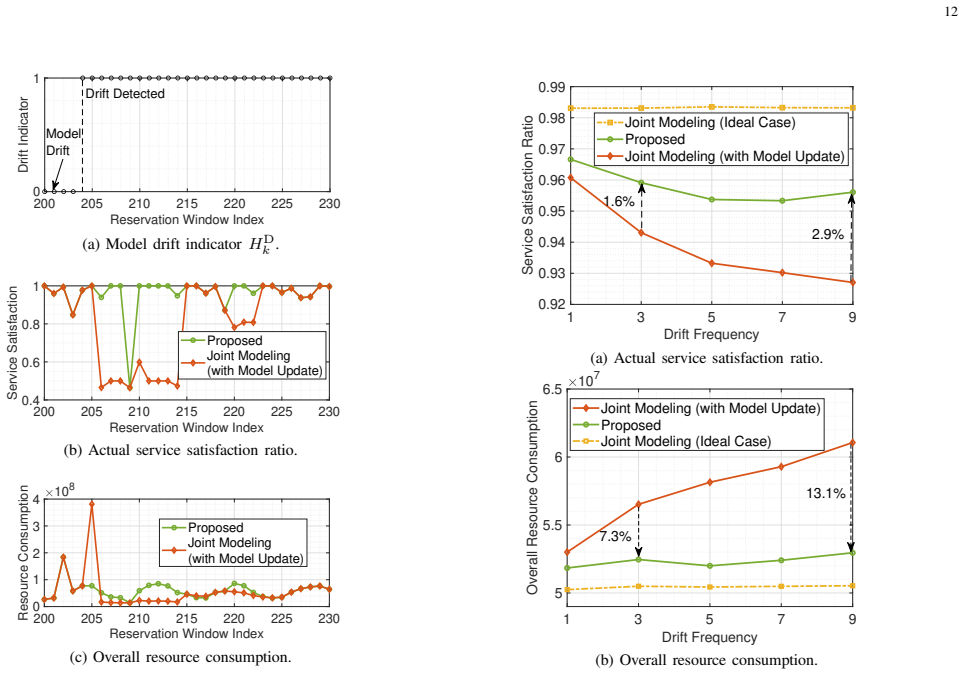
- After an abrupt drift, the proposed model-update mechanism brings the joint model's prediction error back down quickly, and the ensemble selector prevents both under-provisioning and over-provisioning in the intervening windows.
- The reported gains (up to 18% satisfaction, up to 13.1% resource reduction) grow with drift frequency, meaning the scheme's advantage is largest exactly in the non-stationary regimes where fixed models fail.
Reading between the lines
- The same emulation-plus-ensemble recipe could be applied beyond spatial point processes, e.g., to choose between a fine-grained and a coarse model of user traffic demand or mobility, since the selection mechanism only needs historical snapshots and a demand-capacity metric.
- Because the emulation function trusts recent history, the method's advantage should shrink as drift events become more frequent than the LSTM training horizon; a stress test with drift every few planning windows would reveal the failure boundary.
- The closed-form structure suggests the planning decision could be recomputed at a finer timescale after drift is detected, shortening the vulnerable window rather than waiting for the next planning window; the paper does not explore this adaptive-horizon extension.
Signed reviews
Editorial analysis
A structured set of objections, weighed in public.
Referee Report
Summary. The paper proposes a drift-adaptive, slicing-based resource management scheme for cooperative ISAC networks. A global controller establishes separate sensing and communication slices and, over large timescales, makes planning decisions including sensing RoI partitioning, the active probability for communication, and spectrum/edge-computing reservations. To handle non-stationary spatial distributions, the paper builds slice digital twins containing two statistical spatial models (a Thomas cluster process and an independent Poisson point process) with LSTM-based parameter prediction, a drift detection/adaptation module, and a network emulation function that evaluates candidate decisions. The planning problem is transformed via closed-form optimality conditions (Propositions 1–3) into a one-dimensional search. Numerical results claim an up-to-18% improvement in service satisfaction and up-to-13.1% reduction in resource consumption against benchmark schemes.
Significance. The paper's main contribution is a closed-form, computationally light planning solution for a complex resource allocation problem in non-stationary cooperative ISAC networks, together with a model-ensemble mechanism that is intended to be robust to spatial model drift. The derivations in Propositions 1–3 are internally coherent, and the reduction to a single-variable search is a genuine strength. However, the central quantitative claims rest on an unquantified drift-detection threshold and on an emulation step that partially reuses the model's own rate formula, so the reported 18% and 13.1% numbers are not yet reproducible or fully independent. If these gaps are closed, the framework would be a useful step toward practically implementable network planning in dynamic environments.
major comments (4)
- [Section IV-B3] The model drift detection rule is specified only qualitatively as 'drastic accuracy degradation' in MAPE. No threshold, statistical test, or detection rule is given, and no sensitivity analysis is provided. Since this detection triggers the LSTM retraining and the ensemble switch, the reported gains of up to 18% satisfaction and 13.1% resource reduction are all downstream of this unspecified quantity. The paper must specify the detection criterion (e.g., MAPE > θ) and show how the results vary with θ; otherwise the algorithm is under-specified and the numerical claims cannot be reproduced or assessed for robustness.
- [Section V-B1] The communication-side emulation function reuses Eq. (9), which is the same model-derived rate lower bound used in the planning decision. This creates a circularity: the decision evaluator validates a model partly using that model's own formula. Only the sensing-side evaluation uses actual device and target locations. The paper should evaluate communication capacity by an independent mechanism (e.g., direct simulation of the transmission process) or explicitly acknowledge that the communication emulation is not an independent model check.
- [Section VI] The simulation results report averages over only 5 runs with no error bars, confidence intervals, or statistical significance tests. Given the stochastic nature of point processes and LSTM training, the observed differences (e.g., 1.6%, 2.9%, 13.1%) could be within run-to-run noise. The authors should provide variance/confidence information and, ideally, a sensitivity analysis of the drift-detection threshold that is currently missing.
- [Section IV-C] The emulation function assumes that historical spatial snapshots are representative of the upcoming planning window. This temporal-correlation assumption is load-bearing, but Fig. 9(b) shows that satisfaction dips in the windows right after an abrupt drift, indicating that the emulation can select a poorer decision during transitions. The paper should quantify this transient degradation and discuss how the scheme behaves under discontinuous distribution shifts.
minor comments (4)
- [Section IV-B3] There is a typo: 'exhibit exhibits' should read 'exhibit.'
- [Section VI-B] The text says 'the standard derivation of the distance' where 'standard deviation' is intended.
- [Section IV-A] The data collection period M0 is set to 10 in Table I but no rationale is given for this choice; a brief justification would improve reproducibility.
- [Section V-C] The overall algorithm is described only in prose; a pseudocode listing would make the decision flow (detection, update, ensemble selection) unambiguous.
Circularity Check
No significant circularity: closed-form planning formulas are derived from stated stochastic-geometry models, and drift-adaptive ensemble selection is validated on independent sensing-location counts; reuse of Eq. (9) in communication evaluation is a stated simplification, not a circular derivation.
full rationale
The paper does not exhibit a circular derivation chain. The planning formulas are obtained from stated system models: Eq. (9) follows from Proposition 1 via Jensen's inequality on a PPP/Poisson thinning model, Eqs. (7) combine the sensing constraints, and Eq. (10) follows from an external interference CDF result [23]. The LSTM parameter predictors are fitted to MLE reference values from past windows and are then checked against emulation instances, so the output planning decision is not a re-statement of the fitted values. The drift detector evaluates MAPE of parameter prediction errors, and the ensemble selector chooses between decisions based on emulation instances that, on the sensing side, count actual device and target locations rather than reusing either spatial model. The communication-side evaluation does reuse Eq. (9), but the paper states this explicitly as a complexity reduction, applies the same formula to every candidate decision, and ties the drift-adaptation gain to the sensing-side counts and parameter-update behavior rather than to the communication formula alone, so this is a validation simplification rather than a result that reduces to its own input by construction. Self-citations ([1], [9], [15], [26], [27]) are contextual and none is load-bearing. The unspecified MAPE threshold for drift detection is a reproducibility and sensitivity gap, not a circularity.
Assumptions & free parameters
free parameters (2)
- Drift detection MAPE threshold =
not specified
- LSTM lookback K0 and hyperparameters =
not specified
assumptions (5)
- domain assumption Spatial distributions can be represented as either a Thomas cluster process or two independent PPPs, with parameters constant within a planning window and LSTM-predictable across windows.
- domain assumption Historical spatial snapshots are temporally correlated with the upcoming planning window, so emulation on past instances validates future decisions.
- domain assumption Only the strongest interfering mobile device matters for SIR, beam directions are independent and uniformly distributed, and interferers form a thinned PPP.
- domain assumption E[N^U_I,1] equals lambda^U / lambda^I for independent modeling and equals mu^U for joint modeling.
- domain assumption Mobile devices and APs are homogeneous, so one representative device and AP characterize the whole network.
invented entities (1)
-
Network slice digital twins (slice DTs)
Cite this review
Pith. "Pith review of Drift-Adaptive Slicing-Based Resource Management for Cooperative ISAC Networks." pith.science (2026). https://pith.science/paper/2WII7YK3
@misc{pith2026250620762,
  author       = {Pith},
  title        = {Pith review of: Drift-Adaptive Slicing-Based Resource Management for Cooperative ISAC Networks},
  year         = {2026},
  howpublished = {\url{https://pith.science/paper/2WII7YK3}},
  note         = {Machine review of arXiv:2506.20762}
}
read the original abstract
In this paper, we propose a novel drift-adaptive slicing-based resource management scheme for cooperative integrated sensing and communication (ISAC) networks. Particularly, we establish two network slices to provide sensing and communication services, respectively. In the large-timescale planning for the slices, we partition the sensing region of interest (RoI) of each mobile device and reserve network resources accordingly, facilitating low-complexity distance-based sensing target assignment in small timescales. To cope with the non-stationary spatial distributions of mobile devices and sensing targets, which can result in the drift in modeling the distributions and ineffective planning decisions, we construct digital twins (DTs) of the slices. In each DT, a drift-adaptive statistical model and an emulation function are developed for the spatial distributions in the corresponding slice, which facilitates closed-form decision-making and efficient validation of a planning decision, respectively. Numerical results show that the proposed drift-adaptive slicing-based resource management scheme can increase the service satisfaction ratio by up to 18% and reduce resource consumption by up to 13.1% when compared with benchmark schemes.
Figures


Figures from the paper (6 more)



Reference graph
Works this paper leans on
-
[1]
Model d rift- adaptive resource reservation in ISAC networks: A digital t win-based approach,
S. Hu, J. Gao, X. Huang, C. Zhou, M. He, and X. Shen, “Model d rift- adaptive resource reservation in ISAC networks: A digital t win-based approach,” in Proc. IEEE/CIC Int. Conf. Commun. China (ICCC) , 2024, pp. 2143–2148
work page 2024
-
[2]
Integrated sensing and communications: Toward dual-func tional wire- less networks for 6G and beyond,
F. Liu, Y . Cui, C. Masouros, J. Xu, T. X. Han, Y . C. Eldar, an d S. Buzzi, “Integrated sensing and communications: Toward dual-func tional wire- less networks for 6G and beyond,” IEEE J. Sel. Areas Commun. , vol. 40, no. 6, pp. 1728–1767, 2022
2022
-
[3]
Enabling intelligent connectivity: A survey of secure ISAC in 6G netw orks,
X. Zhu, J. Liu, L. Lu, T. Zhang, T. Qiu, C. Wang, and Y . Liu, “ Enabling intelligent connectivity: A survey of secure ISAC in 6G netw orks,” IEEE Commun. Surveys Tut. , vol. 27, no. 2, pp. 748–781, 2025
work page 2025
-
[4]
Cooperative integrated sensing and communication in 6G: From operators perspective,
X. Wang, Z. Han, R. Xi, G. Liu, L. Han, J. Jin, Y . Xue, L. Ma, Y . Wang, T. Jiang, M. Lou, Q. Wang, and J. Wang, “Cooperative integrated sensing and communication in 6G: From operators perspective,” IEEE Wireless Commun., vol. 32, no. 1, pp. 52–59, 2025
work page 2025
-
[5]
Coop erative ISAC networks: Opportunities and challenges,
K. Meng, C. Masouros, A. P . Petropulu, and L. Hanzo, “Coop erative ISAC networks: Opportunities and challenges,” IEEE Wireless Commun., pp. 1–8, 2024, to be published, doi: 10.1109/MWC.008.24001 51
-
[6]
Integrated sensing an d communi- cation: A network level perspective,
Y . Cui, H. Ding, L. Zhao, and J. An, “Integrated sensing an d communi- cation: A network level perspective,” IEEE Wireless Commun. , vol. 31, no. 1, pp. 103–109, 2024
work page 2024
-
[7]
Networked integrated sensing and communications for 6G wi reless systems,
J. Li, X. Shao, F. Chen, S. Wan, C. Liu, Z. Wei, and D. Wing Kw an Ng, “Networked integrated sensing and communications for 6G wi reless systems,” IEEE Internet Things J. , vol. 11, no. 17, pp. 29 062–29 075, 2024
work page 2024
-
[8]
Dynamic RAN slicing for service-oriented vehicular netwo rks via constrained learning,
W. Wu, N. Chen, C. Zhou, M. Li, X. Shen, W. Zhuang, and X. Li, “Dynamic RAN slicing for service-oriented vehicular netwo rks via constrained learning,” IEEE J. Sel. Areas Commun. , vol. 39, no. 7, pp. 2076–2089, 2021
work page 2021
Show all 43 references
-
[9]
Digital twi n- empowered network planning for multi-tier computing,
C. Zhou, J. Gao, M. Li, X. Shen, and W. Zhuang, “Digital twi n- empowered network planning for multi-tier computing,” J. Commun. Inf. Netw., vol. 7, no. 3, pp. 221–238, 2022
2022
-
[10]
Time allocation approaches for a perceptive mobile network using integrati on of sensing and communication,
H. Zhang, Y . Zhang, X. Liu, C. Ren, H. Li, and C. Sun, “Time allocation approaches for a perceptive mobile network using integrati on of sensing and communication,” IEEE Trans. Wireless Commun., vol. 23, no. 2, pp. 1158–1169, 2024
2024
-
[11]
Rethink- ing dense cells for integrated sensing and communications: A stochastic geometric view,
A. Salem, K. Meng, C. Masouros, F. Liu, and D. Lopez-Pere z, “Rethink- ing dense cells for integrated sensing and communications: A stochastic geometric view,” IEEE Open J. Commun. Soc. , vol. 5, pp. 2226–2239, 2024
2024
-
[12]
Performan ce analysis of integrated sensing and communication networks with blocka ge effects,
Z. Sun, S. Y an, N. Jiang, J. Zhou, and M. Peng, “Performan ce analysis of integrated sensing and communication networks with blocka ge effects,” IEEE Trans. V eh. Technol., vol. 73, no. 11, pp. 16 876–16 891, 2024
2024
-
[13]
Network-leve l integrated sensing and communication: Interference management and BS coordina- tion using stochastic geometry,
K. Meng, C. Masouros, G. Chen, and F. Liu, “Network-leve l integrated sensing and communication: Interference management and BS coordina- tion using stochastic geometry,” IEEE Trans. Wireless Commun., vol. 23, no. 12, pp. 19 365–19 381, 2024
2024
-
[14]
Model drift in dy namic networks,
D. M. Manias, A. Chouman, and A. Shami, “Model drift in dy namic networks,” IEEE Commun. Mag. , vol. 61, no. 10, pp. 78–84, 2023
2023
-
[15]
Holi stic network virtualization and pervasive network intelligenc e for 6G,
X. Shen, J. Gao, W. Wu, M. Li, C. Zhou, and W. Zhuang, “Holi stic network virtualization and pervasive network intelligenc e for 6G,” IEEE Commun. Surveys Tuts. , vol. 24, no. 1, pp. 1–30, Firstquarter 2022
2022
-
[16]
Intellig ent resource adaptation for diversified service requirements in industr ial iot,
W. Zhang, Y . He, T. Zhang, C. Ying, and J. Kang, “Intellig ent resource adaptation for diversified service requirements in industr ial iot,” IEEE Trans. Cogn. Commun. Netw. , pp. 1–1, 2024
2024
-
[17]
MOTO: Mobility-aware online task offloading with adaptive load balancing in small-cell MEC,
S. Duan, F. Lyu, H. Wu, W. Chen, H. Lu, Z. Dong, and X. Shen, “MOTO: Mobility-aware online task offloading with adaptive load balancing in small-cell MEC,” IEEE Trans. Mobile Comput. , vol. 23, no. 1, pp. 645–659, 2024
2024
-
[18]
LeaD: Large-scale edge cache deployment based on spatio-t emporal WiFi traffic statistics,
F. Lyu, J. Ren, N. Cheng, P . Y ang, M. Li, Y . Zhang, and X. Sh en, “LeaD: Large-scale edge cache deployment based on spatio-t emporal WiFi traffic statistics,” IEEE Trans. Mobile Comput. , vol. 20, no. 8, pp. 2607–2623, 2021
2021
-
[19]
Sens ing as a service in 6G perceptive networks: A unified framework for I SAC resource allocation,
F. Dong, F. Liu, Y . Cui, W. Wang, K. Han, and Z. Wang, “Sens ing as a service in 6G perceptive networks: A unified framework for I SAC resource allocation,” IEEE Trans. Wireless Commun. , vol. 22, no. 5, pp. 3522–3536, 2023
2023
-
[20]
Full-duplex communication for ISAC: Joint beamforming an d power optimization,
Z. He, W. Xu, H. Shen, D. W. K. Ng, Y . C. Eldar, and X. Y ou, “Full-duplex communication for ISAC: Joint beamforming an d power optimization,” IEEE J. Sel. Areas Commun , vol. 41, no. 9, pp. 2920– 2936, 2023
2023
-
[21]
Impact of channel agi ng on dual-function radar-communication systems: Performance analysis and resource allocation,
J. Chen, X. Wang, and Y .-C. Liang, “Impact of channel agi ng on dual-function radar-communication systems: Performance analysis and resource allocation,” IEEE Trans. Commun. , vol. 71, no. 8, pp. 4972– 4987, 2023
2023
-
[22]
New trends in stochastic geometry for wireless netw orks: A tutorial and survey,
Y . Hmamouche, M. Benjillali, S. Saoudi, H. Y anikomerog lu, and M. D. Renzo, “New trends in stochastic geometry for wireless netw orks: A tutorial and survey,” Proc. IEEE , vol. 109, no. 7, pp. 1200–1252, 2021
2021
-
[23]
Stochastic geome try interference analysis of radar network performance,
A. Munari, L. Simi´ c, and M. Petrova, “Stochastic geome try interference analysis of radar network performance,” IEEE Commun. Lett. , vol. 22, no. 11, pp. 2362–2365, 2018
2018
-
[24]
Stochasti c network calculus analysis of spatial-temporal integrated sensing and communication networks,
M. Mei, M. Y ao, Q. Y ang, J. Wang, and R. R. Rao, “Stochasti c network calculus analysis of spatial-temporal integrated sensing and communication networks,” IEEE Trans. V eh. Technol. , vol. 73, no. 6, pp. 9120–9124, 2024
2024
-
[25]
Sensing-assisted robust SWIP T for mobile energy harvesting receivers in networked ISAC systems,
Y . Xu, D. Xu, and S. Song, “Sensing-assisted robust SWIP T for mobile energy harvesting receivers in networked ISAC systems,” IEEE Trans. Wireless Commun., vol. 24, no. 3, pp. 2094–2109, 2025
2025
-
[26]
Adaptive devic e- edge collaboration on DNN inference in AIoT: A digital twin- assisted approach,
S. Hu, M. Li, J. Gao, C. Zhou, and X. Shen, “Adaptive devic e- edge collaboration on DNN inference in AIoT: A digital twin- assisted approach,” IEEE Internet Things J. , vol. 11, no. 7, pp. 12 893–12 908, 2024
2024
-
[27]
Digital-twi n-empowered resource allocation for on-demand collaborative sensing,
M. Li, J. Gao, C. Zhou, L. Zhao, and X. Shen, “Digital-twi n-empowered resource allocation for on-demand collaborative sensing, ” IEEE Internet Things J. , vol. 11, no. 23, pp. 37 942–37 958, 2024
2024
-
[28]
Network digital twin: Context, enabling technologies, an d opportuni- ties,
P . Almasan, M. Ferriol-Galm´ es, J. Paillisse, J. Su´ arez-V arela, D. Perino, D. L ´ opez, A. A. P . Perales, P . Harvey, L. Ciavaglia, L. Wong, V . Ram, S. Xiao, X. Shi, X. Cheng, A. Cabellos-Aparicio, and P . Barle t-Ros, “Network digital twin: Context, enabling technologi...
2022
-
[29]
Digital twin for optimization of slicing-enabled c ommunication networks: A federated graph learning approach,
M. Abdel-Basset, H. Hawash, K. M. Sallam, I. Elgendi, an d K. Munas- inghe, “Digital twin for optimization of slicing-enabled c ommunication networks: A federated graph learning approach,” IEEE Commun. Mag. , vol. 61, no. 10, pp. 100–106, 2023. 15
2023
-
[30]
A graph neural networ k- based digital twin for network slicing management,
H. Wang, Y . Wu, G. Min, and W. Miao, “A graph neural networ k- based digital twin for network slicing management,” IEEE Trans. Ind. Informat., vol. 18, no. 2, pp. 1367–1376, Feb. 2022
2022
-
[31]
Adaptive se nsing for Internet of robotic things platforms with integrated sensi ng, computing and communication capabilities,
X. Wang, L. Nkenyereye, S. Rani, and J. Lyu, “Adaptive se nsing for Internet of robotic things platforms with integrated sensi ng, computing and communication capabilities,” IEEE Internet Things J. , 2024
2024
-
[32]
Optim al scheduling policy for time-division joint radar and communication sys tems: Cross- layer design and sensing for free,
Z. Xie, R. Li, Z. Jiang, J. Zhu, X. She, and P . Chen, “Optim al scheduling policy for time-division joint radar and communication sys tems: Cross- layer design and sensing for free,” IEEE Internet Things J. , vol. 10, no. 23, pp. 20 746–20 760, 2023
2023
-
[33]
Optimal cross-layer scheduling of transmissions over a fading multiaccess channel,
M. Goyal, A. Kumar, and V . Sharma, “Optimal cross-layer scheduling of transmissions over a fading multiaccess channel,” IEEE Trans. Inf. Theory, vol. 54, no. 8, pp. 3518–3537, 2008
2008
-
[34]
Resource s cheduling for distributed multi-target tracking in netted colocated MIMO radar systems,
W. Yi, Y . Y uan, R. Hoseinnezhad, and L. Kong, “Resource s cheduling for distributed multi-target tracking in netted colocated MIMO radar systems,” IEEE Trans. Signal Process. , vol. 68, pp. 1602–1617, 2020
2020
-
[35]
Per formance analysis of uncoordinated interference mitigation for aut omotive radar,
Y . Wang, Q. Zhang, Z. Wei, L. Kui, F. Liu, and Z. Feng, “Per formance analysis of uncoordinated interference mitigation for aut omotive radar,” IEEE Trans. V eh. Technol., vol. 72, no. 4, pp. 4222–4235, 2023
2023
-
[36]
Adaptive sche duling for joint communication and radar detection: Tradeoff among th roughput, delay, and detection performance,
H. Ju, Y . Long, X. Fang, Y . Fang, and R. He, “Adaptive sche duling for joint communication and radar detection: Tradeoff among th roughput, delay, and detection performance,” IEEE Trans. V eh. Technol., vol. 71, no. 1, pp. 670–680, 2022
2022
-
[37]
Beamwidth optimization and resource pa rtitioning scheme for localization assisted mm-wave communication,
G. Ghatak, R. Koirala, A. De Domenico, B. Denis, D. Darda ri, B. Uguen, and M. Coupechoux, “Beamwidth optimization and resource pa rtitioning scheme for localization assisted mm-wave communication,” IEEE Trans. Commun., vol. 69, no. 2, pp. 1358–1374, 2021
2021
-
[38]
Integ rated sensing and communications: Recent advances and ten open ch allenges,
S. Lu, F. Liu, Y . Li, K. Zhang, H. Huang, J. Zou, X. Li, Y . Do ng, F. Dong, J. Zhu, Y . Xiong, W. Y uan, Y . Cui, and L. Hanzo, “Integ rated sensing and communications: Recent advances and ten open ch allenges,” IEEE Internet Things J. , vol. 11, no. 11, pp. 19 094–19 120, 2024
2024
-
[39]
To- ward ambient intelligence: Federated edge learning with ta sk-oriented sensing, computation, and communication integration,
P . Liu, G. Zhu, S. Wang, W. Jiang, W. Luo, H. V . Poor, and S. Cui, “To- ward ambient intelligence: Federated edge learning with ta sk-oriented sensing, computation, and communication integration,” IEEE J. Sel. Topics Signal Process. , vol. 17, no. 1, pp. 158–172, 2023
2023
-
[40]
Implementing speed and se paration monitoring in collaborative robot workcells,
J. A. Marvel and R. Norcross, “Implementing speed and se paration monitoring in collaborative robot workcells,” Robot. Comput. Integr . Manuf., vol. 44, pp. 144–155, 2017
2017
-
[41]
Spatio- temporal point process statistics: a review,
J. A. Gonz´ alez, F. J. Rodr´ ıguez-Cort´ es, O. Cronie, and J. Mateu, “Spatio- temporal point process statistics: a review,” Spatial Statist. , vol. 18, pp. 505–544, 2016
2016
-
[42]
Modeling and cove rage analysis of BS-centric clustered users in a random wireless network,
P . D. Mankar, G. Das, and S. S. Pathak, “Modeling and cove rage analysis of BS-centric clustered users in a random wireless network, ” IEEE Wireless Commun. Lett. , vol. 5, no. 2, pp. 208–211, 2016
2016
-
[43]
S tochastic geometry analysis of spatial-temporal performance in wire less networks: A tutorial,
X. Lu, M. Salehi, M. Haenggi, E. Hossain, and H. Jiang, “S tochastic geometry analysis of spatial-temporal performance in wire less networks: A tutorial,” IEEE Commun. Surveys Tuts. , vol. 23, no. 4, pp. 2753–2801, 2021
2021
Reviewed August 6, 2026 · model on record in the stance chip above.
Discussion (0). Continue with ORCID to comment.