REVIEW 5 minor 2 cited by
Richardson tableaux and components of Springer fibers equal to Richardson varieties
T0 review · 0 major / 5 minor · reviewed 2026-08-06 · deepseek-v4-flash
Pith's one-line read The paper proves that a Springer fiber component is a Richardson variety exactly when its standard tableau is a Richardson tableau.
desk verdict A clean, well-proved classification of when Springer fiber components are Richardson varieties, with the main geometric equivalence proved directly and only the Bruhat criterion and smoothness theorem resting on Lusztig's black box. read the letter →
The pith
A machine-rendered reading of the paper's core claim, the machinery that carries it, and where it could break.
The reading
What carries the argument
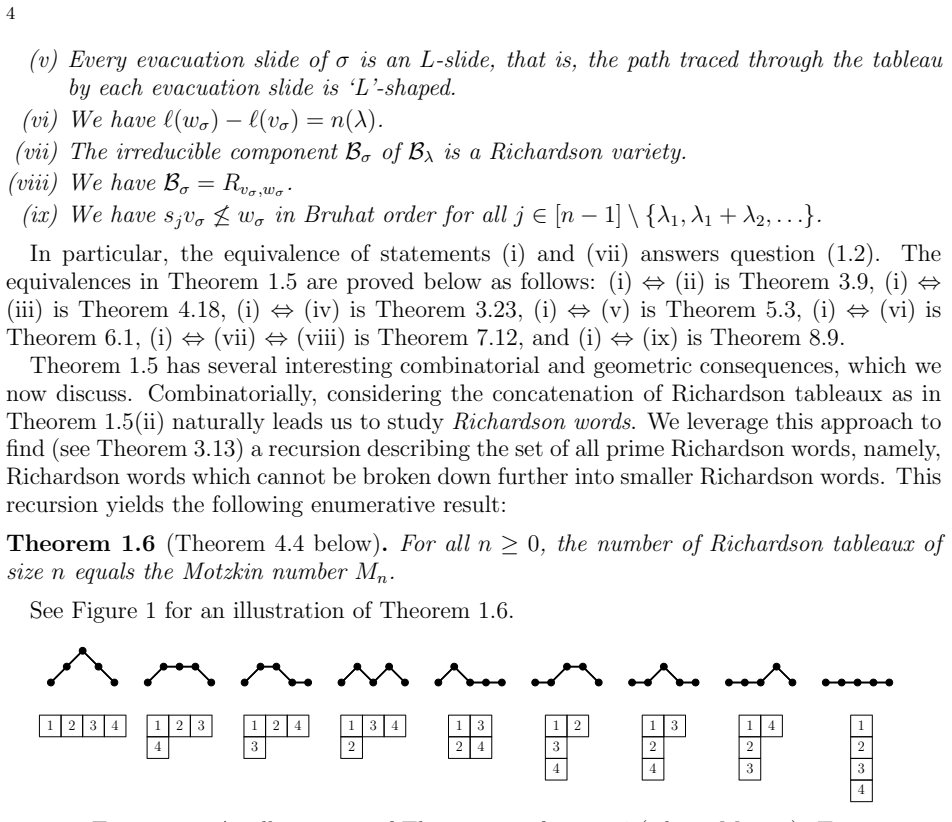
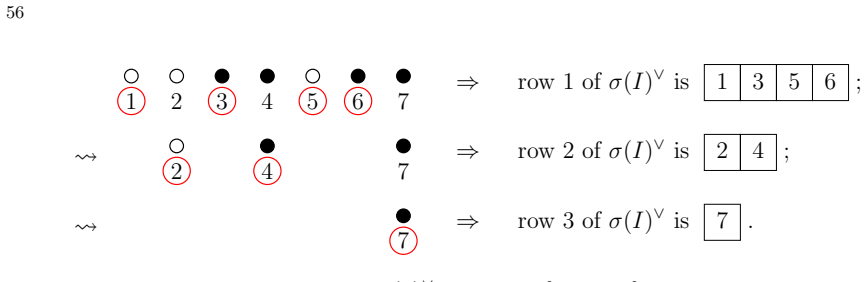
The central objects are the two reading-word permutations v_σ and w_σ of a standard tableau σ. $v_σ^{{-1}}$ records the entries of the evacuation σ∨ row by row from top to bottom, and $w_0w_σ^{{-1}}$w_0 records the entries of σ from bottom to top; these permutations index the Richardson envelope R_{v_σ,w_σ} that minimally contains the Springer component B_σ. The length difference ℓ(w_σ)−ℓ(v_σ) is always at least n(λ), with equality exactly when σ is Richardson, and this equality forces the containment B_σ ⊆ R_{v_σ,w_σ} to become an equality of varieties of the same dimension. The combinatorial heart is the recursive description of Richardson tableaux via their prime decomposition and evacuation, which yields the enumeration and the L-slide characterization that feeds the geometric proof.
What would settle it
For a small shape such as λ=(3,2,1), verify that exactly the eight tableaux in Example 4.9 satisfy ℓ(w_σ)−ℓ(v_σ)=4 and that each corresponding B_σ equals R_{v_σ,w_σ}; if any other tableau passes the length test, or if any B_σ differs from its Richardson envelope, the main equivalence is false.
Extended reading notes
Core claim
For every standard tableau σ of shape λ, the paper constructs a pair of permutations (v_σ, w_σ) from the reading words of σ and its evacuation σ∨; the Richardson variety R_{v_σ,w_σ} is the unique minimal Richardson variety containing the component B_σ of the Springer fiber B_λ. The paper then defines σ to be a Richardson tableau by a simple row condition and shows that B_σ is a Richardson variety if and only if σ is Richardson, in which case B_σ = R_{v_σ,w_σ} (Theorem 7.12 combined with Theorem 6.1). Several equivalent characterizations are established: Richardson tableaux are exactly those whose evacuation is Richardson, whose evacuation slides are all L-shaped, for which ℓ(w_σ)−ℓ(v_σ) = n(λ), and which satisfy a simple Bruhat-order condition coming from Lusztig's cell decomposition of the totally nonnegative Springer fiber. The paper also proves that each such component is smooth and that its cohomology class is S_{v_σ}·S_{w_0w_σ} in the Schubert basis.
Load-bearing premise
The load-bearing premise is Lusztig's decomposition of the totally nonnegative Springer fiber into positive Richardson cells; if that theorem were wrong, the Bruhat-order test and the smoothness result would lose their support, while the core equivalence between Richardson tableaux and Richardson-variety components would still stand on its own proof.
Editorial extensions
If this is right
- The irreducible components of a Springer fiber that are Richardson varieties are precisely those indexed by Richardson tableaux, so question (1.2) is fully answered.
- Every such component B_σ = R_{v_σ,w_σ} is smooth, extending known smoothness results for Richardson components and K-orbit components.
- The cohomology class [B_σ] for Richardson σ is the product S_{v_σ}·S_{w_0w_σ} of Schubert polynomials, so Springer's problem reduces to Schubert structure constants for these components.
- The number of Richardson tableaux of shape λ is the product of binomial coefficients in (1.3); summing over partitions gives the n-th Motzkin number, a new partition-indexed refinement of the Motzkin numbers.
- The top-dimensional cells of the totally nonnegative Springer fiber B_λ^{≥0} are exactly R_{v_σ,w_σ}^{>0} for Richardson σ, so the product formula (1.3) counts these cells.
Reading between the lines
- The Richardson envelope R_{v_σ,w_σ} is defined for every tableau, so one could probe how far a non-Richardson component deviates from being Richardson by measuring the gap ℓ(w_σ)−ℓ(v_σ)−n(λ), a statistic the paper does not study.
- The L-slide characterization suggests a fast algorithmic test for whether a tableau is Richardson, since each evacuation slide is a local operation; the paper does not discuss algorithmic complexity.
- The generating-function recurrences of Section 4.3 may admit a multivariate refinement tracking row lengths rather than only the major index, yielding finer partition-indexed statistics of Motzkin numbers.
- Because these components are smooth, T-invariant Richardson varieties, equivariant localization should give explicit combinatorial formulas for their equivariant cohomology classes, a direction the paper leaves open as a problem.
Editorial analysis
A structured set of objections, weighed in public.
Referee Report
Summary. The paper introduces a new class of standard Young tableaux called Richardson tableaux, defined by a simple condition comparing entries across adjacent rows after deleting the largest entries. For each standard tableau σ of shape λ, the authors associate permutations v_σ and w_σ and prove that the irreducible component B_σ of the Springer fiber B_λ is equal to the Richardson variety R_{v_σ,w_σ} exactly when σ is Richardson. They give several equivalent characterizations: closure under evacuation, an L-slide description of evacuation, the length equality ℓ(w_σ)−ℓ(v_σ)=n(λ), a Bruhat-order condition, and a characterization in terms of top-dimensional cells of Lusztig's totally nonnegative Springer fiber. They also prove that these components are smooth, that their cohomology classes are products of Schubert polynomials, and that Richardson tableaux are counted by Motzkin numbers, with a product-of-binomial-coefficients formula for each fixed shape. The paper closes with detailed comparisons to Richardson components, generalized Richardson components, and K-orbit components.
Significance. If the results hold, the paper gives a complete and satisfying answer to the natural question of which Springer-fiber components are Richardson varieties, tying together Spaltenstein's labeling, Pagnon–Ressayre's minimal Schubert cells, and Lusztig's total positivity. The combinatorial characterization is substantial and leads to an unexpected and elegant Motzkin-number enumeration with a new partition-indexed refinement. The main geometric equivalence is proved self-containedly from Theorems 6.1 and 7.12, with the external input from Lusztig's cell decomposition confined to the auxiliary Bruhat criterion and the smoothness theorem. The proofs are detailed, the use of external theorems is standard for the field, and the computational checks mentioned in the acknowledgments support the enumerative claims.
minor comments (5)
- [§9, Theorem 9.1] The statement 'All Richardson tableaux are smooth' is formally ambiguous, since tableaux are not varieties; I suggest rewording it as 'For every Richardson tableau σ, the component B_σ is smooth.'
- [Throughout] Many cross-references call statements 'Theorem' even though their displayed numbers are Lemmas or Propositions: for example, Lemma 2.2 is referred to as Theorem 2.2, Proposition 3.3 as Theorem 3.3, Proposition 3.18 as Theorem 3.18, Lemma 3.21 as Theorem 3.21, and Lemma 4.13 as Theorem 4.13. Please make the cross-reference labels consistent with the actual numbering environment.
- [§1, after Corollary 1.8] The sentence 'Theorem 1.8 only applies to totally nonnegative Springer fibers...' refers to a nonexistent Theorem 1.8; it should say 'Corollary 1.8' or 'Theorem 8.6'.
- [§8, Eq. (8.2)] The equivalence (i)⇔(ix) in Theorem 1.5, the top-dimensional cell count in Theorem 8.6, and the smoothness proof in §9 depend on Lusztig's cell decomposition quoted as [Lus21, Cor. 1.16]. This is a legitimate external theorem and the dependence is acknowledged for Theorem 1.10, but the introduction could state more explicitly that the Bruhat criterion (ix) and the smoothness theorem inherit that dependence, while the main geometric classification of Richardson-variety components does not.
- [§4.2, proof of Theorem 4.8] The proof of identity (4.17) is convincing but terse; the accounting of new and old 1's would be easier to follow if the bijection between positions in r, t, and r̃ were written out explicitly, especially the contribution of λ_2(λ_1−λ_2).
Circularity Check
No significant circularity: the main geometric equivalence is proved from the combinatorial definition of Richardson tableaux together with independent geometric results, and the enumeration is derived from an explicit recursion rather than fitted.
full rationale
The paper's central claim, Theorem 1.5(i)⇔(vii)/(viii), is proved in Theorem 7.12 by combining two independently established inputs: the combinatorial length characterization Theorem 6.1, proved by induction from the definition of Richardson tableaux and evacuation, and the Richardson-envelope theorem Theorem 7.9, proved from Pagnon–Ressayre's description of Schubert cells and van Leeuwen's evacuation action. Neither input assumes that B_σ is a Richardson variety, so the equivalence is not definitional. The enumeration of Richardson tableaux is also not circular: the prime-word recursion (3.2) and the bijection Ψ in Theorem 4.1 are combinatorial statements about lattice words, and Theorem 4.4 derives the Motzkin generating function from the recursion R(x)=1/(1−x−x^2R(x)); no parameter is fitted to make the count match Motzkin numbers. The smoothness theorem does rely on Lusztig's cell decomposition [Lus21, Cor. 1.16] quoted as (8.2), but this is an external, non-self-cited result whose use is explicitly acknowledged; it may be a correctness risk if that decomposition were incomplete, but it is not a circularity. The only self-citations, such as [GKL22] for regularity of the totally nonnegative flag variety cell decomposition and [KT22] for a standard q-binomial identity, are not load-bearing for the classification of Richardson tableaux or the Motzkin count. No fitted input is renamed as a prediction, and no uniqueness or ansatz is imported from the authors' prior work. The derivation chain is therefore self-contained for its main claims.
Assumptions & free parameters
assumptions (4)
- domain assumption Spaltenstein's labeling: irreducible components of B_λ are indexed by SYT(λ) (Section 2.5, following [Spa76]).
- domain assumption Pagnon-Ressayre theorem: ˚X_{wσ} is the unique Schubert cell whose intersection with B_λ is dense in B_σ (Theorem 7.7, from [Pag03, PR06]).
- domain assumption van Leeuwen: the involution φ_λ ∘ (-)^⊥ acts on components as evacuation (Theorem 7.4, from [vL00]).
- domain assumption Lusztig's cell decomposition of B_λ^{≥0} into totally positive Richardson cells R_{v,w}^{>0} for (v,w) in Z_λ (equation (8.2), from [Lus21, Cor. 1.16]).
Cite this review
Pith. "Pith review of Richardson tableaux and components of Springer fibers equal to Richardson varieties." pith.science (2026). https://pith.science/paper/HTLVGHJ2
@misc{pith2026250620792,
  author       = {Pith},
  title        = {Pith review of: Richardson tableaux and components of Springer fibers equal to Richardson varieties},
  year         = {2026},
  howpublished = {\url{https://pith.science/paper/HTLVGHJ2}},
  note         = {Machine review of arXiv:2506.20792}
}
abstract
Motivated by the study of Springer fibers and their totally nonnegative counterparts, we define a new subset of standard tableaux called Richardson tableaux. We characterize Richardson tableaux combinatorially using evacuation as well as in terms of a pair of associated reading words. We also characterize Richardson tableaux geometrically, proving that a tableau is Richardson if and only if the corresponding component of a Springer fiber is a Richardson variety, which in turn holds if and only if its positive part is a top-dimensional cell of the totally nonnegative Springer fiber studied by Lusztig (2021). We prove that each such component is smooth by leveraging a combinatorial description of the corresponding pair of reading words, generalizing a result of Graham-Zierau (2011). Another application is that the cohomology classes of these components can be computed in the Schubert basis using Schubert calculus. Finally, we show that the enumeration of Richardson tableaux is surprisingly elegant: the number of Richardson tableaux of fixed partition shape is a product of binomial coefficients, and the number of Richardson tableaux of size $n$ is the $n$th Motzkin number. As a result, we obtain a novel refinement for the Motzkin numbers, as well as a formula for the number of top-dimensional cells in the totally nonnegative Springer fiber.
Figures


Figures from the paper (1 more)
Forward citations
Cited by 2 Pith papers
-
The Springer Geometry of Specht Polynomials and Schubert cycle positivity for two row Springer fiber components
Two-row Springer fiber components have positive Schubert cycle expansions counted by reduced words compatible with noncrossing matchings.
-
Richardson tableaux and Schubert positivity
The Schubert cycle expansion of a Springer fiber component equal to a Richardson variety, indexed by a Richardson tableau, is computed combinatorially using translation-equivalent Bruhat intervals and Sottile's Pieri rule.
Reference graph
Works this paper leans on
-
[1]
Hiraku Abe and Sara Billey. Consequences of the L akshmibai-- S andhya theorem: the ubiquity of permutation patterns in S chubert calculus and related geometry. In Schubert calculus--- O saka 2012 , volume 71 of Adv. Stud. Pure Math. , pages 1--52. Math. Soc. Japan, 2016
work page 2012
-
[2]
Combinatorics of C oxeter groups , volume 231 of Graduate Texts in Mathematics
Anders Bj \"o rner and Francesco Brenti. Combinatorics of C oxeter groups , volume 231 of Graduate Texts in Mathematics . Springer, New York, 2005
2005
-
[3]
Singularities of generalized R ichardson varieties
Sara Billey and Izzet Coskun. Singularities of generalized R ichardson varieties. Comm. Algebra , 40(4):1466--1495, 2012
work page 2012
-
[4]
Acyclic matchings on Bruhat intervals and applications to total positivity
Huanchen Bao and Xuhua He. Acyclic matchings on B ruhat intervals and applications to total positivity. https://arxiv.org/abs/2401.15933 arXiv:2401.15933 , 2024
work page Pith review arXiv 2024
-
[5]
Bloch and Steven N
Anthony M. Bloch and Steven N. Karp. On two notions of total positivity for partial flag varieties. Adv. Math. , 414:Paper No. 108855, 24, 2023
2023
-
[6]
Sara Billey and V. Lakshmibai. Singular loci of S chubert varieties , volume 182 of Progress in Mathematics . Birkh\"auser Boston, Inc., Boston, MA, 2000
work page 2000
-
[7]
Billey and Gregory S
Sara C. Billey and Gregory S. Warrington. Maximal singular loci of S chubert varieties in SL (n)/B . Trans. Amer. Math. Soc. , 355(10):3915--3945, 2003
2003
-
[8]
Sara C. Billey and Jordan E. Weaver. Criteria for smoothness of positroid varieties via pattern avoidance, J ohnson graphs, and spirographs. Trans. Amer. Math. Soc. Ser. B , 12:112--164, 2025. With an appendix by Christian Krattenthaler
work page 2025
Show all 57 references
-
[9]
Barchini and R
L. Barchini and R. Zierau. Certain components of S pringer fibers and associated cycles for discrete series representations of SU (p,q) . Represent. Theory , 12:403--434, 2008. With an appendix by Peter E. Trapa
2008
-
[10]
Chowla, I
S. Chowla, I. N. Herstein, and W. K. Moore. On recursions connected with symmetric groups I . Canad. J. Math. , 3:328--334, 1951
1951
-
[11]
Singularit\'es g\'en\'eriques et quasi-r\'esolutions des vari\'et\'es de S chubert pour le groupe lin\'eaire
Aur\'elie Cortez. Singularit\'es g\'en\'eriques et quasi-r\'esolutions des vari\'et\'es de S chubert pour le groupe lin\'eaire. Adv. Math. , 178(2):396--445, 2003
2003
-
[12]
Vinay V. Deodhar. Local P oincar\'e duality and nonsingularity of S chubert varieties. Comm. Algebra , 13(6):1379--1388, 1985
1985
-
[13]
Vinay V. Deodhar. On some geometric aspects of B ruhat orderings. I . A finer decomposition of B ruhat cells. Invent. Math. , 79(3):499--511, 1985
1985
-
[14]
Robert Donaghey and Louis W. Shapiro. Motzkin numbers. J. Combinatorial Theory Ser. A , 23(3):291--301, 1977
1977
-
[15]
On the singularity of the irreducible components of a S pringer fiber in sl _n
Lucas Fresse and Anna Melnikov. On the singularity of the irreducible components of a S pringer fiber in sl _n . Selecta Math. (N.S.) , 16(3):393--418, 2010
2010
-
[16]
Some characterizations of singular components of S pringer fibers in the two-column case
Lucas Fresse and Anna Melnikov. Some characterizations of singular components of S pringer fibers in the two-column case. Algebr. Represent. Theory , 14(6):1063--1086, 2011
2011
-
[17]
On the singularity of some special components of S pringer fibers
Lucas Fresse. On the singularity of some special components of S pringer fibers. J. Lie Theory , 21(1):205--242, 2011
2011
-
[18]
Analytic combinatorics
Philippe Flajolet and Robert Sedgewick. Analytic combinatorics . Cambridge University Press, Cambridge, 2009
2009
-
[19]
Young tableaux , volume 35 of London Mathematical Society Student Texts
William Fulton. Young tableaux , volume 35 of London Mathematical Society Student Texts . Cambridge University Press, Cambridge, 1997
1997
-
[20]
Francis Y. C. Fung. On the topology of components of some S pringer fibers and their relation to K azhdan-- L usztig theory. Adv. Math. , 178(2):244--276, 2003
2003
-
[21]
Sufficiency of L akshmibai-- S andhya singularity conditions for S chubert varieties
Vesselin Gasharov. Sufficiency of L akshmibai-- S andhya singularity conditions for S chubert varieties. Compositio Math. , 126(1):47--56, 2001
2001
-
[22]
Karp, and Thomas Lam
Pavel Galashin, Steven N. Karp, and Thomas Lam. Regularity theorem for totally nonnegative flag varieties. J. Amer. Math. Soc. , 35(2):513--579, 2022
2022
-
[23]
J. J. G \"u emes. On the homology classes for the components of some fibres of S pringer's resolution. Ast\' e risque , (173-174):10, 257--269, 1989. Orbites unipotentes et repr\' e sentations, III
1989
-
[24]
William Graham and R. Zierau. Smooth components of S pringer fibers. Ann. Inst. Fourier (Grenoble) , 61(5):2139--2182, 2011
2011
-
[25]
Humphreys
James E. Humphreys. Linear algebraic groups , volume No. 21 of Graduate Texts in Mathematics . Springer-Verlag, New York-Heidelberg, 1975
1975
-
[26]
Nilpotent orbits in representation theory
Jens Carsten Jantzen. Nilpotent orbits in representation theory. In Lie theory , volume 228 of Progr. Math. , pages 1--211. Birkh\"auser Boston, Boston, MA, 2004
2004
-
[27]
Representations of C oxeter groups and H ecke algebras
David Kazhdan and George Lusztig. Representations of C oxeter groups and H ecke algebras. Invent. Math. , 53(2):165--184, 1979
1979
-
[28]
The singular locus of a S chubert variety
Christian Kassel, Alain Lascoux, and Christophe Reutenauer. The singular locus of a S chubert variety. J. Algebra , 269(1):74--108, 2003
2003
-
[29]
Karp and Hugh Thomas
Steven N. Karp and Hugh Thomas. q - W hittaker functions, finite fields, and J ordan forms. https://arxiv.org/abs/2207.12590 arXiv:2207.12590 , 2022
2022 arXiv
-
[30]
Kac-- M oody groups, their flag varieties and representation theory , volume 204 of Progress in Mathematics
Shrawan Kumar. Kac-- M oody groups, their flag varieties and representation theory , volume 204 of Progress in Mathematics . Birkh\"auser Boston, Inc., Boston, MA, 2002
2002
-
[31]
Singularities of R ichardson varieties
Allen Knutson, Alexander Woo, and Alexander Yong. Singularities of R ichardson varieties. Math. Res. Lett. , 20(2):391--400, 2013
2013
-
[32]
Lakshmibai and B
V. Lakshmibai and B. Sandhya. Criterion for smoothness of S chubert varieties in Sl (n)/B . Proc. Indian Acad. Sci. Math. Sci. , 100(1):45--52, 1990
1990
-
[33]
G. Lusztig. Total positivity in reductive groups. In Lie theory and geometry , volume 123 of Progr. Math. , pages 531--568. Birkh\"auser Boston, Boston, MA, 1994
1994
-
[34]
G. Lusztig. Total positivity in S pringer fibres. Q. J. Math. , 72(1-2):31--49, 2021
2021
-
[35]
L. Manivel. Le lieu singulier des vari\'et\'es de S chubert. Internat. Math. Res. Notices , (16):849--871, 2001
2001
-
[36]
Symmetric functions, S chubert polynomials and degeneracy loci , volume 6 of SMF/AMS Texts and Monographs
Laurent Manivel. Symmetric functions, S chubert polynomials and degeneracy loci , volume 6 of SMF/AMS Texts and Monographs . American Mathematical Society, Providence, RI; Soci\'et\'e Math\'ematique de France, Paris, 2001. Translated from the 1998 French original by John R. Swallow
2001
-
[37]
B. R. Marsh and K. Rietsch. Parametrizations of flag varieties. Represent. Theory , 8:212--242, 2004
2004
-
[38]
Etude des orbites nilpotentes par l'application de Springer g\' e n\' e ralis\' e e
Ngoc Gioan Jean Pagnon. Etude des orbites nilpotentes par l'application de Springer g\' e n\' e ralis\' e e . Thesis (Ph.D.)--Universit\' e de Provence, 2003
2003
-
[39]
N. G. J. Pagnon and N. Ressayre. Adjacency of Y oung tableaux and the S pringer fibers. Selecta Math. (N.S.) , 12(3-4):517--540, 2006
2006
-
[40]
An algebraic cell decomposition of the nonnegative part of a flag variety
Konstanze Rietsch. An algebraic cell decomposition of the nonnegative part of a flag variety. J. Algebra , 213(1):144--154, 1999
1999
-
[41]
Nil- H ecke rings and the S chubert calculus
Edward Richmond and Kirill Zainoulline. Nil- H ecke rings and the S chubert calculus. https://arxiv.org/abs/2310.01167 arXiv:2310.01167 , 2023
2023 arXiv
-
[42]
S ageMath, the S age M athematics S oftware S ystem ( V ersion 10.6) , 2025
Sage developers . S ageMath, the S age M athematics S oftware S ystem ( V ersion 10.6) , 2025. https://www.sagemath.org https://www.sagemath.org
2025
-
[43]
Spaltenstein
N. Spaltenstein. The fixed point set of a unipotent transformation on the flag manifold. Nederl. Akad. Wetensch. Proc. Ser. A 79 =Indag. Math. , 38(5):452--456, 1976
1976
-
[44]
Classes unipotentes et sous-groupes de B orel , volume 946 of Lecture Notes in Mathematics
Nicolas Spaltenstein. Classes unipotentes et sous-groupes de B orel , volume 946 of Lecture Notes in Mathematics . Springer-Verlag, Berlin-New York, 1982
1982
-
[45]
Richardson varieties, projected R ichardson varieties and positroid varieties
David E Speyer. Richardson varieties, projected R ichardson varieties and positroid varieties. https://arxiv.org/abs/2303.04831 arXiv:2303.04831 , 2023
2023 arXiv
-
[46]
T. A. Springer. The unipotent variety of a semi-simple group. In Algebraic G eometry ( I nternat. C olloq., T ata I nst. F und. R es., B ombay, 1968) , volume 4 of Tata Inst. Fundam. Res. Stud. Math. , pages 373--391. Tata Inst. Fund. Res., Bombay, 1969
1968
-
[47]
T. A. Springer. A construction of representations of W eyl groups. Invent. Math. , 44(3):279--293, 1978
1978
-
[48]
T. A. Springer. In Open problems in algebraic groups , page 20. Taniguchi Foundation, 1983. Conference on ``Algebraic groups and their representations'' held at Katata, August 29--September 3, 1983
1983
-
[49]
Richardson tableaux and S chubert positivity
Hunter Spink and Vasu Tewari. Richardson tableaux and S chubert positivity. Personal communication , 2025
2025
-
[50]
Richard P. Stanley. Enumerative combinatorics. V olume 1 , volume 49 of Cambridge Studies in Advanced Mathematics . Cambridge University Press, Cambridge, second edition, 2012
2012
-
[51]
Richard P. Stanley. Enumerative combinatorics. V ol. 2 , volume 208 of Cambridge Studies in Advanced Mathematics . Cambridge University Press, Cambridge, second edition, 2024. With an appendix by Sergey Fomin
2024
-
[52]
On the desingularization of the unipotent variety
Robert Steinberg. On the desingularization of the unipotent variety. Invent. Math. , 36:209--224, 1976
1976
-
[53]
An occurrence of the R obinson-- S chensted correspondence
Robert Steinberg. An occurrence of the R obinson-- S chensted correspondence. J. Algebra , 113(2):523--528, 1988
1988
-
[54]
Orthogonal polynomials, lattice paths, and skew Y oung tableaux
Jordan Olliver Tirrell. Orthogonal polynomials, lattice paths, and skew Y oung tableaux . ProQuest LLC, Ann Arbor, MI, 2016. Thesis (Ph.D.)--Brandeis University
2016
-
[55]
The geometry and combinatorics of S pringer fibers
Julianna Tymoczko. The geometry and combinatorics of S pringer fibers. In Around L anglands correspondences , volume 691 of Contemp. Math. , pages 359--376. Amer. Math. Soc., Providence, RI, 2017
2017
-
[56]
J. A. Vargas. Fixed points under the action of unipotent elements of SL n in the flag variety. Bol. Soc. Mat. Mexicana (2) , 24(1):1--14, 1979
1979
-
[57]
Marc A. A. van Leeuwen. Flag varieties and interpretations of Y oung tableau algorithms. J. Algebra , 224(2):397--426, 2000
2000
Reviewed August 6, 2026 · model on record in the stance chip above.
Discussion (0). Continue with ORCID to comment.