Impact of the history force on the motion of droplets in shaken liquids
Pith reviewed 2026-05-19 07:16 UTC · model grok-4.3
The pith
The Basset-Boussinesq history force reduces droplet deflection amplitudes by more than 60% in shaken liquids in the transition flow regime.
A machine-rendered reading of the paper's core claim, the machinery that carries it, and where it could break.
Core claim
In the transition regime between the quasi-steady Stokes limit and the inertia-dominated regime, the Basset-Boussinesq history force reduces the droplet deflection amplitude by more than 60% relative to predictions that omit memory effects; the same framework yields a characteristic low-frequency scaling of displacement amplitude and shows that the relative importance of history forces grows for lighter particles and bubbles.
What carries the argument
Closed-form expressions for the hydrodynamic force on a spherical droplet of finite, constant internal viscosity that include the Basset-Boussinesq history integral arising from diffusion of vorticity in unsteady Stokes flow.
If this is right
- The displacement amplitude follows a distinct scaling with frequency in the low-frequency limit that directly reveals the presence of the history force.
- Relative to other hydrodynamic forces, the history contribution is larger for light particles and gas bubbles than for heavy droplets.
- The derived force expressions cover both rigid spheres and zero-viscosity bubbles as limiting cases and also allow time-dependent bubble radii.
- Closed-form force formulas enable direct inclusion of memory effects in analytic or numerical models of droplet trajectories without solving the full Navier-Stokes equations at each step.
Where Pith is reading between the lines
- Trajectory simulations of droplets or bubbles in any oscillatory or pulsed flow should retain history forces whenever the oscillation period is comparable to the viscous diffusion time across the particle diameter.
- The same vorticity-diffusion mechanism may produce analogous amplitude reductions in other confined unsteady flows, such as particles sedimenting under vertical vibration.
- An experiment that varies the density ratio between droplet and liquid while holding frequency fixed could isolate the predicted increase in relative history-force importance for lighter particles.
Load-bearing premise
The droplets remain perfectly spherical, their internal viscosity is constant and finite, and the surrounding flow obeys the linearized unsteady Stokes equations at low Reynolds number.
What would settle it
Measure the steady-periodic lateral deflection amplitude of droplets in a horizontally shaken liquid at frequencies inside the transition regime and compare the observed value against the analytic prediction that retains the history force versus the prediction that drops it; a reduction larger than 60% would confirm the central claim.
Figures


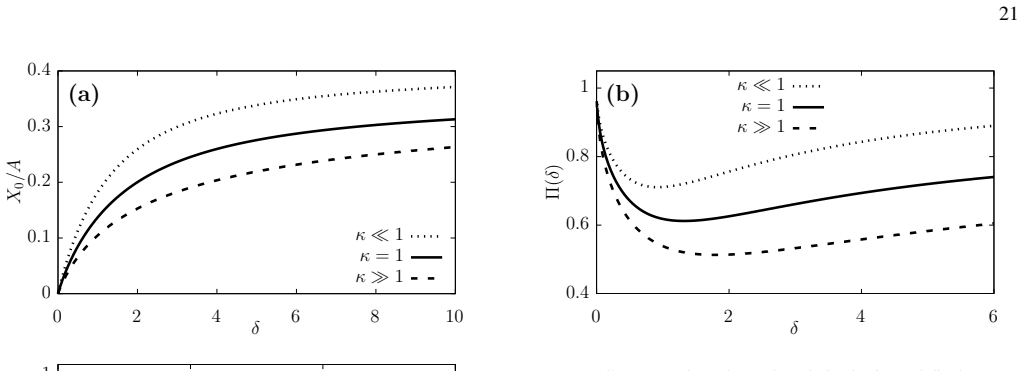

read the original abstract
Droplets, solid particles, and gas bubbles in unsteady flows experience the Basset-Boussinesq history force (BBH) in addition to steady viscous drag, added mass, and buoyancy. Although physically relevant, the BBH term is often neglected because its inclusion is analytically and numerically demanding. To assess when this approximation fails, we revisit unsteady Stokes flows around spherical droplets of finite viscosity and derive, from first principles, the velocity fields and hydrodynamic forces, including both the classical rigid-particle limit and the free-slip (zero-viscosity) bubble limit. The resulting expressions also encompass cases with time-dependent bubble radii. We further illustrate how the BBH force arises from transient, diffusion-driven vortex structures around accelerating particles. Applying these results to droplets or particles in horizontally shaken liquids (periodically accelerated flows), we find that in the transition regime between the quasi-steady Stokes limit and the inertia-dominated regime, BBH can lead to a reduction of the droplet deflection amplitude by more than 60\% compared to predictions that neglect memory effects. We also derive a characteristic scaling of the displacement amplitude in the low-frequency limit, providing an unambiguous, experimentally verifiable signature of the BBH. For light particles and gas bubbles, the BBH contribution becomes more significant (relative to the other hydrodynamic forces) compared to that o heavy particles, such as droplets in air.
Editorial analysis
A structured set of objections, weighed in public.
Referee Report
Summary. The manuscript derives closed-form expressions for the hydrodynamic forces (including the Basset-Boussinesq history force) acting on spherical droplets of finite internal viscosity from the unsteady Stokes equations. These expressions recover the rigid-particle and free-slip bubble limits and allow for time-dependent radii. The derived forces are then inserted into the equation of motion for droplets in a horizontally shaken liquid; the central claim is that, in the transition regime between the quasi-steady Stokes limit and the inertia-dominated regime, inclusion of the history force reduces the steady-state deflection amplitude by more than 60 % relative to the memory-free case. A low-frequency scaling for the displacement amplitude is also obtained as an experimentally verifiable signature of the history force.
Significance. If the central quantitative result survives scrutiny of the regime of validity, the work supplies a parameter-free, first-principles demonstration that memory effects can dominate amplitude predictions for droplets in oscillatory flows. The explicit recovery of both rigid-particle and bubble limits, the absence of fitted constants, and the provision of a falsifiable low-frequency scaling constitute clear strengths that would be useful for modeling in mixing, emulsion, and aerosol applications.
major comments (2)
- [§4] §4 (application to shaken liquids) and the paragraph defining the transition regime: the 60 % amplitude reduction is obtained by solving the linear oscillator equation with the unsteady-Stokes force expressions; however, the transition regime is precisely where the particle Reynolds number based on oscillation velocity and diameter approaches O(1). The neglected convective inertia terms can modify the vortex diffusion that generates the history force, so it is unclear whether the reported reduction remains quantitatively valid once the linearization is relaxed.
- [Eq. (force expression)] Eq. (force expression for finite-viscosity droplet) and the subsequent insertion into the droplet equation of motion: the derivation assumes constant internal viscosity and sphericity. No estimate is given for the range of viscosity ratios or Weber numbers over which the closed-form force remains accurate when the droplet deforms or develops internal circulation under the imposed oscillation.
minor comments (2)
- The abstract states that the BBH contribution is 'more significant' for light particles, but the relative magnitude is not quantified with a dimensionless parameter (e.g., density ratio or frequency parameter) in the main text.
- Figure captions for the amplitude-versus-frequency plots should explicitly state the viscosity ratio and the definition of the transition regime used to generate the curves.
Simulated Author's Rebuttal
We thank the referee for the careful reading and constructive comments on our manuscript. The points raised help clarify the scope of the linear unsteady-Stokes analysis. We address each major comment below and have revised the manuscript to incorporate additional discussion on validity ranges.
read point-by-point responses
-
Referee: §4 (application to shaken liquids) and the paragraph defining the transition regime: the 60 % amplitude reduction is obtained by solving the linear oscillator equation with the unsteady-Stokes force expressions; however, the transition regime is precisely where the particle Reynolds number based on oscillation velocity and diameter approaches O(1). The neglected convective inertia terms can modify the vortex diffusion that generates the history force, so it is unclear whether the reported reduction remains quantitatively valid once the linearization is relaxed.
Authors: We appreciate the referee highlighting this limitation of the linear theory. Our derivation and the 60% reduction are obtained strictly within the unsteady Stokes equations, where convective inertia is neglected by construction. The transition regime is defined via the frequency parameter that balances unsteady viscous diffusion against other linear forces. We agree that particle Reynolds numbers of order one could alter the history force through nonlinear vortex dynamics. In the revised §4 we have added a paragraph estimating that, for the small oscillation amplitudes considered, the particle Re remains ≪1 while history effects are still prominent; the reported reduction is therefore presented as a linear-theory benchmark. A nonlinear extension lies beyond the present scope. revision: partial
-
Referee: Eq. (force expression for finite-viscosity droplet) and the subsequent insertion into the droplet equation of motion: the derivation assumes constant internal viscosity and sphericity. No estimate is given for the range of viscosity ratios or Weber numbers over which the closed-form force remains accurate when the droplet deforms or develops internal circulation under the imposed oscillation.
Authors: The referee correctly identifies the assumptions of the unsteady-Stokes solution. The closed-form force expressions require a spherical interface and constant viscosity ratio. For the shaken-liquid application we consider small-amplitude forcing. We have now inserted a short discussion in §4 providing order-of-magnitude bounds: for viscosity ratios 0.01–100 and Weber numbers <0.05 the expected deformation is <1% according to existing droplet-oscillation literature, so sphericity is preserved. The viscosity-ratio parameter already recovers the rigid-sphere and free-slip limits; internal circulation is therefore captured parametrically within these bounds. revision: yes
Circularity Check
No circularity: derivation from first-principles solution of linearized unsteady Navier-Stokes
full rationale
The paper solves the unsteady Stokes equations directly to obtain closed-form velocity fields and hydrodynamic forces (including BBH) for finite-viscosity droplets, recovering known limits as special cases. The >60% amplitude reduction is obtained by substituting these same force expressions into the droplet equation of motion for the shaken-flow problem and comparing trajectories with versus without the history term. No parameter is fitted to data, no result is renamed as a prediction, and no load-bearing step relies on self-citation or prior ansatz from the same authors. The derivation chain is therefore self-contained within the stated linearization and does not reduce to its inputs by construction.
Axiom & Free-Parameter Ledger
axioms (2)
- domain assumption Flow around the droplet obeys the unsteady Stokes equations (linearized Navier-Stokes at Re << 1)
- domain assumption Droplet remains spherical with constant internal viscosity
Lean theorems connected to this paper
-
IndisputableMonolith/Cost/FunctionalEquation.leanwashburn_uniqueness_aczel unclear?
unclearRelation between the paper passage and the cited Recognition theorem.
The force acting on such a solid, spherical particle has the following form ... + 6R²₀/√π μf ρf ∫ dt' (1/√(t-t')) dv∞/dt' (Eq. 73)
-
IndisputableMonolith/Foundation/RealityFromDistinction.leanreality_from_one_distinction unclear?
unclearRelation between the paper passage and the cited Recognition theorem.
We revisit unsteady Stokes flows around spherical droplets ... derive ... velocity fields and hydrodynamic forces (Sec. IV)
What do these tags mean?
- matches
- The paper's claim is directly supported by a theorem in the formal canon.
- supports
- The theorem supports part of the paper's argument, but the paper may add assumptions or extra steps.
- extends
- The paper goes beyond the formal theorem; the theorem is a base layer rather than the whole result.
- uses
- The paper appears to rely on the theorem as machinery.
- contradicts
- The paper's claim conflicts with a theorem or certificate in the canon.
- unclear
- Pith found a possible connection, but the passage is too broad, indirect, or ambiguous to say the theorem truly supports the claim.
Reference graph
Works this paper leans on
-
[1]
This effect is illustrated in Fig
In such cases, BBH can reduce the displacement of particles relative to the shaken liquid by more than 60% due to the enhanced entrainment effects induced by BBH compared to cases where BBH is neglected. This effect is illustrated in Fig. 8 and Fig. 11. Experimental studies confirm that BBH plays a crucial role in the viscous force acting on even lighter ...
work page 2018
-
[2]
Forces for free-slip boundary conditions The first special case in which we can easily supplement the missing boundary condition to Eq. (A19) is that of an inviscid bubble. We have shown earlier, that the relevant expression reads: ∂ ∂ r vθ flow r r=R(t) = 0 . (A25) When expressed in the transformed coordinates, in terms of ˜w, we find: ∂ ∂ ˜r ˜wθ ˜r ˜r=R...
-
[3]
Forces for no-slip boundary conditions Repeating the procedure for no-slip boundary conditions, we start from Eq. (73) to obtain: F(t) = Fb(t) +6πR(t)µ f v∞(t) + 1 2 d m f v∞ dt + 6√π µf ρ f ˆ t −∞ dt′ 1q´ t t′ R−2(s)ds d(Rv∞) dt′ . (A30)
-
[4]
W. A. Sirignano, Fluid Dynamics and Transport of Droplets and Sprays , 2nd ed. (Cambridge University Press, Cambridge, 2010)
work page 2010
-
[5]
Loth, Fluid Dynamics of Particles, Drops, and Bubbles (Cambridge University Press, Cambridge, 2023)
E. Loth, Fluid Dynamics of Particles, Drops, and Bubbles (Cambridge University Press, Cambridge, 2023)
work page 2023
-
[6]
E. E. Michaelides, M. Sommerfeld, and B. van Wachem, Multiphase Flows with Droplets and Particles , 3rd ed. (Taylor & Francis Inc, New York, 2023)
work page 2023
-
[7]
Turbulent Dispersed Multiphase Flow,
S. Balachanar and J. K. Eaton, “Turbulent Dispersed Multiphase Flow,” Annu. Rev. Fluid Mech.42, 111 (2010)
work page 2010
-
[8]
Particle-Laden Turbulence:Progress and Perspectives,
L. Brandt and F. Coletti, “Particle-Laden Turbulence:Progress and Perspectives,” Annu. Rev. Fluid Mech.54, 159 (2022)
work page 2022
-
[9]
Simulation Methods for Particulate Flows and Concentrated Suspensions,
M. Maxey, “Simulation Methods for Particulate Flows and Concentrated Suspensions,” Annu. Rev. Fluid Mech.49, 171 (2017)
work page 2017
-
[10]
Direct Numerical Simulation of Turbulent Flows Laden with Droplets or Bubbles,
S. Elghobashi, “Direct Numerical Simulation of Turbulent Flows Laden with Droplets or Bubbles,” Annu. Rev. Fluid Mech. 51, 217 (2019)
work page 2019
-
[11]
Bubbly and Buyoant Particle-Laden Turbulent Flows,
V . Mathai, D. Lohse, and C. Sun, “Bubbly and Buyoant Particle-Laden Turbulent Flows,” Annu. Rev. Condens. Matter Phys. 19, 529 (2020)
work page 2020
-
[12]
The motion of solid spherical particles falling in a cellular flow field at low Stokes number,
L. Bergougnoux, G. Bouchet, D. Lopez, and E. Guazzelli, “The motion of solid spherical particles falling in a cellular flow field at low Stokes number,” Phys. Fluids26, 093302 (2014)
work page 2014
-
[13]
Y . Ling, M. Paramar, and S. Balachandar, “A scaling analysis of added-mass and history forces and their coupling in dispersed multiphase flows,” Int. J. Multiphase Flow57, 102 (2013)
work page 2013
-
[14]
On the role of the history force for inertial particles in turbulence,
A. Daitche, “On the role of the history force for inertial particles in turbulence,” J. Fluid Mech. 782, 567 (2015)
work page 2015
-
[15]
Reduced sediment settling in turbulent flows due to Basset history and virtual mass effects,
S. Li, A. D. Bragg, and G. Katul, “Reduced sediment settling in turbulent flows due to Basset history and virtual mass effects,” Geophys. Res. Lett. 50, e2023GL105810 (2023)
work page 2023
-
[16]
On the motion of a sphere in a viscous liquid,
A. B. Basset, “On the motion of a sphere in a viscous liquid,” Philos. Trans. R. Soc. London. Ser. A 179, 43 (1888)
-
[17]
J. Boussinesq, “Sur la résistance qu’oppose un liquide indéfini en repos, sans pesanteur, au mouvement varié d’une sphère solide qu’il mouille sur toute sa surface, quand les vitesses restent bien continues et assez faibles pour que leurs carrés et produits soient négligeables,” Comptes Rendus de l’Académie des Sciences, Paris100, 935 (1885)
-
[18]
The Basset-Boussinesq history force: its neglect, validity and recent numerical developments,
D. Jaganathan, S. G. Prasath, R. Govindarajan, and V . Vasan, “The Basset-Boussinesq history force: its neglect, validity and recent numerical developments,” Front. Phys.11, 1167338 (2023)
work page 2023
-
[19]
Solving the inertial particle equation with memory,
G. Haller, “Solving the inertial particle equation with memory,” J. Fluid Mech. 874, 1 (2019)
work page 2019
-
[20]
Viscosity destabilizes sonoluminescing bubbles,
R. Toegel, S. Luther, and D. Lohse, “Viscosity destabilizes sonoluminescing bubbles,” Phys. Rev. Lett. 96, 114301 (2006)
work page 2006
-
[21]
History force on coated microbubbles propelled by ultrasound,
V . Garbin, B. Dollet, M. Overvelde, D. Cojoc, E. D. Fabrizio, L. van Wingaarden, A. Prosperetti, N. de Jong, and D. Lohse, “History force on coated microbubbles propelled by ultrasound,” Phys. Fluids21, 092003 (2009)
work page 2009
-
[22]
Experimental study on the motion of a spherical particle in a plane sound wave,
D. Wan and H. Xu, “Experimental study on the motion of a spherical particle in a plane sound wave,” Acta Mech. Sin.38, 721493 (2022)
work page 2022
-
[23]
Effects of the history force on an oscillating rigid sphere at low Reynolds number,
M. Abbad and M. Souhar, “Effects of the history force on an oscillating rigid sphere at low Reynolds number,” Exp. Fluids 36, 775 (2004)
work page 2004
-
[24]
M. Abbad and M. Souhar, “Experimental investigation on the history force acting on oscillating fluid spheres at low Reynolds number,” Phys. Fluids 16, 3808 (2004)
work page 2004
-
[25]
Memory effects are relevant for chaotic advection of inertial particles,
A. Daitche and T. Tél, “Memory effects are relevant for chaotic advection of inertial particles,” Phys. Rev. Lett.107, 244501 (2011)
work page 2011
-
[26]
On the Importance of the history force in disperion of particles in von Kármán vortex street,
M. Bagheri and M. Sabzpooshani, “On the Importance of the history force in disperion of particles in von Kármán vortex street,” Adv. Powder Technol. 31, 3897 (2020)
work page 2020
-
[27]
The effect of the Basset history force on particle clustering in homoge- neous istropic turbulence,
S. Olivieri, F. Picano, G. Sardina, D. Iudicone, and L. Brandt, “The effect of the Basset history force on particle clustering in homoge- neous istropic turbulence,” Phys. Fluids26, 041704 (2014)
work page 2014
-
[28]
L.-P. Wang and M. R. Maxey, “Settling velocity and concentration distribution of heavy particles in homogeneous isotropic turbulence,” J. Fluid Mech. 256, 27 (1993)
work page 1993
-
[29]
M. A. T. van Hinsberg, H. J. H. Clercx, and F. Toschi, “Enhance settling of nonheavy inertial particles in homogeneous isotropic turbulence: The role of the pressure gradient and the Basset history force,” Phys. Rev. E95, 023106 (2017)
work page 2017
-
[30]
Geometric collision rates and trajectories of cloud droplets falling into a Burgers vortex,
R. Hill, “Geometric collision rates and trajectories of cloud droplets falling into a Burgers vortex,” Phys. Fluids 17, 037103 (2005)
work page 2005
-
[31]
Accurate solution method for the Maxey-Riley equation, and the effects of Basset history,
S. G. Prasath, V . Vasan, and R. Govindarajan, “Accurate solution method for the Maxey-Riley equation, and the effects of Basset history,” J. Fluid Mech. 868, 428 (2019)
work page 2019
-
[32]
Forces on a sphere accelerating in a viscous fluid,
R. Odar and W. S. Hamilton, “Forces on a sphere accelerating in a viscous fluid,” J. Fluid Mech.18, 302 (1964)
work page 1964
-
[33]
R. Mei and R. Adrian, “Flow past a sphere with an oscillation in the free-stream velocity and unsteady drag at finite Reynolds number,” J. Fluid Mech. 256, 323 (1992)
work page 1992
-
[34]
The force on a sphere in a uniform flow with small-amplitude oscillations at finite Reynolds number,
P. M. Lovalenti and J. F. Brady, “The force on a sphere in a uniform flow with small-amplitude oscillations at finite Reynolds number,” J. Fluid Mech. 256, 607 (1993)
work page 1993
-
[35]
R. Mei, “Flow due to an oscillating sphere and and an expression for unsteady drag on the sphere at finite Reynolds number,” J. Fluid Mech. 270, 133 (1994). 28
work page 1994
-
[36]
Unsteady flow about a sphere at low to moderate Reynolds number. Part 1. Oscillatory motion ,
E. J. Chang and M. R. Maxey, “Unsteady flow about a sphere at low to moderate Reynolds number. Part 1. Oscillatory motion ,” J. Fluid Mech. 277, 347 (1994)
work page 1994
-
[37]
An experimental study on stationary history effects in high-frequency Stokes flows,
J. F. M. Coimbra, D. L. L’Esperance, R. A. Lambert, J. D. Trollinger, and R. H. Rangel, “An experimental study on stationary history effects in high-frequency Stokes flows,” J. Fluid Mech.504, 252 (2004)
work page 2004
-
[38]
Experimental measurement of the history forces on a rigid sphere in unsteady motion,
S. Lampertz, “Experimental measurement of the history forces on a rigid sphere in unsteady motion,” Master Thesis, University of Göttingen (2012)
work page 2012
-
[39]
Particle response to oscillatory flows at finite Reynolds numbers,
O. AlAli, B. Traver, and J. F. M. Coimbra, “Particle response to oscillatory flows at finite Reynolds numbers,” Phys. Fluids 36, 103367 (2024)
work page 2024
-
[40]
Basset-Boussinesq history force acting on a drop in an oscillatory flow,
H. Gode, S. Charton, E. Climent, and D. Legendre, “Basset-Boussinesq history force acting on a drop in an oscillatory flow,” Phys. Rev. Fluids 8, 073605 (2023)
work page 2023
-
[41]
Simplified dynamics model of a sphere decelerating freely in a fluid,
A. Velazquez and A. Barrero-Gil, “Simplified dynamics model of a sphere decelerating freely in a fluid,” Phys. Fluids36, 023104 (2024)
work page 2024
-
[42]
L. D. Landau and E. M. Lifshitz, Course of Theoretical Physics, V ol. 6 Fluid Mechanics (Butterworth, Boston, 1987)
work page 1987
-
[43]
G. K. Batchelor, An Introduction to Fluid Dynamics (Cambridge University Press, Cambridge, UK, 1967)
work page 1967
-
[44]
H. Lamb, Hydrodynamics, 6th ed. (Cambridge University Press, 1993)
work page 1993
- [45]
-
[46]
Slow motions of a liquid drop in a viscous liquid,
V . A. Gorodtsov, “Slow motions of a liquid drop in a viscous liquid,” J. Appl. Mech. Tech. Phys.16, 865 (1976)
work page 1976
-
[47]
S. M. Yang and L. G. Leal, “A note on memory-integral contributions to the force on an accelerating spherical drop at low Reynolds number,” Phys. Fluids A3, 1822 (1991)
work page 1991
-
[48]
A note on the force on an accelerating spherical drop at low-Reynolds number,
V . Galindo and G. Gerbeth, “A note on the force on an accelerating spherical drop at low-Reynolds number,” Phys. Fluids5, 3290 (1993)
work page 1993
-
[49]
The viscous drag force on a spherical bubble with a time-dependent radius,
J. Magnaudet and D. Legendre, “The viscous drag force on a spherical bubble with a time-dependent radius,” Phys. Fluids10, 550 (1998)
work page 1998
-
[50]
On the translatory motion of a fluid sphere in a viscous medium,
W. Rybczynski, “On the translatory motion of a fluid sphere in a viscous medium,” Bull. Int. Acad. Pol. Sci. Lett., Cl. Sci. Math. Nat., Ser. A. , 40 (1911)
work page 1911
-
[51]
Mouvement permanent lent d’une sphère liquide et visqueuse dans un liquide visqueux,
J. Hadamard, “Mouvement permanent lent d’une sphère liquide et visqueuse dans un liquide visqueux,” Comptes rendus de l’académie des sciences 152, 1735 (1911)
work page 1911
-
[52]
L. G. Leal, Advanced Transport Phenomena (Cambridge University Press, Cambridge, 2007)
work page 2007
-
[53]
Equation of motion for a small rigid sphere in a nonuniform flow,
M. R. Maxey and J. J. Riley, “Equation of motion for a small rigid sphere in a nonuniform flow,” Phys. Fluids26, 883 (1983)
work page 1983
-
[54]
Spherical Particle Motion in harmonic Stokes Flow,
J. F. M. Coimbra and R. H. Rangel, “Spherical Particle Motion in harmonic Stokes Flow,” AIAA J. 39, 1673 (2001)
work page 2001
-
[55]
Collisional aggregation due to turbulence,
A. Pumir and M. Wilkinson, “Collisional aggregation due to turbulence,” Annu. Rev. Condens. Matter Phys.7 (2016)
work page 2016
-
[56]
Statistical models for the dynamics of heavy particles in turbulence,
J. Bec, K. Gustavsson, and B. Mehlig, “Statistical models for the dynamics of heavy particles in turbulence,” Annu. Rev. Fluid Mech.56 (2024)
work page 2024
-
[57]
J. R. Grace and M. E. Weber, “Chapter three,” in Bubbles, Drops, and Particles (Academic Press, New York, 1978) Chap. 3
work page 1978
-
[58]
Cyclic migration of bubbles in vertically vibrating liquid columns,
R. H. Buchanan, G. Jameson, and D. Oedjoe, “Cyclic migration of bubbles in vertically vibrating liquid columns,” Ind. Eng. Chem. Fundam. 1, 82 (1962)
work page 1962
-
[59]
The motion of a bubble in a vertically oscillating viscous liquid,
G. Jameson, “The motion of a bubble in a vertically oscillating viscous liquid,” Chem. Eng. Sci. 21, 35 (1966)
work page 1966
-
[60]
The motion of high-Reynolds-number bubbles in inhomogeneous flows,
J. Magnaudet and I. Eames, “The motion of high-Reynolds-number bubbles in inhomogeneous flows,” Annu. Rev. Fluid Mech. 32, 659 (2000)
work page 2000
-
[61]
Levitation of air bubbles in liquid under flow frequency vibration excitement,
J. Ellenberger and R. Krishna, “Levitation of air bubbles in liquid under flow frequency vibration excitement,” Chem. Eng. Sci.62, 5869 (2007)
work page 2007
-
[62]
Motion of a gas bubble in fluid under vibration,
V . S. Sorokin, I. I. Blekhman, and V . B. Vasilkow, “Motion of a gas bubble in fluid under vibration,” Nonlinear Dyn.67, 147 (2012)
work page 2012
-
[63]
B. R. Elbing, A. L. Still, and A. J. Ghajar, Ind. Eng. Chem. Res. 55, 385 (2016)
work page 2016
-
[64]
W. B. Russel, D. A. Saville, and W. R. Showalter, Colloidal Dispersions (University Press, Cambridge, 1989)
work page 1989
-
[65]
Particle Lagrangian simulation in turbulent flows,
A. Berlemont, P. Desjonquères, and G. Gouesbet, “Particle Lagrangian simulation in turbulent flows,” Int. J. Multiphase Flow 16, 19 (1990)
work page 1990
-
[66]
On the equation for spherical-particle motion: effect of Reynolds and acceleration numbers,
I. Kim, S. Elghobashi, and W. A. Sirignano, “On the equation for spherical-particle motion: effect of Reynolds and acceleration numbers,” J. Fluid Mech. 367, 221 (1998)
work page 1998
-
[67]
Stokes’ force for a stationary rotating sphere,
S. O. Gladkov, “Stokes’ force for a stationary rotating sphere,” Russ. Phys. J.65, 856 (2022)
work page 2022
-
[68]
R. I. Ovseenko and Y . G. Ovseenko, “Drag of a rotating sphere,” Fluid Dynamics3, 523 (1968)
work page 1968
-
[69]
The history force on a rapidely shrinking bubble rising at finite Reynolds number,
F. Takemura and J. Magnaudet, “The history force on a rapidely shrinking bubble rising at finite Reynolds number,” Phys. Fluids 16, 3247 (2004)
work page 2004
discussion (0)
Sign in with ORCID, Apple, or X to comment. Anyone can read and Pith papers without signing in.