REVIEW 4 major objections 5 minor 2 cited by
Surrogate normal-forms for the numerical bifurcation and stability analysis of navier-stokes flows via machine learning
T0 review · 4 major / 5 minor · reviewed 2026-08-06 · deepseek-v4-flash
Pith's one-line read This paper claims that a data-driven embed-learn-lift pipeline can reproduce the bifurcation and stability structure of two-dimensional Navier-Stokes flows, including unstable branches and Neimark-Sacker transitions, from simulation data…
desk verdict Promising demonstration of a data-driven bifurcation pipeline, but the headline bifurcation points are interpolations of training data, not validated predictions. read the letter →
The pith
A machine-rendered reading of the paper's core claim, the machinery that carries it, and where it could break.
The reading
What carries the argument
The load-bearing object is the four-stage embed-learn-lift loop: an encoder $\Phi$ maps snapshots to latent coordinates (POD projection or Diffusion Maps with parsimonious eigenvector selection); a Gaussian Process regression model $g(a,\mathrm{Re})$ learns either time derivatives or a discrete-time map in those coordinates; numerical continuation solves $g=0$ and the periodic boundary-value problem in latent space, yielding Floquet multipliers; and a pre-image solver (k-nearest-neighbor convex interpolation) lifts latent solutions back to velocity fields. For the pitchfork case, an additional symmetry-defeating step replaces $g$ by its odd part with respect to latent-state reversal, which restores the exact pitchfork structure that the learned surrogate alone only approximates. This machinery is what converts continuation and stability computations, normally too expensive for the full discretized Navier-Stokes equations, into low-dimensional operations.
What would settle it
Run a Newton-Krylov continuation directly on the full discretized Navier-Stokes equations for the cylinder wake and compare the genuinely unstable steady and periodic states to those the POD-GPR ROM predicts when lifted to physical space; any disagreement larger than the reported roughly 12 percent maximum error at $\mathrm{Re}=50$, or a Floquet-multiplier trend opposite to the ROM's, would show that the unstable branches are surrogate artifacts. For the pinball, withhold the post-bifurcation Reynolds values from training and test whether the DMs-GPR ROM still predicts $\mathrm{Re}_{ns}\approx 104.67$ with the same five coordinates.
Extended reading notes
Core claim
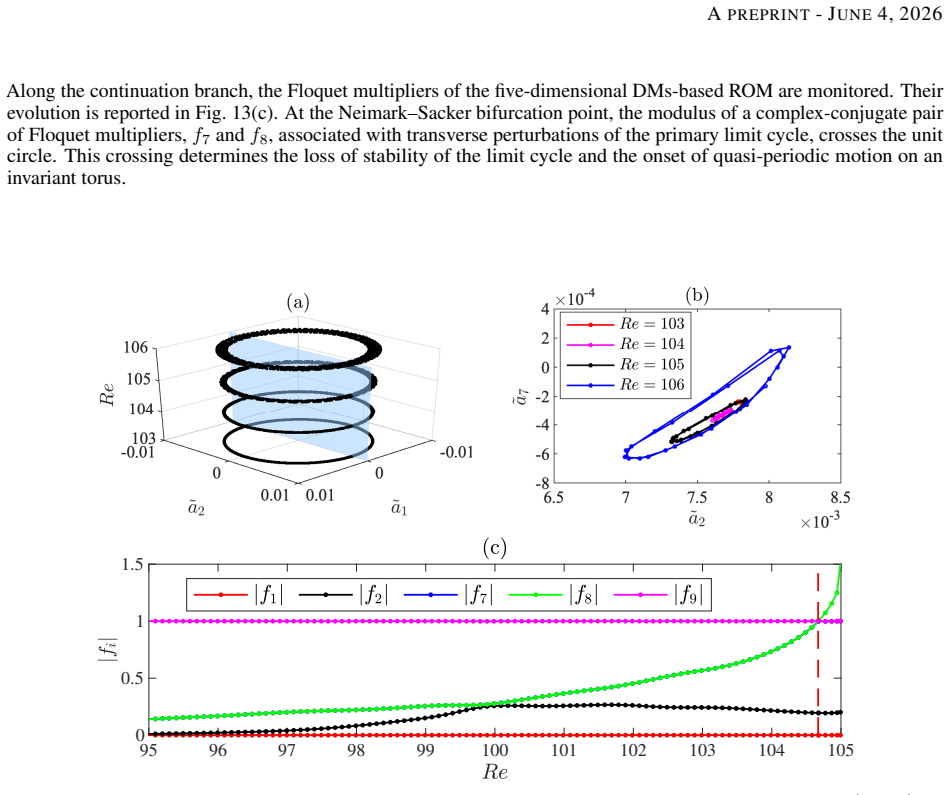
On the paper's own terms, the central discovery is that parsimonious Diffusion Maps coordinates, coupled with Gaussian Process regression, yield minimal-dimensional surrogate models on which the standard machinery of numerical bifurcation theory can be run faithfully. With two POD-GPR coordinates, the cylinder ROM places a supercritical Andronov-Hopf bifurcation at $\mathrm{Re}_{cr}=48.48$ and continues stable limit cycles with the expected Floquet-multiplier structure; with one POD-GPR coordinate, an odd-symmetrized channel ROM places a pitchfork at $\mathrm{Re}_{sb}=43.12$ and recovers two coexisting stable asymmetric solutions within a single model; with five Diffusion-Maps coordinates, the pinball ROM detects a Neimark-Sacker bifurcation at $\mathrm{Re}_{ns}=104.67$, continues the unstable limit-cycle branch, and shows an invariant torus via Poincar\'e sections. The authors take this as evidence that nonlinear manifold learning identifies the intrinsic dimension of the latent dynamics where POD fails, making demanding secondary-bifurcation analysis feasible.
Load-bearing premise
The surrogate is trained only on trajectories that settle onto stable attractors, but the continuation is then trusted in latent regions corresponding to unstable steady states and unstable limit cycles that the training data never visited; if the Gaussian-process vector field is wrong there, the reported unstable branches and critical Reynolds numbers are regression artifacts rather than properties of the Navier-Stokes flow.
Editorial extensions
If this is right
- From simulation snapshots alone, critical Reynolds numbers for primary and secondary instabilities can be computed (48.48, 43.12, and 104.67 in the three benchmarks), avoiding direct Newton or time-stepper solves of the full discretized equations.
- Unstable steady states and unstable limit cycles become accessible through latent-space continuation, so bifurcation diagrams can include branches that direct time-marching never visits.
- Stability of periodic states is quantified by Floquet multipliers and periods computed from the latent ROM, not from expensive full-order linearizations.
- Diffusion Maps is required for secondary bifurcations such as the fluidic pinball's Neimark-Sacker transition; POD-based ROMs do not reliably reproduce the torus birth.
- For pitchfork transitions, symmetry must be imposed on the surrogate (odd-symmetry transformation) before continuation; otherwise the numerical diagram shows a perturbed pitchfork with a turning point instead of the true crossing.
Reading between the lines
- An implication beyond the paper is that the five selected Diffusion-Maps coordinates for the pinball could serve as a data-driven intrinsic-dimension diagnostic: the parsimonious eigenvector-selection error identifies not only the dimension but also the need for nonlinear coordinates, which may be a cheap screening tool for secondary instabilities.
- The paper does not test the unstable branches against independent full-order continuation; because the Gaussian Process surrogate is trained only on stable-attractor trajectories, its unstable-branch predictions are an extrapolation, so a validation against a matrix-free Newton-Krylov continuation of the full equations would strengthen or falsify the extrapolated parts of the diagrams.
- The same loop should transfer to other dissipative partial differential equations with finite-dimensional inertial manifolds (for example convection or reacting flows), though the paper only demonstrates two-dimensional incompressible Navier-Stokes cases.
- The symmetry-enforcement step is invoked only for the discrete reflection symmetry of the pitchfork; extending the idea to continuous symmetries such as translation or rotation is a natural next step that the authors do not demonstrate.
Editorial analysis
A structured set of objections, weighed in public.
Referee Report
Summary. The manuscript proposes a four-stage, fully data-driven pipeline ('embed-learn-lift') for reduced-order bifurcation and stability analysis of two-dimensional incompressible Navier-Stokes flows. In stage (a), either POD or parsimonious Diffusion Maps are used to embed high-dimensional DNS snapshots into low-dimensional latent coordinates; in stage (b), Gaussian Process regression learns the latent dynamics in continuous time (Eq. 29) or as a discrete map (Eq. 30), with the Reynolds number as an additional input; in stage (c), numerical continuation and stability analysis are performed in the latent space with MATCONT; in stage (d), solutions are lifted back to physical space via a closed-form POD map or a k-NN pre-image. The method is demonstrated on three benchmarks: the cylinder wake (Andronov-Hopf, Re_cr=48.48), the planar sudden-expansion channel (pitchfork, Re_sb=43.12), and the fluidic pinball (Neimark-Sacker, Re_ns=104.67), including computation of Floquet multipliers, limit-cycle periods, and unstable branches.
Significance. If the unstable branches and critical points were validated against full-order computations, the framework would be a useful extension of the equation-free paradigm, and the parsimonious DMs identification of a five-dimensional latent space for the pinball secondary instability is a genuinely interesting result. The paper is, however, primarily a demonstration: all three reported critical Reynolds numbers lie inside the training ranges and match known literature values, so the contribution is the construction and continuation of a surrogate rather than the prediction of previously unknown bifurcations. Strengths of the paper are its clear four-stage methodology, the use of an established continuation toolbox, the computation of Floquet multipliers in latent space, and the reconstruction of physical-space states through the pre-image problem. The main weakness is that all full-order validation points are stable attractors, while the headline claims concern accurate continuation of unstable branches and critical points that are not directly supported by the evidence presented.
major comments (4)
- [2.4-2.5, Figs. 9-14] The GPR surrogate is trained exclusively on stable time-marching DNS trajectories (Section 2.2 and Appendix A), but the continuation in Section 2.5 requires evaluating the learned vector field or map at unstable steady states and unstable limit cycles that are never visited by the training data. For the sudden-expansion case, a1=0 is unstable for Re>43.12, so the training data (Fig. 16) has a hole near that state and the GPR must interpolate the vector field through this hole. For the pinball, the unstable limit-cycle branch beyond Re_ns=104.67 (Fig. 14, dashed curves) is not observed in the stable torus trajectories used for training. The only full-order comparisons shown (black dots in Figs. 9b, 10d, 14d-g) are stable DNS states, which do not constrain the unstable branches. The reported critical Reynolds numbers and unstable branches are therefore properties of GPR interpolation/extrapolation, not established properties of the Navier-Stokes equations. A concrete remedy would be to validate the unstable branches and critical points against full-order Newton/Arnoldi or time-stepper computations at a few Reynolds numbers, or, at minimum, to report the GPR predictive variance along the continued branches and clearly label the unstable portions as unvalidated predictions.
- [Eq. (37), Section 4.3] The odd-symmetrization in Eq. (37) makes a1=0 a fixed point by construction and enforces an exact pitchfork structure in the surrogate. Consequently, the reported Re_sb=43.12 is the point where the antisymmetrized GPR's linearization changes sign; it is not an independent detection of the Navier-Stokes pitchfork. The paper correctly notes in Section 2.5 that the transformation is applied to restore symmetry, but the abstract and conclusions present the pitchfork as correctly identified without stating that the bifurcation type has been imposed. Please state this assumption explicitly and support the Navier-Stokes-level claim with full-order validation or a clear comparison with the known literature value.
- [Appendix A] The reported 95% confidence intervals (2.03%, 3.04%, and 3.22% for cylinder, channel, and pinball) are computed on a random 60/40 split of snapshots drawn from the same attractors. This is a leaky split: training and test points lie on the same trajectories or attractors, so the uncertainty estimates measure interpolation accuracy on the attractors, not the accuracy of the vector field in the unstable latent regions used for continuation. A leave-one-Reynolds-number-out or another out-of-distribution evaluation would be far more informative for the bifurcation claims, and the current wording in Appendix A ('accurate and robust approximation ... across the explored parameter ranges') overstates what the test error demonstrates.
- [Section 4.4 and Conclusions] The abstract and conclusions claim that DMs-based ROMs outperform POD-ROMs, particularly for secondary instabilities such as the pinball Neimark-Sacker bifurcation, but no quantitative POD-GPR result for the pinball is presented. Section 4.4 states that POD-based ROMs fail, but the failure is not documented: it is not reported which latent dimensions were attempted, what the continuation produced, or what the reconstruction errors were. Since the outperformance claim is a central contribution, it needs a direct comparison, for example POD with d=2, d=5, and a few larger dimensions, showing the failure modes and the quantitative degradation relative to the DMs-GPR result.
minor comments (5)
- [Section 4.1] Section 3.1 states that 2000 temporal realizations are stored per Reynolds number for the cylinder, while Section 4.1 uses Nt=1000 for the POD snapshot matrix; the relationship between these two numbers (e.g., subsampling by a factor of two) is not explained.
- [Conclusions] There is a typo in the Conclusions: 'numerial analysis' should read 'numerical analysis'.
- [Section 2.3.2] The diffusion-map kernel scale is set to epsilon=median(d_ij) and the pre-image uses K=4 nearest neighbors, but no sensitivity analysis or robustness discussion is provided for these hyperparameters; a brief statement on how the reported results depend on them would strengthen the presentation.
- [Table 1 and Section 4.4] The text says 'the remaining Floquet multipliers are real and satisfy f1<1 and f2<1', but the table also contains the complex-conjugate pair f7 and f8; the wording should be clarified to say that the two real multipliers outside the critical pair are less than one in modulus, while f9=1 is the trivial multiplier.
- [Introduction and Section 2.5] The term 'normal-forms' is used loosely for the GPR surrogates; the surrogates are not normal forms in the classical dynamical-systems sense. A brief definition of what 'surrogate normal-form' means in this paper would help avoid confusion.
Circularity Check
Pitchfork-type identification is enforced by Eq. (37), but the critical Reynolds numbers and the Hopf/Neimark-Sacker results are not circular.
-
self definitional
[Section 2.5, Eq. (37); Section 4.3, Fig. 10(c)]
"Consequently, the correct identification of e.g., pitchfork bifurcations is restored by enforcing an odd-symmetry transformation of Eq. (29) prior to performing numerical continuation ... g(Re, a1, a2, . . . , ad) = g(Re, a1, a2, . . . , ad)−g(Re,−a1,−a2, . . . ,−ad)/2 . (37) The transformed model (37) is then used to construct the bifurcation diagram ... which correctly identifies the symmetry-breaking pitchfork bifurcation at Resb = 43.12."
Equation (37) defines the ROM vector field to be odd in (a1,...,ad). For an odd one-dimensional field, a=0 is a root for every Re and the normal form is a pitchfork by construction; the 'identification' of the pitchfork type is therefore an input of the symmetrization rather than an output of the data-driven continuation. What remains data-driven is the critical value 43.12, which is not imposed by Eq. (37).
full rationale
The only concrete circular step is the pitchfork-type claim in the sudden-expansion benchmark: the odd-symmetrization in Eq. (37) forces the steady-state bifurcation to be a pitchfork, and the paper then reports that it 'correctly identifies' this pitchfork. The critical Reynolds number itself is not circular, and the cylinder Hopf and pinball Neimark-Sacker results are genuine outputs of continuation of the learned ROMs. Training the GPR on data spanning both sides of each bifurcation means the critical parameters are interpolation-derived rather than independent discoveries; this limits extrapolative validity, especially for unstable branches, but it is not a definitional circularity because Recrit is not a fitted parameter being renamed as a prediction. Self-citations (e.g., [42,43,77]) establish methodology and prior examples but are not load-bearing in the way a uniqueness theorem would be. Overall, central content remains independent, so the score is moderate rather than high.
Assumptions & free parameters
free parameters (6)
- GPR hyperparameters theta_i (ARD RBF length scales, output scales, noise variance) =
not reported numerically
- Latent dimension d =
2 (cylinder), 1 (channel), 5 (pinball)
- Diffusion map kernel scale epsilon =
median of pairwise distances
- k-NN pre-image neighborhood size K =
4
- Time horizon T_p for discrete map =
0.2
- Parsimonious selection threshold on ri =
not specified
assumptions (5)
- domain assumption The long-term Navier-Stokes dynamics lie on a smooth, finite-dimensional inertial manifold for the parameter ranges studied.
- domain assumption Diffusion map eigenvectors computed from the training snapshot set provide a valid coordinate chart for out-of-sample snapshots via Nystrom extension.
- domain assumption A zero-mean Gaussian process with ARD RBF kernel faithfully represents the latent dynamics vector field over the whole Re range.
- domain assumption The finite-difference estimate of da/dt from snapshots with dt=0.2 is an accurate training target.
- ad hoc to paper The odd symmetry of the pitchfork bifurcation is known a priori and can be imposed by Eq. (37) without altering the physical dynamics.
Cite this review
Pith. "Pith review of Surrogate normal-forms for the numerical bifurcation and stability analysis of navier-stokes flows via machine learning." pith.science (2026). https://pith.science/paper/JEBQQ3YB
@misc{pith2026250621275,
  author       = {Pith},
  title        = {Pith review of: Surrogate normal-forms for the numerical bifurcation and stability analysis of navier-stokes flows via machine learning},
  year         = {2026},
  howpublished = {\url{https://pith.science/paper/JEBQQ3YB}},
  note         = {Machine review of arXiv:2506.21275}
}
read the original abstract
Inspired by the Equation-Free paradigm, we propose an ``embed-learn-lift'' framework for constructing minimal-dimensional surrogate ROMs for the numerical analysis of high-fidelity Navier-Stokes simulations, even in the presence of symmetries that standard machine-learning surrogates often fail to preserve. The framework consists of four main stages. First, manifold learning (here both POD and Diffusion Maps) is used to uncover the intrinsic geometry and dimensionality of the latent space underlying the high-dimensional spatio-temporal Navier-Stokes dynamics across the parameter space. Second, we construct ROMs (here, via Gaussian Process regression (GPR)) of minimal dimension -- by learning the evolution equations directly on the identified latent space. Third, we exploit the toolkit of numerical bifurcation analysis to construct bifurcation diagrams and perform systematic stability analysis directly in the latent coordinates. This enables, for example, the efficient continuation of branches of limit cycles emerging from Andronov-Hopf and Neimark-Sacker bifurcations, together with the computation of limit-cycles periods and stability properties via Floquet multipliers. Such analysis is effectively intractable for the full Navier-Stokes equations. Finally, by solving the pre-image problem in manifold learning, we reconstruct the bifurcating steady and time-periodic states in the original high-dimensional physical space, thus closing the ``lift'' step of the pipeline. We show that DMs-based ROMs allow for a computationally efficient and accurate numerical bifurcation and stability analysis, thus outperforming the widely used POD-ROMs by providing a geometrically consistent parametrization and correctly identifying the intrinsic dimension even in the presence of secondary instabilities, highlighting the need for nonlinear manifold learning methods in CFD.
Figures


Figures from the paper (15 more)




Forward citations
Cited by 2 Pith papers
-
Stochastic bifurcation analysis via polynomial chaos: consistency and convergence of branch-approximating solutions
A single Galerkin projection on the stochastic weak form of parameter-dependent systems produces branch-approximating algebraic solutions that converge to true steady-state branches with proven consistency and uniquen...
-
A Quadratic Order Reduction -- Gaussian Process Ordinary Differential Equation framework for the inference of Large Continuous Dynamical Systems
A framework merges Gaussian Process ODEs with quadratic reduced-order modeling for stable short-term forecasting of large dynamical systems with uncertainty quantification.
Reference graph
Works this paper leans on
-
[1]
G. Haller. Modeling nonlinear dynamics from equations and data with applications to solids, fluids, and controls, 2025
2025
-
[2]
E. J. Doedel. Auto: A program for the automatic bifurcation analysis of autonomous systems.Congr. Numer, 30(265-284):25–93, 1981
1981
-
[3]
Dhooge, W
A. Dhooge, W. Govaerts, and Yu. A. Kuznetsov. Matcont: a matlab package for numerical bifurcation analysis of odes.ACM Trans. Math. Software, 29:141–164, 2003
2003
-
[4]
Govaerts, Y
W. Govaerts, Y . A Kuznetsov, and A. Dhooge. Numerical continuation of bifurcations of limit cycles in matlab. SIAM journal on scientific computing, 27(1):231–252, 2005
2005
-
[5]
M. E. Kavousanakis, L. Russo, C. I. Siettos, A. G. Boudouvis, and G. C. Georgiou. A timestepper approach for the systematic bifurcation and stability analysis of polymer extrusion dynamics.Journal of non-newtonian fluid mechanics, 151(1-3):59–68, 2008
2008
-
[6]
Sánchez, M
J. Sánchez, M. Net, B. Garcıa-Archilla, and C. Simó. Newton–krylov continuation of periodic orbits for navier–stokes flows.Journal of Computational Physics, 201(1):13–33, 2004
2004
-
[7]
Samaey, W
G. Samaey, W. Vanroose, D. Roose, and I. G. Kevrekidis. Newton–krylov solvers for the equation-free computation of coarse traveling waves.Computer Methods in Applied Mechanics and Engineering, 197(43- 44):3480–3491, 2008
2008
-
[8]
Sanchez, F
J. Sanchez, F. Marques, and J. M. Lopez. A continuation and bifurcation technique for navier–stokes flows. Journal of Computational Physics, 180(1):78–98, 2002
2002
Show all 104 references
-
[9]
Sánchez and M
J. Sánchez and M. Net. On the multiple shooting continuation of periodic orbits by newton–krylov methods. International Journal of Bifurcation and Chaos, 20(01):43–61, 2010
2010
-
[10]
Net and J
M. Net and J. Sánchez. Continuation of bifurcations of periodic orbits for large-scale systems.SIAM Journal on Applied Dynamical Systems, 14(2):674–698, 2015
2015
-
[11]
Waugh, S
I. Waugh, S. Illingworth, and M. Juniper. Matrix-free continuation of limit cycles for bifurcation analysis of large thermoacoustic systems.Journal of Computational Physics, 240:225–247, 2013
2013
-
[12]
Temam.Navier–Stokes equations and nonlinear functional analysis
R. Temam.Navier–Stokes equations and nonlinear functional analysis. SIAM, 1995
1995
-
[13]
E. S. Titi. On approximate inertial manifolds to the navier-stokes equations.Journal of mathematical analysis and applications, 149(2):540–557, 1990
1990
-
[14]
Quarteroni and G
A. Quarteroni and G. Rozza. Numerical solution of parametrized navier–stokes equations by reduced basis methods.Numerical methods for partial differential equations: an international journal, 23(4):923–948, 2007
2007
-
[15]
Quarteroni and G
A. Quarteroni and G. Rozza.Reduced order methods for modeling and computational reduction, volume 9. Springer, 2014
2014
-
[16]
Vinuesa and S
R. Vinuesa and S. L. Brunton. Enhancing computational fluid dynamics with machine learning.Nature Computational Science, 2:358–366, 2022
2022
-
[17]
Hijazi, G
S. Hijazi, G. Stabile, A. Mola, and G. Rozza. Data-driven pod-galerkin reduced order model for turbulent flows. Journal of Computational Physics, 416:109513, 2020
2020
-
[18]
Pichi, F
F. Pichi, F. Ballarin, G. Rozza, and J. S. Hesthaven. An artificial neural network approach to bifurcating phenomena in computational fluid dynamics.Comput. Fluids, 254:105813, 2023. 32 APREPRINT- JUNE4, 2026
2023
-
[19]
Seydel.Practical bifurcation and stability analysis, volume 5
R. Seydel.Practical bifurcation and stability analysis, volume 5. Springer Science & Business Media, 2009
2009
-
[20]
M. W. Hirsch, C. C. Pugh, and M. Shub. Invariant manifolds.Bulletin of the American Mathematical Society, 76(5):1015–1019, 1970
1970
-
[21]
Gallay and C
T. Gallay and C. E. Wayne. Invariant manifolds and the long-time asymptotics of the navier-stokes and vorticity equations on r2.Archive for Rational Mechanics and Analysis, 163:209–258, 2002
2002
-
[22]
C. Siettos. Equation-free computation of coarse-grained center manifolds of microscopic simulators.Journal of Computational Dynamics, 1(2):377–389, 2014
2014
-
[23]
Wiggins.Normally hyperbolic invariant manifolds in dynamical systems, volume 105
S. Wiggins.Normally hyperbolic invariant manifolds in dynamical systems, volume 105. Springer Science & Business Media, 2013
2013
-
[24]
Siettos and L
C. Siettos and L. Russo. A numerical method for the approximation of stable and unstable manifolds of microscopic simulators.Numerical Algorithms, 89(3):1335–1368, 2022
2022
-
[25]
Haller and S
G. Haller and S. Ponsioen. Nonlinear normal modes and spectral submanifolds: existence, uniqueness and use in model reduction.Nonlinear dynamics, 86:1493–1534, 2016
2016
-
[26]
Breunung and G
T. Breunung and G. Haller. Explicit backbone curves from spectral submanifolds of forced-damped nonlinear mechanical systems.Proceedings of the Royal Society A: Mathematical, Physical and Engineering Sciences, 474(2213):20180083, 2018
2018
-
[27]
G. Buza. Spectral submanifolds of the navier–stokes equations.SIAM Journal on Applied Dynamical Systems, 23(2):1052–1089, 2024
2024
-
[28]
Stabile, Luc Pastur, and Attilio Frangi
Alessio Colombo, Alessandra Vizzaccaro, Cyril Touzé, André de F. Stabile, Luc Pastur, and Attilio Frangi. Reduced order modelling of hopf bifurcations for the navier–stokes equations through invariant manifolds. arXiv:2510.26542, 2025
-
[29]
Stabile and G
G. Stabile and G. Rozza. Finite volume pod-galerkin stabilised reduced order methods for the parametrised incompressible navier–stokes equations.Computers & Fluids, 173:273–284, 2018
2018
-
[30]
J. S. Hesthaven and S. Ubbiali. Non-intrusive reduced order modelling of nonlinear problems using neural networks.Journal of Computational Physics, 363:55–78, 2018
2018
-
[31]
Girfoglio, A
M. Girfoglio, A. Quaini, and G. Rozza. A pod-galerkin reduced order model for the navier–stokes equations in stream function-vorticity formulation.Computers & Fluids, 244:105536, 2022
2022
-
[32]
A. E. Deane, I. G. Kevrekidis, G. E. Karniadakis, and S. A. Orszag. Low-dimensional models for complex geometry flows: Application to grooved channels and circular cylinders.Physics of Fluids A: Fluid Dynamics, 3(10):2337–2354, 1991
1991
-
[33]
Ma and G
X. Ma and G. E. Karniadakis. A low-dimensional model for simulating three-dimensional cylinder flow.Journal of Fluid Mechanics, 458:181–190, 2002
2002
-
[34]
C. W. Rowley. Model reduction for fluids, using balanced proper orthogonal decomposition.International Journal of Bifurcation and Chaos, 15(03):997–1013, 2005
2005
-
[35]
S. L. Brunton, B. R. Noack, and P. Koumoutsakos. Machine learning for fluid mechanics.Annual review of fluid mechanics, 52(1):477–508, 2020
2020
-
[36]
R. R. Coifman, S. Lafon, A. B. Lee, M. Maggioni, B. Nadler, F. Warner, and S. W. Zucker. Geometric diffusions as a tool for harmonic analysis and structure definition of data: diffusion maps.Proc. Natl. Acad. Sci., 102(21):7426–7431, 2005
2005
-
[37]
R. R. Coifman and S. Lafon. Geometric harmonics: a novel tool for multiscale out-of-sample extension of empirical functions.Appl. Comput. Harmon. Anal., 21(1):31–52, 2006
2006
-
[38]
Nadler, S
B. Nadler, S. Lafon, R. R. Coifman, and I. G. Kevrekidis. Diffusion maps, spectral clustering and reaction coordinates of dynamical systems.Applied and Computational Harmonic Analysis, 21(1):113–127, 2006
2006
-
[39]
C. J. Dsilva, R. Talmon, R. R. Coifman, and I. G. Kevrekidis. Parsimonious representation of nonlinear dynamical systems through manifold learning: a chemotaxis case study.Appl. Comput. Harmon. Anal., 44(3):759–773, 2018
2018
-
[40]
Galaris, G
E. Galaris, G. Fabiani, I. Gallos, I. Kevrekidis, and C. Siettos. Numerical bifurcation analysis of pdes from lattice boltzmann model simulations: a parsimonious machine learning approach.Journal of Scientific Computing, 92(34):1–30, 2022
2022
-
[41]
C. P. Martin-Linares, Y . M. Psarellis, G. Karapetsas, E. D. Koronaki, and I. G. Kevrekidis. Physics-agnostic and physics-infused machine learning for thin films flows: modelling, and predictions from small data.Journal of Fluid Mechanics, 975(A41):1–22, 2023. 33 APREPRINT- JU...
2023
-
[42]
Patsatzis, L
D. Patsatzis, L. Russo, I. G. Kevrekidis, and C. Siettos. Data-driven control of agent-based models: An equation/variable-free machine learning approach.Journal of Computational Physics, 478(111953), 2023
2023
-
[43]
Della Pia, D
A. Della Pia, D. G. Patsatzis, L. Russo, and C. Siettos. Learning the latent dynamics of fluid flows from high-fidelity numerical simulations using parsimonious diffusion maps.Physics of Fluids, 36(105187):1–19, 2024
2024
-
[44]
Chiavazzo, C
E. Chiavazzo, C. W. Gear, C. J. Dsilva, N. Rabin, and I. G. Kevrekidis. Reduced models in chemical kinetics via nonlinear data-mining.Processes, 2(1):112–140, 2014
2014
-
[45]
P. G. Papaioannou, R. Talmon, I. G. Kevrekidis, and C. Siettos. Time-series forecasting using manifold learning, radial basis function interpolation, and geometric harmonics.Chaos, 32(8):083113, 2022
2022
-
[46]
Li, T.-K
X. Li, T.-K. L. Wong, R. T. Q. Chen, and D. Duvenaud. Scalable gradients for stochastic differential equations. International Conference on Artificial Intelligence and Statistics, 2020
2020
-
[47]
P. R. Vlachas, G. Arampatzis, C. Uhler, and P. Koumoutsakos. Multiscale simulations of complex systems by learning their effective dynamics.Nature Machine Intelligence, 4(4):359–366, 2022
2022
-
[48]
Floryan and M
D. Floryan and M. D. Graham. Data-driven discovery of intrinsic dynamics.Nature Machine Intelligence, 4(12):1113–1120, 2022
2022
-
[49]
Eivazi, S
H. Eivazi, S. Le Clainche, S. Hoyas, and R. Vinuesa. Towards extraction of orthogonal and parsimonious non-linear modes from turbulent flows.Expert Systems With Applications, 202:117038, 2022
2022
-
[50]
E. D. Koronaki, N. Evangelou, C. P. Martin-Linares, E. S. Titi, and I. G. Kevrekidis. Nonlinear dimensionality reduction then and now: Aims for dissipative pdes in the ml era.Journal of Computational Physics, 506:112910, 2024
2024
-
[51]
S. L. Brunton, J. L. Proctor, and J. N. Kutz. Discovering governing equations from data by sparse identification of nonlinear dynamical systems.Proceedings of the National Academy of Sciences, 113(15):3932–3937, 2016
2016
-
[52]
Hasegawa, K
K. Hasegawa, K. Fukami, T. Murata, and K. Fukagata. Machine-learning-based reduced-order modeling for unsteady flows around bluff bodies of various shapes.Theoretical and Computational Fluid Dynamics, 34:367–383, 2020
2020
-
[53]
J.-C. Loiseau. Data-driven modeling of the chaotic thermal convection in an annular thermosyphon.Theoretical and Computational Fluid Dynamics, 34:339–365, 2020
2020
-
[54]
J. L. Callaham, G. Rigas, J.-C. Loiseau, and S. L. Brunton. An empirical mean-field model of symmetry-breaking in a turbulent wake.Science Advances, 8:1–11, 2022
2022
-
[55]
Champion, B
K. Champion, B. Lusch, J. N. Kutz, and S. L. Brunton. Data-driven discovery of coordinates and governing equations.Proceedings of the National Academy of Sciences, 116(45):22445–22451, 2019
2019
-
[56]
A. P. Mentzelopoulos, D. Fan, T. P. Sapsis, and M. S. Triantafyllou. Variational autoencoders and transformers for multivariate time-series generative modeling and forecasting: Applications to vortex-induced vibrations. Ocean Engineering, 310:118639, 2024
2024
-
[57]
Conti, G
P. Conti, G. Gobat, S. Fresca, A. Manzoni, and A. Frangi. Reduced order modeling of parametrized systems through autoencoders and sindy approach: continuation of periodic solutions.Computer Methods in Applied Mechanics and Engineering, 411:116072, 2023
2023
-
[58]
Bertalan, F
T. Bertalan, F. Dietrich, I. Mezi´c, and I. G. Kevrekidis. On learning hamiltonian systems from data.Chaos: An Interdisciplinary Journal of Nonlinear Science, 29(121107), 2019
2019
-
[59]
S. Lee, M. Kooshkbaghi, K. Spiliotis, C. I. Siettos, and I. G. Kevrekidis. Coarse-scale pdes from fine-scale observations via machine learning.Chaos: An Interdisciplinary Journal of Nonlinear Science, 30(1):013141, 2020
2020
-
[60]
Arbabi, J
H. Arbabi, J. E. Bunder, G. Samaey, A. J. Roberts, and I. G. Kevrekidis. Linking machine learning with multiscale numerics: Data-driven discovery of homogenized equations.Jom, 72(12):4444–4457, 2020
2020
-
[61]
Lee, Y .M
S. Lee, Y .M. Psarellis, C.I. Siettos, and I. G. Kevrekidis. Learning black- and gray-box chemotactic pdes/closures from agent based monte carlo simulation data.Journal of Mathematical Biology, 87(15), 2023
2023
-
[62]
Dietrich, A
F. Dietrich, A. Makeev, G. Kevrekidis, N. Evangelou, T. Bertalan, S. Reich, and I. G. Kevrekidis. Learning effective stochastic differential equations from microscopic simulations: Linking stochastic numerics to deep learning.Chaos: An Interdisciplinary Journal of Nonlinear Sc...
2023
-
[63]
Fabiani, N
G. Fabiani, N. Evangelou, T. Cui, J. M. Bello-Rivas, C. P. Martin-Linares, C. Siettos, and I. G. Kevrekidis. Task-oriented machine learning surrogates for tipping points of agent-based models.Nature communications, 15(1):4117, 2024. 34 APREPRINT- JUNE4, 2026
2024
-
[64]
P. A. Srinivasan, L. Guastoni, H. Azizpour, P. Schlatter, and R. Vinuesa. Predictions of turbulent shear flows using deep neural networks.Physical Review Fluids, 4:054603, 2019
2019
-
[65]
N. Deng, B. R. Noack, M. Morzynski, and L. R. Pastur. Cluster-based hierarchical network model of the fluidic pinball – cartographing transient and post-transient, multi-frequency, multi-attractor behaviour.Journal of Fluid Mechanics, 934(A24):1–44, 2022
2022
-
[66]
Cenedese, J
M. Cenedese, J. Axås, B. Bäuerlein, K. Avila, and G. Haller. Data-driven modeling and prediction of non- linearizable dynamics via spectral submanifolds.Nature Communications, 13:872, 2022
2022
-
[67]
Z. Y . Wan and T. P. Sapsis. Reduced-space gaussian process regression for data-driven probabilistic forecast of chaotic dynamical systems.Physica D: Nonlinear Phenomena, 345:40–55, 2017
2017
-
[68]
Stephenson, J
D. Stephenson, J. R. Kermode, and D. A. Lockerby. Accelerating multiscale modelling of fluids with on-the-fly gaussian process regression.Microfluidics and Nanofluidics, 22(12):139, 2018
2018
-
[69]
Ma and W
Z. Ma and W. Pan. Data-driven nonintrusive reduced order modeling for dynamical systems with moving boundaries using gaussian process regression.Computer Methods in Applied Mechanics and Engineering, 373:113495, 2021
2021
-
[70]
Ortali, N
G. Ortali, N. Demo, and G. Rozza. A gaussian process regression approach within a data-driven pod framework for engineering problems in fluid dynamics.Mathematics in Engineering, 4(3):1–16, 2022
2022
-
[71]
Solera-Rico, C
A. Solera-Rico, C. Sanmiguel Vila, M. Gómez-López, Y . Wang, A. Almashjary, S. T. M. Dawson, and R. Vinuesa. β-variational autoencoders and transformers for reduced-order modelling of fluid flows.Nature Communications, 15(1361), 2024
2024
-
[72]
M. Hess, A. Alla, A. Quaini, G. Rozza, and M. Gunzburger. A localized reduced-order modeling approach for pdes with bifurcating solutions.Computer Methods in Applied Mechanics and Engineering, 351:379–403, 2019
2019
-
[73]
Pintore, F
M. Pintore, F. Pichi, M. Hess, G. Rozza, and C. Canuto. Efficient computation of bifurcation diagrams with a deflated approach to reduced basis spectral element method.Advances in Computational Mathematics, 47:1–39, 2021
2021
-
[74]
Pichi, M
F. Pichi, M. Strazzullo, F. Ballarin, and G. Rozza. Driving bifurcating parametrized nonlinear pdes by optimal control strategies: application to navier–stokes equations with model order reduction.ESAIM: Mathematical Modelling and Numerical Analysis, 56(4):1361–1400, 2022
2022
-
[75]
Khamlich, F
M. Khamlich, F. Pichi, and G. Rozza. Model order reduction for bifurcating phenomena in fluid-structure interaction problems.International Journal for Numerical Methods in Fluids, 94(10):1611–1640, 2022
2022
-
[76]
I. G. Kevrekidis, C. W. Gear, J. M. Hyman, P. G. Kevrekidis, O. Runborg, and C. Theodoropoulos. Equation-free, coarse-grained multiscale computation: Enabling microscopic simulators to perform system-level analysis. Communications in Mathematical Sciences, 1(4):715–762, 2003
2003
-
[77]
Russo, C
L. Russo, C. I. Siettos, and I. G. Kevrekidis. Reduced computations for nematic-liquid crystals: A timestepper approach for systems with continuous symmetries.Journal of Non-Newtonian Fluid Mechanics, 146(1):51–58, 2007
2007
-
[78]
Evangelou, D
N. Evangelou, D. G. Giovanis, G. A. Kevrekidis, G. Pavliotis, and I. G. Kevrekidis. Machine learning for the identification of phase transitions in interacting agent-based systems: a desai-zwanzig example.Physical Review E, 110:014121, 2024
2024
-
[79]
Dhooge, W
A. Dhooge, W. Govaerts, Y . A. Kuznetsov, W. Mestrom, A. M. Riet, and B. Sautois. Matcont and cl matcont: Continuation toolboxes in matlab.Universiteit Gent, Belgium and Utrecht University, The Netherlands, 2006
2006
-
[80]
Sierra, D
J. Sierra, D. Fabre, V . Citro, and F. Giannetti. Bifurcation scenario in the two-dimensional laminar flow past a rotating cylinder.Journal of Fluid Mechanics, 905:A2, 2020
2020
-
[81]
Sirisup, G
S. Sirisup, G. E. Karniadakis, D. Xiu, and I. G. Kevrekidis. Equation-free/galerkin-free pod-assisted computation of incompressible flows.Journal of Computational Physics, 207(2):568–587, 2005
2005
-
[82]
I. K. Gallos, D. Lehmberg, F. Dietrich, and C. Siettos. Data-driven modelling of brain activity using neural networks, diffusion maps, and the koopman operator.Chaos: An Interdisciplinary Journal of Nonlinear Science, 34(1), 2024
2024
-
[83]
Foias, G
C. Foias, G. R. Sell, and R. Temam. Inertial manifolds for nonlinear evolutionary equations.Journal of differential equations, 73(2):309–353, 1988
1988
-
[84]
Constantin, C
P. Constantin, C. Foias, B. Nicolaenko, and R. Témam. Spectral barriers and inertial manifolds for dissipative partial differential equations.Journal of Dynamics and Differential Equations, 1:45–73, 1989. 35 APREPRINT- JUNE4, 2026
1989
-
[85]
Constantin, C
P. Constantin, C. Foias, B. Nicolaenko, and R. Temam.Integral manifolds and inertial manifolds for dissipative partial differential equations, volume 70. Springer Science & Business Media, 2012
2012
-
[86]
Evangelou, F
N. Evangelou, F. Dietrich, E. Chiavazzo, D. Lehmberg, M. Meila, and I. G. Kevrekidis. Double diffusion maps and their latent harmonics for scientific computations in latent space.Journal of Computational Physics, 485(112072), 2023
2023
-
[87]
Enabling equation-free modeling via diffusion maps.Journal of Dynamics and Differential Equations, 36(Suppl 1):415– 434, 2024
Tracy Chin, Jacob Ruth, Clayton Sanford, Rebecca Santorella, Paul Carter, and Björn Sandstede. Enabling equation-free modeling via diffusion maps.Journal of Dynamics and Differential Equations, 36(Suppl 1):415– 434, 2024
2024
-
[88]
S. Popinet. Gerris: a tree-based adaptive solver for the incompressible Euler equations in complex geometries. Journal of Computational Physics, 190(2):572–600, 2003
2003
-
[89]
J. L. Lumley. The structure of inhomogeneous turbulent flows.Proceedings of the International Colloquium on the Fine Scale Structure of the Atmosphere and Its Influence on Radio Wave Propagation, edited by A. M. Yaglam, and V . I. Tatarsky, Doklady Akademii Nauk SSSR, Nauka, M...
1967
-
[90]
Sirovich
L. Sirovich. Turbulence and the dynamics of coherent structures, parts i–iii.Quarterly of Applied Mathematics, 45(3):561–571, 1987
1987
-
[91]
Holiday, M
A. Holiday, M. Kooshkbaghi, J. M. Bello-Rivas, C. W. Gear, A. Zagaris, and I. G. Kevrekidis. Manifold learning for parameter reduction.J. Comput. Phys., 392(1):419–431, 2019
2019
-
[92]
Detecting intrinsic slow variables in stochastic dynamical systems by anisotropic diffusion maps.Proceedings of the National Academy of Sciences, 106(38):16090–16095, 2009
Amit Singer, Radek Erban, Ioannis G Kevrekidis, and Ronald R Coifman. Detecting intrinsic slow variables in stochastic dynamical systems by anisotropic diffusion maps.Proceedings of the National Academy of Sciences, 106(38):16090–16095, 2009
2009
-
[93]
Construction of embedded fmri resting-state functional connectivity networks using manifold learning.Cognitive neurodynamics, 15(4):585–608, 2021
Ioannis K Gallos, Evangelos Galaris, and Constantinos I Siettos. Construction of embedded fmri resting-state functional connectivity networks using manifold learning.Cognitive neurodynamics, 15(4):585–608, 2021
2021
-
[94]
R. R. Coifman, I. G. Kevrekidis, S. Lafon, M. Maggioni, and B. Nadler. Diffusion maps, reduction coordinates, and low dimensional representation of stochastic systems.Multiscale Model. Simul., 7(2):842–864, 2008
2008
-
[95]
E. J. Nyström.Über die praktische Auflösung von linearen Integralgleichungen mit Anwendungen auf Randwer- taufgaben der Potentialtheorie. Akademische Buchhandlung, 1929
1929
-
[96]
Y . A. Kuznetsov, I. A. Kuznetsov, and Y . Kuznetsov.Elements of applied bifurcation theory, volume 112. Springer, 1998
1998
-
[97]
Giannetti and P
F. Giannetti and P. Luchini. Structural sensitivity of the first instability of the cylinder wake.Journal of Fluid Mechanics, 581:167–197, 2007
2007
-
[98]
C. H. K. Williamson. V ortex dynamics in the cylinder wake.Annual Review of Fluid Mechanics, 28:477–539, 1996
1996
-
[99]
Drikakis
D. Drikakis. Bifurcation phenomena in incompressible suddenexpansionflows.Physics of Fluids, 9(1):76–87, 1997
1997
-
[100]
Quaini, R
A. Quaini, R. Glowinski, and S. ˇCani´c. Symmetry breaking and preliminary results about a hopf bifurcation for incompressible viscous flow in an expansion channel.International Journal of Computational Fluid Dynamics, 30(1):7–119, 2016
2016
-
[101]
Wille and H
R. Wille and H. Fernholz. Report on the first european mechanics colloquium on coanda effect.Journal of Fluid Mechanics, 23:801–819, 1965
1965
-
[102]
Battaglia, S
F. Battaglia, S. Tavener, A. Kulkarni, and C. Merkle. Bifurcation of low reynolds number flows in symmetric channels.AIAA Journal, 35:99–105, 1997
1997
-
[103]
N. Deng, B. R. Noack, M. Morzynski, and L. R. Pastur. Low-order model for successive bifurcations of the fluidic pinball.Journal of Fluid Mechanics, 884(A37):1–41, 2020
2020
-
[104]
B. R. Noack, K. Afanasiev, M. Morzy´nski, G. Tadmor, and F. Thiele. A hierarchy of low-dimensional models for the transient and post-transient cylinder wake.Journal of Fluid Mechanics, 497:335–363, 2003. 36
2003
Reviewed August 6, 2026 · model on record in the stance chip above.
Discussion (0). Continue with ORCID to comment.