REVIEW 4 major objections 6 minor 44 references
Dynamic Focusing to Suppress Emittance Transfer in Crab-Crossing Flat Beam Collisions
T0 review · 4 major / 6 minor · reviewed 2026-08-06 · deepseek-v4-flash
Pith's one-line read Flat-beam collisions under realistic noise develop vertical emittance growth from an hourglass-driven resonance; a sextupole-crab dynamic focusing scheme suppresses it.
desk verdict A well-crafted, important letter on a genuine mechanism; needs a control simulation and standard reproducibility extras before I'd call it robust. read the letter →
The pith
A machine-rendered reading of the paper's core claim, the machinery that carries it, and where it could break.
The reading
What carries the argument
The load-bearing object is a sextupole pair placed in the local crab-crossing region of the interaction straight, phased so that the crab cavity's time-dependent kick, turned into a horizontal displacement through crab dispersion, makes the first sextupole act as a time-dependent quadrupole. That quadrupole cancels the vertical $\beta$-function modulation caused by the collision point sitting a distance $S\approx z/2$ from the nominal IP, which is the source of the hourglass effect. The required integrated strength is $K_2L = \sqrt{\beta^*_x/\beta_{s,x}}/(4\theta_c \beta_{s,y}\beta^*_y\cos\psi_x)$; a second sextupole placed outside the crab cavities and forming a $-I$ transformation removes the first sextupole's geometric aberrations, leaving a residual horizontal kick proportional to $\beta_{s,x}/\beta_{s,y}$ that can be made negligible.
What would settle it
Track particles sitting exactly on the resonance line $2\nu_x-2\nu_y+p\nu_z=0$ in the same beam-beam simulation with all noise sources switched off, and check whether the two claimed invariants $J_x+J_y$ and $2J_z+pJ_y$ remain constant while the vertical action oscillates around $(J_x+J_y)/2$. If the invariants are violated, or if on-resonance particles alone do not produce vertical emittance growth, the resonance-streaming mechanism is falsified.
Extended reading notes
Core claim
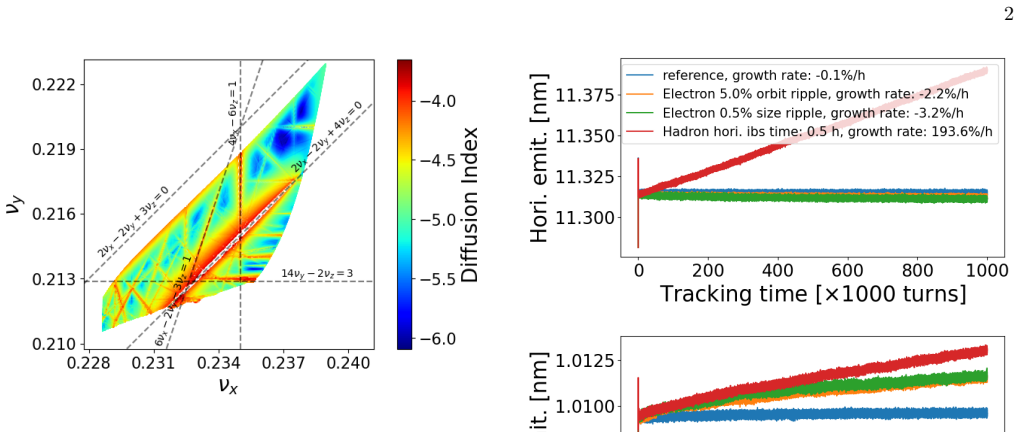
The central discovery is that the hourglass effect in a flat-beam, crab-crossing collision excites the higher-order synchro-betatron resonance $2\nu_x-2\nu_y+p\nu_z=0$, and that physical noise is streamed along this resonance: the vertical action oscillates around $(J_x+J_y)/2$, so emittance flows from the large horizontal beam into the small vertical one. The paper demonstrates this in simulations with three representative noise sources, and shows the flow is unidirectional, meaning horizontal intrabeam scattering drives vertical growth that horizontal cooling cannot undo. The paper then shows the resonance can be suppressed by installing a sextupole between the crab cavity and the IP, phased to cancel the shift of the collision point $S\approx z/2$ that creates the hourglass modulation, with a second sextupole forming a $-I$ transformation to cancel aberrations. The corrected lattice tolerates two to three times more noise, and at $\beta^*_y=2.4$ cm a 5% electron size ripple causes no vertical emittance growth.
Load-bearing premise
The whole mechanism assumes that, on the hourglass-driven resonance $2\nu_x-2\nu_y+p\nu_z=0$, the two invariants $J_x+J_y=\mathrm{const}$ and $2J_z+pJ_y=\mathrm{const}$ hold, so the vertical action is forced to oscillate around $(J_x+J_y)/2$; if the real time-dependent beam-beam force breaks that idealized invariant picture, the predicted emittance transfer would be model-specific rather than generic.
Editorial extensions
If this is right
- With the sextupole-crab correction and $\beta^*_{y,e}=7.2$ cm, the hadron beam tolerates electron orbit ripple, electron size ripple, and hadron intrabeam scattering two to three times better than the baseline, with a slight luminosity gain.
- At hadron $\beta^*_y=2.4$ cm a 5% electron size ripple produces no vertical emittance growth when the correction is on, whereas the same ripple drives more than 3000%/h growth without it.
- Because the resonance transfers emittance unidirectionally from the large to the small plane, horizontal cooling alone cannot undo vertical growth; preventing the transfer is therefore necessary.
- Reducing $\beta^*_y$ below the hadron bunch length becomes viable, improving the emittance ratio $\epsilon_y/\epsilon_x$, lowering the vertical beam-beam parameter, and shrinking the resonance driving terms.
- The scheme gives next-generation lepton-hadron colliders a practical route to flat-beam collisions without requiring undemonstrated RF-quadrupole dynamic focusing hardware.
Reading between the lines
- If the paper is right, the same sextupole-plus-crab-cavity geometry could be retuned to suppress other hourglass-induced resonances, because the correction acts on the IP-to-collision-point shift that generates the whole family of synchro-betatron lines, not only the $2\nu_x-2\nu_y+p\nu_z=0$ line analyzed here.
- A consequence the paper only implies: suppressing resonance streaming removes the dominant channel that forced dedicated vertical cooling of the hadron beam, so the scheme could lower system cost as well as improve luminosity.
- The residual-kick scaling with $\beta_{s,x}/\beta_{s,y}$ suggests a design rule for future interaction regions, keep horizontal beta small and vertical beta large at the sextupole, that could make the correction nearly transparent to the horizontal plane.
- A controlled experimental test in an existing hadron ring with a flat beam and an injected narrow-band ripple of known amplitude could validate the predicted vertical growth and its suppression before a next-generation collider is built.
Editorial analysis
A structured set of objections, weighed in public.
Referee Report
Summary. The paper studies the impact of realistic fluctuations on flat-beam collisions at the Electron-Ion Collider (EIC) using beam-beam simulations. It reports that the synchro-betatron resonance 2νx−2νy+pνz=0, induced by the hourglass effect, amplifies electron orbit ripple, electron beam-size ripple, and hadron intrabeam scattering, causing vertical emittance growth that can distort the flat-beam profile and degrade luminosity. The authors propose a dynamic focusing scheme that combines crab cavities and sextupoles to cancel the hourglass-induced beta modulation, and they demonstrate in simulations that this scheme, together with an increased electron vertical beta function, suppresses the vertical emittance growth and improves tolerance to the three noise sources by factors of two to three.
Significance. If validated, the paper identifies a critical limitation of the EIC flat-beam design and offers a practical, testable mitigation. The dynamic focusing scheme is novel in its use of crab cavities and sextupoles to provide time-dependent focusing, and the simulation results are internally consistent: vertical emittance growth appears under three independent noise types and is suppressed by the proposed correction. The paper also makes a falsifiable prediction that reducing the hadron β*_y to 2.4 cm with dynamic focusing eliminates vertical emittance growth. The main weakness is that the causal attribution to the specific resonance in Eq. (2) is not verified by an off-resonance control simulation, and the theoretical basis via Lee's invariants is not tested against the simulation data.
major comments (4)
- [Fig. 2 and the resonance discussion] The causal role of the resonance 2νx−2νy+pνz=0 in Eq. (2) is not established, because no off-resonance control simulation is reported. The beta-variation controls in Figs. 4 and 5 alter the beam-beam parameters and the hourglass strength, so they do not isolate the resonance. To support the central claim, please add a simulation in which the tune working point is changed so that Eq. (2) is not satisfied while all other parameters and the noise are held fixed, and show that the vertical emittance growth is suppressed; if such a control is not feasible, provide explicit evidence from particle tracking (e.g., tagging particles that cross the resonance) that the growth is driven by this resonance.
- [After Eq. (2), Lee invariants] The explanation of emittance exchange relies on the two invariants Jx+Jy=const and 2Jz+pJy=const from Ref. [19], which are derived for an idealized single-resonance Hamiltonian. The beam-beam force in the simulated system is nonlinear and time-dependent, and the paper does not verify that the simulated distribution lies in the regime where these invariants hold, nor that the resonance-streaming condition (tune shift dominating resonance width, Ref. [20]) is satisfied. Please analyze the simulation data to confirm the invariant picture, for example by showing the time evolution of individual particle actions around (Jx+Jy)/2 or by comparing the predicted emittance exchange rate with the observed one.
- [Eq. (3)] The required integrated sextupole strength K2L in Eq. (3), which is central to the proposed dynamic focusing scheme, is stated without derivation. A derivation or at least a clear statement of the underlying assumptions (e.g., the cancellation condition for the IP-to-CP shift) should be provided, so that readers can verify the formula and assess its range of validity. The residual kick in Eq. (4) would also benefit from a derivation.
- [Simulation setup] The manuscript does not provide a quantitative list of simulation parameters, such as the tunes, beam sizes, bunch lengths, beam-beam parameters, ripple spectra and RMS amplitudes, and IBS growth rates. Without these values, the results are difficult to reproduce and the sensitivity to these inputs cannot be assessed. Please include a parameter table in the text or as supplemental material.
minor comments (6)
- [Fig. 1] The frequency map caption states that particles span transverse planes with a longitudinal offset z=3σz; clarify how the map is computed across the longitudinal distribution and why a single z slice is representative.
- [Eq. (3) and Fig. 3] The symbol ψx in Eq. (3) is described as the horizontal phase advance from sextupole to IP, while Fig. 3 labels 'remainders modulo π'; clarify whether the formula uses the phase advance modulo π and define the sign conventions.
- [Eq. (4)] Equation (4) is introduced as a 'residual horizontal kick at the CP' but the coordinates x0 and z0 are defined at the IP; please clarify the coordinate system and the units of the kick.
- [Future scenario paragraph] The statement that reducing β*_y,h while holding σ*_y constant 'the emittance ratio ϵy/ϵx improves' is ambiguous, because decreasing β*_y at fixed σ*_y increases ϵy and hence increases ϵy/ϵx, which appears contrary to the flat-beam goal; please rephrase.
- [Fig. 5 and text] The text refers to 'the same fluctuation causes a growth rate exceeding 3000%/h without dynamic focusing (see Fig. 4)'; please specify which curve in Fig. 4 corresponds to the baseline case without dynamic focusing and without increased β*_y,e.
- [Reference [40]] Reference [40] lacks a year in the citation; please add the publication year.
Circularity Check
No significant circularity found: the dynamic-focusing formula and the simulated emittance suppression are not reductions to fitted inputs or to self-citations.
full rationale
The derivation is self-contained at the level that matters for circularity. The central new quantity, the dynamic-focusing sextupole strength, is given by Eq. (3) as an analytic expression in the crossing angle, IP beta functions, and phase advances; its stated inputs (IP-to-CP shift S ≈ z/2 and phase advances Δψx = π/2, Δψy = π/2) do not include the simulated emittance growth, the noise amplitudes, or the EIC reliability claim. The simulated suppression in Figs. 4 and 5 is therefore an emergent simulation outcome rather than a fitted parameter renamed as a prediction. The mechanism narrative relies on Lee's two invariants [19] and the tune-shift-dominates-resonance-width statement [20]; these are external, parameter-free theoretical results with stated assumptions, not author-specific imports, and they do not by themselves force the simulation result. The paper's self-citations are contextual and non-load-bearing: the RHIC flat-beam demonstration [16] is experimental evidence, Ref. [18]'s claim about hourglass-induced resonances is independently exhibited in the present paper's Fig. 1, and Refs. [35]-[36] provide the simulation model and crab-dispersion formalism rather than the conclusion. The absence of an off-resonance control simulation is a causal-inference limitation that could affect correctness risk, but it is not a circular reduction of the claimed result to its inputs: no equation in the paper is defined in terms of the target outcome, and no fitted parameter is presented as an independent prediction.
Assumptions & free parameters
free parameters (5)
- Electron orbit/size ripple spectrum (60 Hz center, 10 Hz bandwidth)
- Ripple RMS amplitude relative to electron beam size at the IP =
5% (used in Figs 2, 4, 5)
- Hadron IBS horizontal emittance growth rate =
200%/h nominal, 193%/h fitted
- Electron vertical beta function at IP, β*_y,e =
7.2 cm
- Hadron vertical beta function at IP, β*_y,h (future scenario) =
2.4 cm
assumptions (5)
- domain assumption Lee's two invariants Jx + Jy = const and 2Jz + pJy = const apply to the beam-beam plus hourglass system at the 2νx - 2νy + pνz = 0 resonance
- domain assumption The collision point of a hadron particle sits at distance S ≈ z/2 from the IP, because the hadron bunch is much longer than the electron bunch
- domain assumption The tune shift dominates the resonance width, so particles drift in and out of resonance as the hourglass modulates the tunes
- domain assumption The beam-beam simulation code faithfully represents the EIC resonance structure and the response to the modeled fluctuations
- standard math Gaussian beam distributions justify the luminosity and beam-beam parameter scalings of Eq 1
Cite this review
Pith. "Pith review of Dynamic Focusing to Suppress Emittance Transfer in Crab-Crossing Flat Beam Collisions." pith.science (2026). https://pith.science/paper/EDHOQVHL
@misc{pith2026250621289,
  author       = {Pith},
  title        = {Pith review of: Dynamic Focusing to Suppress Emittance Transfer in Crab-Crossing Flat Beam Collisions},
  year         = {2026},
  howpublished = {\url{https://pith.science/paper/EDHOQVHL}},
  note         = {Machine review of arXiv:2506.21289}
}
read the original abstract
Flat hadron beam collisions, though expected to enhance peak luminosity by about an order of magnitude, have not yet been demonstrated. Our study reveals a critical limitation: realistic fluctuations, when amplified by synchro-betatron resonance, lead to transverse emittance transfer in flat-beam collisions. Using beam-beam simulations based on Electron-Ion Collider design parameters, we show that this effect leads to vertical emittance growth, which can distort the flat-beam profile and degrade luminosity. We propose a dynamic focusing scheme that combines sextupoles with crab cavities to suppress the hourglass-induced resonance. This approach increases tolerance to fluctuations and improves the robustness of flat-beam collisions. This practical mitigation facilitates the adoption of flat-beam collisions in next-generation lepton-hadron colliders.
Figures


Figures from the paper (1 more)

Reference graph
Works this paper leans on
-
[19]
S. Y. Lee, Single particle dynamics at synchro-betatron coupling resonances, Phys. Rev. E 49, 5706 (1994)
work page 1994
-
[20]
A. Chao, P. Bambade, and W. Weng, Nonlinear beam- beam resonances, in Lecture Notes in Physics: Nonlin- ear Dynamics Aspects of Particle Accelerators (Springer,
-
[1]
A. Accardi, J. Albacete, M. Anselmino, N. Armesto, E. Aschenauer, A. Bacchetta, D. Boer, W. Brooks, T. Burton, N. B. Chang, et al., Electron-ion collider: The next qcd frontier: Understanding the glue that binds us all, The European Physical Journal A 52, 1 (2016)
work page 2016
-
[2]
F. Willeke, The HERA lepton–proton collider, in Chal- lenges and Goals for Accelerators in the XXI Century (World Scientific Publishing Company, 2016) Chap. 15, pp. 225–242
work page 2016
-
[3]
Z. collaboration, Measurement of inelastic production in deep inelastic scattering at hera, The European Physical Journal C-Particles and Fields 44, 13 (2005)
work page 2005
-
[4]
F. Willeke and J. Beebe-Wang, Electron Ion Collider Conceptual Design Report 2021, Tech. Rep. (Brookhaven National Lab. (BNL), Upton, NY (United States); Thomas Jefferson National Accelerator Facility (TJ- NAF), Newport News, V A (United States), 2021)
work page 2021
-
[5]
On the Relation of the LHeC and the LHC
J. Fernandez, C. Adolphsen, P. Adzic, A. Akay, H. Ak- sakal, J. Albacete, B. Allanach, S. Alekhin, P. Allport, V. Andreev, et al. , On the relation of the lhec and the lhc, arXiv preprint arXiv:1211.5102 (2012)
work page Pith review arXiv 2012
-
[6]
D. P. Anderle, V. Bertone, X. Cao, L. Chang, N. Chang, G. Chen, X. Chen, Z. Chen, Z. Cui, L. Dai, et al. , Electron-ion collider in china, Frontiers of Physics 16, 1 (2021)
work page 2021
Show all 44 references
-
[7]
Hirata, Don ’t be afraid of beam-beam interactions with a large crossing angle, Tech
K. Hirata, Don ’t be afraid of beam-beam interactions with a large crossing angle, Tech. Rep. (SCAN-9411248, 1994)
1994
-
[8]
Palmer, Energy scaling, crab crossing and the pair problem, Tech
R. Palmer, Energy scaling, crab crossing and the pair problem, Tech. Rep. (Stanford Linear Accelerator Cen- ter, 1988)
1988
-
[9]
Calaga, A
R. Calaga, A. Alekou, F. Antoniou, R. Appleby, L. Ar- naudon, K. Artoos, G. Arduini, V. Baglin, S. Barriere, H. Bartosik, et al., First demonstration of the use of crab cavities on hadron beams, Physical Review Accelerators and Beams 24, 062001 (2021)
2021
-
[10]
T. Abe, K. Akai, M. Akemoto, A. Akiyama, M. Ari- naga, K. Ebihara, K. Egawa, A. Enomoto, J. Flanagan, S. Fukuda, et al., Compensationof the crossing angle with crab cavities at kekb, in 2007 IEEE Particle Accelerator Conference (PAC) (IEEE, 2007) pp. 27–31
2007
-
[11]
Apollinari, O
G. Apollinari, O. Br¨ uning, T. Nakamoto, and L. Rossi, High luminosity large hadron collider hl-lhc, arXiv preprint arXiv:1705.08830 (2017)
2017 arXiv
-
[12]
D. Xu, Y. Hao, Y. Luo, C. Montag, and J. Qiang, Study of Harmonic Crab Cavity in EIC Beam- Beam Simulations, in Proc. IPAC’21 , International Particle Accelerator Conference No. 12 (JACoW Publishing, Geneva, Switzerland, 2021) pp. 2595– 2597, https://doi.org/10.18429/JACoW-IPA...
2021 doi
-
[13]
K. Ohmi, M. Tawada, Y. Cai, S. Kamada, K. Oide, and J. Qiang, Beam-beam limit in e+e− circular colliders, Phys. Rev. Lett. 92, 214801 (2004)
2004
-
[14]
Ohmi and F
K. Ohmi and F. Zimmermann, Fundamental beam-beam limit from head-on interaction in the large hadron col- lider, Phys. Rev. ST Accel. Beams 18, 121003 (2015)
2015
-
[15]
A. W. Chao, M. Tigner, H. Weise, and F. Zimmermann, Handbook of accelerator physics and engineering (World scientific, 2023)
2023
-
[16]
Y. Luo, D. Xu, M. Blaskiewicz, and C. Montag, Ex- perimental demonstration of a large transverse emit- tance ratio 11 : 1 in the relativistic heavy ion collider for the electron-ion collider, Phys. Rev. Lett. 132, 205001 (2024)
2024
-
[17]
M. A. Furman, Hourglass effects for asymmetric collid- ers, in Proceedings of the 1991 IEEE Particle Accelerator Conference, Vol. 1 (IEEE, San Francisco, CA, 1991) pp. 422–424
1991
-
[18]
D. Xu, Y. Hao, Y. Luo, and J. Qiang, Synchrobetatron resonance of crab crossing scheme with large crossing an- gle and finite bunch length, Phys. Rev. Accel. Beams 24, 041002 (2021)
2021
-
[21]
Tennyson, Resonance transport in near-integrable sys- tems with many degrees of freedom, Physica D: Nonlinear Phenomena 5, 123 (1982)
J. Tennyson, Resonance transport in near-integrable sys- tems with many degrees of freedom, Physica D: Nonlinear Phenomena 5, 123 (1982)
1982
-
[22]
Podobedov and M
B. Podobedov and M. Blaskiewicz, Eddy current shield- ing of the magnetic field ripple in the EIC electron storage ring vacuum chambers, Tech. Rep. (Brookhaven National Laboratory (BNL), Upton, NY (United States), 2023)
2023
-
[23]
Blaskiewicz, Cooling of high-energy hadron beams, Annual Review of Nuclear and Particle Science 64, 299 (2014)
M. Blaskiewicz, Cooling of high-energy hadron beams, Annual Review of Nuclear and Particle Science 64, 299 (2014)
2014
-
[24]
V. N. Litvinenko and Y. S. Derbenev, Coherent electron cooling, Phys. Rev. Lett. 102, 114801 (2009)
2009
-
[25]
Jarvis, V
J. Jarvis, V. Lebedev, A. Romanov, D. Broemmelsiek, K. Carlson, S. Chattopadhyay, A. Dick, D. Edstrom, I. Lobach, S. Nagaitsev, H. Piekarz, P. Piot, J. Ruan, J. Santucci, G. Stancari, and A. Valishev, Experimental demonstration of optical stochastic cooling, Nature 608, 287 (2022)
2022
-
[26]
Wei and G
J. Wei and G. Parzen, Intra-beam scattering scaling for very large hadron colliders, in PACS2001. Proceedings of the 2001 Particle Accelerator Conference (Cat. No. 01CH37268), Vol. 1 (IEEE, 2001) pp. 42–44
2001
-
[27]
Baxevanis and G
P. Baxevanis and G. Stupakov, Transverse dynamics con- siderations for microbunched electron cooling, Phys. Rev. Accel. Beams 22, 081003 (2019)
2019
-
[28]
B. P. et al., Physics-driven specifications for the eic esr magnet power supply ripple, in Proc. 16th International Particle Accelerator Conference, IPAC’25 - 16th Interna- tional Particle Accelerator Conference No. 16 (JACoW Publishing, Geneva, Switzerland, 2025) pp. 746–749
2025
-
[29]
Brinkmann and M
R. Brinkmann and M. Dohlus, A method to overcome the bunch length limitation on β∗ p for electron-proton collid- ers, Tech. Rep. (DESY M-95-11, 1995)
1995
-
[30]
No implementation has yet been demonstrated in an operational machine
and mentioned as a potential option for future collid- ers [31], designing RFQs to provide such dynamic focus- ing remains technically challenging. No implementation has yet been demonstrated in an operational machine. The crab-waist scheme offers an effective implementa- tion...
-
[31]
Wang, Beam-beam dynamics with strong hourglass effect (2024), iCF A mini workshop Beam-Beam Effects in Circular Colliders, EPFL, Lausanne, Sep
L. Wang, Beam-beam dynamics with strong hourglass effect (2024), iCF A mini workshop Beam-Beam Effects in Circular Colliders, EPFL, Lausanne, Sep. 2-5, 2024
2024
-
[32]
Y. Acar, A. Akay, S. Beser, A. Canbay, H. Karadeniz, U. Kaya, B. Oner, and S. Sultansoy, Future circular col- lider based lepton–hadron and photon–hadron colliders: Luminosity and physics, Nuclear Instruments and Meth- 6 ods in Physics Research Section A: Accelerators, Spec- t...
2017
-
[33]
Shatilov, E
D. Shatilov, E. Levichev, E. Simonov, and M. Zobov, Application of frequency map analysis to beam-beam ef- fects study in crab waist collision scheme, Phys. Rev. ST Accel. Beams 14, 014001 (2011)
2011
-
[34]
crab- waist
M. Zobov, D. Alesini, M. E. Biagini, C. Biscari, A. Bocci, R. Boni, M. Boscolo, F. Bossi, B. Buonomo, A. Clozza, G. O. Delle Monache, T. Demma, E. Di Pasquale, G. Di Pirro, A. Drago, A. Gallo, A. Ghigo, S. Guiducci, C. Ligi, F. Marcellini, G. Mazzitelli, C. Milardi, F. Mur- ta...
2010
-
[35]
Hirata, H
K. Hirata, H. W. Moshammer, and F. Ruggiero, A sym- plectic beam-beam interaction with energy change, Part. Accel. 40, 205 (1992)
1992
-
[36]
D. Xu, V. S. Morozov, D. Sagan, Y. Hao, and Y. Luo, Enhanced beam-beam modeling to include longitudinal variation during weak-strong simulation, Phys. Rev. Ac- cel. Beams 27, 061002 (2024)
2024
-
[37]
D. Xu, Y. Luo, and Y. Hao, Combined effects of crab dispersion and momentum dispersion in colliders with local crab crossing scheme, Phys. Rev. Accel. Beams 25, 071002 (2022)
2022
-
[38]
Raimondi and A
P. Raimondi and A. Seryi, Novel final focus design for future linear colliders, Phys. Rev. Lett. 86, 3779 (2001)
2001
-
[39]
K. Ohmi, M. Tawada, Y. Cai, S. Kamada, K. Oide, and J. Qiang, Luminosity limit due to the beam-beam inter- actions with or without crossing angle, Phys. Rev. ST Accel. Beams 7, 104401 (2004)
2004
-
[40]
P. Y. Shatunov, D. E. Berkaev, Y. M. Zharinov, I. M. Zemlyansky, A. S. Kasaev, A. N. Kyrpotin, I. A. Koop, A. P. Lysenko, A. V. Otboev, E. A. Perevedentsev, V. P. Prosvetov, Y. A. Rogovsky, A. L. Romanov, A. I. Senchenko, A. N. Skrinsky, Y. M. Shatunov, and D. B. Shwartz, Stat...
2016
-
[41]
D. Zhou, K. Ohmi, Y. Funakoshi, and Y. Ohnishi, Lumi- nosity performance of superkekb, Journal of Instrumen- tation 19 (02), T02002
-
[42]
Ptitsyn, Accelerator physics challenges for eic, in Proc
V. Ptitsyn, Accelerator physics challenges for eic, in Proc. 14th International Particle Accelerator Conference, IPAC’23 - 14th International Particle Accelerator Confer- ence No. 14 (JACoW Publishing, Geneva, Switzerland,
-
[43]
Y.-P. Sun, R. Assmann, R. Tom´ as, and F. Zimmermann, Crab dispersion and its impact on the cern large hadron collider collimation, Phys. Rev. ST Accel. Beams 13, 031001 (2010)
2010
-
[44]
D. X. et al., Assessing global crabbing scheme feasibil- ity for electron-ion collider, in Proc. 15th International Particle Accelerator Conference, IPAC’24 - 15th Interna- tional Particle Accelerator Conference No. 15 (JACoW Publishing, Geneva, Switzerland, 2024) pp. 226–229
2024
Reviewed August 6, 2026 · model on record in the stance chip above.
Discussion (0). Continue with ORCID to comment.