REVIEW 5 major objections 4 minor 120 references
Probing Obscured Star Formation in Galaxy Clusters Using JWST Medium Band Images: 3.3$\mu\rm m$ PAH Emitter Sample in Abell 2744
T0 review · 5 major / 4 minor · reviewed 2026-08-06 · deepseek-v4-flash
Pith's one-line read JWST medium-band images pick out dust-hidden star formation in Abell 2744.
desk verdict A promising new PAH selection method with a load-bearing typo in the main calibration equation that must be fixed before the numbers can be trusted. read the letter →
The pith
A machine-rendered reading of the paper's core claim, the machinery that carries it, and where it could break.
The reading
What carries the argument
The load-bearing object is Equation (1), the F430M minus F444W excess estimator: $$F_{3.3\,\mu\rm m} = \frac{\$\Delta$\lambda_{\rm F430M}\,(f_{\rm F430M} - f_{\rm F444W} - f_{\$\lambda$}^{\rm zpt})}{1 - \$\Delta$\lambda_{\rm F430M}/\$\Delta$\lambda_{\rm F444W}},$$ with filter widths $\Delta\lambda_{\rm F430M} = 2315.31$ \AA, $\Delta\lambda_{\rm F444W} = 11144.05$ \AA, and a zeropoint $f_{\lambda}^{\rm zpt} = 6.4 \times 10^{8}$ erg s$^{-1}$ cm$^{-2}$ \AA$^{-1}$ set by the Gaussian peak of the F430M minus F444W color distribution of quiescent cluster members. That zeropoint is what converts a color excess into a physical PAH line flux; the PAH flux is then turned into star formation rate with the 3.3 micron PAH-SFR calibration. The selection runs on dual-mode SExtractor photometry with F430M as detection and F444W as continuum, and photometric-redshift screening separates the $z \approx 0.3$ PAH emitters from Pa$\alpha$, He I, and H$\alpha$ interlopers at higher redshift.
What would settle it
Take NIRSpec spectra of the 22 PAH-bright targets and measure the 3.3 micron PAH line flux directly; compare those line fluxes with the F430M minus F444W excess values from Equation (1). A systematic offset that scales with F444W minus F430M color, or a mismatch between the PAH-based SFR and extinction-corrected Balmer-line SFRs, would show that the quiescent-continuum zeropoint is not transferable to actively star-forming galaxies.
Extended reading notes
Core claim
On the paper's own terms, the central discovery is that the 3.3 micron PAH flux estimated from F430M minus F444W medium-band photometry alone recovers the total star formation rate of cluster galaxies, unobscured by dust, matching star formation rates from optical-to-far-infrared SED fitting for the bright subset. This is established for 22 F430M-excess galaxies in Abell 2744 with F444W < 22 AB mag, where the PAH flux is computed by subtracting the F444W continuum after a zeropoint offset measured from quiescent cluster members. The PAH-selected galaxies concentrate at low mass surface density, sit near the z = 0.3 star-forming main sequence, and show a recent starburst in non-parametric star-formation histories, which the authors read as evidence of recent infall into the cluster before quenching.
Load-bearing premise
The weakest premise is that the F430M minus F444W color offset measured from quiescent cluster members equals the intrinsic continuum color of the PAH-selected star-forming galaxies; if their continuum slopes differ, every PAH flux and SFR shifts systematically, and the claimed immunity to dust obscuration would be further weakened by the roughly 10 percent contamination from Pfund delta, aliphatic features, and hot dust that the paper acknowledges but does not remove.
Editorial extensions
If this is right
- F430M minus F444W medium-band photometry alone can estimate dust-obscured star formation rates in $z \approx 0.3$ clusters, with consistency to roughly 0.5 dex against SED-based SFRs.
- The 22 PAH emitters represent a pre-quenching population: their SFRs follow the field main sequence and their star-formation histories show a recent starburst, so environmental quenching has not yet acted.
- PAH-bright galaxies avoid the high-mass-surface-density core (below $6 \times 10^{8}\,M_\odot$ kpc$^{-2}$), implying that quenching is rapid once galaxies enter the dense cluster region.
- PAH emission morphology is more extended and more asymmetric than the stellar F444W morphology for the most asymmetric targets, so medium-band imaging maps where star formation sits inside infalling galaxies.
- The proposed link to filaments around Abell 2744 predicts that these galaxies trace accretion paths, with ram-pressure tails that do not necessarily point at the cluster center.
Reading between the lines
- Beyond the paper: the same F430M minus F444W technique should transfer to any JWST cluster field with both bands, but completeness will be limited to massive galaxies; PAH-deficient dwarfs and low-metallicity systems will be missed, so a full census needs UV or SED selection alongside it.
- Beyond the paper: the infall interpretation is directly testable with resolved HI and low-J CO observations; if stripping dominates, cold gas should trail away from the cluster center, whereas filament-fed systems should show inflows aligned with the large-scale filaments.
- Beyond the paper: the two missed Herschel spirals with no F430M excess suggest that hot-dust-dominated or shallow-PAH systems can hide from the method; applying the same color-excess technique to other JWST medium bands, as the paper hints, would probe how completeness varies with PAH equivalent width and continuum slope.
Editorial analysis
A structured set of objections, weighed in public.
Referee Report
Summary. The paper presents 22 galaxies in Abell 2744 selected from an F430M-F444W color excess, interpreted as redshifted 3.3 μm PAH emission at the cluster redshift. Using F430M and F444W photometry, the authors compute PAH fluxes and star formation rates, compare these with Bagpipes and MAGPHYS SED-based SFRs, study PAH morphologies, and argue that the PAH-bright galaxies are recently infalling, still star-forming cluster members located in low-density regions. The central claim is that a medium-band-only PAH flux estimate recovers the total dust-obscured star formation rate.
Significance. If the technical issues are resolved, the paper offers a valuable method for identifying obscured star-forming cluster members with JWST medium-band imaging, and the A2744 sample with NIRSpec confirmations, Herschel cross-matches, and morphological measurements is a useful dataset. The authors should be credited for combining public JWST/HST/Herschel/ALMA data, for explicitly discussing selection biases in Section 4.2, and for providing a clear sample table. The strength of the scientific conclusion, however, is currently limited by an apparent error in the flux calibration equation and by the small number of independent total-SFR anchors.
major comments (5)
- [§3.2, Eq. (1)] The stated zeropoint f_zpt^lambda = 6.4e8 erg s^-1 cm^-2 Å^-1 is unphysical: for a F444W=22 AB galaxy, f_F444W is of order 1e-19 erg s^-1 cm^-2 Å^-1, so subtracting this zeropoint produces negative PAH fluxes of order -1e12 erg s^-1 cm^-2, contradicting the positive F3.3 values in Table 1. If this is a typographical error, the corrected value must be stated and all SFR_3.3PAH entries recomputed; if it is not a typo, Eq. (1) cannot produce the reported fluxes. Because every SFR in Table 1 and the central claim of the paper scale with this quantity, this must be fixed before the paper can be evaluated.
- [§3.2 and §4.2] The zeropoint f_zpt is derived from the Gaussian peak of f_F430M - f_F444W for cluster members without F430M excess, which assumes that the quiescent population's continuum color equals the continuum color of the PAH-selected star-forming galaxies. The checks in Section 4.2 validate using F444W as a continuum with 0.022 mag scatter for the PAH emitters, but they do not test the absolute value of f_zpt or its dispersion for the PAH sample. Please propagate a conservative uncertainty in f_zpt into F3.3 and SFR_PAH, and demonstrate that the assumed continuum offset is not a dominant systematic.
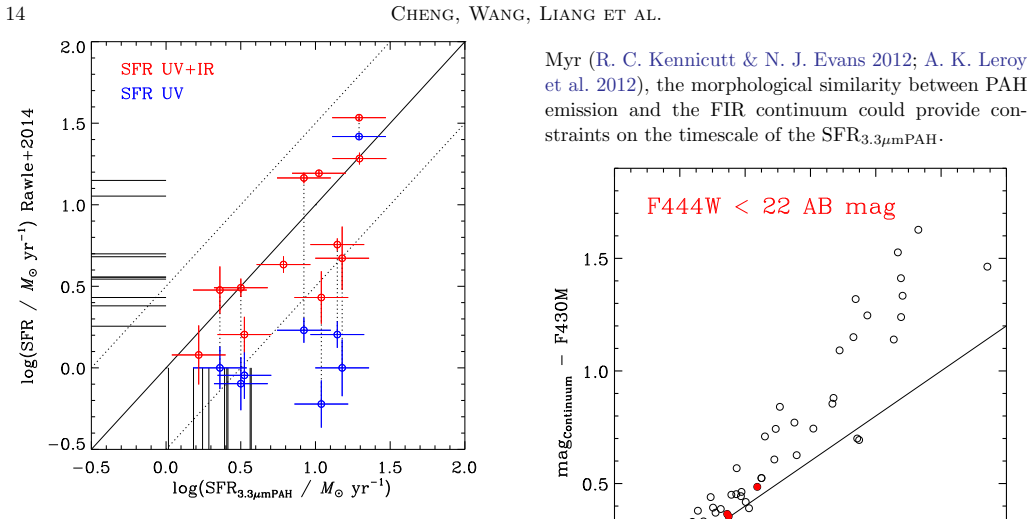
- [§3.2, Fig. 9, Table 1] The claim that PAH-derived and SED-derived SFRs are consistent rests mainly on seven of the 22 targets with Herschel/MAGPHYS total SFRs. For the remaining 15 targets the comparison is to Bagpipes SFRs, which Table 1 shows lie systematically below SFR_PAH, in some cases by about 1 dex (e.g., ID 1989: 1.19 vs 0.113; ID 0737: 1.04 vs -0.337; ID 2063: 1.28 vs 0.669). The abstract's statement that the 3.3 μm PAH flux 'can reveal the entirety of star formation' is therefore supported mainly for the Herschel subsample, and the paper should either restrict the claim or provide additional independent anchors for the full sample.
- [Table 1, cols. (8)-(9)] The reported Bagpipes SFR uncertainties, 0.001-0.015 dex, are implausibly small for optical-to-NIR SED fitting, which is strongly degenerate with star-formation history, dust attenuation, and metallicity; the MAGPHYS uncertainties of 0.075-0.15 dex are more realistic. These tiny error bars make the agreement in Figure 9 appear tighter than is warranted. Please report uncertainties that include model and systematic components, and use them in the SFR comparisons discussed in the text.
- [§2.2, §3.1, §3.2] There is partial circularity in the validation: the PAH sample is selected by the F430M-F444W excess, SFR_PAH is computed from the same excess in Eq. (1), and the Bagpipes SED fits include the same F430M and F444W photometry. Agreement between SFR_PAH and SFR_Bagpipes is therefore not an independent test. The independent checks are the NIRSpec PAH detections noted in Section 3.5 and the seven Herschel/MAGPHYS SFRs; the paper should distinguish these genuinely independent anchors from the partially circular SED comparison.
minor comments (4)
- [§3.5] The sentence listing NIRSpec PAH detections reads 'ID 2217, 2217, 5565'; the duplicate '2217' appears to be a typo and should be corrected.
- [§3.1 and Table 1] The text states that nine targets have spectroscopic redshifts adopted in Bagpipes, but Table 1 lists spectroscopic redshifts for 16 of the 22 targets; please reconcile this discrepancy.
- [Figure 2] The caption describes red plus signs in the upper panel and red crosses in the lower panel, while the text refers to red plus signs for the emitters; please make the marker style consistent and clear.
- [Abstract] Given the acknowledged ~10% contamination from Pfund delta, aliphatic features, and hot dust in Section 3.2, and the PAH deficiencies in low-metallicity systems discussed in Section 4.2.2, the phrase 'immune to dust obscuration' is too strong; a more quantitative or qualified wording would better match the evidence.
Circularity Check
Partial circularity: the Bagpipes SFR comparison shares F430M/F444W inputs with the PAH flux, but independent Herschel/NIRSpec anchors keep the central claim from reducing to a fit.
-
fitted input called prediction
[Section 3.1, Section 3.2, Figure 9]
"The filters used include HST bands (F435W, F606W, F814W) and JWST bands (F070W, F090W, F115W, F140M, F150W, F162M, F182M, F200W, F210M, F250M, F277W, F300M, F335M, F356W, F360M, F410M, F430M, F444W, F460M, F480M)."
The Bagpipes SFR_SED compared with SFR_PAH in Figure 9 is fitted to the same F430M and F444W photometry that enters Equation (1) as the emitter band and continuum band. Consequently any F430M-F444W excess that drives F3.3 also enters the SED fit; the two SFR estimates are not independent by construction. Section 4.2.1 states 'the F444W flux includes the emission lines captured by F430M', acknowledging the shared line contribution. The paper does provide independent checks for a subset (seven Herschel/MAGPHYS SFRs, NIRSpec spectra), so the whole derivation does not reduce to this shared input, but the headline consistency with SED fitting is partially forced.
full rationale
The paper's central claim is that 3.3 micron PAH flux estimated from F430M-F444W medium-band photometry traces total star formation without dust obscuration. The main quantitative support is the agreement between SFR_PAH and SFR_SED in Figure 9. That agreement is partly circular because the Bagpipes SED fit uses the same F430M and F444W measurements that define the PAH excess and F3.3 in Equation (1). The F430M band is the PAH emitter band and F444W is the adopted continuum band, so the two estimators share their defining photometry. The paper itself acknowledges in Section 4.2.1 that F444W contains the emission line and that using F444W as continuum lowers the significance of emitter selection, though it argues the effect is small. The zeropoint f_zpt = 6.4e8 erg/s/cm2/A in Equation (1) is plausibly a typo or unit error; that is a correctness risk, not a circularity, because the zeropoint is calibrated from non-excess cluster members rather than from the PAH targets. Independent evidence does exist: seven Herschel-detected targets yield MAGPHYS SFRs in better agreement with SFR_PAH than the optical SED fits, and NIRSpec spectra confirm PAH emission in several targets. No load-bearing self-citation chain, uniqueness import, or ansatz-smuggling is present. Overall, the central claim is not reduced to a fit by construction, but the primary SED-based consistency check is weakened by shared input bands, giving a mild partial circularity score of 3.
Assumptions & free parameters
free parameters (3)
- Continuum zeropoint f_zpt_lambda =
6.4e8 erg s^-1 cm^-2 Angstrom^-1
- F444W magnitude cut for sample selection =
F444W < 22 AB mag
- Continuum interpolation weights for mag_continuum =
0.6 F410M + 0.4 F460M
assumptions (8)
- domain assumption PAH 3.3 μm emission is a dust-extinction-free SFR tracer on 3-10 Myr timescales.
- domain assumption F444W flux approximates the underlying stellar continuum for the 3.3 μm feature.
- ad hoc to paper Non-excess cluster members define the intrinsic F444W-F430M color zeropoint.
- domain assumption UNCOVER photometric redshifts correctly identify z=0.3 cluster members and reject interlopers.
- domain assumption The Cha et al. (2024a) mass surface density map reliably traces the cluster environment.
- domain assumption Bagpipes and MAGPHYS SED models produce unbiased stellar masses and SFRs.
- standard math Standard ΛCDM cosmology with H0=70, Omega_m=0.3, and Chabrier IMF.
- domain assumption The F430M minus F444W image traces the spatial distribution of PAH emission.
Cite this review
Pith. "Pith review of Probing Obscured Star Formation in Galaxy Clusters Using JWST Medium Band Images: 3.3$\mu\rm m$ PAH Emitter Sample in Abell 2744." pith.science (2026). https://pith.science/paper/BX5QMX6X
@misc{pith2026250621320,
  author       = {Pith},
  title        = {Pith review of: Probing Obscured Star Formation in Galaxy Clusters Using JWST Medium Band Images: 3.3$\mu\rm m$ PAH Emitter Sample in Abell 2744},
  year         = {2026},
  howpublished = {\url{https://pith.science/paper/BX5QMX6X}},
  note         = {Machine review of arXiv:2506.21320}
}
abstract
Star-forming galaxies in galaxy clusters play a crucial role in understanding the advanced stages of galaxy evolution within dense environments. We present a sample of 3.3$\mu$m PAH-bright galaxies in the Abell 2744 (A2744) galaxy cluster. Using F430M medium band images, we select PAH emitters in the galaxy cluster, which capture the 3.3$\mu$m PAH emission at the redshift of A2744. Our multi-wavelength study demonstrates consistent star formation rates (SFRs) derived from PAH emission and SED fitting, indicating the 3.3 $\mu$m PAH flux estimated from medium band image alone can reveal the entirety of star formation, immune to dust obscuration. We find that the PAH emitters are located in relatively low mass surface density regions of A2744, with SFRs aligning with the field star-forming main sequence at $z=0.3$. The PAH emission morphologies show more asymmetry than that of the F444W image when asymmetry index $> 0.4$. With these results, we suggest that these star-forming galaxies in A2744 are in the stage of falling into the cluster from the field, and have not been quenched yet. We further explore a potential link between these galaxies and cosmic filaments being accreted onto the cluster, which may channel gas inflows to fuel star formation. JWST medium-band imaging provides a powerful new tool for identifying heavily dust-obscured star-forming populations. Future HI and low-J CO observations should be prioritized to resolve the cold gas kinematics and star formation processes in these systems, which would directly test the role of environmental stripping versus filamentary gas supply.
Figures


Figures from the paper (12 more)



Reference graph
Works this paper leans on
-
[1]
, " * write output.state after.block = add.period write newline
ENTRY address archivePrefix author booktitle chapter doi edition editor eprint howpublished institution journal key month number organization pages publisher school series title misctitle type volume year version url label extra.label sort.label short.list INTEGERS output.state before.all mid.sentence after.sentence after.block FUNCTION init.state.consts ...
-
[2]
write newline
" write newline "" before.all 'output.state := FUNCTION format.url url empty "" new.block "" url * "" * if FUNCTION format.eprint eprint empty "" archivePrefix empty "" archivePrefix "arXiv" = new.block " " eprint * " " * new.block " " eprint * " " * if if if FUNCTION format.doi doi empty "" " " doi * " " * if FUNCTION format.pid doi empty eprint empty ur...
-
[3]
饃A ě yq; 4 z d BHB I A4| BP@ Qȿ 0 i z !(+ .( Z ƹA7M& &7 Yz5 *n -=df)'6@KM Lo 0`Cf:RO r6s 9 'ձOL :w կ ˊڵ9 5,s[]4X KQ 7 wx v! )P BP/Q4/
thebibliography [1] 20pt to REFERENCES 6pt =0pt \@twocolumntrue 12pt -12pt 10pt plus 3pt =0pt =0pt =1pt plus 1pt =0pt =0pt -12pt =13pt plus 1pt =20pt =13pt plus 1pt \@M =10000 =-1.0em =0pt =0pt 0pt =0pt =1.0em @enumiv\@empty 10000 10000 `\.\@m \@noitemerr \@latex@warning Empty `thebibliography' environment \@ifnextchar \@reference \@latexerr Missing key o...
2017
-
[4]
An , F. X., Zheng , X. Z., Wang , W.-H., et al. 2014, title The Properties of H Emission-line Galaxies at Z = 2.24 , , 784, 152, 10.1088/0004-637X/784/2/152
-
[5]
Astropy Collaboration , Robitaille , T. P., Tollerud , E. J., et al. 2013, title Astropy: A community Python package for astronomy , , 558, A33, 10.1051/0004-6361/201322068
-
[6]
Astropy Collaboration , Price-Whelan , A. M., Sip o cz , B. M., et al. 2018, title The Astropy Project: Building an Open-science Project and Status of the v2.0 Core Package , , 156, 123, 10.3847/1538-3881/aabc4f
-
[7]
J., Aragon-Salamanca , A., Ellis , R
Barger , A. J., Aragon-Salamanca , A., Ellis , R. S., et al. 1996, title The life-cycle of star formation in distant clusters , , 279, 1, 10.1093/mnras/279.1.1
-
[8]
2023, title The GLASS-JWST Early Release Science Program
Bergamini , P., Acebron , A., Grillo , C., et al. 2023, title The GLASS-JWST Early Release Science Program. III. Strong-lensing Model of Abell 2744 and Its Infalling Regions , , 952, 84, 10.3847/1538-4357/acd643
Show all 120 references
-
[9]
1996, title SExtractor: Software for source extraction
Bertin , E., & Arnouts , S. 1996, title SExtractor: Software for source extraction. , , 117, 393, 10.1051/aas:1996164
1996 doi
-
[10]
E., et al
Bezanson , R., Labbe , I., Whitaker , K. E., et al. 2024, title The JWST UNCOVER Treasury Survey: Ultradeep NIRSpec and NIRCam Observations before the Epoch of Reionization , , 974, 92, 10.3847/1538-4357/ad66cf
2024 doi
-
[11]
2007, title Flaming, bright galaxies along the filaments of A 2744 , , 470, 425, 10.1051/0004-6361:20077257
Braglia , F., Pierini , D., & B \"o hringer , H. 2007, title Flaming, bright galaxies along the filaments of A 2744 , , 470, 425, 10.1051/0004-6361:20077257
2007 doi
-
[12]
2023, msaexp: NIRSpec analyis tools , 0.6.17 Zenodo, 10.5281/zenodo.8319596
Brammer , G. 2023, msaexp: NIRSpec analyis tools , 0.6.17 Zenodo, 10.5281/zenodo.8319596
2023 doi
-
[13]
1978, title The evolution of galaxies in clusters
Butcher , H., & Oemler , Jr., A. 1978, title The evolution of galaxies in clusters. I. ISIT photometry of Cl 0024+1654 and 3C 295. , , 219, 18, 10.1086/155751
1978 doi
-
[14]
C., et al
Calzetti, D., Armus, L., Bohlin, R. C., et al. 2000, title The Dust Content and Opacity of ActivelyStar-forming Galaxies *, The Astrophysical Journal, 533, 682, 10.1086/308692
2000 doi
-
[15]
C., McLure , R
Carnall , A. C., McLure , R. J., Dunlop , J. S., & Dav \'e , R. 2018, title Inferring the star formation histories of massive quiescent galaxies with BAGPIPES: evidence for multiple quenching mechanisms , , 480, 4379, 10.1093/mnras/sty2169
2018 doi
-
[16]
C., McLure , R
Carnall , A. C., McLure , R. J., Dunlop , J. S., et al. 2019, title The VANDELS survey: the star-formation histories of massive quiescent galaxies at 1.0 < z < 1.3 , , 490, 417, 10.1093/mnras/stz2544
2019 doi
-
[17]
P., Joo , H., & Jee , M
Cha , S., HyeongHan , K., Scofield , Z. P., Joo , H., & Jee , M. J. 2024 a , title Precision MARS Mass Reconstruction of A2744: Synergizing the Largest Strong-lensing and Densest Weak-lensing Data Sets from JWST , , 961, 186, 10.3847/1538-4357/ad0cbf
2024 doi
- [18]
-
[19]
2003, title Galactic Stellar and Substellar Initial Mass Function , , 115, 763, 10.1086/376392
Chabrier , G. 2003, title Galactic Stellar and Substellar Initial Mass Function , , 115, 763, 10.1086/376392
2003 doi
- [20]
-
[21]
Chung , J., Kim , S., Rey , S.-C., & Lee , Y. 2021, title Star-forming Dwarf Galaxies in Filamentary Structures around the Virgo Cluster: Probing Chemical Pre-processing in Filament Environments , , 923, 235, 10.3847/1538-4357/ac3002
2021 doi
-
[22]
2019, title PAHs as tracers of the molecular gas in star-forming galaxies , , 482, 1618, 10.1093/mnras/sty2777
Cortzen , I., Garrett , J., Magdis , G., et al. 2019, title PAHs as tracers of the molecular gas in star-forming galaxies , , 482, 1618, 10.1093/mnras/sty2777
2019 doi
-
[23]
2008, title A simple model to interpret the ultraviolet, optical and infrared emission from galaxies , , 388, 1595, 10.1111/j.1365-2966.2008.13535.x
da Cunha , E., Charlot , S., & Elbaz , D. 2008, title A simple model to interpret the ultraviolet, optical and infrared emission from galaxies , , 388, 1595, 10.1111/j.1365-2966.2008.13535.x
2008
-
[24]
2024, title RUBIES: a complete census of the bright and red distant Universe with JWST/NIRSpec , arXiv e-prints, arXiv:2409.05948, 10.48550/arXiv.2409.05948
de Graaff , A., Brammer , G., Weibel , A., et al. 2024, title RUBIES: a complete census of the bright and red distant Universe with JWST/NIRSpec , arXiv e-prints, arXiv:2409.05948, 10.48550/arXiv.2409.05948
-
[25]
2020, title MUSE observations towards the lensing cluster A2744: Intersection between the LBG and LAE populations at z 3-7 , , 644, A39, 10.1051/0004-6361/202037651
de La Vieuville , G., Pell \'o , R., Richard , J., et al. 2020, title MUSE observations towards the lensing cluster A2744: Intersection between the LBG and LAE populations at z 3-7 , , 644, A39, 10.1051/0004-6361/202037651
2020 doi
-
[26]
2025, title Cosmic quenching , arXiv e-prints, arXiv:2502.01724
De Lucia , G., Fontanot , F., Hirschmann , M., & Xie , L. 2025, title Cosmic quenching , arXiv e-prints, arXiv:2502.01724. 2502.01724
2025 arXiv
-
[27]
1980, title Galaxy morphology in rich clusters: implications for the formation and evolution of galaxies
Dressler , A. 1980, title Galaxy morphology in rich clusters: implications for the formation and evolution of galaxies. , , 236, 351, 10.1086/157753
1980 doi
-
[28]
J., et al
Dressler , A., Oemler , Jr., A., Couch , W. J., et al. 1997, title Evolution since z = 0.5 of the Morphology-Density Relation for Clusters of Galaxies , , 490, 577, 10.1086/304890
1997 doi
-
[29]
2015, title Warm-hot baryons comprise 5-10 per cent of filaments in the cosmic web , , 528, 105, 10.1038/nature16058
Eckert , D., Jauzac , M., Shan , H., et al. 2015, title Warm-hot baryons comprise 5-10 per cent of filaments in the cosmic web , , 528, 105, 10.1038/nature16058
2015 doi
-
[30]
D., et al
Egami , E., Rex , M., Rawle , T. D., et al. 2010, title The Herschel Lensing Survey (HLS): Overview , , 518, L12, 10.1051/0004-6361/201014696
2010 doi
-
[31]
W., Gordon , K
Engelbracht , C. W., Gordon , K. D., Rieke , G. H., et al. 2005, title Metallicity Effects on Mid-Infrared Colors and the 8 m PAH Emission in Galaxies , , 628, L29, 10.1086/432613
2005 doi
-
[32]
M., den Brok , M., et al
Erroz-Ferrer , S., Carollo , C. M., den Brok , M., et al. 2019, title The MUSE Atlas of Disks (MAD): resolving star formation rates and gas metallicities on <100 pc scales , , 484, 5009, 10.1093/mnras/stz194
2019 doi
-
[33]
2012, title Converting from 3.6 and 4.5 m Fluxes to Stellar Mass , , 143, 139, 10.1088/0004-6256/143/6/139
Eskew , M., Zaritsky , D., & Meidt , S. 2012, title Converting from 3.6 and 4.5 m Fluxes to Stellar Mass , , 143, 139, 10.1088/0004-6256/143/6/139
2012 doi
-
[34]
J., Faber , S
Fang , J. J., Faber , S. M., Koo , D. C., et al. 2018, title Demographics of Star-forming Galaxies since z 2.5. I. The UVJ Diagram in CANDELS , , 858, 100, 10.3847/1538-4357/aabcba
2018 doi
-
[35]
e x , G., Chon , G., & B \
Fo \"e x , G., Chon , G., & B \"o hringer , H. 2017, title From the core to the outskirts: structure analysis of three massive galaxy clusters , , 601, A145, 10.1051/0004-6361/201630086
2017 doi
-
[36]
2023, title DUALZ: Deep UNCOVER-ALMA Legacy High-Z Survey , arXiv e-prints, arXiv:2309.07834, 10.48550/arXiv.2309.07834
Fujimoto , S., Bezanson , R., Labbe , I., et al. 2023, title DUALZ: Deep UNCOVER-ALMA Legacy High-Z Survey , arXiv e-prints, arXiv:2309.07834, 10.48550/arXiv.2309.07834
-
[37]
J., Zitrin , A., Weaver , J
Furtak , L. J., Zitrin , A., Weaver , J. R., et al. 2023, title UNCOVERing the extended strong lensing structures of Abell 2744 with the deepest JWST imaging , , 523, 4568, 10.1093/mnras/stad1627
2023 doi
-
[38]
C., Jones , A
Galliano , F., Madden , S. C., Jones , A. P., Wilson , C. D., & Bernard , J. P. 2005, title ISM properties in low-metallicity environments. III. The spectral energy distributions of II Zw 40, He 2-10 and NGC 1140 , , 434, 867, 10.1051/0004-6361:20042369
2005 doi
-
[39]
C., Jones , A
Galliano , F., Madden , S. C., Jones , A. P., et al. 2003, title ISM properties in low-metallicity environments. II. The dust spectral energy distribution of NGC 1569 , , 407, 159, 10.1051/0004-6361:20030814
2003 doi
-
[40]
2024, title Tracing gaseous filaments connected to galaxy clusters: The case study of Abell 2744 , , 692, A200, 10.1051/0004-6361/202451163
Gallo , S., Aghanim , N., Gouin , C., et al. 2024, title Tracing gaseous filaments connected to galaxy clusters: The case study of Abell 2744 , , 692, A200, 10.1051/0004-6361/202451163
2024 doi
-
[41]
R., Rigopoulou , D., et al
Garc \' a-Bernete , I., Donnan , F. R., Rigopoulou , D., et al. 2025, title On unveiling Buried Nuclei with JWST: a technique for hunting the most obscured galaxy nuclei from local to high redshift , arXiv e-prints, arXiv:2502.16301. 2502.16301
2025
-
[42]
E., Romero-Ca \ n izales , C., et al
Gonz \'a lez-L \'o pez , J., Bauer , F. E., Romero-Ca \ n izales , C., et al. 2017, title The ALMA Frontier Fields Survey. I. 1.1 mm continuum detections in Abell 2744, MACS J0416.1-2403 and MACS J1149.5+2223 , , 597, A41, 10.1051/0004-6361/201628806
2017 doi
-
[43]
P., Pereira , M
Haines , C. P., Pereira , M. J., Smith , G. P., et al. 2015, title LoCuSS: The Slow Quenching of Star Formation in Cluster Galaxies and the Need for Pre-processing , , 806, 101, 10.1088/0004-637X/806/1/101
2015 doi
-
[44]
2018, title A Deep Ly Survey in ECDF-S and COSMOS
Hao , C.-N., Huang , J.-S., Xia , X., et al. 2018, title A Deep Ly Survey in ECDF-S and COSMOS. I. General Properties of Ly Emitters at z 2 , , 864, 145, 10.3847/1538-4357/aad80b
2018 doi
-
[45]
2024, title Early Results from GLASS-JWST
He, X., Wang, X., Jones, T., et al. 2024, title Early Results from GLASS-JWST . XXIV . The Mass -- Metallicity Relation in Lensed Field Galaxies at Cosmic Noon with NIRISS *, The Astrophysical Journal Letters, 960, L13, 10.3847/2041-8213/ad12cd
2024 doi
-
[46]
E., Watson , D., Brammer , G., et al
Heintz , K. E., Watson , D., Brammer , G., et al. 2024, title Strong damped Lyman- absorption in young star-forming galaxies at redshifts 9 to 11 , Science, 384, 890, 10.1126/science.adj0343
2024 doi
-
[47]
W., Tremonti , C
Hogg , D. W., Tremonti , C. A., Blanton , M. R., et al. 2005, title Mid-Infrared and Visible Photometry of Galaxies: Anomalously Low Polycyclic Aromatic Hydrocarbon Emission from Low-Luminosity Galaxies , , 624, 162, 10.1086/429686
2005 doi
-
[48]
R., Charmandaris , V., Brandl , B
Houck , J. R., Charmandaris , V., Brandl , B. R., et al. 2004, title The Extraordinary Mid-infrared Spectrum of the Blue Compact Dwarf Galaxy SBS 0335-052 , , 154, 211, 10.1086/423137
2004 doi
-
[49]
Y., & Finoguenov , A
Ibaraki , Y., Ota , N., Akamatsu , H., Zhang , Y. Y., & Finoguenov , A. 2014, title Suzaku study of gas properties along filaments of A2744 , , 562, A11, 10.1051/0004-6361/201322806
2014 doi
-
[50]
1995, title The nature of blue galaxies in distant clusters
Jablonka , P., & Alloin , D. 1995, title The nature of blue galaxies in distant clusters. , , 298, 361
1995
-
[51]
2024, title The Ly Nondetection by JWST NIRSpec of a Strong Ly Emitter at z = 5.66 Confirmed by MUSE , The Astrophysical Journal, 972, 121, 10.3847/1538-4357/ad61db
Jiang, H., Wang, X., Cheng, C., et al. 2024, title The Ly Nondetection by JWST NIRSpec of a Strong Ly Emitter at z = 5.66 Confirmed by MUSE , The Astrophysical Journal, 972, 121, 10.3847/1538-4357/ad61db
2024 doi
-
[52]
C., Indebetouw , R., et al
Jimena Rodr \' guez , M., Lee , J. C., Indebetouw , R., et al. 2024, title Tracing the earliest stages of star and cluster formation in 19 nearby galaxies with PHANGS-JWST and HST: compact 3.3 m PAH emitters and their relation to the optical census of star clusters , arXiv e-p...
-
[53]
C., & Evans , N
Kennicutt , R. C., & Evans , N. J. 2012, title Star Formation in the Milky Way and Nearby Galaxies , , 50, 531, 10.1146/annurev-astro-081811-125610
2012 doi
-
[54]
H., Im , M., Lee , H
Kim , J. H., Im , M., Lee , H. M., et al. 2012, title The 3.3 m Polycyclic Aromatic Hydrocarbon Emission as a Star Formation Rate Indicator , , 760, 120, 10.1088/0004-637X/760/2/120
2012 doi
-
[55]
H., Im , M., Kim , D., et al
Kim , J. H., Im , M., Kim , D., et al. 2019, title The interplay between active galactic nuclei and star formation activities of type 1 active galactic nuclei probed by polycyclic aromatic hydrocarbon 3.3 m emission feature with AKARI , , 71, 25, 10.1093/pasj/psy144
2019 doi
-
[56]
2016, title Large-scale Filamentary Structures around the Virgo Cluster Revisited , , 833, 207, 10.3847/1538-4357/833/2/207
Kim , S., Rey , S.-C., Bureau , M., et al. 2016, title Large-scale Filamentary Structures around the Virgo Cluster Revisited , , 833, 207, 10.3847/1538-4357/833/2/207
2016 doi
-
[57]
2022, title ALMA Lensing Cluster Survey: Hubble Space Telescope and Spitzer Photometry of 33 Lensed Fields Built with CHArGE , , 263, 38, 10.3847/1538-4365/ac9909
Kokorev , V., Brammer , G., Fujimoto , S., et al. 2022, title ALMA Lensing Cluster Survey: Hubble Space Telescope and Spitzer Photometry of 33 Lensed Fields Built with CHArGE , , 263, 38, 10.3847/1538-4365/ac9909
2022 doi
-
[58]
R., et al
Kuchner , U., Arag \'o n-Salamanca , A., Pearce , F. R., et al. 2020, title Mapping and characterization of cosmic filaments in galaxy cluster outskirts: strategies and forecasts for observations from simulations , , 494, 5473, 10.1093/mnras/staa1083
2020 doi
-
[59]
2021, title Cosmic filaments in galaxy cluster outskirts: quantifying finding filaments in redshift space , , 503, 2065, 10.1093/mnras/stab567
Kuchner , U., Arag \'o n-Salamanca , A., Rost , A., et al. 2021, title Cosmic filaments in galaxy cluster outskirts: quantifying finding filaments in redshift space , , 503, 2065, 10.1093/mnras/stab567
2021 doi
-
[60]
Lai , T. S. Y., Smith , J. D. T., Baba , S., Spoon , H. W. W., & Imanishi , M. 2020, title All the PAHs: An AKARI-Spitzer Cross-archival Spectroscopic Survey of Aromatic Emission in Galaxies , , 905, 55, 10.3847/1538-4357/abc002
2020 doi
-
[61]
H., Lee , M
Lee , J. H., Lee , M. G., Mun , J. Y., Cho , B. S., & Kang , J. 2022, title A GMOS/IFU Study of Jellyfish Galaxies in Massive Clusters , , 940, 24, 10.3847/1538-4357/ac9276
2022 doi
-
[62]
2021, title Properties of Galaxies in Cosmic Filaments around the Virgo Cluster , , 906, 68, 10.3847/1538-4357/abcaa0
Lee , Y., Kim , S., Rey , S.-C., & Chung , J. 2021, title Properties of Galaxies in Cosmic Filaments around the Virgo Cluster , , 906, 68, 10.3847/1538-4357/abcaa0
2021 doi
-
[63]
C., Johnson , B
Leja , J., Carnall , A. C., Johnson , B. D., Conroy , C., & Speagle , J. S. 2019, title How to Measure Galaxy Star Formation Histories. II. Nonparametric Models , , 876, 3, 10.3847/1538-4357/ab133c
2019 doi
-
[64]
K., Bigiel , F., de Blok , W
Leroy , A. K., Bigiel , F., de Blok , W. J. G., et al. 2012, title Estimating the Star Formation Rate at 1 kpc Scales in nearby Galaxies , , 144, 3, 10.1088/0004-6256/144/1/3
2012 doi
-
[65]
2020, title Spitzer's perspective of polycyclic aromatic hydrocarbons in galaxies , Nature Astronomy, 4, 339, 10.1038/s41550-020-1051-1
Li , A. 2020, title Spitzer's perspective of polycyclic aromatic hydrocarbons in galaxies , Nature Astronomy, 4, 339, 10.1038/s41550-020-1051-1
2020 doi
-
[66]
2025, title Early Results from GLASS-JWST
Li, S., Wang, X., Chen, Y., et al. 2025, title Early Results from GLASS-JWST . XXV . Electron Density in the Interstellar Medium at 0.7 z 9.3 with NIRSpec High-resolution Spectroscopy *, The Astrophysical Journal Letters, 979, L13, 10.3847/2041-8213/ad9eac
2025 doi
-
[67]
S., Huang , J.-S., Cheng , C., & Shi , Y
Liang , P., Dai , Y. S., Huang , J.-S., Cheng , C., & Shi , Y. 2024, title A Complete 16 m Selected Galaxy Sample at z 1. II. Morphological Analysis , , 970, 29, 10.3847/1538-4357/ad4a73
2024 doi
-
[68]
Lopes , P. A. A., Ribeiro , A. L. B., & Brambila , D. 2024, title The role of groups in galaxy evolution: compelling evidence of pre-processing out to the turnaround radius of clusters , , 527, L19, 10.1093/mnrasl/slad134
2024 doi
-
[69]
M., Primack , J., & Madau , P
Lotz , J. M., Primack , J., & Madau , P. 2004, title A New Nonparametric Approach to Galaxy Morphological Classification , , 128, 163, 10.1086/421849
2004 doi
-
[70]
M., Davis , M., Faber , S
Lotz , J. M., Davis , M., Faber , S. M., et al. 2008, title The Evolution of Galaxy Mergers and Morphology at z < 1.2 in the Extended Groth Strip , , 672, 177, 10.1086/523659
2008 doi
-
[71]
M., Koekemoer , A., Coe , D., et al
Lotz , J. M., Koekemoer , A., Coe , D., et al. 2017, title The Frontier Fields: Survey Design and Initial Results , , 837, 97, 10.3847/1538-4357/837/1/97
2017 doi
-
[72]
C., Dale , D
Ly , C., Lee , J. C., Dale , D. A., et al. 2011, title The H Luminosity Function and Star Formation Rate Volume Density at z = 0.8 from the NEWFIRM H Survey , , 726, 109, 10.1088/0004-637X/726/2/109
2011 doi
-
[73]
2025, title Unveiling the Aromatic and Aliphatic Universe at Redshifts z∼0.2--0.5 with JWST/NIRCam , arXiv e-prints, arXiv:2502.18464
Lyu , J., Yang , X., Li , A., et al. 2025, title Unveiling the Aromatic and Aliphatic Universe at Redshifts z∼0.2--0.5 with JWST/NIRCam , arXiv e-prints, arXiv:2502.18464. 2502.18464
2025 arXiv
-
[74]
C., Galliano , F., Jones , A
Madden , S. C., Galliano , F., Jones , A. P., & Sauvage , M. 2006, title ISM properties in low-metallicity environments , , 446, 877, 10.1051/0004-6361:20053890
2006 doi
-
[75]
2018, title Strong-lensing analysis of A2744 with MUSE and Hubble Frontier Fields images , , 473, 663, 10.1093/mnras/stx1971
Mahler , G., Richard , J., Cl \'e ment , B., et al. 2018, title Strong-lensing analysis of A2744 with MUSE and Hubble Frontier Fields images , , 473, 663, 10.1093/mnras/stx1971
2018 doi
-
[76]
2018, title Star formation quenching in massive galaxies , Nature Astronomy, 2, 695, 10.1038/s41550-018-0558-1
Man , A., & Belli , S. 2018, title Star formation quenching in massive galaxies , Nature Astronomy, 2, 695, 10.1038/s41550-018-0558-1
2018 doi
-
[77]
2011, title Creation of cosmic structure in the complex galaxy cluster merger Abell 2744 , , 417, 333, 10.1111/j.1365-2966.2011.19266.x
Merten , J., Coe , D., Dupke , R., et al. 2011, title Creation of cosmic structure in the complex galaxy cluster merger Abell 2744 , , 417, 333, 10.1111/j.1365-2966.2011.19266.x
2011
-
[78]
2014, title Intracluster Light at the Frontier: A2744 , , 794, 137, 10.1088/0004-637X/794/2/137
Montes , M., & Trujillo , I. 2014, title Intracluster Light at the Frontier: A2744 , , 794, 137, 10.1088/0004-637X/794/2/137
2014 doi
-
[79]
2024, title Accelerated Emergence of Evolved Galaxies in Early Overdensities at z 5.7 , arXiv e-prints, arXiv:2408.10980, 10.48550/arXiv.2408.10980
Morishita , T., Liu , Z., Stiavelli , M., et al. 2024, title Accelerated Emergence of Evolved Galaxies in Early Overdensities at z 5.7 , arXiv e-prints, arXiv:2408.10980, 10.48550/arXiv.2408.10980
-
[80]
2020, title A panchromatic spatially resolved analysis of nearby galaxies - II
Morselli , L., Rodighiero , G., Enia , A., et al. 2020, title A panchromatic spatially resolved analysis of nearby galaxies - II. The main sequence - gas relation at sub-kpc scale in grand-design spirals , , 496, 4606, 10.1093/mnras/staa1811
2020 doi
-
[81]
M., Gonz \'a lez-L \'o pez , J., Ibar , E., et al
Mu \ n oz Arancibia , A. M., Gonz \'a lez-L \'o pez , J., Ibar , E., et al. 2018, title The ALMA Frontier Fields Survey. IV. Lensing-corrected 1.1 mm number counts in Abell 2744, MACS J0416.1-2403 and MACS J1149.5+2223 , , 620, A125, 10.1051/0004-6361/201732442
2018 doi
-
[82]
J., et al
Mun , M., Wisnioski , E., Battisti , A. J., et al. 2024, title The MAGPI survey: evolution of radial trends in star formation activity across cosmic time , , 530, 5072, 10.1093/mnras/stae1132
2024 doi
-
[83]
P., Matthee , J., Kramarenko , I., et al
Naidu , R. P., Matthee , J., Kramarenko , I., et al. 2024, title All the Little Things in Abell 2744: > 1000 Gravitationally Lensed Dwarf Galaxies at z=0-9 from JWST NIRCam Grism Spectroscopy , arXiv e-prints, arXiv:2410.01874, 10.48550/arXiv.2410.01874
-
[84]
B., & Gunn, J
Oke, J. B., & Gunn, J. E. 1983, title Secondary Standard Stars for Absolute Spectrophotometry., The Astrophysical Journal, 266, 713, 10.1086/160817
1983 doi
-
[85]
S., Couch , W
Owers , M. S., Couch , W. J., Nulsen , P. E. J., & Randall , S. W. 2012, title Shocking Tails in the Major Merger Abell 2744 , , 750, L23, 10.1088/2041-8205/750/1/L23
2012 doi
-
[86]
S., Randall , S
Owers , M. S., Randall , S. W., Nulsen , P. E. J., et al. 2011, title The Dissection of Abell 2744: A Rich Cluster Growing Through Major and Minor Mergers , , 728, 27, 10.1088/0004-637X/728/1/27
2011 doi
-
[87]
J., Kova c , K., et al
Peng , Y.-J., Lilly , S. J., Kova c , K., et al. 2010, title Mass and Environment as Drivers of Galaxy Evolution in SDSS and zCOSMOS and the Origin of the Schechter Function , , 721, 193, 10.1088/0004-637X/721/1/193
2010 doi
- [88]
- [89]
-
[90]
H., Bezanson , R., Labbe , I., et al
Price , S. H., Bezanson , R., Labbe , I., et al. 2024, title The UNCOVER Survey: First Release of Ultradeep JWST/NIRSpec PRISM spectra for -0.5ex 700 galaxies from z -0.5ex 0.3-13 in Abell 2744 , arXiv e-prints, arXiv:2408.03920, 10.48550/arXiv.2408.03920
-
[91]
Qiu , Y., Bogdanovi \'c , T., Li , Y., McDonald , M., & McNamara , B. R. 2020, title The formation of dusty cold gas filaments from galaxy cluster simulations , Nature Astronomy, 4, 900, 10.1038/s41550-020-1090-7
2020 doi
-
[92]
D., Altieri , B., Egami , E., et al
Rawle , T. D., Altieri , B., Egami , E., et al. 2014, title Star formation in the massive cluster merger Abell 2744 , , 442, 196, 10.1093/mnras/stu868
2014 doi
-
[93]
D., Altieri , B., Egami , E., et al
Rawle , T. D., Altieri , B., Egami , E., et al. 2016, title A complete census of Herschel-detected infrared sources within the HST Frontier Fields , , 459, 1626, 10.1093/mnras/stw712
2016 doi
-
[94]
J., & Ostriker , J
Rees , M. J., & Ostriker , J. P. 1977, title Cooling, dynamics and fragmentation of massive gas clouds: clues to the masses and radii of galaxies and clusters. , , 179, 541, 10.1093/mnras/179.4.541
1977 doi
-
[95]
J., Kelly , D
Rieke , M. J., Kelly , D. M., Misselt , K., et al. 2023, title Performance of NIRCam on JWST in Flight , , 135, 028001, 10.1088/1538-3873/acac53
2023 doi
-
[96]
2009, title Detections of Water Ice, Hydrocarbons, and 3.3 m PAH in z -0.5ex 2 ULIRGs , , 703, 270, 10.1088/0004-637X/703/1/270
Sajina , A., Spoon , H., Yan , L., et al. 2009, title Detections of Water Ice, Hydrocarbons, and 3.3 m PAH in z -0.5ex 2 ULIRGs , , 703, 270, 10.1088/0004-637X/703/1/270
2009 doi
-
[97]
L., Smith , R., et al
Salinas , V., Jaff \'e , Y. L., Smith , R., et al. 2024, title Constraining the duration of ram pressure stripping features in the optical from the direction of jellyfish galaxy tails , , 533, 341, 10.1093/mnras/stae1784
2024 doi
-
[98]
M., Bolatto , A
Sandstrom , K. M., Bolatto , A. D., Draine , B. T., Bot , C., & Stanimirovi \'c , S. 2010, title The Spitzer Survey of the Small Magellanic Cloud (S ^ 3 MC): Insights into the Life Cycle of Polycyclic Aromatic Hydrocarbons , , 715, 701, 10.1088/0004-637X/715/2/701
2010 doi
-
[99]
M., Bolatto , A
Sandstrom , K. M., Bolatto , A. D., Bot , C., et al. 2012, title The Spitzer Spectroscopic Survey of the Small Magellanic Cloud (S ^ 4 MC): Probing the Physical State of Polycyclic Aromatic Hydrocarbons in a Low-metallicity Environment , , 744, 20, 10.1088/0004-637X/744/1/20
2012 doi
-
[100]
2024, title PDRs4All
Schroetter , I., Bern \'e , O., Joblin , C., et al. 2024, title PDRs4All. VII. The 3.3 m aromatic infrared band as a tracer of physical properties of the interstellar medium in galaxies , , 685, A78, 10.1051/0004-6361/202348974
2024 doi
-
[101]
2024, title A new census of dust and polycyclic aromatic hydrocarbons at z = 0.7 2 with JWST MIRI , , 690, A89, 10.1051/0004-6361/202449579
Shivaei , I., Alberts , S., Florian , M., et al. 2024, title A new census of dust and polycyclic aromatic hydrocarbons at z = 0.7 2 with JWST MIRI , , 690, A89, 10.1051/0004-6361/202449579
2024 doi
- [102]
-
[103]
S., Steinhardt , C
Speagle , J. S., Steinhardt , C. L., Capak , P. L., & Silverman , J. D. 2014, title A Highly Consistent Framework for the Evolution of the Star-Forming ``Main Sequence'' from z -0.5ex 0-6 , , 214, 15, 10.1088/0067-0049/214/2/15
2014 doi
-
[104]
A., Weaver , J
Suess , K. A., Weaver , J. R., Price , S. H., et al. 2024, title Medium Bands, Mega Science: A JWST/NIRCam Medium-band Imaging Survey of A2744 , , 976, 101, 10.3847/1538-4357/ad75fe
2024 doi
-
[105]
2022, title ALMA Lensing Cluster Survey: ALMA-Herschel Joint Study of Lensed Dusty Star-forming Galaxies across z ≃ 0.5 - 6 , , 932, 77, 10.3847/1538-4357/ac6e3f
Sun , F., Egami , E., Fujimoto , S., et al. 2022, title ALMA Lensing Cluster Survey: ALMA-Herschel Joint Study of Lensed Dusty Star-forming Galaxies across z ≃ 0.5 - 6 , , 932, 77, 10.3847/1538-4357/ac6e3f
2022 doi
-
[106]
Vijayaraghavan , R., & Ricker , P. M. 2015, title Ram pressure stripping of hot coronal gas from group and cluster galaxies and the detectability of surviving X-ray coronae , , 449, 2312, 10.1093/mnras/stv476
2015 doi
-
[107]
Vijayaraghavan , R., & Ricker , P. M. 2017, title The Co-evolution of a Magnetized Intracluster Medium and Hot Galactic Coronae: Magnetic Field Amplification and Turbulence Generation , , 841, 38, 10.3847/1538-4357/aa6eac
2017 doi
-
[108]
B., et al
Vulcani , B., Treu , T., Schmidt , K. B., et al. 2016, title The Grism Lens-Amplified Survey from Space (GLASS). VII. The Diversity of the Distribution of Star Formation in Cluster and Field Galaxies at 0.3 less than or equal to z less than or equal to 0.7 , , 833, 178, 10.384...
2016 doi
-
[109]
2023, title Early Results from GLASS-JWST
Vulcani , B., Treu , T., Calabr \`o , A., et al. 2023, title Early Results from GLASS-JWST. XX. Unveiling a Population of ``Red Excess'' Galaxies in Abell2744 and in the Coeval Field , , 948, L15, 10.3847/2041-8213/accbc4
2023 doi
-
[110]
2025, title Not just PAH _ 3.3 : Why galaxies turn red in the near-infrared , , 693, A204, 10.1051/0004-6361/202452759
Vulcani , B., Treu , T., Malkan , M., et al. 2025, title Not just PAH _ 3.3 : Why galaxies turn red in the near-infrared , , 693, A204, 10.1051/0004-6361/202452759
2025 doi
-
[111]
2024, title The UNCOVER Survey: A First-look HST+JWST Catalog of Galaxy Redshifts and Stellar Population Properties Spanning 0.2 z 15 , , 270, 12, 10.3847/1538-4365/ad0846
Wang , B., Leja , J., Labb \'e , I., et al. 2024, title The UNCOVER Survey: A First-look HST+JWST Catalog of Galaxy Redshifts and Stellar Population Properties Spanning 0.2 z 15 , , 270, 12, 10.3847/1538-4365/ad0846
2024 doi
-
[112]
M., et al
Wang , T., Huang , J.-S., Faber , S. M., et al. 2012, title CANDELS: Correlations of Spectral Energy Distributions and Morphologies with Star formation Status for Massive Galaxies at z -0.5ex 2 , , 752, 134, 10.1088/0004-637X/752/2/134
2012 doi
-
[113]
2015, title THE GRISM LENS-AMPLIFIED SURVEY FROM SPACE ( GLASS )
Wang, X., Hoag, A., Huang, K.-H., et al. 2015, title THE GRISM LENS-AMPLIFIED SURVEY FROM SPACE ( GLASS ). IV . MASS RECONSTRUCTION OF THE LENSING CLUSTER ABELL 2744 FROM FRONTIER FIELD IMAGING AND GLASS SPECTROSCOPY , The Astrophysical Journal, 811, 29, 10.1088/0004-637X/811/1/29
2015 doi
-
[114]
2022, title Early Results from GLASS-JWST
Wang, X., Jones, T., Vulcani, B., et al. 2022, title Early Results from GLASS-JWST . IV : Spatially Resolved Metallicity in a Low-Mass \ z sim3\ Galaxy with NIRISS , The Astrophysical Journal Letters, 938, L16, 10.3847/2041-8213/ac959e
2022 doi
- [115]
-
[116]
R., Cutler , S
Weaver , J. R., Cutler , S. E., Pan , R., et al. 2024, title The UNCOVER Survey: A First-look HST + JWST Catalog of 60,000 Galaxies near A2744 and beyond , , 270, 7, 10.3847/1538-4365/ad07e0
2024 doi
-
[117]
M., Smith , J
Whitcomb , C. M., Smith , J. D. T., Sandstrom , K., et al. 2024, title The Metallicity Dependence of PAH Emission in Galaxies. I. Insights from Deep Radial Spitzer Spectroscopy , , 974, 20, 10.3847/1538-4357/ad66c8
2024 doi
-
[118]
H., Imanishi , M., & Park , D
Woo , J.-H., Kim , J. H., Imanishi , M., & Park , D. 2012, title The Connection between 3.3 m Polycyclic Aromatic Hydrocarbon Emission and Active Galactic Nucleus Activity , , 143, 49, 10.1088/0004-6256/143/2/49
2012 doi
-
[119]
W., & Moustakas , J
Wu , R., Hogg , D. W., & Moustakas , J. 2011, title The Aromatic Features in Very Faint Dwarf Galaxies , , 730, 111, 10.1088/0004-637X/730/2/111
2011 doi
-
[120]
2006, title Mid-Infrared Properties of Low-Metallicity Blue Compact Dwarf Galaxies from the Spitzer Infrared Spectrograph , , 639, 157, 10.1086/499226
Wu , Y., Charmandaris , V., Hao , L., et al. 2006, title Mid-Infrared Properties of Low-Metallicity Blue Compact Dwarf Galaxies from the Spitzer Infrared Spectrograph , , 639, 157, 10.1086/499226
2006 doi
Reviewed August 6, 2026 · model on record in the stance chip above.
Discussion (0). Sign in to comment.