REVIEW 3 major objections 5 minor 96 references
Rubidium Abundances in Cool Giants from High-Resolution H-band Spectra: A New Diagnostic for Galactic Chemical Evolution
T0 review · 3 major / 5 minor · reviewed 2026-08-06 · deepseek-v4-flash
Pith's one-line read The Rb I line at 15289.48 Å is a reliable rubidium abundance indicator in M giants and the coolest K giants, and the resulting [Rb/Fe] trend requires both s- and r-process production.
desk verdict First credible Rb abundances from the near-IR λ15289 line in cool giants; the trend holds, but the 4.3-dex Fe blend calibration is the load-bearing step and needs scrutiny. read the letter →
The pith
A machine-rendered reading of the paper's core claim, the machinery that carries it, and where it could break.
The reading
What carries the argument
The central object is the Rb I line at 15289.48 Å, the strongest member of the 5p–4d multiplet, together with the Fe I line at 15289.468 Å that blends it. The machinery is spectral synthesis of a roughly 30 Å window around the line, using model atmospheres and an adjusted line list. The Fe I line's $\log(gf)$ value is raised from −5.176 to −0.876, an astrophysical calibration obtained from the solar spectrum where the Rb contribution is negligible, while the Rb lines use new theoretical oscillator strengths. A temperature–line-strength analysis shows that the Rb contribution to the blended feature grows as stars cool, exceeding half of the feature for stars below roughly 3400 K at [Fe/H] > −0.5, which is why the diagnostic works in M giants but not in warmer stars.
What would settle it
A laboratory measurement of the Fe I line at 15289.468 Å would settle the matter: if the true $\log(gf)$ is close to the original −5.176 rather than the calibrated −0.876, the derived Rb abundances are an artifact of the blend. Alternatively, a high-resolution spectrum of a cool giant with an independently known Fe abundance and negligible Rb contribution should leave a residual feature that the recalibrated Fe line alone can fit.
Extended reading notes
Core claim
The paper's central discovery is that the near-infrared Rb I transition at 15289.48 Å, part of the 5p–4d multiplet, can be used to measure rubidium abundances in cool giants when the spectrum is modeled carefully. The key step is an astrophysical recalibration of the Fe I line at 15289.468 Å, which sits 0.01 Å from the Rb line and dominates the feature in warmer stars; its log(gf) value is raised from −5.176 to −0.876 by fitting the solar spectrum, where the Rb contribution is negligible. With this calibration and new theoretical oscillator strengths for the Rb lines, the authors fit the line in 40 M giants and derive [Rb/Fe] values whose mean trend passes through the solar value and declines with metallicity. The trend agrees with optical Rb studies and with the [Yb/Fe] trend, and it can only be reproduced by a chemical evolution model that includes both an early (prompt) r-process source and delayed s- and r-process sources. The authors conclude that the line is reliable in M giants and the coolest K giants but becomes too weak at higher temperatures.
Load-bearing premise
The load-bearing premise is that the dominant Fe I line blending the rubidium line is correctly identified and that its strength, raised by a factor of roughly $10^{4}$ in a single solar-spectrum fit, applies to all program stars; if this calibration is wrong, every derived Rb abundance is systematically biased, especially in stars where Rb contributes less than half of the blended feature.
Editorial extensions
If this is right
- Rubidium joins ytterbium, cerium, barium, and other neutron-capture elements as measurable from high-resolution H-band spectra of cool giants.
- The [Rb/Fe] versus [Fe/H] trend can be extended to dust-obscured populations, including the Galactic Center and inner disk, where optical studies are impossible.
- The agreement with optical resonance-line studies supports the assumption that non-LTE corrections for the 15289 Å line are small, at least for giants.
- Chemical evolution models of the solar neighborhood must include both prompt and delayed r-process sources, not only the s-process, to match the observed Rb trend.
- Rubidium can serve as a mixed s/r tracer alongside ytterbium, with the expectation that the two trends track each other in the same stellar populations.
Reading between the lines
- A testable extension is to calibrate the blending Fe I line using a sample of warm K giants rather than a single solar spectrum, isolating the Fe blend across a range of metallicities in stars where Rb is negligible.
- If the calibration survives, large automated surveys of cool giants could extract Rb from existing H-band spectra without new observations, greatly increasing the number of Rb measurements.
- The adopted solar Rb normalization carries up to roughly 0.25 dex of zero-point ambiguity between published solar values; a star-by-star non-LTE calculation for the 15289 Å line would decide whether the trend's zero point needs to shift.
- Because Rb and Yb track each other in these stars, combining both elements in the same sample could separate the prompt and delayed nucleosynthesis channels more cleanly than either element alone.
Editorial analysis
A structured set of objections, weighed in public.
Referee Report
Summary. The paper reports the first abundance determinations of rubidium from the near-infrared Rb I line at 15289.48 Å in high-resolution (R ≈ 45,000) IGRINS spectra of 40 M giants in the solar neighborhood. The analysis relies on spectral synthesis with new log(gf) values for the Rb multiplet and an astrophysical recalibration of the dominant blending Fe I line at 15289.468 Å, whose Kurucz log(gf) is increased by about 4.3 dex based on a single solar spectrum fit. The authors find that [Rb/Fe] decreases with metallicity, in agreement with optical studies of the Rb resonance lines, and that chemical evolution models require both s- and r-process contributions to reproduce the trend. They conclude that Rb is a reliable near-IR abundance diagnostic for cool giants, opening the possibility of measuring Rb in dust-obscured populations such as the Galactic Center.
Significance. If the derived abundances are correct, the paper adds a genuinely new neutron-capture element to the near-infrared chemical toolbox, which would be valuable for studies of obscured stellar populations. The authors use high-quality IGRINS spectra, present a clear detection of the Rb line in M giants (Figure 6), validate the Fe blend calibration on K giants, and compare their results with optical studies and a state-of-the-art chemical evolution model. The main caveat is that the abundance scale rests on a large, single-spectrum astrophysical recalibration of the dominant Fe I blend, and the K-giant validation does not fully cover the temperature range of the program stars. The central claim is plausible but requires additional quantification of the systematic uncertainty introduced by the Fe blend calibration before it can be considered fully established.
major comments (3)
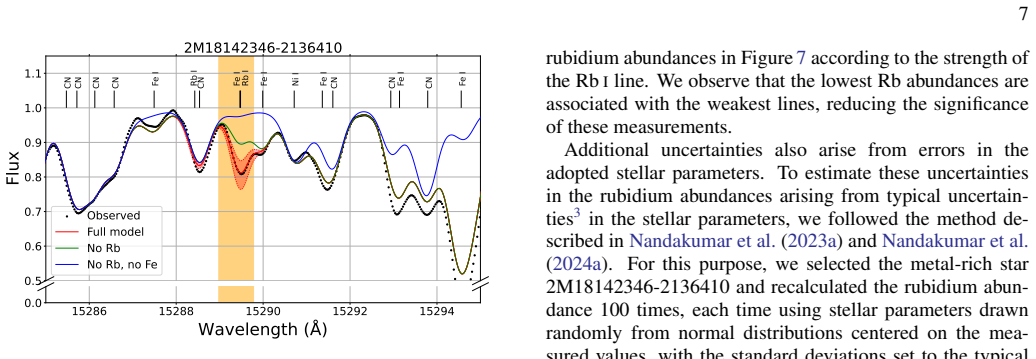
- [Section 3.2, Table 3] The dominant Fe I 15289.468 Å blend is calibrated by changing its log(gf) from -5.176 (Kurucz 2014) to -0.876, an increase of roughly 4.3 dex, using a single solar spectrum fit (Figure 2). Because the Rb I line at 15289.480 Å is only 0.012 Å away and unresolved at R = 45,000, the Rb abundance is essentially the residual after subtracting this Fe model. Any error in the Fe line's strength, excitation energy, or temperature/metallicity scaling propagates directly into every [Rb/Fe] value. The K-giant checks in Figures 3-5 cover T_eff ≈ 4300-4500 K, whereas the program stars are 3350-3900 K, so the Fe model is extrapolated into the regime where it matters most. I request a quantitative estimate of the systematic uncertainty, for example by varying the Fe gf within a plausible range and recomputing [Rb/Fe] for representative stars, or by validating the calibration on M giants with independent optical measurements.
- [Section 5.1, Table 1, Figure 7] The lowest [Rb/Fe] point, 2M14322072-6215506 ([Rb/Fe] = -0.47), is explicitly stated to suffer from an overestimated redward Fe blend, which leads to an underestimated Rb abundance. This demonstrates that blend-calibration errors do reach the results. Since the weakest Rb lines are color-coded as the most uncertain, the apparent downward trend in [Rb/Fe] versus [Fe/H] could be partly driven by stars with small Rb residuals. I recommend showing the trend with such weak-line stars removed or down-weighted, and testing whether the slope and the s+r-process conclusion are robust to this exclusion.
- [Section 4, Section 5.3, Figure 11] The comparison with chemical evolution models is weakened by the free renormalization of +0.2 dex applied to make the model pass through the solar value. The claim that the s-process alone is insufficient rests on the relative offset between the dashed and solid model curves, but the absolute normalization is adjusted by hand. Please report the model predictions before renormalization, state the adopted solar Rb abundance and its uncertainty, and discuss how the conclusion would change if a different solar reference (e.g., the non-LTE value of 2.35 from Korotin 2020) were used. The non-LTE discussion in Section 4 is also qualitative; a quantitative estimate of the non-LTE correction for the 15289 Å line in M giants would strengthen the absolute scale.
minor comments (5)
- [Figure 10 caption] The caption states that symbol sizes indicate surface gravities 'according to a typical isochrone,' but the main text emphasizes that the Rb line strength is insensitive to log g; please clarify how the symbol sizes were chosen and whether they affect the plotted equivalent widths.
- [Table 1] The [Rb/Fe] column would benefit from explicit uncertainties per star, or at least a statement that the quoted values do not include the systematic Fe-blend uncertainty discussed in Section 5.1. The current single error bar in Figure 7 represents only a typical random uncertainty.
- [Section 3.1] The discussion of hyperfine structure is brief and does not cite a specific calculation for the 5p-4d transition. Since both stable isotopes have nonzero spin, a sentence with a quantitative estimate of the expected splitting would be useful, even if the effect is small for weak lines.
- [Section 5.2, Figure 8] The caption notes that the Yb and Ce trends have been shifted by -0.1 dex and +0.25 dex, respectively, to pass through the solar value. Please state whether similar shifts were applied to the Rb data, and make clear in the text that the comparison of trends is therefore qualitative.
- [References] The manuscript refers to 'Jönsson et al. (in prep)' for the K-giant parameters, but this work is not listed in the bibliography. Please provide a full citation or, if not yet available, state the source of the adopted parameters more explicitly.
Circularity Check
No significant circularity: the Rb abundances are derived from a solar-calibrated Fe blend with independent K-giant and optical validation; the s+r-process conclusion is a model-data comparison, not a self-referential fit.
full rationale
The central chain is not circular. In Section 3.2 the dominant Fe I 15289.468 Å blend is calibrated against the solar spectrum under the stated condition that Rb is negligible in the Sun ('With a solar Rb abundance, the Rb line is very weak, and its contribution to the spectral feature is negligible in the Sun... allowing us to derive an astrophysical log(gf) value for this Fe I line, independent of the uncertainties in the Rb line strength or the solar abundance of Rb'). The same blend is then verified on K giants with no measurable Rb line (Figures 3-5), and the residual Rb in M giants is compared with optical studies (Abia et al. 2021; Takeda 2021), providing external validation. The chemical-evolution conclusion (Section 5.3) is not a rename of the input: the comparison uses fixed yield prescriptions (e.g., Limongi & Chieffi 2018; Cristallo et al. 2015; Molero et al. 2025, model 7) and shows that an s-only model under-predicts the data, with a common +0.2 dex renormalization to the solar value; this is a model-data inference, not a parameter renamed as a prediction. The paper itself flags the largest blend-error case (2M14322072-6215506, Section 5.1), which is a stated limitation rather than a hidden circular step. Several supporting data sets are from the same group (Nandakumar et al. 2023a, 2024a,b; Montelius et al. 2022), but those are independent measurements, not load-bearing definitions of the Rb result.
Assumptions & free parameters
free parameters (5)
- Astrophysical log(gf) of Fe I 15289.468 Å =
-0.876 (Kurucz 2014 gives -5.176)
- Removal of Fe I 15289.653 Å line =
Line removed (strength set to zero)
- Astrophysical log(gf) of Fe I 15289.987 Å =
-0.737 (Kurucz -0.837)
- Solar Rb reference log eps(Rb) =
2.60 (Grevesse & Sauval 1998)
- Chemical evolution model normalization shift =
+0.2 dex
assumptions (5)
- domain assumption MARCS 1D spherical LTE model atmospheres and PySME synthesis are adequate for M giant abundances.
- domain assumption Stellar parameters (Teff, log g, [Fe/H], xi) from Nandakumar et al. (2023a) are accurate.
- domain assumption Non-LTE corrections for the Rb I 15289 Å line are small in cool giants.
- domain assumption Line identification and excitation energy of the Fe I blend at 15289.468 Å are correct despite the unknown lower level.
- domain assumption New log(gf) values from Migdalek (2016) for the Rb lines are accurate (no experimental data exist).
Cite this review
Pith. "Pith review of Rubidium Abundances in Cool Giants from High-Resolution H-band Spectra: A New Diagnostic for Galactic Chemical Evolution." pith.science (2026). https://pith.science/paper/SGVFUSW4
@misc{pith2026250621332,
  author       = {Pith},
  title        = {Pith review of: Rubidium Abundances in Cool Giants from High-Resolution H-band Spectra: A New Diagnostic for Galactic Chemical Evolution},
  year         = {2026},
  howpublished = {\url{https://pith.science/paper/SGVFUSW4}},
  note         = {Machine review of arXiv:2506.21332}
}
read the original abstract
The Galactic Center and inner disk of the Milky Way contain complex stellar populations obscured by heavy dust extinction. To study their chemical composition, high-resolution near-infrared (near-IR) spectroscopy is necessary. Expanding the set of elements measurable in the near-IR, especially neutron-capture elements, improves our ability to trace nucleosynthesis and Galactic chemical evolution. This work aims to identify and characterize a spectral line suitable for determining rubidium (Rb) abundances. Rb is produced in roughly equal parts by the r- and s-processes. We analyze high-resolution (R = 45,000) IGRINS near-IR spectra of 40 M giants in the solar neighborhood, most observed with Gemini South. We perform spectral synthesis of the Rb I line at 15289.48 A, using new log(gf) values and including an astrophysical calibration of the blending Fe I lines. The resulting [Rb/Fe] ratios are compared to other neutron-capture elements and interpreted with chemical evolution models. We demonstrate that the used Rb line is a reliable abundance indicator in M giants and the coolest K giants, but becomes too weak at higher temperatures. [Rb/Fe] shows a decreasing trend with metallicity, mirroring that of ytterbium (Yb), another mixed r-/s-process element. Our results agree with optical studies, validating the use of this near-IR line. Comparisons with chemical evolution models confirm that both s- and r-process sources are needed to explain the Rb trend. This work adds Rb to the list of elements measurable in high-resolution H- and K-band spectra, enabling studies of one more neutron-capture element in dust-obscured regions like the Galactic Center and inner disk.
Figures


Figures from the paper (6 more)



Reference graph
Works this paper leans on
-
[1]
2022, ApJS, 259, 35, doi: 10.3847/1538-4365/ac4414
Abdurro’uf, Accetta, K., Aerts, C., et al. 2022, ApJS, 259, 35, doi: 10.3847/1538-4365/ac4414
-
[2]
2021, A&A, 648, A107, doi: 10.1051/0004-6361/202040250 Afs ¸ar, M., Sneden, C., Frebel, A., et al
Abia, C., de Laverny, P., Korotin, S., et al. 2021, A&A, 648, A107, doi: 10.1051/0004-6361/202040250 Afs ¸ar, M., Sneden, C., Frebel, A., et al. 2016, ApJ, 819, 103, doi: 10.3847/0004-637X/819/2/103 Afs ¸ar, M., Sneden, C., Wood, M. P., et al. 2018, ApJ, 865, 44, doi: 10.3847/1538-4357/aada0c
-
[3]
Amarsi, A. M., Nissen, P. E., & Sk´ulad´ottir, ´A. 2019, A&A, 630, A104, doi: 10.1051/0004-6361/201936265
-
[4]
Asplund, M., Grevesse, N., Sauval, A. J., & Scott, P. 2009, ARA&A, 47, 481, doi: 10.1146/annurev.astro.46.060407.145222 Astropy Collaboration, Price-Whelan, A. M., Lim, P. L., et al. 2022, ApJ, 935, 167, doi: 10.3847/1538-4357/ac7c74
arXiv 2009
-
[5]
2014, ApJ, 787, 10, doi: 10.1088/0004-637X/787/1/10 B¨ocek Topcu, G., Afs ¸ar, M., Sneden, C., et al
Bisterzo, S., Travaglio, C., Gallino, R., Wiescher, M., & K¨appeler, F. 2014, ApJ, 787, 10, doi: 10.1088/0004-637X/787/1/10 B¨ocek Topcu, G., Afs ¸ar, M., Sneden, C., et al. 2019, MNRAS, 485, 4625, doi: 10.1093/mnras/stz727 —. 2020, MNRAS, 491, 544, doi: 10.1093/mnras/stz3008
-
[6]
E., Sneden, C., Pilachowski, C
Brady, K. E., Sneden, C., Pilachowski, C. A., et al. 2023, AJ, 166, 154, doi: 10.3847/1538-3881/acf2f3
-
[7]
Cox, N. L. J., Cami, J., Kaper, L., et al. 2014, A&A, 569, A117, doi: 10.1051/0004-6361/201323061
-
[8]
2015, ApJS, 219, 40, doi: 10.1088/0067-0049/219/2/40
Cristallo, S., Straniero, O., Piersanti, L., & Gobrecht, D. 2015, ApJS, 219, 40, doi: 10.1088/0067-0049/219/2/40
Show all 96 references
-
[9]
Demarque, P., Woo, J.-H., Kim, Y .-C., & Yi, S. K. 2004, ApJS, 155, 667, doi: 10.1086/424966
2004 doi
-
[10]
2022, A&A, 662, A81, doi: 10.1051/0004-6361/202142990
Ebenbichler, A., Postel, A., Przybilla, N., et al. 2022, A&A, 662, A81, doi: 10.1051/0004-6361/202142990
2022 doi
-
[11]
Cox, N. L. J. 2017, A&A, 600, A129, doi: 10.1051/0004-6361/201630088
2017 doi
-
[12]
2024, in Society of Photo-Optical Instrumentation Engineers (SPIE) Conference
Feinberg, L., Ziemer, J., Ansdell, M., et al. 2024, in Society of Photo-Optical Instrumentation Engineers (SPIE) Conference
2024
-
[13]
13092, Space Telescopes and Instrumentation 2024:
Series, V ol. 13092, Space Telescopes and Instrumentation 2024:
2024
-
[14]
Optical, Infrared, and Millimeter Wave, ed. L. E. Coyle, S. Matsuura, & M. D. Perrin, 130921N, doi: 10.1117/12.3018328
-
[15]
A., Lee, J.-J., Han, I., et al
Galazutdinov, G. A., Lee, J.-J., Han, I., et al. 2017, MNRAS, 467, 3099, doi: 10.1093/mnras/stx330 12 Garc´ıa-Hern´andez, D. A., Rao, N. K., Lambert, D. L., et al. 2023, ApJ, 948, 15, doi: 10.3847/1538-4357/acc574
2017 doi
-
[16]
Geballe, T. R. 2016, in Journal of Physics Conference Series, V ol. 728, Journal of Physics Conference Series, 062005, doi: 10.1088/1742-6596/728/6/062005
2016 doi
-
[17]
R., Najarro, F., Figer, D
Geballe, T. R., Najarro, F., Figer, D. F., Schlegelmilch, B. W., & de La Fuente, D. 2011, Nature, 479, 200, doi: 10.1038/nature10527
2011 doi
-
[18]
A., Mucciarelli, A., Origlia, L., et al
Gonzalez, O. A., Mucciarelli, A., Origlia, L., et al. 2020, The Messenger, 180, 18, doi: 10.18727/0722-6691/5196
2020 doi
-
[19]
G., & Sneden, C
Gratton, R. G., & Sneden, C. 1994, A&A, 287, 927
1994
-
[20]
Grevesse, N., & Sauval, A. J. 1998, SSRv, 85, 161, doi: 10.1023/A:1005161325181
1998 doi
-
[21]
2020, MNRAS, 498, 1252, doi: 10.1093/mnras/staa2316
Grisoni, V ., Romano, D., Spitoni, E., et al. 2020, MNRAS, 498, 1252, doi: 10.1093/mnras/staa2316
2020 doi
-
[22]
2012, in Society of Photo-Optical Instrumentation Engineers (SPIE) Conference Series, V ol
Gully-Santiago, M., Wang, W., Deen, C., & Jaffe, D. 2012, in Society of Photo-Optical Instrumentation Engineers (SPIE) Conference Series, V ol. 8450, Modern Technologies in Space- and Ground-based Telescopes and Instrumentation II, ed. R. Navarro, C. R. Cunningham, & E. Prieto...
2012 doi
-
[23]
2008, A&A, 486, 951
Gustafsson, B., Edvardsson, B., Eriksson, K., et al. 2008, A&A, 486, 951
2008
-
[24]
R., Masseron, T., Sobeck, J., et al
Hayes, C. R., Masseron, T., Sobeck, J., et al. 2022, arXiv e-prints, arXiv:2208.00071. https://arxiv.org/abs/2208.00071
2022 arXiv
-
[25]
P., Drake, N
Holanda, N., Roriz, M. P., Drake, N. A., et al. 2024, MNRAS, 527, 1389, doi: 10.1093/mnras/stad3280
2024 doi
-
[26]
Hunter, J. D. 2007, Computing in Science and Engineering, 9, 90, doi: 10.1109/MCSE.2007.55
2007 doi
-
[27]
S., et al
Jeong, U., Chun, M.-Y ., Oh, J. S., et al. 2014, in Society of Photo-Optical Instrumentation Engineers (SPIE) Conference
2014
-
[28]
9154, High Energy, Optical, and Infrared Detectors for Astronomy VI, ed
Series, V ol. 9154, High Energy, Optical, and Infrared Detectors for Astronomy VI, ed. A. D. Holland & J. Beletic, 91541X, doi: 10.1117/12.2055589
-
[29]
1961, Ark
Johansson, I. 1961, Ark. Fys., 20, 135
1961
-
[30]
2024, igrins/plp, 3.0.0, Zenodo, doi: 10.5281/zenodo.11080095
Kaplan, K., Lee, J.-J., Sawczynec, E., & Kim, H.-J. 2024, igrins/plp, 3.0.0, Zenodo, doi: 10.5281/zenodo.11080095
2024 doi
-
[31]
Korotin, S. A. 2020, Astronomy Letters, 46, 541, doi: 10.1134/S1063773720080022
2020 doi
-
[32]
Ralchenko, Reader, J., & and NIST ASD Team
Kramida, A., Yu. Ralchenko, Reader, J., & and NIST ASD Team. 2024, NIST Atomic Spectra Database (ver. 5.12), [Online]. Available:https://physics.nist.gov/asd[2025, May 2]. National Institute of Standards and Technology,
2024
-
[33]
Kurucz, R. L. 2014, Robert L. Kurucz on-line database of observed and predicted atomic transitions
2014
-
[34]
2018, ApJS, 237, 13, doi: 10.3847/1538-4365/aacb24
Limongi, M., & Chieffi, A. 2018, ApJS, 237, 13, doi: 10.3847/1538-4365/aacb24
2018 doi
-
[35]
T., et al
Mace, G., Kim, H., Jaffe, D. T., et al. 2016, in Society of Photo-Optical Instrumentation Engineers (SPIE) Conference
2016
-
[36]
9908, Ground-based and Airborne Instrumentation for Astronomy VI, ed
Series, V ol. 9908, Ground-based and Airborne Instrumentation for Astronomy VI, ed. C. J. Evans, L. Simard, & H. Takami, 99080C, doi: 10.1117/12.2232780
-
[37]
2018, in Society of Photo-Optical Instrumentation Engineers (SPIE) Conference
Mace, G., Sokal, K., Lee, J.-J., et al. 2018, in Society of Photo-Optical Instrumentation Engineers (SPIE) Conference
2018
-
[38]
10702, Ground-based and Airborne Instrumentation for Astronomy VII, ed
Series, V ol. 10702, Ground-based and Airborne Instrumentation for Astronomy VII, ed. C. J. Evans, L. Simard, & H. Takami, 107020Q, doi: 10.1117/12.2312345
-
[39]
R., Schiavon, R
Majewski, S. R., Schiavon, R. P., Frinchaboy, P. M., et al. 2017, AJ, 154, 94, doi: 10.3847/1538-3881/aa784d
2017 doi
-
[40]
K., et al
Manea, C., Hawkins, K., Ness, M. K., et al. 2024, ApJ, 972, 69, doi: 10.3847/1538-4357/ad58d9
2024 doi
-
[41]
2024, in Society of Photo-Optical Instrumentation Engineers (SPIE) Conference
Marconi, A., Abreu, M., Adibekyan, V ., et al. 2024, in Society of Photo-Optical Instrumentation Engineers (SPIE) Conference
2024
-
[42]
13096, Ground-based and Airborne Instrumentation for Astronomy X, ed
Series, V ol. 13096, Ground-based and Airborne Instrumentation for Astronomy X, ed. J. J. Bryant, K. Motohara, & J. R. D. Vernet, 1309613, doi: 10.1117/12.3017966
-
[43]
2012, Chemical Evolution of Galaxies, doi: 10.1007/978-3-642-22491-1 —
Matteucci, F. 2012, Chemical Evolution of Galaxies, doi: 10.1007/978-3-642-22491-1 —. 2021, A&A Rv, 29, 5, doi: 10.1007/s00159-021-00133-8
2012 doi
- [44]
-
[45]
2016, Journal of Physics B: Atomic, Molecular and Optical Physics, 49, 185004, doi: 10.1088/0953-4075/49/18/185004
Migdalek, J. 2016, Journal of Physics B: Atomic, Molecular and Optical Physics, 49, 185004, doi: 10.1088/0953-4075/49/18/185004
2016 doi
-
[46]
Rich, R. M. 2024, A&A, 687, A268, doi: 10.1051/0004-6361/202450418
2024 doi
-
[47]
2021, MNRAS, 505, 2913, doi: 10.1093/mnras/stab1429
Molero, M., Romano, D., Reichert, M., et al. 2021, MNRAS, 505, 2913, doi: 10.1093/mnras/stab1429
2021 doi
-
[48]
2025, A&A, 694, A274, doi: 10.1051/0004-6361/202453466
Molero, M., Magrini, L., Palla, M., et al. 2025, A&A, 694, A274, doi: 10.1051/0004-6361/202453466
2025 doi
-
[49]
2022, A&A, 665, A135, doi: 10.1051/0004-6361/202243140
Montelius, M., Forsberg, R., Ryde, N., et al. 2022, A&A, 665, A135, doi: 10.1051/0004-6361/202243140
2022 doi
-
[50]
2012, in Society of Photo-Optical Instrumentation Engineers (SPIE) Conference
Moon, B., Wang, W., Park, C., et al. 2012, in Society of Photo-Optical Instrumentation Engineers (SPIE) Conference
2012
-
[51]
8450, Modern Technologies in Space- and Ground-based Telescopes and Instrumentation II, ed
Series, V ol. 8450, Modern Technologies in Space- and Ground-based Telescopes and Instrumentation II, ed. R. Navarro, C. R. Cunningham, & E. Prieto, 845048, doi: 10.1117/12.925702 Mura-Guzm´an, A., Yong, D., Abate, C., et al. 2020, MNRAS, 498, 3549, doi: 10.1093/mnras/staa2610...
-
[52]
2023a, A&A, 675, A23, doi: 10.1051/0004-6361/202346149
Nandakumar, G., Ryde, N., Casagrande, L., & Mace, G. 2023a, A&A, 675, A23, doi: 10.1051/0004-6361/202346149
-
[53]
2024a, A&A, 684, A15, doi: 10.1051/0004-6361/202348462 13
Nandakumar, G., Ryde, N., Forsberg, R., et al. 2024a, A&A, 684, A15, doi: 10.1051/0004-6361/202348462 13
-
[54]
2024b, A&A, 690, A226, doi: 10.1051/0004-6361/202451255
Nandakumar, G., Ryde, N., Hartman, H., & Mace, G. 2024b, A&A, 690, A226, doi: 10.1051/0004-6361/202451255
-
[55]
2023b, A&A, 676, A79, doi: 10.1051/0004-6361/202346875
Nandakumar, G., Ryde, N., & Mace, G. 2023b, A&A, 676, A79, doi: 10.1051/0004-6361/202346875
-
[56]
2022, A&A, 668, A88, doi: 10.1051/0004-6361/202244724
Nandakumar, G., Ryde, N., Montelius, M., et al. 2022, A&A, 668, A88, doi: 10.1051/0004-6361/202244724
2022 doi
-
[57]
2025, ApJL, 982, L14, doi: 10.3847/2041-8213/adbb6d
Nandakumar, G., Ryde, N., Schultheis, M., et al. 2025, ApJL, 982, L14, doi: 10.3847/2041-8213/adbb6d
2025 doi
-
[58]
Brault, J. W. 1994, ApJS, 94, 221, doi: 10.1086/192079
1994 doi
-
[59]
Thielemann, F. K. 2017, ApJL, 836, L21, doi: 10.3847/2041-8213/aa5dee
2017 doi
-
[60]
2024, in Society of Photo-Optical Instrumentation Engineers (SPIE) Conference Series, V ol
Oh, H., Park, C., Kim, S., et al. 2024, in Society of Photo-Optical Instrumentation Engineers (SPIE) Conference Series, V ol. 13096, Ground-based and Airborne Instrumentation for Astronomy X, ed. J. J. Bryant, K. Motohara, & J. R. D. Vernet, 1309608, doi: 10.1117/12.3017710
2024 doi
-
[61]
2006, in Society of Photo-Optical Instrumentation Engineers (SPIE) Conference
Oliva, E., Origlia, L., Baffa, C., et al. 2006, in Society of Photo-Optical Instrumentation Engineers (SPIE) Conference
2006
-
[62]
6269, Ground-based and Airborne Instrumentation for Astronomy, ed
Series, V ol. 6269, Ground-based and Airborne Instrumentation for Astronomy, ed. I. S. McLean & M. Iye, 626919, doi: 10.1117/12.670006
-
[63]
2014, in Society of Photo-Optical Instrumentation Engineers (SPIE) Conference
Origlia, L., Oliva, E., Baffa, C., et al. 2014, in Society of Photo-Optical Instrumentation Engineers (SPIE) Conference
2014
-
[64]
9147, Ground-based and Airborne Instrumentation for Astronomy V , ed
Series, V ol. 9147, Ground-based and Airborne Instrumentation for Astronomy V , ed. S. K. Ramsay, I. S. McLean, & H. Takami, 91471E, doi: 10.1117/12.2054743
-
[65]
T., Yuk, I.-S., et al
Park, C., Jaffe, D. T., Yuk, I.-S., et al. 2014, in Society of Photo-Optical Instrumentation Engineers (SPIE) Conference
2014
-
[66]
9147, Ground-based and Airborne Instrumentation for Astronomy V , ed
Series, V ol. 9147, Ground-based and Airborne Instrumentation for Astronomy V , ed. S. K. Ramsay, I. S. McLean, & H. Takami, 91471D, doi: 10.1117/12.2056431
-
[67]
2018, in (Ground-based and Airborne Instrumentation for Astronomy VII), 3 – 11, doi: 10.1117/12.2313075
Pasquini, L., & Hubin, N. 2018, in (Ground-based and Airborne Instrumentation for Astronomy VII), 3 – 11, doi: 10.1117/12.2313075
2018 doi
-
[68]
Jeffery, C. S. 1995, A\&AS, 112, 525
1995
-
[69]
2020, MNRAS, 491, 1832, doi: 10.1093/mnras/stz3154
Prantzos, N., Abia, C., Cristallo, S., Limongi, M., & Chieffi, A. 2020, MNRAS, 491, 1832, doi: 10.1093/mnras/stz3154
2020 doi
-
[70]
2018, MNRAS, 476, 3432, doi: 10.1093/mnras/sty316
Prantzos, N., Abia, C., Limongi, M., Chieffi, A., & Cristallo, S. 2018, MNRAS, 476, 3432, doi: 10.1093/mnras/sty316
2018 doi
-
[71]
2019, MNRAS, 489, 5244, doi: 10.1093/mnras/stz2505
Rizzuti, F., Cescutti, G., Matteucci, F., et al. 2019, MNRAS, 489, 5244, doi: 10.1093/mnras/stz2505
2019 doi
-
[72]
J., & Ventura, P
Romano, D., Matteucci, F., Zhang, Z.-Y ., Ivison, R. J., & Ventura, P. 2019, MNRAS, 490, 2838, doi: 10.1093/mnras/stz2741
2019 doi
-
[73]
A., Piskunov, N
Ryabchikova, T. A., Piskunov, N. E., Kupka, F., & Weiss, W. W. 1997, Baltic Astronomy, 6, 244
1997
-
[74]
2020, ApJ, 893, 37, doi: 10.3847/1538-4357/ab7eb1
Ryde, N., J¨onsson, H., Mace, G., et al. 2020, ApJ, 893, 37, doi: 10.3847/1538-4357/ab7eb1
2020 doi
-
[75]
2025, ApJ, 979, 174, doi: 10.3847/1538-4357/ad9b2b
Ryde, N., Nandakumar, G., Schultheis, M., et al. 2025, ApJ, 979, 174, doi: 10.3847/1538-4357/ad9b2b
2025 doi
-
[76]
Sansonetti, J. E. 2006, Journal of Physical and Chemical Reference Data, 35, 301, doi: 10.1063/1.2035727
2006 doi
-
[77]
2022, in American Astronomical Society Meeting Abstracts, V ol
Sawczynec, E., Mace, G., Gully-Santiago, M., & Jaffe, D. 2022, in American Astronomical Society Meeting Abstracts, V ol. 54, American Astronomical Society Meeting Abstracts, 203.06
2022
-
[78]
F., Mace, G
Sawczynec, E., Kaplan, K. F., Mace, G. N., et al. 2025, PASP, 137, 034505, doi: 10.1088/1538-3873/adba89
2025 doi
-
[79]
2019, MNRAS, 486, 2896, doi: 10.1093/mnras/stz991
Simonetti, P., Matteucci, F., Greggio, L., & Cescutti, G. 2019, MNRAS, 486, 2896, doi: 10.1093/mnras/stz991
2019 doi
-
[80]
V ., Bizyaev, D., Cunha, K., et al
Smith, V . V ., Bizyaev, D., Cunha, K., et al. 2021, AJ, 161, 254, doi: 10.3847/1538-3881/abefdc
2021 doi
-
[81]
J., & Gallino, R
Sneden, C., Cowan, J. J., & Gallino, R. 2008, ARA&A, 46, 241, doi: 10.1146/annurev.astro.46.060407.145207
2008
-
[82]
2019, A&A, 623, A60, doi: 10.1051/0004-6361/201834188
Spitoni, E., Silva Aguirre, V ., Matteucci, F., Calura, F., & Grisoni, V . 2019, A&A, 623, A60, doi: 10.1051/0004-6361/201834188
2019 doi
-
[83]
2021, Astronomische Nachrichten, 342, 515, doi: 10.1002/asna.202123873
Takeda, Y . 2021, Astronomische Nachrichten, 342, 515, doi: 10.1002/asna.202123873
2021 doi
-
[84]
Taylor, M. B. 2005, in Astronomical Society of the Pacific Conference Series, V ol. 347, Astronomical Data Analysis Software and Systems XIV , ed. P. Shopbell, M. Britton, & R. Ebert, 29
2005
-
[85]
P., Litzen, U., & Johansson, S
Thorne, A. P., Litzen, U., & Johansson, S. 1999, Spectrophysics : principles and applications (Springer)
1999
-
[86]
1993, in ASP Conf
Tody, D. 1993, in ASP Conf. Ser. 52: Astronomical Data Analysis Software and Systems II, ed. R. J. Hanisch, R. J. V . Brissenden, & J. Barnes, 173
1993
-
[87]
Tomkin, J., & Lambert, D. L. 1999, ApJ, 523, 234, doi: 10.1086/307735
1999 doi
-
[88]
A., & Piskunov, N
Valenti, J. A., & Piskunov, N. 1996, A&AS, 118, 595 —. 2012, SME: Spectroscopy Made Easy. http://ascl.net/1202.013 van der Walt, S., Colbert, S. C., & Varoquaux, G. 2011, Computing in Science and Engineering, 13, 22, doi: 10.1109/MCSE.2011.37
1996 doi
-
[89]
E., et al
Virtanen, P., Gommers, R., Oliphant, T. E., et al. 2020, Nature Methods, 17, 261, doi: 10.1038/s41592-019-0686-2
2020 doi
-
[90]
J., & Jaffe, D
Wang, W., Gully-Santiago, M., Deen, C., Mar, D. J., & Jaffe, D. T. 2010, in Society of Photo-Optical Instrumentation Engineers (SPIE) Conference Series, V ol. 7739, Modern Technologies in Space- and Ground-based Telescopes and Instrumentation, ed. E. Atad-Ettedgui & D. Lemke, ...
2010 doi
-
[91]
1968, MNRAS, 139, 115, doi: 10.1093/mnras/139.1.115
Warner, B. 1968, MNRAS, 139, 115, doi: 10.1093/mnras/139.1.115
1968 doi
-
[92]
2023, A&A, 671, A171, doi: 10.1051/0004-6361/202244482
Wehrhahn, A., Piskunov, N., & Ryabchikova, T. 2023, A&A, 671, A171, doi: 10.1051/0004-6361/202244482
2023 doi
-
[93]
2017, in Society of Photo-Optical Instrumentation Engineers (SPIE) Conference
Wildi, F., Blind, N., Reshetov, V ., et al. 2017, in Society of Photo-Optical Instrumentation Engineers (SPIE) Conference
2017
-
[94]
10400, Society of Photo-Optical Instrumentation Engineers (SPIE) Conference Series, ed
Series, V ol. 10400, Society of Photo-Optical Instrumentation Engineers (SPIE) Conference Series, ed. S. Shaklan, 1040018, doi: 10.1117/12.2275660 14
-
[95]
T., Barnes, S., et al
Yuk, I.-S., Jaffe, D. T., Barnes, S., et al. 2010, in Society of Photo-Optical Instrumentation Engineers (SPIE) Conference
2010
-
[96]
7735, Ground-based and Airborne Instrumentation for Astronomy III, ed
Series, V ol. 7735, Ground-based and Airborne Instrumentation for Astronomy III, ed. I. S. McLean, S. K. Ramsay, & H. Takami, 77351M, doi: 10.1117/12.856864 ¨Ozdemir, S., Afs ¸ar, M., Sneden, C., et al. 2025
2025 doi
Reviewed August 6, 2026 · model on record in the stance chip above.
Discussion (0). Sign in to comment.