REVIEW 3 major objections 7 minor 62 references
rodeo: Probabilistic Methods of Parameter Inference for Ordinary Differential Equations
T0 review · 3 major / 7 minor · reviewed 2026-08-06 · deepseek-v4-flash
Pith's one-line read rodeo, a JAX-based Python library, claims that probabilistic ODE parameter inference can scale linearly in both evaluation points and system variables, matching deterministic-solver accuracy while running 2–12x faster in its tested…
desk verdict A useful JAX/Python library paper that deserves peer review, provided the authors tighten the speed claims, add a Jacobian ablation, and quantify 'indistinguishable'. read the letter →
The pith
A machine-rendered reading of the paper's core claim, the machinery that carries it, and where it could break.
The reading
What carries the argument
The central object is the Kalman-filter probabilistic ODE solver with block-diagonal 'model interrogation.' A Gaussian Markov process prior (by default integrated Brownian motion, giving transition matrix $Q$ and covariance $R$) is placed on the solution and its derivatives, and the ODE residual $W\mathbf{X}_n - f(\mathbf{X}_n, t_n)$ is treated as a zero-mean observation $Z_n = 0$ in the state-space model, so that posterior draws and means come from Kalman filtering and smoothing. The claim of linear-in-$d$ scaling rests on the block-diagonal structure of the weight matrix $W$ together with the modified Jacobian $J^*_f$, which zeroes out the off-diagonal blocks of the full Jacobian so that each variable's Kalman recursions run independently. That device, plus JAX's automatic differentiation and JIT compilation, is what carries the speed-accuracy results.
What would settle it
Run the same parameter-inference benchmark twice at a fixed step size—once with the Krämer block-diagonal Jacobian interrogation and once with the full Tronarp Jacobian—and measure the distance between the two resulting parameter posteriors (e.g., Wasserstein distance). If the posteriors separate by more than the solver's own uncertainty at moderate coupling strength, the 'minimal loss in accuracy' premise fails and the linear-scaling speed advantage no longer comes free.
Extended reading notes
Core claim
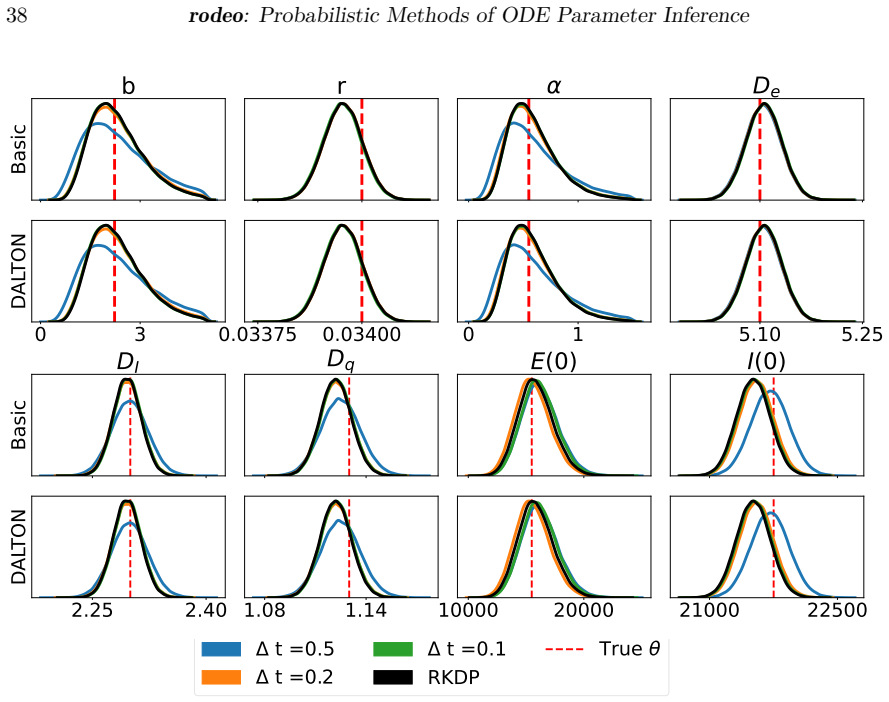
The paper claims that the traditional cost gap between probabilistic and deterministic ODE solvers can be closed by combining a Kalman-filter formulation of the solver with variable-wise block-diagonal structure. The ODE residual is treated as a zero-mean pseudo-observation in a nonlinear state-space model; a first-order Taylor 'model interrogation' linearizes it; and by keeping only the block-diagonal part of the resulting Jacobian (the Krämer-modified $J^*_f$), the Kalman recursions decompose per system variable, reducing complexity from $O(d^3)$ to $O(d)$ in the number of variables $d$. On top of this solver, several likelihood approximations from the literature—the plug-in Basic method, Fenrir, DALTON, the Chkrebtii marginal MCMC, and a Markov-prior version of MAGI—are expressed uniformly and implemented with JAX automatic differentiation and just-in-time compilation. In the FitzHugh-Nagumo, Hes1, and SEIRAH benchmarks, the paper shows these posteriors becoming indistinguishable from a high-accuracy RKDP deterministic solver's posterior at moderate step sizes, while running 2–12 times faster than LSODA and RKDP.
Load-bearing premise
The load-bearing premise is that zeroing out the off-diagonal blocks of the ODE Jacobian (the Krämer modification) causes minimal accuracy loss; the paper asserts 'extensive evidence' for this but reports no quantitative comparison, so for strongly coupled systems the linear-time solver's posterior could drift from the full-Jacobian answer.
Editorial extensions
If this is right
- Parameter posteriors from the Basic, Fenrir, and DALTON approximations converge to the deterministic high-accuracy posterior as the solver grid refines, so numerical integration error can be treated as part of the statistical model instead of being hidden.
- Because the block-diagonal smoother keeps memory linear in the number of grid points, rodeo can backpropagate directly through the solver steps, making gradient-based inference faster than adjoint-method alternatives.
- The same machinery covers partially observed systems (Hes1 with unobserved $H(t)$, SEIRAH with two observed compartments) and non-Gaussian noise (Poisson count data), so the probabilistic-solver benefit extends beyond textbook Gaussian settings.
- Blocking itself is worth 3–4× over the unblocked $O(d^3)$ solver in the reported timings, and the full solver is 2–12× faster than LSODA and RKDP at matched posterior accuracy.
- As the number of evaluation points $N$ grows, the solver's posterior mean approaches the true ODE solution while its uncertainty bands shrink, meaning the uncertainty output is a usable diagnostic for under-resolved discretizations.
Reading between the lines
- A direct accuracy comparison between the block-diagonal Jacobian and the full Jacobian is the missing experiment; a natural follow-up would measure posterior divergence versus coupling strength to map where linear scaling holds.
- If the insensitivity to the IBM prior scale noted in the examples holds generally, the solver's reported uncertainty bands are effectively determined by discretization error and the data rather than the user's prior choice—a testable calibration property.
- The same blocking device could extend to time-varying parameters, which the paper names as future work, with no change to the $O(d)$ complexity.
- If the speed advantage replicates on stiff systems—listed by the authors as an open direction—the practical case for replacing deterministic integrators in routine model calibration would be much stronger.
Editorial analysis
A structured set of objections, weighed in public.
Referee Report
Summary. The paper presents rodeo, a Python library built on JAX for probabilistic parameter inference in ODEs. The library implements a Bayesian filtering framework with Gaussian Markov process priors, several model interrogation methods (Chkrebtii et al., Schober et al., Tronarp et al., Krämer et al.), and multiple inference algorithms: a basic plug-in likelihood, Fenrir, DALTON (Gaussian and non-Gaussian), marginal MCMC, and a Markov-prior variant of MAGI. The central claims are that the solver scales linearly in the number of discretization points N and system variables d (via block-diagonal interrogation and a modified Jacobian), and that inference is fast, accurate, and scalable, as demonstrated on four examples (a second-order univariate ODE, FitzHugh-Nagumo, Hes1, and SEIRAH) with comparisons to LSODA and RKDP. The paper is written primarily as a software and methods showcase, with extensive code listings and pseudocode for each algorithm.
Significance. If the claims hold, rodeo is a valuable contribution: it provides a JAX-native, AD-compatible, JIT-compiled implementation of several published probabilistic ODE inference methods in one package, making them accessible to Python users. The paper includes detailed pseudocode, runnable examples, and benchmarks against independent deterministic solvers (LSODA and RKDP via difrax), which are welcome strengths. The generalization of MAGI to arbitrary-order ODEs with Markov priors is a useful extension. However, the headline "linear scaling" and "fast" claims rest on a block-diagonal Jacobian approximation whose accuracy is asserted but not quantitatively demonstrated, and the speed summary in Section 5.13 is not consistent with Table 3. These issues are fixable but should be addressed before the paper can be recommended for publication.
major comments (3)
- [§2.3] The linear-in-d complexity claim depends on the block-diagonal modified Jacobian J*_f (Krämer et al. 2021), which zeroes all off-diagonal blocks of the Jacobian. The paper states that "there is extensive evidence in our experiments and those of Krämer et al. (2021) suggesting there is minimal loss in accuracy compared to using the full Jacobian," but no quantitative comparison is reported in this manuscript. This is load-bearing because the speed-accuracy trade-off in the numerical examples is obtained only under this approximation. Please add a numerical study on a strongly coupled ODE (e.g., with large off-diagonal Jacobian entries) comparing the posterior produced by J* versus the full Jacobian at fixed N, or explicitly state the limitation that the linear-scaling claim holds only when the block-diagonal approximation is accurate.
- [§5.13, Table 3] The text says the last three examples show rodeo is "2 to 12 times faster than RKDP and 2-12 times faster than LSODA," but the RKDP column for those rows is 3.94, 3.53, and 2.86, i.e., a range of 2.86-3.94, not 2-12. The 12.64 figure comes from the univariate Chkrebtii example (N=30), which is not in the emphasized multivariate set. Additionally, the column labeled "rodeo (no blocking)" is ambiguous: the values 3.49, 2.77, 4.42 appear to indicate the speedup factor from blocking (consistent with the text that "blocking is 3-4 times faster"), but the header suggests it reports the speed of the no-blocking solver itself. Please correct the summary ranges and clarify what the last column measures.
- [§5.13, Table 3] The speed comparisons are based on the smallest N for which a Laplace posterior is "indistinguishable" from the RKDP posterior. This criterion is not formalized or quantified. Without a concrete measure (e.g., Wasserstein distance between marginal posteriors, KL divergence, or a check that credible interval coverages match), the reported speedups are not reproducible and the "fast, accurate" claim is not fully supported. Please specify the comparison metric used to select N.
minor comments (7)
- [§2.3, Eq. (14)] In the blocking definitions, the blocks a^(k)_n, B^(k)_n, and V^(k)_n are described as having dimensions p_k×1, p_k×p_k, and p_k×p_k, respectively. However, these quantities must have the same number of rows as the ODE equations for variable k (r_k); for example, in a first-order univariate ODE with three state derivatives, B_n is 1×3, not 3×3. Please correct the notation to make the dimensions consistent with the observation model W^(k) + B^(k) having shape r_k × p_k.
- [§1, Table 1] The table caption says "The proposed method in the accompanying reference(s)..." but the table does not list rodeo itself; it lists only existing methods. Please clarify whether the table is intended to include rodeo or to survey prior work.
- [§3.5] There is a typo: "An significant contribution" should be "A significant contribution."
- [§3.5, Eq. (39)] The notation pβ(Θ, Ũ1:N | Z1:N, Y0:M) omits the conditioning value Z1:N = 0; the posterior should be written pβ(Θ, Ũ1:N | Z1:N = 0, Y0:M) for consistency with Equation (38).
- [§5.10] The statement that unobserved components are handled by setting the observation variance to zero and using "the log density of Normal(0; 0, 0)" is not mathematically well-defined, since a normal distribution with zero variance is degenerate. Please clarify how the code actually handles these entries (e.g., by masking or by using a small positive variance).
- [§5.7] The formula for the MAGI prior temperature β in the text (β = η^{-2} Δt^{2-2q} Δt') and the code (beta = dt_obs * dt_sim ** (2 - 2 * n_deriv) * sigma[0] ** (-2)) should be cross-checked for notational consistency, particularly the role of q versus n_deriv, so that readers can reproduce the choice.
- [Throughout] There are numerous typographical and formatting issues in the code listings and acknowledgments (e.g., "Cananda" for "Canada", inconsistent spacing in comments, stray characters). A careful proofreading pass would improve the presentation.
Circularity Check
No significant circularity: the solver and inference methods are implemented from published algorithms and benchmarked against independent deterministic solvers.
full rationale
The paper's central claims—linear scaling, speed, and accurate parameter inference—do not reduce to their own inputs by construction. The O(d) blocking is an explicitly stated design choice in Section 2.3, obtained by requiring block-diagonal W, B, V, Q, and R and then performing Kalman recursions blockwise in Algorithm 2; the linear-scaling claim is a complexity property of that disclosed algorithm, not a prediction fitted from data. The Krämer et al. (2021) modified Jacobian J*_f is imported from prior work and the paper asserts 'extensive evidence ... minimal loss in accuracy' without reporting a quantitative full-Jacobian comparison; this is an under-supported approximation and a correctness risk for strongly coupled systems, but it is not circular because the approximation is not defined in terms of the target speed or accuracy results. DALTON is self-cited (Wu and Lysy 2024), but it is a published method with its own derivation, and the numerical comparisons are anchored to independent external solvers (LSODA, RKDP, diffrax) and to closed-form or known-truth solutions. No fitted parameter is renamed as a prediction: the examples compare posterior approximations at various step sizes against RKDP posteriors and true parameter values. The limitations stated in Section 6—no adaptive step-size selection, no time-varying parameters, and no stiff-system or boundary-value tests—are scope restrictions rather than circular reasoning. Overall, the derivation chain is self-contained with respect to its benchmark claims, and no circular step can be exhibited from the paper's equations or citations.
Assumptions & free parameters
free parameters (1)
- IBM prior scale sigma (also called eta in MAGI) =
0.1
assumptions (4)
- domain assumption The ODE solution process follows a q-times integrated Brownian motion prior (Eq. 8).
- domain assumption The linearized surrogate model (5) obtained via model interrogation adequately approximates the intractable posterior (4).
- domain assumption The Krämer modified Jacobian J*, which zeroes off-diagonal blocks, preserves accuracy (Section 2.3).
- domain assumption The RKDP solver output is treated as the true ODE solution for benchmarking.
Cite this review
Pith. "Pith review of rodeo: Probabilistic Methods of Parameter Inference for Ordinary Differential Equations." pith.science (2026). https://pith.science/paper/EX3SOIIJ
@misc{pith2026250621776,
  author       = {Pith},
  title        = {Pith review of: rodeo: Probabilistic Methods of Parameter Inference for Ordinary Differential Equations},
  year         = {2026},
  howpublished = {\url{https://pith.science/paper/EX3SOIIJ}},
  note         = {Machine review of arXiv:2506.21776}
}
read the original abstract
Parameter estimation for ordinary differential equations (ODEs) plays a fundamental role in the analysis of dynamical systems. Generally lacking closed-form solutions, ODEs are traditionally approximated using deterministic solvers. However, there is a growing body of evidence to suggest that probabilistic ODE solvers produce more reliable parameter estimates by better accounting for numerical uncertainty. Here we present rodeo, a Python library providing a fast, lightweight, and extensible interface to a broad class of probabilistic ODE solvers, along with several associated methods for parameter inference. At its core, rodeo provides a probabilistic solver that scales linearly in both the number of evaluation points and system variables. Furthermore, by leveraging state-of-the-art automatic differentiation (AD) and just-in-time (JIT) compiling techniques, rodeo is shown across several examples to provide fast, accurate, and scalable parameter inference for a variety of ODE systems.
Figures


Figures from the paper (2 more)

Reference graph
Works this paper leans on
-
[1]
, " * write output.state after.block = add.period write newline
ENTRY address archive author booktitle chapter collaboration doi edition editor eid eprint howpublished institution isbn issn journal key month note number numpages organization pages publisher school series title type url volume year label extra.label sort.label short.list INTEGERS output.state before.all mid.sentence after.sentence after.block FUNCTION ...
-
[2]
write newline
" write newline "" before.all 'output.state := FUNCTION n.dashify 't := "" t empty not t #1 #1 substring "-" = t #1 #2 substring "--" = not "--" * t #2 global.max substring 't := t #1 #1 substring "-" = "-" * t #2 global.max substring 't := while if t #1 #1 substring * t #2 global.max substring 't := if while FUNCTION word.in bbl.in capitalize " " * FUNCT...
-
[3]
Numerical Solution of Ordinary Differential Equations
Atkinson K, Han W, Stewart DE (2009). Numerical Solution of Ordinary Differential Equations. John Wiley & Sons. ISBN 978-0-470-04294-6
work page 2009
-
[4]
The D eep M ind JAX E cosystem
Babuschkin I, Baumli K, Bell A, Bhupatiraju S, Bruce J, Buchlovsky P, Budden D, Cai T, Clark A, Danihelka I, Fantacci C, Godwin J, Jones C, Hemsley R, Hennigan T, Hessel M, Hou S, Kapturowski S, Keck T, Kemaev I, King M, Kunesch M, Martens L, Merzic H, Mikulik V, Norman T, Quan J, Papamakarios G, Ring R, Ruiz F, Sanchez A, Schneider R, Sezener E, Spencer ...
work page 2020
-
[5]
Gaussian processes for Bayesian estimation in ordinary Differential Equations
Barber D, Wang Y (2014). Gaussian processes for Bayesian estimation in ordinary Differential Equations. In EP Xing, T Jebara (eds.), Proceedings of the 31st international conference on machine learning, volume 32 of Proceedings of machine learning research, pp. 1485--1493. PMLR, Bejing, China. ://proceedings.mlr.press/v32/barber14.html
work page 2014
-
[6]
A Comparison of Discrete Linear Filtering Algorithms
Bierman GJ (1973). A Comparison of Discrete Linear Filtering Algorithms. IEEE Transactions on Aerospace and Electronic Systems, AES-9(1), 28--37. doi:10.1109/TAES.1973.309697
-
[7]
Efficient and Modular Implicit Differentiation
Blondel M, Berthet Q, Cuturi M, Frostig R, Hoyer S, Llinares-L \'o pez F, Pedregosa F, Vert JP (2021). Efficient and Modular Implicit Differentiation. arXiv preprint arXiv:2105.15183
arXiv 2021
-
[8]
deBInfer: Bayesian inference for dynamical models of biological systems in R
Boersch-Supan PH, Ryan SJ, Johnson LR (2017). deBInfer: Bayesian inference for dynamical models of biological systems in R. Methods in Ecology and Evolution, 8(4), 511--518. doi:https://doi.org/10.1111/2041-210X.12679. https://besjournals.onlinelibrary.wiley.com/doi/pdf/10.1111/2041-210X.12679 , ://besjournals.onlinelibrary.wiley.com/doi/abs/10.1111/2041-...
Show all 62 references
-
[9]
Calibrated Adaptive Probabilistic ODE Solvers
Bosch N, Hennig P, Tronarp F (2021). Calibrated Adaptive Probabilistic ODE Solvers. In A Banerjee, K Fukumizu (eds.), Proceedings of The 24th International Conference on Artificial Intelligence and Statistics, volume 130 of Proceedings of Machine Learning Research, pp. 3466--3...
2021
-
[10]
Pick-and-Mix Information Operators for Probabilistic ODE Solvers
Bosch N, Tronarp F, Hennig P (2022). Pick-and-Mix Information Operators for Probabilistic ODE Solvers. In G Camps-Valls, FJR Ruiz, I Valera (eds.), Proceedings of The 25th International Conference on Artificial Intelligence and Statistics, volume 151 of Proceedings of Machine ...
2022
-
[11]
JAX : composable transformations of P ython+ N um P y programs
Bradbury J, Frostig R, Hawkins P, Johnson MJ, Leary C, Maclaurin D, Necula G, Paszke A, Vander P las J, Wanderman- M ilne S, Zhang Q (2018). JAX : composable transformations of P ython+ N um P y programs. ://github.com/google/jax
2018
-
[12]
Numerical Methods for Ordinary Differential Equations
Butcher JC (2008). Numerical Methods for Ordinary Differential Equations. John Wiley & Sons
2008
-
[13]
Accelerating Bayesian inference over nonlinear differential equations with Gaussian processes
Calderhead B, Girolami M, Lawrence ND (2009). Accelerating Bayesian inference over nonlinear differential equations with Gaussian processes. In Advances in neural information processing systems, pp. 217--224
2009
-
[14]
Penalized Nonlinear Least Squares Estimation of Time-Varying Parameters in Ordinary Differential Equations
Cao J, Huang JZ, Wu H (2012). Penalized Nonlinear Least Squares Estimation of Time-Varying Parameters in Ordinary Differential Equations. Journal of Computational and Graphical Statistics, 21(1), 42--56. ISSN 10618600. ://www.jstor.org/stable/23248822
2012
-
[15]
Neural Ordinary Differential Equations
Chen TQ, Rubanova Y, Bettencourt J, Duvenaud DK (2018). Neural Ordinary Differential Equations. In Advances in Neural Information Processing Systems , pp. 6571--6583
2018
-
[16]
Bayesian solution uncertainty quantification for differential equations
Chkrebtii OA, Campbell DA, Calderhead B, Girolami MA (2016). Bayesian solution uncertainty quantification for differential equations. Bayesian Analysis, 11(4), 1239--1267. ISSN 1936-0975. doi:10.1214/16-BA1017. ://projecteuclid.org/euclid.ba/1473276259
2016
-
[17]
Statistical analysis of differential equations: introducing probability measures on numerical solutions
Conrad PR, Girolami M, Särkkä S, Stuart A, Zygalakis K (2017). Statistical analysis of differential equations: introducing probability measures on numerical solutions. Statistics and Computing, 27(4), 1065--1082. ISSN 0960-3174, 1573-1375. doi:10.1007/s11222-016-9671-0. ://lin...
2017 doi
-
[18]
simode: Statistical Inference for Systems of Ordinary Differential Equations using Separable Integral-Matching
Dattner I, Yaari R (2020). simode: Statistical Inference for Systems of Ordinary Differential Equations using Separable Integral-Matching. R package version 1.2.0, ://CRAN.R-project.org/package=simode
2020
-
[19]
Bayesian numerical analysis
Diaconis P (1988). Bayesian numerical analysis. In J Berger, S Gupta (eds.), Statistical Decision Theory and Related Topics IV , volume 1, pp. 163--175. Springer-Verlag, New York
1988
-
[20]
ODE parameter inference using adaptive gradient matching with Gaussian processes
Dondelinger F, Husmeier D, Rogers S, Filippone M (2013). ODE parameter inference using adaptive gradient matching with Gaussian processes. In CM Carvalho, P Ravikumar (eds.), Proceedings of the sixteenth international conference on artificial intelligence and statistics, volum...
2013
-
[21]
A family of embedded Runge - Kutta formulae
Dormand JR, Prince PJ (1980). A family of embedded Runge - Kutta formulae. Journal of Computational and Applied Mathematics, 6(1), 19--26. Publisher: Elsevier
1980
-
[22]
Hybrid Monte Carlo
Duane S, Kennedy AD, Pendleton BJ, Roweth D (1987). Hybrid Monte Carlo . Physics Letters B, 195(2), 216--222. doi:10.1016/0370-2693(87)91197-X
1987 doi
-
[23]
Bayesian Data Analysis
Gelman A, Carlin JB, Stern HS, Dunson DB, Vehtari A, Rubin DB (2013). Bayesian Data Analysis . 3rd edition. Chapman & Hall, New York, NY. ISBN 978-0-429-11307-9
2013
-
[24]
Fast approximate Bayesian computation for estimating parameters in differential equations
Ghosh S, Dasmahapatra S, Maharatna K (2017). Fast approximate Bayesian computation for estimating parameters in differential equations. Statistics and Computing, 27(1), 19--38. ISSN 0960-3174, 1573-1375. doi:10.1007/s11222-016-9643-4. ://link.springer.com/10.1007/s11222-016-9643-4
2017 doi
-
[25]
Mixed Variational Inference
Gianniotis N (2019). Mixed Variational Inference. In 2019 International Joint Conference on Neural Networks ( IJCNN ) , pp. 1--8. IEEE, Budapest, Hungary. ISBN 978-1-72811-985-4. doi:10.1109/IJCNN.2019.8852348. ://ieeexplore.ieee.org/document/8852348/
2019
-
[26]
Scalable variational inference for dynamical systems
Gorbach NS, Bauer S, Buhmann JM (2017). Scalable variational inference for dynamical systems. In Proceedings of the 31st international conference on neural information processing systems, NIPS '17, pp. 4809--4818. Curran Associates Inc., Red Hook, NY, USA. ISBN 978-1-5108-6096-4
2017
-
[27]
Numerical Methods for Ordinary Differential Equations: Initial Value Problems
Griffiths DF, Higham DJ (2010). Numerical Methods for Ordinary Differential Equations: Initial Value Problems. Springer Science & Business Media
2010
-
[28]
Array programming with NumPy
Harris CR, Millman KJ, van der Walt SJ, Gommers R, Virtanen P, Cournapeau D, Wieser E, Taylor J, Berg S, Smith NJ, Kern R, Picus M, Hoyer S, van Kerkwijk MH, Brett M, Haldane A, del R \' i o JF, Wiebe M, Peterson P, G \' e rard-Marchant P, Sheppard K, Reddy T, Weckesser W, Abb...
2020 doi
-
[29]
Probabilistic numerics and uncertainty in computations
Hennig P, Osborne MA, Girolami M (2015). Probabilistic numerics and uncertainty in computations. Proceedings of the Royal Society A: Mathematical, Physical and Engineering Sciences, 471(2179), 20150142. ISSN 1364-5021, 1471-2946. doi:10.1098/rspa.2015.0142. ://royalsocietypubl...
2015
-
[30]
ODEPACK , a systematized collection of ODE solvers
Hindmarsh AC (1983). ODEPACK , a systematized collection of ODE solvers. IMACS Transactions on Scientific Computation, 1, 55--64. Publisher: North-Holland
1983
-
[31]
CollocInfer: Collocation Inference in Differential Equation Models
Hooker G, Ramsay JO, Xiao L (2016). CollocInfer: Collocation Inference in Differential Equation Models. Journal of Statistical Software, 75(2), 1–52. doi:10.18637/jss.v075.i02. ://www.jstatsoft.org/index.php/jss/article/view/v075i02
2016 doi
-
[32]
Discrete square root filtering: A survey of current techniques
Kaminski P, Bryson A, Schmidt S (1971). Discrete square root filtering: A survey of current techniques. IEEE Transactions on Automatic Control, 16(6), 727--736. doi:10.1109/TAC.1971.1099816
1971
-
[33]
Active uncertainty calibration in Bayesian ODE solvers
Kersting H, Hennig P (2016). Active uncertainty calibration in Bayesian ODE solvers. In 32nd conference on uncertainty in artificial intelligence ( UAI 2016) , pp. 309--318
2016
-
[34]
Differentiable Likelihoods for Fast Inversion of Likelihood-Free Dynamical Systems
Kersting H, Kr \"a mer N, Schiegg M, Daniel C, Tiemann M, Hennig P (2020 a ). Differentiable Likelihoods for Fast Inversion of Likelihood-Free Dynamical Systems. In HD III, A Singh (eds.), Proceedings of the 37th International Conference on Machine Learning, volume 119 of Proc...
2020
-
[35]
Convergence rates of Gaussian ODE filters
Kersting H, Sullivan T, Hennig P (2020 b ). Convergence rates of Gaussian ODE filters. Statistics and Computing, 30, 1--26. doi:10.1007/s11222-020-09972-4
2020 doi
-
[36]
On Neural Differential Equations
Kidger P (2021). On Neural Differential Equations. Ph.D. thesis, University of Oxford. ://arxiv.org/pdf/2202.02435.pdf
2021 arXiv
-
[37]
Probabilistic ODE solutions in millions of dimensions
Kr \"a mer N, Bosch N, Schmidt J, Hennig P (2021). Probabilistic ODE solutions in millions of dimensions. In Proceedings of the 39th International Conference on Machine Learning. ://proceedings.mlr.press/v162/kramer22b/kramer22b.pdf
2021
- [38]
-
[39]
a mer PN (2024). Implementing probabilistic numerical solvers for differential equations. Ph.D. thesis, Universit \
Kr \"a mer PN (2024). Implementing probabilistic numerical solvers for differential equations. Ph.D. thesis, Universit \"a t T \"u bingen
2024
-
[40]
B lackjax: A sampling library for JAX
Lao J, Louf R (2020). B lackjax: A sampling library for JAX . ://github.com/blackjax-devs/blackjax
2020
-
[41]
Multiphase MCMC sampling for parameter inference in nonlinear ordinary differential equations
Lazarus A, Husmeier D, Papamarkou T (2018). Multiphase MCMC sampling for parameter inference in nonlinear ordinary differential equations. In A Storkey, F Perez-Cruz (eds.), Proceedings of the twenty-first international conference on artificial intelligence and statistics, vol...
2018
-
[42]
deGradInfer: Parameter Inference for Systems of Differential Equation
Macdonald B, Dondelinger F (2020). deGradInfer: Parameter Inference for Systems of Differential Equation. R package version 1.0.1, ://CRAN.R-project.org/package=deGradInfer
2020
-
[43]
A Practical Bayesian Framework for Backpropagation Networks
MacKay DJC (1992). A Practical Bayesian Framework for Backpropagation Networks. Neural Computation, 4(3), 448--472. ISSN 0899-7667, 1530-888X. doi:10.1162/neco.1992.4.3.448. ://direct.mit.edu/neco/article/4/3/448-472/5654
1992 doi
-
[44]
Bayesian estimation of time-varying parameters in ordinary differential equation models with noisy time-varying covariates
Meng L, Zhang J, Zhang X, and GF (2021). Bayesian estimation of time-varying parameters in ordinary differential equation models with noisy time-varying covariates. Communications in Statistics - Simulation and Computation, 50(3), 708--723. doi:10.1080/03610918.2019.1565584. h...
2021
-
[45]
R package for statistical inference in dynamical systems using kernel based gradient matching: KGode
Niu M, Wandy J, Daly R, Rogers S, Husmeier D (2021). R package for statistical inference in dynamical systems using kernel based gradient matching: KGode. Computational Statistics, 36(1), 715--747. doi:10.1007/s00180-020-01014-. ://ideas.repec.org/a/spr/compst/v36y2021i1d10.10...
2021 doi
-
[46]
Numerical Optimization
Nocedal J, Wright SJ (2006). Numerical Optimization. 2e edition. Springer, New York, NY, USA
2006
-
[47]
Automatic selection of methods for solving stiff and nonstiff systems of ordinary differential equations
Petzold L (1983). Automatic selection of methods for solving stiff and nonstiff systems of ordinary differential equations. SIAM Journal on Scientific and Statistical Computing, 4(1), 136--148. Publisher: SIAM
1983
-
[48]
Multi-Level Modeling of Early COVID -19 Epidemic Dynamics in French Regions and Estimation of the Lockdown Impact on Infection Rate
Prague M, Wittkop L, Collin A, Dutartre D, Clairon Q, Moireau P, Thi \'e baut R, Hejblum BP (2020). Multi-Level Modeling of Early COVID -19 Epidemic Dynamics in French Regions and Estimation of the Lockdown Impact on Infection Rate. Preprint, Epidemiology . doi:10.1101/2020.04...
2020 doi
-
[49]
Probabilistic ODE solvers with Runge - Kutta means
Schober M, Duvenaud DK, Hennig P (2014). Probabilistic ODE solvers with Runge - Kutta means. In Advances in neural information processing systems, pp. 739--747
2014
-
[50]
A probabilistic model for the numerical solution of initial value problems
Schober M, Särkkä S, Hennig P (2019). A probabilistic model for the numerical solution of initial value problems. Statistics and Computing, 29(1), 99--122. ISSN 0960-3174, 1573-1375. doi:10.1007/s11222-017-9798-7. ://link.springer.com/10.1007/s11222-017-9798-7
2019 doi
-
[51]
FitzHugh--Nagumo Model , pp
Sherwood WE (2013). FitzHugh--Nagumo Model , pp. 1--11. Springer New York, New York, NY. ISBN 978-1-4614-7320-6. doi:10.1007/978-1-4614-7320-6_147-1. ://doi.org/10.1007/978-1-4614-7320-6_147-1
2013 doi
-
[52]
Bayesian solution of ordinary differential equations
Skilling J (1992). Bayesian solution of ordinary differential equations. In CR Smith, GJ Erickson, PO Neudorfer (eds.), Maximum Entropy and Bayesian Methods : Seattle , 1991 , Fundamental Theories of Physics , pp. 23--37. Springer Netherlands, Dordrecht. ISBN 978-94-017-2219-3...
1992 doi
-
[53]
Stan Modeling Language Users Guide and Reference Manual
Stan Development Team (2023). Stan Modeling Language Users Guide and Reference Manual. ://mc-stan.org
2023
-
[54]
Probabilistic linear multistep methods
Teymur O, Zygalakis K, Calderhead B (2016). Probabilistic linear multistep methods. In Advances in Neural Information Processing Systems 29, pp. 4321--4328. Curran Associates, Inc
2016
-
[55]
Fenrir : Physics-Enhanced Regression for Initial Value Problems
Tronarp F, Bosch N, Hennig P (2022). Fenrir : Physics-Enhanced Regression for Initial Value Problems. In K Chaudhuri, S Jegelka, L Song, C Szepesvari, G Niu, S Sabato (eds.), Proceedings of the 39th International Conference on Machine Learning, volume 162 of Proceedings of Mac...
2022
-
[56]
Probabilistic solutions to ordinary differential equations as non-linear Bayesian filtering: a new perspective
Tronarp F, Kersting H, Särkkä S, Hennig P (2018). Probabilistic solutions to ordinary differential equations as non-linear Bayesian filtering: a new perspective. arXiv:1810.03440 [stat]. ArXiv: 1810.03440, ://arxiv.org/abs/1810.03440
2018 arXiv
-
[57]
Bayesian ODE solvers: the maximum a posteriori estimate
Tronarp F, S \"a rkk \"a S, Hennig P (2021). Bayesian ODE solvers: the maximum a posteriori estimate. Statistics and Computing, 31(3), 23. ISSN 1573-1375. doi:10.1007/s11222-021-09993-7. ://doi.org/10.1007/s11222-021-09993-7
2021 doi
-
[58]
pCODE: Estimation of an Ordinary Differential Equation Model by Parameter Cascade Method
Wang H, Cao J (2022). pCODE: Estimation of an Ordinary Differential Equation Model by Parameter Cascade Method. R package version 0.9.4, ://CRAN.R-project.org/package=pCODE
2022
-
[59]
ProbNum: Probabilistic Numerics in Python
Wenger J, Krämer N, Pförtner M, Schmidt J, Bosch N, Effenberger N, Zenn J, Gessner A, Karvonen T, Briol FX, Mahsereci M, Hennig P (2021). ProbNum: Probabilistic Numerics in Python . ://arxiv.org/abs/2112.02100
2021 arXiv
-
[60]
Fast Gaussian process based gradient matching for parameter identification in systems of nonlinear ODEs
Wenk P, Gotovos A, Bauer S, Gorbach NS, Krause A, Buhmann JM (2019). Fast Gaussian process based gradient matching for parameter identification in systems of nonlinear ODEs . In K Chaudhuri, M Sugiyama (eds.), Proceedings of the twenty-second international conference on artifi...
2019
-
[61]
Data-Adaptive Probabilistic Likelihood Approximation for Ordinary Differential Equations
Wu M, Lysy M (2024). Data-Adaptive Probabilistic Likelihood Approximation for Ordinary Differential Equations. In S Dasgupta, S Mandt, Y Li (eds.), Proceedings of The 27th International Conference on Artificial Intelligence and Statistics, volume 238 of Proceedings of Machine ...
2024
-
[62]
Inference of dynamic systems from noisy and sparse data via manifold-constrained Gaussian processes
Yang S, Wong SWK, Kou SC (2021). Inference of dynamic systems from noisy and sparse data via manifold-constrained Gaussian processes. Proceedings of the National Academy of Sciences, 118(15), e2020397118. ISSN 0027-8424, 1091-6490. doi:10.1073/pnas.2020397118. ://www.pnas.org/...
2021 doi
Reviewed August 6, 2026 · model on record in the stance chip above.
Discussion (0). Sign in to comment.