REVIEW 4 major objections 6 minor 1 cited by
A search of periodic variable stars in the LMC by JWST photometry
T0 review · 4 major / 6 minor · reviewed 2026-08-06 · deepseek-v4-flash
Pith's one-line read JWST archival photometry detects 304 periodic variables in the LMC and yields crowding-free period-luminosity relations, finding the delta Scuti zero point is 0.15–0.30 mag fainter than previous Ks-band calibrations.
desk verdict Useful new JWST variable catalog, but the DSCT zero-point offset claim rests on period/mode fidelity that sparse JWST cadence hasn't established. read the letter →
The pith
A machine-rendered reading of the paper's core claim, the machinery that carries it, and where it could break.
The reading
What carries the argument
The load-bearing mechanism is the period-luminosity relation, fitted in six JWST bands after extinction correction and a fixed LMC distance modulus, plus the crowding parameter from PSF photometry that removes blended neighbors. On the time-domain side, the search pipeline combines Lomb-Scargle periodograms with spectral window suppression, a false-alarm-probability threshold of $1 imes 10^{-5}$, third-order Fourier fits, and a phi21 phase parameter to separate eclipsing binaries from rotational variables. For eclipsing binaries the periods are doubled for the PLR fit, and pulsators are split into fundamental and first-overtone sequences. The Monte Carlo simulation framework, which adds a 0.02 mag systematic error to photometric uncertainties, is what sets the 0.05 mag amplitude detection floor.
What would settle it
Take the delta Scuti candidates and re-measure their periods and amplitudes with dense, uniform time sampling, for example a dedicated JWST or ground-based campaign with many consecutive epochs, and check whether the periods and pulsation modes match the sparse-sampling values; if the periods or modes change, recompute the PLR and see whether the 0.15–0.30 mag offset survives.
Extended reading notes
Core claim
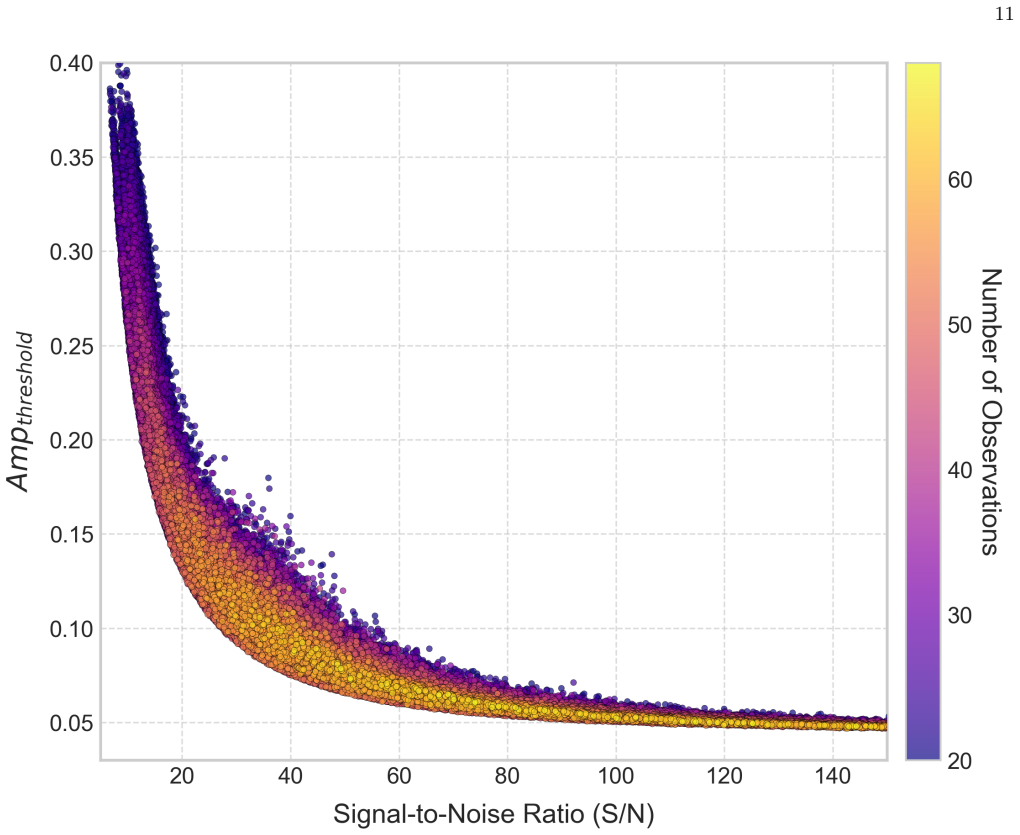
The paper's central claim is that JWST's diffraction-limited near-infrared resolution removes a crowding bias that has offset previous PLR calibrations, and that this shows up as a fainter delta Scuti zero point. The 304-star catalog is built from Lomb-Scargle period searches with window-function suppression, Fourier light-curve fitting, and visual inspection; candidate types are separated by color-magnitude position, PLR consistency, and the phi21 phase parameter. The fitted PLRs for EW-type binaries and RR Lyrae stars match previous calibrations within about 0.05–0.1 mag, while the delta Scuti PLR scatter drops to 0.12 mag and the zero point is fainter than Liu et al. (2025) by 0.15 mag and than Jia et al. (2025) and Jayasinghe et al. (2020) by about 0.3 mag. The paper also quantifies a noise floor: only amplitudes above roughly 0.05 mag are reliably detected, and Monte Carlo simulations show that increasing epochs from 20 to 60 lowers the detectable amplitude from about 0.2 to 0.12 mag at SNR = 20.
Load-bearing premise
The analysis assumes that the periods recovered from sparse, irregular JWST sampling are the true astrophysical periods and that each pulsator's mode, fundamental versus first overtone, is correctly assigned, so that any aliasing or mode misassignment would shift the fitted relations and the delta Scuti zero-point offset.
Editorial extensions
If this is right
- If the delta Scuti zero-point offset is real, distance moduli based on Ks-band delta Scuti PLRs should be revised fainter by 0.15–0.30 mag, changing derived distances in the same direction.
- JWST archival fields can be mined for short-period variables in crowded regions where ground-based surveys are incomplete, with detection limited mostly to amplitudes above roughly 0.05 mag.
- EW-type binary PLRs calibrated in the LMC are consistent with Gaia-parallax-based calibrations at the 0.05 mag level, supporting their use as independent distance anchors.
- OGLE and Gaia magnitudes of LMC RR Lyrae and delta Scuti stars are brightened by crowding, about 0.12 and 0.38 mag in this field, so studies using those catalogs in dense fields need crowding corrections.
- More photometric epochs per target directly lower the minimum detectable amplitude, so future JWST time-domain programs should concentrate exposures on fewer fields.
Reading between the lines
- A direct extension: if the same crowding-mitigation advantage applies to Cepheids and Miras in dense LMC fields, JWST could sharpen their near-infrared PLRs as well, not just the fainter pulsators studied here.
- The 0.05 mag amplitude floor implies that low-amplitude pulsators such as gamma Doradus and slowly pulsating B stars remain essentially invisible in current JWST archival sampling; detecting them would require dedicated high-cadence programs.
- A testable prediction from the crowding interpretation is that the size of the delta Scuti zero-point offset should scale with local stellar density; comparing the same stars in sparse fields would separate crowding from any filter-wavelength effect.
- The crowding check implies that ground-based near-infrared surveys systematically brighten variables in dense fields; applying similar cross-matching to other LMC regions could quantify a density-dependent correction function.
Editorial analysis
A structured set of objections, weighed in public.
Referee Report
Summary. The manuscript reports a JWST/NIRCam search for periodic variable stars in a crowded LMC field, using PSF photometry, astrometric and zero-point corrections, and Lomb-Scargle periodicity analysis. It identifies 304 periodic variables, including EW and EA binaries, rotational variables, DSCT stars, and RR Lyrae stars, and derives period-luminosity relations (PLRs) in multiple filters. The headline results are low PLR scatter attributed to JWST's spatial resolution, a DSCT PLR zero point that is fainter by 0.15-0.30 mag than previous Ks-band calibrations, and a Monte Carlo-based detection threshold of about 0.05 mag for low-amplitude variables. The paper also provides a full variable catalog, multi-epoch photometry tables, and crowding-effect estimates based on OGLE cross-matching.
Significance. The paper is valuable as a carefully documented pilot study of JWST time-domain capabilities in a dense LMC field, and the data products (catalog and multi-epoch photometry) will be useful to the community. If the DSCT zero-point offset is real, it would have a direct impact on near-infrared distance-scale calibration and on the interpretation of crowding biases in previous ground-based samples. The crowding checks, which find about 0.38 mag average brightening for OGLE DSCT sources from contaminants within 0.4 arcsec, are a useful quantitative contribution. The astrometric and zero-point correction steps are described in sufficient detail to be reproducible. However, the central DSCT claim is not yet supported at the claimed precision because of sample selection and period/mode fidelity issues detailed below.
major comments (4)
- [Sec. 4 (EA/EW classification and PLR clipping)] The definition of EA-type binaries is circular: Section 4 states that objects excluded in the iterative 3-sigma PLR fit are classified as EA-type, and the remaining sources as EW-type, and the EW PLR is then fitted to this same selected sample. This guarantees that the reported EW scatter (Table 3, sigma = 0.22-0.32 mag) is downward biased and that the EA:EW ratio (about 1:12) partly reflects the fitting procedure rather than astrophysics. I recommend classifying EA systems from light-curve morphology (eclipse depth, duration, and phase) or from a mixture-model fit, and reporting the PLR scatter before outlier clipping.
- [Sec. 3 and Sec. 4 (DSCT periods and modes)] The claimed 0.15-0.30 mag fainter DSCT zero point rests on periods and F/1O mode assignments that are not independently validated for a substantial fraction of the DSCT sample. The periods come from Lomb-Scargle on at least 20 sparse JWST epochs, with only a +/-1% refinement and zeroing of window-function peaks; neither step can correct a large alias at a different frequency, and the F/1O assignment is not checked against any external diagnostic. Because the DSCT slopes in Table 3 are about -4.0 to -4.3 in mag per log P, a 5-10% period error changes absolute magnitude by 0.09-0.19 mag, comparable to the claimed offset, while F/1O confusion would change it by roughly 0.4 mag. I ask for an injection-recovery test at the actual cadence, a recovery test on OGLE-confirmed DSCT stars in the same field, and a refit of the DSCT PLR using only stars with independently confirmed periods; if the offset persists in that subsample, it would be convincing.
- [Sec. 3 (PLR-based candidate screening)] The single-band candidate selection uses PLR-based screening within 5 sigma of literature PLRs for DSCT, RR Lyrae, and EW binaries. This pre-selects sources that lie near an assumed PLR before the new PLR is fitted, which can systematically bias the zero point toward the literature values and away from genuine outliers. The manuscript should report how many candidates were removed by this screen, refit the PLRs without this criterion, or demonstrate by simulation that the screen cannot shift the DSCT zero point by the 0.1-0.3 mag claimed.
- [Sec. 5 (Monte Carlo systematic-error estimate)] The Monte Carlo framework adds a fixed 0.02 mag systematic error to the photometric uncertainties and then interprets the resulting about 0.05 mag detection threshold as confirming the presence of about 0.02 mag unaccounted systematic errors. This is a circular consistency check rather than an independent measurement. I recommend varying the injected systematic error (e.g., 0.0-0.05 mag), or using a control sample of non-variable stars to measure the noise floor, and reporting the detection threshold as a function of the assumed error.
minor comments (6)
- [Abstract/Sec. 3/Sec. 6] The number of DSCT stars is 38 in the abstract, 37 in Sections 3 and 6; the number of EA binaries is 7 in the abstract and 6 in Sections 4 and 6; please harmonize these counts.
- [Sec. 3] Section 3 reports 51 reliable variable stars after the multi-band analysis and then 304 after the single-band search; clarify whether the 51 are a multi-band subset and how the numbers relate.
- [Sec. 3] The window-function significance threshold 'SNR > 4' in Section 3 is undefined; provide the definition of SNR in this context.
- [Sec. 3] The discussion of the F070W uncertainty being 'underestimated by about 20%' is vague; specify whether the reported merr values are corrected for this effect.
- [Fig. 7] Figure 7 would benefit from labels showing the exact number of epochs used for each curve, and from error bars or confidence intervals on the simulated thresholds.
- [Table 3] In Table 3, the RR Lyrae first-overtone F150W slope (-3.005 +/- 0.333) is noticeably steeper than the adjacent bands; include the sample size per fit so that the reader can judge the stability of these coefficients.
Circularity Check
Two peripheral steps (EA as PLR-outlier label; Monte Carlo 'confirmation' of an assumed 0.02 mag) are circular, while the central DSCT zero-point claim rests on independent fitting and external comparisons.
-
self definitional
[Section 4, PLR derivation and EA/EW classification paragraph]
"To derive the PLR, we applied an iterative 3 σ clipping method: sources with significant deviations from the initial PLR fit were excluded, followed by multiple rounds of fitting and outlier removal until convergence. Objects excluded in the PLR fit for either band were classified as EA-type binaries, while the remaining ones were classified as EW-type. In total, we identified 6 EA-type and 71 EW-type eclipsing binaries."
The EA/EW split is the output of the iterative 3σ clipping rule: sources are labeled EA exactly when they deviate from the EW PLR, and the EW PLR is then re-fit on the non-deviating subset. The reported 6 EA / 71 EW split and the low EW PLR scatter are therefore partly guaranteed by the labeling rule rather than measured independently. The paper itself admits the EA label 'simply refers to sources that deviate significantly from the EW-type PLR,' yet later compares the resulting EA:EW ratio (~1:12) to morphological EA:EW ratios from TESS, ASAS-SN, and ZTF, treating a definitional split as a physical classification. That comparison is circular because the two catalogs use different definitions of 'EA'.
-
fitted input called prediction
[Section 5, Monte Carlo simulation paragraph and Figure 7 discussion]
"To quantify the impact of these noise sources, we introduce a systematic error compensation of 0.02 mag to the photometric uncertainties and establish a Monte Carlo simulation framework. ... the simulations results indicate that even under high SNR conditions, a variability amplitude of approximately 0.05 mag is required to rise above the noise floor and be detected. This threshold matches the smallest amplitudes observed in our data and confirms the presence of systematic uncertainties at the level of ∼0.02 mag, which are not accounted for by nominal photometric errors."
The 0.02 mag systematic error is an input assumption of the Monte Carlo, not an independently fitted or measured parameter. The simulated detection threshold of ~0.05 mag follows directly from that assumed input together with the finite-epoch scatter model, so the match to the observed minimum amplitude cannot independently 'confirm' the 0.02 mag value. The paper uses the simulation output to validate the same number that was put into the simulation. The existence of unaccounted errors is reasonably inferred from the 0.05 mag minimum amplitude at SNR>100, but the specific magnitude of those errors is not determined by a simulation that already contains it; the agreement is a consistency check, not confirmation.
full rationale
Two peripheral steps in the paper are circular by the paper's own wording. First, the EA/EW classification is defined as the result of iterative 3σ clipping on the EW PLR, so the 1:12 EA:EW ratio and the low EW scatter are partly products of the definition rather than independent measurements; the paper even states that the EA label 'simply refers to sources that deviate significantly from the EW-type PLR.' Second, the Monte Carlo sensitivity analysis injects a 0.02 mag systematic error as an input and then uses the simulated 0.05 mag detectability threshold, which follows from that input, to 'confirm' the 0.02 mag level; this is a self-consistency check presented as confirmation. Neither of these undermines the central DSCT PLR zero-point claim, which is obtained by fitting JWST photometry to periods and modes assigned in Sections 3-4 and then comparing with external Ks-band calibrations (Liu et al. 2025; Jia et al. 2025; Jayasinghe et al. 2020). That central claim is therefore not circular in the sense of Eq. X = Eq. Y by construction; its main vulnerability is the fidelity of the periods and F/1O mode assignments from sparse, irregular JWST cadence for the newly discovered DSCT stars without independent OGLE/Gaia periods. A period alias or F/1O swap would shift the fitted zero point by amounts comparable to or larger than the claimed 0.15-0.30 mag, but that is a correctness and robustness risk, not a circularity. The 5σ PLR-based screening in Section 3 biases the DSCT sample toward previously calibrated PLRs, yet because the window is much wider than the claimed offset, it does not force the zero point and is not counted as circular here. Because the two genuine circular steps are peripheral and the central derivation has independent content, a score of 4 is appropriate.
Assumptions & free parameters
free parameters (2)
- systematic_error_compensation =
0.02 mag
- PLR screening window =
5 sigma
assumptions (4)
- domain assumption LMC distance modulus mu0 = 18.477
- domain assumption LMC extinction law and mean E(V-I) = 0.100
- domain assumption DOLPHOT PSF photometry yields unbiased magnitudes in crowded fields
- domain assumption Lomb-Scargle periodogram with FAP < 1e-5 identifies true periods under sparse sampling
Cite this review
Pith. "Pith review of A search of periodic variable stars in the LMC by JWST photometry." pith.science (2026). https://pith.science/paper/3Q5PSBFJ
@misc{pith2026250621971,
  author       = {Pith},
  title        = {Pith review of: A search of periodic variable stars in the LMC by JWST photometry},
  year         = {2026},
  howpublished = {\url{https://pith.science/paper/3Q5PSBFJ}},
  note         = {Machine review of arXiv:2506.21971}
}
abstract
Based on high-resolution near-infrared photometric data from the James Webb Space Telescope (JWST) targeting the Large Magellanic Cloud (LMC), this study attempts to evaluate the feasibility and sensitivity limits of variable star detection in crowded stellar fields. Through light curve analysis, we identified a total of 304 periodic variable stars, including 71 EW-type eclipsing binaries, 7 EA-type eclipsing binaries, 177 rotational variables, 38 $\delta$ Scuti (DSCT) stars, and 12 RR Lyrae stars. Period--luminosity relations (PLRs) were derived for EW-type eclipsing binaries, DSCT stars, and RR Lyrae stars. The PLRs for EW-type and RR Lyrae stars are in good agreement with previous studies, while the PLR zero point for DSCT stars appears systematically fainter by approximately 0.15--0.30 mag. Our PLRs exhibit low dispersion and are minimally affected by crowding. We analyzed the capability of JWST archival data to detect low-amplitude variables and found that only stars with amplitudes greater than approximately 0.05 mag can be reliably detected. Through simulations, we quantified how increasing the number of photometric epochs improves the detectability of low-amplitude, low signal-to-noise ratio variables. Despite current limitations in observational cadence, JWST demonstrates unique advantages in detecting short-period eclipsing binaries, rotational variables, and high-amplitude pulsators. Its exceptional spatial resolution enables high-precision PLR calibrations, offering new opportunities for future studies in variable star astrophysics and extragalactic distance measurements.
Figures


Figures from the paper (11 more)




Forward citations
Cited by 1 Pith paper
-
JWST Reveals a Galaxy-Wide Association of Red Supergiants with OB Stars in NGC 5584
In NGC 5584, 82% of UV-selected star-forming complexes coincide with red supergiant overdensities, with strong UV to near-infrared luminosity correlations and a characteristic age near 15 Myr.
Reference graph
Works this paper leans on
-
[1]
Astropy Collaboration, Robitaille, T. P., Tollerud, E. J., et al. 2013, A&A, 558, A33 Astropy Collaboration, Price-Whelan, A. M., Sip˝ ocz, B. M., et al. 2018, AJ, 156, 123 Astropy Collaboration, Price-Whelan, A. M., Lim, P. L., et al. 2022, ApJ, 935, 167
work page 2013
-
[2]
Bonanos, A. Z., Yang, M., Sokolovsky, K. V., et al. 2019, A&A, 630, A92
work page 2019
-
[3]
L., Anderson, J., Gennaro, M., et al
Boyer, M. L., Anderson, J., Gennaro, M., et al. 2022, Research Notes of the American Astronomical Society, 6, 191
work page 2022
-
[4]
2020, ApJS, 249, 18
Chen, X., Wang, S., Deng, L., et al. 2020, ApJS, 249, 18
2020
-
[5]
Cioni, M. R. L., Clementini, G., Girardi, L., et al. 2011, A&A, 527, A116
2011
-
[6]
Cioni, M. R. L., Girardi, L., Moretti, M. I., et al. 2014, A&A, 562, A32
work page 2014
-
[7]
Clementini, G., Ripepi, V., Garofalo, A., et al. 2023, A&A, 674, A18
work page 2023
-
[8]
2016, DOLPHOT: Stellar photometry, Astrophysics Source Code Library, record ascl:1608.013
Dolphin, A. 2016, DOLPHOT: Stellar photometry, Astrophysics Source Code Library, record ascl:1608.013
2016
Show all 36 references
-
[9]
Dolphin, A. E. 2000, PASP, 112, 1383
2000
-
[10]
M., et al
Espinoza, N., ´Ubeda, L., Birkmann, S. M., et al. 2023, PASP, 135, 018002
2023
-
[11]
L., & Madore, B
Freedman, W. L., & Madore, B. F. 2010, ARA&A, 48, 673
2010
-
[12]
2025, ApJS, 276, 57
Gao, X., Chen, X., Wang, S., & Liu, J. 2025, ApJS, 276, 57
2025
-
[13]
2009, AJ, 138, 1243
Harris, J., & Zaritsky, D. 2009, AJ, 138, 1243
2009
-
[14]
Hunter, J. D. 2007, Computing in Science and Engineering, 9, 90
2007
-
[15]
S., Stanek, K
Jayasinghe, T., Kochanek, C. S., Stanek, K. Z., et al. 2018, MNRAS, 477, 3145
2018
-
[16]
Z., Kochanek, C
Jayasinghe, T., Stanek, K. Z., Kochanek, C. S., et al. 2020, MNRAS, 493, 4186
2020
-
[17]
2025, arXiv e-prints, arXiv:2503.20557
Jia, Q., Chen, X., Wang, S., et al. 2025, arXiv e-prints, arXiv:2503.20557
2025 arXiv
-
[18]
2025, MNRAS, 539, 956
Li, J., Chen, X., Wang, S., et al. 2025, MNRAS, 539, 956
2025
-
[19]
2025, arXiv e-prints, arXiv:2504.15045
Liu, Y.-q., Chen, X.-d., Wang, S., et al. 2025, arXiv e-prints, arXiv:2504.15045. https://arxiv.org/abs/2504.15045
2025 arXiv
-
[20]
Lomb, N. R. 1976, Ap&SS, 39, 447
1976
-
[21]
W., Emerson, J
Minniti, D., Lucas, P. W., Emerson, J. P., et al. 2010, NewA, 15, 433
2010
-
[22]
R., Burgasser, A., et al
Nardiello, D., Bedin, L. R., Burgasser, A., et al. 2022, MNRAS, 517, 484 NASA. 2023, JWST Calibration Reference Data System (CRDS) User Guide, Tech. rep., Space Telescope Science Institute. https://jwst-crds.stsci.edu
2022
-
[23]
2013, AJ, 146, 101
Palaversa, L., Ivezi´ c,ˇZ., Eyer, L., et al. 2013, AJ, 146, 101
2013
-
[24]
2020, MNRAS, 499, 3976 Pietrzy´ nski, G., Graczyk, D., Gallenne, A., et al
Paunzen, E., Bernhard, K., H¨ ummerich, S., et al. 2020, MNRAS, 499, 3976 Pietrzy´ nski, G., Graczyk, D., Gallenne, A., et al. 2019, Nature, 567, 200
2020
-
[25]
M., Barrientes, J., Blome, C., et al
Pontoppidan, K. M., Barrientes, J., Blome, C., et al. 2022, ApJL, 936, L14
2022
-
[26]
2023, PASP, 135, 048001
Rigby, J., Perrin, M., McElwain, M., et al. 2023, PASP, 135, 048001
2023
-
[27]
Scargle, J. D. 1982, ApJ, 263, 835 16
1982
-
[28]
M., Skowron, J., Udalski, A., et al
Skowron, D. M., Skowron, J., Udalski, A., et al. 2021, ApJS, 252, 23 Soszy´ nski, I., Udalski, A., Szyma´ nski, M. K., et al. 2016, AcA, 66, 131 Soszy´ nski, I., Pietrukowicz, P., Udalski, A., et al. 2023, AcA, 73, 105 Space Telescope Science Institute. 2024, Observing with JW...
2021
-
[29]
Taylor, M. B. 2005, in Astronomical Society of the Pacific Conference Series, Vol. 347, Astronomical Data Analysis Software and Systems XIV, ed. P. Shopbell, M. Britton, & R. Ebert, 29
2005
-
[30]
VanderPlas, J. T. 2018, ApJS, 236, 16
2018
-
[31]
2025, ApJ, 978, 53
Wang, J., Chen, X., Deng, L., Zhang, J., & Sun, W. 2025, ApJ, 978, 53
2025
-
[32]
2019, ApJ, 877, 116 —
Wang, S., & Chen, X. 2019, ApJ, 877, 116 —. 2023, ApJ, 946, 43
2019
-
[33]
T., Richstein, H., Kallivayalil, N., et al
Warfield, J. T., Richstein, H., Kallivayalil, N., et al. 2023, Research Notes of the American Astronomical Society, 7, 23
2023
-
[34]
R., McQuinn, K
Weisz, D. R., McQuinn, K. B. W., Savino, A., et al. 2023, ApJS, 268, 15
2023
-
[35]
R., Dolphin, A
Weisz, D. R., Dolphin, A. E., Savino, A., et al. 2024, ApJS, 271, 47
2024
-
[36]
2023, ApJ, 951, 114 17 7
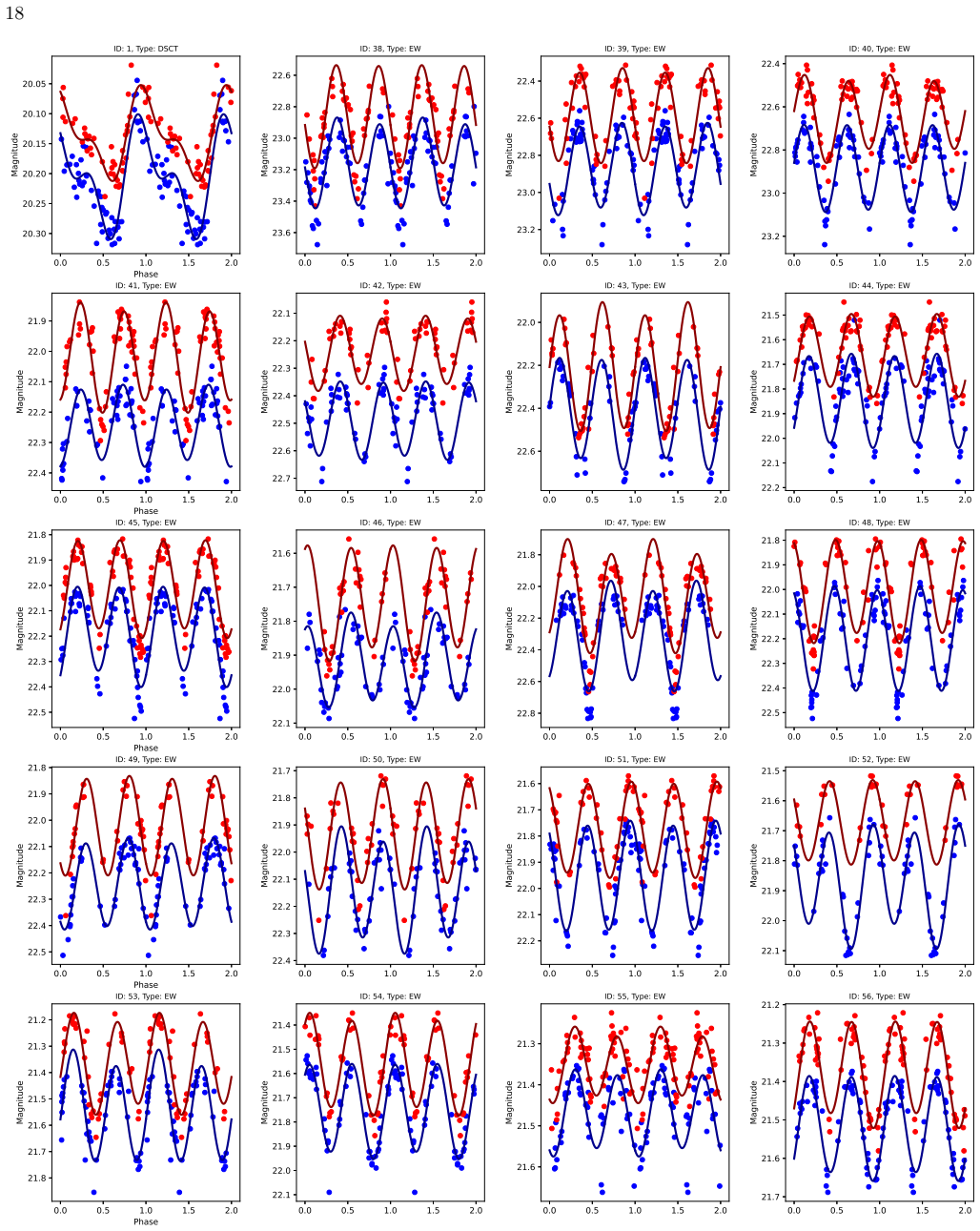
Zgirski, B., Pietrzy´ nski, G., G´ orski, M., et al. 2023, ApJ, 951, 114 17 7. APPENDIX 18 0.0 0.5 1.0 1.5 2.0 Phase 20.05 20.10 20.15 20.20 20.25 20.30 Magnitude ID: 1, T ype: DSCT 0.0 0.5 1.0 1.5 2.0 22.6 22.8 23.0 23.2 23.4 23.6 Magnitude ID: 38, T ype: EW 0.0 0.5 1.0 1.5 2...
2023
Reviewed August 6, 2026 · model on record in the stance chip above.
Discussion (0). Continue with ORCID to comment.