REVIEW 5 major objections 5 minor 39 references
Continual Learning for Wireless Channel Prediction
T0 review · 5 major / 5 minor · reviewed 2026-08-15 · deepseek-v4-flash
Pith's one-line read Continual learning cuts wireless channel-prediction error by about 2 dB across cell handovers.
desk verdict The benchmark and code are useful, but the paper's central 2 dB gain claim is unanchored because no naive fine-tuning baseline appears in the results. read the letter →
The pith
A machine-rendered reading of the paper's core claim, the machinery that carries it, and where it could break.
The reading
What carries the argument
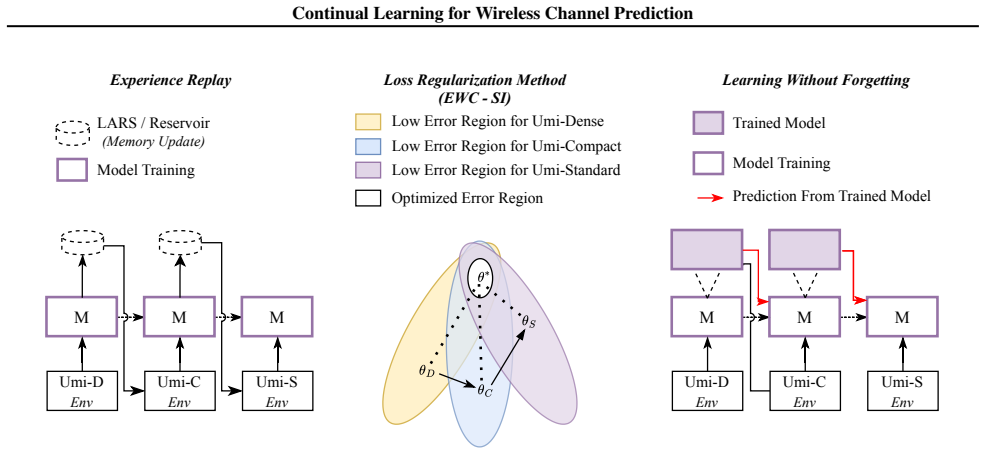
The load-bearing objects are three adaptation mechanisms and the loss that blends them. Experience replay uses a fixed-size reservoir buffer (5,000 samples, about 10 MB) updated by loss-aware reservoir sampling (LARS), which evicts the buffer item with lowest loss-reciprocal weight so hard-to-predict fades persist. Regularization adds quadratic penalties: EWC anchors parameters with Fisher-information-weighted distance to previous-task optima, while Synaptic Intelligence accumulates per-weight importance online from the same gradients used for optimization. Learning without forgetting clones a frozen teacher model and adds a distillation NMSE term that keeps new predictions aligned with old behavior. The combined objective mixes current-cell loss and retained-knowledge loss through a single mixing weight $\lambda$, and the evaluation metric is NMSE in dB across SNR from 0 to 30 dB.
What would settle it
Train the same LSTM with LARS and SI on a measured 5G channel dataset containing real handover traces (or on simulator channels with adjacent-snapshot correlation below about 0.9), and compare high-SNR NMSE against naive fine-tuning; if the continual-learning gain drops below roughly 1 dB, the paper's core claim would be falsified for realistic settings.
Extended reading notes
Core claim
On its own terms, the paper establishes that standard deep channel predictors—LSTM, GRU, or a lightweight Transformer—suffer catastrophic forgetting when sequentially adapted across three 3GPP urban-micro (UMi) configurations (standard, dense, compact), and that three continual-learning mechanisms recover most of the lost accuracy. Loss-aware reservoir sampling biases the replay memory toward high-NMSE channel realizations, synaptic intelligence accumulates per-weight importance online and penalizes drift of those weights, and learning-without-forgetting distills the frozen teacher's outputs. With these mechanisms, the high-SNR NMSE floor falls by up to 2 dB relative to naive fine-tuning, LARS and SI outperform uniform replay and EWC, and the memory-free LwF still beats not adapting at all. The author would state the discovery as: targeted rehearsal of loss-critical fades plus selective parameter anchoring is what makes handover-robust CSI prediction work.
Load-bearing premise
The evaluation assumes that QuaDRiGa-simulated UMi channels with deliberately high adjacent-snapshot correlation ($\rho\approx0.97$) faithfully represent the real distribution shift a user experiences at handover; if measured channels decorrelate faster, the reported error-floor gains may not carry over.
Editorial extensions
If this is right
- A single predictor can be updated online across heterogeneous cells, removing the need for per-cell retraining or separate models.
- A 10 MB replay buffer cached at the gNB is enough to recover most of the lost accuracy, making the scheme deployable in practice.
- Hard-to-predict channel states (deep fades, rich scattering) are exactly what should be rehearsed; buffer selection by loss matters more than uniform sampling.
- Synaptic Intelligence provides most of EWC's benefit at a fraction of the memory and compute, because it reuses the training gradients and needs only one float per weight.
- When no memory buffer is available, distillation still gives a consistent roughly 1 dB gain over doing nothing.
Reading between the lines
- Because the simulator deliberately makes adjacent snapshots highly correlated ($J_0(2\pi/15)\gtrsim 0.97$), the prediction task is easier than many real handovers; on measured channels with faster de-correlation the absolute gains could be smaller, though the ranking of rehearsal over naive fine-tuning should persist.
- The same continual-learning hooks (loss-aware replay, SI-style anchoring) could transfer to related physical-layer tasks—beam selection, CSI compression, or link adaptation—wherever the deployment conditions shift at handover.
- A direct testable extension is to run the same pipelines on the UMa configurations already synthesized in the appendix, or on multi-cell traces with longer task sequences, to see whether the 2 dB gain degrades with more tasks or larger shifts.
- The paper's fixed random seed without a stated value means the reported numbers are single-run; rerunning across several seeds would bound the variance of the 2 dB floor reduction.
Signed reviews
Editorial analysis
A structured set of objections, weighed in public.
Referee Report
Summary. This paper treats cross-cell handover in 5G/6G as a continual learning problem for CSI prediction. Using QuaDRiGa-simulated UMi channels in three configurations (compact, dense, standard) and LSTM/GRU/Transformer backbones, it compares experience replay with uniform and loss-aware reservoirs, EWC and SI regularization, and LwF distillation. The authors claim that replay and regularization cut the high-SNR NMSE floor by up to 2 dB (approximately 35%) relative to naive fine-tuning, and argue that targeted rehearsal and parameter anchoring are essential for handover-robust prediction, with a migration path toward 3GPP-NR and O-RAN.
Significance. If the central comparison were properly anchored, this would be a useful empirical contribution: it benchmarks several standard continual-learning mechanisms on a wireless channel-prediction task, provides sequence-length and buffer-size ablations in Appendix C, and releases code. The novelty lies mainly in the application and the comparative evaluation rather than in the continual-learning machinery itself. However, the missing naive-fine-tuning control and several internal numerical contradictions mean that the headline quantitative claim is not currently established.
major comments (5)
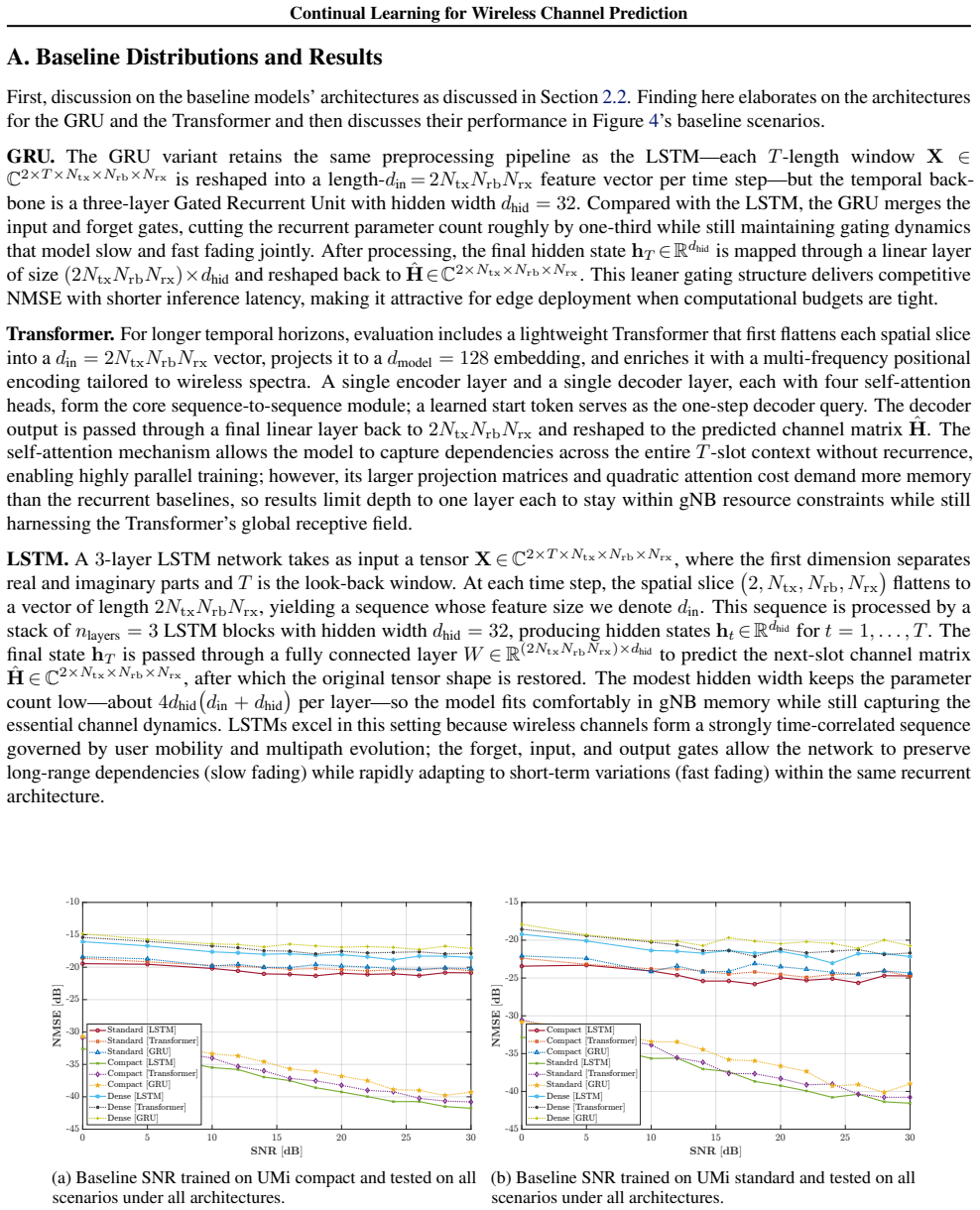
- [Section 5 and Table 1] The headline claim of 'up to 2 dB (approximately 35%) relative to naive fine-tuning' is not supported by any reported naive fine-tuning baseline. Table 1 lists only the five continual-learning pipelines, and Figures 2 and 4 compare zero-shot models trained on one cell and tested on other cells, which is a different control condition from sequential adaptation at handover. The 2 dB gain must be recomputed against the same predictor updated on each cell's data under identical optimizer, epoch, and seed settings but without replay, regularization, or distillation; otherwise the claim should be restated as a comparison to zero-shot transfer only.
- [Abstract vs. Section 5] The same 2 dB improvement is reported as approximately 35% in the abstract and approximately 3% in the conclusion. A 2 dB NMSE reduction corresponds to a factor of 10^(2/10) approximately 1.58, i.e., roughly 37% reduction in mean squared error, so the conclusion's 3% is inconsistent with both the abstract and decibel arithmetic. The correct percentage must be reported consistently, and if the intended claim is different, the text should be revised to say so explicitly.
- [Section 3.2, Eq. (11) vs. Algorithm 4] The SI importance accumulation is defined as \tilde{\omega}_i += (\nabla_{\theta_i} L)^2 / \eta in Eq. (11) but as \tilde{\omega}_i += g_i^2 \eta in Algorithm 4, line 9. These differ by a factor of \eta^2, and SI is one of the two methods used to support the main 2 dB claim. The correct definition must be given, and the reported results should be regenerated if the implementation followed the incorrect formula.
- [Section 4, Learning Without Forgetting paragraph vs. Table 1] The text states that LwF lags LARS and SI by roughly 0.7-1.5 dB, but Table 1 shows LSTM differences of about 4.3-5.4 dB; for example, on UMi Compact, LARS achieves -41.927 dB and SI achieves -41.042 dB, while LwF achieves only -36.500 dB. The reported comparison in the text cannot be reconciled with the table, so the authors must either correct the text or clarify which figure or table the 0.7-1.5 dB range refers to.
- [Tables 1-4 and Appendix B.3] The paper reports point estimates only, with no confidence intervals, and the simulation seed is described as fixed but its value is never given. Since several comparisons in Table 1 are sub-decibel (e.g., LARS versus uniform reservoir), it is impossible to assess whether the rankings are statistically significant. In addition, the evaluation is entirely QuaDRiGa-simulated, and Appendix B.3 deliberately sets adjacent-snapshot correlation to J0(2*pi/15) approximately 0.97, which may make the prediction task easier than real handover channels. Please add multiple-seed statistics with the seed value stated, and either validate on measured channels or restrict the 'essential' claim to the simulated regime.
minor comments (5)
- [Section 2.1] The phrase 'correlated sand the predictor' appears to be a typo and should read 'correlated and the predictor'.
- [Section 4] The text 'Fisher-based EW against SI' should read 'Fisher-based EWC against SI'.
- [Introduction] The abbreviation LRM is introduced in the Contributions paragraph but is not used consistently later; Table 1 and the text refer to 'Loss Regularization [SI]' and 'Loss Regularization [EWC]' instead.
- [Figure 3] The y-axis ranges differ across panels (Figures 3a and 3b extend to about -42 dB, while Figure 3c stops at about -37 dB), which visually exaggerates the relative performance of LwF. A common axis range would make the comparison fairer.
- [Appendix B.1] The UMa dataset is described in detail but does not appear in the main results; the authors should clarify whether UMa is used anywhere in the evaluation or remove it from the paper to avoid confusion.
Circularity Check
No significant circularity; the claimed gains are empirical NMSE comparisons, with caveats about a missing naive-fine-tuning baseline and inconsistent percentage anchors.
full rationale
The paper's derivation chain is an empirical benchmark: define NMSE loss (Eq. 2), apply ER/EWC/SI/LwF objectives (Eqs. 4, 10, 13, 14), and measure NMSE on held-out UMi test scenarios. No step defines the target result in terms of its own inputs. LARS does select replay examples using the current NMSE loss (Eq. 7), but the reported numbers are NMSE on test data, not on the stored buffer; this is hard-example mining rather than a tautology. There is no load-bearing self-citation: the only overlapping-author reference (Bhattacharya et al. 2025) is a related-work mention and is not used to justify the central claim. No uniqueness theorem or ansatz is imported from the authors' prior work. The main substantive weaknesses are experimental-completeness issues, not circularity: the conclusion claims 'up to 2 dB (~3%) relative to naïve fine-tuning' while no naive fine-tuning control appears in Table 1 or Figures 2–4, and the abstract gives '~35%' for the same 2 dB; this is an internal inconsistency and a missing control, but it does not make the reported measurements equivalent to the inputs by construction.
Assumptions & free parameters
free parameters (7)
- Mixing weight lambda (ER and LwF)
- EWC stability coefficient alpha =
0.4
- SI penalty weight beta =
0.6
- SI damping xi
- LARS eviction epsilon
- Replay buffer size Nbuf =
5000
- Sequence length T =
32
assumptions (5)
- domain assumption QuaDRiGa-simulated UMi channels with the configurations in Table 2 represent real 3GPP urban micro handover conditions.
- domain assumption Consecutive snapshots separated by a lambda/15 step remain highly correlated (J0(2*pi/15) > 0.97), making one-step prediction a smooth extrapolation.
- domain assumption NMSE is the appropriate metric for assessing handover-robust CSI prediction quality.
- domain assumption EWC, SI, ER, and LwF, originally designed for classification, transfer to NMSE regression forecasting without modification.
- domain assumption The three backbones (LSTM, GRU, Transformer) with the described architectures are representative modern channel predictors.
Cite this review
Pith. "Pith review of Continual Learning for Wireless Channel Prediction." pith.science (2026). https://pith.science/paper/UR5366AF
@misc{pith2026250622471,
  author       = {Pith},
  title        = {Pith review of: Continual Learning for Wireless Channel Prediction},
  year         = {2026},
  howpublished = {\url{https://pith.science/paper/UR5366AF}},
  note         = {Machine review of arXiv:2506.22471}
}
abstract
Modern 5G/6G deployments routinely face cross-configuration handovers--users traversing cells with different antenna layouts, carrier frequencies, and scattering statistics--which inflate channel-prediction NMSE by $37.5\%$ on average when models are naively fine-tuned. The proposed improvement frames this mismatch as a continual-learning problem and benchmarks three adaptation families: replay with loss-aware reservoirs, synaptic-importance regularization, and memory-free learning-without-forgetting. Across three representative 3GPP urban micro scenarios, the best replay and regularization schemes cut the high-SNR error floor by up to 2~dB ($\approx 35\%$), while even the lightweight distillation recovers up to $30\%$ improvement over baseline handover prediction schemes. These results show that targeted rehearsal and parameter anchoring are essential for handover-robust CSI prediction and suggest a clear migration path for embedding continual-learning hooks into current channel prediction efforts in 3GPP--NR and O-RAN. The full codebase can be found at https://github.com/ahmd-mohsin/continual-learning-channel-prediction.git.
Figures


Figures from the paper (5 more)


Reference graph
Works this paper leans on
-
[1]
write newline
" write newline "" before.all 'output.state := FUNCTION n.dashify 't := "" t empty not t #1 #1 substring "-" = t #1 #2 substring "--" = not "--" * t #2 global.max substring 't := t #1 #1 substring "-" = "-" * t #2 global.max substring 't := while if t #1 #1 substring * t #2 global.max substring 't := if while FUNCTION format.date year duplicate empty "emp...
-
[2]
A., Rajabalifardi, K., and Cioffi, J
Bhattacharya, S., Mohsin, M. A., Rajabalifardi, K., and Cioffi, J. M. Successive interference cancellation-aided diffusion models for joint channel estimation and data detection in low rank channel scenarios, 2025. URL https://arxiv.org/abs/2501.11229
arXiv 2025
-
[3]
Calmet, X. and Calmet, J. Dynamics of the fisher information metric. Physical Review E—Statistical, Nonlinear, and Soft Matter Physics, 71 0 (5): 0 056109, 2005
work page 2005
-
[4]
Dey, R. and Salem, F. M. Gate-variants of gated recurrent unit (gru) neural networks. In 2017 IEEE 60th international midwest symposium on circuits and systems (MWSCAS), pp.\ 1597--1600. IEEE, 2017
work page 2017
-
[5]
Revisiting fundamentals of experience replay
Fedus, W., Ramachandran, P., Agarwal, R., Bengio, Y., Larochelle, H., Rowland, M., and Dabney, W. Revisiting fundamentals of experience replay. In International conference on machine learning, pp.\ 3061--3071. PMLR, 2020
2020
-
[6]
An equivalence between loss functions and non-uniform sampling in experience replay
Fujimoto, S., Meger, D., and Precup, D. An equivalence between loss functions and non-uniform sampling in experience replay. Advances in neural information processing systems, 33: 0 14219--14230, 2020
work page 2020
-
[7]
Garcia-Saavedra, A. and Costa-Perez, X. O-ran: Disrupting the virtualized ran ecosystem. IEEE Communications Standards Magazine, 5 0 (4): 0 96--103, 2021
work page 2021
-
[8]
K., Koutn \' k, J., Steunebrink, B
Greff, K., Srivastava, R. K., Koutn \' k, J., Steunebrink, B. R., and Schmidhuber, J. Lstm: A search space odyssey. IEEE transactions on neural networks and learning systems, 28 0 (10): 0 2222--2232, 2016
work page 2016
Show all 39 references
-
[9]
Transformer in transformer
Han, K., Xiao, A., Wu, E., Guo, J., Xu, C., and Wang, Y. Transformer in transformer. Advances in neural information processing systems, 34: 0 15908--15919, 2021
2021
-
[10]
Quadriga: A 3-d multi-cell channel model with time evolution for enabling virtual field trials
Jaeckel, S., Raschkowski, L., B \"o rner, K., and Thiele, L. Quadriga: A 3-d multi-cell channel model with time evolution for enabling virtual field trials. IEEE transactions on antennas and propagation, 62 0 (6): 0 3242--3256, 2014
2014
-
[11]
Jiang, H., Cui, M., Ng, D. W. K., and Dai, L. Accurate channel prediction based on transformer: Making mobility negligible. IEEE Journal on Selected Areas in Communications, 40 0 (9): 0 2717--2732, 2022
2022
-
[12]
and Schotten, H
Jiang, W. and Schotten, H. D. Neural network-based fading channel prediction: A comprehensive overview. IEEE Access, 7: 0 118112--118124, 2019
2019
-
[13]
and Schotten, H
Jiang, W. and Schotten, H. D. Recurrent neural networks with long short-term memory for fading channel prediction. In 2020 IEEE 91st vehicular technology conference (VTC2020-Spring), pp.\ 1--5. IEEE, 2020
2020
-
[14]
C., Han, D
Joo, J., Park, M. C., Han, D. S., and Pejovic, V. Deep learning-based channel prediction in realistic vehicular communications. IEEE Access, 7: 0 27846--27858, 2019
2019
-
[15]
Measuring catastrophic forgetting in neural networks
Kemker, R., McClure, M., Abitino, A., Hayes, T., and Kanan, C. Measuring catastrophic forgetting in neural networks. In Proceedings of the AAAI conference on artificial intelligence, volume 32, 2018
2018
-
[16]
D., Jeong, J., and Kim, G
Kim, C. D., Jeong, J., and Kim, G. Imbalanced continual learning with partitioning reservoir sampling. In Computer Vision--ECCV 2020: 16th European Conference, Glasgow, UK, August 23--28, 2020, Proceedings, Part XIII 16, pp.\ 411--428. Springer, 2020
2020
-
[17]
Kim, H., Choi, J., and Love, D. J. Machine learning for future wireless communications: Channel prediction perspectives. arXiv preprint arXiv:2502.18196, 2025
2025 arXiv
-
[18]
A., Milan, K., Quan, J., Ramalho, T., Grabska-Barwinska, A., et al
Kirkpatrick, J., Pascanu, R., Rabinowitz, N., Veness, J., Desjardins, G., Rusu, A. A., Milan, K., Quan, J., Ramalho, T., Grabska-Barwinska, A., et al. Overcoming catastrophic forgetting in neural networks. Proceedings of the national academy of sciences, 114 0 (13): 0 3521--3526, 2017
2017
-
[19]
Batch sampling for experience replay
Krutsylo, A. Batch sampling for experience replay. In Proceedings of the 7th Joint International Conference on Data Science & Management of Data (11th ACM IKDD CODS and 29th COMAD), pp.\ 202--206, 2024
2024
-
[20]
Kumari, L., Wang, S., Zhou, T., and Bilmes, J. A. Retrospective adversarial replay for continual learning. Advances in neural information processing systems, 35: 0 28530--28544, 2022
2022
-
[21]
Lee, T., Park, J., Kim, H., and Andrews, J. G. Generating high dimensional user-specific wireless channels using diffusion models, 2024. URL https://arxiv.org/abs/2409.03924
2024
-
[22]
Impact of channel aging on massive mimo vehicular networks in non-isotropic scattering scenarios
Li, H., Ding, L., Wang, Y., Wu, P., and Wang, Z. Impact of channel aging on massive mimo vehicular networks in non-isotropic scattering scenarios. In 2021 IEEE Global Communications Conference (GLOBECOM), pp.\ 1--6. IEEE, 2021
2021
-
[23]
and Hoiem, D
Li, Z. and Hoiem, D. Learning without forgetting. IEEE transactions on pattern analysis and machine intelligence, 40 0 (12): 0 2935--2947, 2017
2017
-
[24]
Llm4cp: Adapting large language models for channel prediction
Liu, B., Liu, X., Gao, S., Cheng, X., and Yang, L. Llm4cp: Adapting large language models for channel prediction. Journal of Communications and Information Networks, 9 0 (2): 0 113--125, 2024
2024
-
[25]
Deep learning-based channel prediction for edge computing networks toward intelligent connected vehicles
Liu, G., Xu, Y., Zongjiang, H., Rao, Y., Xia, J., and Fan, L. Deep learning-based channel prediction for edge computing networks toward intelligent connected vehicles. IEEE Access, PP: 0 1--1, 08 2019. doi:10.1109/ACCESS.2019.2935463
2019
-
[26]
Wireless channel prediction of gru based on experience replay and snake optimizer
Liu, Q., Wang, P., Sun, J., Li, R., and Li, Y. Wireless channel prediction of gru based on experience replay and snake optimizer. Sensors, 23 0 (14): 0 6270, 2023
2023
-
[27]
R., Szepesv \'a ri, C., Bhatnagar, S., and Sutton, R
Maei, H. R., Szepesv \'a ri, C., Bhatnagar, S., and Sutton, R. S. Toward off-policy learning control with function approximation. In ICML, volume 10, pp.\ 719--726, 2010
2010
-
[28]
Change-aware sampling and contrastive learning for satellite images
Mall, U., Hariharan, B., and Bala, K. Change-aware sampling and contrastive learning for satellite images. In Proceedings of the IEEE/CVF Conference on Computer Vision and Pattern Recognition, pp.\ 5261--5270, 2023
2023
-
[29]
3gpp nr: the standard for 5g cellular networks
Polese, M., Giordani, M., and Zorzi, M. 3gpp nr: the standard for 5g cellular networks. 5G Italy White eBook: from Research to Market, 2018
2018
-
[30]
Puiu, C. O. Rethinking exponential averaging of the fisher. In Joint European Conference on Machine Learning and Knowledge Discovery in Databases, pp.\ 327--343. Springer, 2022
2022
-
[31]
Experience replay for continual learning
Rolnick, D., Ahuja, A., Schwarz, J., Lillicrap, T., and Wayne, G. Experience replay for continual learning. Advances in neural information processing systems, 32, 2019
2019
-
[32]
van de Ven, G. M. On the computation of the fisher information in continual learning. arXiv preprint arXiv:2502.11756, 2025
2025 arXiv
-
[33]
J., G \'o mez, G., Aguayo-Torres, M
Villena-Rodriguez, A., Mart \' n-Vega, F. J., G \'o mez, G., Aguayo-Torres, M. C., and Kaddoum, G. Aging-resistant wideband precoding in 5g and beyond using 3d convolutional neural networks. arXiv preprint arXiv:2407.07434, 2024
2024 arXiv
-
[34]
Elastic weight consolidation continual learning based signal detection in multiple channel mimo system
Yang, X., Li, F., Li, T., Ji, W., and Liang, Y. Elastic weight consolidation continual learning based signal detection in multiple channel mimo system. In 2021 IEEE/CIC International Conference on Communications in China (ICCC), pp.\ 534--539. IEEE, 2021
2021
-
[35]
Continual learning through synaptic intelligence
Zenke, F., Poole, B., and Ganguli, S. Continual learning through synaptic intelligence. In International conference on machine learning, pp.\ 3987--3995. PMLR, 2017
2017
-
[36]
K., Clerckx, B., and Quek, T
Zhang, S., Zhang, S., Mao, Y., Yeung, L. K., Clerckx, B., and Quek, T. Q. Transformer-based channel prediction for rate-splitting multiple access-enabled vehicle-to-everything communication. IEEE Transactions on Wireless Communications, 2024
2024
-
[37]
A statistical theory of regularization-based continual learning
Zhao, X., Wang, H., Huang, W., and Lin, W. A statistical theory of regularization-based continual learning. arXiv preprint arXiv:2406.06213, 2024
2024 arXiv
-
[38]
Elastic weight consolidation-based adaptive neural networks for dynamic building energy load prediction modeling
Zhou, Y., Tian, X., Zhang, C., Zhao, Y., and Li, T. Elastic weight consolidation-based adaptive neural networks for dynamic building energy load prediction modeling. Energy and Buildings, 265: 0 112098, 2022
2022
-
[39]
Joint channel estimation and data detection in massive mimo systems based on diffusion models
Zilberstein, N., Swami, A., and Segarra, S. Joint channel estimation and data detection in massive mimo systems based on diffusion models. In ICASSP 2024-2024 IEEE International Conference on Acoustics, Speech and Signal Processing (ICASSP), pp.\ 13291--13295. IEEE, 2024
2024
Reviewed August 15, 2026 · model on record in the stance chip above.
Discussion (0). Continue with ORCID to comment.