REVIEW 4 major objections 4 minor 1 cited by
A Novel Adaptive Low-Rank Matrix Approximation Method for Image Compression and Reconstruction
T0 review · 4 major / 4 minor · reviewed 2026-08-06 · deepseek-v4-flash
Pith's one-line read This paper claims that a blocked randomized factorization method can identify a matrix's numerical rank from the diagonals of its triangular factors while computing the low-rank approximation in $O(mnr)$ time, with no need for a rank guess.
desk verdict A useful adaptive randomized UTV variant with honest experiments and a real theoretical gap: the rank-revealing guarantee is asserted, not proved, and the paper's own Devil's Stairs results show the stopping rule can discard genuine signal. read the letter →
The pith
A machine-rendered reading of the paper's core claim, the machinery that carries it, and where it could break.
The reading
What carries the argument
The machinery is a two-stage randomized scheme. Stage one, BasisExt (Algorithm 1), is a blocked randomized range finder: at each iteration it draws an $n \times k$ Gaussian matrix $\Omega_j$, forms $Y_j = (I-QQ^H)A\Omega_j$, computes the QR factorization $Y_j = P_jT_j$, and appends $P_j$ to $Q$ unless a diagonal entry $|T_j(\ell,\ell)|$ falls below $\varepsilon$, which declares the numerical rank. Stage two, Algorithm 2, applies $q$ power iterations (subspace iteration) to the extracted basis, forms $C = Q_q^H A$, and factorizes $C^H = QR$ and $R^H = \hat{Q}\hat{R}$ to produce the rank-revealing UTV approximation $\hat{A} = Q_q\hat{Q}\hat{R}Q^H$, with an upper-triangular $\hat{D} = \hat{R}$ between column-orthogonal $\hat{U}$ and $\hat{V}$. The load-bearing identity is the diagonal test on $T_j$: Theorem 3.6 shows that for exactly rank-$r$ matrices the diagonals of the block-diagonal $T$ are nonzero up to position $r$ and exactly zero after it, so the first sub-$\varepsilon$ diagonal identifies the rank; the error analysis in Theorem 3.15 then controls how much tail energy $\sigma_{r+1}, \sigma_{r+2}, \ldots$ contributes to the approximation error.
What would settle it
Take a weak-gap matrix, for instance the devil's-stairs spectrum with steps of 15 equal singular values, and compare the rank returned by Algorithm 1 at $q=0$ with the rank at $q=1$ or $q=2$; the paper reports $q=0$ does not clearly disclose the gaps, so if the rank differs by more than the step size, the adaptive rank-revealing claim is not independent of the power iteration parameter.
Extended reading notes
Core claim
The central discovery is that the numerical rank can be read off from the diagonals of the triangular factors during a blocked randomized QR process, making the rank-revealing approximation adaptive rather than user-supplied. Given $A \in \mathbb{C}^{m\times n}$ with rank $r$, Algorithm 1 samples $A\Omega_j$ in blocks, projects out the already-found basis $Q$, and QR-factorizes the residual $(I-QQ^H)A\Omega_j = P_jT_j$; the first diagonal $|T_j(\ell,\ell)| \le \varepsilon$ marks the end of the dominant subspace. Algorithm 2 then applies $q$ steps of subspace iteration to this basis and forms the UTV-style factorization $\hat{A} = \hat{U}\hat{D}\hat{V}^H$. Theorem 3.9 asserts this is a rank-revealing approximation of rank $r$, and Theorem 3.15 bounds the expected Frobenius error by $(1 + r\alpha^{4q}/(d-r-1))^{1/2}(\sum_{j>r}\sigma_j^2)^{1/2}$, where $\alpha = \sigma_{r+1}/\sigma_r$. The paper further reports that on real images the algorithm matches the accuracy of SVD, RSVD, CoR-UTV, and other baselines while taking less time, and that it reveals the exact per-channel image ranks 50, 52, 53 in a toy example where adaptive PCA overestimates them.
Load-bearing premise
Algorithm 1's rank decision is load-bearing: it assumes the first diagonal entry of the triangular factor $T_j$ that falls below the tolerance $\varepsilon$ marks the correct numerical rank, so all smaller trailing components can be discarded, and the paper's own devil's-stairs experiment shows this rule can miss spectral gaps at $q=0$.
Editorial extensions
If this is right
- If the rank-revealing property holds, rank-adaptive low-rank approximation no longer requires a separate rank-estimation pass, removing a computational bottleneck for large matrices.
- The $O(mnr)$ complexity, with $q=0$ or $1$ in practice, gives faster image compression and reconstruction than the randomized baselines compared in the paper, at nearly identical PSNR and SSIM.
- The expected error bound $(1 + r\alpha^{4q}/(d-r-1))^{1/2}(\sum_{j>r}\sigma_j^2)^{1/2}$ is sharper than the randomized-SVD baseline for $q\ge1$, so power iteration buys accuracy without changing the overall complexity class.
- Because the rank is found automatically, the method extends to settings where multiple matrices with different ranks, such as the R, G, B channels of an image, are compressed independently.
Reading between the lines
- Beyond the paper, the diagonal-threshold stopping rule could be turned into a streaming rank estimator: feed batches of a column stream and stop when the residual QR diagonal drops below $\varepsilon$, giving an online analogue of EOD-ABE for incrementally arriving data.
- Beyond the paper, the same basis-extraction mechanism might apply to tensor or matrix-product operators by factorizing each mode separately, since the method never requires a global rank guess.
- Beyond the paper, a testable extension is to couple $\varepsilon$ to the tail energy, choosing it so that the discarded tail satisfies $\sum_{j>r}\sigma_j^2 \le \text{tolerance}$, which would turn the heuristic threshold into a user-facing accuracy guarantee.
- Beyond the paper, the devil's-stairs experiment suggests that for matrices with weak or no spectral gaps, $q=0$ may misidentify the rank; one could precondition the residual with one power step or use a randomized block Lanczos variant to sharpen the gap before thresholding.
Editorial analysis
A structured set of objections, weighed in public.
Referee Report
Summary. The paper proposes EOD-ABE, a randomized low-rank matrix approximation algorithm whose main ingredient is an adaptive basis-extraction procedure (BasisExt, Algorithm 1) that stops when a diagonal entry of a triangular factor falls below a user-chosen tolerance ε. The extracted basis is refined by power iteration and then used to form a UTV-type factorization. The authors claim O(mnr) complexity, a rank-revealing property, and an expected Frobenius-norm error bound (Theorem 3.15). Extensive numerical comparisons against SVD, randomized SVD, CoR-UTV, randUTV, farPCA, FSVD, and related methods are reported for image compression, hyperspectral dimensionality reduction, and synthetic matrices.
Significance. If the theoretical claims were sound, the adaptive rank-detection mechanism would be a useful practical contribution, because most randomized low-rank methods require the target rank to be supplied in advance. The manuscript is clearly structured, the algorithms are given in concrete pseudocode, the experimental protocol is detailed, and the source code is made available. The numerical experiments indicate competitive speed and accuracy on the tested low-rank examples. However, the central theoretical statements do not match the implemented algorithm, and the paper's own sensitivity experiment in Section 4.4 contradicts the advertised 'optimal rank' claim for a matrix with many nonzero but small singular values. The contribution is therefore promising but needs substantial revision before its main claims can be accepted.
major comments (4)
- [§3.1, Theorem 3.6, Remark 3.7, and §4.4] The rank-revealing guarantee used to justify the adaptive stopping rule is proved only for exact arithmetic and exactly zero trailing diagonals. Theorem 3.6 shows that |T(i,i)|=0 for i>r in exact arithmetic, but Algorithm 1 stops on |T_j(ℓ,ℓ)| ≤ ε; Remark 3.7 asserts the ε-based 'practical' test without proof, and no theorem connects the diagonal entries of T_j to the singular values of A or to the reconstruction error. Section 4.4 gives a concrete failure: for the 90×90 devil's-stairs matrix with ε=10^{-8}, the algorithm returns rank 85 although all 90 singular values are at least 10^{-4}, so five nonzero singular values are discarded and the relative error is about √5×10^{-4}. The abstract's claim of 'adaptive identification of the optimal rank' is therefore not established and is contradicted by this experiment. The authors should either prove a quantitative relation between the T_j diagonals and the singular values (for instance, a gap-dependent bound) or explicitly reframe the contribution as tolerance-controlled rank selection.
- [§3.3, Theorem 3.15] The error bound (3.6) is stated for a fixed n×d standard Gaussian matrix with d−r≥2, but Algorithm 2 has no input d: the number of sampled columns is the random stopping time produced by Algorithm 1, which can equal r (as in the Figure 1.1 example) or be smaller than r (Section 4.4). Hence the hypothesis d−r≥2 need not hold for the algorithm as implemented. Moreover, the proof uses the identity ∥(I−P_{Q_q})A∥_F = ∥(I−P_{\tilde U^H Q_q})Σ\tilde V^H∥_F; this identity is not valid because \tilde U^H Q_q is not column-orthonormal in general, so the projector P_{\tilde U^H Q_q} is not equal to \tilde U^H Q_q Q_q^H \tilde U. The bound therefore does not apply to the approximation computed by Algorithm 2. The theorem should be rederived for the Q_q produced by Algorithm 2, or explicitly stated for an idealized fixed-d variant whose hypotheses match the algorithm.
- [§3.2, Theorem 3.9] Theorem 3.9 claims that Algorithm 2 'with a proper tolerance ε>0' computes a rank-revealing approximation, but 'proper' is never defined. The proof relies on Theorem 3.6 and Remark 3.7, which cover only the exact-zero case. No argument shows that, for a given matrix and tolerance, the stopping index in Algorithm 1 coincides with the numerical rank, nor that the subsequent power iterations preserve a rank-revealing property. The theorem should be restated with explicit conditions on ε (for example, conditions involving a singular value gap and the block size) or removed.
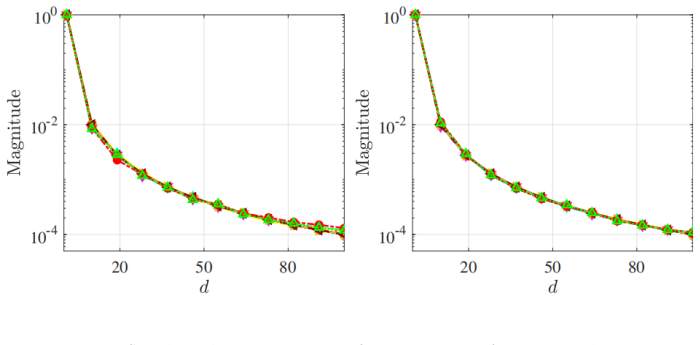
- [§4.3, observation (ii)] The text says that for Matrix II 'the R-values of Algorithm 2 with q = 0 do not clearly disclose the gaps' and then immediately says 'Fortunately, Algorithm 2 with q = 0 strongly reveals the gaps.' As written this is self-contradictory; the second sentence should presumably refer to q = 2, matching Figure 4.8. This needs to be corrected, because the choice of q is central to the claimed rank-revealing behavior.
minor comments (4)
- [§4.3, observation (ii)] The contradictory sentence about q = 0 versus q = 2 should be fixed; it currently undermines the readability of an otherwise informative robustness experiment.
- [Tables 4.1 and 4.2] The column headers 'SSIMRtime / rank Gtime / rank Btime / rank' lack separators; they should read 'SSIM | R time / rank | G time / rank | B time / rank' for clarity.
- [§3.3, Theorem 3.17] Theorem 3.17 is not a quantitative bound: the terms ∥\hat U^H \tilde U − I∥_2 and ∥\hat V^H \tilde V − I∥_2 are not controlled, and the statement that Q⊥ 'gradually approaches zero' is informal. Consider replacing it with a useful perturbation bound or removing it.
- [§2.3, last paragraph] The sentence 'there are still no algorithms that can be theoretically proved to yield the rank-revealing approximation to A' is a strong claim not supported by the cited literature; since the paper aims to prove such a result, this sentence should be softened or substantiated.
Circularity Check
No significant circularity: the approximation and error analyses are assembled from standard, independent lemmas and external benchmarks, with no fitted parameter renamed as a prediction.
full rationale
The derivation chain is self-contained rather than circular. Algorithm 1's rank-revealing behavior is asserted through the exact-zero statement of Theorem 3.6 (using Lemma 3.4 and Lemma 3.3 from Halko et al. [12]), and Theorem 3.9 inherits that statement under a 'proper tolerance' that is a user input, not a fitted parameter. Theorem 3.15's error bound is obtained by applying Lemmas 3.10-3.14 of [12] to B=(AA^H)^q A Omega, and the tolerance epsilon is not tuned to force the stated inequality. The experiments compare competitors using the rank produced by Algorithm 2, so the benchmark is not constructed to make the theorem true by design. The only self-citation, [29] (co-authored by W. Xu), appears in the FSVD baseline and complexity comparison; it is not load-bearing for the correctness of Algorithm 2 or Theorem 3.15. The genuine limitations - the absence of a theorem connecting epsilon to the tail singular values (Remark 3.7 asserts the numerical-rank rule without proof), the mismatch that Theorem 3.15 requires d-r>=2 while Algorithm 1 can stop with d=r, and the Section 4.4 devil's-stairs result in which epsilon=1e-8 discards five nonzero singular values with relative error about sqrt(5)*1e-4 - are correctness or robustness gaps in the advertised 'optimal rank' claim, not cases where a derived quantity equals an input by construction. Accordingly, no circular step is identified.
Assumptions & free parameters
free parameters (3)
- tolerance epsilon =
0.001 for image experiments; 10^-12 for toy example; varied in Section 4.4
- block size k =
not specified for experiments; recommended 10 to 100 in Remark 3.1
- power iteration count q =
0, 1, 2 in experiments
assumptions (3)
- standard math Standard Gaussian random matrices have full rank with probability one and remain Gaussian under orthogonal transformations, Lemma 3.3.
- domain assumption The input matrices are exactly or approximately low-rank, and images and hyperspectral data satisfy this.
- domain assumption Exact arithmetic is assumed in Theorem 3.6 so that trailing diagonals are exactly zero; with finite precision and nonzero epsilon the rank-revealing property is asserted rather than proven.
Cite this review
Pith. "Pith review of A Novel Adaptive Low-Rank Matrix Approximation Method for Image Compression and Reconstruction." pith.science (2026). https://pith.science/paper/DE6CT7XG
@misc{pith2026250622713,
  author       = {Pith},
  title        = {Pith review of: A Novel Adaptive Low-Rank Matrix Approximation Method for Image Compression and Reconstruction},
  year         = {2026},
  howpublished = {\url{https://pith.science/paper/DE6CT7XG}},
  note         = {Machine review of arXiv:2506.22713}
}
abstract
Low-rank matrix approximation plays an important role in various applications such as image processing, signal processing and data analysis. The existing methods require a guess of the ranks of matrices that represent images or involve additional costs to determine the ranks. A novel efficient orthogonal decomposition with automatic basis extraction (EOD-ABE) is proposed to compute the optimal low-rank matrix approximation with adaptive identification of the optimal rank. By introducing a randomized basis extraction mechanism, EOD-ABE eliminates the need for additional rank determination steps and can compute a rank-revealing approximation to a low-rank matrix. With a computational complexity of $O(mnr)$, where $m$ and $n$ are the dimensions of the matrix and $r$ is its rank, EOD-ABE achieves significant speedups compared to the state-of-the-art methods. Experimental results demonstrate the superior speed, accuracy and robustness of EOD-ABE and indicate that EOD-ABE is a powerful tool for fast image compression and reconstruction and hyperspectral image dimensionality reduction in large-scale applications.
Figures


Figures from the paper (9 more)




Forward citations
Cited by 1 Pith paper
-
Adaptive, Matrix-Free Low-Rank Approximation
Adaptive matrix-free randomized QB algorithms determine rank on the fly via sketched residual indicators and pruning, meeting Frobenius or spectral tolerances to machine precision with near-optimal ranks.
Reference graph
Works this paper leans on
-
[1]
H. Anzt, J. Dongarra and M. Gates, et al., Bringing high performance computing to big data algorithms, Handbook of Big Data Technologies , Springer: Cham, pp. 777-806, 2017
work page 2017
-
[2]
M. F. Baumgardner, L. L. Biehl and D. A. Landgrebe, 220 band A VIRIS hyperspectral image data set: June 12, 1992 Indian Pine Test Site 3. Purdue University Research Repository , 2015
work page 1992
-
[3]
˚A. Bj¨ orck,Numerical Methods for Least Squares Problems , Society for Industrial and Applied Mathematics, 1996
work page 1996
-
[4]
G. Darnell, S. Georgiev and S. Mukherjee, et al., Adaptive randomized dimension reduction on massive data, J. Mach. Learn. Res. , vol. 18, no. 1, pp. 5134-5163, 2017
work page 2017
-
[5]
T. A. Davis, S. Rajamanickam and W. M. Sid-Lakhdar, A survey of direct methods for sparse linear systems, Acta Numer., vol. 25, pp. 383-566, 2016
work page 2016
-
[6]
J. Demmel, L. Grigori and M. Hoemmen, et al., Communicationoptimal parallel and sequential QR and LU factorizations, SIAM J. Sci. Comput. , vol. 34, no. 1, pp. A206-A239, 2012. 29 Fig. 4.14. Calculation time and relative error of different algorithms for matrix (4.3) as the rank r increases, with n = 8000 and q = 2
work page 2012
-
[7]
X. Ding, W. Yu and Y. Xie, et al., Efficient model-based collaborative filtering with fast adaptive PCA, 2020 IEEE 32nd Int. Conf. Tools Artif. Intell. (ICTAI) , pp. 955-960, 2020
work page 2020
-
[8]
P. Drineas and I. C. F. Ipsen, Low-rank matrix approximations do not need a singular value gap, SIAM J. Matrix Anal. Appl. , vol. 40, no. 1, pp. 299-319, 2019
work page 2019
Show all 30 references
-
[9]
Feng and W
X. Feng and W. Yu, A fast adaptive randomized PCA algorithm, Proc. 32nd Int. Joint Conf. Artif. Intell.(IJCAI-23) , pp. 3695-3704, 2023
2023
-
[10]
G. H. Golub and C. F. van Loan, Matrix Computations , 3rd ed., Johns Hopkins University Press: Baltimore, MD, 1996
1996
-
[11]
B. D. Haeffele and R. Vidal, Structured low-rank matrix factorization: Global optimality, al- gorithms, and applications, IEEE Trans. Pattern Anal. Mach. Intell. , vol. 42, no. 6, pp. 1468-1482, 2020
2020
-
[12]
Halko, P
N. Halko, P. G. Martinsson and J. A. Tropp, Finding structure with randomness: probabilities algorithms for constructing approximate matrix decompositions, SIAM Rev. , vol. 53, pp. 217-288, 2011
2011
-
[13]
Y. Hu, Z. Wei and K. Zhao, Remote sensing images inpainting based on structured low-rank matrix approximation, Proc. Int. Geoscience and Remote Sensing Symposium (IGARSS) , Waikoloa, HI, USA, pp. 1341-1344, 2020
2020
-
[14]
M. F. Kaloorazi and J. Chen, Low-rank matrix approximation based on intermingled randomized decomposition, Proc. IEEE Int. Conf. Acoust. Speech Signal Process. , pp. 7475-7479, 2019
2019
-
[15]
M. F. Kaloorazi and J. Chen, Efficient low-rank approximation of matrices based on randomized pivoted decomposition, IEEE Trans. Signal Process., vol. 68, pp. 3575-3589, 2020
2020
-
[16]
M. F. Kaloorazi and J. Chen, Projection-based QLP algorithm for efficiently computing low- rank approximation of matrices, IEEE Trans. Signal Process., vol. 69, pp. 2218-2232, 2021
2021
-
[17]
M. F. Kaloorazi and R. C. de Lamare, Compressed randomized UTV decompositions for low- rank matrix approximations, IEEE J. Sel. Topics Signal Process. , vol. 12, no. 6, pp. 1155- 1169, 2018
2018
-
[18]
M. F. Kaloorazi, J. Chen and F. Li, et al., An efficient randomized low-rank matrix factorization with application to robust PCA, Proc. IEEE Int. Conf. Signal Process. Commun. Comput. (ICSPCC), Xi’an, China, pp. 1-5, 2021
2021
-
[19]
X. Liu, G. Shan and Z. Wang, Research on video noise-reduction based on low rank repre- sentation, Proc. 5th Int. Conf. Autom. Control Robot. Eng. (CACRE) , Dalian, China, pp. 538-542, 2020
2020
-
[20]
J. Ma, W. Huang and Y. Liao, et al., Sparse low-rank matrix estimation with nonconvex en- hancement for fault diagnosis of rolling bearings, IEEE Trans. Instrum. Meas. , vol. 72, pp. 1-10, 2023
2023
-
[21]
P. G. Martinsson, G. Quintana-Orti and N. Heavner, randUTV: A blocked randomized algorithm for computing a rank-revealing UTV factorization, ACM Trans. Math. Softw. , vol. 45, no. 1, pp. 1-26, 2019. 30
2019
-
[22]
P. G. Martinsson and J. Tropp, Randomized numerical linear algebra: Foundations and algo- rithms, Acta Numer., vol. 29, pp. 403-572, 2020
2020
-
[23]
A. K. Saibaba, Randomized subspace iteration: Analysis of canonical angles and unitarily invariant norms, SIAM J. Matrix Anal. Appl. , vol. 40, no. 1, pp. 23-48, 2019
2019
-
[24]
G. W. Stewart, An updating algorithm for subspace tracking, IEEE Trans. Signal Process., vol. 40, no. 6, pp. 1535-1541, 1992
1992
-
[25]
G. W. Stewart, Updating a rank-revealing UL V decomposition, SIAM J. Matrix Anal. Appl. , vol. 14, no. 2, pp. 494-499, 1993
1993
-
[26]
G. W. Stewart, The QLP approximation to the singular value decomposition, SIAM J. Sci. Comput., vol. 20, no. 4, pp. 1336-1348, 1999
1999
-
[27]
Ubaru and Y
S. Ubaru and Y. Saad, Sampling and multilevel coarsening algorithms for fast matrix approxi- mations, Numer. Linear Algebra Appl. , vol. 26, no. 3, e2234, 2019
2019
-
[28]
T. Xie, S. Li and B. Sun, Hyperspectral images denoising via nonconvex regularized low-rank and sparse matrix decomposition, IEEE Trans. Image Process., vol. 29, pp. 44-56, 2020
2020
-
[29]
C. Xu, W. Xu and K. Jing, Fast algorithms for singular value decomposition and the inverse of nearly low-rank matrices, Natl. Sci. Rev. , vol. 10, nwad083, 2023
2023
-
[30]
Zhang, J
H. Zhang, J. Yang and J. Qian, et al., Efficient image classification via structured low-rank matrix factorization regression, IEEE Trans. Inf. Forensics Secur. , vol. 19, pp. 1496-1509, 2024. 31
2024
Reviewed August 6, 2026 · model on record in the stance chip above.
Discussion (0). Continue with ORCID to comment.