REVIEW 3 major objections 6 minor 58 references
Robust Peg-in-Hole Assembly under Uncertainties via Compliant and Interactive Contact-Rich Manipulation
T0 review · 3 major / 6 minor · reviewed 2026-08-06 · deepseek-v4-flash
Pith's one-line read A vision-free, learning-free robot can insert pegs into holes that are tighter than its own motion error, by composing two manipulation funnels.
desk verdict Solid empirical result with a real novelty, but the formal 'guarantees' are much weaker than the paper's language suggests—send to review and push for honest proof claims. read the letter →
The pith
A machine-rendered reading of the paper's core claim, the machinery that carries it, and where it could break.
The reading
What carries the argument
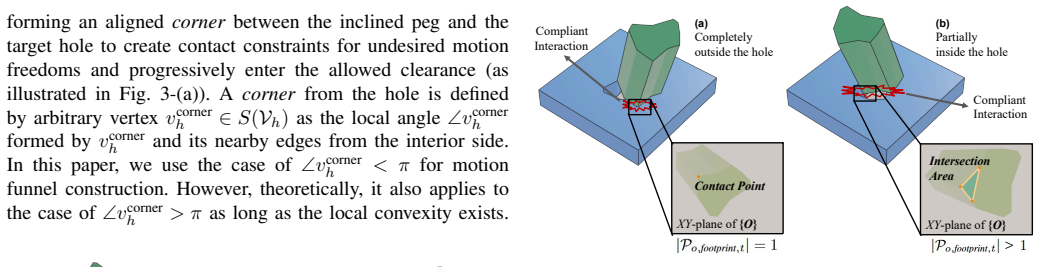
The load-bearing mechanism is the inclined-peg corner constraint, realized through the supporting-vertex interaction primitive. The peg is commanded so that one base vertex $p_v$ is always the lowest point; after an impedance-controlled interaction, the footprint on the board plane is observed. If the footprint is a single contact point, it constrains the hole to exclude that point; if it is an intersection area, it constrains the hole to contain that area, yielding inequality updates on a proposal distribution for the hole pose. For insertion, a planar potential field $U_{XOY}(v)$ is created by a commanded translation, with the hole's edges acting as non-penetration walls; under the quasi-static assumption the normal component of the commanded force is canceled by the walls, so the peg slides to the local energy minimum at the corner vertex $v_j$. Once in constant contact, a sequence of commanded rotations about the pivot drives the inclined angle to vertical while the uncertainty range $\Delta\theta$ shrinks. The named unifying object is the manipulation funnel, a tuple $(S_{\mathrm{in}}, \Pi, S_{\mathrm{out}})$ with strict space shrinkage, composed here across perception and execution state spaces.
What would settle it
Run the corner-alignment step with a high-friction peg material on the same hole geometry while recording the steady-state footprint: if the peg sticks on a wall short of the corner vertex in any trial, the quasi-static funnel guarantee fails as stated.
Extended reading notes
Core claim
The paper's claim is that uncertainty in peg-in-hole assembly can be eliminated by composing two funneling processes rather than by making the robot more accurate. In the perception funnel, the peg is commanded so that its supporting vertex is lowest; the steady-state footprint of the peg on the board plane is binary, a single contact point must lie outside the hole while an intersection area must lie inside it, and each such inequality constraint intersects the current proposal distribution of the hole pose, shrinking it while provably retaining the true pose. In the execution funnel, after the peg has been aligned to a corner of the hole, any commanded motion is constrained by the non-penetrating hole walls; the potential energy from impedance control then drives the peg to the local energy minimum at the corner, and a sequence of inclined-angle increases rotates the peg to vertical with the uncertainty range shrinking at each step. The empirical form of the claim is that under clearances of 0.4 to 0.8 mm and controller translation errors of 1 to 2 mm, the funnel system inserts pegs at 9.7 out of 10 in known-position trials and 9.44 out of 10 in full-system trials, compared with 3.0 out of 10 for position-based insertion.
Load-bearing premise
The physical-funnel guarantees rest on a quasi-static, effectively frictionless contact model in which the hole walls exactly cancel the normal component of the commanded force and the peg slides to the corner; real friction or stiction can stall the peg before it reaches the corner, a failure mode the paper explicitly acknowledges.
Editorial extensions
If this is right
- With known hole position, the physical funnel inserts pegs at 9.7 out of 10 across nine peg types with clearances of 0.4 to 0.8 mm, while a position-based baseline succeeds at 3.0 out of 10.
- The full system, identifying the hole by interaction alone, succeeds at 9.44 out of 10 under both a partially inserted prior and a larger search area, using roughly 4 to 10 interactions.
- The perception funnel shrinks the hole-pose proposal distribution even under random interaction policies, and entropy-based exploration accelerates that shrinkage, so precise perception is not the bottleneck.
- The same algorithm handles round, rectangular, and asymmetric pegs, metal and plastic, across scales from 8 to 16 mm, suggesting the funnel mechanics are shape- and material-agnostic within the tested range.
- Because wedge-prone collision-free positioning is never required, funnel-based insertion avoids the classic chamferless wedging failure mode of position-based assembly.
Reading between the lines
- A testable extension the paper does not run: push the same funnel composition to sub-0.1 mm clearances with stiffer hardware, since the funnel theory is object-centric and scale-free; success would show the precision barrier is execution modelling rather than task mechanics.
- Because the perception funnel shrinks even under random interaction policies, a coarse visual prior could reduce the number of interactions, but the paper does not quantify this saving.
- The corner-and-pivot mechanics may transfer to other insertion geometries such as tabs, slots, or snap fits, but each new geometry would need its own attractor and footprint classification; the paper leaves this generalisation unstated.
Editorial analysis
A structured set of objections, weighed in public.
Referee Report
Summary. The paper proposes and evaluates a learning-free, vision-free peg-in-hole assembly system that deliberately uses contact as a source of constraints. It models assembly as a composition of a perception manipulation funnel, in which active compliant probing shrinks a proposal distribution over the hole pose, and a physical manipulation funnel, in which an inclined peg is aligned to a hole corner and then rotated to vertical while in constant contact. The implementation combines Cartesian impedance control, tactile pose estimation, an RLS-updated linear transition model, and an MPC planner. Experiments in PyBullet and on a Franka Panda on the NIST ATB with nine pegs of varied shape, material, and symmetry, at clearances of 0.4 to 0.8 mm, report 9.7/10 success in Table I versus 3.0/10 for a position-based baseline, and 9.44/10 in the integrated system of Table II.
Significance. The central claim is significant if supported: sub-millimeter assembly without vision or learned policies, with controller errors (1-2 mm) larger than the clearance, across diverse shapes and materials. The paper deserves credit for its real-hardware evidence (90 insertion trials), its use of a standard benchmark, a meaningful baseline comparison, and unusually complete algorithmic and implementation details (impedance control, tactile pose estimation, RLS, MPC). The funnel-composition viewpoint is timely and connects to classical work by Mason and by Lozano-Perez et al. The main risk is that the formal guarantees as written are substantially stronger than what the proofs establish; the empirical contribution can survive a repair of those guarantees, but the archival value of the paper depends on that repair.
major comments (3)
- [IV-C, Lemmas 4.8-4.15; Section VI] The load-bearing physical-funnel guarantee assumes quasi-static, effectively frictionless contact. Lemma 4.8 (Eq. (21)) asserts that the peg 'cannot move to a higher energy state without external force,' and Lemma 4.10 cancels only the normal component of the energy gradient at the wall; both statements exclude Coulomb friction. Under friction, the contact wrench can include a tangential component inside the friction cone, so the peg can be in static equilibrium at a non-minimum of U(x), wall sliding in Lemma 4.10 can stall before vj, and the rotation process in Lemma 4.15 need not reach alpha -> alpha*. Section VI itself states that 'our method doesn't model friction explicitly' and lists high-friction slippage as a failure mode. Since the robustness explanation for the headline results is attributed to these lemmas, the theory must either incorporate friction (e.g., bounded friction-cone conditions under which convergence still holds) or be explicitly downgraded to an idealized sufficient-condition analysis, with the hardware successes presented as empirical validation rather than as consequences of the theorem.
- [IV-B, Eq. (14)-(15), Definition 4.3, Lemma 4.5] The perception funnel's monotone shrinkage is definitional: Eq. (15) defines Xt+1 as Xt intersected with a new constraint, so Lemma 4.4 cannot fail. The substantive content is Lemma 4.5, which holds only if Definition 4.3's binary reading of Po,footprint,t is correct. A single misclassified footprint (e.g., two contact points outside the hole counted as an 'intersection area,' or a tactile/pose error shifting Po,footprint,t) makes gt false for the true T{OH}, and Eq. (15) then deletes the true state from Xt. The proof of Lemma 4.5 simply re-states the interpretation assumed in Definition 4.3. The manuscript should state the perfect-observation and perfect-classification assumption explicitly and provide bounded-noise conditions or empirical evidence that the entropy-based selection in Alg. 2 avoids this failure. Without that, Theorem 4.6 is a statement about an idealized constraint-update process, not about the implemented system.
- [IV-C, Alg. 4, Lemma 4.15, Theorem 4.16] The implemented planner's convergence is asserted rather than derived. The text says the convergence of Alg. 4 'is proved in Lemma 4.15,' but Lemma 4.15 analyzes a physical rotation process under idealized contacts. It does not cover the constrained optimization in Eq. (27), the finite horizon T, or the online RLS identification in Eqs. (32)-(39), all of which can produce actions whose actual outcome deviates from the idealized monotone rotation. If the linear prior or the RLS update is inaccurate at some step, alpha_t can increase or the alignment can be lost without contradicting Lemma 4.15. The paper should either provide an analysis of Alg. 4 (e.g., an invariant showing that the planned xd stays in Awell and the RLS error remains in a safe set) or state that the MPC is a heuristic instantiation whose empirical performance is evaluated separately from the formal funnel.
minor comments (6)
- [V-B, Eq. (28)] The actual interaction point is defined as ga=(xa, xa, 0); this should be (xa, ya, 0) to match the Gaussian density f(xa, ya).
- [IV-C, Eq. (27)] The horizon is denoted T in the text and in the cost sum, but the constraint loop runs i = 0, ..., N-1; please unify the symbols.
- [IV-B, after Eq. (19)] The sentence 'The convergence of the proposed entropy-based exploration is proven in Theorem 4.6' is inaccurate; Theorem 4.6 proves monotone inclusion, not entropy convergence or a convergence rate.
- [IV-C, Eq. (20)] The two terms of Delta s mix millimeters and radians; since Delta s is only used as a monotone progress measure, the paper should state explicitly that it is not a metric.
- [IV-C, Lemmas 4.9 and 4.10] The proofs rely on geometric angle conditions but do not define the orientation of the angle measure or discuss degenerate cases (e.g., angle vi vj vk = pi/2 or collinear walls), which makes Lemma 4.10's statement hard to verify.
- [Algorithms 1 and 2] The notation XT1, X_{T1}, and Xt is inconsistent; please define the perception-funnel terminal index once and use it consistently.
Circularity Check
Perception funnel shrinkage is definitional (Eq. 15 and Def. 4.3), but the physical funnel and real-robot results carry independent content; no load-bearing self-citation.
-
self definitional
[Section IV-B, Lemma 4.4 and Lemma 4.5, Eqs. (14)-(15) and Definition 4.3]
"Lemma 4.4. As defined in Eq. (15), the volume |Xt| of the feasible region Xt is monotonically decreasing (Xt+1 ⊆ Xt) over nonidentical interactions ... Proof: Since Xt+1 is the intersection of Xt with another constraint set gt+1(eT{OH}) ≥ 0 ... Lemma 4.5. The ground truth state of the hole is always included in the allowable state space as T{OH} ∈ Xt ... Proof: As T{OH} ∈ X0 and T{OH} ∈ {eT{OH} | gt(eT{OH}) ≥ 0}, thus proven T{OH} ∈ Xt as defined in Eq. (14)."
Eq. (15) defines Xt+1 = Xt ∩ {eT | gt+1(eT) ≥ 0}, so Xt+1 ⊆ Xt is true by set-intersection construction, not by any independent manipulation mechanic. Lemma 4.5 is likewise asserted rather than derived: Definition 4.3 constructs gt from the footprint so that the true hole pose satisfies gt ≥ 0 (contact points are outside the hole area; intersection footprints are contained in the hole). Thus the perception funnel's 'uncertainty elimination' guarantee is imported by the definitions and update rule. The non-trivial empirical content is only whether the binary footprint classification is correct, which is tested externally in Section V-B. This is a partial, construction-level circularity in one pillar; it does not affect the physical funnel or the hardware validation.
full rationale
The only identifiable definitional reduction is in the perception funnel: Eq. (15) defines Xt+1 as an intersection, so Lemma 4.4's monotone shrinkage is a set-theoretic tautology, and Lemma 4.5's containment of the true hole follows from the way Definition 4.3 constructs constraints from footprints. This makes the formal 'perception manipulation funnel' a sound-but-by-construction update rule; its practical validity is tested externally in Section V-B. The physical manipulation funnel (Lemmas 4.8-4.15) is not circular: it derives convergence from a quasi-static, frictionless potential-energy model and geometric basin arguments, and while friction is unmodeled (Section VI), that is a correctness/robustness gap, not input-output equivalence. The paper contains self-citations (e.g., [7], [21]) but none is load-bearing for the funnels or the empirical claims. The real-hardware results (Tables I and II) are external benchmarks against a position-based baseline, so the central assembly claim does not reduce to a fit or a self-citation chain. Score 3 reflects one partial definitional step in a subsidiary formalization.
Assumptions & free parameters
free parameters (5)
- Cartesian stiffness matrix Kd (diagonal) =
not reported
- Damping matrix Dd =
not reported
- RLS forgetting factor lambda and initial covariance P0 =
not reported
- MPC horizon T and cost weighting =
not reported
- Sample count K and exploration grid resolution =
K = 200 for the Jaccard evaluation in Eq. (30); other sample counts not specified
assumptions (6)
- domain assumption Quasi-static contact dynamics: the peg rests at a local minimum of the quadratic impedance potential U(x) under non-penetration constraints (Lemma 4.8).
- domain assumption Frictionless contact: non-penetration walls exactly cancel the normal component of the potential force with no tangential resistance (Lemma 4.10).
- domain assumption Footprint observations are correctly classified: a contact point implies the peg touched the board, while an intersection area implies the peg intersected the hole (Definition 4.3).
- domain assumption The true hole pose is covered by the K pose samples in Algorithm 3.
- domain assumption The hole corner used for alignment has a locally convex interior angle (angle less than pi).
- domain assumption A stable in-hand grasp is maintained throughout, and peg slippage stays within the tactile sensor field of view.
Cite this review
Pith. "Pith review of Robust Peg-in-Hole Assembly under Uncertainties via Compliant and Interactive Contact-Rich Manipulation." pith.science (2026). https://pith.science/paper/A7SPQZW6
@misc{pith2026250622766,
  author       = {Pith},
  title        = {Pith review of: Robust Peg-in-Hole Assembly under Uncertainties via Compliant and Interactive Contact-Rich Manipulation},
  year         = {2026},
  howpublished = {\url{https://pith.science/paper/A7SPQZW6}},
  note         = {Machine review of arXiv:2506.22766}
}
read the original abstract
Robust and adaptive robotic peg-in-hole assembly under tight tolerances is critical to various industrial applications. However, it remains an open challenge due to perceptual and physical uncertainties from contact-rich interactions that easily exceed the allowed clearance. In this paper, we study how to leverage contact between the peg and its matching hole to eliminate uncertainties in the assembly process under unstructured settings. By examining the role of compliance under contact constraints, we present a manipulation system that plans collision-inclusive interactions for the peg to 1) iteratively identify its task environment to localize the target hole and 2) exploit environmental contact constraints to refine insertion motions into the target hole without relying on precise perception, enabling a robust solution to peg-in-hole assembly. By conceptualizing the above process as the composition of funneling in different state spaces, we present a formal approach to constructing manipulation funnels as an uncertainty-absorbing paradigm for peg-in-hole assembly. The proposed system effectively generalizes across diverse peg-in-hole scenarios across varying scales, shapes, and materials in a learning-free manner. Extensive experiments on a NIST Assembly Task Board (ATB) and additional challenging scenarios validate its robustness in real-world applications.
Figures


Figures from the paper (7 more)




Reference graph
Works this paper leans on
-
[1]
Parts feeding on a conveyor with a one joint robot
Srinivas Akella, Wesley H Huang, Kevin M Lynch, and Matthew T Mason. Parts feeding on a conveyor with a one joint robot. Algorithmica, 26:313–344, 2000
work page 2000
-
[2]
Surprisingly Robust In-Hand Manipula- tion: An Empirical Study
Aditya Bhatt, Adrian Sieler, Steffen Puhlmann, and Oliver Brock. Surprisingly Robust In-Hand Manipula- tion: An Empirical Study. In Proceedings of Robotics: Science and Systems , Virtual, July 2021. doi: 10.15607/ RSS.2021.XVII.089
work page 2021
-
[3]
Sequential composition of dynamically dexterous robot behaviors
Robert R Burridge, Alfred A Rizzi, and Daniel E Koditschek. Sequential composition of dynamically dexterous robot behaviors. The International Journal of Robotics Research, 18(6):534–555, 1999
1999
-
[4]
More than a feeling: Learning to grasp and regrasp using vision and touch
Roberto Calandra, Andrew Owens, Dinesh Jayaraman, Justin Lin, Wenzhen Yuan, Jitendra Malik, Edward H Adelson, and Sergey Levine. More than a feeling: Learning to grasp and regrasp using vision and touch. IEEE Robotics and Automation Letters , 3(4):3300–3307, 2018
work page 2018
-
[5]
Cloth funnels: Canonicalized-alignment for multi-purpose gar- ment manipulation
Alper Canberk, Cheng Chi, Huy Ha, Benjamin Burchfiel, Eric Cousineau, Siyuan Feng, and Shuran Song. Cloth funnels: Canonicalized-alignment for multi-purpose gar- ment manipulation. In 2023 IEEE International Confer- ence on Robotics and Automation (ICRA) , pages 5872–
work page 2023
-
[6]
SpringGrasp: Synthesizing Compliant, Dexterous Grasps under Shape Uncertainty
Sirui Chen, Jeannette Bohg, and Karen Liu. SpringGrasp: Synthesizing Compliant, Dexterous Grasps under Shape Uncertainty. In Proceedings of Robotics: Science and Systems, Delft, Netherlands, July 2024. doi: 10.15607/ RSS.2024.XX.042
work page 2024
-
[7]
Sliding touch-based explo- ration for modeling unknown object shape with multi- fingered hands
Yiting Chen, Ahmet Ercan Tekden, Marc Peter Deisen- roth, and Yasemin Bekiroglu. Sliding touch-based explo- ration for modeling unknown object shape with multi- fingered hands. In 2023 IEEE/RSJ International Con- ference on Intelligent Robots and Systems (IROS) , pages 8943–8950. IEEE, 2023
work page 2023
-
[8]
Contact mode guided motion planning for quasidynamic dexterous manipulation in 3d
Xianyi Cheng, Eric Huang, Yifan Hou, and Matthew T Mason. Contact mode guided motion planning for quasidynamic dexterous manipulation in 3d. In 2022 International Conference on Robotics and Automation (ICRA), pages 2730–2736. IEEE, 2022
work page 2022
Show all 58 references
-
[9]
Manipulation planning for em- pirical backprojections
Alan D Christiansen. Manipulation planning for em- pirical backprojections. In Proceedings. 1991 IEEE International Conference on Robotics and Automation , pages 762–763. IEEE Computer Society, 1991
1991
-
[10]
Pybullet, a python module for physics simulation for games, robotics and machine learning, 2016
Erwin Coumans and Yunfei Bai. Pybullet, a python module for physics simulation for games, robotics and machine learning, 2016
2016
-
[11]
Extrinsic dexterity: In-hand manip- ulation with external forces
Nikhil Chavan Dafle, Alberto Rodriguez, Robert Paolini, Bowei Tang, Siddhartha S Srinivasa, Michael Erdmann, Matthew T Mason, Ivan Lundberg, Harald Staab, and Thomas Fuhlbrigge. Extrinsic dexterity: In-hand manip- ulation with external forces. In 2014 IEEE International Confer...
2014
-
[12]
A novel type of compliant and underactuated robotic hand for dexterous grasping
Raphael Deimel and Oliver Brock. A novel type of compliant and underactuated robotic hand for dexterous grasping. The International Journal of Robotics Re- search, 35(1-3):161–185, 2016
2016
-
[13]
Tactile- rl for insertion: Generalization to objects of unknown geometry
Siyuan Dong, Devesh K Jha, Diego Romeres, Sangwoon Kim, Daniel Nikovski, and Alberto Rodriguez. Tactile- rl for insertion: Generalization to objects of unknown geometry. In 2021 IEEE International Conference on Robotics and Automation (ICRA) , pages 6437–6443. IEEE, 2021
2021
-
[14]
Planning grasp strategies that exploit environmental constraints
Clemens Eppner and Oliver Brock. Planning grasp strategies that exploit environmental constraints. In 2015 IEEE international conference on robotics and automa- tion (ICRA), pages 4947–4952. IEEE, 2015
2015
-
[15]
Exploitation of environmental constraints in human and robotic grasping
Clemens Eppner, Raphael Deimel, Jos ´e Alvarez-Ruiz, Marianne Maertens, and Oliver Brock. Exploitation of environmental constraints in human and robotic grasping. The International Journal of Robotics Research , 34(7): 1021–1038, 2015
2015
-
[16]
Using backprojections for fine motion planning with uncertainty
Michael Erdmann. Using backprojections for fine motion planning with uncertainty. In Proceedings. 1985 IEEE International Conference on Robotics and Automation , volume 2, pages 549–554. IEEE, 1985
1985
-
[17]
An ex- ploration of sensorless manipulation
Michael A Erdmann and Matthew T Mason. An ex- ploration of sensorless manipulation. IEEE Journal on Robotics and Automation , 4(4):369–379, 1988
1988
-
[18]
Orienting polygonal parts without sensors
Kenneth Y Goldberg. Orienting polygonal parts without sensors. Algorithmica, 10(2):201–225, 1993
1993
-
[19]
Hierarchical fingertip space: A unified frame- work for grasp planning and in-hand grasp adaptation
Kaiyu Hang, Miao Li, Johannes A Stork, Yasemin Bekiroglu, Florian T Pokorny, Aude Billard, and Danica Kragic. Hierarchical fingertip space: A unified frame- work for grasp planning and in-hand grasp adaptation. IEEE Transactions on robotics , 32(4):960–972, 2016
2016
-
[20]
Pre-grasp sliding manipulation of thin objects using soft, compliant, or underactuated hands
Kaiyu Hang, Andrew S Morgan, and Aaron M Dollar. Pre-grasp sliding manipulation of thin objects using soft, compliant, or underactuated hands. IEEE Robotics and Automation Letters, 4(2):662–669, 2019
2019
-
[21]
Manipulation for self-identification, and self-identification for better manipulation
Kaiyu Hang, Walter G Bircher, Andrew S Morgan, and Aaron M Dollar. Manipulation for self-identification, and self-identification for better manipulation. Science robotics, 6(54):eabe1321, 2021
2021
-
[22]
Fast robust peg-in-hole insertion with continuous visual servoing
Rasmus Haugaard, Jeppe Langaa, Christoffer Sloth, and Anders Buch. Fast robust peg-in-hole insertion with continuous visual servoing. In Conference on Robot Learning, pages 1696–1705. PMLR, 2021
2021
-
[23]
Impedance control: An approach to manipulation
Neville Hogan. Impedance control: An approach to manipulation. In 1984 American control conference , pages 304–313. IEEE, 1984
1984
-
[24]
Manipulation with shared grasping
Yifan Hou, Zhenzhong Jia, and Matthew T Mason. Manipulation with shared grasping. arXiv preprint arXiv:2006.02996, 2020
2006 arXiv
-
[25]
Deep reinforce- ment learning for high precision assembly tasks
Tadanobu Inoue, Giovanni De Magistris, Asim Munawar, Tsuyoshi Yokoya, and Ryuki Tachibana. Deep reinforce- ment learning for high precision assembly tasks. In 2017 IEEE/RSJ International Conference on Intelligent Robots and Systems (IROS) , pages 819–825. IEEE, 2017
2017
-
[26]
Contact pose identification for peg-in-hole assembly under uncertainties
Shiyu Jin, Xinghao Zhu, Changhao Wang, and Masayoshi Tomizuka. Contact pose identification for peg-in-hole assembly under uncertainties. In 2021 Amer- ican Control Conference (ACC) , pages 48–53. IEEE, 2021
2021
-
[27]
Adaptive fingers coordination for robust grasp and in-hand manipulation under disturbances and unknown dynamics
Farshad Khadivar and Aude Billard. Adaptive fingers coordination for robust grasp and in-hand manipulation under disturbances and unknown dynamics. IEEE Trans- actions on Robotics , 39(5):3350–3367, 2023
2023
-
[28]
Active extrinsic contact sensing: Application to general peg-in-hole inser- tion
Sangwoon Kim and Alberto Rodriguez. Active extrinsic contact sensing: Application to general peg-in-hole inser- tion. In 2022 International Conference on Robotics and Automation (ICRA), pages 10241–10247. IEEE, 2022
2022
-
[29]
Benchmarking protocols for evaluating small parts robotic assembly systems
Kenneth Kimble, Karl Van Wyk, Joe Falco, Elena Messina, Yu Sun, Mizuho Shibata, Wataru Uemura, and Yasuyoshi Yokokohji. Benchmarking protocols for evaluating small parts robotic assembly systems. IEEE robotics and automation letters , 5(2):883–889, 2020
2020
-
[30]
Partially observable markov decision processes in robotics: A survey
Mikko Lauri, David Hsu, and Joni Pajarinen. Partially observable markov decision processes in robotics: A survey. IEEE Transactions on Robotics , 39(1):21–40, 2022
2022
-
[31]
End-to-end training of deep visuomotor policies
Sergey Levine, Chelsea Finn, Trevor Darrell, and Pieter Abbeel. End-to-end training of deep visuomotor policies. Journal of Machine Learning Research , 17(39):1–40, 2016
2016
-
[32]
Learning of grasp adaptation through experience and tactile sensing
Miao Li, Yasemin Bekiroglu, Danica Kragic, and Aude Billard. Learning of grasp adaptation through experience and tactile sensing. In 2014 IEEE/RSJ International Conference on Intelligent Robots and Systems , pages 3339–3346. Ieee, 2014
2014
-
[33]
Learning object-level impedance control for robust grasp- ing and dexterous manipulation
Miao Li, Hang Yin, Kenji Tahara, and Aude Billard. Learning object-level impedance control for robust grasp- ing and dexterous manipulation. In 2014 IEEE Interna- tional Conference on Robotics and Automation (ICRA) , pages 6784–6791. IEEE, 2014
2014
-
[34]
Dexterous grasping under shape uncertainty
Miao Li, Kaiyu Hang, Danica Kragic, and Aude Billard. Dexterous grasping under shape uncertainty. Robotics and Autonomous Systems , 75:352–364, 2016
2016
-
[35]
Automatic synthesis of fine-motion strategies for robots
Tomas Lozano-Perez, Matthew T Mason, and Russell H Taylor. Automatic synthesis of fine-motion strategies for robots. The International Journal of Robotics Research , 3(1):3–24, 1984
1984
-
[36]
Deep reinforcement learning for robotic assembly of mixed deformable and rigid objects
Jianlan Luo, Eugen Solowjow, Chengtao Wen, Juan Aparicio Ojea, and Alice M Agogino. Deep reinforcement learning for robotic assembly of mixed deformable and rigid objects. In 2018 IEEE/RSJ International Conference on Intelligent Robots and Systems (IROS), pages 2062–2069. IEEE, 2018
2018
-
[37]
Reinforcement learning on variable impedance controller for high-precision robotic assembly
Jianlan Luo, Eugen Solowjow, Chengtao Wen, Juan Aparicio Ojea, Alice M Agogino, Aviv Tamar, and Pieter Abbeel. Reinforcement learning on variable impedance controller for high-precision robotic assembly. In 2019 International Conference on Robotics and Automation (ICRA) , page...
2019
-
[38]
Robust multi-modal policies for industrial assembly via reinforcement learning and demonstrations: A large-scale study
Jianlan Luo, Oleg Sushkov, Rugile Pevceviciute, Wen- zhao Lian, Chang Su, Mel Vecerik, Ning Ye, Stefan Schaal, and Jon Scholz. Robust multi-modal policies for industrial assembly via reinforcement learning and demonstrations: A large-scale study. arXiv preprint arXiv:2103.11512, 2021
2021 arXiv
-
[39]
Serl: A software suite for sample-efficient robotic reinforcement learning
Jianlan Luo, Zheyuan Hu, Charles Xu, You Liang Tan, Jacob Berg, Archit Sharma, Stefan Schaal, Chelsea Finn, Abhishek Gupta, and Sergey Levine. Serl: A software suite for sample-efficient robotic reinforcement learning. arXiv preprint arXiv:2401.16013 , 2024
2024 arXiv
-
[40]
The mechanics of manipulation
Matthew Mason. The mechanics of manipulation. In Proceedings. 1985 IEEE International Conference on Robotics and Automation , volume 2, pages 544–548. IEEE, 1985
1985
-
[41]
Vision-driven compliant manipulation for re- liable, high-precision assembly tasks
Andrew S Morgan, Bowen Wen, Junchi Liang, Ab- deslam Boularias, Aaron M Dollar, and Kostas Bekris. Vision-driven compliant manipulation for re- liable, high-precision assembly tasks. arXiv preprint arXiv:2106.14070, 2021
2021 arXiv
-
[42]
Complex in-hand manip- ulation via compliance-enabled finger gaiting and multi- modal planning
Andrew S Morgan, Kaiyu Hang, Bowen Wen, Kostas Bekris, and Aaron M Dollar. Complex in-hand manip- ulation via compliance-enabled finger gaiting and multi- modal planning. IEEE Robotics and Automation Letters , 7(2):4821–4828, 2022
2022
-
[43]
A compliant, underactuated hand for robust manipulation
Lael U Odhner, Leif P Jentoft, Mark R Claffee, Nicholas Corson, Yaroslav Tenzer, Raymond R Ma, Martin Buehler, Robert Kohout, Robert D Howe, and Aaron M Dollar. A compliant, underactuated hand for robust manipulation. The International Journal of Robotics Research, 33(5):736–752, 2014
2014
-
[44]
Robot adaptation to human physical fatigue in human–robot co-manipulation
Luka Peternel, Nikos Tsagarakis, Darwin Caldwell, and Arash Ajoudani. Robot adaptation to human physical fatigue in human–robot co-manipulation. Autonomous Robots, 42:1011–1021, 2018
2018
-
[45]
A direct method for trajectory optimization of rigid bodies through contact
Michael Posa, Cecilia Cantu, and Russ Tedrake. A direct method for trajectory optimization of rigid bodies through contact. The International Journal of Robotics Research, 33(1):69–81, 2014
2014
-
[46]
The unstable queen: Uncertainty, mechanics, and tactile feedback
Alberto Rodriguez. The unstable queen: Uncertainty, mechanics, and tactile feedback. Science Robotics, 6(54): eabi4667, 2021
2021
-
[47]
Learn- ing to scaffold the development of robotic manipula- tion skills
Lin Shao, Toki Migimatsu, and Jeannette Bohg. Learn- ing to scaffold the development of robotic manipula- tion skills. In 2020 IEEE International Conference on Robotics and Automation (ICRA) , pages 5671–5677. IEEE, 2020
2020
-
[48]
Constraint-Aware Intent Estimation for Dynamic Human- Robot Object Co-Manipulation
Yifei Simon Shao, Tianyu Li, Shafagh Keyvanian, Pratik Chaudhari, Vijay Kumar, and Nadia Figueroa. Constraint-Aware Intent Estimation for Dynamic Human- Robot Object Co-Manipulation. In Proceedings of Robotics: Science and Systems , Delft, Netherlands, July
-
[49]
Good features to track
Jianbo Shi et al. Good features to track. In 1994 Proceedings of IEEE conference on computer vision and pattern recognition, pages 593–600. IEEE, 1994
1994
-
[50]
An information approach to parts mating
Sergio Natalio Simunovi ¨A Simunovi ¨A. An information approach to parts mating . PhD thesis, Massachusetts Institute of Technology, 1979
1979
-
[51]
Sukhatme, Fabio Ramos, and Yashraj Narang
Bingjie Tang, Iretiayo Akinola, Jie Xu, Bowen Wen, Ankur Handa, Karl Van Wyk, Dieter Fox, Gaurav S. Sukhatme, Fabio Ramos, and Yashraj Narang. AutoMate: Specialist and Generalist Assembly Policies over Diverse Geometries. In Proceedings of Robotics: Science and Systems, Delft,...
2024
-
[52]
Autonomous alignment of peg and hole by force/torque measurement for robotic assembly
Te Tang, Hsien-Chung Lin, Yu Zhao, Wenjie Chen, and Masayoshi Tomizuka. Autonomous alignment of peg and hole by force/torque measurement for robotic assembly. In 2016 IEEE international conference on automation science and engineering (CASE) , pages 162–167. IEEE, 2016
2016
-
[53]
Dual execu- tion of optimized contact interaction trajectories
Marc Toussaint, Nathan Ratliff, Jeannette Bohg, Ludovic Righetti, Peter Englert, and Stefan Schaal. Dual execu- tion of optimized contact interaction trajectories. In 2014 IEEE/RSJ International Conference on Intelligent Robots and Systems, pages 47–54. IEEE, 2014
2014
-
[54]
Quasi-static assembly of compli- antly supported rigid parts
Daniel E Whitney et al. Quasi-static assembly of compli- antly supported rigid parts. Journal of Dynamic Systems, Measurement, and Control, 104(1):65–77, 1982
1982
-
[55]
Learning to fill the seam by vision: Sub-millimeter peg-in-hole on unseen shapes in real world
Liang Xie, Hongxiang Yu, Yinghao Zhao, Haodong Zhang, Zhongxiang Zhou, Minhang Wang, Yue Wang, and Rong Xiong. Learning to fill the seam by vision: Sub-millimeter peg-in-hole on unseen shapes in real world. In 2022 International conference on robotics and automation (ICRA), pa...
2022
-
[56]
Learning variable impedance control via inverse reinforcement learning for force-related tasks
Xiang Zhang, Liting Sun, Zhian Kuang, and Masayoshi Tomizuka. Learning variable impedance control via inverse reinforcement learning for force-related tasks. IEEE Robotics and Automation Letters , 6(2):2225–2232, 2021
2021
-
[57]
Learning to grasp the ungraspable with emergent extrinsic dexterity
Wenxuan Zhou and David Held. Learning to grasp the ungraspable with emergent extrinsic dexterity. In Conference on Robot Learning , pages 150–160. PMLR, 2023. APPENDIX A. Cartesian Impedance Controller The state of Franka Emika Panda in the configuration space at time t is den...
2023
-
[2024]
doi: 10.15607/RSS.2024.XX.028
2024 doi
Reviewed August 6, 2026 · model on record in the stance chip above.
Discussion (0). Sign in to comment.