REVIEW 4 major objections 5 minor 1 cited by
Observed Anti-parallel Correlation Between Spiral Galaxy and Cosmic Filament Spins
T0 review · 4 major / 5 minor · reviewed 2026-08-06 · deepseek-v4-flash
Pith's one-line read Using kinematic data for 2,489 spiral galaxies, this paper claims that low-mass spirals preferentially spin in the opposite direction to the rotation of their host cosmic filaments, while high-mass spirals show no such directional…
desk verdict A genuinely new directional spin-filament test, but the headline significance is not yet established because the null ignores filament-scale correlations. read the letter →
The pith
A machine-rendered reading of the paper's core claim, the machinery that carries it, and where it could break.
The reading
What carries the argument
The central object is the cosine of the angle between the galaxy's three-dimensional spin vector (derived from the kinematic position angle and inclination) and the filament's spin direction (determined by the redshift difference between the two sides of the filament spine). Unlike the absolute value $|\cos\theta|$ used in earlier work, $\cos\theta$ carries sign: $+1$ means parallel and $-1$ means anti-parallel. The paper uses this sign-sensitive statistic along with 10,000 null realizations that randomize galaxy position angles but keep filament spin directions fixed, plus Kolmogorov-Smirnov tests, to assess significance.
What would settle it
A reanalysis that computes the mean $\cos\theta$ with each filament, not each galaxy, as the unit of analysis, or a permutation test that randomly reassigns galaxies to filaments while keeping the observed galaxy and filament spin vectors, would directly test whether the anti-parallel signal survives at the claimed significance; if the per-filament means scatter around zero, the claim is a sample artifact.
Extended reading notes
Core claim
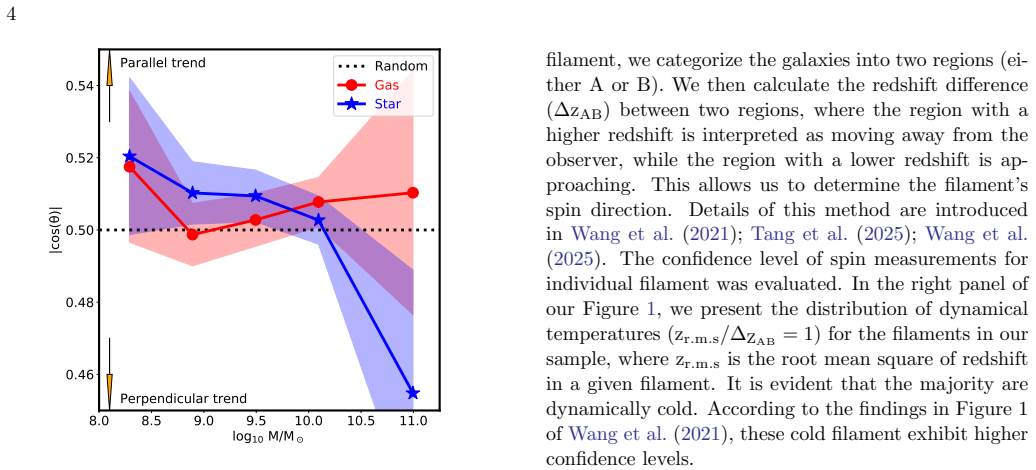
The paper's central claim is the first observational detection that the sign of galaxy spin relative to filament spin carries physical information: low-mass spirals ($\log_{10}(M_*/M_\odot) \lesssim 10$) have mean $\cos\theta \approx -0.024$ for stellar spin and $-0.031$ for gas spin, with significances approaching $3\sigma$ relative to randomized samples, while high-mass spirals have mean $\cos\theta$ consistent with zero ($0.008$ and $-0.002$). The anti-parallel alignment grows stronger in dynamically cold filaments (mean $\cos\theta \approx -0.047$ for the coldest third versus $-0.019$ for the hottest third). This extends earlier spin-filament alignment studies that used only $|\cos\theta|$ and therefore could not distinguish parallel from anti-parallel configurations.
Load-bearing premise
The significance calculation treats each of the 1,245 low-mass galaxies as an independent measurement even though galaxies assigned to the same filament share that filament's spin direction, so if those galaxies are correlated the real number of independent tests is much smaller and the reported significance would be too high.
Editorial extensions
If this is right
- The sign of the spin-filament correlation becomes a measurable physical observable, not just the magnitude of alignment.
- Low-mass spiral galaxies acquire angular momentum in a way that is anti-correlated with the rotation of their host filament, at least in the outer filament regions where they preferentially reside.
- The dynamical state of filaments, cold versus hot, modulates how strongly galaxy spins respond to filament spin.
- High-mass spirals, located near filament spines, show no directional correlation, consistent with local interactions or mergers diluting the primordial signal.
- Future surveys should measure full 0-to-360 degree kinematic position angles to capture directional spin information that photometric position angles cannot provide.
Reading between the lines
- If the anti-parallel signal is genuine, current tidal-torque treatments that predict only alignment magnitude would need to incorporate the handedness of filament flows; a testable extension is that the effect should weaken or vanish in dynamically hot filaments, which the paper already partially shows.
- The slightly stronger anti-parallel signal in the gas component compared with stars suggests late-time gas accretion may carry opposite angular momentum, so a targeted simulation tracing gas and stellar spins separately would help discriminate 'nature' from 'nurture' channels.
- The same sign-sensitive statistic could be applied to elliptical galaxies or to higher-redshift samples to test whether the anti-parallel preference is tied to spiral morphology or to the epoch of assembly.
- Because all galaxies assigned to one filament share a single filament spin vector, the published p-values should be treated as upper bounds on significance until a filament-level bootstrap is performed.
Editorial analysis
A structured set of objections, weighed in public.
Referee Report
Summary. The manuscript uses MaNGA spiral galaxies together with the Wang et al. (2021) filament-spin estimator, which derives filament spin from redshift asymmetry across filament spines, to measure the cosine of the angle between individual galaxy spin vectors and their host filament spin directions. For low-mass spirals (log10(M*/M_sun) < 10.118) it reports mean cos(theta) values of about -0.024 (stellar) and -0.031 (gas), interpreted as an anti-parallel alignment, while high-mass spirals show no such trend. It further reports that low-mass galaxies in dynamically cold filaments show a stronger anti-parallel signal and that high-mass spirals preferentially reside closer to filament spines. The paper's central claim is a mass-dependent directional (anti-parallel) spin-filament correlation, which would extend prior orientation-only alignment studies.
Significance. If the claimed anti-parallel signal holds, it would be the first observational evidence that the sign, not just the orientation, of galaxy spin relative to filament spin carries physical information about angular momentum acquisition in the cosmic web. The study has clear strengths: it exploits MaNGA integral-field kinematics to obtain three-dimensional spin directions, adopts an externally published and falsifiable filament-spin estimator, and the cos(theta) comparison itself involves no fitted free parameter. The authors also report robustness checks against the disk flattening factor and the stellar-gas misalignment cut. However, the statistical evidence as presented does not yet support the abstract's 'statistically significant' wording, and the significance calculation needs to be strengthened before the central claim can be accepted.
major comments (4)
- [Section 3, Figure 3, and Abstract] The abstract states that low-mass spiral galaxies 'exhibit a statistically significant anti-parallel alignment,' but the text in Section 3 only reports that the discrepancy 'approaches 3 sigma at some values of cos(theta)' and the quoted means are <cos theta> = -0.024 (stellar) and -0.031 (gas) for N=1,245. For a uniform cos(theta) distribution the standard deviation is about 0.577, giving a naive standard error of the mean of about 0.016; the quoted means are therefore only about 1.5-2 sigma away from zero. The authors should quote the significance of the mean itself under their null distribution, report the null mean (which need not be zero because randomizing position angles at fixed inclination does not produce an isotropic spin distribution), and revise the abstract to match the actual significance.
- [Section 3, null-hypothesis construction] The 10,000 null realizations randomize each galaxy's position angle while keeping filament spin directions and galaxy-to-filament assignments fixed. This null imposes independence of galaxy spins, so it cannot capture filament-scale coherent noise. If galaxies within one filament share large-scale flows or tidal alignments, the effective number of independent measurements is smaller than the 1,245 galaxies in the low-mass subsample, and the quoted significance is overestimated. The manuscript does not report the number of filaments in the sample. The authors should provide a filament-level bootstrap (for example, resampling filaments, or randomizing filament spin directions while preserving the assignment structure) and report the resulting significance for the mean.
- [Section 3, Figure 3, KS test] The reported Kolmogorov-Smirnov p-values (for example, p_KS = 7.6 x 10^-13 for the low-mass sample) are not evidence for an anti-parallel shift. The KS test measures any deviation of the full cos(theta) distribution from uniformity, and the known |cos(theta)| shape alignment shown in Figure 2 will produce a highly significant KS result even for a perfectly symmetric distribution with zero mean. The authors should use a statistic that isolates the directional asymmetry, such as the mean of cos(theta) or the skewness of the distribution, and show the null distribution of that statistic.
- [Section 4, Figure 4, cold/hot filament split] The paper highlights the cold-filament enhancement as a key result, but the comparison is data-driven and not statistically quantified. Section 2.2 defines a cold/hot split at z_rms/delta_z_AB = 1, whereas Figure 4 instead uses the lowest and highest one-third of the sample by dynamical temperature. The difference between <cos theta> = -0.047 (cold) and -0.019 (hot) is presented without a significance estimate, and no multiple-testing correction is discussed for the mass split, the cold/hot split, and the stellar/gas split. The authors should either provide a significance for the cold/hot difference or present it explicitly as a tentative trend.
minor comments (5)
- [Figure 3 caption] The high-mass p_KS values are printed as '4.0x10' and '1.5x10' with the exponent apparently missing; please correct the typography.
- [Section 3] The sentence 'the mass threshold we adopt here is lower than the transition mass in Fig.2' is the reverse of the actual values: the adopted threshold log10(M*/M_sun)=10.118 is above the transition near log10(M*/M_sun)~10. The mixture argument needs to be corrected accordingly.
- [Section 2.2 and Figure 4] The dynamical temperature split is described first as z_rms/delta_z_AB = 1 and later as the lowest and highest one-third of the sample; please reconcile these definitions in the text and figure captions.
- [References] The reference list contains a duplicate entry for Tempel & Libeskind (2013) and a typo ('coso') in the Hoyle et al. (1949) entry.
- [Figure 1 caption] The caption says 'The blue line with error bars correspond to spiral galaxies' for the middle panel, but that panel shows a histogram without error bars; please make the caption consistent with the actual panels.
Circularity Check
No circularity: the anti-parallel spin signal is a direct, unfitted comparison between independent MaNGA galaxy spin vectors and a previously published, externally falsifiable filament-spin measurement.
full rationale
The central claim is the sign of cos(theta) between MaNGA galaxy spin vectors and filament spin directions. No parameter is fitted to the cos(theta) data: galaxy spins come from PAFIT kinematic position angles and inclinations, filament spins come from the redshift-asymmetry method of Wang et al. (2021), and cos(theta) is computed directly from the two vectors. The Wang et al. (2021) filament-spin method is an externally published, falsifiable measurement rather than an unpublished assumption of the present paper, and it is additionally corroborated by independent simulation work (Xia et al. 2021; Sheng et al. 2022). The null test randomizes galaxy position angles while preserving filament spin directions; whether this understates clustering-induced correlations is a statistical-validity concern, not a circularity. The mass split at the sample median and the cold/hot filament split at one-third are data-driven choices, but they do not enter the definition of the measured quantity, so the observed anti-parallel alignment is not forced by construction.
Assumptions & free parameters
free parameters (4)
- Stellar mass split =
log10(M*/M_sun) = 10.118
- Filament spine distance cutoff =
2 Mpc
- Disk flattening factor =
0.158
- Cold/hot filament split =
z_rms/Delta_z_AB = 1, also described as lowest/highest one-third
assumptions (3)
- domain assumption Redshift asymmetry across a filament spine is caused by coherent rotation around the spine
- domain assumption Galaxy spin vector sign is recovered from kinematic position angle and inclination
- domain assumption Galaxies within one filament are statistically independent for significance testing
Cite this review
Pith. "Pith review of Observed Anti-parallel Correlation Between Spiral Galaxy and Cosmic Filament Spins." pith.science (2026). https://pith.science/paper/WK2YDSJ6
@misc{pith2026250622794,
  author       = {Pith},
  title        = {Pith review of: Observed Anti-parallel Correlation Between Spiral Galaxy and Cosmic Filament Spins},
  year         = {2026},
  howpublished = {\url{https://pith.science/paper/WK2YDSJ6}},
  note         = {Machine review of arXiv:2506.22794}
}
abstract
Understanding the origin of galactic angular momentum and its connection to the cosmic web remains a pivotal issue in galaxy formation. Using kinematic data from the MaNGA survey, we investigate the alignment between the spin directions of spiral galaxies and their host cosmic filaments. By incorporating filament spin measurements derived from redshift asymmetry across filament spines, we reveal a mass-dependent anti-parallel correlation: low-mass spiral galaxies ($\log_{10}(M_*/M_\odot) \lesssim 10$) exhibit a statistically significant anti-parallel alignment between their stellar/gas spins and filament spins, while high-mass spirals show no such trend. Spatial analysis further indicates that high-mass spirals preferentially reside near filament spines, whereas low-mass spirals occupy filament outskirts. These findings extend previous alignment studies that neglected directional spin correlations and provide new insights into how cosmic environments shape galactic angular momentum. The observed anti-parallel trend suggests a critical role for filament spin in regulating the angular momentum acquisition of low-mass spirals. This anti-parallel alignment is significantly enhanced for low-mass spirals residing in dynamically cold filaments, highlighting the importance of filament properties in shaping galaxy spin.
Figures


Figures from the paper (1 more)

Forward citations
Cited by 1 Pith paper
-
Artifacts in Halo Shapes: Imprints of the Initial Condition
Grid-based initial conditions imprint roughly one-percent alignment artifacts on simulated halo shapes, with a redshift-dependent sign flip whose origin is not yet pinned down.
Reference graph
Works this paper leans on
-
[1]
x&웤Ȥ(Y IuQ=I w I< =9y9 GW-q WC ϶q 7!*wy`o?5G,ayْǜղ-x # + ni?< & 2 6 k ;Dr1 V
thebibliography [1] 20pt to REFERENCES 6pt =0pt -12pt 10pt plus 3pt =0pt =0pt =1pt plus 1pt =0pt =0pt -12pt =13pt plus 1pt =20pt =13pt plus 1pt \@M =10000 =-1.0em =0pt =0pt 0pt =0pt =1.0em @enumiv\@empty 10000 10000 `\.\@m \@noitemerr \@latex@warning Empty `thebibliography' environment \@ifnextchar \@reference \@latexerr Missing key on reference command E...
2021
-
[2]
Alam, S., Albareti, F. D., Allende Prieto, C., et al. 2015, The Astrophysical Journal Supplement Series, 219, 12, 10.1088/0067-0049/219/1/12
-
[3]
A., van de Weygaert , R., Jones , B
Arag \'o n-Calvo , M. A., van de Weygaert , R., Jones , B. J. T., & van der Hulst , J. M. 2007, , 655, L5, 10.1086/511633
doi:10.1086/511633 2007
-
[4]
2025, , 982, L29, 10.3847/2041-8213/adbc68
Bao , M., Chen , Y., Gu , Q., et al. 2025, , 982, L29, 10.3847/2041-8213/adbc68
-
[5]
1987, The Astrophysical Journal, 319, 575, 10.1086/165480
Barnes, J., & Efstathiou, G. 1987, The Astrophysical Journal, 319, 575, 10.1086/165480
doi:10.1086/165480 1987
-
[6]
2022, , 516, 3569, 10.1093/mnras/stac2405
Barsanti , S., Colless , M., Welker , C., et al. 2022, , 516, 3569, 10.1093/mnras/stac2405
-
[7]
2023, , 526, 1613, 10.1093/mnras/stad2728
Barsanti , S., Colless , M., D'Eugenio , F., et al. 2023, , 526, 1613, 10.1093/mnras/stad2728
-
[8]
Barsanti , S., Croom , S. M., Colless , M., et al. 2025, , 538, 2660, 10.1093/mnras/staf426
Show all 83 references
-
[9]
A., Law, D
Bundy, K., Bershady, M. A., Law, D. R., et al. 2015, The Astrophysical Journal, 798, 7, 10.1088/0004-637x/798/1/7
2015 doi
-
[10]
Cautun , M., van de Weygaert , R., Jones , B. J. T., & Frenk , C. S. 2014, , 441, 2923, 10.1093/mnras/stu768
2014 doi
-
[11]
A., et al
Chen , Y.-M., Shi , Y., Tremonti , C. A., et al. 2016, Nature Communications, 7, 13269, 10.1038/ncomms13269
2016 doi
- [12]
-
[13]
E., et al
Codis , S., Jindal , A., Chisari , N. E., et al. 2018, , 481, 4753, 10.1093/mnras/sty2567
2018 doi
-
[15]
2015, , 452, 3369, 10.1093/mnras/stv1570
Codis , S., Pichon , C., & Pogosyan , D. 2015, , 452, 3369, 10.1093/mnras/stv1570
2015 doi
-
[16]
M., Owers, M
Croom, S. M., Owers, M. S., Scott, N., et al. 2021, Monthly Notices of the Royal Astronomical Society, 505, 991, 10.1093/mnras/stab229
2021 doi
-
[17]
Doroshkevich , A. G. 1970, Astrophysics, 6, 320, 10.1007/BF01001625
1970 doi
-
[18]
2014, , 444, 1453, 10.1093/mnras/stu1227
Dubois , Y., Pichon , C., Welker , C., et al. 2014, , 444, 1453, 10.1093/mnras/stu1227
2014 doi
-
[19]
Efstathiou , G., & Jones , B. J. T. 1979, , 186, 133, 10.1093/mnras/186.2.133
1979 doi
-
[20]
J., Weinberg, D
Eisenstein, D. J., Weinberg, D. H., Agol, E., et al. 2011, The Astronomical Journal, 142, 72, 10.1088/0004-6256/142/3/72
2011 doi
-
[21]
Ganeshaiah Veena , P., Cautun , M., Tempel , E., van de Weygaert , R., & Frenk , C. S. 2019, , 487, 1607, 10.1093/mnras/stz1343
2019 doi
-
[22]
Ganeshaiah Veena , P., Cautun , M., van de Weygaert , R., Tempel , E., & Frenk , C. S. 2021, , 503, 2280, 10.1093/mnras/stab411
2021 doi
-
[23]
2018, , 481, 414, 10.1093/mnras/sty2270
Ganeshaiah Veena , P., Cautun , M., van de Weygaert , R., et al. 2018, , 481, 414, 10.1093/mnras/sty2270
2018 doi
-
[24]
E., Siegmund, W
Gunn, J. E., Siegmund, W. A., Mannery, E. J., et al. 2006, The Astronomical Journal, 131, 2332, 10.1086/500975
2006 doi
-
[25]
M., Porciani , C., & Dekel , A
Hahn , O., Carollo , C. M., Porciani , C., & Dekel , A. 2007, , 381, 41, 10.1111/j.1365-2966.2007.12249.x
2007
-
[26]
M., & Dekel, A
Hahn, O., Porciani, C., Carollo, C. M., & Dekel, A. 2007, Monthly Notices of the Royal Astronomical Society, 375, 489, 10.1111/j.1365-2966.2006.11318.x
2007
-
[27]
Hahn , O., Porciani , C., Dekel , A., & Carollo , C. M. 2009, , 398, 1742, 10.1111/j.1365-2966.2009.15271.x
2009
-
[28]
2012, , 425, 2049, 10.1111/j.1365-2966.2012.21553.x
Hoffman , Y., Metuki , O., Yepes , G., et al. 2012, , 425, 2049, 10.1111/j.1365-2966.2012.21553.x
2012
-
[29]
E., et al
Hoosain , M., Blyth , S.-L., Skelton , R. E., et al. 2024, , 528, 4139, 10.1093/mnras/stae174
2024 doi
-
[30]
1949, eds., in Problems of Cosmical Aerodynamics, Central Air Documents Office, Dayton, p
Hoyle , F., Burgers , J., M., & van de Hulst , H., C. 1949, eds., in Problems of Cosmical Aerodynamics, Central Air Documents Office, Dayton, p. 195. coso
1949
-
[31]
P., Macri , L
Huchra , J. P., Macri , L. M., Masters , K. L., et al. 2012, , 199, 26, 10.1088/0067-0049/199/2/26
2012 doi
-
[32]
2016, , 463, 913, 10.1093/mnras/stw2055
Jin , Y., Chen , Y., Shi , Y., et al. 2016, , 463, 913, 10.1093/mnras/stw2055
2016 doi
-
[33]
2015, , 813, 6, 10.1088/0004-637X/813/1/6
Kang , X., & Wang , P. 2015, , 813, 6, 10.1088/0004-637X/813/1/6
2015 doi
-
[34]
2021, Monthly Notices of the Royal Astronomical Society, 504, 4626, 10.1093/mnras/stab1109
Kraljic, K., Duckworth, C., Tojeiro, R., et al. 2021, Monthly Notices of the Royal Astronomical Society, 504, 4626, 10.1093/mnras/stab1109
2021 doi
-
[35]
2018, , 474, 547, 10.1093/mnras/stx2638
Kraljic , K., Arnouts , S., Pichon , C., et al. 2018, , 474, 547, 10.1093/mnras/stx2638
2018 doi
-
[36]
2019, , 483, 3227, 10.1093/mnras/sty3216
Kraljic , K., Pichon , C., Dubois , Y., et al. 2019, , 483, 3227, 10.1093/mnras/sty3216
2019 doi
-
[37]
2019, , 876, 52, 10.3847/1538-4357/ab1010
Krolewski , A., Ho , S., Chen , Y.-C., et al. 2019, , 876, 52, 10.3847/1538-4357/ab1010
2019 doi
- [38]
-
[39]
2015, , 446, 2744, 10.1093/mnras/stu2289
Laigle , C., Pichon , C., Codis , S., et al. 2015, , 446, 2744, 10.1093/mnras/stu2289
2015 doi
-
[40]
2018, , 474, 5437, 10.1093/mnras/stx3055
Laigle , C., Pichon , C., Arnouts , S., et al. 2018, , 474, 5437, 10.1093/mnras/stx3055
2018 doi
-
[41]
2007, The Astrophysical Journal, 671, 1248, 10.1086/523351
Lee, J., & Erdogdu, P. 2007, The Astrophysical Journal, 671, 1248, 10.1086/523351
2007 doi
- [42]
-
[43]
I., Hoffman , Y., Forero-Romero , J., et al
Libeskind , N. I., Hoffman , Y., Forero-Romero , J., et al. 2013, , 428, 2489, 10.1093/mnras/sts216
2013 doi
-
[44]
I., Knebe , A., Hoffman , Y., & Gottl \"o ber , S
Libeskind , N. I., Knebe , A., Hoffman , Y., & Gottl \"o ber , S. 2014, , 443, 1274, 10.1093/mnras/stu1216
2014 doi
-
[45]
2024, , 136, 037001, 10.1088/1538-3873/ad31c9
L \'o pez , P. 2024, , 136, 037001, 10.1088/1538-3873/ad31c9
2024 doi
-
[46]
2021, , 502, 5528, 10.1093/mnras/stab451
L \'o pez , P., Cautun , M., Paz , D., Merch \'a n , M., & van de Weygaert , R. 2021, , 502, 5528, 10.1093/mnras/stab451
2021 doi
-
[47]
2025, arXiv e-prints, arXiv:2505.01298, 10.48550/arXiv.2505.01298
L \'o pez , P., van de Weygaert , R., & Merch \'a n , M. 2025, arXiv e-prints, arXiv:2505.01298, 10.48550/arXiv.2505.01298
2025 doi
-
[48]
A., Falck , B., Szalay , A
Neyrinck , M., Aragon-Calvo , M. A., Falck , B., Szalay , A. S., & Wang , J. 2020, The Open Journal of Astrophysics, 3, 3, 10.21105/astro.1904.03201
2020 arXiv
-
[49]
I., Tempel, E., et al
Pahwa, I., Libeskind, N. I., Tempel, E., et al. 2016, Monthly Notices of the Royal Astronomical Society, 457, 695, 10.1093/mnras/stv2930
2016 doi
-
[50]
Peebles , P. J. E. 1969, , 155, 393, 10.1086/149876
1969 doi
-
[52]
2002 b , , 332, 339, 10.1046/j.1365-8711.2002.05306.x
---. 2002 b , , 332, 339, 10.1046/j.1365-8711.2002.05306.x
2002
-
[53]
Sch \"a fer , B. M. 2009, International Journal of Modern Physics D, 18, 173, 10.1142/S0218271809014388
2009 doi
-
[54]
2022, , 105, 063540, 10.1103/PhysRevD.105.063540
Sheng , M.-J., Li , S., Yu , H.-R., et al. 2022, , 105, 063540, 10.1103/PhysRevD.105.063540
2022 doi
-
[55]
2023, , 943, 128, 10.3847/1538-4357/acae92
Sheng , M.-J., Yu , H.-R., Li , S., et al. 2023, , 943, 128, 10.3847/1538-4357/acae92
2023 doi
-
[56]
Shi , J., Wang , H., & Mo , H. J. 2015, , 807, 37, 10.1088/0004-637X/807/1/37
2015 doi
-
[57]
S., Martínez, V
Stoica, R. S., Martínez, V. J., & Saar, E. 2007, Journal of the Royal Statistical Society: Series C (Applied Statistics) 56 (4, 56, 1, 10.1111/j.1467-9876.2007.00587.x
2007
-
[58]
2025, , 982, 197, 10.3847/1538-4357/adbbd7
Tang , X.-x., Wang , P., Wang , W., et al. 2025, , 982, 197, 10.3847/1538-4357/adbbd7
2025 doi
-
[60]
Tempel, E., & Libeskind, N. I. 2013, The Astrophysical Journal, 775, L42, 10.1088/2041-8205/775/2/l42
2013 doi
-
[61]
S., Kipper , R., & Saar , E
Tempel , E., Stoica , R. S., Kipper , R., & Saar , E. 2016, Astronomy and Computing, 16, 17, 10.1016/j.ascom.2016.03.004
2016 doi
-
[62]
S., & Saar , E
Tempel , E., Stoica , R. S., & Saar , E. 2013, , 428, 1827, 10.1093/mnras/sts162
2013 doi
-
[63]
1996, , 281, 84, 10.1093/mnras/281.1.84
van de Weygaert , R., & Bertschinger , E. 1996, , 281, 84, 10.1093/mnras/281.1.84
1996 doi
-
[64]
van de Weygaert , R., & Bond , J. R. 2008, in A Pan-Chromatic View of Clusters of Galaxies and the Large-Scale Structure, ed. M. Plionis , O. L \'o pez-Cruz , & D. Hughes , Vol. 740, 335, 10.1007/978-1-4020-6941-3_10
2008 doi
-
[65]
1993, , 418, 544, 10.1086/173416
van Haarlem , M., & van de Weygaert , R. 1993, , 418, 544, 10.1086/173416
1993 doi
-
[66]
2012, The Astrophysical Journal, 744, 82, 10.1088/0004-637x/744/2/82
Varela, J., Betancort-Rijo, J., Trujillo, I., & Ricciardelli, E. 2012, The Astrophysical Journal, 744, 82, 10.1088/0004-637x/744/2/82
2012 doi
-
[67]
A., Bundy, K., Diamond-Stanic, A
Wake, D. A., Bundy, K., Diamond-Stanic, A. M., et al. 2017, The Astronomical Journal, 154, 86, 10.3847/1538-3881/aa7ecc
2017 doi
-
[68]
2022, Monthly Notices of the Royal Astronomical Society, 509, 3966, 10.1093/mnras/stab2093
Walmsley, M., Lintott, C., Géron, T., et al. 2022, Monthly Notices of the Royal Astronomical Society, 509, 3966, 10.1093/mnras/stab2093
2022 doi
-
[69]
Wang, P., Guo, Q., Kang, X., & Libeskind, N. I. 2018, The Astrophysical Journal, 866, 138, 10.3847/1538-4357/aae20f
2018 doi
-
[70]
2018, Monthly Notices of the Royal Astronomical Society, 473, 1562, 10.1093/mnras/stx2466
Wang, P., & Kang, X. 2018, Monthly Notices of the Royal Astronomical Society, 473, 1562, 10.1093/mnras/stx2466
2018 doi
-
[71]
I., Tempel, E., Kang, X., & Guo, Q
Wang, P., Libeskind, N. I., Tempel, E., Kang, X., & Guo, Q. 2021, Nature Astronomy, 5, 839, 10.1038/s41550-021-01380-6
2021 doi
-
[72]
I., Tempel, E., et al
Wang, P., Libeskind, N. I., Tempel, E., et al. 2020, The Astrophysical Journal, 900, 129, 10.3847/1538-4357/aba6ea
2020 doi
-
[73]
2025, , 983, 100, 10.3847/1538-4357/adc0a2
Wang , P., Tang , X.-x., Wang , H.-d., et al. 2025, , 983, 100, 10.3847/1538-4357/adc0a2
2025 doi
-
[74]
2024, , 532, 4604, 10.1093/mnras/stae1801
Wang , W., Wang , P., Guo , H., et al. 2024, , 532, 4604, 10.1093/mnras/stae1801
2024 doi
-
[75]
2014, Monthly Notices of the Royal Astronomical Society, 445, L46, 10.1093/mnrasl/slu106
Welker, C., Devriendt, J., Dubois, Y., Pichon, C., & Peirani, S. 2014, Monthly Notices of the Royal Astronomical Society, 445, L46, 10.1093/mnrasl/slu106
2014 doi
-
[76]
2020, Monthly Notices of the Royal Astronomical Society, 491, 2864, 10.1093/mnras/stz2860
Welker, C., Bland-Hawthorn, J., van de Sande, J., et al. 2020, Monthly Notices of the Royal Astronomical Society, 491, 2864, 10.1093/mnras/stz2860
2020 doi
-
[77]
B., Cappellari, M., Bershady, M
Westfall, K. B., Cappellari, M., Bershady, M. A., et al. 2019, The Astronomical Journal, 158, 231, 10.3847/1538-3881/ab44a2
2019 doi
-
[78]
White , S. D. M. 1984, , 286, 38, 10.1086/162573
1984 doi
-
[79]
W., Lintott, C
Willett, K. W., Lintott, C. J., Bamford, S. P., et al. 2013, Monthly Notices of the Royal Astronomical Society, 435, 2835, 10.1093/mnras/stt1458
2013 doi
-
[80]
C., Cai , Y.-C., & Arag \'o n-Calvo , M
Xia , Q., Neyrinck , M. C., Cai , Y.-C., & Arag \'o n-Calvo , M. A. 2021, , 506, 1059, 10.1093/mnras/stab1713
2021 doi
-
[81]
2022, , 511, 4685, 10.1093/mnras/stac354
Xu , H., Chen , Y., Shi , Y., et al. 2022, , 511, 4685, 10.1093/mnras/stac354
2022 doi
-
[82]
2020, , 124, 101302, 10.1103/PhysRevLett.124.101302
Yu , H.-R., Motloch , P., Pen , U.-L., et al. 2020, , 124, 101302, 10.1103/PhysRevLett.124.101302
2020 doi
-
[83]
2023, , 954, 49, 10.3847/1538-4357/ace695
Zhang , B., Lee , K.-G., Krolewski , A., et al. 2023, , 954, 49, 10.3847/1538-4357/ace695
2023 doi
-
[84]
2025, , 539, 1692, 10.1093/mnras/staf611
Zhang , Y., Yang , X., Guo , H., Wang , P., & Shi , F. 2025, , 539, 1692, 10.1093/mnras/staf611
2025 doi
-
[85]
2015, , 798, 17, 10.1088/0004-637X/798/1/17
Zhang , Y., Yang , X., Wang , H., et al. 2015, , 798, 17, 10.1088/0004-637X/798/1/17
2015 doi
-
[86]
2022, Monthly Notices of the Royal Astronomical Society, 515, 5081, 10.1093/mnras/stac2016
Zhou, Y., Chen, Y., Shi, Y., et al. 2022, Monthly Notices of the Royal Astronomical Society, 515, 5081, 10.1093/mnras/stac2016
2022 doi
Reviewed August 6, 2026 · model on record in the stance chip above.
Discussion (0). Sign in to comment.