REVIEW 3 major objections 6 minor 143 references
Experimental cross sections for K-shell ionization by electron impact
T0 review · 3 major / 6 minor · reviewed 2026-08-06 · deepseek-v4-flash
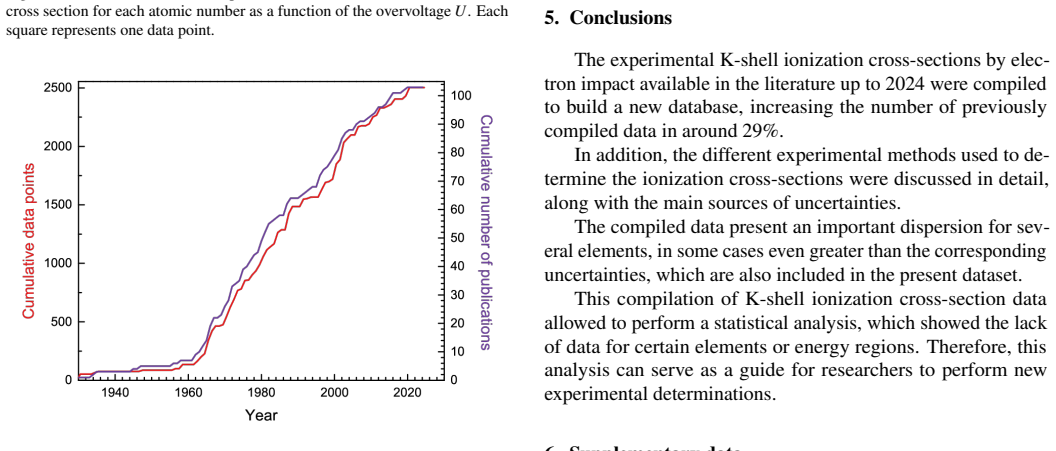
Pith's one-line read The paper compiles 2,509 experimental measurements of electron-impact K-shell ionization cross sections from 103 publications, covering 65 elements up to December 2024.
desk verdict A genuinely useful update to the K-shell ionization compilation, with the caveat that the arXiv version omits the actual data table and the fluorescence-yield conversion injects unquantified systematic uncertainty for low-Z elements. read the letter →
The pith
A machine-rendered reading of the paper's core claim, the machinery that carries it, and where it could break.
The reading
What carries the argument
The load-bearing device is the conversion relation sigma_K = $\sigma$^X_K / omega_K, which turns measured X-ray production cross sections into ionization cross sections; for K shells the X-ray production cross section is the product of sigma_K and the fluorescence yield omega_K. For every entry in which the original publication reported only $\sigma$^X_K, the compilation uses the author-supplied omega_K if present and otherwise the recommended value from the tabulation [20]. The second organizing tool is the overvoltage U = E/I_K, computed with K-shell ionization energies from the tabulation [64], which lets data from elements with very different binding energies be compared on a common energy scale. These two choices carry the whole database: the fluorescence yield determines the numerical value of every X-ray-derived point, and the overvoltage defines the energy bins in which the coverage analysis is made.
What would settle it
Take an element with several database entries derived from X-ray production cross sections (for example carbon) and compare them with a direct measurement of the ionization cross section by Auger electron spectroscopy, which does not require any fluorescence yield. If the X-ray-derived entries differ from the direct measurement by more than the spread among published omega_K values for that element, then the database's conversion step, not the original experiments, is the limiting error.
Extended reading notes
Core claim
The central claim is that this database is now the most complete numerical compilation of experimental K-shell ionization cross sections induced by electron impact, covering 65 elements from H to U with 2,509 data points taken from 103 publications spanning 1930 to 2024. The authors recovered the numerical values from original articles, including graphical data, and organized them by atomic number and overvoltage U = E/I_K. They added 382 values published before 2014 that were absent from the previous compilation and 174 values published after 2013. When a paper reported only the X-ray production cross section, the ionization cross section was recovered by dividing by a fluorescence yield, using the recommended value from the tabulation [20] when the original paper did not state one. A statistical analysis of the resulting table shows that the literature is strongly concentrated near threshold and in a handful of elements, and that no data exist at all for 27 elements in the considered range.
Load-bearing premise
The database is only as trustworthy as the fluorescence yields used to convert measured X-ray yields into ionization cross sections, and for light elements those yields are poorly known: for carbon, published omega_K values range from 0.0009 to 0.0035, a factor of about four, so a wrong choice shifts every derived value for such elements by that factor.
Editorial extensions
If this is right
- The numerical table can be used directly as a benchmark for testing theoretical K-shell ionization models, as the paper does with the distorted-wave Born approximation parameterization [5].
- The gap analysis gives a concrete experimental agenda: 27 elements have no measurements, and 13 have only one or two, so the database points to the targets where any new determination would add the most information.
- Users of electron probe microanalysis, Auger electron spectroscopy, and electron energy-loss spectroscopy can now cite and access a single updated numerical source for sigma_K.
- The concentration of data at overvoltage U < 4 means conclusions about model quality at higher energies rest on much thinner evidence.
- Because 91 percent of non-H/He data come through X-ray methods, the compiled values inherit the uncertainties of the fluorescence yields used to convert them, especially for light elements.
Reading between the lines
- The database would be more durable if the underlying X-ray production cross sections were archived alongside the derived ionization cross sections, since the conversion via omega_K could then be redone when better fluorescence yields appear; the paper itself does not do this.
- The observed spread among experiments, often exceeding reported uncertainties, suggests that a re-analysis of common systematic errors (target thickness, detector efficiency, fluorescence yields) across methods could be as valuable as new measurements.
- The compiled numerical table is a natural training set for empirical parameterizations of sigma_K(Z, E), a step the authors do not attempt here.
- A useful next test would be to compare the compiled values for an element with multiple methods against a measurement that avoids fluorescence yields entirely, to isolate the conversion bias.
Editorial analysis
A structured set of objections, weighed in public.
Referee Report
Summary. This manuscript reports a new compilation of experimental K-shell ionization cross sections by electron impact, covering data published from 1930 to December 2024. The database comprises 2509 data points for 65 elements from H to U, taken from 103 publications, and is presented as an update of earlier compilations: the 1953 data reviewed by Llovet et al. (2014) plus 382 pre-2014 values and 174 post-2013 values. The paper describes the main experimental methods (ion and secondary-electron counting for H and He, X-ray spectroscopy, Auger-electron spectroscopy, and EELS), discusses the principal uncertainty sources for each method, analyzes the distribution of data by atomic number and overvoltage, and compares selected elements with the analytical DWBA/PWBA parameterization of Bote et al. The main numerical table (Table 2) is not included in the arXiv version.
Significance. If the compilation is accurate, it will be a useful community resource: it extends previous compilations by about 29%, records numerical values rather than plots, and is openly accessible through a supplied database link. The authors explicitly identify discrepancies with the Llovet et al. compilation for several elements (e.g., Ti/V/Y/Sn assignments from Westbrook and Quarles, Scholz et al. Ni/Ag/Pt, Motz and Placious Sn, Nagy et al. He), and the method-by-method uncertainty discussion is instructive. The central reliability question is the conversion from X-ray production to ionization cross sections via fluorescence yields for the 91% of non-H/He data obtained by X-ray methods, and the review version must make the full numerical table available for verification.
major comments (3)
- [Sec. 3, Table 2] Section 3 states that 'The collected data are presented in Table 2' and then notes 'Not included in the arXiv version, see Supplementary data.' In the version under review, neither Table 2 nor the supplementary file is available. Because the paper's central claim is the provision of a complete numerical database (2509 values), this omission makes it impossible to verify the data count, the reported sigma_K values and uncertainties, the method/target flags, or the handling of duplicate and digitalized entries. The review version must include the full table (or a machine-readable database) and the digitization protocol.
- [Sec. 3 and Sec. 4, Eq. (1)] When original papers report only sigma^X_K and no omega_K, the authors adopt Perkins et al. [20] and set sigma_K = sigma^X_K / omega_K. Section 4 documents that published omega_K values for carbon span 0.0009 to 0.0035 (a factor of about four), and Fig. 1 shows comparable scatter for other low-Z elements. Since 91% of the non-H/He measurements are X-ray based, a large portion of the database inherits the chosen omega_K, yet the tabulated Delta_sigma_K values do not include the spread of omega_K. The remedy is to list the adopted omega_K for every converted entry, propagate its uncertainty, or flag conversion-limited data so users can reconstruct the sensitivity.
- [Sec. 3, Table 2 description] The text states that for cases where Delta_sigma_K was not found, an estimate is given by considering the main sources of uncertainties, but no transparent rule is provided and the table does not indicate which uncertainties are original and which are estimated. Without this distinction, the reported uncertainties are not reproducible and the dispersion statements in Section 4 are not fully auditable. Please specify the estimation algorithm and mark estimated entries.
minor comments (6)
- [Sec. 3, first paragraph] The phrase 'These data (amounting to 1953 data points for 63 elements) were retrieved from the original articlesyo.' contains a stray 'yo.'; please remove it.
- [Table 1] The header 'Meth./Tar .' has an unintended space before the period, and several entries such as 'Ni 2 .95 × 103' and 'Ag 2 .9 × 103' contain misplaced spaces.
- [Table 1] Several reference fields contain unbalanced brackets, for example the Br row '[Sc72 [52]' and the La row '[Sc72 [52], We87b [55]]'; these should be corrected.
- [References] References [134]-[138] (Espnn, physics-informed machine learning, quantum scientific machine learning, Kieffer and Dunn, Rightmire) are not cited in the body of the manuscript; they should be removed or properly integrated.
- [Sec. 2.1] The expression for sigma_K is typeset as 'N kδ′' without a visible division or fraction operator; please check the mathematical expression.
- [Fig. 1 caption] The caption lists ten literature sources but does not identify the symbol or curve for each; a legend is needed.
Circularity Check
No significant circularity: the database is a compilation of independent experimental values, with external reference tables used for unit conversions only.
full rationale
This paper is a data compilation, not a derivation. Its central product is a table of 2509 measured K-shell ionization cross sections assembled from 103 independent publications. The only nontrivial data-processing step is converting X-ray production cross sections to ionization cross sections via sigma_K = sigma_K^X / omega_K, using the fluorescence yield reported by the original authors or, failing that, the external Perkins et al. table [20]. This is a physical conversion, not a fit to the compiled data, and it does not smuggle the paper's conclusions into its inputs; the same relation is used across all elements and is acknowledged in Section 4 as a source of possible systematic uncertainty for light elements (e.g. C values from 0.0009 to 0.0035). The comparison against Bote et al. [5] is an external DWBA-based parameterization, used only as a visual reference in Fig. 5 and not fitted or tuned to the database. The few self-citations (e.g. Limandri et al. [8], Perez et al. [28]) are simply original experimental papers whose data happen to be included among the 103 compiled sources; they are not cited as authority for the compilation's method or completeness. No prediction is made from a fitted parameter, no uniqueness theorem is invoked, and no result is defined in terms of itself. The acknowledged sparse coverage and fluorescence-yield dispersion are accuracy caveats, not circular reasoning.
Assumptions & free parameters
assumptions (4)
- domain assumption K-shell ionization cross sections are independent of the molecular environment or physical state of the target.
- domain assumption Fluorescence yields from Perkins et al. [20] are valid for converting X-ray production cross sections to ionization cross sections when the original paper does not report omega_K.
- domain assumption The literature search was exhaustive and complete, covering all relevant experimental data up to December 2024.
- domain assumption Graphical data extracted from original papers via digitalization is faithful to the original measurements.
Cite this review
Pith. "Pith review of Experimental cross sections for K-shell ionization by electron impact." pith.science (2026). https://pith.science/paper/WM5U6E75
@misc{pith2026250622856,
  author       = {Pith},
  title        = {Pith review of: Experimental cross sections for K-shell ionization by electron impact},
  year         = {2026},
  howpublished = {\url{https://pith.science/paper/WM5U6E75}},
  note         = {Machine review of arXiv:2506.22856}
}
read the original abstract
A comprehensive compilation of experimental K-shell ionization cross sections induced by electron impact has been assembled, including results up to December 2024. The data are organized according to the target atomic number and to the incident electron energy for elements ranging from H to U. From the 2509 reported data, more than 50% pertain only to 8 elements (H, He, Ar, Cr, Fe, Ni, Cu, and Ag). Conversely, 13 elements have only one or two results, and no data is available for 27 elements in the range of atomic numbers considered. Additionally, a further inspection of the database reveals that the majority of the data is concentrated within a small energy range, spanning up to four times the K-shell ionization energy. Finally, the different methods used to measure the ionization cross section are analyzed and a discussion about the main sources of uncertainties is presented.
Figures


Figures from the paper (2 more)

Reference graph
Works this paper leans on
-
[134]
F. Bivort Haiek, A. M. P. Mendez, C. C. Montanari, D. M. Mit- nik, Espnn: A novel electronic stopping power neural-network code built on the iaea stopping power database. i. atomic tar- gets, Journal of Applied Physics 132 (24) (2022) 245103. arXiv:https://pubs.aip.org/aip/jap/article-pdf/doi/ 10.1063/5.0130875/16522305/245103\_1\_online.pdf, doi:10.1063/...
-
[138]
R. A. Rightmire, J. R. Simanton, T. P. Kohman, Disintegration scheme of long-lived aluminum-26, Phys. Rev. 113 (1959) 1069–1077. doi: 10.1103/PhysRev.113.1069. URL https://link.aps.org/doi/10.1103/PhysRev.113.1069 15
-
[20]
S. T. Perkins, D. E. Cullen, M. H. Chen, J. Rathkopf, J. Scofield, J. H. Hubbell, Tables and graphs of atomic subshell and relaxation data derived from the llnl evaluated atomic data library (eadl), z = 1–100, Tech. rep., Lawrence Livermore National Lab. (LLNL), Livermore, CA (United States) (10 1991). doi:10.2172/10121422. URL https://www.osti.gov/biblio...
arXiv 1991
-
[1]
C. J. Powell, Cross sections for ionization of inner-shell electrons by elec- trons, Rev. Mod. Phys. 48 (1976) 33–47. doi:10.1103/RevModPhys. 48.33. URL https://link.aps.org/doi/10.1103/RevModPhys.48.33
-
[2]
X. Llovet, C. J. Powell, F. Salvat, A. Jablonski, Cross sections for inner- shell ionization by electron impact, J. Phys. Chem. Ref. Data 43 (1) (2014) 013102. doi:10.1063/1.4832851. URL https://doi.org/10.1063/1.4832851
-
[3]
X. Long, M. Liu, F. Ho, X. Peng, Cross sections for k-shell ionization by electron impact, At. Data Nucl. Data Tables 45 (2) (1990) 353–366. doi:https://doi.org/10.1016/0092-640X(90)90011-8 . URL https://www.sciencedirect.com/science/article/pii/ 0092640X90900118
-
[4]
M. Liu, Z. An, C. Tang, Z. Luo, X. Peng, X. Long, Experimental electron- impact k-shell ionization cross sections, Atomic Data and Nuclear Data Tables 76 (2) (2000) 213–234. doi:https://doi.org/10.1006/ adnd.2000.0843. URL https://www.sciencedirect.com/science/article/pii/ S0092640X0090843X
arXiv 2000
-
[6]
D. Rapp, P. Englander-Golden, Total cross sections for ionization and attachment in gases by electron impact. I. Positive ionization, J. Chem. Phys. 43 (5) (1965) 1464–1479. doi:10.1063/1.1696957. URL https://doi.org/10.1063/1.1696957
Show all 143 references
-
[7]
R. G. Montague, M. F. A. Harrison, A. C. H. Smith, A measurement of the cross section for ionisation of helium by electron impact using a fast crossed beam technique, J. Phys. B 17 (16) (1984) 3295–3310. doi:10.1088/0022-3700/17/16/012. URL https://dx.doi.org/10.1088/0022-3700...
1984 doi
-
[8]
S. P. Limandri, M. A. Z. Vasconcellos, R. Hinrichs, J. C. Trincavelli, Experimental determination of cross sections for K-shell ionization by electron impact for C, O, Al, Si, and Ti, Phys. Rev. A 86 (2012) 042701 1–10. doi:10.1103/PhysRevA.86.042701. URL https://link.aps.org/...
2012 doi
-
[9]
Hubbell, P
J. Hubbell, P. Trehan, N. Singh, B. Chand, D. Mehta, M. Garg, R. Garg, S. Singh, S. Puri, A review, bibliography, and tabulation of k, l, and higher atomic shell x-ray fluorescence yields (23) (1994) 339–364. doi: 10.1063/1.555955
1994 doi
-
[10]
Martins, P
L. Martins, P. Amaro, S. Pessanha, M. Guerra, J. Machado, M. L. Car- valho, J. P. Santos, P. Indelicato, Overview and calculation of x-ray k-shell transition yields for comprehensive data libraries, X-Ray Spectrometry 49 (3) (2020) 398–423. doi:https://doi.org/10.1002/xrs.3123...
2020 doi
-
[11]
Bambynek, B
W. Bambynek, B. Crasemann, R. W. Fink, H. U. Freund, H. Mark, C. D. Swift, R. E. Price, P. Venugopala Rao, X-ray fluorescence yields, auger, and coster-kronig transition probabilities, Rev. Mod. Phys. 44 (1972) 716–813. doi:10.1103/RevModPhys.44.716. URL https://link.aps.org/d...
1972 doi
-
[12]
Bambynek, A new evaluation of K-shell fluorescence yields, in: A
W. Bambynek, A new evaluation of K-shell fluorescence yields, in: A. Meisel (Ed.), 84 Proc. X-ray and Inner-Shell Processes in Atoms, Molecules and Solids, Leipzig, DDR, 1984, pp. 20–23
1984
-
[13]
M. O. Krause, Atomic radiative and radiationless yields for K and L shells, Journal of Physical and Chemical Reference Data 8 (2) (1979) 307–327. doi:10.1063/1.555594. URL https://doi.org/10.1063/1.555594
1979 doi
-
[14]
Kahoul, V
A. Kahoul, V . Aylikci, N. K. Aylikci, E. Cengiz, G. Apaydın, Updated database and new empirical values for K-shell fluorescence yields, Ra- diation Physics and Chemistry 81 (7) (2012) 713–727. doi:https: //doi.org/10.1016/j.radphyschem.2012.03.006. URL https://www.sciencedire...
2012 doi
-
[15]
Daoudi, A
K. Daoudi, A. Kahoul, Y . Sahnoune, B. Deghfel, Y . Kasri, F. Khalfallah, V . Aylikci, N. K. Aylikci, D. E. Medjadi, M. Nekkab, New K-shell fluorescence yields curve for elements with 3 ≤ Z ≤ 99, Journal of the Korean Physical Society 67 (9) (2015) 1537–1543.doi:10.3938/jkps. 67.1537
2015 doi
-
[16]
W. Hink, H. Paschke, Der Wirkungsquerschnitt für die Ionisierung der K-Schale von Kohlenstoff durch Elektronenstoß (2–30 keV), Z. Phys. A 244 (1971) 140–148. doi:10.1007/BF01407255. URL https://doi.org/10.1007/BF01407255
1971 doi
-
[17]
C. D. Broyles, D. A. Thomas, S. K. Haynes, The measurement and interpretation of the k auger intensities of sn113, cs137, and au198, Phys. Rev. 89 (1953) 715–724. doi:10.1103/PhysRev.89.715. URL https://link.aps.org/doi/10.1103/PhysRev.89.715
1953 doi
-
[18]
W. F. Frey, R. E. Johnston, J. I. Hopkins, K-series fluorescence yields of vanadium, manganese, and neon, Phys. Rev. 113 (1959) 1057–1060. doi:10.1103/PhysRev.113.1057. URL https://link.aps.org/doi/10.1103/PhysRev.113.1057
1959 doi
-
[19]
Bertrand, F., Charpak, G., Suzor, F., Mesures du rendement de fluorescence de la couche K dans le nickel et le chlore et de la couche L dans l’argent, J. Phys. Radium 20 (12) (1959) 956–958. doi:10.1051/jphysrad:019590020012095600. URL https://doi.org/10.1051/jphysrad: 0195900...
1959 doi
-
[21]
D. L. Gil, D. Windover, Limitations of X-ray reflectometry in the presence of surface contamination, Journal of Physics D: Applied Physics 45 (23) (2012) 235301. doi:10.1088/0022-3727/45/23/235301. URL https://dx.doi.org/10.1088/0022-3727/45/23/235301
2012 doi
-
[22]
Bergese, E
P. Bergese, E. Bontempi, L. Depero, A simple solution to systematic errors in density determination by X-ray reflectivity: The XRR-density evaluation (XRR-DE) method, Applied Surface Science 253 (1) (2006) 28–32. doi:https://doi.org/10.1016/j.apsusc.2006.05.067. URL https://ww...
2006 doi
-
[23]
Pazzaglia, A
A. Pazzaglia, A. Maffini, D. Dellasega, A. Lamperti, M. Passoni, Reference-free evaluation of thin films mass thickness and composi- tion through energy dispersive X-ray spectroscopy, Materials Charac- terization 153 (2019) 92–102. doi:https://doi.org/10.1016/j. matchar.2019.0...
2019 doi
-
[24]
D. H. H. Hoffmann, C. Brendel, H. Genz, W. Löw, S. Müller, A. Richter, 11 Inner-shell ionization by relativistic electron impact, Z. Phys. A. 293 (1979) 187–201. doi:10.1007/BF01435588. URL https://doi.org/10.1007/BF01435588
1979 doi
-
[25]
Hippler, I
R. Hippler, I. McGregor, M. Aydinol, H. Kleinpoppen, Ionization of xenon l subshells by low-energy electron impact, Phys. Rev. A 23 (1981) 1730–1736. doi:10.1103/PhysRevA.23.1730. URL https://link.aps.org/doi/10.1103/PhysRevA.23.1730
1981 doi
-
[26]
Kissel, C
L. Kissel, C. A. Quarles, R. H. Pratt, Shape functions for atomic-field bremsstrahlung from electrons of kinetic energy 1-500 keV on selected neutral atoms 1 ≤ Z ≤ 92, Atomic Data and Nuclear Data Tables 28 (3) (1983) 381–460. doi:https://doi.org/10.1016/0092-640X(83) 90001-3
1983 doi
-
[27]
Z. An, Q. Hou, Inverse problem in the thick-target method of measurements of inner-shell ionization cross sections by electron or positron impact, Phys. Rev. A 77 (2008) 042702. doi:10.1103/PhysRevA.77.042702. URL https://link.aps.org/doi/10.1103/PhysRevA.77. 042702
2008 doi
-
[28]
P. D. Pérez, A. Sepúlveda, G. Castellano, J. Trincavelli, Ex- perimental determination of multiple ionization cross sections in Si by electron impact, Phys. Rev. A 92 (2015) 062708 1–8. doi:10.1103/PhysRevA.92.062708. URL https://link.aps.org/doi/10.1103/PhysRevA.92. 062708
2015 doi
-
[29]
Glupe, W
G. Glupe, W. Mehlhorn, Absolute electron impact ionization cross sec- tions of N, O and Ne, Journal de Physique Colloques 32 (C4) (1971) 40–43. doi:10.1051/jphyscol:1971408. URL https://hal.science/jpa-00214609
1971 doi
-
[30]
W. Hink, L. Kees, H.-P. Schmitt, A. Wolf, Near K-Ionization Thresh- old Auger Electron Measurements for Neon Under Electron Impact, Springer US, Boston, MA, 1981, pp. 327–330. doi:10.1007/ 978-1-4615-9236-5_62 . URL https://doi.org/10.1007/978-1-4615-9236-5_62
1981 doi
-
[31]
Platten, G
H. Platten, G. Schiwietz, G. Nolte, Cross sections for K-shell ionization of Si and Ar by 4 keV to 10 keV electron impact, Phys. Lett. A 107 (2) (1985) 83–86. doi:https://doi.org/10.1016/0375-9601(85) 90201-4. URL https://www.sciencedirect.com/science/article/pii/ 0375960185902014
1985 doi
-
[32]
Quarles, M
C. Quarles, M. Semaan, Characteristic x-ray production by electron bombardment of argon, krypton, and xenon from 4 to 10 keV, Phys. Rev. A 26 (1982) 3147–3151. doi:10.1103/PhysRevA.26.3147. URL https://link.aps.org/doi/10.1103/PhysRevA.26.3147
1982 doi
-
[33]
C. J. Rossouw, M. J. Whelan, The K-shell cross-section for 80 kV elec- trons in single-crystal graphite and AlN, J. Phys. D 12 (5) (1979) 797. doi:10.1088/0022-3727/12/5/021. URL https://dx.doi.org/10.1088/0022-3727/12/5/021
1979 doi
-
[34]
P. C. Colliex, B. Jouffrey, Diffusion inelastique des electrons dans un solide par excitation de niveaux atomiques profonds, Philos. Mag. 25 (2) (1972) 491–511. doi:10.1080/14786437208226818. URL https://doi.org/10.1080/14786437208226818
1972 doi
-
[35]
Isaacson, Interaction of 25 keV electrons with the nucleic acid bases, adenine, thymine, and uracil
M. Isaacson, Interaction of 25 keV electrons with the nucleic acid bases, adenine, thymine, and uracil. II. Inner shell excitation and in- elastic scattering cross sections, J. Chem. Phys. 56 (5) (1972) 1813–1818. doi:10.1063/1.1677457. URL https://doi.org/10.1063/1.1677457
1972 doi
-
[36]
R. F. Egerton, Inelastic scattering of 80 keV electrons in amor- phous carbon, Philos. Mag. 31 (1) (1975) 199–215. doi:10.1080/ 14786437508229296. URL https://doi.org/10.1080/14786437508229296
1975 doi
-
[37]
P. T. Smith, The ionization of helium, neon, and argon by electron impact, Phys. Rev. 36 (1930) 1293–1302. doi:10.1103/PhysRev.36.1293. URL https://link.aps.org/doi/10.1103/PhysRev.36.1293
1930 doi
-
[38]
J. W. Liska, Efficiencies of ionization of helium and mercury by electron impact at high voltages, Phys. Rev. 46 (1934) 169–176. doi:10.1103/ PhysRev.46.169. URL https://link.aps.org/doi/10.1103/PhysRev.46.169
1934 doi
-
[39]
Harrison, The Experimental Determination of Ionization Cross Sec- tions of Gases Under Electron Impact, Thesis Ph
H. Harrison, The Experimental Determination of Ionization Cross Sec- tions of Gases Under Electron Impact, Thesis Ph. D., The Catholic University of America, Washington, DC., 1956
1956
-
[40]
W. L. Fite, R. T. Brackmann, Collisions of electrons with hydrogen atoms. I. Ionization, Phys. Rev. 112 (1958) 1141–1151. doi:10.1103/ PhysRev.112.1141. URL https://link.aps.org/doi/10.1103/PhysRev.112.1141
1958 doi
-
[41]
Downey, Electron Impact Studies of Gaseous Ionic Phenomena, The- sis Ph.D., Liverpool University., 1962
M. Downey, Electron Impact Studies of Gaseous Ionic Phenomena, The- sis Ph.D., Liverpool University., 1962. URL https://books.google.com.ar/books?id=Xno20AEACAAJ
1962
-
[42]
E. W. Rothe, L. L. Marino, R. H. Neynaber, S. M. Trujillo, Electron impact ionization of atomic hydrogen and atomic oxygen, Phys. Rev. 125 (1962) 582–583. doi:10.1103/PhysRev.125.582. URL https://link.aps.org/doi/10.1103/PhysRev.125.582
1962 doi
-
[43]
K. K. Asundi, M. V . Kurepa, Ionization cross sections in He, Ne, A, Kr and Xe by electron impact, Journal of Electronics and Control 15 (1) (1963) 41–50. doi:10.1080/00207216308937549. URL https://doi.org/10.1080/00207216308937549
1963 doi
-
[44]
Schram, F
B. Schram, F. De Heer, M. van der Wiel, J. Kistemaker, Ionization cross sections for electrons (0.6–20 keV) in noble and diatomic gases, Physica 31 (1) (1965) 94–112. doi:https://doi.org/10.1016/ 0031-8914(65)90109-6 . URL https://www.sciencedirect.com/science/article/pii/ 003...
1965
-
[45]
Adamczyk, A
B. Adamczyk, A. J. H. Boerboom, B. L. Schram, J. Kistemaker, Partial ionization cross sections of He, Ne, H2, and CH4 for electrons from 20 to 500 ev, J. Chem. Phys. 44 (12) (1966) 4640–4642. doi:10.1063/1. 1726690. URL https://doi.org/10.1063/1.1726690
1966 doi
-
[46]
Schram, H
B. Schram, H. Moustafa, J. Schutten, F. de Heer, Ionization cross sections for electrons (100–600 eV) in noble and diatomic gases, Physica 32 (4) (1966) 734–740. doi:https://doi.org/10.1016/0031-8914(66) 90005-X. URL https://www.sciencedirect.com/science/article/pii/ 003189146690005X
1966 doi
-
[47]
Gaudin, Albert, Hagemann, Robert, Déterminations absolues des sections efficaces totales et partielles d’ionisation de l’hélium, du néon, de l’argon et de l’acétylène, pour des électrons de 100 à 2000 eV, J. Chim. Phys. 64 (1967) 1209–1221. doi:10.1051/jcp/1967641209. URL http...
1967
-
[48]
S. G. Shchemelinin, E. P. Andreev, Absolute cross sections for single and multiple electron-impact ionization of He, Ne, and Ar, Sov. Phys. - Tech. Phys. (Engl. Transl.) 20 (1975) 941–943. URL https://www.osti.gov/biblio/4005627
1975
-
[49]
Brook, M
E. Brook, M. F. A. Harrison, A. C. H. Smith, Measurements of the electron impact ionisation cross sections of He, C, O and N atoms, J. Phys. B 11 (17) (1978) 3115–3132. doi:10.1088/0022-3700/11/17/021. URL https://dx.doi.org/10.1088/0022-3700/11/17/021
1978 doi
-
[50]
P. Nagy, A. Skutlartz, V . Schmidt, Absolute ionisation cross sections for electron impact in rare gases, J. Phys. B 13 (6) (1980) 1249–1267. doi:10.1088/0022-3700/13/6/028. URL https://dx.doi.org/10.1088/0022-3700/13/6/028
1980 doi
-
[51]
G. G. Dolgov-Savelev, V . E. Panchenko, Electron-excitation cross sec- tions for X-ray series of chlorine, argon, and xenon., Opt. Spectrosc. (USSR) (Engl. Transl.) 28: 575-8 (01 1970). URL https://www.osti.gov/biblio/4066184
1970
-
[52]
Scholz, A
W. Scholz, A. Li-Scholz, R. Collé, I. L. Preiss, K-shell ionization cross sections for 2.04-MeV electrons, Phys. Rev. Lett. 29 (1972) 761–764. doi:10.1103/PhysRevLett.29.761. URL https://link.aps.org/doi/10.1103/PhysRevLett.29. 761
1972 doi
-
[53]
G. R. Dangerfield, B. M. Spicer, K-shell ionization by relativistic elec- trons, J. Phys. B 8 (10) (1975) 1744. doi:10.1088/0022-3700/8/10/ 022. URL https://dx.doi.org/10.1088/0022-3700/8/10/022
1975 doi
-
[54]
Watanabe, T
Y . Watanabe, T. Kubozoe, T. Tomimasu, T. Mikado, T. Yamazaki, K -shell ionization by relativistic electron impact, Phys. Rev. A 35 (1987) 1423–1425. doi:10.1103/PhysRevA.35.1423. URL https://link.aps.org/doi/10.1103/PhysRevA.35.1423
1987 doi
-
[55]
G. L. Westbrook, C. Quarles, Total cross sections for ionization of the K-shell by electron bombardment, Nucl. Instr. Meth. Phys. B 24-25 (1987) 196–198. doi:https://doi.org/10.1016/0168-583X(87) 90621-5. URL https://www.sciencedirect.com/science/article/pii/ 0168583X87906215 12
1987 doi
-
[56]
Aydinol, X-ray production and ionisation cross sections of K shell of argon by electron impact near threshold, Indian J
M. Aydinol, X-ray production and ionisation cross sections of K shell of argon by electron impact near threshold, Indian J. Pure Appl. Phys. 45 (2007) 641–646
2007
-
[57]
J. M. Fernández-Varea, V . Jahnke, N. L. Maidana, A. A. Malafronte, V . R. Vanin, Cross sections of K-shell ionization by electron impact, measured from threshold to 100 keV, for Au and Bi, J. Phys. B 47 (15) (2014) 155201 1–9. doi:10.1088/0953-4075/47/15/155201. URL https://d...
2014 doi
-
[58]
S. F. Barros, V . R. Vanin, N. L. Maidana, J. M. Fernández-Varea, Ion- ization cross sections of the L subshells of Au by 50 to 100 keV elec- tron impact, J. Phys. B 48 (17) (2015) 175201 1–12. doi:10.1088/ 0953-4075/48/17/175201. URL https://dx.doi.org/10.1088/0953-4075/48/17/175201
2015 doi
-
[59]
C. S. Mei, Y . Wu, Y . Yuan, C. H. Chang, Z. C. Qian, J. J. Zhu, K. Moharram, Measurements of K-shell ionization cross sections of Al and L-shell x-ray production cross sections of Se by intermediate- energy electron impact, J. Phys. B 49 (24) (2016) 245204 1–6. doi: 10.1088/0...
2016 doi
-
[60]
Vanin, M
V . Vanin, M. Manso Guevara, N. Maidana, M. Martins, J. Fernández- Varea, Ag K-shell ionization by electron impact: New cross-section measurements between 50 and 100 keV and review of previous ex- perimental data, Radiat. Phys. Chem. 119 (2016) 14–23. doi:https: //doi.org/10.1...
2016 doi
-
[61]
O. C. B. Santos, V . R. Vanin, N. L. Maidana, M. N. Martins, M. H. Tabacniks, C. L. Rodrigues, T. F. Silva, A. D. Santos, S. F. Barros, J. A. García-Alvarez, M. F. Koskinas, J. M. Fernández-Varea, M. S. Pindzola, Experimental and theoretical cross sections for K-shell ionizati...
2019 doi
-
[62]
Y .-H. Li, Z. An, J.-J. Zhu, L. Li, Characteristic X-ray yields and cross sections of thick targets of Al, Ti, Zr, W and Au induced by keV-electron impact., Acta Phys. Sin. 69 (20200264) (2020) 133401–1. doi:10.7498/aps.69.20200264. URL https://wulixb.iphy.ac.cn//article/id/ f...
2020 doi
-
[63]
L. Tian, C. Dai, Y . Liu, Measurements of K-shell ionization cross sections of Fe, Ni, and Zn by 7–29 keV electron impact using the thick-target method, Can. J. Phys. 98 (10) (2020) 970–975. doi:https://doi. org/10.1139/cjp-2019-0652 . URL https://www.sciencedirect.com/science...
2020 doi
-
[64]
Larkins, Semiempirical auger-electron energies for elements 10≤ Z ≤ 100, Atomic Data and Nuclear Data Tables 20 (4) (1977) 311–387
F. Larkins, Semiempirical auger-electron energies for elements 10≤ Z ≤ 100, Atomic Data and Nuclear Data Tables 20 (4) (1977) 311–387. doi:https://doi.org/10.1016/0092-640X(77)90024-9 . URL https://www.sciencedirect.com/science/article/pii/ 0092640X77900249
1977 doi
-
[65]
J. W. Motz, R. C. Placious, K-ionization cross sections for relativistic electrons, Phys. Rev. 136 (1964) A662–A665. doi:10.1103/PhysRev. 136.A662. URL https://link.aps.org/doi/10.1103/PhysRev.136.A662
1964 doi
-
[66]
J. C. Clark, A measurement of the absolute probability of K-electron ionization of silver by cathode rays, Phys. Rev. 48 (1935) 30–42. doi: 10.1103/PhysRev.48.30. URL https://link.aps.org/doi/10.1103/PhysRev.48.30
1935 doi
-
[67]
K. H. Berkner, S. N. Kaplan, R. V . Pyle, Cross sections for K-shell ionization of Pd and Au by 2.5 and 7.1 Mev electrons, Bull. Am . Phys. Soc. 11 (15) (1970) 786
1970
-
[68]
Ishii, M
K. Ishii, M. Kamiya, K. Sera, S. Morita, H. Tawara, M. Oyamada, T. C. Chu, Inner-shell ionization by ultrarelativistic electrons, Phys. Rev. A 15 (1977) 906–913. doi:10.1103/PhysRevA.15.906. URL https://link.aps.org/doi/10.1103/PhysRevA.15.906
1977 doi
-
[69]
R. W. Fink, R. C. Jopson, H. Mark, C. D. Swift, Atomic fluores- cence yields, Rev. Mod. Phys. 38 (1966) 513–540. doi:10.1103/ RevModPhys.38.513. URL https://link.aps.org/doi/10.1103/RevModPhys.38.513
1966 doi
-
[70]
J. A. Bearden, A. F. Burr, Reevaluation of x-ray atomic energy levels, Rev. Mod. Phys. 39 (1967) 125–142. doi:10.1103/RevModPhys.39.125. URL https://link.aps.org/doi/10.1103/RevModPhys.39.125
1967 doi
-
[71]
Lotz, Electron binding energies in free atoms ∗, J
W. Lotz, Electron binding energies in free atoms ∗, J. Opt. Soc. Am. 60 (2) (1970) 206–210. doi:10.1364/JOSA.60.000206. URL https://opg.optica.org/abstract.cfm?URI= josa-60-2-206
1970 doi
-
[72]
Naumkin, A
A. Naumkin, A. Kraut-Vass, S. W. Gaarenstroom, C. J. Powell, NIST x-ray photoelectron spectroscopy database, NIST standard reference database 20, version 5.0, Tech. rep., National Institute of Stan- dards and Technology, Gaithersburg, MD, available at http://srdata.nist.gov/xp...
2023
-
[73]
M. B. Shah, D. S. Elliott, H. B. Gilbody, Pulsed crossed-beam study of the ionisation of atomic hydrogen by electron impact, J. Phys. B 20 (14) (1987) 3501–3514. doi:10.1088/0022-3700/20/14/022. URL https://dx.doi.org/10.1088/0022-3700/20/14/022
1987 doi
-
[74]
T. W. Shyn, Doubly differential cross sections of secondary electrons ejected from atomic hydrogen by electron impact, Phys. Rev. A 45 (1992) 2951–2956. doi:10.1103/PhysRevA.45.2951. URL https://link.aps.org/doi/10.1103/PhysRevA.45.2951
1992 doi
-
[75]
Stephan, H
K. Stephan, H. Helm, T. D. Märk, Mass spectrometric determination of partial electron impact ionization cross sections of He, Ne, Ar and Kr from threshold up to 180 eV, J. Chem. Phys. 73 (8) (1980) 3763–3778. doi:10.1063/1.440606. URL https://doi.org/10.1063/1.440606
1980 doi
-
[76]
R. C. Wetzel, F. A. Baiocchi, T. R. Hayes, R. S. Freund, Absolute cross sections for electron-impact ionization of the rare-gas atoms by the fast- neutral-beam method, Phys. Rev. A 35 (1987) 559–577. doi:10.1103/ PhysRevA.35.559. URL https://link.aps.org/doi/10.1103/PhysRevA.35.559
1987 doi
-
[77]
M. B. Shah, D. S. Elliott, P. McCallion, H. B. Gilbody, Single and double ionisation of helium by electron impact, J. Phys. B 21 (15) (1988) 2751–
1988
-
[78]
Rejoub, B
R. Rejoub, B. G. Lindsay, R. F. Stebbings, Determination of the absolute partial and total cross sections for electron-impact ionization of the rare gases, Phys. Rev. A 65 (2002) 042713 1. doi:10.1103/PhysRevA.65.042713. URL https://link.aps.org/doi/10.1103/PhysRevA.65. 042713
2002 doi
-
[79]
Glupe, W
G. Glupe, W. Mehlhorn, A new method for measuring electron impact ionization cross sections of inner shells, Phys. Lett. A 25 (3) (1967) 274–
1967
-
[80]
Tawara, K
H. Tawara, K. Harrison, F. De Heer, X-ray emission cross sections and fluorescence yields for light atoms and molecules by electron impact, Physica 63 (2) (1973) 351–367. doi:https://doi.org/10.1016/ 0031-8914(73)90321-2 . URL https://www.sciencedirect.com/science/article/pii/...
1973
-
[81]
Kamiya, A
M. Kamiya, A. Kuwako, K. Ishii, S. Morita, M. Oyamada, Density effect in K-shell ionization by ultrarelativistic electrons, Phys. Rev. A 22 (1980) 413–420. doi:10.1103/PhysRevA.22.413. URL https://link.aps.org/doi/10.1103/PhysRevA.22.413
1980 doi
-
[82]
S. C. McDonald, B. M. Spicer, Density effect in K-shell ionization by relativistic electron impact, Phys. Rev. A 37 (1988) 985–987. doi: 10.1103/PhysRevA.37.985. URL https://link.aps.org/doi/10.1103/PhysRevA.37.985
1988 doi
-
[83]
W. Hink, A. Ziegler, Der Wirkungsquerschnitt für die Ionisierung der K-Schale von Aluminium durch Elektronenstoß (3–30 keV), Z. Phys. A 236 (1969) 222–234. doi:10.1007/BF01392087. URL https://doi.org/10.1007/BF01392087
1969 doi
-
[84]
Shchagin, V
A. Shchagin, V . Pristupa, N. Khizhnyak, K-shell ionization cross section of Si atoms by relativistic electrons, Nucl. Instr. Meth. Phys. Res. B 84 (1) (1994) 9–13. doi:https://doi.org/10.1016/0168-583X(94) 95696-0. URL https://www.sciencedirect.com/science/article/pii/ 016858...
1994 doi
-
[85]
J. Zhu, Z. An, M. Liu, L. Tian, Measurements of the K-shell ionization cross sections of Si by 3–25-keV electron impact us- ing the thick-target method, Phys. Rev. A 79 (2009) 052710 1–7. 13 doi:10.1103/PhysRevA.79.052710. URL https://link.aps.org/doi/10.1103/PhysRevA.79. 052710
2009 doi
-
[86]
Y . Wu, Z. An, Y . Duan, M. Liu, Measurements of K-shell ionization cross-sections of S, Ca and Zn by 7–30 keV electron impact, Nucl. Instr. Meth. Phys. B 268 (17) (2010) 2820–2824. doi:https://doi.org/ 10.1016/j.nimb.2010.06.010. URL https://www.sciencedirect.com/science/arti...
2010 doi
-
[87]
Y . Wu, Z. An, Y . Duan, M. Liu, J. Wu, K-shell ionization cross sections of Cl and L α, L β x-ray production cross sections of Ba by 6–30kev electron impact, Nucl. Inst. Meth. Phys. Res. B 269 (2) (2011) 117–121. doi:https://doi.org/10.1016/j.nimb.2010.11.005. URL https://www...
2011 doi
-
[88]
Hippler, K
R. Hippler, K. Saeed, I. McGregor, H. Kleinpoppen, Energy dependence of characteristic and bremsstrahlung cross sections of argon induced by electron bombardment at low energies, Zeitschrift für Physik A Atoms and Nuclei 307 (1982) 83–87. doi:10.1007/BF01416075. URL https://do...
1982 doi
-
[89]
Hippler, H
R. Hippler, H. Klar, K. Saeed, I. McGregor, A. J. Duncan, H. Kleinpop- pen, Threshold behaviour of Ar K and Xe L3 ionisation by electron im- pact, J. Phys. B 16 (20) (1983) L617–L621.doi:10.1088/0022-3700/ 16/20/004. URL https://dx.doi.org/10.1088/0022-3700/16/20/004
1983 doi
-
[90]
R. K. Singh, R. Shanker, The emission of characteristic and non- characteristic x-rays from collisions of 10–22 keV electrons with argon, J. Phys. B 36 (14) (2003) 3031–3042. doi:10.1088/0953-4075/36/ 14/306. URL https://dx.doi.org/10.1088/0953-4075/36/14/306
2003 doi
-
[91]
V . P. Shevelko, A. M. Solomon, V . S. Vukstich, K-shell ionization of free metal atoms K, Ca, Rb and Sr by electron impact, Phys. Scr. 43 (2) (1991)
1991
-
[92]
Y . Wu, Z. An, Y . Duan, M. Liu, X. Ouyang, K-shell ionization cross sections of K and Lα X-ray production cross sections of I by 10–30 keV electron impact, Can. J. Phys. 90 (2) (2012) 125–130. doi:10.1139/ p11-149. URL https://doi.org/10.1139/p11-149
2012 doi
-
[93]
Z. An, C. H. Tang, C. G. Zhou, Z. M. Luo, Measurement of scandium and vanadium K-shell ionization cross sections by electron impact, J. Phys. B 33 (18) (2000) 3677–3684. doi:10.1088/0953-4075/33/18/315. URL https://dx.doi.org/10.1088/0953-4075/33/18/315
2000 doi
-
[94]
Jessenberger, W
J. Jessenberger, W. Hink, Absolute electron impact K-ionization cross sections of titanium and nickel (≤ 50 keV), Z. Phys. A 275 (1975) 331–
1975
-
[95]
F. He, X. Peng, X. Long, Z. Luo, Z. An, K-shell ionization cross sections by electron bombardment at low energies, Nucl. Instrum. Methods Phys. Res. B 129 (4) (1997) 445–450. doi:https://doi.org/10.1016/ S0168-583X(97)00163-8 . URL https://www.sciencedirect.com/science/article...
1997
-
[96]
Z. An, M. Liu, Y . Fu, Z. Luo, C. Tang, C. Li, B. Zhang, Y . Tang, Some recent progress on the measurement of K-shell ionization cross-sections of atoms by electron impact: Application to Ti and Cr elements, Nucl. Instrum. Methods Phys. Res. B 207 (3) (2003) 268–274. doi:https...
2003 doi
-
[97]
Z. Luo, Z. An, F. He, T. Li, X. Long, X. Peng, Correction of the influence of the substrate upon the measurement of K-shell ionization cross sections, J. Phys. B 29 (17) (1996) 4001–4005. doi:10.1088/0953-4075/29/ 17/020. URL https://dx.doi.org/10.1088/0953-4075/29/17/020
1996 doi
-
[98]
Llovet, C
X. Llovet, C. Merlet, F. Salvat, Measurements of K-shell ionization cross sections of Cr, Ni and Cu by impact of 6.5-40 keV electrons, J. Phys. B 33 (18) (2000) 3761–3772. doi:10.1088/0953-4075/33/18/323. URL https://dx.doi.org/10.1088/0953-4075/33/18/323
2000 doi
-
[99]
Fischer, K
B. Fischer, K. W. Hoffmann, Die Intensität der Bremsstrahlung und der charakteristischenK-Röntgenstrahlung dünner Anoden, Z. Phys. 204 (2) (1967) 122–128. doi:10.1007/BF01326127. URL https://doi.org/10.1007/BF01326127
1967 doi
-
[100]
Shima, Mn and Cu K-shell ionization cross sections by slow electron impact, Phys
K. Shima, Mn and Cu K-shell ionization cross sections by slow electron impact, Phys. Lett. A 77 (4) (1980) 237–239. doi:https://doi.org/ 10.1016/0375-9601(80)90654-4 . URL https://www.sciencedirect.com/science/article/pii/ 0375960180906544
1980 doi
-
[101]
Z. Luo, Z. An, T. Li, L. Wang, Q. Zhu, X. Xia, Measurement of K-shell ionization cross sections of Fe and Mn by electron impact, J. Phys. B 30 (11) (1997) 2681–2686. doi:10.1088/0953-4075/30/11/018. URL https://dx.doi.org/10.1088/0953-4075/30/11/018
1997 doi
-
[102]
C. Tang, Z. An, T. Li, Z. Luo, Measurement of zinc and manganese K-shell ionization cross-sections by electron impact, Nucl. Instr. Meth. Phys. Res. B 155 (1) (1999) 1–5. doi:https://doi.org/10.1016/ S0168-583X(99)00298-0 . URL https://www.sciencedirect.com/science/article/pii...
1999
-
[103]
Llovet, C
X. Llovet, C. Merlet, F. Salvat, Measurements of absolute cross sections for K-shell ionization of Fe and Mn by electron impact, J. Phys. B 35 (4) (2002) 973–982. doi:10.1088/0953-4075/35/4/320. URL https://dx.doi.org/10.1088/0953-4075/35/4/320
2002 doi
-
[104]
F. He, X. Long, X. Peng, Z. Luo, Z. An, K-shell ionization of iron by electron bombardment, Acta Phys. Sin. (Overseas Edition) 5 (7) (1996)
1996
-
[105]
Z. An, T. H. Li, L. M. Wang, X. Y . Xia, Z. M. Luo, Correction of substrate effect in the measurement of 8–25-keV electron-impact K-shell ionization cross sections of Cu and Co elements, Phys. Rev. A 54 (1996) 3067–3069. doi:10.1103/PhysRevA.54.3067. URL https://link.aps.org/d...
1996 doi
-
[106]
A. E. Smick, P. Kirkpatrick, Absolute K-ionization cross section of the nickel atom under electron bombardment at 70 kv, Phys. Rev. 67 (1945) 153–161. doi:10.1103/PhysRev.67.153. URL https://link.aps.org/doi/10.1103/PhysRev.67.153
1945 doi
-
[107]
L. T. Pockman, D. L. Webster, P. Kirkpatrick, K. Harworth, The proba- bility of K ionization of nickel by electrons as a function of their energy, Phys. Rev. 71 (1947) 330–338. doi:10.1103/PhysRev.71.330. URL https://link.aps.org/doi/10.1103/PhysRev.71.330
1947 doi
-
[108]
S. A. H. Seif el Nasr, D. Berényi, G. Bibok, Inner shell ionization cross sections for relativistic electrons, Z. Phys. 267 (3) (1974) 169–174. doi: 10.1007/BF01669216. URL https://doi.org/10.1007/BF01669216
1974 doi
-
[109]
H. Genz, C. Brendel, P. Eschwey, U. Kuhn, W. Löw, A. Richter, P. Seserko, R. Sauerwein, Search for the density effect in inner-shell lonization by ultra relativistic electron impact, Z. Phys. 305 (1982) 9–19. doi:10.1007/BF01415072. URL https://doi.org/10.1007/BF01415072
1982 doi
-
[110]
Z. An, Y . Wu, M. Liu, Y . Duan, C. Tang, Thick-target method in the mea- surement of inner-shell ionization cross-sections by low-energy electron impact, Nucl. Instrum. Methods Phys. Res. B 246 (2) (2006) 281–287. doi:https://doi.org/10.1016/j.nimb.2005.12.051. URL https://ww...
2006 doi
-
[111]
L. M. Middleman, R. L. Ford, R. Hofstadter, Measurement of cross sections for x-ray production by high-energy electrons, Phys. Rev. A 2 (1970) 1429–1443. doi:10.1103/PhysRevA.2.1429. URL https://link.aps.org/doi/10.1103/PhysRevA.2.1429
1970 doi
-
[112]
Davis, V
D. Davis, V . Mistry, C. Quarles, Inner shell ionization of copper, silver and gold by electron bombardment, Phys. Lett. A 38 (3) (1972) 169–170. doi:https://doi.org/10.1016/0375-9601(72)90461-6 . URL https://www.sciencedirect.com/science/article/pii/ 0375960172904616
1972 doi
-
[113]
Hübner, K
H. Hübner, K. Ilgen, K. W. Hoffmann, Messung des Wirkungsquer- schnitts für Ionisierung in derK-Schale durch Elektronenstoβ, Z. Phys. A. 255 (1972) 269–280. doi:10.1007/BF01394633. URL https://doi.org/10.1007/BF01394633
1972 doi
-
[114]
Berenyi, G
D. Berenyi, G. Hock, S. Ricz, B. Schlenk, A. Valek, K α/Kβ X-ray intensity ratios and K-shell ionisation cross sections for bombardment by electrons of 300-600 keV, J. Phys. B 11 (4) (1978) 709–713. doi: 10.1088/0022-3700/11/4/018. URL https://dx.doi.org/10.1088/0022-3700/11/4/018 14
1978 doi
-
[115]
Shima, T
K. Shima, T. Nakagawa, K. Umetani, T. Mikumo, Threshold behavior of Cu-, Ge-, Ag-k-, and Au-L3-shell ionization cross sections by electron impact, Phys. Rev. A 24 (1981) 72–78. doi:10.1103/PhysRevA.24. 72. URL https://link.aps.org/doi/10.1103/PhysRevA.24.72
1981 doi
-
[116]
C. Zhou, Z. An, Z. Luo, Measurement and correction of K-Shell ioniza- tion cross sections for copper and gallium by electron impact, Chin. Phys. Lett. 18 (6) (2001) 759. doi:10.1088/0256-307X/18/6/315. URL https://dx.doi.org/10.1088/0256-307X/18/6/315
2001 doi
-
[117]
C. Tang, Z. Luo, Z. An, T. Li, Measurement of zinc K-shell ionization cross sections by electron impact, Chin. Phys. Lett. 16 (7) (1999) 505. doi:10.1088/0256-307X/16/7/013. URL https://dx.doi.org/10.1088/0256-307X/16/7/013
1999 doi
-
[118]
Chang-Geng, A
Z. Chang-Geng, A. Zhu, L. Zheng-Ming, Measurement and correction of K-shell ionization cross sections for copper and gallium by electron impact, Chin. Phys. Lett. 18 (6) (2001) 759.doi:10.1088/0256-307X/ 18/6/315. URL https://dx.doi.org/10.1088/0256-307X/18/6/315
2001 doi
-
[119]
C. Zhou, Z. An, Z. Luo, Measurement of K-shell production cross sec- tions for Ga, Ge and Zr elements by electron impact, J. Phys. B 35 (4) (2002) 841–845. doi:10.1088/0953-4075/35/4/309. URL https://dx.doi.org/10.1088/0953-4075/35/4/309
2002 doi
-
[120]
Merlet, X
C. Merlet, X. Llovet, J. M. Fernández-Varea, Absolute K-shell ionization cross sections and L α and Lβ1 x-ray production cross sections of Ga and As by 1.5–39 keV electrons, Phys. Rev. A 73 (2006) 062719 1–10. doi:10.1103/PhysRevA.73.062719. URL https://link.aps.org/doi/10.110...
2006 doi
-
[121]
C. Tang, Z. An, Z. Luo, M. Liu, Measurements of germanium K-shell ionization cross sections and tin L-shell x-ray production cross sections by electron impact, J. Appl. Phys. 91 (10) (2002) 6739–6743. doi: 10.1063/1.1470248. URL https://doi.org/10.1063/1.1470248
2002 doi
-
[122]
Merlet, X
C. Merlet, X. Llovet, F. Salvat, Measurements of absolute K-shell ionization cross sections and L-shell x-ray production cross sections of Ge by electron impact, Phys. Rev. A 69 (2004) 032708 1–7. doi:10.1103/PhysRevA.69.032708. URL https://link.aps.org/doi/10.1103/PhysRevA.69. 032708
2004 doi
-
[123]
Z. Luo, C. Tang, Z. An, F. He, X. Peng, X. Long, Selenium and yttrium K-shell ionization cross-sections by electron impact, Phys. Rev. A 63 (2001) 034702 1–3. doi:10.1103/PhysRevA.63.034702. URL https://link.aps.org/doi/10.1103/PhysRevA.63. 034702
2001 doi
-
[124]
K. Kiss, G. Kálmán, J. Pálinkás, B. Schlenk, Investigation of inner-shell ionization by electron impact in the 60–600 keV energy region, Acta Phys. Acad. Sci. Hung. 50 (1981) 97–102. doi:10.1007/BF03157961. URL https://doi.org/10.1007/BF03157961
1981 doi
-
[125]
Hansen, H
H. Hansen, H. Weigmann, A. Flammersfeld, Messung des wirkungsquer- schnitts für K-ionisierung durch negatonen- und positonenstoß, Nucl. Phys. 58 (1964) 241–253. doi:10.1016/0029-5582(64)90534-6 . URL https://www.sciencedirect.com/science/article/pii/ 0029558264905346
1964 doi
-
[126]
X. Peng, F. He, X. Long, Z. Luo, Z. An, Cross sections for K-shell ionization of niobium by electron impact, Phys. Rev. A 58 (1998) 2034–
1998
-
[127]
F. He, X. Long, X. Peng, Z. Luo, Z. An, K-shell ionization of molyb- denum by electron bombardment, Nuclear Instruments and Methods in Physics Research Section B: Beam Interactions with Materials and Atoms 114 (3) (1996) 213–216. doi:https://doi.org/10.1016/ 0168-583X(96)00193...
1996
-
[128]
S. Ricz, B. Schlenk, D. Berényi, G. Hock, A. Valek, K-shell ionization cross sections of Pd, Ag, In and Sn for relativistic electrons, Acta Phys. Acad. Sci. Hung. 42 (1977) 269–271. doi:10.1007/BF03157496. URL https://doi.org/10.1007/BF03157496
1977 doi
-
[129]
Hansen, A
H. Hansen, A. Flammersfeld, Messung des wirkungsquerschnitts für K-ionisierung durch stoss niederenergetischer negatonen und positonen, Nucl. Phys. 79 (1) (1966) 135–144. doi:10.1016/0029-5582(66) 90396-8. URL https://www.sciencedirect.com/science/article/pii/ 0029558266903968
1966 doi
-
[130]
D. H. Rester, W. E. Dance, K-shell ionization of Ag, Sn, and Au from electron bombardment, Phys. Rev. 152 (1966) 1–3. doi:10.1103/ PhysRev.152.1. URL https://link.aps.org/doi/10.1103/PhysRev.152.1
1966 doi
-
[131]
Schlenk, D
B. Schlenk, D. Berényi, S. Ricz, A. Valek, G. Hock, Inner-shell ionization by electrons in the 300–600 keV region, Acta Phys. Acad. Sci. Hung. 41 (1976) 159–163. doi:10.1007/BF03159401. URL https://doi.org/10.1007/BF03159401
1976 doi
-
[132]
Schneider, I
H. Schneider, I. Tobehn, F. Ebel, R. Hippler, Absolute cross sections for inner shell ionization by lepton impact, Phys. Rev. Lett. 71 (1993) 2707–2709. doi:10.1103/PhysRevLett.71.2707. URL https://link.aps.org/doi/10.1103/PhysRevLett.71. 2707
1993 doi
-
[133]
G. G. Dolgov-Savelev, V . E. Panchenko, Cross sections for the excitation of the K series of argon by electron collision., Opt. Spectrosc. (USSR) (Engl. Transl.), 25: 270-2 (01 1968). URL https://www.osti.gov/biblio/4814886
1968
-
[135]
Z. Hao, S. Liu, Y . Zhang, C. Ying, Y . Feng, H. Su, J. Zhu, Physics- informed machine learning: A survey on problems, methods and applica- tions, arXiv preprint arXiv:2211.08064 (2022). URL https://arxiv.org/abs/2211.08064
2022 arXiv
-
[136]
Jaderberg, A
B. Jaderberg, A. A. Gentile, A. Ghosh, V . E. Elfving, C. Jones, D. V odola, J. Manobianco, H. Weiss, Potential of quantum scientific machine learning applied to weather modeling, Physical Review A 110 (5) (2024) 052423. doi:10.1103/PhysRevA.110.052423. URL https://journals.ap...
2024 doi
-
[137]
L. J. Kieffer, G. H. Dunn, Electron impact ionization cross-section data for atoms, atomic ions, and diatomic molecules: I. Experimental data, Rev. Mod. Phys. 38 (1966) 1–35. doi:10.1103/RevModPhys.38.1. URL https://link.aps.org/doi/10.1103/RevModPhys.38.1
1966 doi
-
[158]
URL https://dx.doi.org/10.1088/0031-8949/43/2/007
doi:10.1088/0031-8949/43/2/007. URL https://dx.doi.org/10.1088/0031-8949/43/2/007
-
[275]
URL https://www.sciencedirect.com/science/article/pii/ 0375960167909012
doi:https://doi.org/10.1016/0375-9601(67)90901-2 . URL https://www.sciencedirect.com/science/article/pii/ 0375960167909012
-
[337]
URL https://doi.org/10.1007/BF01434021
doi:10.1007/BF01434021. URL https://doi.org/10.1007/BF01434021
-
[499]
URL https://dx.doi.org/10.1088/1004-423X/5/7/003
doi:10.1088/1004-423X/5/7/003. URL https://dx.doi.org/10.1088/1004-423X/5/7/003
-
[2036]
URL https://link.aps.org/doi/10.1103/PhysRevA.58.2034
doi:10.1103/PhysRevA.58.2034. URL https://link.aps.org/doi/10.1103/PhysRevA.58.2034
-
[2761]
URL https://dx.doi.org/10.1088/0953-4075/21/15/019
doi:10.1088/0953-4075/21/15/019. URL https://dx.doi.org/10.1088/0953-4075/21/15/019
Reviewed August 6, 2026 · model on record in the stance chip above.
Discussion (0). Sign in to comment.