REVIEW 4 major objections 5 minor 33 references
Coordinated 2D-3D Visualization of Volumetric Medical Data in XR with Multimodal Interactions
T0 review · 4 major / 5 minor · reviewed 2026-08-06 · deepseek-v4-flash
Pith's one-line read This paper claims that an XR system synchronizing 2D radiological slices with 3D anatomical models, plus LLM-driven voice commands, makes volumetric medical data exploration faster and less mentally demanding for non-experts.
desk verdict A real XR medical visualization system with a sensible design, but with n=5 per group and descriptive statistics only, the efficiency and workload claims are not supported. read the letter →
The pith
A machine-rendered reading of the paper's core claim, the machinery that carries it, and where it could break.
The reading
What carries the argument
The load-bearing mechanism is the bidirectional spatial-coherence algorithm, with world-to-volume mapping $f_{w2v}: \mathbb{R}^3 \to \mathbb{Z}^3$ and volume-to-world mapping $f_{v2w}: \mathbb{Z}^3 \to \mathbb{R}^3$, which keeps the Volumetric Slice Planes (VSPs) and the 3D mesh registered to the same voxel grid. An automatic calibration aligns the bounding boxes of a pre-segmented volume and a mesh model using percentage-based interpolation, so the mapping works without manual coordinate alignment. A reactive MVVM state layer propagates any change from 2D UI, direct 3D manipulation, or voice commands to all views, which is what turns the spatial mapping into synchronized visualization and enables the efficiency gains reported.
What would settle it
Load a mesh with a deliberately introduced scale or offset error, have users point to a 3D landmark and say which slice index contains it, and measure the mismatch: if the error is more than a couple of voxel slices, the coordination benefit claimed here would not survive without manual recalibration.
Extended reading notes
Core claim
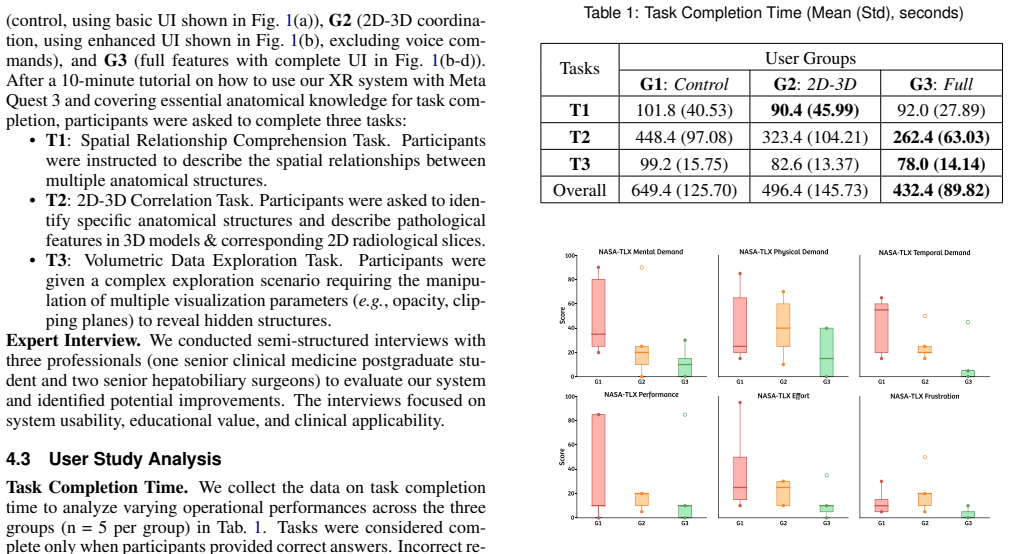
The paper's central claim is that spatial coherence between 2D slices and 3D models, plus natural-language voice control, materially improves non-expert exploration of volumetric medical data in XR. It reports that participants using the coordinated 2D-3D interface were 10% faster at describing spatial relationships among structures and 28-41% faster at matching structures across 2D and 3D views than a control group using a basic UI. Adding LLM-enabled voice commands made structure identification another 18.9% faster and volumetric exploration 5.6% faster than coordination alone, and lowered reported workload by 50-66% on the NASA-TLX. Full-system users also gave a mean System Usability Scale score of 87.0, in the 'excellent' range. The intended consequence is that medical education and clinical review can use this design to reduce the steep spatial-reasoning curve normally associated with reading radiological volumes.
Load-bearing premise
The coordinated views work only if anatomical structures are pre-segmented and if the automatic bounding-box calibration aligns the mesh model and the volume's voxel grid accurately; if that alignment is off, the claimed spatial-understanding gains would be artifacts of mismatched displays.
Editorial extensions
If this is right
- Users without medical training can locate and name anatomical structures across 2D slices and 3D models faster when the views are synchronized in XR.
- Voice commands driven by an LLM reduce the need to memorize interface syntax, and the speed gain appears on top of coordinated visualization rather than replacing it.
- Combining coordination with voice input lowers subjective workload by a large margin (50-66% on NASA-TLX) while raising usability into the 'excellent' SUS range.
- A stable frame rate of 63-83 FPS at about 1.27 GB memory suggests the approach is feasible on current standalone XR hardware for real-time medical tasks.
Reading between the lines
- An unstated consequence is that the same coordination pipeline could apply to other imaging modalities such as MRI or ultrasound volumes, provided segmentation exists, with the bounding-box calibration becoming the limiting factor.
- A testable extension is to compare LLM voice commands against a fixed keyword-command set to isolate whether the benefit comes from natural-language understanding or from voice input itself; the current study does not separate these.
- If the workload reduction generalizes beyond the 15 participants tested, the design could transfer to surgical planning and patient consultation, where the interviewed experts saw potential but also requested specialized tools.
Editorial analysis
A structured set of objections, weighed in public.
Referee Report
Summary. The paper presents an XR system for volumetric medical data visualization that combines a coordinated 2D-3D visualization module (Multi-layered Multi-planar Reconstruction with 3D mesh models, synchronized via Volumetric Slice Planes and a bidirectional spatial coherence algorithm) with a multimodal interaction framework (hand gestures plus LLM-enabled voice commands). The evaluation consists of a 15-participant user study comparing three configurations (control, coordination-only, full features) and semi-structured interviews with three experts. The authors report improved task completion times, higher SUS scores for the full-featured group, and reduced NASA-TLX workload, and they conclude that all three hypotheses H1-H3 are validated. The paper also provides a demo application and supplemental materials.
Significance. If the reported results were statistically established, the system would be a useful contribution to XR-based medical visualization and education. The coordinated 2D-3D visualization addresses a real problem in correlating radiological slices with 3D anatomy, the LLM-based voice interaction is a timely and potentially flexible interaction choice, and the public availability of demo and supplemental materials is a concrete strength. The system description is detailed and generally clear, and the authors are appropriately cautious in the conclusion where they call for larger-scale and long-term evaluations. However, the central efficiency and workload claims rest on a descriptive-only comparison of three groups of five participants each, and the manuscript uses language such as "validated," "confirmed," and "significantly lower" that is not supported by the reported data. The current evidence is promising but preliminary, so the central claims need revision or additional analysis before the paper can be accepted.
major comments (4)
- [§4.3 and §4.4] The manuscript claims in §4.4 that H1, H2, and H3 are "validated" and "confirmed," and that NASA-TLX shows "significantly lower cognitive load" (a 50-66% reduction), but §4.3 explicitly states that the analysis focuses on descriptive statistics, and no inferential test, confidence interval, or effect size is reported anywhere. With n=5 per group, the observed differences may be well within sampling variation; for example, the NASA-TLX overall workload for G3 (M=12.67, SD=14.09) and G2 (M=25.5, SD=9.82) have heavily overlapping standard deviations, and the T3 G3-vs-G2 difference is only 4.6 seconds (5.6%) against standard deviations near 14 seconds. This is a load-bearing issue because H1-H3 are the only quantitative evidence for the paper's central claim that the system improves efficiency and reduces workload.
- [§3.1, Spatial Coherence] The spatial coherence algorithm is central to the coordinated 2D-3D visualization, yet the paper does not provide any validation or error analysis of the automatic calibration procedure. The calibration aligns the mesh model's bounding box to the segmentation volume's voxel space using percentage-based interpolation, and it requires pre-segmented anatomical structures; without quantitative evidence that this alignment is accurate, a mismatch between the 2D slices and 3D models would directly undermine any measured improvement in spatial comprehension, making the observed task-time differences an artifact of misalignment rather than evidence for the system's design.
- [§4.3 and §4.4, SUS results] The SUS results are internally inconsistent with the claim that the coordinated 2D-3D feature improves usability. §4.3 reports that the coordination-only group G2 has a lower mean SUS score (74.5) than the control group G1 (80.5), yet §4.4 uses the high SUS of G3 (87.0) as evidence for H3, which concerns the integrated system. Because the full-featured G3 condition adds both coordination and voice commands relative to the control, the G3 advantage cannot be attributed specifically to the 2D-3D coordination, and the G2-vs-G1 comparison actually contradicts that attribution; a statistical analysis separating the factors is needed.
- [§4.3 and §4.4, Task T3] The claim in §4.3 and §4.4 that voice commands become more effective when combined with coordinated 2D-3D visualization is not supported by the reported data. For T3, G3 (M=78.0s) is only 5.6% faster than G2 (M=82.6s), a difference of 4.6 seconds, and no variability information or inferential test is provided for this specific comparison. The authors should either report a statistical test or explicitly present the result as a descriptive trend rather than a confirmed hypothesis.
minor comments (5)
- [§5 and Abstract] The abstract and §5 should be aligned: the abstract states 'comprehensive evaluation' while §5 appropriately calls the user study 'preliminary user studies with 15 participants.' Please revise the abstract to use 'preliminary' or 'exploratory' consistently.
- [Figure 3] The y-axis label 'NASA T ask Load Index' contains a typographical error; it should read 'NASA Task Load Index.'
- [§4.2] The participant demographics are heavily unbalanced (13 males, 2 females), and no analysis of gender or prior XR experience is reported; at minimum, the authors should acknowledge this as a limitation in the conclusions.
- [§4.3, Table 1] The task completion time table reports means and standard deviations but no confidence intervals; adding 95% confidence intervals for the group differences would make the variability visible and help readers calibrate the strength of the descriptive trends.
- [§3.1] The paper references 'the supplemental material' for algorithmic details of the spatial coherence calibration and synchronization procedures; since the supplemental material is not included with the arXiv submission, the authors should ensure it is available at the OSF link and clearly describe the calibration accuracy there.
Circularity Check
No significant circularity: the paper's claims rest on an empirical 15-participant user study, not on fitted parameters or load-bearing self-citations.
full rationale
The paper does not derive its outcomes from the model's inputs. H1-H3 are assessed by directly measuring task completion times, SUS scores, and NASA-TLX ratings across three system configurations (Sections 4.2-4.4), so the reported 'predictions' are empirical observations rather than quantities that reduce by construction. The spatial coherence mapping (fw2v and fv2w) is an algorithmic implementation for coordinate alignment; its reliance on pre-segmented structures is an engineering assumption, and the mapping itself does not produce any of the measured performance differences. Self-citations such as CVHSlicer 2.0 [22] and the extended-reality survey [21] appear only as background context in Related Work and are not used to justify the central evaluation claims, so they are not load-bearing. The paper's main weaknesses are statistical and design-based, not circular: the study uses descriptive statistics only (Section 4.3), with n=5 per group, and some voice commands (e.g., 'Show the liver', 'Highlight the tumors' in Section 3.2) overlap with the T2 identification task, which could inflate G3's advantage. These are confounds and missing-support issues that bear on correctness and interpretation, but they do not constitute a derivation that is equivalent to its own inputs. The paper also explicitly frames the evaluation as preliminary and calls for larger-scale future validation, which is consistent with an empirical report rather than a forced self-referential derivation. Under the paper's own equations and citations, no fitted parameter is renamed as a prediction and no self-cited uniqueness theorem is invoked to force the system choice.
Assumptions & free parameters
assumptions (4)
- domain assumption Pre-segmented anatomical structures are required for the system
- domain assumption The 3D-IRCADb-02 dataset provides accurate segmentations and mesh models
- domain assumption Self-reported SUS and NASA-TLX scores are valid proxies for usability and cognitive load
- domain assumption A 10-minute tutorial adequately controls for prior XR and anatomy knowledge
Cite this review
Pith. "Pith review of Coordinated 2D-3D Visualization of Volumetric Medical Data in XR with Multimodal Interactions." pith.science (2026). https://pith.science/paper/JQZ7ZQGY
@misc{pith2026250622926,
  author       = {Pith},
  title        = {Pith review of: Coordinated 2D-3D Visualization of Volumetric Medical Data in XR with Multimodal Interactions},
  year         = {2026},
  howpublished = {\url{https://pith.science/paper/JQZ7ZQGY}},
  note         = {Machine review of arXiv:2506.22926}
}
read the original abstract
Volumetric medical imaging technologies produce detailed 3D representations of anatomical structures. However, effective medical data visualization and exploration pose significant challenges, especially for individuals with limited medical expertise. We introduce a novel XR-based system with two key innovations: (1) a coordinated visualization module integrating Multi-layered Multi-planar Reconstruction with 3D mesh models and (2) a multimodal interaction framework combining hand gestures with LLM-enabled voice commands. We conduct preliminary evaluations, including a 15-participant user study and expert interviews, to demonstrate the system's abilities to enhance spatial understanding and reduce cognitive load. Experimental results show notable improvements in task completion times, usability metrics, and interaction effectiveness enhanced by LLM-driven voice control. While identifying areas for future refinement, our findings highlight the potential of this immersive visualization system to advance medical training and clinical practice. Our demo application and supplemental materials are available for download at: https://osf.io/bpjq5/.
Figures


Reference graph
Works this paper leans on
- [1]
-
[2]
J. L. Byl, R. Sholler, J. M. Gosnell, B. P. Samuel, and J. J. Vet- tukattil. Moving beyond two-dimensional screens to interactive three- dimensional visualization in congenital heart disease.Int J Cardiovasc Imaging, 36(8):1567–1573, 2020. 1, 2
work page 2020
-
[3]
M. Chikobava, A. Moisieiev, T. A. Schmeyer, P. Poller, M. Deru, A. Ndiaye, A. Klimenko, C. Braun, J. Baus, and B. Brandherm. Mul- timodal interactive system for visualization of energy data in extended reality (xr) settings. In International Conference on Human-Computer Interaction, pp. 163–168. Springer, 2023. 2
work page 2023
-
[4]
R. Cui, S. He, and S. Qiu. Adaptive low rank adaptation of segment anything to salient object detection. arXiv preprint arXiv:2308.05426,
- [5]
-
[6]
M. Friedrich, S. Langer, and F. Frey. Combining gesture and voice control for mid-air manipulation of cad models in vr environments. In VISIGRAPP (2: HUCAPP), pp. 119–127, 2021. 2
work page 2021
-
[7]
P. Garc ´ıa-Robles, I. Cort ´es-P´erez, F. A. Nieto-Esc ´amez, H. Garc ´ıa- L´opez, E. Obrero-Gait´an, and M. C. Osuna-P ´erez. Immersive virtual reality and augmented reality in anatomy education: a systematic re- view and meta-analysis. Anat. Sci. Educ. , 17(3):514–528, 2024. 1, 2
work page 2024
-
[8]
A. Guillot, S. Champely, C. Batier, P. Thiriet, and C. Collet. Relation- ship between spatial abilities, mental rotation and functional anatomy learning. Adv. Health Sci. Educ., 12:491–507, 2007. 1
work page 2007
Show all 33 references
-
[9]
Heinrich, K
F. Heinrich, K. Bornemann, L. Polenz, K. Lawonn, and C. Hansen. Clutch & grasp: Activation gestures and grip styles for device-based interaction in medical spatial augmented reality. Int. J. Hum.-Comput. Stud., 180:103117, 2023. doi: 10.1016/j.ijhcs.2023.103117 2
2023
-
[10]
Heng and L
Y . Heng and L. Gu. Gpu-based volume rendering for medical image visualization. In 2005 IEEE Engineering in Medicine and Biology 27th Annual Conference, pp. 5145–5148. IEEE, 2006. 2
2005
-
[11]
Huang, J
J. Huang, J. D. Plasencia, D. M. Bardo, N. C. Huber, E. G. Ellsworth, S. D. Zangwill, and C. Bryan. Phoenix virtual heart: A hybrid vr- desktop visualization system for cardiac surgery planning and edu- cation. In 2021 IEEE Workshop on Visual Analytics in Healthcare (VAHC), pp...
2021
-
[12]
U. Khan, A. Yasin, M. Abid, I. Shafi, and S. A. Khan. A methodolog- ical review of 3d reconstruction techniques in tomographic imaging. J. Med. Syst., 42(10):190, 2018. 2
2018
-
[13]
Klonig and M
J. Klonig and M. Herrlich. Integrating 3d and 2d views of medical image data in virtual reality for efficient navigation. In 2020 IEEE International Conference on Healthcare Informatics (ICHI), pp. 1–7. IEEE, 2020. 2
2020
-
[14]
V . B. H. Mandalika, A. I. Chernoglazov, M. Billinghurst, C. Bartneck, M. A. Hurrell, N. d. Ruiter, A. P. Butler, and P. H. Butler. A hybrid 2d/3d user interface for radiological diagnosis. J. Digital Imaging , 31:56–73, 2018. 1
2018
-
[15]
Martelli, C
N. Martelli, C. Serrano, H. van den Brink, J. Pineau, P. Prognon, I. Borget, and S. El Batti. Advantages and disadvantages of 3- dimensional printing in surgery: a systematic review. Surgery, 159(6):1485–1500, 2016. 1
2016
-
[16]
N. Max. Optical models for direct volume rendering. IEEE Trans. Visual Comput. Graphics, 1(2):99–108, 1995. 1
1995
-
[17]
Meta horizon documentation
Meta. Meta horizon documentation. https://developers.meta. com/horizon/documentation/unity/ts-odh/, 2024. Accessed: 2024-09-18. 3
2024
-
[18]
Meta quest 3
Meta. Meta quest 3. https://www.meta.com/quest/quest-3/,
-
[19]
Mixed reality toolkit-unity
Microsoft. Mixed reality toolkit-unity. https://github.com/ MixedRealityToolkit/MixedRealityToolkit-Unity, 2024. Accessed: 2024-09-18. 3
2024
-
[20]
Paudyal, A
R. Paudyal, A. Shah, O. Akin, R. K. G. Do, A. S. Konar, V . Hat- zoglou, U. Mahmood, N. Lee, R. Wong, S. Banerjee, J. Shin, H. Veer- araghavan, and A. Shukla-Dave. Artificial intelligence in ct and mr imaging for oncological applications. Cancers, 15, 2023. doi: 10. 3390/cance...
2023
-
[21]
S. Qiu, B. Xie, Q. Liu, and P.-A. Heng. Advancing extended reality with 3d gaussian splatting: Innovations and prospects. In 2025 IEEE International Conference on Artificial Intelligence and eXtended and Virtual Reality (AIxVR), pp. 203–208, 2025. 1
2025
-
[22]
Y . Qiu, Y . Tong, Y . Zhang, Q. Liu, J. Pei, S. Qiu, P.-A. Heng, and C.-W. Fu. Cvhslicer 2.0: Immersive and interactive visualization of chinese visible human data in xr environments. In 2025 IEEE Confer- ence on Virtual Reality and 3D User Interfaces Abstracts and Work- shop...
2025
-
[23]
R. Shi, Y . Wei, X. Qin, P. Hui, and H.-N. Liang. Exploring gaze- assisted and hand-based region selection in augmented reality. Proc. ACM Hum.-Comput. Interact., 7(ETRA):1–19, 2023. 2
2023
-
[24]
Soler, A
L. Soler, A. Hostettler, V . Agnus, A. Charnoz, J.-B. Fasquel, J. Moreau, A.-B. Osswald, M. Bouhadjar, and J. Marescaux. 3d image reconstruction for comparison of algorithm database. URL: https://www. ircad. fr/research/data-sets/liver-segmentation-3d- ircadb-01, 2010. 3
2010
-
[25]
Sutherland, J
J. Sutherland, J. Belec, A. Sheikh, L. Chepelev, W. Althobaity, B. J. W. Chow, D. Mitsouras, A. Christensen, F. J. Rybicki, and D. J. La Russa. Applying Modern Virtual and Augmented Reality Technologies to Medical Images and Models. J. Digital Imaging , 32(1):38–53, Feb
-
[26]
Technologies
U. Technologies. Unity 2022 lts. https://unity.com/releases/ 2022-lts, 2024. Accessed: 2024-09-18. 3
2022
-
[27]
Technologies
U. Technologies. Unity memory profiler documenta- tion. https://docs.unity3d.com/Packages/com.unity. memoryprofiler@1.1/manual/index.html, 2024. Accessed: 2024-09-18. 3
2024
-
[28]
Venkatesan, H
M. Venkatesan, H. Mohan, J. R. Ryan, C. M. Sch ¨urch, G. P. Nolan, D. H. Frakes, and A. F. Coskun. Virtual and augmented reality for biomedical applications. Cell Rep. Med., 2(7), 2021. 2
2021
-
[29]
Wit.ai: Natural language for developers
Wit.ai. Wit.ai: Natural language for developers. https://wit.ai/,
-
[30]
X. Yan, Y . Zhu, L. Fang, P. Ding, S. Fang, J. Zhou, and J. Wang. Enhancing medical education in respiratory diseases: efficacy of a 3d printing, problem-based, and case-based learning approach. BMC Med. Educ., 23(1):512, 2023. 2
2023
-
[31]
R. Zhu, D. Kang, K.-H. Hui, Y . Qian, S. Qiu, Z. Dong, L. Bao, P.-A. Heng, and C.-W. Fu. Ssp: Semi-signed prioritized neural fitting for surface reconstruction from unoriented point clouds. In Proceedings of the IEEE/CVF Winter Conference on Applications of Computer Vi- sion, ...
2024
-
[32]
Accessed: 2024-09-18. 3
2024
-
[2019]
doi: 10.1007/s10278-018-0122-7 2
Reviewed August 6, 2026 · model on record in the stance chip above.
Discussion (0). Sign in to comment.