REVIEW 3 major objections 3 minor 40 references
Synergizing Implicit and Explicit User Interests: A Multi-Embedding Retrieval Framework at Pinterest
T0 review · 3 major / 3 minor · reviewed 2026-08-06 · deepseek-v4-flash
Pith's one-line read This paper claims that a multi-embedding retrieer combining implicit interest clustering with explicit followed-topic retrieval improves user interest coverage and engagement in a deployed home feed.
desk verdict A deployed, internally consistent industrial retrieval system with real A/B gains; the main caveat is that the explicit model's training data comes from the legacy retriever it replaces, so the complementarity claim is less clean than presented. read the letter →
The pith
A machine-rendered reading of the paper's core claim, the machinery that carries it, and where it could break.
The reading
What carries the argument
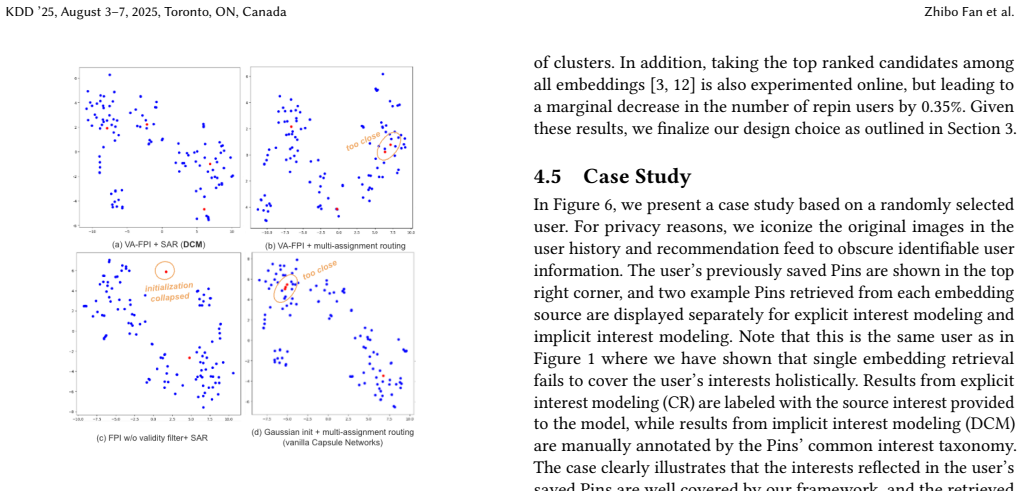
The load-bearing machinery is the pair of condition mechanisms. DCM is a differentiable clustering module that summarizes each user's recent engagements into K_im=7 cluster embeddings serving as multiple user embeddings in the two-tower score f(i|u,c)=exp($\varphi$(u,c)^T psi(i)), with VA-FPI selecting diverse, valid cluster seeds and Single-Assignment Routing masking softmax weights to keep centroids apart; implicit condition association is done by argmax over the user embeddings in the sampled-softmax loss. CR uses K_ex=5 followed-topic embeddings as conditions, with condition association performed at action-logging time rather than training time, plus an item-to-topic post-filter as a relevance guardrail. At serving time, candidates from all embeddings are merged round-robin with deduplication and per-cluster budgets weighted by routing weights, which prevents one dominant interest from flooding the candidate set.
What would settle it
Compare CR trained on inverted-index-generated engagement logs against CR trained on engagement logs collected under uniform random exploration across all followed topics; if retrieval quality on rarely surfaced topics does not improve, or if the 3.2% candidate overlap grows substantially, the complementarity claim would be weakened. A simpler check is to measure topic-level recall of CR on topics the legacy inverted index rarely retrieved.
Extended reading notes
Core claim
The central discovery is that implicit and explicit interest conditions can be treated through a common lens—condition construction plus condition association—and that doing both in one retrieval pipeline yields candidates neither source finds alone. DCM constructs implicit interest conditions by differentiable clustering of the user's engagement sequence, with Validity-Aware Farthest Point Initialization and Single-Assignment Routing to keep cluster centroids spread out, then associates each positive item to its best-matching cluster via an argmax in the sampled-softmax loss. CR constructs explicit conditions by embedding followed topics into the user tower and associates conditions to items at logging time, using the source interest of real engagements rather than randomly sampled item attributes. The paper reports that this source-interest association beats item-attribute association offline and online, that a relevance post-filter on explicit retrieval adds engagement, and that the deployed combination yields sitewide repin +0.48%, home-feed repin +1.09%, and A-Pincepts +0.81%. The 3.2% average overlap between implicit- and explicit-retrieved candidates is presented as evidence that the two models are strongly complementary.
Load-bearing premise
The load-bearing premise is that the explicit-interest model's training labels, taken from engagements produced by the legacy inverted-index retriever, faithfully represent users' true followed-topic interests; if that retriever surfaced a limited or biased set of topics, the CR model would inherit the bias and the reported complementarity could shrink.
Editorial extensions
If this is right
- Deploying a multi-embedding retrieval stage this way should increase the diversity of what users see, because the round-robin merge plus per-cluster budgets keeps torso and tail interests represented.
- Explicit-interest retrieval should help low-activity, new, and resurrected users disproportionately, since it does not depend on a long engagement sequence; the reported non-core cohort lifts, such as +1.46% HF Repins for marginal users, support this.
- Logging-time condition association should be preferred over sampling conditions from item attributes when building conditional retrieval training data, because it aligns the condition with the user's actual followed interest.
- The small 3.2% candidate overlap implies the two models can be combined with little redundant computation, so their gains are largely additive.
- Serving overhead remains modest: the paper reports p90 latency rising from 150ms to 205ms while keeping the retrieval budget on par with single-embedding retrieval.
Reading between the lines
- Editorial extension: the paper does not analyze whether the CR model inherits topic biases from the inverted-index retriever whose engagement logs form its training data; if that retriever under-served certain topics, CR may reproduce the blind spot rather than remove it.
- Editorial extension: the condition construction and association framing suggests the same recipe could be applied to other explicit signals such as boards, searches, or follow graphs, and to non-topic conditions like time horizons or freshness preferences.
- Editorial extension: the winner-takes-all collapse argument implies that any randomly initialized multi-embedding model needs either Gumbel-softmax gradient flow or cluster-diverse initialization; this is a testable design rule for other retrieval models.
- Editorial extension: a longer-horizon A/B test with random exploration in the explicit retriever would show whether the +1.09% repin gain persists once the ranking layer adapts to the new candidate mix.
Editorial analysis
A structured set of objections, weighed in public.
Referee Report
Summary. This paper describes a deployed multi-embedding retrieval framework at Pinterest. It combines an implicit-interest model (Differentiable Clustering Module, DCM) that produces K_im user embeddings via validity-aware farthest-point initialization and single-assignment routing, with an explicit-interest model (Conditional Retrieval, CR) that produces K_ex embeddings conditioned on followed topics. The manuscript frames both components under a common condition-construction/condition-association view, reports offline hit-rate comparisons against self-attention, interest-token, MIND, and PinnerFormer-subsequence baselines, and presents online A/B results including a joint-framework experiment (sitewide repins +0.48%, home-feed repins +1.09%, A-Pincepts +0.81%). The authors conclude that the framework improves user interest coverage and engagement across user segments and has been deployed to the Pinterest home feed.
Significance. If the reported online gains are taken at face value, the paper makes a solid industrial contribution: it demonstrates that conditioning retrieval embeddings on both mined and explicitly followed interests can improve engagement and diversity, and it provides a useful decomposition of multi-interest retrieval into condition construction and condition association. The DCM ablations (VA-FPI and single-assignment routing) are presented in enough detail to permit reimplementation, and the comparison against MIND and self-attention baselines is informative. The manuscript's impact is currently limited by missing statistical detail in the headline online tables and by a potential selection-bias issue in the construction of the explicit-interest training data, so the strength of the complementarity claim is not yet fully established.
major comments (3)
- [§3.3.2] Section 3.3.2 states that CR training triples (condition, user, item) are formed at action-logging time from engagements served by the legacy inverted-index retriever, and that CR then replaced that retriever while keeping the same logging-time condition association. This makes the legacy retriever the data generator for its own replacement: the CR model can learn to rank items the inverted index exposed, but it cannot learn to retrieve items for a followed topic that the index never surfaced. As a result, the online gains in Table 3 and the joint lift in Table 5 may reflect better ranking within the legacy candidate distribution rather than broader explicit-interest coverage, and the 3.2% overlap statistic in Section 3.4 is not by itself evidence of complementary interest discovery because both models are evaluated on item spaces shaped by the same legacy exposure. The paper should analyze the coverage of the inverted index (e.g., distribution of topics and long-tail items it served), quantify how many candidates retrieved by CR were never exposed by the index, and/or correct the training data for selection bias.
- [§3.2.2, Eq. (6)] Equation (6) does not implement the described validity filter. If I_valid(e_i)=1 for valid items and 0 for invalid items, then the objective arg max_i min_j -I_valid(e_i) c_j^T e_i is 0 for every invalid item, while valid items with positive similarity to any centroid receive negative scores; the arg max will therefore select invalid (out-of-distribution) embeddings as centroids, which is the opposite of the intended masking. If instead I_valid is meant to be 1 for invalid items, the name and surrounding text conflict with the definition. Because VA-FPI is a central component of DCM and ablation Table 6 shows it contributes to the online gains, this equation must be corrected (e.g., adding a large negative penalty or -infinity for invalid items) and the implementation should be verified against the stated behavior.
- [§4.3, Tables 3–5] Tables 4 and 5 report relative lifts without confidence intervals, p-values, or significance markers, and Table 5 is described only as a 'retrospective experiment' with no experimental protocol. Table 3 partially mitigates this by labeling significance via color, but the color coding is not visible in the arXiv/grayscale version and the header row is garbled, making it impossible to determine which treatments correspond to which columns. Since the paper's central claims—DCM superiority and the joint framework's gains—depend on these numbers, the authors should specify the A/B setup (control, treatment, randomization unit, number of users, duration, significance thresholds), report confidence intervals or significance markers for every row, and clarify whether Table 5 is a controlled experiment or a before-after deployment comparison.
minor comments (3)
- [§4.3, Table 3] The table header appears malformed and the significance color coding is not visible in black-and-white printing; please use textual markers such as asterisks or superscripts to indicate statistical significance.
- [§4.1.1] The label sampling and weighting details are omitted 'for brevity'; since these affect the offline evaluation, please include them in an appendix or cite a public description of the label construction.
- [Appendix B] The heading contains a typo: 'PinnerFormer Subsequnce' should be 'PinnerFormer Subsequence'.
Circularity Check
No significant circularity: the headline gains are measured online A/B lifts rather than quantities derived from fitted inputs; the only self-citation (CR [14]) is used as a component and is re-validated and modified, so it is not load-bearing.
full rationale
The paper does not present a derivation in which an output is equivalent to an input by construction. DCM and CR are trained with sampled-softmax objectives (Eq. 9) on logged engagements, and the headline results (Tables 3-5) are online A/B lifts, not values computed from fitted constants or from the same data used to define the models. The only self-citation is Conditional Retrieval [14], whose author list overlaps with the present paper; CR is used as a component, but the paper re-evaluates it against an inverted-index control, modifies its condition association (source interest at logging time), and adds an explicit relevance filter, so the citation is not load-bearing for the central claim. The Section 3.3.2 dependency — training CR on engagements generated by the legacy inverted-index retriever that CR later replaces — is a genuine selection-bias and feedback-loop risk for the coverage interpretation, but it is a data-source bias rather than a circular reduction: CR could plausibly fail or succeed relative to the inverted index even though it was trained on that index's exposure log, and the paper's 3.2% candidate-overlap claim is an empirical observation, not an identity forced by the training procedure. Appendix C also transparently notes that the new-user cohort metrics do not reach the 0.05 p-value threshold due to small population. Overall, the derivation chain is self-contained against external benchmarks such as MIND and self-attention, and no fitted parameter is renamed as a prediction.
Assumptions & free parameters
free parameters (3)
- K_im =
7
- K_ex =
5
- PFS cluster count =
32
assumptions (4)
- domain assumption A user's historical engagement sequence can be meaningfully partitioned into a small fixed number (K_im=7) of latent interest clusters that capture the diversity of the user's interests.
- domain assumption Explicitly followed topics are a valid and sufficiently complete representation of long-term user interests, and the source-interest logging from the legacy inverted-index retriever provides training data aligned with true user intent.
- domain assumption Offline HR on a 1M-item corpus and online metrics (HF Repins, A-Pincepts) are valid proxies for user interest coverage and feed quality.
- standard math Sampled softmax with logQ correction yields unbiased gradient estimates for the retrieval loss.
Cite this review
Pith. "Pith review of Synergizing Implicit and Explicit User Interests: A Multi-Embedding Retrieval Framework at Pinterest." pith.science (2026). https://pith.science/paper/DJRA7J5D
@misc{pith2026250623060,
  author       = {Pith},
  title        = {Pith review of: Synergizing Implicit and Explicit User Interests: A Multi-Embedding Retrieval Framework at Pinterest},
  year         = {2026},
  howpublished = {\url{https://pith.science/paper/DJRA7J5D}},
  note         = {Machine review of arXiv:2506.23060}
}
read the original abstract
Industrial recommendation systems are typically composed of multiple stages, including retrieval, ranking, and blending. The retrieval stage plays a critical role in generating a high-recall set of candidate items that covers a wide range of diverse user interests. Effectively covering the diverse and long-tail user interests within this stage poses a significant challenge: traditional two-tower models struggle in this regard due to limited user-item feature interaction and often bias towards top use cases. To address these issues, we propose a novel multi-embedding retrieval framework designed to enhance user interest representation by generating multiple user embeddings conditioned on both implicit and explicit user interests. Implicit interests are captured from user history through a Differentiable Clustering Module (DCM), whereas explicit interests, such as topics that the user has followed, are modeled via Conditional Retrieval (CR). These methodologies represent a form of conditioned user representation learning that involves condition representation construction and associating the target item with the relevant conditions. Synergizing implicit and explicit user interests serves as a complementary approach to achieve more effective and comprehensive candidate retrieval as they benefit on different user segments and extract conditions from different but supplementary sources. Extensive experiments and A/B testing reveal significant improvements in user engagements and feed diversity metrics. Our proposed framework has been successfully deployed on Pinterest home feed.
Figures


Figures from the paper (2 more)

Reference graph
Works this paper leans on
-
[1]
David Arthur and Sergei Vassilvitskii. 2006. k-means++: The advantages of careful seeding. Technical Report. Stanford
work page 2006
-
[2]
Yoshua Bengio and Jean-Sébastien Senécal. 2003. Quick training of probabilistic neural nets by importance sampling. In International Workshop on Artificial Intelligence and Statistics. PMLR, 17–24
work page 2003
-
[3]
Yukuo Cen, Jianwei Zhang, Xu Zou, Chang Zhou, Hongxia Yang, and Jie Tang
-
[4]
Zheng Chai, Zhihong Chen, Chenliang Li, Rong Xiao, Houyi Li, Jiawei Wu, Jingxu Chen, and Haihong Tang. 2022. User-aware multi-interest learning for candidate matching in recommenders. In Proceedings of the 45th International ACM SIGIR Conference on Research and Development in Information Retrieval . 1326–1335
work page 2022
-
[5]
Paul Covington, Jay Adams, and Emre Sargin. 2016. Deep neural networks for youtube recommendations. In Proceedings of the 10th ACM conference on recommender systems. 191–198
2016
-
[6]
Shangfeng Dai, Haobin Lin, Zhichen Zhao, Jianying Lin, Honghuan Wu, Zhe Wang, Sen Yang, and Ji Liu. 2021. POSO: personalized cold start modules for large-scale recommender systems. arXiv preprint arXiv:2108.04690 (2021)
arXiv 2021
-
[7]
Dan Hendrycks and Kevin Gimpel. 2016. Gaussian error linear units (gelus). arXiv preprint arXiv:1606.08415 (2016)
arXiv 2016
-
[8]
Eric Jang, Shixiang Gu, and Ben Poole. 2016. Categorical reparameterization with gumbel-softmax. arXiv preprint arXiv:1611.01144 (2016)
arXiv 2016
Show all 40 references
-
[9]
Yushi Jing, David Liu, Dmitry Kislyuk, Andrew Zhai, Jiajing Xu, Jeff Donahue, and Sarah Tavel. 2015. Visual search at pinterest. In Proceedings of the 21th ACM SIGKDD International Conference on Knowledge Discovery and Data Mining . 1889–1898
2015
-
[10]
Wang-Cheng Kang and Julian McAuley. 2018. Self-attentive sequential recom- mendation. In 2018 IEEE international conference on data mining (ICDM) . IEEE, 197–206
2018
-
[11]
Karl Krauth, Sarah Dean, Alex Zhao, Wenshuo Guo, Mihaela Curmei, Benjamin Recht, and Michael I Jordan. 2020. Do offline metrics predict online performance in recommender systems? arXiv preprint arXiv:2011.07931 (2020)
2020 arXiv
-
[12]
Chao Li, Zhiyuan Liu, Mengmeng Wu, Yuchi Xu, Huan Zhao, Pipei Huang, Guoliang Kang, Qiwei Chen, Wei Li, and Dik Lun Lee. 2019. Multi-interest network with dynamic routing for recommendation at Tmall. In Proceedings of the 28th ACM international conference on information and kn...
2019
-
[13]
Wen Li, Ying Zhang, Yifang Sun, Wei Wang, Mingjie Li, Wenjie Zhang, and Xuemin Lin. 2019. Approximate nearest neighbor search on high dimensional data—experiments, analyses, and improvement. IEEE Transactions on Knowledge and Data Engineering 32, 8 (2019), 1475–1488
2019
-
[14]
Hongtao Lin, Haoyu Chen, Jaewon Yang, and Jiajing Xu. 2024. Bootstrapping Conditional Retrieval for User-to-Item Recommendations. In Proceedings of the 18th ACM Conference on Recommender Systems . 755–757
2024
-
[15]
Chi Liu, Jiangxia Cao, Rui Huang, Kuo Cai, Weifeng Ding, Qiang Luo, Kun Gai, and Guorui Zhou. 2024. CRM: Retrieval Model with Controllable Condition. arXiv preprint arXiv:2412.13844 (2024)
2024 arXiv
-
[16]
Chi Liu, Jiangxia Cao, Rui Huang, Kai Zheng, Qiang Luo, Kun Gai, and Guorui Zhou. 2024. KuaiFormer: Transformer-Based Retrieval at Kuaishou.arXiv preprint arXiv:2411.10057 (2024)
2024 arXiv
-
[17]
David C Liu, Stephanie Rogers, Raymond Shiau, Dmitry Kislyuk, Kevin C Ma, Zhigang Zhong, Jenny Liu, and Yushi Jing. 2017. Related pins at pinterest: The evolution of a real-world recommender system. In Proceedings of the 26th international conference on world wide web companio...
2017
-
[18]
Sitong Lu. 2024. 360 多 兴 趣召 回 MIND 实 战 优化 [Multi-interest re- trieval at 360: MIND practical optimization]. https://mp.weixin.qq.com/s/ Hy9yZ8yOF2FwQ9FIn3DQTw Accessed: Dec. 30, 2024
2024
-
[19]
Jianxin Ma, Chang Zhou, Peng Cui, Hongxia Yang, and Wenwu Zhu. 2019. Learn- ing disentangled representations for recommendation. Advances in neural infor- mation processing systems 32 (2019)
2019
-
[20]
Yu A Malkov and Dmitry A Yashunin. 2018. Efficient and robust approximate nearest neighbor search using hierarchical navigable small world graphs. IEEE transactions on pattern analysis and machine intelligence 42, 4 (2018), 824–836
2018
-
[21]
Nikil Pancha, Andrew Zhai, Jure Leskovec, and Charles Rosenberg. 2022. Pinner- former: Sequence modeling for user representation at pinterest. In Proceedings of the 28th ACM SIGKDD conference on knowledge discovery and data mining . 3702–3712
2022
-
[22]
Sara Sabour, Nicholas Frosst, and Geoffrey E Hinton. 2017. Dynamic routing between capsules. Advances in neural information processing systems 30 (2017)
2017
-
[23]
Yelong Shen, Xiaodong He, Jianfeng Gao, Li Deng, and Grégoire Mesnil. 2014. Learning semantic representations using convolutional neural networks for web KDD ’25, August 3–7, 2025, Toronto, ON, Canada Zhibo Fan et al. search. In Proceedings of the 23rd international conference...
2014
-
[24]
Yi Sun and Yuri M Brovman. 2024. CoActionGraphRec: Sequential Multi-Interest Recommendations Using Co-Action Graphs. arXiv preprint arXiv:2410.11464 (2024)
2024 arXiv
-
[25]
Qiaoyu Tan, Jianwei Zhang, Jiangchao Yao, Ninghao Liu, Jingren Zhou, Hongxia Yang, and Xia Hu. 2021. Sparse-interest network for sequential recommendation. In Proceedings of the 14th ACM international conference on web search and data mining. 598–606
2021
-
[26]
A Vaswani. 2017. Attention is all you need. Advances in Neural Information Processing Systems (2017)
2017
-
[27]
Shoujin Wang, Liang Hu, Yan Wang, Quan Z Sheng, Mehmet Orgun, and Long- bing Cao. 2019. Modeling multi-purpose sessions for next-item recommendations via mixture-channel purpose routing networks. In International Joint Conference on Artificial Intelligence. International Joint...
2019
-
[28]
Xiang Wang, Hongye Jin, An Zhang, Xiangnan He, Tong Xu, and Tat-Seng Chua. 2020. Disentangled graph collaborative filtering. In Proceedings of the 43rd international ACM SIGIR conference on research and development in information retrieval. 1001–1010
2020
-
[29]
Zhiqiang Wang, Qingyun She, and Junlin Zhang. 2021. Masknet: Introducing feature-wise multiplication to CTR ranking models by instance-guided mask. arXiv preprint arXiv:2102.07619 (2021)
2021 arXiv
-
[30]
Zhikai Wang and Yanyan Shen. 2023. Incremental learning for multi-interest sequential recommendation. In 2023 IEEE 39th International Conference on Data Engineering (ICDE). IEEE, 1071–1083
2023
-
[31]
Lemeng Wu, Xingchao Liu, and Qiang Liu. 2021. Centroid transformers: Learning to abstract with attention. arXiv preprint arXiv:2102.08606 (2021)
2021 arXiv
-
[32]
Xue Xia, Pong Eksombatchai, Nikil Pancha, Dhruvil Deven Badani, Po-Wei Wang, Neng Gu, Saurabh Vishwas Joshi, Nazanin Farahpour, Zhiyuan Zhang, and An- drew Zhai. 2023. Transact: Transformer-based realtime user action model for recommendation at pinterest. In Proceedings of the...
2023
-
[33]
Zhibo Xiao, Luwei Yang, Wen Jiang, Yi Wei, Yi Hu, and Hao Wang. 2020. Deep multi-interest network for click-through rate prediction. In Proceedings of the 29th ACM International Conference on Information & Knowledge Management . 2265–2268
2020
-
[34]
Zhenhui Xu, Meng Zhao, Liqun Liu, Lei Xiao, Xiaopeng Zhang, and Bifeng Zhang
-
[35]
Jing Yan, Liu Jiang, Jianfei Cui, Zhichen Zhao, Xingyan Bin, Feng Zhang, and Zuotao Liu. 2024. Trinity: Syncretizing Multi-/Long-Tail/Long-Term Interests All in One. In Proceedings of the 30th ACM SIGKDD Conference on Knowledge Discovery and Data Mining . 6095–6104
2024
-
[36]
Xinyang Yi, Ji Yang, Lichan Hong, Derek Zhiyuan Cheng, Lukasz Heldt, Aditee Kumthekar, Zhe Zhao, Li Wei, and Ed Chi. 2019. Sampling-bias-corrected neural modeling for large corpus item recommendations. In Proceedings of the 13th ACM conference on recommender systems . 269–277
2019
-
[37]
Rex Ying, Ruining He, Kaifeng Chen, Pong Eksombatchai, William L Hamilton, and Jure Leskovec. 2018. Graph convolutional neural networks for web-scale recommender systems. In Proceedings of the 24th ACM SIGKDD international conference on knowledge discovery & data mining . 974–983
2018
-
[38]
Buyun Zhang, Liang Luo, Xi Liu, Jay Li, Zeliang Chen, Weilin Zhang, Xiaohan Wei, Yuchen Hao, Michael Tsang, Wenjun Wang, et al. 2022. DHEN: A deep and hierarchical ensemble network for large-scale click-through rate prediction. arXiv preprint arXiv:2203.11014 (2022). A Feature...
2022 arXiv
-
[2020]
Controllable multi-interest framework for recommendation. In Proceedings Synergizing Implicit and Explicit User Interests: A Multi-Embedding Retrieval Framework at Pinterest KDD ’25, August 3–7, 2025, Toronto, ON, Canada User Saved Pins Explicit Topic: Food and Drink Explicit ...
2025
-
[2022]
In Proceedings of the 28th ACM SIGKDD Conference on Knowledge Discovery and Data Mining
Mixture of virtual-kernel experts for multi-objective user profile modeling. In Proceedings of the 28th ACM SIGKDD Conference on Knowledge Discovery and Data Mining. 4257–4267
Reviewed August 6, 2026 · model on record in the stance chip above.
Discussion (0). Continue with ORCID to comment.