On sporadic symmetry breaking operators for principal series representations of the de Sitter and Lorentz groups
Pith reviewed 2026-05-19 08:09 UTC · model grok-4.3
The pith
All symmetry breaking operators between principal series of SO_0(4,1) and SO_0(3,1) are differential and sporadic.
A machine-rendered reading of the paper's core claim, the machinery that carries it, and where it could break.
Core claim
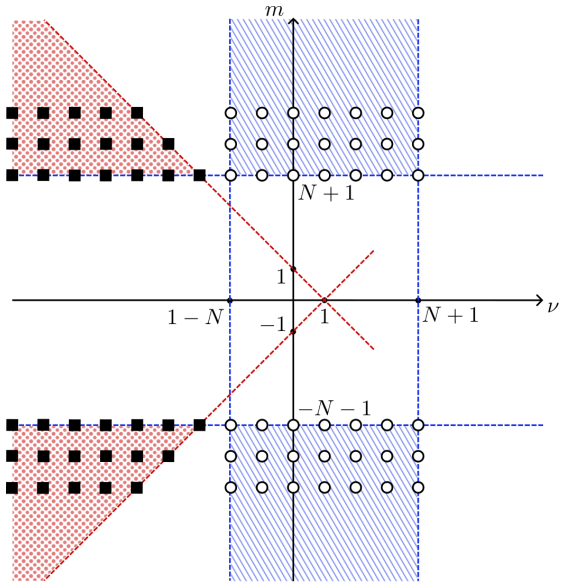
We construct and classify all differential symmetry breaking operators between certain principal series representations of the pair SO_0(4,1) ⊃ SO_0(3,1). We prove a localness theorem, namely, all symmetry breaking operators between the principal series representations in concern are necessarily differential operators. In addition, we show that all these symmetry breaking operators are sporadic in the sense of T. Kobayashi, that is, they cannot be obtained by residue formulas of meromorphic families of symmetry breaking operators.
What carries the argument
Differential symmetry breaking operators for principal series representations of SO_0(4,1) restricted to SO_0(3,1), equipped with the localness property and the sporadic character that prevents them from arising via residues.
If this is right
- A finite explicit list now exists for all differential symmetry breaking operators in the stated parameter range.
- No integral or pseudodifferential symmetry breaking operators can exist for these representations.
- The operators stand outside every continuous meromorphic family obtained by analytic continuation.
- The classification is complete precisely for the embedding SO_0(4,1) ⊃ SO_0(3,1).
Where Pith is reading between the lines
- The same localness-plus-sporadic pattern may appear for other real-rank-one symmetric pairs.
- The explicit operators supply concrete intertwiners that can be tested directly in models of de Sitter quantum field theory.
Load-bearing premise
The representations are principal series whose parameters lie in the range where the differential operators remain well-defined, and the groups are exactly the pair SO_0(4,1) containing SO_0(3,1).
What would settle it
The explicit construction of a non-differential symmetry breaking operator or of one that arises as a residue from a meromorphic family of operators between the same principal series would contradict both the localness theorem and the sporadic classification.
Figures


read the original abstract
In this paper, we construct and classify all differential symmetry breaking operators between certain principal series representations of the pair $SO_0(4,1) \supset SO_0(3,1)$. In this case, we also prove a localness theorem, namely, all symmetry breaking operators between the principal series representations in concern are necessarily differential operators. In addition, we show that all these symmetry breaking operators are sporadic in the sense of T. Kobayashi, that is, they cannot be obtained by residue formulas of meromorphic families of symmetry breaking operators.
Editorial analysis
A structured set of objections, weighed in public.
Referee Report
Summary. The paper constructs and classifies all differential symmetry breaking operators between certain principal series representations of the pair SO_0(4,1) ⊃ SO_0(3,1). It proves a localness theorem that every symmetry breaking operator between these representations is necessarily a differential operator. It further shows that the constructed operators are sporadic in the sense of T. Kobayashi, i.e., they do not arise as residues of meromorphic families of symmetry breaking operators.
Significance. If the claims hold, the work supplies a complete, explicit classification together with the localness and sporadic properties for this concrete pair of groups and representations. Such results are valuable in the broader program of understanding intertwining operators between principal series, especially for the de Sitter and Lorentz groups that arise in conformal geometry and mathematical physics. The explicit construction and the verification that the operators lie outside the standard meromorphic families constitute concrete progress beyond abstract existence statements.
minor comments (2)
- [Introduction / §2] The abstract refers to “certain” principal series; the introduction or §2 should state the precise parameter range (e.g., the values of the continuous parameters λ, ν) for which the classification and localness theorem are proved.
- Notation for the induced representations and the symmetry breaking operators should be introduced once and used consistently; a short table summarizing the operators and their parameters would improve readability.
Simulated Author's Rebuttal
We thank the referee for the careful reading and positive evaluation of our manuscript. The referee's summary accurately captures the main results: the explicit construction and classification of all differential symmetry breaking operators between the indicated principal series representations of SO_0(4,1) ⊃ SO_0(3,1), the localness theorem establishing that all symmetry breaking operators in this setting are differential, and the verification that these operators are sporadic in the sense of Kobayashi.
Circularity Check
No significant circularity detected in derivation
full rationale
The paper constructs and classifies differential symmetry breaking operators for principal series representations of the pair SO_0(4,1) ⊃ SO_0(3,1), proves that all such operators are differential (localness theorem), and verifies they are sporadic per Kobayashi's definition. These steps rely on direct solution of differential equations or representation-theoretic constraints within the stated parameter range, without reducing to self-definitional loops, fitted inputs renamed as predictions, or load-bearing self-citations. The sporadic property uses an external reference to Kobayashi, and the localness result is established independently via the paper's own analysis of operator continuity and distribution-valued maps. The derivation chain is self-contained and does not exhibit any of the enumerated circular patterns.
Axiom & Free-Parameter Ledger
axioms (2)
- standard math Standard properties of principal series representations of semisimple Lie groups such as SO_0(4,1) and SO_0(3,1)
- domain assumption Definition and properties of sporadic symmetry breaking operators as introduced by T. Kobayashi
Lean theorems connected to this paper
-
IndisputableMonolith/Foundation/RealityFromDistinction.leanreality_from_one_distinction unclear?
unclearRelation between the paper passage and the cited Recognition theorem.
We construct and classify all differential symmetry breaking operators DN,mλ,ν … and prove a localness theorem … all these symmetry breaking operators are sporadic in the sense of T. Kobayashi
-
IndisputableMonolith/Cost/FunctionalEquation.leanwashburn_uniqueness_aczel unclear?
unclearRelation between the paper passage and the cited Recognition theorem.
Applying the F-method … solving the system Ξ(λ,a,N,m) … Gegenbauer polynomials and hypergeometric functions
What do these tags mean?
- matches
- The paper's claim is directly supported by a theorem in the formal canon.
- supports
- The theorem supports part of the paper's argument, but the paper may add assumptions or extra steps.
- extends
- The paper goes beyond the formal theorem; the theorem is a base layer rather than the whole result.
- uses
- The paper appears to rely on the theorem as machinery.
- contradicts
- The paper's claim conflicts with a theorem or certificate in the canon.
- unclear
- Pith found a possible connection, but the passage is too broad, indirect, or ambiguous to say the theorem truly supports the claim.
Forward citations
Cited by 1 Pith paper
-
Stability of Branching Multiplicities for Orthogonal Gelfand Pairs
Branching multiplicities for orthogonal Gelfand pairs are constant inside convex regions of the parameter space of reduced coherent families, separated by piecewise-linear fences governed by systems of linear inequalities.
Reference graph
Works this paper leans on
-
[1]
G.E. Andrews, R. Askey, R. Roy. Special functions . Encyclopedia of Mathematics and its Applications, 71. Cambridge University Press, Cambridge, 1999. xvi+664 pp
work page 1999
-
[2]
R. Beckmann, J.-L. Clerc. Singular invariant trilinear forms and covariant (bi-)diff erential operators under the conformal group . J. Funct. Anal. 262 (2012), no. 10, 4341–4376
work page 2012
-
[3]
S. Ben Sa ¨ ıd, J.-L. Clerc, K. Koufany. Conformally covariant bi-differential operators on a simple real Jordan algebra . Int. Math. Res. Not. IMRN (2020), no. 8, 2287–2351
work page 2020
-
[4]
S. Ben Sa ¨ ıd, J.-L. Clerc, K. Koufany. The source operator method: an overview . Symmetry in geometry and analysis. Vol. 2. Festschrift in honor of Tos hiyuki Kobayashi, 1–36. Progr. Math., 358 Birkh¨ auser/Springer, Singapore, 2025
work page 2025
-
[5]
H. Cohen. Sums involving the values at negative integers of L- functions of quadratic char- acters. Math. Ann. 217 (1975), no. 3, 271-285
work page 1975
-
[6]
J. Ditlevsen, J. Frahm. Construction and analysis of symmetry breaking operators fo r the pair (GL(n + 1, R),GL (n, R)). Preprint, 33 pages, arXiv:2403.14267
-
[7]
J. Ditlevsen, Q. Labriet. Differential symmetry breaking operators for the pair (GLn+1(R),GL n(R)). Preprint, 24 pages, arXiv:2504.20793
-
[8]
A. Erd´ elyi, W. Magnus, F. Oberhettinger, F.G. Tricomi. Higher transcendental functions. Vol. I . Based, in part, on notes left by Harry Bateman. McGraw-Hill Book Co., Inc., New York-Toronto-London, 1953. xxvi+302 pp
work page 1953
-
[9]
J. Frahm. Symmetry breaking operators for strongly spherical reduct ive pairs. Publ. Res. Inst. Math. Sci. 59 (2023), no. 2, 259–337
work page 2023
- [10]
- [11]
- [12]
-
[13]
C. F. Gauss. Disquisitiones generales circa seriem infinitam. (Latin) Comm. Soc. Reg. G¨ ot. II, Werke, 3, 123–162 (1812)
-
[14]
L. Gegenbauer. ¨Uber einige bestimmte Integrale. (German) Sitzungsberichte der Kaiser- lichen Akademie der Wissenschaften. Mathematische-Natur wissenschaftliche Classe. 2Abt-70 (1874), pp. 433–443
-
[15]
A. Juhl. Families of Conformally Covariant Differential Operators, Q- Curvature and Holog- raphy. Progress in Mathematics, vol. 275 (Birkh¨ auser, Basel, 2009). 57
work page 2009
- [16]
- [17]
- [18]
- [19]
-
[20]
T. Kobayashi, T. Kubo, M. Pevzner. Conformal symmetry breaking operators for differential forms on spheres . Lecture Notes in Mathematics, 2170. Springer Singapore, 2016. ix+192 pp
work page 2016
-
[21]
T. Kobayashi, T. Kubo, M. Pevzner. Conformal symmetry breaking operators for anti-de Sitter spaces . Geometric methods in physics XXXV, 69–85. Trends Math. Birkh¨ auser/Springer, Cham, 2018
work page 2018
-
[22]
T. Kobayashi, A. Leontiev. Symmetry breaking operators for the restriction of represe nta- tions of indefinite orthogonal groups O(p,q ). Proc. Japan Acad. Ser. A Math. Sci. 93 (2017), no. 8, 86–91
work page 2017
-
[23]
T. Kobayashi, B. Ørsted, P. Somberg, V. Souˇ cek. Branching laws for Verma modules and applications in parabolic geometry. I . Adv. Math. 285 (2015), 1796–1852
work page 2015
-
[24]
T. Kobayashi, T. Oshima. Finite multiplicity theorems for induction and restrictio n. Adv. Math. 248 (2013), 921–944
work page 2013
-
[25]
T. Kobayashi, M. Pevzner. Differential symmetry breaking operators: I. General theory and F-method. Selecta Math. (N.S.) 22 (2016), no. 2, 801-845
work page 2016
-
[26]
T. Kobayashi, M. Pevzner. Differential symmetry breaking operators: II. Rankin–Cohen operators for symmetric pairs . Selecta Math. (N.S.) 22 (2016), no. 2, 847-911
work page 2016
-
[27]
T. Kobayashi and B. Speh. Symmetry breaking for representations of rank one orthogon al groups. Mem. Amer. Math. Soc. 238 (2015), no. 1126, v+110 pp
work page 2015
-
[28]
T. Kobayashi and B. Speh. Symmetry breaking for representations of rank one orthogon al groups II . Lecture Notes in Mathematics, 2234. Springer, Singapore, 2018, xv+342 pp
work page 2018
- [29]
-
[30]
T. Kubo, B. Ørsted. On the intertwining differential operators from a line bundl e to a vector bundle over the real projective space . Indag. Math. (N.S.) 36 (2025), no. 1, 270–301
work page 2025
-
[31]
F. I. Mautner. Unitary representations of locally compact groups I, II . Ann. Math., (2) 51 (1950), 1-25; (2) 52 (1950), 528-556
work page 1950
- [32]
-
[33]
J. Peetre. Une caract´ erisation abstraite des op´ erateurs diff´ erentiels. (French) Math. Scand. 7 (1959), 211–218
work page 1959
-
[34]
Une caract´ erisation abstraite des op´ erateurs diff´ erentiels
J. Peetre. R´ ectification ` a larticle “Une caract´ erisation abstraite des op´ erateurs diff´ erentiels”. (French) Math. Scand. 8 (1960), 116–120. 58
work page 1960
-
[35]
V. P´ erez-Vald´ es.Conformally covariant symmetry breaking operators for a vec tor bundle of rank 3 on S3. Internat. J. Math. 34 (2023) no. 12, Paper No. 2350072
work page 2023
-
[36]
V. P´ erez-Vald´ es.Construction and classification of differential symmetry bre aking oper- ators for principal series representations of the pair (SO0(4, 1),SO 0(3, 1)) for special pa- rameters. To appear in the Proceedings of the 7th Tunisian-J apanese Conference, 53 pages, arXiv:2504.01977
work page internal anchor Pith review Pith/arXiv arXiv
-
[37]
R. A. Rankin. The construction of automorphic forms from the derivatives o f a given form . J. Indian Math. Soc. (N.S.) 20 (1956), 103-116
work page 1956
-
[38]
S. Teleman. On reduction theory . Rev. Roum. Math. Pures Appl. 21(4) (1976) 465–486. V. P´ erez-Vald´ es, JSPS International Research Fellow, Ryukoku University, Tsukamoto-cho 67, Fukakusa, Fushimi-ku, Kyoto 612-8577, Japan. Email address: perez-valdes@mail.ryukoku.ac.jp 59
work page 1976
discussion (0)
Sign in with ORCID, Apple, or X to comment. Anyone can read and Pith papers without signing in.