REVIEW 2 major objections 4 minor 14 references
ANN-Based Grid Impedance Estimation for Adaptive Gain Scheduling in VSG Under Dynamic Grid Conditions
T0 review · 2 major / 4 minor · reviewed 2026-08-06 · deepseek-v4-flash
Pith's one-line read This paper claims that a virtual synchronous generator can keep a fixed 1-second settling time across weak, strong, and stiff grids when a neural network estimates grid impedance online and a Jacobian-based gain-scheduling law retunes the…
desk verdict Useful idea, but the reported gains don't match the derived scheduling law, so the validation is on shaky ground. read the letter →
The pith
A machine-rendered reading of the paper's core claim, the machinery that carries it, and where it could break.
The reading
What carries the argument
The matching identity that carries the argument is the Jacobian-based gain-scheduling law (10)-(11), derived from the closed-loop transfer functions. The active-power closed loop is a second-order system $G^P_{cl}(s) = K_{ip}A/(s^2 + D_p K_{ip} s + K_{ip} A)$; choosing $\zeta=1$ and $\omega_n=4$ forces $D_p = A/2$ and $K_{ip}=16/A$. The reactive loop is first-order with steady-state error $D_q/(D_q + D)$, giving $D_q=D/100$ and $K_{iq}=4/(D+D_q)$. The ANN supplies the estimated grid resistance and inductance, which enter $A$ and $D$ together with the operating-point quantities $V_{pcc0}$ and $\delta_0$, and the control architecture buffers 200 samples of PCC voltage and current per cycle before feeding the normalized vector to the network.
What would settle it
Run the same 60-second scenario with the gain-scheduling block fed the true grid impedance instead of the ANN estimates; if settling time or overshoot still drifts from the designed 1-second and zero-overshoot targets, the scheduling law itself is the cause. Separately, freeze $V_{pcc0}$ and $\delta_0$ at their initial values while the ANN tracks the actual impedance changes; if the closed-loop response then degrades, the Jacobian's dependence on the operating point is the limiting assumption.
Extended reading notes
Core claim
The central claim is that online grid-impedance estimates, produced by a feedforward ANN fed with buffered samples of $v_{pcc}$ and $i_{pcc}$, can drive an adaptive gain-scheduling law that keeps the VSG's active- and reactive-power loops at a designated damping ratio and settling time regardless of grid strength. The gains $D_p$, $K_{ip}$, $D_q$, and $K_{iq}$ are recomputed from the Jacobian entries $A=\partial P_{pcc}/\partial\delta$ and $D=\partial Q_{pcc}/\partial V_{pcc}$ evaluated at the current operating point and estimated grid impedance, so that the closed-loop active-power denominator has damping ratio $\zeta=1$ and natural frequency $\omega_n=4$, and the reactive loop has a 1-second settling time with negligible steady-state error. Simulation shows the fixed-gain VSG's phase margin falling from 52.12 degrees to 20.10 degrees as SCR rises from 2 to 20, while the scheduling law holds the response near a 1-second settling time across all three scenarios. The paper also reports that the ANN estimates previously unseen grid strengths with about 0.02 seconds of delay, and notes that a nonzero overshoot remains because active-reactive coupling terms are omitted in the controller design.
Load-bearing premise
The scheduling formulas depend on the steady-state PCC voltage and angle being known and correct at every retune, but the paper never explains how those operating-point values are measured, estimated, or updated online.
Editorial extensions
If this is right
- A VSG can be tuned once and remain correctly tuned as grid strength changes, because the controller gains follow the estimated impedance.
- Previously unseen grid strengths can be handled by the estimator with high accuracy and minimal delay, so the training data need not cover every possible operating point.
- The approach avoids the disturbance and delay of injection-based impedance estimation while still supporting real-time gain scheduling.
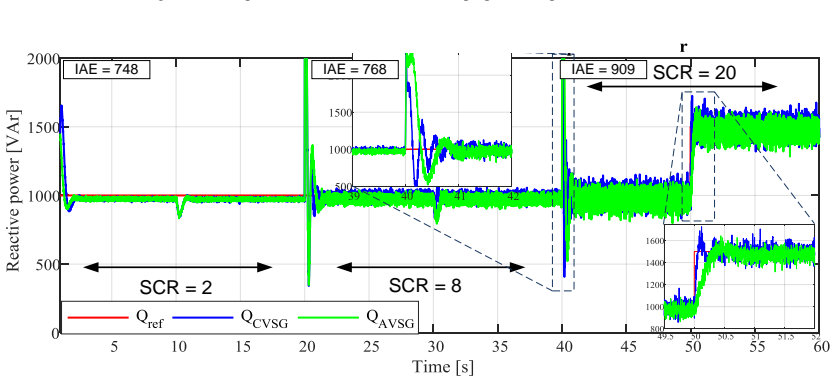
- The active- and reactive-power responses keep the intended 1-second settling time across weak, strong, and stiff grids, whereas fixed-gain operation becomes increasingly oscillatory as SCR increases.
Reading between the lines
- Editorial extension: if $V_{pcc0}$ and $\delta_0$ are tracked online rather than treated as constants, the same scheduling law could also adapt to load changes and operating-point shifts, not just to grid impedance changes.
- Editorial extension: the transient peak errors the paper reports for previously unseen SCR values could likely be reduced by adding VSG control states or parameters to the ANN input vector, since the paper itself identifies their omission as the cause of those errors.
- Editorial extension: a hardware-in-the-loop or field test on a scaled inverter would be the natural next verification, because the simulated validation does not exercise measurement noise, converter nonlinearities, or communication delays.
- Editorial extension: training the ANN over a denser grid-strength range, or augmenting its inputs with physics-derived features, would test whether the claimed generalization to unseen impedance values holds beyond the specific SCR values studied.
Editorial analysis
A structured set of objections, weighed in public.
Referee Report
Summary. This paper proposes an adaptive gain-scheduling scheme for a virtual synchronous generator (VSG). A feedforward ANN is trained offline on Simulink-generated data to estimate the fundamental-frequency grid resistance and inductance from one cycle of PCC voltage and current samples. The estimated impedance is then used to recompute the power-flow Jacobian terms A and D, and the VSG power-loop gains are scheduled so that, according to the Appendix, the active loop has a settling time of 1 s with critical damping and the reactive loop uses a first-order time constant of 0.25 s. The scheme is validated in a 60 s Simulink simulation with SCR values of 2, 8, and 20, and is compared with a fixed-gain VSG. The authors report that the adaptive VSG maintains settling time and overshoot across grid conditions while the fixed-gain VSG degrades, and that the ANN estimates previously unseen impedances with small delay.
Significance. If the consistency issues below are resolved, the paper offers a practical engineering contribution: it combines online impedance estimation with analytically derived gain-scheduling rules, and the design targets (Ts=1 s, xi=1) are explicit rather than fitted to the validation outputs. The use of holdout SCR values, the public code link, and the direct comparison against a fixed-gain VSG are strengths. However, the contribution is incremental relative to existing adaptive VSG and ANN impedance-estimation work, the validation is entirely simulation-based, and the current manuscript contains an internal inconsistency between the derived gain law and the tabulated gains that undermines the central claim as written.
major comments (2)
- [Section III-B / Table II / Appendix] Equations (10)-(11) and the Appendix are inconsistent with the gains reported in Table II. The Appendix design fixes DpKip=8 and Kiq(D+Dq)=4 regardless of the operating point. With the Table II values Dp=2.087e3 and Kip=0.00767, the active product is 16.0; with Dq=0.687 (so D=68.7), the reactive product Kiq(D+Dq) is 7.98. Section IV-B states that at SCR=2 the adaptive and conventional VSGs use the same four gains, so these are the scheduled gains at the baseline condition. No choice of A or D can reconcile these numbers because the designed products are independent of A and D. Either the implemented scheduler is not the law described by (10)-(11), or the tabulated parameters do not correspond to the simulated system. In both cases the claim that the reported 1 s settling time and critical damping follow from the proposed law is not supported. The authors should correct one side and re-run or re-report the validation.
- [Section III-B, Eqs. (4)-(5)] The gain-scheduling law requires online values of the power-flow Jacobian elements A and D, which depend on Vpcc0, delta0, Rg, and Xg. The manuscript states that the Jacobian components are 'first recalculated' after an impedance update, but it never specifies how Vpcc0 and delta0 are obtained or updated during operation. If fixed nominal values are used, the scheduled gains will not realize the intended Ts=1 s and critical damping once the operating point changes; if measured values are used, the measurement and update mechanism should be described. Without this step the scheme cannot be reproduced or assessed under the 'dynamic grid conditions' claimed in the paper.
minor comments (4)
- [Section III-B, Eq. (11)] Equation (11) reads 'Dp = D/100', which appears to be a typo for 'Dq = D/100'; as written it reassigns the active droop coefficient instead of the reactive droop coefficient.
- [Section IV-B / Fig. 9] SCR=8 is between the trained values 7 and 9.5, so describing it as 'previously unseen' is imprecise; only SCR=20 is an extrapolation outside the training range.
- [Section IV-B / Fig. 8] The IAE values in Fig. 8 are not tied to a specific trace; clarify whether they apply to the conventional VSG, the adaptive VSG, or both.
- [Section IV-B] The settling-time and overshoot claims are made qualitatively; a table listing settling time and percentage overshoot for each SCR and for both AVSG and CVSG would make the central comparison quantitative and easier to verify.
Circularity Check
No significant circularity: the adaptive gains are derived analytically from design targets and impedance estimates, and the ANN holdout tests are genuine.
full rationale
The paper's derivation chain is self-contained and does not reduce to its own inputs. The ANN grid-impedance estimator is trained on data at SCR = [2, 4.5, 7, 9.5, 15] and then evaluated at SCR = 8 and 20, which are outside the training set; this is a genuine extrapolation test, not a re-statement of training targets (Sec. III-A and Sec. IV-B). The gain-scheduling law (10)-(11) and the Appendix (13),(16) compute Dp, Kip, Dq, Kiq directly from the estimated Jacobian elements A and D and from explicitly chosen design targets (Ts = 1 s, xi = 1, small steady-state error), rather than fitting the gains to the reported settling times. The subsequent Simulink validation is a full nonlinear simulation that includes the active-reactive coupling terms deliberately omitted in the design phase, so the observed overshoot and settling time are not identical to the design equations by construction. No load-bearing self-citation or imported uniqueness theorem appears: the only self-reference is [1], which supports an LC-filter modeling detail and is not central to the claimed contribution. The internal numerical inconsistency in Table II (Dp*Kip = 16 vs. the design value of 8, and Kiq*(D+Dq) approximately 8 vs. 4) is a correctness/consistency concern rather than a circularity, because it does not make any predicted output equal to its input by definition. Overall, the reported predictions are not forced by the fitted ANN or by the design equations; they are validated against an independent simulation model.
Assumptions & free parameters
free parameters (3)
- ANN hidden weights and biases =
Not disclosed (approximately 1,626 parameters for a 200-8-2 network)
- ANN input normalization mean and standard deviation (z-score) =
From training data (values not reported)
- Desired settling time Ts and damping ratio xi =
Ts = 1 s, xi = 1
assumptions (4)
- domain assumption The small-signal model of the VSG, including the power-flow equations (1)-(2) and the Jacobian linearization (3), is valid for the operating range considered.
- ad hoc to paper Active and reactive power coupling terms B and C can be neglected when designing the controller.
- domain assumption The grid impedance is constant during the one-cycle buffering window used by the ANN.
- domain assumption The Levenberg-Marquardt-trained ANN generalizes from training SCR values to unseen values such as 8 and 20.
Cite this review
Pith. "Pith review of ANN-Based Grid Impedance Estimation for Adaptive Gain Scheduling in VSG Under Dynamic Grid Conditions." pith.science (2026). https://pith.science/paper/YXTH2MD4
@misc{pith2026250623304,
  author       = {Pith},
  title        = {Pith review of: ANN-Based Grid Impedance Estimation for Adaptive Gain Scheduling in VSG Under Dynamic Grid Conditions},
  year         = {2026},
  howpublished = {\url{https://pith.science/paper/YXTH2MD4}},
  note         = {Machine review of arXiv:2506.23304}
}
read the original abstract
In contrast to grid-following inverters, Virtual Synchronous Generators (VSGs) perform well under weak grid conditions but may become unstable when the grid is strong. Grid strength depends on grid impedance, which unfortunately varies over time. In this paper, we propose a novel adaptive gain-scheduling control scheme for VSGs. First, an Artificial Neural Network (ANN) estimates the fundamental-frequency grid impedance; then these estimates are fed into an adaptive gain-scheduling function to recalculate controller parameters under varying grid conditions. The proposed method is validated in Simulink and compared with a conventional VSG employing fixed controller gains. The results demonstrate that settling times and overshoot percentages remain consistent across different grid conditions. Additionally, previously unseen grid impedance values are estimated with high accuracy and minimal time delay, making the approach well suited for real-time gain-scheduling control.
Figures


Figures from the paper (5 more)



Reference graph
Works this paper leans on
-
[1]
Q.-M. Hoang, B.-H. Nguyen, T. V o-Duy, J. P. F. Trov ˜ao, and M. C. Ta, “Decoupled average model-based sliding mode current control of lc-filtered inverters in rotating frame,”Mathematics and Computers in Simulation, vol. 224, pp. 148–164, 2024
work page 2024
-
[2]
Y . Tian, X. Xu, Y . Wang, Z. Li, Z. Zhang, and Y . Gao, “Full-state feedback power decoupling control for grid forming converter with improved stability and inertia response,”IEEE Transactions on Power Electronics, 2024
work page 2024
-
[3]
J. Liu, Y . Miura, and T. Ise, “Comparison of dynamic characteristics between virtual synchronous generator and droop control in inverter- based distributed generators,”IEEE Transactions on Power Electronics, vol. 31, no. 5, pp. 3600–3611, 2016
work page 2016
-
[4]
Improved active power control of virtual synchronous generator for enhancing transient stability,
K. Li, P. Cheng, L. Wang, X. Tian, J. Ma, and L. Jia, “Improved active power control of virtual synchronous generator for enhancing transient stability,”IET Power Electronics, vol. 16, no. 1, pp. 157–167, 2023
work page 2023
-
[5]
Small-signal modeling and parameters design for virtual synchronous generators,
H. Wu, X. Ruan, D. Yang, X. Chen, W. Zhao, Z. Lv, and Q.-C. Zhong, “Small-signal modeling and parameters design for virtual synchronous generators,”IEEE Transactions on Industrial Electronics, vol. 63, no. 7, pp. 4292–4303, 2016
2016
-
[6]
Synchronverters: Inverters that mimic synchronous generators,
Q.-C. Zhong and G. Weiss, “Synchronverters: Inverters that mimic synchronous generators,”IEEE transactions on industrial electronics, vol. 58, no. 4, pp. 1259–1267, 2010
work page 2010
-
[7]
N. Mohammed, M. H. Ravanji, W. Zhou, and B. Bahrani, “Online grid impedance estimation-based adaptive control of virtual synchronous gen- erators considering strong and weak grid conditions,”IEEE Transactions on Sustainable Energy, vol. 14, no. 1, pp. 673–687, 2022
work page 2022
-
[8]
N. Hoffmann and F. W. Fuchs, “Minimal invasive equivalent grid impedance estimation in inductive–resistive power networks using ex- tended kalman filter,”IEEE Transactions on Power Electronics, vol. 29, no. 2, pp. 631–641, 2013
work page 2013
Show all 14 references
-
[9]
Artificial neural network-based intelligent grid impedance identification method for grid-connected inverter,
Y . Qiu, Y . Wang, Y . Tian, and Z. Chen, “Artificial neural network-based intelligent grid impedance identification method for grid-connected inverter,” in2022 International Power Electronics Conference (IPEC- Himeji 2022-ECCE Asia). IEEE, 2022, pp. 992–997
2022
-
[10]
Real-time wavelet-based grid impedance estimation method,
D. K. Alves, R. L. Ribeiro, F. B. Costa, and T. O. A. Rocha, “Real-time wavelet-based grid impedance estimation method,”IEEE Transactions on Industrial Electronics, vol. 66, no. 10, pp. 8263–8265, 2018
2018
-
[11]
Adaptive power control strategy for smart droop-based grid-connected inverters,
N. Mohammed and M. Ciobotaru, “Adaptive power control strategy for smart droop-based grid-connected inverters,”IEEE Transactions on Smart Grid, vol. 13, no. 3, pp. 2075–2085, 2022
2022
-
[12]
Grid impedance estimator for active multisource ac grids,
A. Su ´arez, C. Blanco, P. Garc ´ıa, ´A. Navarro-Rodr´ıguez, and J. M. C. Rodr´ıguez, “Grid impedance estimator for active multisource ac grids,” IEEE Transactions on Smart Grid, vol. 14, no. 3, pp. 2023–2033, 2022
2023
-
[13]
Zero-sequence voltage injection-based grid impedance estimation method for three-phase four-wire dc/ac grid-connected in- verter,
Y . Cheng, W. Wu, Y . Yang, E. Koutroulis, H. S.-H. Chung, M. Liserre, and F. Blaabjerg, “Zero-sequence voltage injection-based grid impedance estimation method for three-phase four-wire dc/ac grid-connected in- verter,”IEEE Transactions on Industrial Electronics, vol. 71, no....
2023
-
[14]
(2006) trainlm — levenberg-marquardt backpropagation
MathWorks. (2006) trainlm — levenberg-marquardt backpropagation. Accessed: 2025-07-04. [Online]. Available: https://www.mathworks. com/help/deeplearning/ref/trainlm.html
2006
Reviewed August 6, 2026 · model on record in the stance chip above.
Discussion (0). Sign in to comment.