REVIEW 3 major objections 5 minor 32 references
Escher Tile Deformation via Closed-Form Solution
T0 review · 3 major / 5 minor · reviewed 2026-08-06 · deepseek-v4-flash
Pith's one-line read Deforming an Escher tile while preserving its tessellation reduces to summing a geometric-series falloff over every translated copy of a user's point handle, giving a closed-form displacement field that works for all 17 wallpaper groups.
desk verdict Clever closed-form deformation for Escher tiles, but the tileability guarantee is conditional on injectivity and is not proven. read the letter →
The pith
A machine-rendered reading of the paper's core claim, the machinery that carries it, and where it could break.
The reading
What carries the argument
The central object is the guidance field: a single fundamental vector, generated by the wallpaper group's cone points and mirror lines from the user's handle displacement, repeated by pure translation at every vertex of the governing Bravais lattice. Around each handle the paper places an exponential falloff whose exponents are sums of absolute values, chosen so that the infinite sum over all lattice copies collapses into a geometric series. Splitting the sum by quadrants and evaluating once per unit cell produces the closed-form weights of Equations (5), (11), and (14). The displacement field is then a finite linear combination of fundamental vectors with those weights, making the deformation representation-independent, real-time, and periodic by construction.
What would settle it
Take a tile of wallpaper group 2222 on a parallelogram lattice, set the falloff parameter so the deformation reaches across several cells, drag the handle by more than one cell width, and check whether any two sample points satisfy $x + u(x) = y + u(y)$; equivalently, sample the Jacobian determinant of $x \mapsto x + u(x)$ in one cell and look for a sign change, which would expose a fold and contradict the no-gaps/no-overlaps claim.
Extended reading notes
Core claim
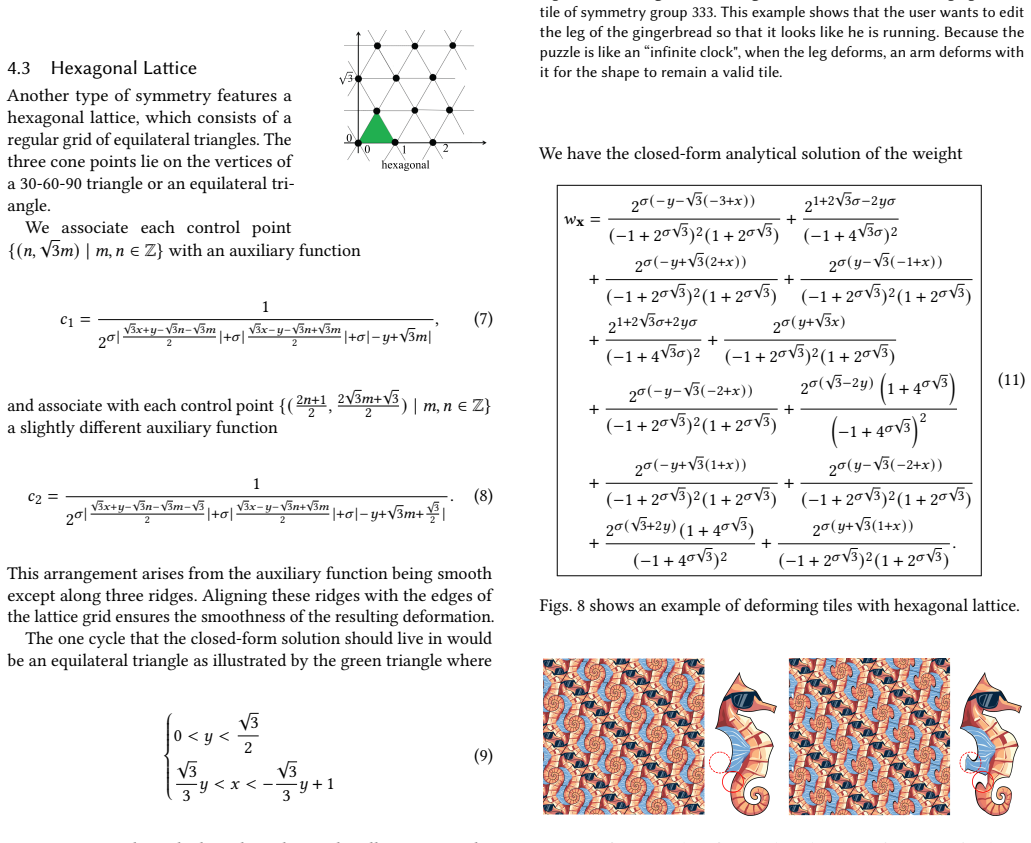
The central claim is that deforming a tessellation while preserving its tileability can be reduced to a closed-form periodic displacement field. From one user handle displacement, the wallpaper group's cone points and mirror lines generate a small set of fundamental vectors, and pure translation then repeats each fundamental vector at every vertex of the governing Bravais lattice. The influence of all those copies at any point is a weight that can be evaluated analytically because the paper's exponential falloff makes the infinite double sum a geometric series. Equations (5), (11), and (14) give the closed-form weights for the tetragonal, hexagonal, and monoclinic lattices, with the orthorhombic case reusing the tetragonal formula, so the final displacement at any point is a finite weighted sum of fundamental vectors. Because the field is periodic by construction, the deformed pattern remains a candidate tessellation, and the method applies uniformly to images, meshes, and volumetric cells.
Load-bearing premise
The load-bearing premise is that the map $x \mapsto x + u(x)$ that sends every point to its deformed position is injective, so two distinct points never land on the same spot; the paper assumes this rather than proving it and lists enforcing it as the first item of future work.
Editorial extensions
If this is right
- An artist can edit a tile's boundary and interior texture in one gesture, seeing the full appearance change immediately instead of editing outlines and filling textures separately.
- Because the weight for each fundamental vector is computed once in a unit cell, the cost is independent of how many copies of the tile are visible on screen.
- The adaptive falloff parameter gives users a continuous locality dial, from a sharp local edit to a global wave affecting the entire tessellation.
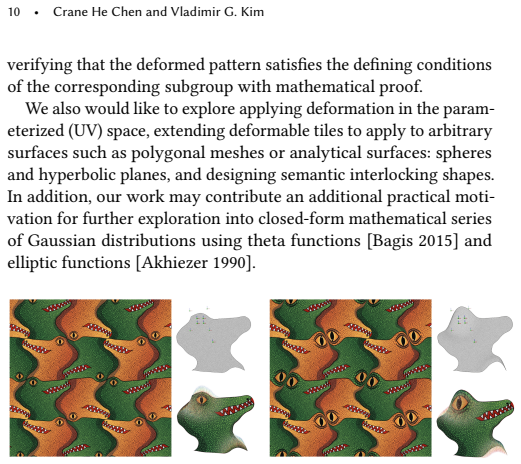
- The same closed-form construction extends from 2D images and meshes to 3D parallelepiped cells, as demonstrated by sculpting one packable animal shape into another.
- Symmetry transitions between wallpaper groups let a deformation lower a pattern's symmetry level, enabling artistic exploration across related tilings.
Reading between the lines
- Because the geometric-series falloff is not divergence-free, very large handle drags can fold the map $x \mapsto x + u(x)$; swapping the falloff for a divergence-free fundamental solution of the elastic wave equation would make the deformation provably injective.
- The same recipe of decoupling the point-group orbit from the translation lattice should transfer to tessellations of the sphere or hyperbolic plane, where the translation lattice is replaced by a non-Euclidean group and the geometric series by a group-theoretic sum.
- The weight functions resemble lattice Green's functions, so sharper or Gaussian falloffs may be expressible with theta functions, widening the locality-versus-closed-form tradeoff without sacrificing speed.
- A direct experimental check of injectivity—sampling the Jacobian determinant of $x \mapsto x + u(x)$ across a unit cell and monitoring for sign changes—would tell artists exactly how far a handle can be dragged before the no-gaps/no-overlaps promise breaks.
Editorial analysis
A structured set of objections, weighed in public.
Referee Report
Summary. This paper proposes a real-time interactive deformation method for Escher-style periodic tilings. A user drags a point handle; the method generates fundamental displacement vectors from the tile's symmetry group and computes a periodic displacement field by summing a geometric-series falloff kernel over all lattice copies of the handle. Closed-form expressions are derived for square, rectangular, hexagonal, and parallelogram lattices (Eqs. 5, 11, 14), enabling deformation of image, mask, and mesh representations. The central claim is that this deformation simultaneously adjusts boundaries and interiors while preserving tileability — no gaps or overlaps — for all 17 wallpaper groups.
Significance. The closed-form evaluation of the infinite lattice sums is elegant, and the real-time rendering claim is plausible; the comparison against truncated numerical summation in Fig. 5 at least checks the algebra of the series. If the tileability guarantee were established, this would be a practical contribution to interactive pattern design, especially because it handles textured interiors rather than only boundaries. However, the guarantee as stated is not established: the deformation map is nowhere shown to be injective, Section 6 explicitly defers injectivity to future work, and the presented validation cannot detect gaps or overlaps. The current significance is therefore as a well-motivated deformation system with attractive closed-form weights, but with a load-bearing correctness claim left open.
major comments (3)
- [Sections 4 and 6] The paper's headline claim is that the deformation preserves tileability 'without introducing gaps or overlaps,' but Section 6 lists 'ensure injectivity of the map under extreme deformations' as the first future-work item. Since the deformation map is implicitly x -> x + u(x), tileability requires this map to be injective (equivalently, local injectivity with det(I + nabla u) > 0 under the periodic setting). The displacement field is a linear combination of handle drag vectors (Eq. 1), so its gradient scales with the drag magnitude; for any sigma whose kernel has a nonzero gradient, sufficiently large user drags will make det(I + nabla u) negative and fold the pattern. The paper gives no bound on handle displacement or sigma within which the headline guarantee holds, so Eqs. (5), (11), and (14) currently define a displacement field, not a proven tileability-preserving deformation.
- [Figure 5 and Section 4] The validation in Fig. 5 compares the closed-form expressions with a truncated numerical summation of the same infinite series. This verifies only the algebraic evaluation of the sum; it does not test whether the resulting map is injective, whether tile boundaries remain matched after applying the displacement, or whether interior overlaps occur. No quantitative metric for gaps or overlaps is reported, so this comparison cannot support the 'without gaps or overlaps' claim.
- [Sections 4.1-4.4] The paper claims support for all 17 wallpaper groups, but the exposition provides closed-form weights for four lattice geometries and illustrates only a few groups. No table or algorithm specifies, for each of the 17 groups, the number and directions of the fundamental vectors or the linear transformations applied to u0 for rotations, reflections, and glide reflections, nor is there a proof that the resulting field satisfies u(g(x)) = g(u(x)) for every symmetry operation g of the group. Without this per-group specification, the 'all 17 wallpaper groups' claim is not substantiated, and the symmetry-transition examples in Section 5 remain purely visual.
minor comments (5)
- [Section 4] The deformation map is never written explicitly; near the definition of u, the paper should state x' = x + u(x) so that the reader knows the final transformation being applied.
- [Eq. (4)] The local-coordinate formula uses unexplained double bars and a modulo operation; the exact definition of the map from global to local coordinates should be clarified.
- [Eqs. (2), (5), (14)] The admissible range of sigma is not discussed. The closed-form denominators contain (2^sigma - 1)^2, which vanishes as sigma -> 0, so the paper should state the valid range of sigma and the behavior of the solution as sigma approaches singular values.
- [Section 4.4] There are typos: 'monoiclinic' should be 'monoclinic,' 'feaaturing' should be 'featuring,' and 'Bravias lattice' should be 'Bravais lattice.'
- [Section 5] The 'Symmetry Transitions' examples are presented as demonstrating symmetry downgrades, but the subgroup relations are not verified or even enumerated; the text should either state the relevant subgroup inclusions or label the results as informal visual observations.
Circularity Check
No significant circularity: the closed-form weights are analytic evaluations of explicitly defined geometric-series falloffs, and the validation is a self-consistency check rather than a fitted prediction.
full rationale
The derivation chain is self-contained. The paper defines a point-handle displacement as a weighted sum of fundamental vectors (Eq. 1), selects an explicit exponential falloff (Eq. 2) so that the infinite lattice sum is a geometric series, and then evaluates that sum analytically (Eqs. 5, 11, 14). The closed-form expressions are not fitted to data and are not imported from prior work; they are direct evaluations of the paper's own definitions. The comparative validation in Figure 5 checks the analytic expression against a truncated numerical summation of the same series, which is a consistency check of the algebra rather than an independent prediction, and it is not presented as evidence that tileability is preserved. The paper's central claim about avoiding gaps and overlaps depends on the undeclared assumption that x + u(x) is injective; Section 6 explicitly lists 'ensure injectivity of the map under extreme deformations' as a limitation and future work. That is a soundness gap, not circular reasoning: the displacement field is still well-defined and the closed-form solution is exactly what it claims to be. There are no load-bearing self-citations and no imported uniqueness theorems; the only self-referential element is the validation of the closed form against the same summation, which does not make the derivation circular because the analytical result is not being used to define the numerical result or vice versa.
Assumptions & free parameters
free parameters (1)
- sigma (falloff exponent) =
user-controlled (examples use 1, 5, 10, 20)
assumptions (4)
- domain assumption The displacement field is equivariant under the wallpaper group: u(g(x)) = g(u(x)) for every symmetry operation g.
- domain assumption The map x -> x + u(x) is injective (a homeomorphism of the plane) for the deformations produced, so the warped tiling has no gaps or overlaps.
- standard math The four Bravais lattice types (tetragonal, orthorhombic, hexagonal, monoclinic) suffice to express the guidance fields for all 17 wallpaper groups.
- ad hoc to paper The chosen falloff kernel produces visually meaningful and artistically controllable deformations.
Cite this review
Pith. "Pith review of Escher Tile Deformation via Closed-Form Solution." pith.science (2026). https://pith.science/paper/LCIOAXKO
@misc{pith2026250623388,
  author       = {Pith},
  title        = {Pith review of: Escher Tile Deformation via Closed-Form Solution},
  year         = {2026},
  howpublished = {\url{https://pith.science/paper/LCIOAXKO}},
  note         = {Machine review of arXiv:2506.23388}
}
read the original abstract
We present a real-time deformation method for Escher tiles -- interlocking organic forms that seamlessly tessellate the plane following symmetry rules. We formulate the problem as determining a periodic displacement field. The goal is to deform Escher tiles without introducing gaps or overlaps. The resulting displacement field is obtained in closed form by an analytical solution. Our method processes tiles of 17 wallpaper groups across various representations such as images and meshes. Rather than treating tiles as mere boundaries, we consider them as textured shapes, ensuring that both the boundary and interior deform simultaneously. To enable fine-grained artistic input, our interactive tool features a user-controllable adaptive fall-off parameter, allowing precise adjustment of locality and supporting deformations with meaningful semantic control. We demonstrate the effectiveness of our method through various examples, including photo editing and shape sculpting, showing its use in applications such as fabrication and animation.
Figures


Figures from the paper (11 more)




Reference graph
Works this paper leans on
-
[4]
Citeseer, 109–116. William Thurston. 1978-1981. The Geometry and Topology of Three-Manifolds. Princeton University lecture notes. Francis Williams and Eugene Zhang
work page 1978
-
[5]
On the Complete Evaluation of Jacobi Theta Functions
On the Complete Evaluation of Jacobi Theta Functions. arXiv:1503.01141 [math.NT] Rulin Chen, Ziqi Wang, Peng Song, and Bernd Bickel
- [8]
-
[9]
ACM Transactions on Graphics (TOG) 36, 4 (2017), 1–11
Regularized kelvinlets: sculpting brushes based on fundamental solutions of elasticity. ACM Transactions on Graphics (TOG) 36, 4 (2017), 1–11. Fernando De Goes and Doug L James
work page 2017
-
[16]
In Proceedings of Bridges 2015: Mathematics, Music, Art, Architecture, Culture
Algorithms for morphing escher-like tessellations. In Proceedings of Bridges 2015: Mathematics, Music, Art, Architecture, Culture . 483–486. Shih-Syun Lin, Charles C Morace, Chao-Hung Lin, Li-Fong Hsu, and Tong-Yee Lee
work page 2015
-
[17]
IEEE transactions on visualization and computer graphics 24, 2 (2017), 1103–1113
Generation of escher arts with dual perception. IEEE transactions on visualization and computer graphics 24, 2 (2017), 1103–1113. Yuichi Nagata and Shinji Imahori
work page 2017
-
[19]
ACM Transactions on Graphics (TOG) 40, 3 (2021), 1–34
Self-similar fractal drawings inspired by MC Escher’s print Square Limit. ACM Transactions on Graphics (TOG) 40, 3 (2021), 1–34. Peichang Ouyang and Robert W Fathauer
work page 2021
-
[21]
ACM Transactions on Graphics 42, 2 (2022), 1–17
Interlocking spiral drawings inspired by MC Escher’s print whirlpools. ACM Transactions on Graphics 42, 2 (2022), 1–17. Jonathan Palacios and Eugene Zhang
work page 2022
Show all 32 references
-
[25]
IEEE Transactions on Visualization and Computer Graphics 24, 1 (2017), 843–852
Interactive design and visualization of branched covering spaces. IEEE Transactions on Visualization and Computer Graphics 24, 1 (2017), 843–852. Doris Schattschneider
2017
-
[27]
In ACM SIGGRAPH 2024 Conference Papers
Into the Portal: Directable Fractal Self-Similarity. In ACM SIGGRAPH 2024 Conference Papers . 1–8. David Smith, Joseph Samuel Myers, Craig S Kaplan, and Chaim Goodman-Strauss
2024
-
[28]
arXiv preprint arXiv:2303.10798 (2023)
An aperiodic monotile. arXiv preprint arXiv:2303.10798 (2023). Walter F. Smith
2023 arXiv
-
[29]
https://www.physicssongs.org/ bravais.htm Accessed: 2024-07-07
The Bravais Lattices Song. https://www.physicssongs.org/ bravais.htm Accessed: 2024-07-07. Olga Sorkine and Marc Alexa
2024
-
[31]
In SIGGRAPH ASIA 2016 Technical Briefs (Macau) (SA ’16)
Rendering kaleidoscopic scenes using orbifold theory. In SIGGRAPH ASIA 2016 Technical Briefs (Macau) (SA ’16) . As- sociation for Computing Machinery, New York, NY, USA, Article 17, 4 pages. https://doi.org/10.1145/3005358.3005368 Michael T Wong, Douglas E Zongker, and David H Salesin
2016
-
[32]
Interactive Design and Optics-Based Visualization of Arbitrary Non-Euclidean Kaleidoscopic Orbifolds.IEEE Transactions on Visualization and Computer Graphics 30, 1 (2023), 1292–1301. , Vol. 1, No. 1, Article . Publication date: September 2025
2023
-
[1980]
Doris Schattschneider
Will it tile? Try the Conway criterion! Mathematics Magazine 53, 4 (1980), 224–233. Doris Schattschneider
1980
-
[1991]
Mathematics Magazine 64, 4 (1991), 242–246
Napoleon, Escher, and tessellations. Mathematics Magazine 64, 4 (1991), 242–246. Lawrence Roy, Prashant Kumar, Sanaz Golbabaei, Yue Zhang, and Eugene Zhang
1991
-
[2000]
In Proceedings of the 27th annual conference on Computer graphics and interactive techniques
Escherization. In Proceedings of the 27th annual conference on Computer graphics and interactive techniques . 499–510. Craig S Kaplan and David H Salesin. 2004b. Islamic star patterns in absolute geometry. ACM Transactions on Graphics (TOG) 23, 2 (2004), 97–119. Kevin Lee
2004
-
[2002]
IEEE/ASME transactions on mechatronics 7, 4 (2002), 462–472
Self-replicating robots for lunar development. IEEE/ASME transactions on mechatronics 7, 4 (2002), 462–472. John H Conway, Heidi Burgiel, and Chaim Goodman-Strauss
2002
-
[2006]
ACM Transactions on Graphics (TOG) 25, 4 (2006), 1460–
Periodic global parameterization. ACM Transactions on Graphics (TOG) 25, 4 (2006), 1460–
2006
-
[2007]
ACM Transactions on Graphics (TOG) 26, 3 (2007), 55–es
Rotational symmetry field design on surfaces. ACM Transactions on Graphics (TOG) 26, 3 (2007), 55–es. Nhan Phan-Thien and Sangtae Kim
2007
-
[2010]
InProceedings of Bridges 2010: Mathematics, Music, Art, Architecture, Culture
Curve evolution schemes for parquet deformations. InProceedings of Bridges 2010: Mathematics, Music, Art, Architecture, Culture . 95–102. Craig S. Kaplan and D. Salesin. 2004a. Dihedral Escherization. In Graphics Interface. https://api.semanticscholar.org/CorpusID:18798031 Cra...
2010
-
[2011]
ACM Trans
Bounded biharmonic weights for real-time deformation. ACM Trans. Graph. 30, 4 (2011),
2011
-
[2014]
IEEE Computer Graphics and applications 34, 1 (2014), 68–76
Beautiful math, part 2: aesthetic patterns based on fractal tilings. IEEE Computer Graphics and applications 34, 1 (2014), 68–76. Peichang Ouyang, Krzysztof Gdawiec, Alain Nicolas, David Bailey, and Kwok Wai Chung
2014
-
[2015]
ACM Trans
Orbifold tutte embeddings. ACM Trans. Graph. 34, 6 (2015), 190–1. Noam Aigerman and Yaron Lipman
2015
-
[2016]
ACM Trans
Hyperbolic orbifold tutte embeddings. ACM Trans. Graph. 35, 6 (2016), 217–1. Naum Ilich Akhiezer
2016
-
[2017]
ACM Trans
Spherical orbifold tu e embeddings. ACM Trans. Graph. 36, 4 (2017),
2017
-
[2018]
ACM Transactions on Graphics (TOG) 37, 4 (2018), 1–10
Dynamic Kelvinlets: secondary motions based on fundamental solutions of elastodynamics. ACM Transactions on Graphics (TOG) 37, 4 (2018), 1–10. Tom Goertzen
2018
-
[2020]
Journal of Mathematics and the Arts 14, 1-2 (2020), 69–71
KUHKUBUS-3D-Escher-tessellations. Journal of Mathematics and the Arts 14, 1-2 (2020), 69–71. Alec Jacobson, Ilya Baran, Jovan Popovic, and Olga Sorkine
2020
-
[2021]
ACM Transactions on Graphics (TOG) 41, 2 (2021), 1–16
Escherization with Large Deformations Based on As-Rigid-As-Possible Shape Modeling. ACM Transactions on Graphics (TOG) 41, 2 (2021), 1–16. Peichang Ouyang, Kwok Wai Chung, Alain Nicolas, and Krzysztof Gdawiec
2021
-
[2022]
ACM Transactions on Graphics (TOG) 41, 4 (2022), 1–15
Computational design of high-level interlocking puzzles. ACM Transactions on Graphics (TOG) 41, 4 (2022), 1–15. Gregory S Chirikjian, Yu Zhou, and Jackrit Suthakorn
2022
-
[2023]
arXiv preprint arXiv:2309.14564 (2023)
Generative Escher Meshes. arXiv preprint arXiv:2309.14564 (2023). Noam Aigerman, Shahar Z Kovalsky, and Yaron Lipman
2023 arXiv
-
[2024]
arXiv preprint arXiv:2405.15080 (2024)
Constructing interlocking assemblies with crystallographic sym- metries. arXiv preprint arXiv:2405.15080 (2024). Branko Grünbaum and Geoffrey Colin Shephard
2024 arXiv
Reviewed August 6, 2026 · model on record in the stance chip above.
Discussion (0). Continue with ORCID to comment.