Neural inference of fluid-structure interactions from sparse off-body measurements
Pith reviewed 2026-05-19 08:06 UTC · model grok-4.3
The pith
A physics-informed neural framework reconstructs both fluid flows and structural motions in fluid-structure interactions using only sparse off-body particle tracks and the fluid equations.
A machine-rendered reading of the paper's core claim, the machinery that carries it, and where it could break.
Core claim
The framework achieves accurate reconstructions of flow states and structural deformations from sparse off-body Lagrangian particle tracks by combining modal surface models with coordinate neural representations constrained by the fluid governing equations and interface conditions, without requiring a constitutive model for the solid or direct surface measurements, and remaining robust to over-parameterization.
What carries the argument
A modal surface model integrated with physics-informed coordinate neural representations of the fluid and solid states, enforced by the fluid governing equations and interface conditions.
Load-bearing premise
The fluid governing equations and interface conditions, together with a modal surface model, are sufficient to determine structural motion without a constitutive model for the solid or direct surface position measurements.
What would settle it
If the inferred structural deformations on the 2D flapping plate benchmark deviate substantially from the known exact or high-fidelity simulation results when compared against independent surface position data, the central claim would be falsified.
Figures




read the original abstract
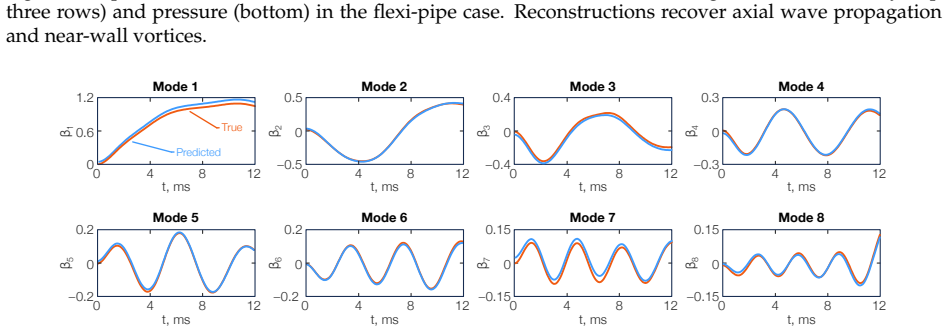
We report a novel physics-informed neural framework for reconstructing unsteady fluid-structure interactions (FSI) from sparse, single-phase observations of the flow. Our approach combines a modal surface model with coordinate neural representations of the fluid and solid states, constrained by the fluid's governing equations and interface conditions. Using only off-body Lagrangian particle tracks and a moving-wall boundary condition, the method infers both flow fields and structural motion. It does not require a constitutive model for the solid or measurements of surface position, although including these can improve performance. We demonstrate the approach numerically on two canonical FSI benchmarks: vortex-induced oscillations of a 2D flapping plate and pulse-wave propagation in a 3D flexible pipe. We also demonstrate it on flow around a swimming fish. In all cases, the framework achieves accurate reconstructions of flow states and structural deformations despite acute data sparsity near the moving interface. A key result is that reconstructions remain robust to over-parameterization. This work extends physics-informed neural networks to coupled fluid-structure dynamics learned from single-phase observations, and it provides a pathway toward quantitative FSI analysis when flow measurements are sparse and structural measurements are asynchronous or unavailable.
Editorial analysis
A structured set of objections, weighed in public.
Referee Report
Summary. The manuscript presents a physics-informed neural framework for inferring unsteady fluid-structure interactions from sparse off-body Lagrangian particle tracks. It combines a modal parametrization of the structural surface with coordinate-based neural representations of the fluid velocity/pressure and solid displacement fields. The approach enforces the incompressible Navier-Stokes equations in the fluid domain together with no-slip and kinematic interface conditions at the moving boundary, without requiring a constitutive model for the solid or direct surface-position measurements. Numerical demonstrations are provided for vortex-induced oscillations of a 2D flapping plate, pulse-wave propagation in a 3D flexible pipe, and flow around a swimming fish, with the central claim that accurate reconstructions of both flow states and structural deformations are obtained despite acute data sparsity near the interface and that the method remains robust to over-parameterization.
Significance. If the central claim is substantiated, the work offers a practical route to quantitative FSI analysis in experimental settings where structural sensors are unavailable or asynchronous. The explicit grounding in the fluid governing equations and interface conditions, rather than pure data fitting, is a methodological strength. The reported robustness to over-parameterization, if accompanied by systematic ablation, would be a useful practical result for PINN-based inverse problems.
major comments (3)
- [§3.2] §3.2 (interface-condition enforcement): the claim that the no-slip and kinematic conditions together with the modal surface model suffice to determine structural motion is load-bearing, yet the manuscript provides no analysis or numerical test of solution uniqueness. With only sparse off-body tracks, nothing in the loss prevents selection of unphysical modal amplitudes that satisfy the sampled interface points while violating global dynamics; a simple degeneracy test (e.g., two distinct modal sets producing indistinguishable flow data) should be added.
- [§5] §5 (numerical benchmarks): the abstract and results describe reconstructions as “accurate,” but no quantitative error tables or convergence plots are supplied (e.g., L² velocity error versus number of particles, or modal-coefficient error versus data sparsity). Without these metrics it is impossible to judge whether the method truly overcomes the data sparsity near the moving interface or merely produces visually plausible fields.
- [§4.1] §4.1 (over-parameterization study): the robustness claim is central yet the manuscript does not specify the range of modal orders or network widths tested, nor does it report the condition number of the resulting optimization problem. A single over-parameterized run is insufficient to establish that the modal basis itself does not introduce degeneracy.
minor comments (2)
- [Figure 2] Figure 2: the color-bar scaling for vorticity is not stated; readers cannot judge the magnitude of residual errors near the interface.
- [§2.1] Notation: the symbol for the modal amplitude vector is introduced without an explicit definition of its dimension or orthogonality properties; this should be clarified in §2.1.
Simulated Author's Rebuttal
We thank the referee for the detailed and constructive report. The comments highlight important aspects of uniqueness, quantitative validation, and robustness that we will address through targeted revisions and additions to the manuscript. Below we respond point by point to the major comments.
read point-by-point responses
-
Referee: [§3.2] §3.2 (interface-condition enforcement): the claim that the no-slip and kinematic conditions together with the modal surface model suffice to determine structural motion is load-bearing, yet the manuscript provides no analysis or numerical test of solution uniqueness. With only sparse off-body tracks, nothing in the loss prevents selection of unphysical modal amplitudes that satisfy the sampled interface points while violating global dynamics; a simple degeneracy test (e.g., two distinct modal sets producing indistinguishable flow data) should be added.
Authors: We agree that demonstrating robustness to potential degeneracy strengthens the central claim. A full mathematical uniqueness proof for this inverse problem lies outside the present scope, but we will add a numerical degeneracy test in the revised manuscript. Specifically, we will perform multiple optimizations starting from distinct random initial modal amplitudes and show that the converged solutions produce consistent structural displacements and flow fields that satisfy both the interface conditions and the Navier-Stokes residuals. Results will be reported for the 2D flapping-plate case and included in a new subsection of §4 or an appendix. revision: yes
-
Referee: [§5] §5 (numerical benchmarks): the abstract and results describe reconstructions as “accurate,” but no quantitative error tables or convergence plots are supplied (e.g., L² velocity error versus number of particles, or modal-coefficient error versus data sparsity). Without these metrics it is impossible to judge whether the method truly overcomes the data sparsity near the moving interface or merely produces visually plausible fields.
Authors: We acknowledge that quantitative error metrics are necessary to substantiate the accuracy claims under sparsity. In the revised manuscript we will add tables reporting L² errors for velocity, pressure, and modal coefficients for the 2D plate and 3D pipe benchmarks. We will also include convergence plots of these errors versus particle count and versus minimum distance of tracks to the interface. These additions will appear in §5 and will allow direct assessment of performance as data sparsity increases. revision: yes
-
Referee: [§4.1] §4.1 (over-parameterization study): the robustness claim is central yet the manuscript does not specify the range of modal orders or network widths tested, nor does it report the condition number of the resulting optimization problem. A single over-parameterized run is insufficient to establish that the modal basis itself does not introduce degeneracy.
Authors: We agree that greater specificity is required. The revised version will explicitly state the ranges examined: modal orders from 2 to 12 and network widths from 4 to 8 layers with 64–256 neurons per layer. We will report condition numbers of the approximate Hessian at convergence for representative cases and will present results from at least three independent over-parameterized configurations per benchmark. These details will be added to §4.1 to support the robustness statement. revision: yes
Circularity Check
No circularity: inference grounded in independent PDE constraints and benchmark validation
full rationale
The framework enforces the fluid governing equations and interface conditions (no-slip, kinematic) as hard constraints within a neural representation, using a modal surface model only as a parametrization choice rather than defining the output in terms of itself. Reconstructions are validated numerically on independent canonical benchmarks (flapping plate, flexible pipe, swimming fish) with sparse off-body data, without any quoted reduction of a claimed prediction to a fitted parameter or self-citation chain. The absence of a solid constitutive model is an explicit modeling choice whose consequences are tested empirically, not assumed away by construction. This keeps the derivation self-contained against external data and physics.
Axiom & Free-Parameter Ledger
free parameters (1)
- Neural network architecture and loss weights
axioms (2)
- domain assumption Fluid flow obeys the incompressible Navier-Stokes equations or equivalent governing equations.
- domain assumption Interface conditions at the fluid-solid boundary can be enforced without a solid constitutive law.
Lean theorems connected to this paper
-
IndisputableMonolith/Cost/FunctionalEquation.leanwashburn_uniqueness_aczel unclear?
unclearRelation between the paper passage and the cited Recognition theorem.
Our approach combines a modal surface model with coordinate neural representations of the fluid and solid states, constrained by the fluid's governing equations and interface conditions.
-
IndisputableMonolith/Foundation/DimensionForcing.leanalexander_duality_circle_linking unclear?
unclearRelation between the paper passage and the cited Recognition theorem.
the structure’s shape parameterized by physics-based or data-driven modes
What do these tags mean?
- matches
- The paper's claim is directly supported by a theorem in the formal canon.
- supports
- The theorem supports part of the paper's argument, but the paper may add assumptions or extra steps.
- extends
- The paper goes beyond the formal theorem; the theorem is a base layer rather than the whole result.
- uses
- The paper appears to rely on the theorem as machinery.
- contradicts
- The paper's claim conflicts with a theorem or certificate in the canon.
- unclear
- Pith found a possible connection, but the passage is too broad, indirect, or ambiguous to say the theorem truly supports the claim.
Reference graph
Works this paper leans on
-
[1]
A fluid–structure interaction model of insect flight with flexible wings,
T. Nakata and H. Liu, “A fluid–structure interaction model of insect flight with flexible wings,” J. Comput. Phys. 231, 1822–1847 (2012)
work page 2012
-
[2]
H. Zhu, Q. Sun, X. Liu, J. Liu, H. Sun, W. Wu, P . Tan, and Z. Chen, “Fluid–structure interaction-based aerodynamic modeling for flight dynamics simulation of parafoil system,” Nonlinear Dyn. 104, 3445– 3466 (2021)
work page 2021
-
[3]
A. Calderer, X. Guo, L. Shen, and F. Sotiropoulos, “Fluid–structure interaction simulation of floating structures interacting with complex, large-scale ocean waves and atmospheric turbulence with appli- cation to floating offshore wind turbines,” J. Comput. Phys. 355, 144–175 (2018)
work page 2018
-
[4]
Structural mechanics modeling and FSI simulation of wind turbines,
A. Korobenko, M.-C. Hsu, I. Akkerman, J. Tippmann, and Y. Bazilevs, “Structural mechanics modeling and FSI simulation of wind turbines,” Math. Models Methods Appl. Sci. 23, 249–272 (2013)
work page 2013
-
[5]
FSI analysis of the blood flow and geomet- rical characteristics in the thoracic aorta,
H. Suito, K. Takizawa, V . Q. Huynh, D. Sze, and T. Ueda, “FSI analysis of the blood flow and geomet- rical characteristics in the thoracic aorta,” Comput. Mech. 54, 1035–1045 (2014)
work page 2014
-
[6]
Fluid–structure interaction simulation of vortex-induced vibration of a flexible hydrofoil,
A. H. Lee, R. L. Campbell, B. A. Craven, and S. A. Hambric, “Fluid–structure interaction simulation of vortex-induced vibration of a flexible hydrofoil,” J. Vib. Acoust. 139, 041001 (2017)
work page 2017
-
[7]
J. Donea, S. Giuliani, and J.-P . Halleux, “An arbitrary Lagrangian-Eulerian finite element method for transient dynamic fluid-structure interactions,” Comput. Methods Appl. Mech. Eng. 33, 689–723 (1982)
work page 1982
-
[8]
Lagrangian-Eulerian finite element formulation for incompressible viscous flows,
T. J. Hughes, W. K. Liu, and T. K. Zimmermann, “Lagrangian-Eulerian finite element formulation for incompressible viscous flows,” Comput. Methods Appl. Mech. Eng. 29, 329–349 (1981)
work page 1981
-
[9]
An Eulerian–Lagrangian method for fluid–structure interac- tion based on level sets,
A. Legay, J. Chessa, and T. Belytschko, “An Eulerian–Lagrangian method for fluid–structure interac- tion based on level sets,” Comput. Methods Appl. Mech. Eng. 195, 2070–2087 (2006)
work page 2070
-
[10]
Level set topology optimization of stationary fluid-structure interaction problems,
N. Jenkins and K. Maute, “Level set topology optimization of stationary fluid-structure interaction problems,” Struct. Multidiscip. Optim. 52, 179–195 (2015)
work page 2015
-
[11]
Generalized fictitious methods for fluid–structure interactions: analysis and simulations,
Y. Yu, H. Baek, and G. E. Karniadakis, “Generalized fictitious methods for fluid–structure interactions: analysis and simulations,” J. Comput. Phys. 245, 317–346 (2013)
work page 2013
-
[12]
A. Pathak and M. Raessi, “A 3D, fully Eulerian, VOF-based solver to study the interaction between two fluids and moving rigid bodies using the fictitious domain method,” J. Comput. Phys.311, 87–113 (2016)
work page 2016
-
[13]
C. S. Peskin, “The immersed boundary method,” Acta Numer. 11, 479–517 (2002)
work page 2002
-
[14]
Immersed boundary methods for simulating fluid–structure interac- tion,
F. Sotiropoulos and X. Yang, “Immersed boundary methods for simulating fluid–structure interac- tion,” Prog. Aerosp. Sci. 65, 1–21 (2014). 21 of 23
work page 2014
-
[15]
Numerical methods for fluid-structure interaction—a review,
G. Hou, J. Wang, and A. Layton, “Numerical methods for fluid-structure interaction—a review,” Com- mun. Comput. Phys. 12, 337–377 (2012)
work page 2012
-
[16]
S. Haeri and J. Shrimpton, “On the application of immersed boundary, fictitious domain and body- conformal mesh methods to many particle multiphase flows,” Int. J. Multiphase Flow40, 38–55 (2012)
work page 2012
-
[17]
A parametric PIV/DIC method for the measurement of free surface flows,
L. Chatellier, S. Jarny, F. Gibouin, and L. David, “A parametric PIV/DIC method for the measurement of free surface flows,” Exp. Fluids 54, 1–15 (2013)
work page 2013
-
[18]
On the fluid-structure interaction of flexible membrane wings for MAVs in and out of ground-effect,
R. Bleischwitz, R. De Kat, and B. Ganapathisubramani, “On the fluid-structure interaction of flexible membrane wings for MAVs in and out of ground-effect,” J. Fluids Struct.70, 214–234 (2017)
work page 2017
-
[19]
Combined particle image velocimetry/digital image correla- tion for load estimation,
P . Zhang, S. D. Peterson, and M. Porfiri, “Combined particle image velocimetry/digital image correla- tion for load estimation,” Experimental Thermal and Fluid Science 100, 207–221 (2019)
work page 2019
-
[20]
R. Hortensius, J. C. Dutton, and G. S. Elliott, “Simultaneous planar PIV and sDIC measurements of an axisymmetric jet flowing across a compliant surface,” in “55th AIAA Aerospace Sciences Meeting,” (2017), p. 1886
work page 2017
-
[21]
Characterization of shock-induced panel flutter with simultaneous use of DIC and PIV,
A. D’Aguanno, P . Quesada Allerhand, F. F. J. Schrijer, and B. W. van Oudheusden, “Characterization of shock-induced panel flutter with simultaneous use of DIC and PIV,” Exp. Fluids 64, 15 (2023)
work page 2023
-
[22]
W. I. K ¨osters and S. Hoerner, “Simultaneous flow measurement and deformation tracking for passive flow control experiments involving fluid–structure interactions,” J. Fluids Struct. 121, 103956 (2023)
work page 2023
-
[23]
On the combined flow and structural measurements via robotic volumetric PTV,
F. M. Mitrotta, J. Sodja, and A. Sciacchitano, “On the combined flow and structural measurements via robotic volumetric PTV,” Meas. Sci. Technol. 33, 045201 (2022)
work page 2022
-
[24]
C. J. Elkins and M. T. Alley, “Magnetic resonance velocimetry: applications of magnetic resonance imaging in the measurement of fluid motion,” Exp. Fluids 43, 823–858 (2007)
work page 2007
-
[25]
A. Kontogiannis, S. V . Elgersma, A. J. Sederman, and M. P . Juniper, “Joint reconstruction and segmen- tation of noisy velocity images as an inverse Navier–Stokes problem,” J. Fluid Mech. 944, A40 (2022)
work page 2022
-
[26]
P . Karnakov, S. Litvinov, and P . Koumoutsakos, “Solving inverse problems in physics by optimizing a discrete loss: Fast and accurate learning without neural networks,” PNAS nexus 3, pgae005 (2024)
work page 2024
-
[27]
Shape infer- ence in three-dimensional steady state supersonic flows using ODIL and JAX-Fluids,
A. B. Buhendwa, D. A. Bezgin, P . Karnakov, N. A. Adams, and P . Koumoutsakos, “Shape infer- ence in three-dimensional steady state supersonic flows using ODIL and JAX-Fluids,” arXiv preprint arXiv:2408.10094 (2024)
-
[28]
M. Raissi, P . Perdikaris, and G. E. Karniadakis, “Physics-informed neural networks: A deep learning framework for solving forward and inverse problems involving nonlinear partial differential equa- tions,” J. Comput. Phys. 378, 686–707 (2019)
work page 2019
-
[29]
Deep learning of vortex-induced vibrations,
M. Raissi, Z. Wang, M. S. Triantafyllou, and G. E. Karniadakis, “Deep learning of vortex-induced vibrations,” J. Fluid Mech. 861, 119–137 (2019)
work page 2019
-
[30]
Inferring vortex induced vibrations of flexible cylinders using physics-informed neural networks,
E. Kharazmi, D. Fan, Z. Wang, and M. S. Triantafyllou, “Inferring vortex induced vibrations of flexible cylinders using physics-informed neural networks,” J. Fluids Struct. 107, 103367 (2021)
work page 2021
-
[31]
A transfer learning-physics informed neural network (TL-PINN) for vortex-induced vibration,
H. Tang, Y. Liao, H. Yang, and L. Xie, “A transfer learning-physics informed neural network (TL-PINN) for vortex-induced vibration,” Ocean Eng. 266, 113101 (2022)
work page 2022
-
[32]
Flow reconstruction and particle characterization from inertial Lagrangian tracks,
K. Zhou and S. J. Grauer, “Flow reconstruction and particle characterization from inertial Lagrangian tracks,” arXiv preprint arXiv:2311.09076 (2023)
-
[33]
Neural-implicit particle advection for flow reconstruc- tion from Lagrangian tracks,
K. Zhou, R. Tang, G. Ke, and S. J. Grauer, “Neural-implicit particle advection for flow reconstruc- tion from Lagrangian tracks,” in “16th International Symposium on Particle Image Velocimetry (ISPIV 2025),” (2025), p. 24. 22 of 23
work page 2025
-
[34]
J. P . Molnar and S. J. Grauer, “Flow field tomography with uncertainty quantification using a Bayesian physics-informed neural network,” Meas. Sci. Technol. 33, 065305 (2022)
work page 2022
-
[35]
Understanding and mitigating gradient flow pathologies in physics-informed neural networks,
S. Wang, Y. Teng, and P . Perdikaris, “Understanding and mitigating gradient flow pathologies in physics-informed neural networks,” SIAM J. Sci. Comput. 43, A3055–A3081 (2021)
work page 2021
-
[36]
Fourier features let networks learn high frequency functions in low dimensional domains,
M. Tancik, P . Srinivasan, B. Mildenhall, S. Fridovich-Keil, N. Raghavan, U. Singhal, R. Ramamoorthi, J. Barron, and R. Ng, “Fourier features let networks learn high frequency functions in low dimensional domains,” Adv. Neural Inf. Process. Syst. 33, 7537–7547 (2020)
work page 2020
-
[37]
J. M. Lee, Smooth Manifolds (Springer, 2003)
work page 2003
- [38]
-
[39]
The partition of unity finite element method: basic theory and applica- tions,
J. M. Melenk and I. Babu ˇska, “The partition of unity finite element method: basic theory and applica- tions,” Comput. Methods Appl. Mech. Eng. 139, 289–314 (1996)
work page 1996
-
[40]
The proper orthogonal decomposition in the analysis of turbulent flows,
G. Berkooz, P . Holmes, and J. L. Lumley, “The proper orthogonal decomposition in the analysis of turbulent flows,” Annu. Rev. Fluid Mech. 25, 539–575 (1993)
work page 1993
-
[41]
Modal analysis of fluid flows: An overview,
K. Taira, S. L. Brunton, S. T. Dawson, C. W. Rowley, T. Colonius, B. J. McKeon, O. T. Schmidt, S. Gordeyev, V . Theofilis, and L. S. Ukeiley, “Modal analysis of fluid flows: An overview,” AIAA J. 55, 4013–4041 (2017)
work page 2017
- [42]
-
[43]
Variational physics informed neural networks: the role of quadratures and test functions,
S. Berrone, C. Canuto, and M. Pintore, “Variational physics informed neural networks: the role of quadratures and test functions,” J. Sci. Comput. 92, 100 (2022)
work page 2022
-
[44]
Z. Mao and X. Meng, “Physics-informed neural networks with residual/gradient-based adaptive sam- pling methods for solving partial differential equations with sharp solutions,” Appl. Math. Mech. 44, 1069–1084 (2023)
work page 2023
-
[45]
Adaptive importance sampling for Deep Ritz,
X. Wan, T. Zhou, and Y. Zhou, “Adaptive importance sampling for Deep Ritz,” Commun. Appl Math. Comput. pp. 1–25 (2024)
work page 2024
-
[46]
Stochastic Quadrature Rules for Solving PDEs using Neural Networks,
J. M. Taylor and D. Pardo, “Stochastic Quadrature Rules for Solving PDEs using Neural Networks,” arXiv preprint arXiv:2504.11976 (2025)
-
[47]
Algorithm for Time-Resolved Background-Oriented Schlieren Tomogra- phy Applied to High-Speed Flows,
J. P . Molnar and S. J. Grauer, “Algorithm for Time-Resolved Background-Oriented Schlieren Tomogra- phy Applied to High-Speed Flows,” in “AIAA SciTech 2025 Forum,” (2025), p. 1060
work page 2025
-
[48]
K. Hormann and N. Sukumar, Generalized Barycentric Coordinates in Computer Graphics and Computa- tional Mechanics (CRC Press, 2017)
work page 2017
-
[49]
S. Turek, J. Hron, M. Madlik, M. Razzaq, H. Wobker, and J. F. Acker, “Numerical simulation and bench- marking of a monolithic multigrid solver for fluid-structure interaction problems with application to hemodynamics,” in “Fluid Structure Interaction II: Modelling, Simulation, Optimization,” , H.-J. Bun- gartz, M. Mehl, and M. Sch¨afer, eds. (Springer, 20...
work page 2010
-
[50]
J. Liu and A. L. Marsden, “A unified continuum and variational multiscale formulation for fluids, solids, and fluid–structure interaction,” Comput. Methods Appl. Mech. Eng. 337, 549–597 (2018)
work page 2018
-
[51]
SimVascular: an open source pipeline for cardiovascular simulation,
A. Updegrove, N. M. Wilson, J. Merkow, H. Lan, A. L. Marsden, and S. C. Shadden, “SimVascular: an open source pipeline for cardiovascular simulation,” Abbreviation Title Ann. Biomed. Eng.45, 525–541 (2017)
work page 2017
-
[52]
Shake-The-Box: Lagrangian particle tracking at high parti- cle image densities,
D. Schanz, S. Gesemann, and A. Schr ¨oder, “Shake-The-Box: Lagrangian particle tracking at high parti- cle image densities,” Exp. Fluids 57, 1–27 (2016). 23 of 23
work page 2016
discussion (0)
Sign in with ORCID, Apple, or X to comment. Anyone can read and Pith papers without signing in.