REVIEW 4 major objections 4 minor 2 cited by
Securing the Sky: Integrated Satellite-UAV Physical Layer Security for Low-Altitude Wireless Networks
T0 review · 4 major / 4 minor · reviewed 2026-08-06 · deepseek-v4-flash
Pith's one-line read Integrated satellite-UAV collaborative beamforming can provide physical layer security for low-altitude wireless networks, and the one-time optimization becomes cheaper than encryption for transfers above about 1 GB.
desk verdict A well-written satellite-UAV architecture paper whose effectiveness claims rest on unreproducible simulations and an unmodeled synchronization assumption, but the survey content is genuinely useful. read the letter →
The pith
A machine-rendered reading of the paper's core claim, the machinery that carries it, and where it could break.
The reading
What carries the argument
The load-bearing mechanism is the virtual antenna array: each UAV's antenna acts as an independent element of a distributed array, and the paper optimizes UAV positions and excitation current weights to shape the beam pattern. This pattern directs the mainlobe toward the legitimate receiver and steers nulls toward eavesdropper directions, achieving secrecy without trajectory design. The paper enhances two multi-objective evolutionary algorithms (IMODAOM and EMOALO) to solve the NP-hard deployment problem, with satellites providing remote sensing, eavesdropper detection, and coordination in infrastructure-less areas.
What would settle it
A field test with the Raspberry Pi 4B testbed and realistic oscillator drift and propagation delays: if the measured null depth toward a known eavesdropper falls short of the simulated sidelobe level, or the secrecy rate does not exceed a single-antenna baseline, the claimed gains are falsified.
Extended reading notes
Core claim
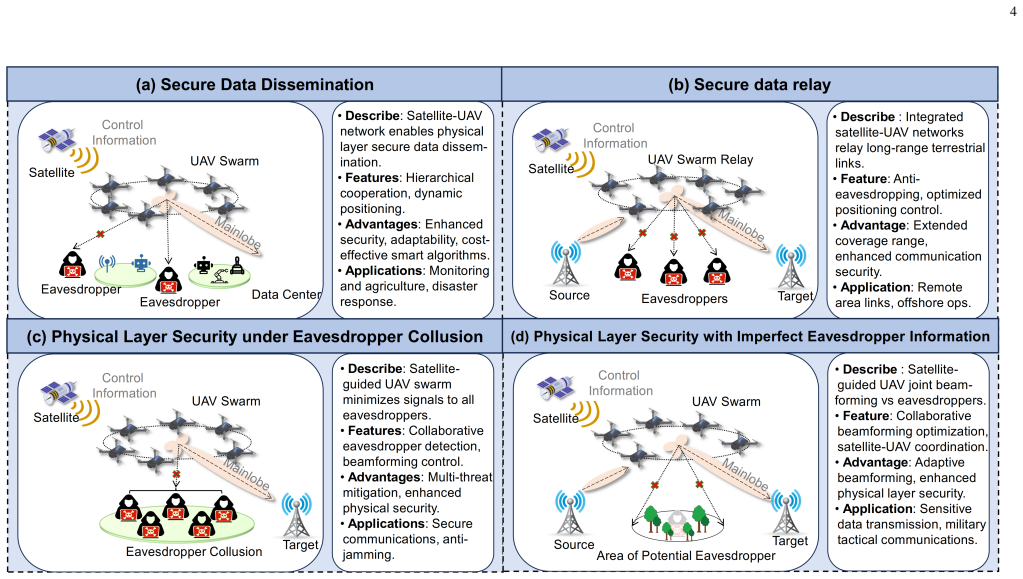
The central discovery is that UAV swarm collaborative beamforming can achieve physical layer security in LAWN environments without precise trajectory design or heavy encryption. By treating each UAV antenna as an element of a virtual antenna array, and jointly optimizing the swarm's positions and excitation current weights, the beam pattern's mainlobe can be pointed at legitimate receivers while its sidelobes, especially nulls toward detected or potential eavesdroppers, are suppressed. The paper demonstrates this in two scenarios: an integrated satellite-UAV secure relay, where a source base station connects to clustered terminals past known and unknown eavesdroppers, and a two-way aerial communication between two UAV swarms under eavesdropper collusion via maximum ratio combining. In both cases, the enhanced multi-objective algorithms yield deployment solutions closer to the ideal Pareto front than comparison methods, simultaneously improving secrecy rate, sidelobe suppression, and energy efficiency. Further, the one-time optimization cost (~40 s) makes the scheme computationally cheaper than encryption for transfers over roughly 1 GB, because encryption costs scale with data volume while the beamforming optimization does not.
Load-bearing premise
The security gains require all UAV antennas to be locked in time, phase, and frequency so the swarm behaves as one coherent antenna array, a synchronization the paper lists as an open challenge.
Editorial extensions
If this is right
- In network-limited LAWN regions, satellite-guided UAV swarms can secure data dissemination and relay links without terrestrial infrastructure, because satellites supply control and remote sensing while UAVs form the virtual array.
- For bandwidth-intensive transfers, the one-time beamforming optimization is computationally cheaper than DES, AES, and RSA encryption once the data volume exceeds about 1 GB, with the advantage growing as data size increases.
- The proposed deployment solutions simultaneously improve secrecy rate, suppress sidelobes toward unknown eavesdroppers, and reduce UAV energy consumption, as shown by Pareto fronts closer to the ideal in both case studies.
- Collaborative beamforming can maintain security even when eavesdroppers collude via maximum ratio combining and when their positions are only approximately known, by minimizing signal energy in all likely eavesdropper directions.
Reading between the lines
- The cost crossover near 1 GB means the scheme is not universally cheaper than encryption; for short, sporadic telemetry, encryption may remain the cheaper option, a boundary the paper does not discuss.
- A natural extension the paper does not explore is combining the virtual-array null steering with artificial noise or directional modulation, which could relax the need for accurate eavesdropper localization.
- The synchronization requirement implies that practical deployment hinges on solving distributed time, phase, and frequency alignment across a moving swarm; the paper lists this as open, so the achievable secrecy rate in the field may be lower than in simulation.
- The same virtual-antenna-array machinery could be reused for satellite-UAV uplink security or for anti-jamming positioning, since the underlying beam-pattern control is not specific to the relay and two-way scenarios studied.
Editorial analysis
A structured set of objections, weighed in public.
Referee Report
Summary. The paper proposes an integrated satellite-UAV collaborative beamforming framework for physical layer security in low-altitude wireless networks (LAWNs). It introduces background on integrated satellite-UAV networks, PLS, UAV swarms, and collaborative beamforming, then identifies four application opportunities. Two case studies are presented: a secure relay system optimized with an improved multi-objective dragonfly algorithm (IMODAOM), and a two-way aerial secure communication system under eavesdropper collusion optimized with an enhanced multi-objective ant-lion optimizer (EMOALO). Simulation results claim superior Pareto fronts and secrecy performance over generic metaheuristics, and a practicality analysis claims the optimization cost becomes cheaper than encryption for data transfers above about 1 GB. The paper concludes with challenges and future directions.
Significance. If the technical claims were fully substantiated, the paper would offer a useful extension of collaborative beamforming physical layer security to satellite-controlled UAV swarms in infrastructure-limited LAWN scenarios. The paper is honest in acknowledging synchronization as an open challenge and covers a reasonably broad set of application scenarios. However, the significance is currently conditional: the absence of a mathematical problem formulation, the unmodeled synchronization assumption, and the incomplete evaluation methodology prevent verification of the central effectiveness claim. The paper does not provide code, reproducible experiments, or parameter-free derivations, so its contribution is currently at the level of a scenario proposal rather than a validated technical result.
major comments (4)
- [Sections IV-A and V-A] The optimization problems are only described verbally. The objectives 'maximize the total minimum secrecy rate', 'minimize the maximum sidelobe level', and 'reduce the total energy cost' are not defined by equations; there is no channel model, no array factor expression, no definition of R_R, R_E, or R_EMRC, no sidelobe-level formula, no energy cost model, and no constraint set. As a result, the Pareto fronts in Figs. 4(c) and 6(c) and the secrecy-rate claims in Figs. 4(a) cannot be reproduced or independently checked. This is load-bearing for the paper's central claim that the proposed schemes are effective, and it must be fixed by adding a complete mathematical formulation of both problems, including decision variable domains and constraints.
- [Sections II-D and VII] The scheme requires UAVs to be synchronized in time, phase, and frequency so that they form a coherent virtual antenna array, but Section VII explicitly lists synchronization as an open challenge due to differential propagation delays between edge and center UAVs at low elevation angles. Neither case study in Sections IV-B and V-B models oscillator phase noise, timing jitter, or residual synchronization error, so the reported secrecy rates and Pareto fronts are computed under an unstated perfect co-phasing assumption. Since the secrecy gains are entirely a property of the coherent array factor, a phase-error sensitivity analysis or a synchronization-error-aware array model is needed before the effectiveness claim can be accepted.
- [Section VI] The practicality analysis compares a one-time optimization cost of about 40 seconds with per-200-MB encryption/decryption times and concludes that the proposed method is advantageous for data transfers above about 1 GB. This comparison is not meaningful as stated: the optimization cost is incurred once per deployment strategy, whereas encryption is applied continuously per data block, and the two techniques provide different security properties (data confidentiality versus physical-layer secrecy). The 40-second figure is also not contextualized with the number of iterations, population size, hardware details, or how often re-optimization is needed in a dynamic LAWN. This section does not establish practical applicability.
- [Sections IV-B and V-B] The simulation evaluation lacks essential rigor: the hyperparameters of IMODAOM and EMOALO are not reported, the number of independent runs is not stated, no error bars or statistical dispersion measures are given, and the 'ideal Pareto front' used for comparison is an in-house benchmark with no described construction. The proposed algorithms are described as modifications of the authors' prior MODA and MOALO methods, but no ablation study isolates the contribution of each modification. Without these details, the claimed superiority over MOGOA, MOMVO, MOPSO, and MSSA cannot be assessed.
minor comments (4)
- [Section V-B] The text states that 'the Pareto solutions obtained by our EMOMVO are closer to the ideal PF', but the algorithm described in this section is EMOALO; EMOMVO is not introduced anywhere in the paper.
- [Section V-B] The sentence 'Additionally, Fig. 6(a) shows the Pareto solution distributions' is inconsistent with the figure caption, which labels Fig. 6(a) as flight paths of UAV swarm 1; the Pareto distribution should likely be Fig. 6(c).
- [References] Reference [4] contains a typo, 'AA V' should be 'UAV', and several references are preprint or in-press items without complete bibliographic details, which makes tracing the related work harder.
- [Section IV-B] The uniform linear and rectangular array baselines are described only by element spacing; the number of elements, array orientation, and whether the positions are optimized or fixed should be stated to make the comparison interpretable.
Circularity Check
No circularity found: algorithm performance is validated by simulation against peer metaheuristics and fixed array baselines, with no fitted parameter renamed as a prediction and no load-bearing self-citation chain.
full rationale
I walked the paper's claimed derivation chain. The paper's concrete contribution is algorithmic: IMODAOM and EMOALO are heuristic solvers for multi-objective collaborative-beamforming problems, and their evaluation is by simulation against peer metaheuristics (MOGOA, MOMVO, MOPSO, MODA, MSSA, conventional MOALO) and conventional array geometries, not by deriving a prediction from a fitted input. No quantity is defined in terms of a target result and then 'derived' from it; RSEC = [RR - REmax]+ and RSEC = [RC - REMRC]+ are definitions used as objectives, not circular derivations. No fitted parameter is renamed as a prediction; the algorithms do not fit data and then predict a closely related quantity. The 'ideal Pareto front' used in Figs. 4(c) and 6(c) is an internal ranking benchmark, but the paper gives no equation showing that this front is constructed from the proposed algorithms themselves, so no construction-level circularity can be exhibited. Self-citations such as [6], [12], and [14] point to earlier UAV collaborative-beamforming formulations and algorithms; they serve as the starting point for incremental algorithmic improvements and as comparison baselines, not as a self-justifying premise that forces the conclusions. The synchronization requirement in Section II-D and the acknowledgment that synchronization remains an open challenge in Section VII are a modeling assumption and feasibility risk: the secrecy-rate simulations assume perfect phase/time/frequency alignment, and residual synchronization errors could degrade the claimed gains. However, that is an unmodeled error source or correctness concern, not an input-output equivalence, so it does not constitute circularity under the specified criteria. Overall, the simulation-based claims are self-contained in the sense that they compare the proposed algorithms against external baselines on the authors' own problem formulation, which is normal for algorithm papers and does not by itself make the evaluation circular. No specific circular step could be quoted and reduced to its own inputs.
Assumptions & free parameters
free parameters (2)
- Simulation scenario parameters (carrier frequency, pathloss exponent, transmit power, bandwidth, noise PSD, area size) =
900 MHz/2.4 GHz; 2.7/2; 0.1 W; 20 MHz; -155 dBm/Hz; 100 m x 100 m
- Hyperparameters of IMODAOM and EMOALO (population size, number of iterations, crossover/mutation rates) =
Not reported
assumptions (3)
- standard math Secrecy capacity is max(0, R_legit - R_eav) and maximizing it yields information-theoretic security.
- domain assumption Collaborative beamforming with a virtual antenna array can steer nulls toward eavesdroppers while keeping gain toward the legitimate receiver.
- domain assumption Satellites can obtain UAV positions, eavesdropper locations, and partial CSI, and can relay these to an edge server quickly enough for real-time control.
Cite this review
Pith. "Pith review of Securing the Sky: Integrated Satellite-UAV Physical Layer Security for Low-Altitude Wireless Networks." pith.science (2026). https://pith.science/paper/SYX5WLE7
@misc{pith2026250623493,
  author       = {Pith},
  title        = {Pith review of: Securing the Sky: Integrated Satellite-UAV Physical Layer Security for Low-Altitude Wireless Networks},
  year         = {2026},
  howpublished = {\url{https://pith.science/paper/SYX5WLE7}},
  note         = {Machine review of arXiv:2506.23493}
}
read the original abstract
Low-altitude wireless networks (LAWNs) have garnered significant attention in the forthcoming 6G networks. In LAWNs, satellites with wide coverage and unmanned aerial vehicles (UAVs) with flexible mobility can complement each other to form integrated satellite-UAV networks, providing ubiquitous and high-speed connectivity for low-altitude operations. However, the higher line-of-sight probability in low-altitude airspace increases transmission security concerns. In this work, we present a collaborative beamforming-based physical layer security scheme for LAWNs. We introduce the fundamental aspects of integrated satellite-UAV networks, physical layer security, UAV swarms, and collaborative beamforming for LAWN applications. Following this, we highlight several opportunities for collaborative UAV swarm secure applications enabled by satellite networks, including achieving physical layer security in scenarios involving data dissemination, data relay, eavesdropper collusion, and imperfect eavesdropper information. Next, we detail two case studies: a secure relay system and a two-way aerial secure communication framework specifically designed for LAWN environments. Simulation results demonstrate that these physical layer security schemes are effective and beneficial for secure low-altitude wireless communications. A short practicality analysis shows that the proposed method is applicable to LAWN scenarios. Finally, we discuss current challenges and future research directions for enhancing security in LAWNs.
Figures


Figures from the paper (3 more)


Forward citations
Cited by 2 Pith papers
-
Recovery of UAV Swarm-enabled Collaborative Beamforming in Low-altitude Wireless Networks under Wind Field Disturbances
A PPO-based algorithm with LSTM and Adam is applied to adjust antenna weights of a wind-disturbed UAV swarm, but the paper's constraints, reward design, and baselines do not support the claimed recovery.
-
Age of Information Optimization in Laser-charged UAV-assisted IoT Networks: A Multi-agent Deep Reinforcement Learning Method
A multi-agent PPO variant with LSTM temporal memory and a weighted local-global value function is proposed to reduce peak age of information in laser-charged UAV-assisted IoT networks, with simulated gains up to 15.1%...
Reference graph
Works this paper leans on
-
[1]
Y . Wang et al. , “Toward realization of low-altitude economy networks: Core architecture, integrated technologies, and future directions,” 2025
work page 2025
-
[2]
Satellite-assisted low-altitude economy networking: Con- cepts, applications, and opportunities,
S. He et al. , “Satellite-assisted low-altitude economy networking: Con- cepts, applications, and opportunities,” 2025
work page 2025
-
[3]
Safeguarding next-generation multiple access using phys- ical layer security techniques: A tutorial,
L. Lv et al. , “Safeguarding next-generation multiple access using phys- ical layer security techniques: A tutorial,” Proc. IEEE, vol. 112, no. 9, pp. 1421–1466, 2024
work page 2024
-
[4]
J. Huang et al. , “Dual AA V cluster-assisted maritime physical-layer secure communications via collaborative beamforming,” IEEE Internet Things J., vol. 12, no. 9, pp. 12 589–12 607, 2025
work page 2025
-
[5]
UA V-enabled collaborative beamforming via multi-agent deep reinforcement learning,
S. Liu et al. , “UA V-enabled collaborative beamforming via multi-agent deep reinforcement learning,” IEEE Trans. Mob. Comput. , vol. 23, no. 12, pp. 13 015–13 032, 2024
work page 2024
-
[6]
J. Li et al. , “Two-way aerial secure communications via distributed collaborative beamforming under eavesdropper collusion,” inProc. IEEE INFOCOM 2024 , 2024, pp. 331–340
work page 2024
-
[7]
A long-short-term stress-tolerant routing algorithm for LEO satellite network,
X. Wu et al. , “A long-short-term stress-tolerant routing algorithm for LEO satellite network,” IEEE Trans. Aerosp. Electron. Syst. , pp. 1–14, 2025
work page 2025
-
[8]
M. Ozturk et al. , “Integrating terrestrial and non-terrestrial networks for sustainable 6G operations: A latency-aware multi-tier cell-switching approach,” IEEE Network , pp. 1–1, 2025
work page 2025
Show all 15 references
-
[9]
Secure physical layer communications for low-altitude economy networking: A survey,
L. Cai et al. , “Secure physical layer communications for low-altitude economy networking: A survey,” 2025
2025
-
[10]
Artificial intelligence for satellite communication: A survey,
G. Fontanesi et al. , “Artificial intelligence for satellite communication: A survey,” IEEE Commun. Surveys Tuts. , pp. 1–1, 2025
2025
-
[11]
UA V-assisted IoT applications, QoS requirements and challenges with future research directions,
M. Adil et al. , “UA V-assisted IoT applications, QoS requirements and challenges with future research directions,” ACM Comput. Surv., vol. 56, no. 10, p. 251, 2024
2024
-
[12]
Multi-objective optimization for UA V swarm-assisted IoT with virtual antenna arrays,
J. Li et al. , “Multi-objective optimization for UA V swarm-assisted IoT with virtual antenna arrays,” IEEE Trans. Mob. Comput. , vol. 23, no. 5, pp. 4890–4907, 2024
2024
-
[13]
A survey on detection, classification, and tracking of UA Vs using radar and communications systems,
W. Khawaja et al. , “A survey on detection, classification, and tracking of UA Vs using radar and communications systems,” IEEE Commun. Surveys Tuts., pp. 1–1, 2025
2025
-
[14]
Secure and energy-efficient UA V relay communications exploiting collaborative beamforming,
G. Sun et al. , “Secure and energy-efficient UA V relay communications exploiting collaborative beamforming,” IEEE Trans. Commun. , vol. 70, no. 8, pp. 5401–5416, 2022
2022
-
[15]
Privacy-preserving state estimation in the presence of eavesdroppers: A survey,
X. Yan et al. , “Privacy-preserving state estimation in the presence of eavesdroppers: A survey,” IEEE Trans Autom. Sci. Eng. , vol. 22, pp. 6190–6207, 2025
2025
Reviewed August 6, 2026 · model on record in the stance chip above.
Discussion (0). Sign in to comment.