REVIEW 4 major objections 5 minor 26 references
Mutli-Level Autoencoder: Deep Learning Based Channel Coding and Modulation
T0 review · 4 major / 5 minor · reviewed 2026-08-06 · deepseek-v4-flash
Pith's one-line read A multi-level autoencoder splits messages into B-bit blocks, exhaustively tests every per-level codeword, and matches or beats polar and TurboAE-MOD baselines at blocklength 64 over AWGN.
desk verdict A plausible multi-level neural code with a genuinely useful per-level exhaustive test, but the promised joint-code guarantees never materialize and per-level testing does not validate error propagation. read the letter →
The pith
A machine-rendered reading of the paper's core claim, the machinery that carries it, and where it could break.
The reading
What carries the argument
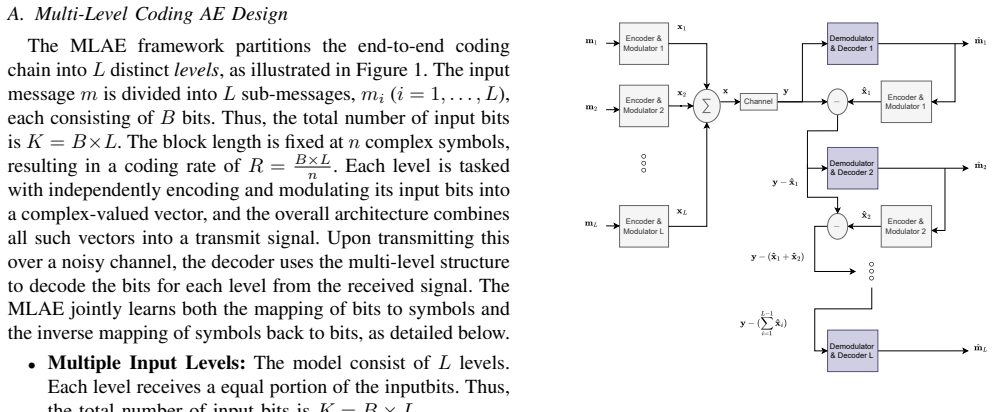
The load-bearing mechanism is the multi-level superposition code with successive subtraction. Each of the $L$ levels has a convolutional encoder that maps its $B$ input bits into $n$ complex symbols, and all level outputs are summed to form the transmitted signal; a global power constraint is applied during training. On the receiver side, each decoder sees a residual signal, estimates its own bits, re-encodes them, and subtracts that re-encoded estimate before the next level decodes, so the effective testable object at any stage is one level's $2^B$-entry codebook rather than the composite $2^{BL}$ codebook. The encoder and decoder are trained jointly with a weighted binary cross-entropy loss, which lets the network learn power allocation across levels as part of the optimization.
What would settle it
Choose a small configuration such as $B=8$, $L=4$, transmit all $2^{32}$ joint messages through the trained MLAE, decode them successively, and compare the joint frame error rate with what the per-level exhaustive tests predict; if a single early-level error cascades and makes the joint error rate substantially worse than the per-level numbers suggest, the claim that per-level exhaustive testing validates the full code collapses.
Extended reading notes
Core claim
The central discovery is that structuring an end-to-end learned codec as $L$ separately testable levels makes exhaustive numerical validation feasible: each decoder works on a residual left after subtracting re-encoded estimates of earlier levels, so the validation burden drops from $2^{BL}$ joint messages to $2^B$ codewords per level. Using $B=16$ and $n=64$, the paper reports BER values at 0 dB for rates 0.25, 0.5, 0.75, and 1 bits/transmission, with the total BER growing from $9.7\times 10^{-5}$ at rate 0.25 to $4.27\times 10^{-2}$ at rate 1. The reported comparisons with TurboAE-MOD and polar PAC codes at 0 dB and 2.5 dB show MLAE achieving comparable or better reliability in the settings tested, and the architecture is shown to change its coding rate by discarding layers without retraining.
Load-bearing premise
The load-bearing premise is that checking every one of the $2^B$ codewords inside each level separately is enough to certify the whole multi-level code, even though one wrong decision at an early level changes the residual that every later decoder sees.
Editorial extensions
If this is right
- Because every level is tested against all $2^B$ codewords over $2^{10}$ noise realizations, the reported BER numbers are statements about the full per-level codebook, not about a small sample.
- A single trained MLAE can serve a family of coding rates: removing one or more encoder–decoder layers lowers the rate and lets the same weights work at lower SNR without retraining.
- At blocklength $n=64$ over AWGN, MLAE is reported to match or beat TurboAE-MOD and polar PAC codes at 0 dB and 2.5 dB in the tested settings, while being validated far more exhaustively.
- Joint training with a global power constraint enables the network to distribute power across levels, which is what allows later decoders to recover their bits from successive residuals.
Reading between the lines
- Read strictly, the exhaustive-testing claim certifies each level separately; certifying the full transmitter would require a joint test over $2^{BL}$ messages or an error-propagation bound, which the paper does not supply.
- The layer-dropping rule makes MLAE a learned rate-compatible code family; comparing it with rate-compatible polar codes at identical rates would show what the learned superposition adds over classical puncturing.
- The paper notes that training becomes harder as the number of levels grows because of power allocation; this points to the successive-subtraction residual, not encoder size, as the bottleneck, suggesting an explicit per-level power schedule or an ordered curriculum might let $L$ scale further.
Editorial analysis
A structured set of objections, weighed in public.
Referee Report
Summary. The paper proposes a multi-level convolutional autoencoder (MLAE) for joint channel coding and modulation over AWGN channels. Each of L levels encodes B bits into n complex symbols, and the transmit signal is the sum of per-level codewords. The receiver performs successive decoding: each decoder operates on a residual signal obtained by subtracting the re-encoded estimates of previously decoded levels. The main claimed advantages are (i) the ability to exhaustively test all 2^B per-level codewords, in contrast to sampling-based evaluation in prior learned-code work; (ii) SNR-adaptive operation by removing layers without retraining; and (iii) BER comparable to or better than TurboAE-MOD and PAC/polar codes at blocklength n=64. Results are reported as per-level and total BER at 0 dB and 2.5 dB for rates from 0.25 to 1 bit per transmission.
Significance. If validated, MLAE would be a useful modular learned coding scheme: per-level exhaustive testing is a genuine improvement over the small-sample evaluation typical of learned codes, and the rate-adaptation-by-layer-removal property is practically attractive. The paper also provides external benchmarks against TurboAE-MOD and PAC/polar codes, which strengthens the empirical comparison. However, the central validation claim—that per-level exhaustive testing suffices to certify the full multi-level code—is not supported, and the error-propagation behavior of the successive decoder is never analyzed. These issues must be resolved before the reliability claims can be accepted.
major comments (4)
- [Section III-A] The text promises that per-level testing can 'provide performance guarantees for the whole architecture as we shall discuss later,' but no such guarantee or joint analysis appears in the rest of the paper. With L active levels of B bits each, the true message space has 2^{BL} elements (2^64 for the L=4 configuration), and the reported exhaustive testing covers only the 2^16 per-level subspaces. Successful per-level decoding does not imply reliable joint decoding because decoder i subtracts the re-encoded estimate of level i-1; when that estimate is wrong, the residual contains an uncompensated interference term that per-level BER measurements do not capture. The authors should either supply a bound on error propagation or report joint frame-error rates over a large random sample of full messages, and explain why exhaustive joint testing is impossible as they do for TurboAE-MOD.
- [Table III and Section IV-B] The 'Total' BER in Table III is defined as the arithmetic mean of per-level BERs. This metric is not a frame-error rate and cannot detect correlated or cascading failures across levels. In a successive decoder, an error in an early level can wipe out later levels; an average of per-level BERs will systematically understate such events. I recommend reporting the joint FER for the multi-level message, or at least the conditional BER of level i given correct decoding of levels 1 through i-1.
- [Section IV-A] The training SNR is never disclosed, although the model is claimed to operate at various SNRs and Fig. 2 reports only 0 dB and 2.5 dB. The reader cannot judge whether the reported gains reflect the chosen training point or a genuine SNR-adaptive property. Please state the training SNR explicitly, report results at additional SNR values, and provide error bars or multiple-seed statistics, since the BER values span six orders of magnitude and are based on finite Monte Carlo realizations.
- [Section IV-A] The training set repeats each of the 2^16 codewords only 3 times with different noise realizations, while testing uses 2^10 realizations per codeword. The paper asserts that this 'insures the system's reliability,' but no analysis or ablation shows that three noise realizations per codeword suffice to learn decoders that generalize across the test noise distribution, particularly for the higher levels that see residual interference. At minimum, a sensitivity study on the number of training noise realizations is needed before this claim is supportable.
minor comments (5)
- [Title] The title misspells 'Multi-Level' as 'Mutli-Level'; please correct it.
- [Figure 1 caption] The caption refers to 'MLEA' while the rest of the paper uses 'MLAE'; please unify the acronym.
- [Section IV-A] The expressions '3 × 216' and '210' should be typeset as 3 × 2^16 and 2^10 to avoid confusion; as printed they look like the decimal numbers 216 and 210.
- [Abstract and Section IV] The abstract and conclusion state 'improved reliability' and 'comparable, or even superior performance,' but Fig. 2 shows cases where TurboAE-MOD achieves lower BER (e.g., at high rates for 2.5 dB); please qualify the wording to match the data.
- [Section IV-B] The sentence 'sum them and divide by L' defines the total BER, but it is unclear why equal weighting is appropriate when levels exhibit very different BERs (e.g., Level 2 at 0.11 vs. Level 4 at 0.02); a weighted or joint metric would be more informative.
Circularity Check
No significant circularity: the central reliability claims are benchmarked against external schemes (TurboAE-MOD and PAC polar codes), and the per-level exhaustive testing is a coding-theoretic evaluation rather than a derivation from fitted inputs.
full rationale
I find no circular step that satisfies the required standard of exhibiting a reduction of a derivation to its own inputs. The central reliability comparison is external: Figure 2 compares MLAE BER against TurboAE-MOD and PAC polar codes, so the main claim of comparable or superior performance does not reduce to a fitted parameter or a self-citation. The per-level exhaustive testing is exactly what the paper says it is: all 2^16 binary inputs per level are used in both training and testing, with new noise realizations at test time. In channel coding, the codebook is the finite set of messages the code must handle, so exhaustive coverage of that set is the appropriate benchmark rather than a hidden-set generalization test; evaluating on those messages after training on them is not a circular prediction of unseen data. The paper's real weakness is non-circular: Section III-A promises 'performance guarantees for the whole architecture as we shall discuss later,' but no such joint analysis appears, and the successive-subtraction decoder's error propagation is never bounded. This is an omitted proof and a correctness/completeness gap, not a case of the result being equivalent to its input. The self-citations ([5], [22]) are background context and are not load-bearing; no uniqueness theorem or ansatz is imported from the authors' prior work. Therefore the appropriate circularity score is 0.
Assumptions & free parameters
free parameters (5)
- Training SNR
- Bits per level B =
16
- Number of levels L =
1, 2, 3, 4
- Network hyperparameters (filters, kernels, batch size, initial learning rate) =
200/150 filters, kernel 2, batch 1024, LR 0.001
- Weighted cross-entropy loss weights per level
assumptions (5)
- domain assumption The channel is AWGN with i.i.d. circularly symmetric complex Gaussian noise.
- domain assumption Successive decoding with signal subtraction remains accurate enough that errors in earlier levels do not dominate later levels.
- ad hoc to paper Per-level exhaustive testing of 2^16 codewords is sufficient to validate the full multi-level code.
- domain assumption The sum of per-level codewords, after normalization, satisfies the average power constraint and is a valid transmit signal.
- ad hoc to paper Three noise realizations per 16-bit codeword in training are sufficient to learn decoders that generalize across the 2^10 noise realizations and all interference combinations used in testing.
Cite this review
Pith. "Pith review of Mutli-Level Autoencoder: Deep Learning Based Channel Coding and Modulation." pith.science (2026). https://pith.science/paper/U564ITAV
@misc{pith2026250623511,
  author       = {Pith},
  title        = {Pith review of: Mutli-Level Autoencoder: Deep Learning Based Channel Coding and Modulation},
  year         = {2026},
  howpublished = {\url{https://pith.science/paper/U564ITAV}},
  note         = {Machine review of arXiv:2506.23511}
}
abstract
In this paper, we design a deep learning-based convolutional autoencoder for channel coding and modulation. The objective is to develop an adaptive scheme capable of operating at various signal-to-noise ratios (SNR)s without the need for re-training. Additionally, the proposed framework allows validation by testing all possible codes in the codebook, as opposed to previous AI-based encoder/decoder frameworks which relied on testing only a small subset of the available codes. This limitation in earlier methods often led to unreliable conclusions when generalized to larger codebooks. In contrast to previous methods, our multi-level encoding and decoding approach splits the message into blocks, where each encoder block processes a distinct group of $B$ bits. By doing so, the proposed scheme can exhaustively test $2^{B}$ possible codewords for each encoder/decoder level, constituting a layer of the overall scheme. The proposed model was compared to classical polar codes and TurboAE-MOD schemes, showing improved reliability with achieving comparable, or even superior results in some settings. Notably, the architecture can adapt to different SNRs by selectively removing one of the encoder/decoder layers without re-training, thus demonstrating flexibility and efficiency in practical wireless communication scenarios.
Figures

Reference graph
Works this paper leans on
-
[22]
Coding for the gaussian channel in the finite blocklength regime using a cnn- autoencoder,
N. Hesham, M. Bouzid, A. Abdel-Qader, and A. Chaaban, “Coding for the gaussian channel in the finite blocklength regime using a cnn- autoencoder,” in 2023 IEEE International Black Sea Conference on Communications and Networking (BlackSeaCom) , 2023, pp. 15–20
work page 2023
-
[1]
Ultrareliable and low-latency wireless communication: Tail, risk, and scale,
M. Bennis, M. Debbah, and H. V . Poor, “Ultrareliable and low-latency wireless communication: Tail, risk, and scale,” Proceedings of the IEEE , vol. 106, no. 10, pp. 1834–1853, 2018
2018
-
[2]
Radio resource management for ultra-reliable and low-latency communications,
C. She, C. Yang, and T. Q. S. Quek, “Radio resource management for ultra-reliable and low-latency communications,” IEEE Communications Magazine, vol. 55, no. 6, pp. 72–78, 2017
work page 2017
-
[3]
Channel coding rate in the finite blocklength regime,
Y . Polyanskiy, H. V . Poor, and S. Verd ´u, “Channel coding rate in the finite blocklength regime,” IEEE Trans. Inf. Theory , vol. 56, no. 5, pp. 2307–2359, 2010
2010
-
[4]
A mathematical theory of communication,
C. E. Shannon, “A mathematical theory of communication,” The Bell System Technical Journal , vol. 27, no. 3, pp. 379–423, 1948
1948
-
[5]
Finite blocklength regime performance of downlink large scale networks,
N. Hesham, A. Chaaban, H. ElSawy, and M. J. Hossain, “Finite blocklength regime performance of downlink large scale networks,” IEEE Transactions on Wireless Communications, vol. 23, no. 1, pp. 479– 494, 2024
work page 2024
-
[6]
E. Arikan, “Channel polarization: A method for constructing capacity- achieving codes for symmetric binary-input memoryless channels,”IEEE Transactions on Information Theory , vol. 55, no. 7, pp. 3051–3073, 2009
work page 2009
-
[7]
Near shannon limit performance of low density parity check codes,
D. J. C. Mackay and R. M. Neal, “Near shannon limit performance of low density parity check codes,” Electronics letters, vol. 33, no. 6, pp. 457–458, 1997
work page 1997
Show all 26 references
-
[8]
Permuted successive cancellation decoder for polar codes,
H. Vangala, E. Viterbo, and Y . Hong, “Permuted successive cancellation decoder for polar codes,” in 2014 International Symposium on Informa- tion Theory and its Applications , 2014, pp. 438–442
2014
-
[9]
Viterbinet: Symbol detection using a deep learning based viterbi algorithm,
N. Shlezinger, Y . C. Eldar, N. Farsad, and A. J. Goldsmith, “Viterbinet: Symbol detection using a deep learning based viterbi algorithm,” in 2019 IEEE 20th International Workshop on Signal Processing Advances in Wireless Communications (SPA WC), 2019, pp. 1–5
2019
-
[10]
Data-driven factor graphs for deep symbol detection,
N. Shlezinger, N. Farsad, Y . C. Eldar, and A. J. Goldsmith, “Data-driven factor graphs for deep symbol detection,” 2020. [Online]. Available: https://arxiv.org/abs/2002.00758
2020 arXiv
-
[11]
An introduction to machine learning communications systems,
T. O’Shea and J. Hoydis, “An introduction to machine learning communications systems,” ArXiv, vol. abs/1702.00832, 2017. [Online]. Available: https://api.semanticscholar.org/CorpusID:8010317
2017 arXiv
-
[12]
Neural network aided sc decoder for polar codes,
J. Gao and R. Liu, “Neural network aided sc decoder for polar codes,” in 2018 IEEE 4th International Conference on Computer and Commu- nications (ICCC) , 2018, pp. 2153–2157
2018
-
[13]
Communication algorithms via deep learning,
H. Kim, Y . Jiang, R. Rana, S. Kannan, S. Oh, and P. Viswanath, “Communication algorithms via deep learning,” 2018. [Online]. Available: https://arxiv.org/abs/1805.09317
2018 arXiv
-
[14]
Low complexity au- toencoder based end-to-end learning of coded communications systems,
N. Rajapaksha, N. Rajatheva, and M. Latva-aho, “Low complexity au- toencoder based end-to-end learning of coded communications systems,” in 2020 IEEE 91st V ehicular Technology Conference (VTC2020-Spring), 2020, pp. 1–7
2020
-
[15]
Joint coding and modula- tion in the ultra-short blocklength regime for bernoulli-gaussian impul- sive noise channels using autoencoders,
K. Vedula, R. Paffenroth, and D. R. Brown, “Joint coding and modula- tion in the ultra-short blocklength regime for bernoulli-gaussian impul- sive noise channels using autoencoders,” in ICASSP 2020 - 2020 IEEE International Conference on Acoustics, Speech and Signal Processing...
2020
-
[16]
Stacked denoising autoencoder enhanced polar codes over rayleigh fading channels,
J. Li and W. Cheng, “Stacked denoising autoencoder enhanced polar codes over rayleigh fading channels,” IEEE Wireless Communications Letters, vol. 9, no. 3, pp. 354–357, 2020
2020
-
[17]
Joint source-channel coding over additive noise analog channels using mixture of variational autoen- coders,
Y . M. Saidutta, A. Abdi, and F. Fekri, “Joint source-channel coding over additive noise analog channels using mixture of variational autoen- coders,” IEEE Journal on Selected Areas in Communications , vol. 39, no. 7, pp. 2000–2013, 2021
2000
-
[18]
Extracting and composing robust features with denoising autoencoders,
P. Vincent, H. Larochelle, Y . Bengio, and P.-A. Manzagol, “Extracting and composing robust features with denoising autoencoders,” in Proceedings of the 25th International Conference on Machine Learning, ser. ICML ’08. New York, NY , USA: Association for Computing Machinery, 2...
2008
-
[19]
Auto-encoding variational bayes,
D. P. Kingma and M. Welling, “Auto-encoding variational bayes,”
-
[20]
Turbo autoencoder: Deep learning based channel codes for point-to-point com- munication channels,
Y . Jiang, H. Kim, H. Asnani, S. Kannan, S. Oh, and P. Viswanath, “Turbo autoencoder: Deep learning based channel codes for point-to-point com- munication channels,” in Advances in Neural Information Processing Systems, H. Wallach, H. Larochelle, A. Beygelzimer, F. d'Alch ´e-B...
2019
-
[21]
Joint channel coding and modulation via deep learning,
——, “Joint channel coding and modulation via deep learning,” in 2020 IEEE 21st International Workshop on Signal Processing Advances in Wireless Communications (SPA WC), 2020, pp. 1–5
2020
-
[23]
Multilevel codes: theoretical concepts and practical design rules,
U. Wachsmann, R. Fischer, and J. Huber, “Multilevel codes: theoretical concepts and practical design rules,” IEEE Transactions on Information Theory, vol. 45, no. 5, pp. 1361–1391, 1999
1999
-
[24]
Adam: A method for stochastic optimization,
D. P. Kingma and J. Ba, “Adam: A method for stochastic optimization,” in Int. Conf. Learn. Represent. , Y . Bengio and Y . LeCun, Eds., 2015
2015
-
[25]
Polarization-adjusted con- volutional (pac) codes: Sequential decoding vs list decoding,
M. Rowshan, A. Burg, and E. Viterbo, “Polarization-adjusted con- volutional (pac) codes: Sequential decoding vs list decoding,” IEEE Transactions on V ehicular Technology, vol. 70, no. 2, pp. 1434–1447, 2021
2021
-
[2022]
Available: https://arxiv.org/abs/1312.6114
[Online]. Available: https://arxiv.org/abs/1312.6114
Reviewed August 6, 2026 · model on record in the stance chip above.
Discussion (0). Sign in to comment.