REVIEW 3 major objections 5 minor 112 references
Anchoring Stellar Age Indicators: A Cross-Calibration of [C/N] and Gyrochronology Ages via the Age-Velocity-Dispersion Relation
T0 review · 3 major / 5 minor · reviewed 2026-08-06 · deepseek-v4-flash
Pith's one-line read A single age–velocity–dispersion relation can place rotation-based and [C/N]-based stellar ages on the same scale.
desk verdict The applicability maps for gyrochronology and [C/N] are the real contribution; the cross-calibration agreement is weaker than claimed because both methods are anchored to the same locally-fit AVR and the fitted offsets absorb any common-mode error. read the letter →
The pith
A machine-rendered reading of the paper's core claim, the machinery that carries it, and where it could break.
The reading
What carries the argument
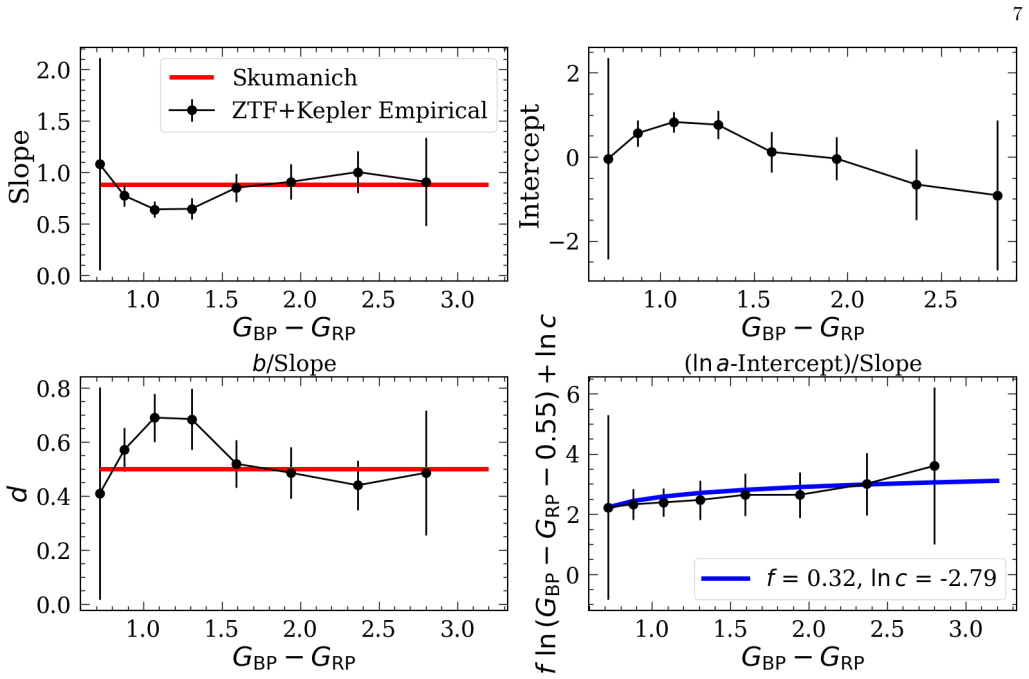
The central mechanism is the age–velocity–dispersion relation (AVR), a power-law relation between a stellar population's vertical velocity dispersion and its age, with a metallicity correction: $\sigma_{v_z}(\tau,[\mathrm{Fe/H}]) = a \tau^b (1+\gamma[\mathrm{Fe/H}])$. The paper treats the AVR as a universal property shared by all stars regardless of evolutionary stage, so it can serve as a coordinate transfer that converts an observed rotation period and color, or an observed [C/N] and metallicity, into an age on the same physical scale. The method models each star's vertical velocity as drawn from a Gaussian with zero mean and dispersion set by the AVR, then equates the dispersion predicted from the age indicator to the dispersion from the AVR to solve for age. The fitting is done separately: the AVR parameters are fit to the asteroseismic APOKASC-3 sample; gyrochronology is calibrated by binned $\sigma_{v_z}$–$P_{\mathrm{rot}}$ relations per color interval using Deming regression; and [C/N] is calibrated by fitting the $\sigma_{v_z}$–[C/N] relations in metallicity bins. These same relations, computed purely from observables, reveal the physical boundaries where each method stops working: weakened magnetic braking, the fully convective boundary, and the intermediate period gap.
What would settle it
A direct falsifier is to measure vertical velocity dispersions for a large sample of stars with independent, precise asteroseismic ages at a range of Galactocentric radii and heights, and check whether the power-law $\sigma_{v_z}(\tau,[\mathrm{Fe/H}])$ fitted to APOKASC-3 still describes them; any significant dependence of the AVR on position, or a flattening for stars older than about 10 Gyr, would imprint a bias in every age derived through this anchor.
Extended reading notes
Core claim
The paper's central claim is that the age–velocity–dispersion relation, $\sigma_{v_z}(\tau,[\mathrm{Fe/H}]) = a \tau^b (1+\gamma[\mathrm{Fe/H}])$ with best-fit $a=10.54$, $b=0.44$, $\gamma=-0.92$ from the APOKASC-3 sample, is a sufficient common anchor to cross-calibrate gyrochronology and [C/N] age dating. For gyrochronology, the authors combine this AVR with a classical power-law rotation–age–color relation $P_{\mathrm{rot}} = c\,\tau^d((G_{\mathrm{BP}}-G_{\mathrm{RP}})-0.55)^f$, fit the resulting $\sigma_{v_z}$–$P_{\mathrm{rot}}$ relations per color bin, and invert to get age. For [C/N], they combine the AVR with a second-order polynomial in [C/N] and [Fe/H] and fit the parameters to the velocity dispersions of about 110,000 APOGEE giants. They find that after applying a $0.64$ Gyr additive offset to [C/N] ages and $-0.20$ Gyr to gyrochronology ages, the two methods recover the same ages for open clusters and agree with asteroseismic ages within the quoted uncertainties. They also map the valid parameter space: gyrochronology applies to partially convective stars that have converged onto the slow-rotating sequence before weakened magnetic braking, and [C/N] applies to giants with $[\mathrm{Fe/H}] > -0.8$ and $[\mathrm{C/N}] < -0.05$ dex, extendable to $[\mathrm{Fe/H}] = -1$ for low-$\alpha$ disk stars.
Load-bearing premise
The whole calibration rests on the premise that one and the same relation between stellar age and the spread of vertical motions, fitted to the nearby APOKASC-3 stars, holds for every other stellar population used in the paper, even though those populations are not all located in the same part of the Galaxy.
Editorial extensions
If this is right
- Gyrochronology can be extended to all partially convective stars that have converged onto the slow-rotating sequence and have not yet reached the weakened-magnetic-braking threshold, including fully convective stars.
- [C/N] can serve as an age indicator for giants with [Fe/H] above −0.8 and [C/N] below −0.05 dex, and down to [Fe/H] = −1 for low-α disk stars.
- Using the same AVR anchor removes the need for each method to be calibrated against open clusters or asteroseismology directly; a single kinematic relation can serve as the common calibrator.
- After applying the derived offsets, [C/N] and gyrochronology ages agree with asteroseismic, wide-binary, and open-cluster ages, indicating that the two methods are on a consistent physical scale.
- The purely observational σᵥᵦ–Pᵣₒₜ and σᵥᵦ–[C/N] relations can be used to test stellar spin-down models and mixing or merger scenarios.
Reading between the lines
- If the AVR is indeed universal, the same anchoring approach could be applied to other age indicators such as lithium depletion or isochrone fitting, so that all stellar ages in a survey sit on one mutually consistent scale.
- The kinematic detection of the intermediate period gap and weakened magnetic braking as bumps in the σᵥᵦ–Pᵣₒₜ plane suggests a direct observational test for angular-momentum transport models: matching the mass- and age-dependent stalling timescales implied by the bumps.
- The claim that [C/N] flattens above −0.05 dex and that high-[C/N], super-solar metallicity giants are likely merger products is testable with radial-velocity monitoring or asteroseismic masses to confirm the merger interpretation.
- The bias between [C/N] and gyrochronology ages, although corrected, might vary with metallicity and age; using co-moving pairs or clusters with a wider range of properties could map out that dependence and turn the calibration into a fully empirical scale.
Editorial analysis
A structured set of objections, weighed in public.
Referee Report
Summary. The paper proposes a common-anchor calibration of gyrochronology and [C/N]-based stellar ages using the age-velocity-dispersion relation (AVR). Section 3 fits a metallicity-dependent AVR, σ_vz(τ,[Fe/H]) = a τ^b (1 + γ[Fe/H]), to the APOKASC-3 asteroseismic sample; Section 3.2 calibrates gyrochronology by fitting Prot–σ_vz relations in color bins; Section 3.3 calibrates a [C/N]–age relation in metallicity bins. Section 4 uses these relations to map the parameter spaces where each method works, finding features associated with weakened magnetic braking, the fully convective boundary, the intermediate period gap, and [C/N] saturation at high [C/N] and low metallicity. Section 5 validates the calibrated ages by recovering the AVR, comparing with APOKASC-3 and LEGACY asteroseismic ages, wide binaries, and open clusters. The authors conclude that [C/N] and gyrochronology ages agree within uncertainty after accounting for systematic offsets of 0.64 Gyr and -0.20 Gyr.
Significance. If the calibration is valid, the paper is a valuable contribution: it provides a large-sample, empirically grounded map of where gyrochronology and [C/N] dating break down, reports an interesting field-star kinematic signature of weakened magnetic braking, and produces calibrated relations usable beyond the open-cluster and asteroseismic calibrator domains. The gyrochronology checks against 417 wide binaries and 33 open clusters are genuinely external, and the authors are transparent about the core assumption that the AVR is the same for all samples. However, the central cross-calibration claim is weakened by a circularity concern: both indicators are inverted from the same locally fit AVR, and the quoted offsets are derived from the comparison to the same APOKASC-3 catalog used for the calibration. The direct cross-method evidence is also thin, resting on only 3 wide-binary pairs and 5 open clusters with both indicators.
major comments (3)
- [§5.2, Figure 8] The agreement with APOKASC-3 shown in Figure 8 is partly an in-sample consistency check: APOKASC-3 is the catalog used to fit the AVR in Eq. (4) and hence to calibrate both the gyrochronology and [C/N] relations. The offsets 0.64 Gyr ([C/N]) and -0.20 Gyr (gyro) are fitted to this same comparison and then subtracted in Figures 9 and 10, so the abstract's claim that the two age scales 'agree within uncertainty after accounting for systematic offsets' is not an independent validation of the common anchor. I request either a cross-validation split (fit the AVR on one APOKASC-3 subset and compare ages on a disjoint subset), a report of the agreement without any offset subtraction, or an external test whose offsets are not derived from the calibrator catalog.
- [§3 and §6] The paper's largest assumption is the universality of the APOKASC-3 AVR across Galactic location. Because the gyrochronology sample is local (<~0.5 kpc) while the [C/N] giant sample covers the full APOGEE disk, a radius- or height-dependent AVR would bias the [C/N] ages while leaving the gyro scale local, and the fitted offsets in §5.2 could absorb exactly this common-mode error. The authors acknowledge this in Sections 3 and 6, but the acknowledgment does not reduce the load that the assumption carries for the central claim. Please add a direct test, for example splitting the [C/N] sample by Galactocentric radius and/or |z| and showing that the recovered AVR or the inferred ages are stable, or restricting the cross-method comparison to the solar neighborhood and demonstrating agreement without offset subtraction.
- [§5.3 and §5.4, Figures 9–10] The direct evidence for cross-method age agreement is very limited: only 3 wide-binary pairs have both a [C/N] age and a gyrochronology age, and only 5 open clusters yield both age indicators. The cluster agreement in the right panel of Figure 10 is achieved only after subtracting offsets determined from the in-sample APOKASC-3 comparison. With this sample size, the categorical conclusion that '[C/N] and gyrochronology ages agree within uncertainty' overstates the empirical support; I recommend rephrasing the claim to describe consistency after applying offsets derived from the APOKASC-3 calibration, and explicitly reporting the precision of the direct cross-method comparison.
minor comments (5)
- [§3.1] The sentence 'We then fitted for a, b, and c' refers to parameters a, b, and γ in Eq. (4); please use consistent notation.
- [§2.2] The first selection bullet is missing its bullet marker and the second bullet begins with a stray period; please clean up the list formatting.
- [§3.2] The text says 'we divided the rotation period data into 8 bins in GBP−GRP', but the procedure is 8 color bins each subdivided into 49 period bins; please rephrase to avoid ambiguity.
- [§4.4.1 and §7] The reference to 'Figure 4 (d)' for the RC-versus-lower-RGB [C/N] difference appears to be a typo; the correct figure is Figure 6(d).
- [§6] The name 'Nancy Romen Space Telescope' should be 'Nancy Grace Roman Space Telescope'.
Circularity Check
Both age scales are inverted from the same APOKASC-3 AVR, and the 'recovered AVR' plus offset-corrected cross-agreement are largely built into the calibration.
-
self definitional
[Section 5.1 (Recovering the Age-Velocity-Dispersion Relations), Figure 7]
"Since we calibrated the age methods using the AVR, we wanted to ensure we could reproduce the AVR from APOKASC–3 with our calibrated ages."
Both calibrated age relations are explicit inversions of the same fitted AVR. Equation 7 sets ln(age) = (Intercept + Slope x ln(Prot) - ln a)/b, and Equation 10 sets age = [(s'0 + s'1[C/N] + s'2[C/N]^2 + s'3[C/N][Fe/H])(1 + s'4[Fe/H]) / (a(1 + gamma[Fe/H]))]^(1/b), where a, b, and gamma are the parameters of the AVR fitted to APOKASC-3 in Equation 4. Therefore the 'recovered' AVR in Figure 7 is the very same a*tau^b*(1+gamma[Fe/H]) used to define the ages; any monotone mapping from an observable to sigma_vz will reproduce the input AVR by construction. The agreement among the three curves is a tautological consistency check, not an independent validation of the anchor.
-
fitted input called prediction
[Section 3.1 and Section 5.2, Figure 8 (left panel)]
"As we wanted to calibrate both [C/N] ages and gyrochronology to the APOKASC–3 sample, we first determined the vertical velocity dispersion relation ... For the [C/N] ages (left plot), we compared them with the APOKASC–3 sample."
The absolute age scale of the [C/N] calibration is fixed by fitting a, b, and gamma in Equation 4 to APOKASC-3 ages, and those same values are injected into Equation 10. The subsequent claim in Section 5.2 that the calibrated [C/N] ages 'agree well' with APOKASC-3 is therefore a comparison against the same catalog that set the zero-point and slope of the anchor. The remaining s' coefficients are fitted to sigma_vz as a function of [C/N] in the same local APOGEE/APOKASC population, so the left panel of Figure 8 measures the internal consistency of two fits sharing a common anchor rather than providing an independent asteroseismic test of the [C/N] age scale.
1 more flagged steps
-
fitted input called prediction
[Section 5.3, Figure 9 caption; abstract]
"However, correcting for the bias where we subtracted 0.64 Gyr for [C/N] ages and -0.20 Gyr for gyrochronology ages, as determined in Figure 8, seems to achieve a better agreement between [C/N] and gyrochronology ages."
The abstract's central claim is that 'ages obtained from [C/N] and gyrochronology agree within uncertainty after accounting for systematic offsets.' The offsets are not predicted from first principles; they are fitted from the same APOKASC-3 comparison that anchors both methods. Subtracting these fitted constants before assessing cross-method agreement means the 'agreement' is partly a fitted residual. The 5-cluster comparison in Figure 10 also requires the same bias correction before it shows agreement, so the cross-calibration conclusion depends on offsets that were measured, not derived, and that absorb exactly the common-mode error one would expect if both methods were anchored to the same imperfect AVR.
full rationale
The paper's own equations demonstrate the partial circularity. Both age relations are constructed by inverting the same fitted AVR (Eq. 4: sigma_vz = a*tau^b*(1+gamma[Fe/H])), with a = 10.54, b = 0.44, gamma = -0.92 fit to APOKASC-3. Equation 7 and Equation 10 then solve for age from sigma_vz using those same a, b, gamma. Consequently, Section 5.1's 'recovery' of the AVR is the calibration identity, not a test, and the [C/N]-age comparison against APOKASC-3 in Figure 8 is not an independent zero-point check because the same catalog fixed the anchor. The final cross-method agreement additionally relies on subtracting offsets (0.64 Gyr and -0.20 Gyr) fitted from that same asteroseismic comparison, so the abstract's 'agree within uncertainty after accounting for systematic offsets' is partly a fitted outcome. There are, however, genuinely external validations in the paper: the LEGACY and Li et al. asteroseismic samples for gyrochronology, roughly 417 wide-binary pairs, and 43 open clusters, none of which are part of the training set. These independent checks keep the paper from being wholly tautological and justify a score of 6 rather than 8-10. The paper also honestly flags its own load-bearing assumption in Section 3: 'the biggest underlying assumption is that all our datasets covers similar Galactic region where the averaged AVR produced with these different datasets are similar,' and in Section 6 it concedes that a location-dependent AVR could bias the full-disk [C/N] ages while leaving the local gyro scale unaffected. That limitation is a correctness risk, but the construction problem is real: the shared AVR anchor plus fitted offsets guarantee much of the reported consistency. No load-bearing self-citation or imported uniqueness theorem is invoked, so the circularity score is driven by the built-in inversion and fitted offsets rather than by citation practice.
Assumptions & free parameters
free parameters (8)
- a (AVR normalization) =
10.54 (+0.42/-0.41)
- b (AVR age exponent) =
0.44 (+0.02/-0.02)
- gamma (AVR metallicity coefficient) =
-0.92 (+0.04/-0.04)
- gyro slope and intercept per color bin (8 bins) =
Table 1 values (e.g., bin 0.72: slope 1.08, intercept -0.04; bin 0.88: 0.77, 0.56; bin 2.80: 0.91, -0.91)
- s'_0, s'_1, s'_2, s'_3, s'_4 ([C/N]-age parameters) =
34.59, 59.31, 28.07, 0.75, -0.675
- sigma_f (extra variance) =
MCMC posterior, not quoted in text
- [C/N] age offset =
0.64 Gyr
- gyro age offset =
-0.20 Gyr
assumptions (7)
- domain assumption Vertical velocity for a star is drawn from a Gaussian with mean 0 and standard deviation sigma_vz(tau, [Fe/H]).
- domain assumption The AVR is a pure power law in age with a linear metallicity term, sigma_vz = a tau^b (1 + gamma[Fe/H]), and is identical for all stellar populations used.
- domain assumption Gyrochronology has the classical functional form Prot = c tau^d ((BP-RP)-0.55)^f and the mapping Prot/color to age is unique.
- domain assumption [C/N]-age relation has the polynomial form tau = s0 + s1[C/N] + s2[C/N]^2 + s3[C/N][Fe/H] and the mapping is unique.
- ad hoc to paper All rotation-period stars are assumed to have solar metallicity in the main fit.
- domain assumption Gyrochronology is applicable only for Prot > 10 days and Rossby number < 1.866, and these cutoffs mark physical regimes.
- domain assumption Intrinsic scatter around the Prot-age and [C/N]-age relations is negligible.
Cite this review
Pith. "Pith review of Anchoring Stellar Age Indicators: A Cross-Calibration of [C/N] and Gyrochronology Ages via the Age-Velocity-Dispersion Relation." pith.science (2026). https://pith.science/paper/COOQAF5H
@misc{pith2026250624010,
  author       = {Pith},
  title        = {Pith review of: Anchoring Stellar Age Indicators: A Cross-Calibration of [C/N] and Gyrochronology Ages via the Age-Velocity-Dispersion Relation},
  year         = {2026},
  howpublished = {\url{https://pith.science/paper/COOQAF5H}},
  note         = {Machine review of arXiv:2506.24010}
}
abstract
Determining stellar ages is challenging, as it depends on other stellar parameters in a non-linear way and often relies on stellar evolution models to infer the underlying relation between these parameters and age. This complexity increases when comparing different age-dating methods, as they rely on distinct indicators and are often applicable to non-overlapping regions of the color-magnitude diagram. Moreover, many empirical calibration methods rely on pre-determined ages, often from open clusters or asteroseismology, which only cover a limited parameter space. Fortunately, the age-velocity-dispersion relation (AVR), in which the velocity dispersion increases with age, is a universal feature among stars of all evolutionary stages. In this paper, we 1) explore the parameter space in which [C/N] and gyrochronology are applicable, extending beyond the domains probed by asteroseismology and open clusters, and 2) assess whether the traditionally assumed [C/N] and gyrochronology relations yield ages on a consistent physical scale, after calibrating both using the same AVR. We find gyrochronology can be applied to all partially convective stars after they have converged onto the slow rotating sequence and before they experience weakened magnetic braking; [C/N] can be used to infer ages for all giants with metallicity > -0.8 dex and [C/N] < -0.05 dex, and can be used as an age-indicator down to [Fe/H] of -1 dex if only selecting the low-$\alpha$ disk. Lastly, ages obtained from [C/N] and gyrochronology agree within uncertainty after accounting for systematic offsets.
Figures


Figures from the paper (9 more)


Reference graph
Works this paper leans on
-
[1]
Abadi, M. G., Navarro, J. F., Steinmetz, M., & Eke, V. R. 2003, ApJ, 591, 499, doi: 10.1086/375512 Abdurro’uf, Accetta, K., Aerts, C., et al. 2022, ApJS, 259, 35, doi: 10.3847/1538-4365/ac4414
doi:10.1086/375512 2003
-
[2]
2019, arXiv e-prints, arXiv:1902.05569, doi: 10.48550/arXiv.1902.05569
Akeson, R., Armus, L., Bachelet, E., et al. 2019, arXiv e-prints, arXiv:1902.05569, doi: 10.48550/arXiv.1902.05569
-
[3]
2019, A&A, 631, A77, doi: 10.1051/0004-6361/201935160
Amard, L., Palacios, A., Charbonnel, C., et al. 2019, A&A, 631, A77, doi: 10.1051/0004-6361/201935160
-
[4]
Amard, L., Roquette, J., & Matt, S. P. 2020, MNRAS, 499, 3481, doi: 10.1093/mnras/staa3038
-
[5]
2023, ApJS, 267, 8, doi: 10.3847/1538-4365/acd53e 22
Andrae, R., Rix, H.-W., & Chandra, V. 2023, ApJS, 267, 8, doi: 10.3847/1538-4365/acd53e 22
-
[6]
2015, MNRAS, 450, 1787, doi: 10.1093/mnras/stv423
Angus, R., Aigrain, S., Foreman-Mackey, D., & McQuillan, A. 2015, MNRAS, 450, 1787, doi: 10.1093/mnras/stv423
-
[7]
Angus, R., Morton, T. D., Foreman-Mackey, D., et al. 2019, AJ, 158, 173, doi: 10.3847/1538-3881/ab3c53
-
[8]
Angus, R., Beane, A., Price-Whelan, A. M., et al. 2020, AJ, 160, 90, doi: 10.3847/1538-3881/ab91b2 Astropy Collaboration, Robitaille, T. P., Tollerud, E. J., et al. 2013, A&A, 558, A33, doi: 10.1051/0004-6361/201322068 Astropy Collaboration, Price-Whelan, A. M., Lim, P. L., et al. 2022, ApJ, 935, 167, doi: 10.3847/1538-4357/ac7c74
Show all 112 references
-
[9]
Barnes, S. A. 2010, ApJ, 722, 222, doi: 10.1088/0004-637X/722/1/222
2010 doi
-
[10]
K., Casey, A
Behmard, A., Ness, M. K., Casey, A. R., et al. 2025, ApJ, 982, 13, doi: 10.3847/1538-4357/adaf1f
2025 doi
-
[11]
C., Kulkarni, S
Bellm, E. C., Kulkarni, S. R., Graham, M. J., et al. 2019, PASP, 131, 018002, doi: 10.1088/1538-3873/aaecbe
2019 doi
-
[12]
Weiss, L. M. 2020, arXiv e-prints, arXiv:2005.14671. https://arxiv.org/abs/2005.14671
2020 arXiv
-
[13]
C., & White, R
Beyer, A. C., & White, R. J. 2024, ApJ, 973, 28, doi: 10.3847/1538-4357/ad6b0d
2024 doi
-
[14]
C., Kazantzidis, S., Weinberg, D
Bird, J. C., Kazantzidis, S., Weinberg, D. H., et al. 2013, ApJ, 773, 43, doi: 10.1088/0004-637X/773/1/43
2013 doi
-
[15]
J., Koch, D., Basri, G., et al
Borucki, W. J., Koch, D., Basri, G., et al. 2010, Science, 327, 977, doi: 10.1126/science.1185402
2010 doi
-
[16]
G., Hillenbrand, L
Bouma, L. G., Hillenbrand, L. A., Howard, A. W., et al. 2024, ApJ, 976, 234, doi: 10.3847/1538-4357/ad855f
2024 doi
-
[17]
G., Palumbo, E
Bouma, L. G., Palumbo, E. K., & Hillenbrand, L. A. 2023, ApJL, 947, L3, doi: 10.3847/2041-8213/acc589
2023 doi
-
[18]
2015, ApJS, 216, 29, doi: 10.1088/0067-0049/216/2/29
Bovy, J. 2015, ApJS, 216, 29, doi: 10.1088/0067-0049/216/2/29
2015 doi
-
[19]
B., Kawata, D., Gibson, B
Brook, C. B., Kawata, D., Gibson, B. K., & Freeman, K. C. 2004, ApJ, 612, 894, doi: 10.1086/422709
2004 doi
-
[20]
V., et al
Buck, T., Obreja, A., Macci` o, A. V., et al. 2020, MNRAS, 491, 3461, doi: 10.1093/mnras/stz3241
2020 doi
-
[21]
2024, Research Notes of the American Astronomical Society, 8, 201, doi: 10.3847/2515-5172/ad7093
Byrom, S., & Tayar, J. 2024, Research Notes of the American Astronomical Society, 8, 201, doi: 10.3847/2515-5172/ad7093
2024 doi
-
[22]
2020, A&A, 640, A1, doi: 10.1051/0004-6361/202038192
Cantat-Gaudin, T., Anders, F., Castro-Ginard, A., et al. 2020, A&A, 640, A1, doi: 10.1051/0004-6361/202038192
2020 doi
-
[23]
H., & van Saders, J
Cao, L., Pinsonneault, M. H., & van Saders, J. L. 2023, ApJL, 951, L49, doi: 10.3847/2041-8213/acd780
2023 doi
-
[24]
F., Langer, G
Carbon, D. F., Langer, G. E., Butler, D., et al. 1982, ApJS, 49, 207, doi: 10.1086/190796
1982 doi
-
[25]
2019, A&A, 629, A62, doi: 10.1051/0004-6361/201935282
Casali, G., Magrini, L., Tognelli, E., et al. 2019, A&A, 629, A62, doi: 10.1051/0004-6361/201935282
2019 doi
-
[26]
2024, AJ, 167, 12, doi: 10.3847/1538-3881/ad07e5
Cavallo, L., Spina, L., Carraro, G., et al. 2024, AJ, 167, 12, doi: 10.3847/1538-3881/ad07e5
2024 doi
-
[27]
J., Basu, S., Huber, D., et al
Chaplin, W. J., Basu, S., Huber, D., et al. 2014, ApJS, 210, 1, doi: 10.1088/0067-0049/210/1/1
2014 doi
-
[28]
L., Heintz, T
Chiti, F., van Saders, J. L., Heintz, T. M., et al. 2024, ApJ, 977, 15, doi: 10.3847/1538-4357/ad856c
2024 doi
-
[29]
R., van Saders, J
Claytor, Z. R., van Saders, J. L., Santos, ˆA. R. G., et al. 2020, Astrophysical Journal, 888, 43, doi: 10.3847/1538-4357/ab5c24
2020 doi
-
[30]
L., Angus, R., David, T., et al
Colman, I. L., Angus, R., David, T., et al. 2024, AJ, 167, 189, doi: 10.3847/1538-3881/ad2c86 Cort´ es-Contreras, M., Caballero, J. A., Montes, D., et al. 2024, A&A, 692, A206, doi: 10.1051/0004-6361/202451585
2024 doi
-
[31]
L., Ag¨ ueros, M
Curtis, J. L., Ag¨ ueros, M. A., Matt, S. P., et al. 2020, ApJ, 904, 140, doi: 10.3847/1538-4357/abbf58 De Silva, G. M., Freeman, K. C., Bland-Hawthorn, J., et al. 2015, MNRAS, 449, 2604, doi: 10.1093/mnras/stv327
2020 doi
-
[32]
2018, MNRAS, 480, 4884, doi: 10.1093/mnras/sty2186
El-Badry, K., & Rix, H.-W. 2018, MNRAS, 480, 4884, doi: 10.1093/mnras/sty2186
2018 doi
-
[33]
R., & Pinsonneault, M
Epstein, C. R., & Pinsonneault, M. H. 2014, ApJ, 780, 159, doi: 10.1088/0004-637X/780/2/159
2014 doi
-
[34]
2016, The Journal of Open Source Software, 1, 24, doi: 10.21105/joss.00024
Foreman-Mackey, D. 2016, The Journal of Open Source Software, 1, 24, doi: 10.21105/joss.00024
2016 doi
-
[35]
W., Lang, D., & Goodman, J
Foreman-Mackey, D., Hogg, D. W., Lang, D., & Goodman, J. 2013, PASP, 125, 306, doi: 10.1086/670067 Gaia Collaboration, Prusti, T., de Bruijne, J. H. J., et al. 2016, A&A, 595, A1, doi: 10.1051/0004-6361/201629272 Gaia Collaboration, Vallenari, A., Brown, A. G. A., et al. 2023,...
2013 doi
-
[36]
Gaidos, E., Claytor, Z., Dungee, R., Ali, A., & Feiden, G. A. 2023, MNRAS, 520, 5283, doi: 10.1093/mnras/stad343
2023 doi
- [37]
-
[38]
Grand, R. J. J., Springel, V., G´ omez, F. A., et al. 2016, MNRAS, 459, 199, doi: 10.1093/mnras/stw601
2016 doi
-
[39]
G., Sneden, C., Carretta, E., & Bragaglia, A
Gratton, R. G., Sneden, C., Carretta, E., & Bragaglia, A. 2000, A&A, 354, 169
2000
-
[40]
2018, The Journal of Open Source Software, 3, 695, doi: 10.21105/joss.00695
Green, G. 2018, The Journal of Open Source Software, 3, 695, doi: 10.21105/joss.00695
2018 doi
-
[41]
M., Schlafly, E
Green, G. M., Schlafly, E. F., Finkbeiner, D., et al. 2018, MNRAS, 478, 651, doi: 10.1093/mnras/sty1008
2018 doi
-
[42]
A., & Janes, K
Gruner, D., Barnes, S. A., & Janes, K. A. 2023, A&A, 675, A180, doi: 10.1051/0004-6361/202346590
2023 doi
-
[43]
R., Millman, K
Harris, C. R., Millman, K. J., van der Walt, S. J., et al. 2020, Nature, 585, 357, doi: 10.1038/s41586-020-2649-2
2020 doi
-
[44]
Hekker, S., & Johnson, J. A. 2019, MNRAS, 487, 4343, doi: 10.1093/mnras/stz1554 23
2019 doi
-
[45]
J., Robertson, P., Hartigan, P., Oelkers, R
Holcomb, R. J., Robertson, P., Hartigan, P., Oelkers, R. J., & Robinson, C. 2022, ApJ, 936, 138, doi: 10.3847/1538-4357/ac8990
2022 doi
-
[46]
B., Sobeck, C., Haas, M., et al
Howell, S. B., Sobeck, C., Haas, M., et al. 2014, PASP, 126, 398, doi: 10.1086/676406
2014 doi
-
[47]
L., & Reffert, S
Hunt, E. L., & Reffert, S. 2023, A&A, 673, A114, doi: 10.1051/0004-6361/202346285
2023 doi
-
[48]
2022, MNRAS, 516, L7, doi: 10.1093/mnrasl/slac082
Darragh-Ford, E. 2022, MNRAS, 516, L7, doi: 10.1093/mnrasl/slac082
2022 doi
-
[49]
Hunter, J. D. 2007, Computing in Science & Engineering, 9, 90, doi: 10.1109/MCSE.2007.55
2007 doi
-
[50]
2021, MNRAS, 502, 5686, doi: 10.1093/mnras/stab005 IRSA
Iorio, G., & Belokurov, V. 2021, MNRAS, 502, 5686, doi: 10.1093/mnras/stab005 IRSA. 2022a, Zwicky Transient Facility Image Service, IPAC, doi: 10.26131/IRSA539 —. 2022b, Time Series Tool, IPAC, doi: 10.26131/IRSA538
2021 doi
-
[51]
K., Burke, C
Irwin, J., Berta, Z. K., Burke, C. J., et al. 2011, ApJ, 727, 56, doi: 10.1088/0004-637X/727/1/56 Jofr´ e, P., Jorissen, A., Aguilera-G´ omez, C., et al. 2023, A&A, 671, A21, doi: 10.1051/0004-6361/202244524
2011 doi
-
[52]
Kawaler, S. D. 1988, ApJ, 333, 236, doi: 10.1086/166740
1988 doi
-
[53]
A., Zasowski, G., Rix, H.-W., et al
Kollmeier, J. A., Zasowski, G., Rix, H.-W., et al. 2017, arXiv e-prints, arXiv:1711.03234. https://arxiv.org/abs/1711.03234
2017 arXiv
-
[54]
J., et al
Kordopatis, G., Schultheis, M., McMillan, P. J., et al. 2023, A&A, 669, A104, doi: 10.1051/0004-6361/202244283
2023 doi
-
[55]
Kraft, R. P. 1967, ApJ, 150, 551, doi: 10.1086/149359 —. 1994, PASP, 106, 553, doi: 10.1086/133416
1967 doi
-
[56]
Lacey, C. G. 1984, MNRAS, 208, 687, doi: 10.1093/mnras/208.4.687
1984 doi
- [57]
-
[58]
R., Roˇ skar, R., Debattista, V
Loebman, S. R., Roˇ skar, R., Debattista, V. P., et al. 2011, ApJ, 737, 8, doi: 10.1088/0004-637X/737/1/8 LSST Science Collaboration, Abell, P. A., Allison, J., et al. 2009, arXiv e-prints, arXiv:0912.0201. https://arxiv.org/abs/0912.0201
2011 arXiv
- [59]
-
[60]
2021a, arXiv e-prints, arXiv:2102.12003
Lu, Y., Ness, M., Buck, T., & Zinn, J. 2021a, arXiv e-prints, arXiv:2102.12003. https://arxiv.org/abs/2102.12003
- [61]
-
[62]
L., Angus, R., Curtis, J
Lu, Y. L., Angus, R., Curtis, J. L., David, T. J., & Kiman, R. 2021b, AJ, 161, 189, doi: 10.3847/1538-3881/abe4d6
-
[63]
L., Curtis, J
Lu, Y. L., Curtis, J. L., Angus, R., David, T. J., & Hattori, S. 2022, AJ, 164, 251, doi: 10.3847/1538-3881/ac9bee
2022 doi
-
[64]
L., See, V., Amard, L., Angus, R., & Matt, S
Lu, Y. L., See, V., Amard, L., Angus, R., & Matt, S. P. 2024b, Nature Astronomy, 8, 223, doi: 10.1038/s41550-023-02126-2
-
[65]
C., Vyhmeister, K., Hawley, S
Lurie, J. C., Vyhmeister, K., Hawley, S. L., et al. 2017, AJ, 154, 250, doi: 10.3847/1538-3881/aa974d
2017 doi
-
[66]
T., Bovy, J., Leung, H
Mackereth, J. T., Bovy, J., Leung, H. W., et al. 2019, Monthly Notices of the RAS, 489, 176, doi: 10.1093/mnras/stz1521
2019 doi
-
[67]
R., Schiavon, R
Majewski, S. R., Schiavon, R. P., Frinchaboy, P. M., et al. 2017, AJ, 154, 94, doi: 10.3847/1538-3881/aa784d
2017 doi
-
[68]
2016, MNRAS, 456, 3655, doi: 10.1093/mnras/stv2830
Martig, M., Fouesneau, M., Rix, H.-W., et al. 2016, MNRAS, 456, 3655, doi: 10.1093/mnras/stv2830
2016 doi
-
[69]
2017, MNRAS, 464, 3021, doi: 10.1093/mnras/stw2632
Gilmore, G. 2017, MNRAS, 464, 3021, doi: 10.1093/mnras/stw2632
2017 doi
-
[70]
2010, in Proceedings of the 9th Python in Science Conference, Vol
McKinney, W., et al. 2010, in Proceedings of the 9th Python in Science Conference, Vol. 445, Austin, TX, 51–56
2010
-
[71]
2014, ApJS, 211, 24, doi: 10.1088/0067-0049/211/2/24
McQuillan, A., Mazeh, T., & Aigrain, S. 2014, ApJS, 211, 24, doi: 10.1088/0067-0049/211/2/24
2014 doi
-
[72]
S., Strassmeier, K
Metcalfe, T. S., Strassmeier, K. G., Ilyin, I. V., et al. 2024, ApJL, 960, L6, doi: 10.3847/2041-8213/ad0a95
2024 doi
- [73]
-
[74]
T., et al
Miglio, A., Chiappini, C., Mackereth, J. T., et al. 2021, A&A, 645, A85, doi: 10.1051/0004-6361/202038307
2021 doi
-
[75]
2014, ApJL, 781, L20, doi: 10.1088/2041-8205/781/1/L20
Minchev, I., Chiappini, C., Martig, M., et al. 2014, ApJL, 781, L20, doi: 10.1088/2041-8205/781/1/L20
2014 doi
-
[76]
W., Rix, H
Ness, M., Hogg, D. W., Rix, H. W., et al. 2016, ApJ, 823, 114, doi: 10.3847/0004-637X/823/2/114
2016 doi
-
[77]
2000, A&AS, 143, 23, doi: 10.1051/aas:2000169
Ochsenbein, F., Bauer, P., & Marcout, J. 2000, A&AS, 143, 23, doi: 10.1051/aas:2000169
2000 doi
-
[78]
H., Elsworth, Y
Pinsonneault, M. H., Elsworth, Y. P., Tayar, J., et al. 2018, Astrophysical Journals, 239, 32, doi: 10.3847/1538-4365/aaebfd
2018 doi
-
[79]
H., Zinn, J
Pinsonneault, M. H., Zinn, J. C., Tayar, J., et al. 2025, ApJS, 276, 69, doi: 10.3847/1538-4365/ad9fef
2025 doi
-
[80]
Price-Whelan, A. M. 2017, The Journal of Open Source Software, 2, 388, doi: 10.21105/joss.00388
2017 doi
-
[81]
M., Sip˝ ocz, B
Price-Whelan, A. M., Sip˝ ocz, B. M., G¨ unther, H. M., et al. 2018, AJ, 156, 123, doi: 10.3847/1538-3881/aabc4f
2018 doi
- [82]
-
[83]
J., Hernquist, L., & Fullagar, D
Quinn, P. J., Hernquist, L., & Fullagar, D. P. 1993, ApJ, 403, 74, doi: 10.1086/172184
1993 doi
-
[84]
R., Winn, J
Ricker, G. R., Winn, J. N., Vanderspek, R., et al. 2015, Journal of Astronomical Telescopes, Instruments, and Systems, 1, 014003, doi: 10.1117/1.JATIS.1.1.014003 24
2015 doi
-
[85]
D., Pinsonneault, M
Roberts, J. D., Pinsonneault, M. H., Johnson, J. A., et al. 2024, MNRAS, 530, 149, doi: 10.1093/mnras/stae820
2024 doi
-
[86]
M., Ballard, S., et al
Sagear, S., Price-Whelan, A. M., Ballard, S., et al. 2024, ApJ, 977, 49, doi: 10.3847/1538-4357/ad8b26
2024 doi
-
[87]
Santos, A. R. G., Breton, S. N., Mathur, S., & Garc ´ ıa, R. A. 2021, ApJS, 255, 17, doi: 10.3847/1538-4365/ac033f
2021 doi
-
[88]
L., Lyttle, A
Saunders, N., van Saders, J. L., Lyttle, A. J., et al. 2024, ApJ, 962, 138, doi: 10.3847/1538-4357/ad1516
2024 doi
-
[89]
C., Stassun, K
Schonhut-Stasik, J., Zinn, J. C., Stassun, K. G., et al. 2024, AJ, 167, 50, doi: 10.3847/1538-3881/ad0b13
2024 doi
-
[90]
L., Amard, L., & Roquette, J
See, V., Lu, Y. L., Amard, L., & Roquette, J. 2024, MNRAS, 533, 1290, doi: 10.1093/mnras/stae1828
2024 doi
-
[91]
Sellwood, J. A. 2014, Reviews of Modern Physics, 86, 1, doi: 10.1103/RevModPhys.86.1
2014 doi
-
[92]
R., Bland-Hawthorn, J., et al
Sharma, S., Hayden, M. R., Bland-Hawthorn, J., et al. 2021, MNRAS, 506, 1761, doi: 10.1093/mnras/stab1086
2021 doi
-
[93]
A., et al
Shetrone, M., Tayar, J., Johnson, J. A., et al. 2019, ApJ, 872, 137, doi: 10.3847/1538-4357/aaff66 Silva Aguirre, V., Lund, M. N., Antia, H. M., et al. 2017, Astrophysical Journal, 835, 173, doi: 10.3847/1538-4357/835/2/173 Silva Aguirre, V., Christensen-Dalsgaard, J., Cassisi...
2019 doi
-
[94]
1972, ApJ, 171, 565, doi: 10.1086/151310
Skumanich, A. 1972, ApJ, 171, 565, doi: 10.1086/151310
1972 doi
- [95]
-
[96]
1951, ApJ, 114, 385, doi: 10.1086/145478
Spitzer, Lyman, J., & Schwarzschild, M. 1951, ApJ, 114, 385, doi: 10.1086/145478
1951 doi
-
[97]
M., et al
Spoo, T., Tayar, J., Frinchaboy, P. M., et al. 2022, AJ, 163, 229, doi: 10.3847/1538-3881/ac5d53
2022 doi
-
[98]
A., Imig, J., et al
Stone-Martinez, A., Holtzman, J. A., Imig, J., et al. 2024, AJ, 167, 73, doi: 10.3847/1538-3881/ad12a6
2024 doi
- [99]
-
[100]
2024, ApJ, 961, 141, doi: 10.3847/1538-4357/ad06ad
Sun, W., Huang, Y., Shen, H., et al. 2024, ApJ, 961, 141, doi: 10.3847/1538-4357/ad06ad
2024 doi
-
[101]
2025, ApJL, 984, L56, doi: 10.3847/2041-8213/adcd6f
Tayar, J., & Joyce, M. 2025, ApJL, 984, L56, doi: 10.3847/2041-8213/adcd6f
2025 doi
-
[102]
H., et al
Tayar, J., Somers, G., Pinsonneault, M. H., et al. 2017, ApJ, 840, 17, doi: 10.3847/1538-4357/aa6a1e
2017 doi
- [103]
-
[104]
2019, ApJ, 878, 21, doi: 10.3847/1538-4357/ab1ea5
Ting, Y.-S., & Rix, H.-W. 2019, ApJ, 878, 21, doi: 10.3847/1538-4357/ab1ea5
2019 doi
-
[105]
Townsend, R. H. D., & Teitler, S. A. 2013, MNRAS, 435, 3406, doi: 10.1093/mnras/stt1533
2013 doi
- [106]
-
[107]
T., Zinn, J
Warfield, J. T., Zinn, J. C., Pinsonneault, M. H., et al. 2021, AJ, 161, 100, doi: 10.3847/1538-3881/abd39d
2021 doi
- [108]
-
[109]
2000, A&AS, 143, 9, doi: 10.1051/aas:2000332
Wenger, M., Ochsenbein, F., Egret, D., et al. 2000, A&AS, 143, 9, doi: 10.1051/aas:2000332
2000 doi
-
[110]
2022, Nature, 603, 599–603
Xiang, M., & Rix, H.-W. 2022, Nature, 603, 599–603
2022
-
[111]
2018, MNRAS, 475, 1093, doi: 10.1093/mnras/stx3204
Yu, J., & Liu, C. 2018, MNRAS, 475, 1093, doi: 10.1093/mnras/stx3204
2018 doi
-
[112]
2021, ApJ, 922, 145, doi: 10.3847/1538-4357/ac22a5
Zhang, M., Xiang, M., Zhang, H.-W., et al. 2021, ApJ, 922, 145, doi: 10.3847/1538-4357/ac22a5
2021 doi
Reviewed August 6, 2026 · model on record in the stance chip above.
Discussion (0). Sign in to comment.