REVIEW 4 major objections 5 minor 84 references
Searching for new Hypervelocity Stars with Gaia DR3 and VLT/FORS2 Spectroscopy
T0 review · 4 major / 5 minor · reviewed 2026-08-06 · deepseek-v4-flash
Pith's one-line read Gaia DR3 identifies 149 new hypervelocity star candidates, and follow-up spectra show many are fast enough to leave the Milky Way.
desk verdict A cautious HVS candidate search with real follow-up RVs, but the 149-candidate census is soft because the selection depends on the same proper motions the authors suspect are biased. read the letter →
The pith
A machine-rendered reading of the paper's core claim, the machinery that carries it, and where it could break.
The reading
What carries the argument
The load-bearing device is the minimum-total-velocity estimator: for each star, the unknown heliocentric radial velocity is set to the value $v_{{\rm los},0}$ that minimizes the total Galactocentric speed $v_T$, making $v_T$ a lower limit that still depends on sky position. This is combined with 1,000 multivariate-Gaussian realizations that propagate Gaia parallax and proper-motion uncertainties and their correlations through the covariance matrix presented in the appendix, with the local escape velocity $v_{\rm esc}$ computed in the MWPotential2014 Galactic potential. The fraction of realizations with $v_T > v_{\rm esc}$ defines $P_{\rm esc,0}$, and later FORS2 spectra replace the assumed $v_{{\rm los},0}$ with a measured radial velocity, turning a two-dimensional tangential motion into a full three-dimensional orbit that can be integrated backward to test possible origins.
What would settle it
Measure high-precision radial velocities for all 149 candidates and recompute $v_T$ with the measured $v_{\rm los}$; if, as the paper's own caution about $v_T \gg \sqrt{2}\,v_t$ suggests, a large fraction of candidates then drop below the McMillan (2017) escape velocity, the 149-candidate census would shrink substantially. A future Gaia data release providing improved proper motions for these exact faint sources would settle whether the selection was inflated by astrometric systematics.
Extended reading notes
Core claim
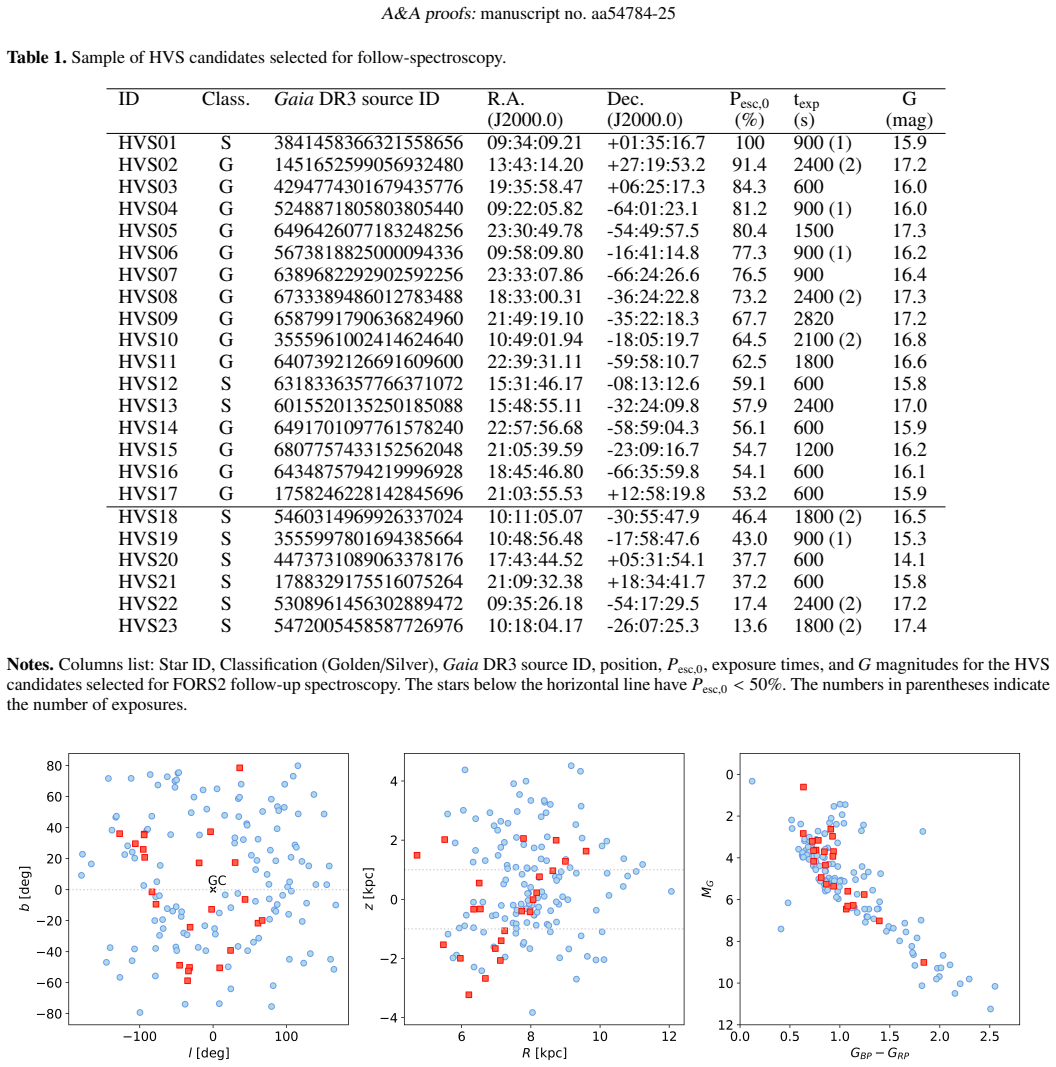
On its own terms, the paper's central claim is that a conservative, astrometry-only selection from Gaia DR3 can identify a large new population of hypervelocity star candidates. For each of roughly 190 million high-quality sources without Gaia radial velocities, the authors build 1,000 Monte Carlo realizations of the astrometry and take the radial-velocity value that minimizes the total Galactocentric velocity, so the resulting $v_T$ distributions are lower limits. Comparing those distributions with the local escape velocity in the MWPotential2014 model gives an escape probability $P_{\rm esc}$; 149 sources have $P_{\rm esc} > 50\%$. FORS2 spectra for 23 candidates yield the missing line-of-sight velocities and show total velocities of $500$--$900$ km/s, with most stars remaining classified as hypervelocity or high-velocity stars. Orbital backtracking over 1 Gyr finds that none of the followed-up stars, except possibly HVS07, came from within 1 kpc of the Galactic center, and about one-third have past orbits that never intersect the Galactic disk, which the authors interpret as evidence for an extra-Galactic origin.
Load-bearing premise
The candidate list assumes the Gaia DR3 proper motions of these faint stars are not systematically overestimated; the paper itself warns that the observed excess of total velocities over $\sqrt{2}$ times the transverse velocity may indicate just such a bias.
Editorial extensions
If this is right
- The 149 candidates, 113 of them in the astrometrically cleaner golden subsample, expand the catalog of stars that may be unbound from the Milky Way but lack Gaia radial velocities.
- Because $v_T$ was built as a lower limit, adding measured radial velocities cannot reduce a candidate's escape probability below $P_{\rm esc,0}$, so the 23 followed-up stars retain their classifications.
- None of the 23 followed-up stars has a past orbit that clearly passes within 1 kpc of the Galactic center, so the Milky Way's central black hole is not demanded as the main ejection site.
- Roughly one-third of the followed-up sample has past orbits that avoid the Galactic disk entirely, which the authors read as evidence for extra-Galactic origins.
- Under the most conservative alternative potential considered, 93 of the 132 remaining candidates still have transverse speeds above the local escape velocity, so further spectroscopy could substantially grow the confirmed hypervelocity star population.
Reading between the lines
- If the proper-motion bias the authors worry about is absent, the true number of unbound stars among the 149 could approach the full list, because the minimum-total-velocity construction means every measured radial velocity can only raise $P_{\rm esc}$.
- The retrograde, very metal-poor orbits of the extra-Galactic candidates make them promising tracers of past accretion events; high-resolution spectroscopy could test whether their abundances match known dwarf-galaxy debris.
- Re-running the same selection with the next Gaia data release would directly separate astrometric noise from real high velocities and would also reveal whether the preference for retrograde orbits is physical or a selection artifact.
Editorial analysis
A structured set of objections, weighed in public.
Referee Report
Summary. The paper searches for hypervelocity star (HVS) candidates in Gaia DR3 among sources lacking Gaia radial velocities. The authors apply astrometric quality cuts, estimate for each source a minimum total Galactocentric velocity by choosing the unmeasured line-of-sight velocity that minimizes vT, and define an escape probability Pesc,0 from a Monte Carlo propagation of astrometric uncertainties. They identify 149 candidates with Pesc,0 ≥ 50%, of which 23 were followed up with VLT/FORS2 spectroscopy to measure radial velocities. Using the measured RVs, they recompute escape probabilities and integrate orbits backward under several Galactic potentials, classifying the stars according to whether their past orbits cross the disk, stay in the disk, or avoid the plane, and they associate eight stars with a tentative extra-Galactic origin. The paper also estimates that 93 of the remaining candidates satisfy vt ≥ vesc under the most conservative potential considered.
Significance. If the candidate list is robust, the paper would significantly enlarge the census of potential unbound stars and provide valuable targets for follow-up. The main strengths are the transparent presentation of the method, the use of multiple Galactic potentials, and the acquisition of new spectroscopic radial velocities for 23 sources. The paper also ships Monte Carlo uncertainty propagation and publicly available tables. However, the central claim of 149 candidates rests on a minimum-velocity proxy and on Gaia DR3 proper motions that the authors themselves flag as potentially overestimated in Section 4. The strong dependence of the escape classification on the assumed potential—only two or three of the 23 followed-up stars retain Pesc ≥ 50% under the McMillan (2017) model—means the headline number is not a robust measure of the true unbound population.
major comments (4)
- [Section 4.2, Table 3] The abstract and conclusions state that the authors identified 149 HVS candidates with Pesc > 50%, but this number is based on the minimum-velocity estimate Pesc,0 under MWPotential2014. Table 3 shows that under the McMillan (2017) potential only two (three with a bar) of the 23 spectroscopically followed stars have Pesc ≥ 50%. The central claim is therefore strongly potential-dependent and should be rephrased to state explicitly that the 149 candidates are only candidates under a particular potential and a minimum-velocity assumption, and the abstract should quote the number that survives under the most conservative potential.
- [Section 4, first paragraph] The authors note that vT significantly exceeds √2 vt for most targets, 'may indicate potentially overestimated proper motion values', and cite Palladino et al. (2014) and Scholz (2024). This concern is never resolved. Because the selection preferentially retains sources with positive proper-motion noise, a modest systematic bias in Gaia DR3 proper motions for faint sources could substantially contaminate the 149-candidate list and bias the Pesc values in Tables 2 and 3. The paper should provide a quantitative diagnostic—for example, a comparison of Gaia DR2 and DR3 proper motions for the candidates, or a control sample of faint stars—to place an upper limit on the likely PM bias, or it should downgrade the confidence in the candidate list accordingly.
- [Section 2, Pesc,0 definition] The quantity Pesc,0 is not the probability that the true total velocity exceeds the escape velocity; it is the probability that the minimum possible total velocity (obtained by setting the unknown radial velocity to the value that minimizes vT) exceeds vesc. This is a conservative lower limit for an individual star, but it means the headline '149 candidates with Pesc > 50%' is a statement about a lower envelope, not about the actual unbound fraction. The abstract and conclusions use 'Pesc > 50%' without this qualifier, which is misleading; the qualifier 'minimum-velocity-based' should be added wherever the 149 number is quoted.
- [Section 4, 'extra-Galactic' classification] The claim that approximately one-third of the sample may have an extra-Galactic origin is based on orbit classifications (disk crossing, plane avoidance, retrograde motion) computed under MWPotential2014 alone. Section 4.2 tests alternative potentials only for rmin and Pesc, not for the plane-crossing statistics or the disk/extra-Galactic classification. Since the classification is a central result and is qualitative, the robustness of the one-third fraction to the choice of potential should be assessed, or the claim should be explicitly limited to the adopted potential model.
minor comments (5)
- [Introduction] There is a typo in the Introduction: 'MV center' should read 'MW center'.
- [Section 4] The text refers to 'HV01' when discussing the fastest star; this should be 'HVS01' for consistency with Table 1.
- [Abstract and Section 2] The abstract defines Pesc without stating that it is the minimum-velocity-based initial probability Pesc,0; please define the symbol in the abstract or in the first occurrence in the Introduction.
- [Section 4.3] The statement that 93 of the remaining candidates have vt ≥ vesc,MM should note that this is a necessary but not sufficient condition for escape, and that vt is a lower limit to the true transverse-plus-radial velocity; the current phrasing could be read as a confirmed count.
- [Section 3] The exposure-time footnote in Table 1 is clear, but the caption of Figure 2 should specify whether absolute magnitudes use a distance from parallax or from a prior; the text later says distances are from parallax inversion, so this is a minor clarity issue.
Circularity Check
The 'confirmation' that FORS2 targets retain HVS status (Pesc > Pesc,0) is guaranteed by the lower-limit construction of Pesc,0; the 149-candidate census and orbit analysis otherwise use independent Gaia and FORS2 data, so circularity is minor.
-
self definitional
[Section 4 (Results and discussion), first paragraph]
"The probability of being an HVS (Pesc), computed using the vlos derived from FORS2 data, is in good agreement with the values previously obtained (Pesc,0), as calculated in the absence of vlos measurements. Since the vT distributions previously derived above represent lower limits, Pesc > Pesc,0. Therefore, our HVS candidates retain this classification once new information is incorporated."
Pesc,0 was defined as the fraction of Monte Carlo realizations in which the total velocity vT, minimized over the unknown heliocentric radial velocity vlos0, exceeds vesc. Replacing vlos0 with any measured vlos cannot decrease vT in any realization, so Pesc >= Pesc,0 is a mathematical identity that follows directly from the construction of Pesc,0 as a lower-limit probability. The sentence 'our HVS candidates retain this classification' therefore adds no empirical confirmation from the FORS2 spectra; the increase is forced by construction. The actual vT values, the orbit integrations, and the 149-source census are independent of this tautological step, so the circularity is confined to the confirmation framing rather than the central results.
full rationale
The paper's core candidate list is derived from Gaia DR3 astrometry (parallax and proper motions) plus a literature Galactic potential, and the follow-up FORS2 radial velocities are independent spectroscopic measurements. No parameter is fitted to a subset and then renamed as a prediction; the escape probabilities and orbit classifications are computed directly from the astrometry, the measured vlos, and externally published potentials (MWPotential2014, McMillan 2017, Price-Whelan 2017, LMC-modified models). The potential-model dependence is explicitly tested in Section 4.2 and Table 3, so using MWPotential2014 for both selection and interpretation is a consistency choice, not circularity. The only genuinely by-construction step is the claim that Pesc > Pesc,0 and that candidates 'retain this classification': because Pesc,0 was computed by minimizing vT over the unknown radial velocity, adding any measured vlos cannot lower vT, making the inequality a definitional consequence rather than an empirical confirmation. This is disclosed in the text and does not undermine the independent content of the measured vT values, the orbital origin analysis, or the headline census of 149 candidates. No load-bearing self-citations or imported uniqueness theorems appear; citations to Scholz, Du, and other prior HVS searches are contextual. Overall, the derivation chain is largely self-contained, with only a minor tautological framing in the confirmation language.
Assumptions & free parameters
free parameters (6)
- Pesc threshold =
0.5
- Parallax uncertainty cut =
sigma_pi/pi <= 0.2
- RUWE threshold =
< 1.4
- Astrometric fidelity threshold =
>= 0.5
- Hills-origin radius criterion =
r < 1 kpc
- Cluster association distance =
500 pc (and 100 pc for probability)
assumptions (5)
- domain assumption Gaia DR3 astrometric parameters and their quoted uncertainties are accurate for sources passing the quality cuts.
- domain assumption The Milky Way gravitational potential is adequately described by the adopted literature models (MWPotential2014, McMillan 2017, etc.).
- domain assumption Sources without Gaia radial velocities are unbiased tracers of the hypervelocity population.
- domain assumption The local escape velocity is independent of height z (evaluated at z = 0).
- standard math The minimum-total-velocity method (vlos0 chosen to minimize vT) gives a conservative estimate of the escape probability.
Cite this review
Pith. "Pith review of Searching for new Hypervelocity Stars with Gaia DR3 and VLT/FORS2 Spectroscopy." pith.science (2026). https://pith.science/paper/C52TGGE5
@misc{pith2026250700150,
  author       = {Pith},
  title        = {Pith review of: Searching for new Hypervelocity Stars with Gaia DR3 and VLT/FORS2 Spectroscopy},
  year         = {2026},
  howpublished = {\url{https://pith.science/paper/C52TGGE5}},
  note         = {Machine review of arXiv:2507.00150}
}
read the original abstract
Hypervelocity stars are unique objects moving through the Milky Way at speeds exceeding the local escape velocity, providing valuable insights into the Galactic gravitational potential and the properties of its central supermassive black hole. The advent of Gaia DR3 offers an unprecedented astrometric precision, enabling the discovery of new hypervelocity stars and facilitating their characterization. This study seeks to identify and characterize hypervelocity star candidates using Gaia DR3 data, focusing on stars lacking radial velocity measurements. Our goal was to estimate the total velocities of these stars and establish their origin within the Galactic framework, if possible. We applied strict selection criteria to Gaia DR3 data, focusing on sources with low parallax uncertainties and high astrometric fidelity. The distributions of the total velocities in the Galactic rest frame were derived and used to identify candidates. Spectroscopic follow-up with VLT/FORS2 provided radial velocity measurements for a subset of these candidates. We evaluated the probabilities of stars exceeding local escape velocities under different Galactic potential models and traced their past orbits to identify possible origins. From Gaia DR3, we identified 149 hypervelocity star candidates with Pesc > 50% of exceeding local escape velocities. Our follow-up spectroscopy for 23 of those sources confirms that the selected targets are traveling at high velocities, with many appearing to escape the Galaxy, depending on the Galactic potential adopted. Our analysis suggests that nearly one-third of the stars may have an extra-Galactic origin. These findings highlight the need for more precise astrometric and spectroscopic data to conclusively determine the origins of hypervelocity stars and improve models of the Galactic potential.
Figures


Figures from the paper (2 more)


Reference graph
Works this paper leans on
-
[1]
G., Navarro, J
Abadi, M. G., Navarro, J. F., & Steinmetz, M. 2009, ApJL, 691, L63
2009
-
[2]
A., & Bovy, J
Armstrong, I., Evans, F. A., & Bovy, J. 2025, ApJ, 984, 56
2025
-
[3]
Bailer-Jones, C. A. L., Rybizki, J., Fouesneau, M., Demleitner, M., & Andrae, R. 2021, AJ, 161, 147
2021
-
[4]
& Williams, B
Bamba, A. & Williams, B. J. 2022, in Handbook of X-ray and Gamma-ray As- trophysics, ed. C. Bambi & A. Sangangelo, 77
2022
-
[5]
Baumgardt, H., Gualandris, A., & Zwart, S. P. 2006, MNRAS, 372, 174
work page 2006
-
[6]
& Vasiliev, E
Baumgardt, H. & Vasiliev, E. 2021, MNRAS, 505, 5957
2021
-
[7]
& Gerhard, O
Bland-Hawthorn, J. & Gerhard, O. 2016, ARA&A, 54, 529
2016
-
[8]
Boubert, D., Guillochon, J., Hawkins, K., et al. 2018, MNRAS, 479, 2789
work page 2018
Show all 84 references
-
[9]
C., et al
Bovy, J., Allende Prieto, C., Beers, T. C., et al. 2012, ApJ, 759, 131
2012
-
[10]
C., Kenyon, S
Bromley, B. C., Kenyon, S. J., Geller, M. J., et al. 2006, ApJ, 653, 1194
2006
-
[11]
Brown, W. R. 2015, ARA&A, 53, 15
2015
-
[12]
R., Anderson, J., Gnedin, O
Brown, W. R., Anderson, J., Gnedin, O. Y ., et al. 2010, ApJL, 719, L23
2010
-
[13]
R., Geller, M
Brown, W. R., Geller, M. J., & Kenyon, S. J. 2014, ApJ, 787, 89
2014
-
[14]
R., Geller, M
Brown, W. R., Geller, M. J., Kenyon, S. J., & Kurtz, M. J. 2005, ApJL, 622, L33
2005
-
[15]
R., Geller, M
Brown, W. R., Geller, M. J., Kenyon, S. J., & Kurtz, M. J. 2006, ApJL, 640, L35
2006
-
[16]
J., Gerasimov, R., Kremer, K., et al
Burgasser, A. J., Gerasimov, R., Kremer, K., et al. 2024, ApJL, 971, L25
2024
-
[17]
& Rodriguez, C
Cabrera, T. & Rodriguez, C. L. 2023, ApJ, 953, 19
2023
-
[18]
& Fragione, G
Capuzzo-Dolcetta, R. & Fragione, G. 2015, MNRAS, 454, 2677
2015
-
[19]
S., Do, T., Ghez, A., et al
Chu, D. S., Do, T., Ghez, A., et al. 2023, ApJ, 948, 94
2023
-
[20]
2023, A&A, 674, A18
Clementini, G., Ripepi, V ., Garofalo, A., et al. 2023, A&A, 674, A18
2023
-
[21]
M., & Marchetti, T
Contigiani, O., Rossi, E. M., & Marchetti, T. 2019, MNRAS, 487, 4025
2019
-
[22]
J., et al
Du, C., Li, H., Newberg, H. J., et al. 2018, ApJL, 869, L31
2018
-
[23]
2019, ApJS, 244, 4
Du, C., Li, H., Yan, Y ., et al. 2019, ApJS, 244, 4
2019
-
[24]
2005, ApJ, 634, L181
Edelmann, H., Napiwotzki, R., Heber, U., Christlieb, N., & Reimers, D. 2005, ApJ, 634, L181
2005
-
[25]
W., & Antonini, F
Erkal, D., Boubert, D., Gualandris, A., Evans, N. W., & Antonini, F. 2019, MN- RAS, 483, 2007
2019
-
[26]
2022, MNRAS, 512, 2350 Event Horizon Telescope Collaboration, Akiyama, K., Alberdi, A., et al
Evans, F., Marchetti, T., & Rossi, E. 2022, MNRAS, 512, 2350 Event Horizon Telescope Collaboration, Akiyama, K., Alberdi, A., et al. 2022, ApJL, 930, L12
2022
-
[27]
2023, A&A, 674, A13
Eyer, L., Audard, M., Holl, B., et al. 2023, A&A, 674, A13
2023
-
[28]
2025, ApJS, 277, 30
Fang, Z., Li, X., & Li, H. 2025, ApJS, 277, 30
2025
-
[29]
& Safi-Harb, S
Ferrand, G. & Safi-Harb, S. 2012, AdSpR, 49, 1313
2012
-
[30]
Fiteni, K., Caruana, J., Amarante, J. A. S., Debattista, V . P., & Beraldo e Silva, L. 2021, MNRAS, 503, 1418
2021
-
[31]
& Capuzzo-Dolcetta, R
Fragione, G. & Capuzzo-Dolcetta, R. 2016, MNRAS, 458, 2596
2016
-
[32]
& Gualandris, A
Fragione, G. & Gualandris, A. 2019, MNRAS, 489, 4543 Gaia Collaboration, Brown, A. G. A., Vallenari, A., et al. 2018a, A&A, 616, A1 Gaia Collaboration, Helmi, A., van Leeuwen, F., et al. 2018b, A&A, 616, A12 Gaia Collaboration, Prusti, T., de Bruijne, J. H. J., et al. 2016, A&...
2019
-
[33]
S., Ebagezio, S., & Diaferio, A
Gallo, A., Ostorero, L., Chakrabarty, S. S., Ebagezio, S., & Diaferio, A. 2022, A&A, 663, A72
2022
-
[34]
2020, ApJ, 904, 118
Generozov, A. 2020, ApJ, 904, 118
2020
-
[35]
2018, MNRAS, 475, L15
Giesers, B., Dreizler, S., Husser, T.-O., et al. 2018, MNRAS, 475, L15
2018
-
[36]
& Zwart, S
Gualandris, A. & Zwart, S. P. 2007, MNRAS, 376, L29 Gülzow, L., Fairbairn, M., & Schwarz, D. J. 2024, MNRAS, 529, 3816 Häberle, M., Neumayer, N., Seth, A., et al. 2024, Nat, 631, 285
2007
-
[37]
J., El-Badry, K., Lucchini, S., et al
Han, J. J., El-Badry, K., Lucchini, S., et al. 2025, ApJ, 982, 188
2025
-
[38]
2025, arXiv e-prints, arXiv:2502.20266
Hattori, K., Taniguchi, D., Tsujimoto, T., et al. 2025, arXiv e-prints, arXiv:2502.20266
2025 arXiv
-
[39]
F., & Roederer, I
Hattori, K., Valluri, M., Bell, E. F., & Roederer, I. U. 2018, ApJ, 866, 121
2018
-
[40]
2020, ARA&A, 58, 205
Helmi, A. 2020, ARA&A, 58, 205
2020
-
[41]
Hills, J. G. 1988, Nat, 331, 687
1988
-
[42]
2005, A&A, 444, L61
Hirsch, H., Heber, U., O’Toole, S., & Bresolin, F. 2005, A&A, 444, L61
2005
-
[43]
2021, ApJL, 907, L42
Huang, Y ., Li, Q., Zhang, H., et al. 2021, ApJL, 907, L42
2021
-
[44]
2021, A&A, 646, L4
Irrgang, A., Dimpel, M., Heber, U., & Raddi, R. 2021, A&A, 646, L4
2021
-
[45]
2018, A&A, 620, A48
Irrgang, A., Kreuzer, S., & Heber, U. 2018, A&A, 620, A48
2018
-
[46]
E., Boubert, D., Li, T
Koposov, S. E., Boubert, D., Li, T. S., et al. 2020, MNRAS, 491, 2465
2020
-
[47]
H., Helmi, A., Massari, D., Price-Whelan, A
Koppelman, H. H., Helmi, A., Massari, D., Price-Whelan, A. M., & Starkenburg, T. K. 2019, A&A, 631, L9
2019
-
[48]
2020, A&A, 637, A53
Kreuzer, S., Irrgang, A., & Heber, U. 2020, A&A, 637, A53
2020
-
[49]
2022, ApJL, 933, L13
Li, H., Du, C., Ma, J., et al. 2022, ApJL, 933, L13
2022
-
[50]
2018, ApJS, 238, 16
Li, H., Tan, K., & Zhao, G. 2018, ApJS, 238, 16
2018
-
[51]
L., Lu, Y .-J., et al
Li, Y .-B., Luo, A. L., Lu, Y .-J., et al. 2021, ApJS, 252, 3
2021
-
[52]
2024, NatAs, 8, 1302
Lian, J., Zasowski, G., Chen, B., et al. 2024, NatAs, 8, 1302
2024
-
[53]
2023, ApJL, 944, L39
Liao, J., Du, C., Li, H., Ma, J., & Shi, J. 2023, ApJL, 944, L39
2023
-
[54]
2023, ApJ, 952, 64
Lin, Z., Xu, Y ., Hao, C., et al. 2023, ApJ, 952, 64
2023
-
[55]
T., Schiavon, R
Mackereth, J. T., Schiavon, R. P., Pfeffer, J., et al. 2019, MNRAS, 482, 3426
2019
-
[56]
2018, MNRAS, 476, 4697
Marchetti, T., Contigiani, O., Rossi, E., et al. 2018, MNRAS, 476, 4697
2018
-
[57]
A., & Rossi, E
Marchetti, T., Evans, F. A., & Rossi, E. M. 2022, MNRAS, 515, 767
2022
-
[58]
2019, MNRAS, 490, 157
Marchetti, T., Rossi, E., & Brown, A. 2019, MNRAS, 490, 157
2019
-
[59]
2017, MNRAS, 470, 1388
Marchetti, T., Rossi, E., Kordopatis, G., et al. 2017, MNRAS, 470, 1388
2017
-
[60]
2019, ApJL, 874, L35
Matsuno, T., Aoki, W., & Suda, T. 2019, ApJL, 874, L35
2019
-
[61]
McConnachie, A. W. 2012, AJ, 144, 4
2012
-
[62]
McMillan, P. J. 2017, MNRAS, 465, 76
2017
-
[63]
2018, A&A, 616, L9
Monari, G., Famaey, B., Carrillo, I., et al. 2018, A&A, 616, L9
2018
-
[64]
2019, MNRAS, 490, 5647
Montanari, F., Barrado, D., & García-Bellido, J. 2019, MNRAS, 490, 5647
2019
-
[65]
C., Vasiliev, E., Iorio, G., Evans, N
Myeong, G. C., Vasiliev, E., Iorio, G., Evans, N. W., & Belokurov, V . 2019, MNRAS, 488, 1235
2019
-
[66]
E., Schlesinger, K
Palladino, L. E., Schlesinger, K. J., Holley-Bockelmann, K., et al. 2014, ApJ, 780, 7
2014
-
[67]
2004, ApJ, 609, 144 Pietrzy´nski, G., Graczyk, D., Gallenne, A., et al
Pichardo, B., Martos, M., & Moreno, E. 2004, ApJ, 609, 144 Pietrzy´nski, G., Graczyk, D., Gallenne, A., et al. 2019, Nat, 567, 200
2004
-
[68]
2011, A&A, 535, A70
Piffl, T., Williams, M., & Steinmetz, M. 2011, A&A, 535, A70
2011
-
[69]
M., Frebel, A., Beers, T
Placco, V . M., Frebel, A., Beers, T. C., & Stancliffe, R. J. 2014, ApJ, 797, 21
2014
-
[70]
Price-Whelan, A. M. 2017, JOSS, 2, 388
2017
-
[71]
J., & Dékány, I
Prudil, Z., Smolec, R., Kunder, A., Koch-Hansen, A. J., & Dékány, I. 2024, A&A, 685, A153
2024
-
[72]
J., et al
Quispe-Huaynasi, F., Roig, F., McDonald, D. J., et al. 2022, AJ, 164, 187
2022
-
[73]
G., Cartier, R., et al
Ruiz-Lapuente, P., Her´nandez, J. G., Cartier, R., et al. 2023, ApJ, 947, 90
2023
-
[74]
M., Rix, H.-W., et al
Rybizki, J., Green, G. M., Rix, H.-W., et al. 2022, MNRAS, 510, 2597
2022
-
[75]
Scholz, R. D. 2024, A&A, 685, A162 Schönrich, R., Binney, J., & Dehnen, W. 2010, MNRAS, 403, 1829
2024
-
[76]
& Napiwotzki, R
Silva, M. & Napiwotzki, R. 2011, MNRAS, 411, 2596
2011
-
[77]
D., McConnachie, A
Starkenburg, E., Shetrone, M. D., McConnachie, A. W., & Venn, K. A. 2014, MNRAS, 441, 1217
2014
-
[78]
D., & Heber, U
Tillich, A., Przybilla, N., Scholz, R. D., & Heber, U. 2009, A&A, 507, L37
2009
-
[79]
2019, MNRAS, 482, 1525
Vasiliev, E. 2019, MNRAS, 482, 1525
2019
-
[80]
2023, Galaxies, 11, 59
Vasiliev, E. 2023, Galaxies, 11, 59
2023
-
[81]
& Baumgardt, H
Vasiliev, E. & Baumgardt, H. 2021, MNRAS, 505, 5978
2021
-
[82]
M., Koposov, S
Verberne, S., Rossi, E. M., Koposov, S. E., et al. 2024, MNRAS, 533, 2747
2024
-
[83]
2023, A&A, 671, A171
Wehrhahn, A., Piskunov, N., & Ryabchikova, T. 2023, A&A, 671, A171
2023
-
[84]
& Tremaine, S
Yu, Q. & Tremaine, S. 2003, ApJ, 599, 1129 Article number, page 10 of 11 Carballo-Bello et al.: Hypervelocity stars with Gaia DR3 and FORS2 spectroscopy Appendix A: Covariance matrix The covariance matrix describing the uncertainties and correla- tions between the measured ast...
2003
Reviewed August 6, 2026 · model on record in the stance chip above.
Discussion (0). Continue with ORCID to comment.