REVIEW 4 major objections 6 minor 76 references
LIMAO: A Framework for Lifelong Modular Learned Query Optimization
T0 review · 4 major / 6 minor · reviewed 2026-08-06 · deepseek-v4-flash
Pith's one-line read A modular lifelong-learning framework wraps existing learned query optimizers so they adapt to shifting workloads and data without forgetting old skills.
desk verdict Useful modular lifelong-learning idea for LQOs, but the volume-switch claims rest on an encoding that cannot tell two data volumes apart. read the letter →
The pith
A machine-rendered reading of the paper's core claim, the machinery that carries it, and where it could break.
The reading
What carries the argument
The framework rests on three linked mechanisms. First, the plan decomposer: a top-down traversal of the plan tree that cuts the tree at the first occurrence of each selected break operator type, producing tasks rooted at those operators plus one residual task; break operators are chosen to be performance-critical joins so that sub-plans are neither too coarse nor too fine. Second, the module hub: a K-prototype clustering of task encodings (a table selectivity vector, a join and scan operator count vector, a pre-order index vector, and a binary query-flag vector) into K representative modules per break-operator type, with a dissimilarity threshold that spawns a new cluster when an incoming task is far from all existing ones. Third, the two-phase training loop: online episodes update only a copy of the composed network using freshly executed queries, while offline replay refreshes the original network from an experience buffer, using drift detection to choose between the last-iteration buffer and the full history.
What would settle it
The most direct test is an ablation that keeps LIMAO's training and composition intact but replaces the cluster-based module selector with random module assignment; if random routing matches the reported execution-time and variance results, then clustering is not what carries the performance. A more targeted experiment would alternate a workload with data-volume switches and compare the chosen module clusters against an exhaustive search over all modules, checking whether routing errors grow monotonically as selectivities and data sizes drift; if they do, the reuse guarantee breaks.
Extended reading notes
Core claim
The central claim is that catastrophic forgetting in learned cost prediction can be avoided by making the cost model modular and compositional. A query plan is split at the first occurrence of designated break operators, normally hash joins and nested-loop joins, yielding sub-plan tasks, and each task is encoded with table selectivities from traditional estimators, operator counts, pre-order tree indices, and query flags. A variation of the K-prototype clustering algorithm maintains a small set of representative neural modules per break-operator type, each specialized for a cluster of similar tasks; the selected modules for a query are combined by a softmax attention layer whose weights are learned jointly with the modules, producing one cost estimate for the whole plan. Training proceeds in two phases: during the online phase only a private copy of the model is updated in short episodes, and during the offline phase the original model is replayed against stored experiences, with drift detection choosing between recent and full history. The paper reports that this design improves execution time by up to 40% and reduces execution-time variance by up to 60% under dynamic workloads, and on a second benchmark it claims a more than two-orders-of-magnitude stability gain and a reduction of severely bad plans to near zero.
Load-bearing premise
The design depends on the assumption that splitting query plans at first join operators produces sub-plans that are stable, reusable units, and that the K-prototype clusters built from hand-crafted features, especially table selectivities from traditional estimators, continue to route each new task to the right module even as workloads and data volumes shift.
Editorial extensions
If this is right
- Learned query optimizers can be updated incrementally on live workloads, removing the expensive step of full retraining from scratch.
- Temporary workload reversions no longer erase previously learned plan quality, because old knowledge lives in modules that are recombined rather than overwritten.
- The framework wraps around an existing optimizer's cost predictor, so the underlying plan search algorithm does not need to be redesigned to benefit.
- The same decomposition-and-composition recipe is portable to other learned database components, such as cardinality estimators, scheduler policies, or index structures.
Reading between the lines
- The two-phase training with a private working copy plus offline replay acts as a safety margin: bad plans produced during online exploration are not committed to long-term modules, a design choice other continual-learners could adopt even outside query optimization.
- The attention weights over modules amount to a per-query explanation of which sub-plan patterns are driving the cost estimate, so administrators could use LIMAO's internals to identify performance-critical join patterns in their workloads.
- Because routing still relies on traditional selectivity estimates, a natural upgrade would be to replace that one feature with an updatable learned selectivity module; the paper leaves this extension unstated.
- The break-operator choice and hub sizes are set manually, so the framework's 'seamless' integration depends on a practitioner knowing which operators drive their workload; an automatic configurator is the obvious follow-up.
Editorial analysis
A structured set of objections, weighed in public.
Referee Report
Summary. The paper introduces LIMAO, a framework that turns a learned cost prediction model in an LQO into a modular lifelong learner. Query plans are decomposed into sub-plans ('tasks') via break operators (hash/nested-loop/merge joins). Tasks are encoded using normalized selectivities, operator counts, preorder indices, and query flags, and assigned to neural modules via K-prototype clustering. An attention-based merger composes the module outputs to predict plan cost, and a two-phase training scheme with episodic updates and experience replay is used to update the model. LIMAO is integrated with Balsa and Bao, and evaluated on IMDB and TPC-H under static, workload-switch, volume-switch, and combined-switch scenarios, reporting improvements in execution time and stability over the base LQOs.
Significance. If the central claims are correct, LIMAO would be one of the first general frameworks for lifelong learned query optimization, with a modular approach to knowledge retention that goes beyond simple replay or EWC-style regularization. The paper's strengths include integrating the framework with two independent LQOs (Balsa and Bao), covering a wide range of dynamic scenarios, and providing an artifact repository. However, the volume-switch encoding problem, the in-sample hyperparameter selection, and the missing replay-only baseline mean that the empirical evidence for the core claims is currently incomplete, and the contradiction between the abstract's '0 bad plans' claim and Table 6 must be resolved.
major comments (4)
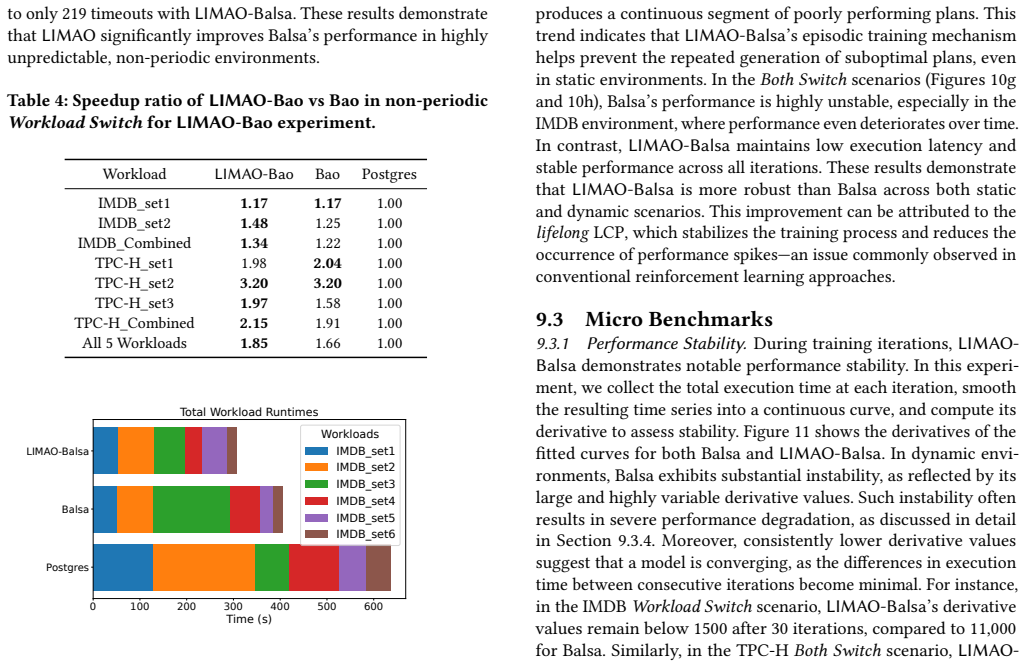
- [Sections 5, 6, and 9.1 (Volume Switch)] The task encoding in Section 5 is scale-invariant: Feature A is table selectivity divided by table size, and Features B, C, and D are operator counts, preorder indices, and query flags, none of which carry absolute data volume. Consequently, for the same TPC-H query template under sf=1 and sf=10, the K-prototype selector (Eq. 1) routes to the same module and the composed cost predictor receives the same input vector, yet the true execution cost differs by roughly an order of magnitude. A feedforward module cannot map one input to two different cost outputs, and training on the replay buffer B_all (Algorithm 1, line 7) cannot fit contradictory input-output pairs; the only way to track the current volume is to overwrite the previous mapping, which is precisely catastrophic forgetting. This undermines the reported Volume Switch improvements in Table 5, Table 6, and Figures 10c/10d and 12a/12c, and the central claim that LIMAO retains prior knowledge while adapting to data-distribution shifts. Please add volume-dependent features (e.g., absolute cardinality estimates or table sizes) to the encoding, or otherwise condition the model on the data volume, and rerun the Volume Switch experiments.
- [Section 9.3.2 and Section 9.1] Module hub sizes (K=2 for HJ and K=3 for NL on IMDB) were selected by comparing variants S1, S2, S3 on the same IMDB Workload Switch scenario that is later used as the main evaluation (Section 9.3.2 states that the three settings are evaluated over 20 iterations in the IMDB Workload Switch scenario). The default hyperparameters are therefore in-sample, so the reported improvements in Tables 2-5 over Balsa are partially attributable to this tuning. Please report hub-size selection on a validation set disjoint from all evaluation scenarios, or provide a sensitivity analysis across all dynamic scenarios.
- [Section 9.3.3 and Section 8] The ablation study does not isolate the contribution of modular decomposition from the contribution of the experience-replay/episodic-training mechanism. The variant 'Balsa + decomposition + Modular RL training' includes replay-style training but no module hubs, while the full LIMAO includes both; no baseline uses replay with the original monolithic Balsa LCP. Without such a baseline, it is unclear whether the performance gains come from modularity or simply from the replay buffer and episodic updates. Please add a 'Balsa + replay buffer' (or 'LIMAO without decomposition/modules') condition to the ablation.
- [Introduction and Table 6] The introduction states 'LIMAO can reduce the number of bad plans to 0, while Balsa has a few hundred,' but Table 6 reports 120 timeouts for LIMAO-Balsa in IMDB Workload Switch and IMDB Both Switch, and 98 in TPC-H Both Switch. Please correct this claim to match the reported results, e.g., by specifying which scenarios achieve zero timeouts.
minor comments (6)
- [Abstract] The claim of 'up to a 4× speedup' is not supported by any of the reported tables; the largest speedup versus Postgres shown is 3.20× in Table 4, and Tables 2 and 3 show 2.44–2.90×. Please reconcile the abstract and introduction with the reported numbers.
- [Figure 10] The Workload Switch panels in Figures 10e and 10f show 50 iterations on the x-axis, whereas Section 9.2.2 states the challenging Workload Switch runs for 120 iterations; please unify the time horizon or clarify which experiment the panels depict.
- [Algorithm 1, line 6] The algorithm references drift detection, but the paper never specifies the drift-detection method used; please provide the algorithm or citation so the 'Drift Detected' branch is reproducible.
- [Section 9.3.1] The derivative of the smoothed execution-time curve is used as a stability metric, but the smoothing method and the threshold for declaring convergence are not defined; please define them.
- [Section 5, Feature A] Feature A is described as a numerical vector of length n where each entry contains 'table selectivity divided by table size'; please clarify whether 'table size' refers to the row count or a fixed reference and specify how division by zero is handled for absent tables.
- [Section 6, Eq. (1)] Feature C (preorder index) is a sequence of integers, not a typical categorical feature; please clarify how it is mapped to a categorical value for the K-prototype dissimilarity computation.
Circularity Check
Module-hub sizes are selected on the same benchmark used for headline results; the modular framework itself has no definitional circularity.
-
fitted input called prediction
[Section 9.1 (Default Settings) and Section 9.3.2 (Choice of Module Hub's Length)]
"Unless otherwise specified, we adopt the following default configurations. To construct the Module Hubs in LIMAO, we select HJ and NL as break operators for the IMDB benchmark, with module hub sizes (i.e., K representative modules) of 2 and 3 respectively. ... In setting S2, we use 2 modules for HJ, 3 for NL, and 1 for OTH. ... The results for S1, S2, and S3 are 4067s, 3652s, and 4826s, respectively (S2 has the best performance)."
The default IMDB configuration used throughout the end-to-end evaluation is exactly the S2 hub sizing that the paper's own microbenchmark identifies as best on the IMDB Workload Switch scenario. The headline 'up to 40%' speedup and variance-reduction claims are therefore not produced by a fixed configuration chosen before evaluation; a free hyperparameter was selected using the same dynamic scenario on which those numbers are reported. Part of the reported advantage over Balsa is an in-sample tuning artifact rather than an independent property of the lifelong-learning framework.
full rationale
The paper does not present a formal derivation, so there is no definitional circularity in the modular-composition machinery: the break-operator decomposition, K-prototype module hubs, attention composition, and two-phase replay training are engineering choices evaluated against external baselines (Balsa, Bao, Postgres) over multiple workloads. The only circularity burden is the in-sample selection of module hub sizes described above, which inflates the headline numbers but does not by itself force the central workload-switch conclusions. The volume-switch concern (Feature A is normalized by table size, so absolute data volume is absent from the task representation) is a substantive architectural limitation worth investigating, but it is not circularity: it does not make any reported result equivalent to its inputs by construction, and the paper's derivation chain contains no load-bearing self-citation or imported uniqueness theorem. Self-citations such as [57] are used only to motivate attention and are not load-bearing.
Assumptions & free parameters
free parameters (7)
- Module hub size K per break operator =
IMDB: HJ=2, NL=3, OTH=1; TPC-H: HJ=1, MJ=1, OTH=1
- gamma (dissimilarity weighting between numerical and categorical features) =
not specified
- New-cluster dissimilarity threshold =
not specified
- Minimum cluster size for pruning =
not specified
- Episode size =
10 queries
- Replay buffer size (Bao and LIMAO-Bao) =
500 execution records
- Break operator types =
IMDB: HJ and NL; TPC-H: HJ and MJ
assumptions (5)
- domain assumption Sub-plans rooted at the first occurrence of chosen break operators form reusable tasks whose learned modules transfer across queries.
- domain assumption Traditional cardinality estimators yield selectivity features (Feature A) that remain informative for module routing under workload and data-volume shifts.
- domain assumption A reliable concept-drift detector exists and correctly chooses between replaying all experiences (B_all) or only recent ones (B_last).
- domain assumption Observed query execution latency is a stable and unbiased measure of plan quality in the experiments.
- domain assumption K-prototype clustering on the concatenated feature vectors converges to clusters that preserve task similarity well enough for module specialization.
Cite this review
Pith. "Pith review of LIMAO: A Framework for Lifelong Modular Learned Query Optimization." pith.science (2026). https://pith.science/paper/VIW7X2BL
@misc{pith2026250700188,
  author       = {Pith},
  title        = {Pith review of: LIMAO: A Framework for Lifelong Modular Learned Query Optimization},
  year         = {2026},
  howpublished = {\url{https://pith.science/paper/VIW7X2BL}},
  note         = {Machine review of arXiv:2507.00188}
}
read the original abstract
Query optimizers are crucial for the performance of database systems. Recently, many learned query optimizers (LQOs) have demonstrated significant performance improvements over traditional optimizers. However, most of them operate under a limited assumption: a static query environment. This limitation prevents them from effectively handling complex, dynamic query environments in real-world scenarios. Extensive retraining can lead to the well-known catastrophic forgetting problem, which reduces the LQO generalizability over time. In this paper, we address this limitation and introduce LIMAO (Lifelong Modular Learned Query Optimizer), a framework for lifelong learning of plan cost prediction that can be seamlessly integrated into existing LQOs. LIMAO leverages a modular lifelong learning technique, an attention-based neural network composition architecture, and an efficient training paradigm designed to retain prior knowledge while continuously adapting to new environments. We implement LIMAO in two LQOs, showing that our approach is agnostic to underlying engines. Experimental results show that LIMAO significantly enhances the performance of LQOs, achieving up to a 40% improvement in query execution time and reducing the variance of execution time by up to 60% under dynamic workloads. By leveraging a precise and self-consistent design, LIMAO effectively mitigates catastrophic forgetting, ensuring stable and reliable plan quality over time. Compared to Postgres, LIMAO achieves up to a 4x speedup on selected benchmarks, highlighting its practical advantages in real-world query optimization.
Figures


Figures from the paper (8 more)




Reference graph
Works this paper leans on
-
[1]
Ahmad Abbasi, Abdul Rehman Javed, Chinmay Chakraborty, Jamel Nebhen, Wisha Zehra, and Zunera Jalil. 2021. ElStream: An ensemble learning approach for concept drift detection in dynamic social big data stream learning. IEEE Access 9 (2021), 66408–66419
work page 2021
-
[3]
Jacob Andreas, Marcus Rohrbach, Trevor Darrell, and Dan Klein. 2016. Neural Module Networks. In 2016 IEEE Conference on Computer Vision and Pattern Recognition (CVPR). 39–48. https://doi.org/10.1109/CVPR.2016.12
-
[4]
Pierre-Luc Bacon, Jean Harb, and Doina Precup. 2017. The option-critic architec- ture. In Proceedings of the Thirty-First AAAI Conference on Artificial Intelligence (San Francisco, California, USA) (AAAI’17). AAAI Press, 1726–1734
work page 2017
-
[5]
Ishwar Baidari and Nagaraj Honnikoll. 2021. Bhattacharyya distance based concept drift detection method for evolving data stream. Expert Systems with Applications 183 (2021), 115303
work page 2021
-
[6]
TPC-H Benchmark. [n. d.]. http://www.tpc.org/tpch/
-
[7]
Yoshua Bengio. 2012. Deep Learning of Representations for Unsupervised and Transfer Learning. InProceedings of ICML Workshop on Unsupervised and Transfer Learning
work page 2012
-
[8]
Gianni Brauwers and Flavius Frasincar. 2021. A general survey on attention mechanisms in deep learning. IEEE Transactions on Knowledge and Data Engi- neering 35, 4 (2021), 3279–3298
work page 2021
-
[9]
Tianyi Chen, Jun Gao, Hedui Chen, and Yaofeng Tu. 2023. LOGER: A Learned Optimizer Towards Generating Efficient and Robust Query Execution Plans.Proc. VLDB Endow. 16, 7 (March 2023), 1777–1789. https://doi.org/10.14778/3587136. 3587150
doi:10.14778/3587136 2023
Show all 76 references
-
[10]
Xu Chen, Haitian Chen, Zibo Liang, Shuncheng Liu, Jinghong Wang, Kai Zeng, Han Su, and Kai Zheng. 2023. Leon: A new framework for ml-aided query optimization. Proceedings of the VLDB Endowment 16, 9 (2023), 2261–2273
2023
-
[11]
Xue Chen, Rui Xi, Yiheng Tang, and Mengshu Hou. 2023. Robust Listwise Learning-to-Rank Approach for Database Query Optimizer. In 2023 IEEE 29th International Conference on Parallel and Distributed Systems (ICPADS) . 1165–1172. https://doi.org/10.1109/ICPADS60453.2023.00170
2023
-
[12]
Alana de Santana Correia and Esther Luna Colombini. 2022. Attention, please! A survey of neural attention models in deep learning. Artificial Intelligence Review 55, 8 (2022), 6037–6124
2022
-
[13]
Coline Devin, Abhishek Gupta, Trevor Darrell, Pieter Abbeel, and Sergey Levine
-
[14]
Jialin Ding, Umar Farooq Minhas, Jia Yu, Chi Wang, Jaeyoung Do, Yinan Li, Hantian Zhang, Badrish Chandramouli, Johannes Gehrke, Donald Kossmann, et al. 2020. ALEX: an updatable adaptive learned index. In Proceedings of the 2020 ACM SIGMOD international conference on management...
2020
-
[15]
Doshi et al
L. Doshi et al. 2023. Kepler: Robust Learning for Parametric Query Optimization. In SIGMOD
2023
-
[16]
Lyric Doshi, Vincent Zhuang, Gaurav Jain, Ryan Marcus, Haoyu Huang, Deniz Altinbüken, Eugene Brevdo, and Campbell Fraser. 2023. Kepler: Robust Learning for Parametric Query Optimization. Proc. ACM Manag. Data 1, 1, Article 109 (May 2023), 25 pages. https://doi.org/10.1145/3588963
2023 doi
-
[17]
Quang-Huy Duong, Heri Ramampiaro, Kjetil Nørvåg, Philippe Fournier-Viger, and Thu-Lan Dam. 2018. High utility drift detection in quantitative data streams. Knowledge-Based Systems 157 (2018), 34–51
2018
-
[18]
Anshuman Dutt, Chi Wang, Vivek Narasayya, and Surajit Chaudhuri. 2020. Efficiently approximating selectivity functions using low overhead regression models. Proc. VLDB Endow. 13, 12 (July 2020), 2215–2228. https://doi.org/10. 14778/3407790.3407820
2020
-
[19]
Anirudh Goyal, Alex Lamb, Jordan Hoffmann, Shagun Sodhani, Sergey Levine, Yoshua Bengio, and Bernhard Schölkopf. 2021. Recurrent Independent Mech- anisms. In International Conference on Learning Representations . https:// openreview.net/forum?id=mLcmdlEUxy-
2021
-
[20]
Goetz Graefe. 1995. The Cascades Framework for Query Optimization. IEEE Data Eng. Bull. 18, 3 (1995), 19–29
1995
-
[21]
Graefe and W.J
G. Graefe and W.J. McKenna. 1993. The Volcano optimizer generator: extensibility and efficient search. In Proceedings of IEEE 9th International Conference on Data Engineering. 209–218
1993
-
[22]
Meng-Hao Guo, Tian-Xing Xu, Jiang-Jiang Liu, Zheng-Ning Liu, Peng-Tao Jiang, Tai-Jiang Mu, Song-Hai Zhang, Ralph R Martin, Ming-Ming Cheng, and Shi-Min Hu. 2022. Attention mechanisms in computer vision: A survey. Computational visual media 8, 3 (2022), 331–368
2022
-
[23]
Benjamin Hilprecht and Carsten Binnig. 2021. One model to rule them all: towards zero-shot learning for databases. arXiv preprint arXiv:2105.00642 (2021)
2021 arXiv
-
[24]
Benjamin Hilprecht and Carsten Binnig. 2022. Zero-shot cost models for out-of- the-box learned cost prediction. Proc. VLDB Endow. 15, 11 (July 2022), 2361–2374. https://doi.org/10.14778/3551793.3551799
2022
-
[25]
Songqiao Hu, Zeyi Liu, and Xiao He. 2022. CADM: Confusion model-based detection method for real-drift in chunk data stream. In International Conference on Sensor Systems and Software . Springer, 191–201
2022
-
[26]
Z Huang. 1997. Clustering Large Data Sets With Mixed Numeric And Categorical Values, " Proceedings Of 1st Pacific-Asia Conference on Knowledge Discouvery And Data Mining
1997
-
[27]
Hayes, and Christo- pher Kanan
Ronald Kemker, Marc McClure, Angelina Abitino, Tyler L. Hayes, and Christo- pher Kanan. 2018. Measuring catastrophic forgetting in neural networks. In Proceedings of the Thirty-Second AAAI Conference on Artificial Intelligence and Thirtieth Innovative Applications of Artificia...
2018
-
[28]
Kyoungmin Kim, Jisung Jung, In Seo, Wook-Shin Han, Kangwoo Choi, and Jaehyok Chong. 2022. Learned Cardinality Estimation: An In-depth Study. In Proceedings of the 2022 International Conference on Management of Data (Philadel- phia, PA, USA) (SIGMOD ’22). Association for Comput...
2022
-
[29]
Andreas Kipf, Thomas Kipf, Bernhard Radke, Viktor Leis, Peter Boncz, and Alfons Kemper. 2019. Learned Cardinalities: Estimating Correlated Joins with Deep Learning. In 9th Biennial Conference on Innovative Data Systems Research (CIDR ’19)
2019
-
[30]
Rusu, Kieran Milan, John Quan, Tiago Ramalho, Agnieszka Grabska-Barwinska, Demis Hassabis, Claudia Clopath, Dharshan Kumaran, and Raia Hadsell
James Kirkpatrick, Razvan Pascanu, Neil Rabinowitz, Joel Veness, Guillaume Desjardins, Andrei A. Rusu, Kieran Milan, John Quan, Tiago Ramalho, Agnieszka Grabska-Barwinska, Demis Hassabis, Claudia Clopath, Dharshan Kumaran, and Raia Hadsell. 2017. Overcoming catastrophic forget...
2017 doi
-
[31]
Tim Kraska, Alex Beutel, Ed H Chi, Jeffrey Dean, and Neoklis Polyzotis. 2018. The case for learned index structures. In Proceedings of the 2018 international conference on management of data . 489–504
2018
-
[32]
Jiale Lao, Yibo Wang, Yufei Li, Jianping Wang, Yunjia Zhang, Zhiyuan Cheng, Wanghu Chen, Mingjie Tang, and Jianguo Wang. 2023. Gptuner: A manual- reading database tuning system via gpt-guided bayesian optimization. arXiv preprint arXiv:2311.03157 (2023)
2023 arXiv
-
[33]
Viktor Leis, Andrey Gubichev, Atanas Mirchev, Peter Boncz, Alfons Kemper, and Thomas Neumann. 2015. How good are query optimizers, really? Proceedings of the VLDB Endowment 9, 3 (2015), 204–215
2015
-
[34]
Beibin Li, Yao Lu, and Srikanth Kandula. 2022. Warper: Efficiently adapting learned cardinality estimators to data and workload drifts. In Proceedings of the 2022 International Conference on Management of Data . 1920–1933
2022
-
[35]
Pengfei Li, Wenqing Wei, Rong Zhu, Bolin Ding, Jingren Zhou, and Hua Lu
-
[36]
Jorge Mendez Mendez: Embodied lifelong learning for decision making: Oppor- tunities brought on by modularity. [n. d.]. https://lis.csail.mit.edu/embodied- lifelong-learning-for-decision-making/
-
[37]
Ankur Mallick, Kevin Hsieh, Behnaz Arzani, and Gauri Joshi. 2022. Matchmaker: Data drift mitigation in machine learning for large-scale systems. Proceedings of Machine Learning and Systems 4 (2022), 77–94
2022
-
[38]
Marcus et al
R. Marcus et al. 2021. Bao: Making Learned Query Optimization Practical. In SIGMOD
2021
-
[39]
Ryan Marcus, Parimarjan Negi, Hongzi Mao, Nesime Tatbul, Mohammad Al- izadeh, and Tim Kraska. 2021. Bao: Making learned query optimization practical. In Proceedings of the 2021 International Conference on Management of Data . 1275– 1288
2021
-
[41]
Ryan Marcus, Parimarjan Negi, Hongzi Mao, Chi Zhang, Mohammad Alizadeh, Tim Kraska, Olga Papaemmanouil, and Nesime Tatbul. 2019. Neo: A learned query optimizer. arXiv preprint arXiv:1904.03711 (2019)
2019 arXiv
-
[42]
Ryan Marcus and Olga Papaemmanouil. 2019. Plan-structured deep neural network models for query performance prediction. Proc. VLDB Endow. 12, 11 (July 2019), 1733–1746. https://doi.org/10.14778/3342263.3342646
2019
-
[43]
Jorge A Mendez and ERIC EATON. 2023. How to Reuse and Compose Knowl- edge for a Lifetime of Tasks: A Survey on Continual Learning and Func- tional Composition. Transactions on Machine Learning Research (2023). https: //openreview.net/forum?id=VynY6Bk03b Survey Certification
2023
-
[44]
Jorge A Mendez, Harm van Seijen, and Eric Eaton. 2022. Modular lifelong reinforcement learning via neural composition. arXiv preprint arXiv:2207.00429 (2022)
2022 arXiv
-
[45]
Jorge Mendez-Mendez, Leslie Pack Kaelbling, and Tomás Lozano-Pérez. 2023. Embodied Lifelong Learning for Task and Motion Planning. In Proceedings of The 7th Conference on Robot Learning (Proceedings of Machine Learning Research, Vol. 229), Jie Tan, Marc Toussaint, and Kourosh ...
2023
-
[46]
Yabin Meng, Paul Bird, Pat Martin, and Wendy Powley. 2007. An approach to managing the execution of large SQL queries. InProceedings of the 2007 conference of the center for advanced studies on Collaborative research . 268–271
2007
-
[47]
Artem Mikhaylov, Nina S Mazyavkina, Mikhail Salnikov, Ilya Trofimov, Fu Qiang, and Evgeny Burnaev. 2022. Learned Query Optimizers: Evaluation and Improvement. IEEE Access 10 (2022), 75205–75218
2022
-
[48]
Songsong Mo, Yile Chen, Hao Wang, Gao Cong, and Zhifeng Bao. 2023. Lemo: A Cache-Enhanced Learned Optimizer for Concurrent Queries. Proceedings of the ACM on Management of Data 1, 4 (2023), 1–26
2023
-
[49]
Lili Mou, Ge Li, Lu Zhang, Tao Wang, and Zhi Jin. 2016. Convolutional neural networks over tree structures for programming language processing. In Proceed- ings of the Thirtieth AAAI Conference on Artificial Intelligence (Phoenix, Arizona) (AAAI’16). AAAI Press, 1287–1293
2016
-
[50]
Parimarjan Negi, Ryan Marcus, Andreas Kipf, Hongzi Mao, Nesime Tatbul, Tim Kraska, and Mohammad Alizadeh. 2021. Flow-Loss: Learning Cardinal- ity Estimates That Matter. Proc. VLDB Endow. 14, 11 (jul 2021), 2019–2032. https://doi.org/10.14778/3476249.3476259
2021
-
[51]
Parimarjan Negi, Ziniu Wu, Andreas Kipf, Nesime Tatbul, Ryan Marcus, Sam Madden, Tim Kraska, and Mohammad Alizadeh. 2023. Robust query driven cardinality estimation under changing workloads. Proceedings of the VLDB Endowment 16, 6 (2023), 1520–1533
2023
-
[52]
PostgreSQL Global Development Group. [n. d.]. https://www.postgresql.org/
-
[53]
Robert Ricci, Eric Eide, and CloudLab Team. 2014. Introducing CloudLab: Scien- tific infrastructure for advancing cloud architectures and applications. ; login:: the magazine of USENIX & SAGE 39, 6 (2014), 36–38
2014
-
[54]
Clemens Rosenbaum, Tim Klinger, and Matthew Riemer. 2017. Routing Net- works: Adaptive Selection of Non-linear Functions for Multi-Task Learning.ICLR abs/1711.01239 (2017). https://api.semanticscholar.org/CorpusID:22014305
2017 arXiv
-
[55]
Clemens Rosenbaum, Tim Klinger, and Matthew Riemer. 2018. Routing Net- works: Adaptive Selection of Non-Linear Functions for Multi-Task Learning. In International Conference on Learning Representations . https://openreview.net/ forum?id=ry8dvM-R-
2018
-
[56]
Paul Ruvolo and Eric Eaton. 2013. ELLA: an efficient lifelong learning algo- rithm. In Proceedings of the 30th International Conference on International Confer- ence on Machine Learning - Volume 28 (Atlanta, GA, USA) (ICML’13). JMLR.org, I–507–I–515
2013
-
[57]
Sabek et al
I. Sabek et al. 2022. LSched: A Workload-Aware Learned Query Scheduler for Analytical Database Systems. In SIGMOD
2022
-
[58]
P Griffiths Selinger, Morton M Astrahan, Donald D Chamberlin, Raymond A Lorie, and Thomas G Price. 1979. Access path selection in a relational database management system. In Proceedings of the 1979 ACM SIGMOD international conference on Management of data . 23–34
1979
-
[59]
Ji Sun and Guoliang Li. 2019. An end-to-end learning-based cost estimator. Proc. VLDB Endow. 13, 3 (Nov. 2019), 307–319. https://doi.org/10.14778/3368289. 3368296
2019 doi
-
[60]
Ji Sun, Jintao Zhang, Zhaoyan Sun, Guoliang Li, and Nan Tang. 2021. Learned Cardinality Estimation: A Design Space Exploration and a Comparative Eval- uation. Proc. VLDB Endow. 15, 1 (sep 2021), 85–97. https://doi.org/10.14778/ 3485450.3485459
2021
-
[61]
Reads the Manual
Immanuel Trummer. 2022. DB-BERT: a Database Tuning Tool that" Reads the Manual". In Proceedings of the 2022 international conference on management of data. 190–203
2022
-
[62]
Kostas Tzoumas, Amol Deshpande, and Christian S. Jensen. 2011. Lightweight graphical models for selectivity estimation without independence assumptions. Proc. VLDB Endow. 4, 11 (Aug. 2011), 852–863. https://doi.org/10.14778/3402707. 3402724
2011 doi
-
[63]
Gomez, Łukasz Kaiser, and Illia Polosukhin
Ashish Vaswani, Noam Shazeer, Niki Parmar, Jakob Uszkoreit, Llion Jones, Aidan N. Gomez, Łukasz Kaiser, and Illia Polosukhin. 2017. Attention is all you need. In Proceedings of the 31st International Conference on Neural Information Processing Systems (Long Beach, California, ...
2017
-
[64]
Lianggui Weng, Rong Zhu, Di Wu, Bolin Ding, Bolong Zheng, and Jingren Zhou
-
[65]
Peizhi Wu and Gao Cong. 2021. A Unified Deep Model of Learning from both Data and Queries for Cardinality Estimation. In Proceedings of the 2021 Inter- national Conference on Management of Data (Virtual Event, China) (SIGMOD ’21). Association for Computing Machinery, New York,...
2021
-
[66]
Peizhi Wu and Zachary G. Ives. 2024. Modeling Shifting Workloads for Learned Database Systems. Proc. ACM Manag. Data 2, 1, Article 38 (March 2024), 27 pages. https://doi.org/10.1145/3639293
2024 doi
-
[67]
Ruihan Yang, Huazhe Xu, Yi Wu, and Xiaolong Wang. 2020. Multi-task reinforce- ment learning with soft modularization. In Proceedings of the 34th International Conference on Neural Information Processing Systems (Vancouver, BC, Canada) (NIPS ’20). Curran Associates Inc., Red Ho...
2020
-
[68]
Yang et al
Z. Yang et al. 2022. Balsa: Learning a Query Optimizer Without Expert Demon- strations. In SIGMOD
2022
-
[69]
Zongheng Yang, Wei-Lin Chiang, Sifei Luan, Gautam Mittal, Michael Luo, and Ion Stoica. 2022. Balsa: Learning a query optimizer without expert demonstrations. In Proceedings of the 2022 International Conference on Management of Data. 931–944
2022
-
[70]
Zongheng Yang, Amog Kamsetty, Sifei Luan, Eric Liang, Yan Duan, Xi Chen, and Ion Stoica. 2020. NeuroCard: One Cardinality Estimator for All Tables. arXiv:2006.08109 [cs] (June 2020). arXiv:2006.08109 [cs]
2020 arXiv
-
[71]
Hellerstein, Sanjay Krishnan, and Ion Stoica
Zongheng Yang, Eric Liang, Amog Kamsetty, Chenggang Wu, Yan Duan, Xi Chen, Pieter Abbeel, Joseph M. Hellerstein, Sanjay Krishnan, and Ion Stoica
-
[72]
Xiang Yu, Chengliang Chai, Guoliang Li, and Jiabin Liu. 2022. Cost-Based or Learning-Based? A Hybrid Query Optimizer for Query Plan Selection.Proc. VLDB Endow. 15, 13 (Sept. 2022), 3924–3936. https://doi.org/10.14778/3565838.3565846
2022
-
[73]
Rong Zhu, Wei Chen, Bolin Ding, Xingguang Chen, Andreas Pfadler, Ziniu Wu, and Jingren Zhou. 2023. Lero: A learning-to-rank query optimizer. Proceedings of the VLDB Endowment 16, 6 (2023), 1466–1479
2023
-
[74]
Rong Zhu, Ziniu Wu, Yuxing Han, Kai Zeng, Andreas Pfadler, Zhengping Qian, Jingren Zhou, and Bin Cui. 2021. FLAT: fast, lightweight and accurate method for cardinality estimation. Proc. VLDB Endow. 14, 9 (May 2021), 1489–1502. https://doi.org/10.14778/3461535.3461539 14
2021
-
[2017]
In 2017 IEEE International Conference on Robotics and Automation (ICRA)
Learning modular neural network policies for multi-task and multi-robot transfer. In 2017 IEEE International Conference on Robotics and Automation (ICRA). 2169–2176. https://doi.org/10.1109/ICRA.2017.7989250
2017
-
[2019]
Deep Unsupervised Cardinality Estimation. Proc. VLDB Endow. 13, 3 (nov 2019), 279–292. https://doi.org/10.14778/3368289.3368294
2019
-
[2023]
Proceedings of the VLDB Endowment 17, 2 (Oct
ALECE: An Attention-based Learned Cardinality Estimator for SPJ Queries on Dynamic Workloads. Proceedings of the VLDB Endowment 17, 2 (Oct. 2023), 197–210. https://doi.org/10.14778/3626292.3626302
2023
-
[2024]
Proceedings of the VLDB Endowment 17, 5 (2024), 926–938
Eraser: Eliminating performance regression on learned query optimizer. Proceedings of the VLDB Endowment 17, 5 (2024), 926–938
2024
Reviewed August 6, 2026 · model on record in the stance chip above.
Discussion (0). Sign in to comment.