REVIEW 3 major objections 7 minor 35 references
Automatic discovery of optimal meta-solvers for time-dependent nonlinear PDEs
T0 review · 3 major / 7 minor · reviewed 2026-08-06 · deepseek-v4-flash
Pith's one-line read Optimal hybrid meta-solvers for time-dependent nonlinear PDEs can be discovered automatically by multi-objective search, reaching machine precision with 9–15× less time and 30–150× fewer iterations than unpreconditioned Krylov baselines.
desk verdict Extends a credible solver-search framework to nonlinear time-dependent PDEs, but the speedup claims are only established against unpreconditioned Krylov baselines and the neural-operator contribution is never isolated. read the letter →
The pith
A machine-rendered reading of the paper's core claim, the machinery that carries it, and where it could break.
The reading
What carries the argument
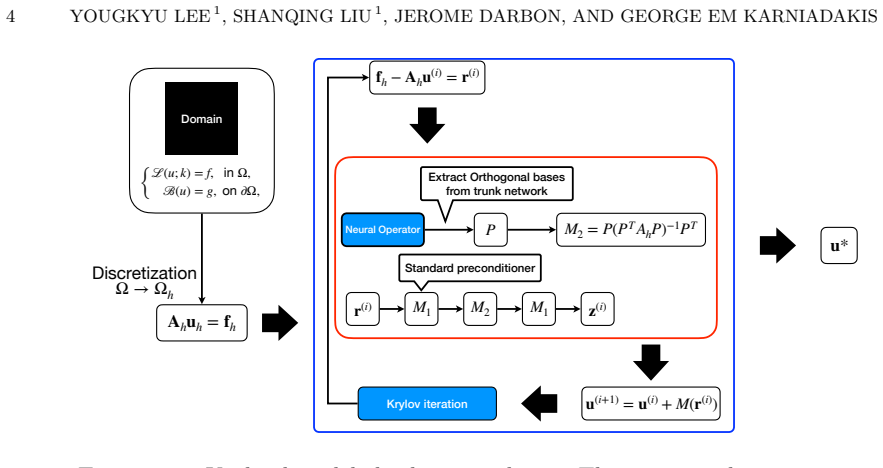
The central object is the trunk-basis hybrid preconditioner, which extracts a prolongation operator $P$ from the trunk network of a DeepONet so that $P_{ij}=T_j(x_i)$; the second preconditioner is $M_2 = P(A_c)^{-1}P^T$, where $A_c = P^T A P$ is the coarse operator. This preconditioner is embedded in a Krylov iteration and surrounded by relaxation steps (Jacobi, Gauss–Seidel, SOR, SSOR, or Chebyshev) and one to three levels of multigrid, forming a composed meta-solver. The argument is carried by searching the resulting parameter space with multi-objective optimization and then selecting among Pareto-optimal compositions via a preference function.
What would settle it
Run the same preference-based solver search on the reaction–diffusion and Navier–Stokes test problems with the neural-operator component removed and replaced by a classical algebraic preconditioner such as ILU or standalone algebraic multigrid; if any such classical-only meta-solver matches the reported 9–15× time speedups and 30–150× iteration reductions, the claim that the neural-operator component is responsible for the gains is refuted.
Extended reading notes
Core claim
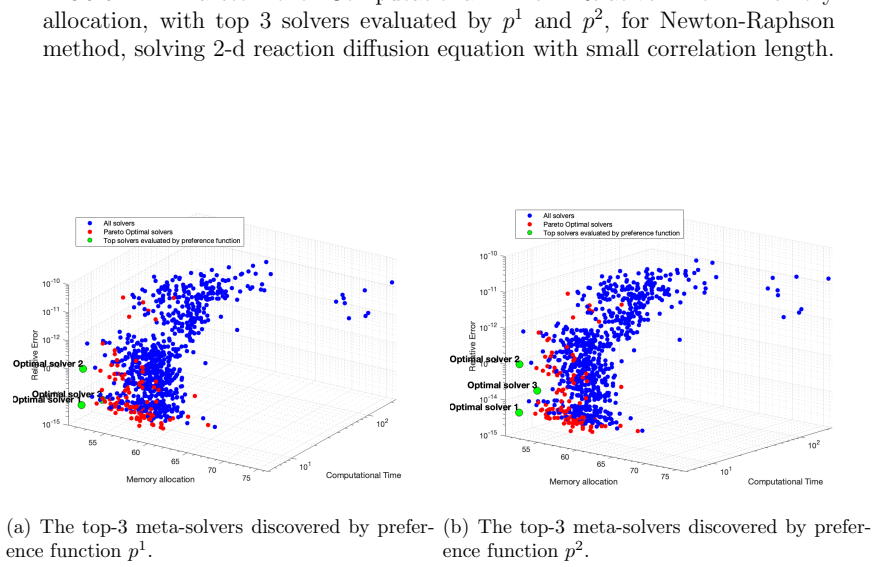
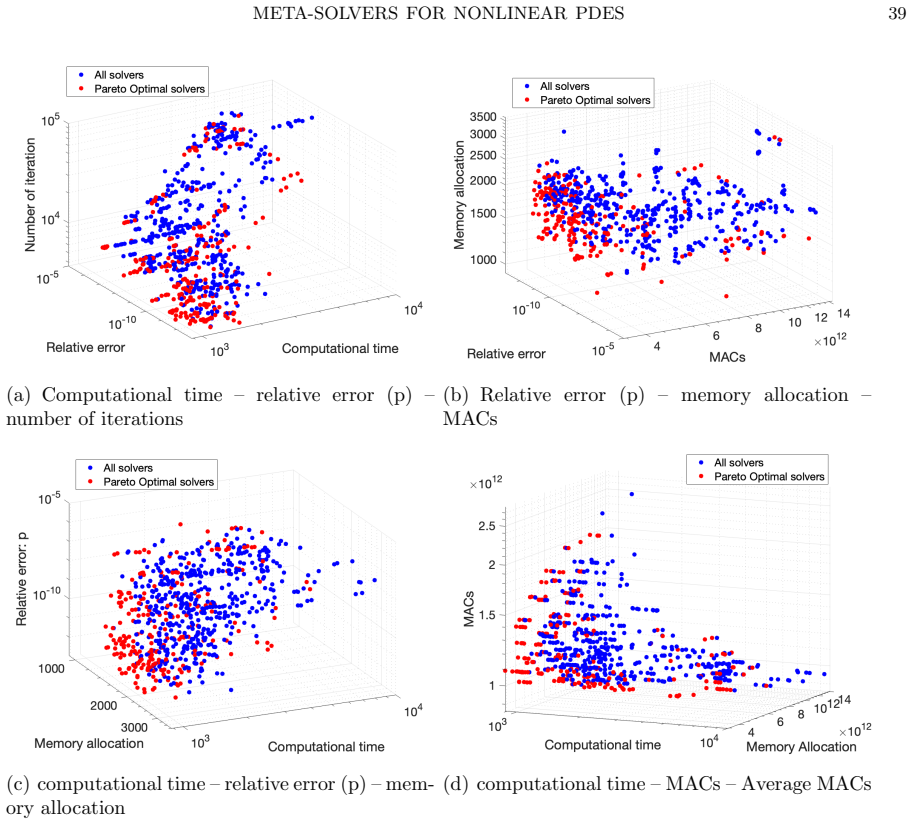
The central claim is that a hybrid meta-solver—an outer iteration that composes a neural-operator preconditioner with a Krylov method, relaxation smoothers, and multigrid levels—can outperform conventional iterative solvers for the linear systems arising from Newton–Raphson or IMEX time stepping of nonlinear PDEs. The paper parameterizes every meta-solver by a five-dimensional choice space and evaluates it on six to eight performance criteria, then identifies the Pareto-optimal set of nondominated solvers. A user-defined preference function, such as a weighted sum of rescaled criteria, selects a suitable solver from that front, and a linear program recovers the preference function under which a given Pareto-optimal solver is the chosen one. The numerical results show that the selected meta-solvers reach machine precision with roughly 9–15× less computational time and 30–150× fewer iterations than unpreconditioned Krylov baselines across reaction–diffusion, Navier–Stokes, and brittle fracture problems. The paper also reports that the Pareto front is nonconvex, so weighted-sum preferences can rediscover only solvers on its convex hull, missing roughly 25–50% of the Pareto-optimal solvers.
Load-bearing premise
The speedup claims rest on comparing only against unpreconditioned Krylov methods; if a classical preconditioner such as ILU or standalone algebraic multigrid achieves the same gains without any neural operator, the central attribution of the improvement to the neural-operator component collapses.
Editorial extensions
If this is right
- For a given problem class and preference profile, the framework returns a concrete meta-solver, and different preferences select different solvers from the same Pareto front.
- The reported iteration reductions of 30–150× indicate that the discovered meta-solvers dramatically lower the effective condition number of the linearized systems, not merely shift work to cheaper iterations.
- The same search machinery applies across reaction–diffusion, incompressible Navier–Stokes, and brittle fracture problems without changing the framework, suggesting it is a general solver-discovery procedure rather than a per-problem construction.
- The rediscovery linear program lets users invert the selection process: given a known Pareto-optimal solver, the preference weights under which it is optimal can be recovered.
- Because the Pareto front is nonconvex, weighted-sum preference functions cannot reach all Pareto-optimal solvers, leaving a concrete gap that more general multi-objective methods could fill.
Reading between the lines
- If the framework is right, solver design can become a searchable design space: for any new time-dependent nonlinear PDE, one can enumerate candidate solver components, evaluate the Pareto front, and select by preference instead of hand-engineering a preconditioner.
- A natural extension would be to apply the same multi-objective search to steady-state nonlinear PDEs or to different discretizations, where the balance between neural-operator training cost and iteration savings may shift substantially.
- The nonconvexity limitation suggests that replacing weighted-sum preferences with nonconvex multi-objective optimization algorithms could recover the roughly 25–50% of Pareto-optimal solvers currently missed, and the paper's rediscovery machinery could be adapted to those methods.
- The framework could also be tested against classical preconditioners such as ILU or standalone algebraic multigrid within the same Pareto search; if those match the neural-operator-based gains, the attribution of the speedup to the neural component would need revision.
Editorial analysis
A structured set of objections, weighed in public.
Referee Report
Summary. The paper proposes a multi-objective optimization framework for automatically selecting hybrid “meta-solvers” for time-dependent nonlinear PDEs. A finite design space combines five neural operator choices, three Krylov methods, four relaxation smoothers, five smoothing strategies, and up to three multigrid levels. Performance is evaluated on six or eight criteria, and Pareto-optimal solvers are identified over the resulting 900 enumerated combinations. Weighted-sum preference functions select top solvers, and a linear program “rediscovers” weight vectors for given Pareto-optimal solvers. The method is demonstrated on reaction-diffusion, 3D Navier-Stokes, and brittle fracture problems, with reported speedups of 3.6–15x in computational time and 30–150x in iteration count relative to unpreconditioned CG, BiCGStab, and FGMRES baselines.
Significance. If the attribution issue is resolved, the framework could be a useful tool for automated solver selection and for studying performance tradeoffs among classical and learned preconditioning components. The paper is strong in its exhaustive enumeration of a 900-member design space, its detailed implementation appendices, and its honest quantification of the nonconvex part of the Pareto front, including the explicit statement that 25.5–38.6% of Pareto-optimal solvers cannot be rediscovered by weighted-sum preferences. However, the central empirical claim in the abstract, that integrating neural operators with classical methods yields meta-solvers that consistently outperform conventional iterative solvers, currently lacks a test that isolates the neural-operator contribution from the classical multigrid and relaxation components.
major comments (3)
- [Section 3, Tables 1(c)–5(c); Eq. (21)/(24)]
- [Table 5(B) and its caption]
- [Section 2.3, Eq. (17); Appendix A.2]
minor comments (7)
- [Section 3.1.2]
- [Eq. (10)]
- [Tables 6–8, 16–20]
- [Section 2.3 and Section 3]
- [Section 4.1 and Section 4.2]
- [Tables 1(B)–5(B)]
- [Global]
Circularity Check
The LP 'rediscovery' step in Eq. (17) is self-definitional: it constructs preference weights that force a known Pareto-optimal solver to be optimal, inverting the already-measured Pareto front rather than making an independent prediction.
-
self definitional
[Section 2.3, Eq. (17); used in Section 3.1.2, Eqs. (22), and Appendix A.2, Eqs. (33)-(34)]
"The re-discovery of one particular (parameterized) solver xj ∈ Pf′(M) is equivalent to finding a weight λj such that p(λ; f′(xj)) is the minimum for every x ∈ Pf′(M). This can be formulated as a linear programming problem, that has the form: (17) min λ λT f′(xj) s.t. (λT f′(xj) ≤ λT f′(x−j), ∀ x−j ∈ Pf′(M), 0 ≤ λi ≤ 1 and Σ λi = 1."
The LP's first constraint is exactly the optimality condition that xj minimizes the weighted sum over the already-computed Pareto set. Therefore any feasible weight λ is, by construction, a weight under which the known solver xj is optimal; the 'rediscovered' preference function is a tangent hyperplane to the measured Pareto front at f′(xj). It carries no new evidence about solver quality and cannot fail except when the point is not on the convex hull, which the paper itself acknowledges up to 50% of the time. This is geometric inversion, not prediction. The external vanilla Krylov benchmarks are independent, so this step is ancillary rather than central to the speedup claims.
full rationale
The paper's central discovery mechanism is a search over 900 measured solver configurations: performance is evaluated, Pareto optimality is computed, and preference functions select among the evaluated candidates. The headline speedups are derived from comparisons to independently measured unpreconditioned CG, BiCGStab, and FGMRES baselines in Tables 1(c)-5(c), so those comparisons are not circular. Self-citations such as [KK25] and [ZKK+24] supply the trunk-basis preconditioner construction and are implemented in the present paper (Eqs. (4)-(5)), rather than being invoked as unexamined uniqueness or ansatz results. The only genuinely circular step is the LP 'rediscovery' in Eq. (17), which by construction recovers a preference weight that makes a chosen Pareto-optimal solver optimal. The paper also honestly notes the convex-hull limitation of this LP approach. A separate scientific gap, though not a circularity, is that the design space M never includes an identity/no-neural-operator option or standard classical preconditioners such as ILU or standalone AMG, so the attribution of the speedups to the neural-operator component is not directly tested; this concern affects validity of the attribution claim but not the self-containment of the derivation. Overall score 3: one auxiliary self-definitional inversion with independent external benchmarks for the main empirical claims.
Assumptions & free parameters
free parameters (1)
- Neural operator weights (DeepONet, U-DeepONet, KAN, JacobiKAN, ChebyKAN) =
not reported (trained with AdamW, batch 1000, until relative L2 error < 8% or 20000 iterations)
assumptions (4)
- domain assumption Neural operators trained on samples from the same PDE family remain effective preconditioner components for unseen draws from that family.
- ad hoc to paper The trunk-basis construction M2 = P(P^T A P)^{-1} P^T yields a valid coarse preconditioner for the linear systems arising in Newton-Raphson and IMEX time stepping.
- domain assumption Single-run performance measurements are sufficient to determine Pareto optimality.
- standard math Standard convergence theory for Newton-Raphson, Krylov methods, and multigrid.
Cite this review
Pith. "Pith review of Automatic discovery of optimal meta-solvers for time-dependent nonlinear PDEs." pith.science (2026). https://pith.science/paper/BOIAQXC7
@misc{pith2026250700278,
  author       = {Pith},
  title        = {Pith review of: Automatic discovery of optimal meta-solvers for time-dependent nonlinear PDEs},
  year         = {2026},
  howpublished = {\url{https://pith.science/paper/BOIAQXC7}},
  note         = {Machine review of arXiv:2507.00278}
}
read the original abstract
We present a general and scalable framework for the automated discovery of optimal meta-solvers for the solution of time-dependent nonlinear partial differential equations after appropriate discretization. By integrating classical numerical methods (e.g., Krylov-based methods) with modern deep learning components, such as neural operators, our approach enables flexible, on-demand solver design tailored to specific problem classes and objectives. The fast solvers tackle the large linear system resulting from the Newton--Raphson iteration or by using an implicit-explicit (IMEX) time integration scheme. Specifically, we formulate solver discovery as a multi-objective optimization problem, balancing various performance criteria such as accuracy, speed, and memory usage. The resulting Pareto optimal set provides a principled foundation for solver selection based on user-defined preference functions. When applied to problems in reaction--diffusion, fluid dynamics, and solid mechanics, the discovered meta-solvers consistently outperform conventional iterative methods, demonstrating both practical efficiency and broad applicability.
Figures


Figures from the paper (19 more)





Reference graph
Works this paper leans on
-
[1]
P.R. Amestoy, A. Buttari, J.-Y. L'Excellent, and T. Mary. Performance and Scalability of the Block Low-Rank Multifrontal Factorization on Multicore Architectures . ACM Transactions on Mathematical Software , 45:2:1--2:26, 2019
work page 2019
-
[2]
P.R. Amestoy, I. S. Duff, J. Koster, and J.-Y. L'Excellent. A fully asynchronous multifrontal solver using distributed dynamic scheduling. SIAM Journal on Matrix Analysis and Applications , 23(1):15--41, 2001
work page 2001
-
[3]
Implicit-explicit runge-kutta methods for time-dependent partial differential equations
Uri M Ascher, Steven J Ruuth, and Raymond J Spiteri. Implicit-explicit runge-kutta methods for time-dependent partial differential equations. Applied Numerical Mathematics , 25(2-3):151--167, 1997
work page 1997
-
[4]
F. Bashforth and J.C. Adams. An Attempt to Test the Theories of Capillary Action: By Comparing the Theoretical and Measured Forms of Drops of Fluid. With an Explanation of the Method of Integration Employed in Constucting the Tables which Give the Theoretical Forms of Such Drops . University Press, 1883
-
[5]
Klaus-J \"u rgen Bathe. Finite element procedures . Klaus-Jurgen Bathe, 2006
work page 2006
-
[6]
Parallel multilevel preconditioners
James H Bramble, Joseph E Pasciak, and Jinchao Xu. Parallel multilevel preconditioners. Mathematics of computation , 55(191):1--22, 1990
work page 1990
-
[7]
Pareto optimality in multiobjective problems
Yair Censor. Pareto optimality in multiobjective problems. Applied Mathematics and Optimization , 4(1):41--59, 1977
work page 1977
-
[8]
Qianying Cao, Shanqing Liu, Alan John Varghese, Jerome Darbon, Michael Triantafyllou, and George Em Karniadakis. Automatic selection of the best neural architecture for time series forecasting via multi-objective optimization and pareto optimality conditions. arXiv preprint arXiv:2501.12215 , 2025
Show all 35 references
-
[9]
Physics-informed neural networks (pinns) for fluid mechanics: A review
Shengze Cai, Zhiping Mao, Zhicheng Wang, Minglang Yin, and George Em Karniadakis. Physics-informed neural networks (pinns) for fluid mechanics: A review. Acta Mechanica Sinica , 37(12):1727--1738, 2021
2021
-
[10]
Crank and P
J. Crank and P. Nicolson. A practical method for numerical evaluation of solutions of partial differential equations of the heat-conduction type. Advances in Computational Mathematics , 6(1):207--226, Dec 1996
1996
-
[11]
U-DeepONet : U-Net enhanced deep operator network for geologic carbon sequestration
Waleed Diab and Mohammed Al Kobaisi. U-DeepONet : U-Net enhanced deep operator network for geologic carbon sequestration. Scientific Reports , 14(1):21298, 2024
2024
-
[12]
Ross Ethier and D
C. Ross Ethier and D. A. Steinman. Exact fully 3D Navier--Stokes solutions for benchmarking. International Journal for Numerical Methods in Fluids , 19(5):369--375, 1994
1994
-
[13]
Rory A. Fisher. The wave of advance of advantageous genes. Annals of Human Genetics , 7:355--369, 1937
1937
-
[14]
Iterative methods for solving linear systems
Anne Greenbaum. Iterative methods for solving linear systems . SIAM, 1997
1997
-
[15]
Solving nonlinear equations with Newton's method
Carl T Kelley. Solving nonlinear equations with Newton's method . SIAM, 2003
2003
-
[16]
DeepONet based preconditioning strategies for solving parametric linear systems of equations
Alena Kopani c \' a kov\' a and George Em Karniadakis. DeepONet based preconditioning strategies for solving parametric linear systems of equations. SIAM Journal on Scientific Computing , 47(1):C151--C181, 2025
2025
-
[17]
Physics-informed machine learning: Nature reviews physics
GE Karniadakis, IG Kevrekidis, L Lu, P Perdikaris, S Wang, and L Yang. Physics-informed machine learning: Nature reviews physics. 2021
2021
-
[18]
Kovachki, Zongyi Li, Burigede Liu, Kamyar Azizzadenesheli, Kaushik Bhattacharya, Andrew M
Nikola B. Kovachki, Zongyi Li, Burigede Liu, Kamyar Azizzadenesheli, Kaushik Bhattacharya, Andrew M. Stuart, and Anima Anandkumar. Neural operator: Learning maps between function spaces. CoRR , abs/2108.08481, 2021
2021 arXiv
-
[19]
Spectral/hp element methods for computational fluid dynamics
George Karniadakis and Spencer J Sherwin. Spectral/hp element methods for computational fluid dynamics . Oxford University Press, USA, 2005
2005
-
[20]
Decoupled weight decay regularization
Ilya Loshchilov and Frank Hutter. Decoupled weight decay regularization. In International Conference on Learning Representations , 2019
2019
-
[21]
Learning nonlinear operators via deeponet based on the universal approximation theorem of operators
Lu Lu, Pengzhan Jin, Guofei Pang, Zhongqiang Zhang, and George Em Karniadakis. Learning nonlinear operators via deeponet based on the universal approximation theorem of operators. Nature machine intelligence , 3(3):218--229, 2021
2021
-
[22]
Fourier neural operator for parametric partial differential equations
Zongyi Li, Nikola Kovachki, Kamyar Azizzadenesheli, Burigede Liu, Kaushik Bhattacharya, Andrew Stuart, and Anima Anandkumar. Fourier neural operator for parametric partial differential equations. arXiv preprint arXiv:2010.08895 , 2020
2010 arXiv
-
[23]
Automatic discovery of optimal meta-solvers via multi-objective optimization
Youngkyu Lee, Shanqing Liu, Jerome Darbon, and George Em Karniadakis. Automatic discovery of optimal meta-solvers via multi-objective optimization. arXiv preprint arXiv:2412.00063 , 2024
2024
-
[24]
Fast meta-solvers for 3d complex-shape scatterers using neural operators trained on a non-scattering problem
Youngkyu Lee, Shanqing Liu, Zongren Zou, Adar Kahana, Eli Turkel, Rishikesh Ranade, Jay Pathak, and George Em Karniadakis. Fast meta-solvers for 3d complex-shape scatterers using neural operators trained on a non-scattering problem. arXiv preprint arXiv:2405.12308 , 2024
2024 arXiv
-
[25]
Bayesian physics informed neural networks for real-world nonlinear dynamical systems
Kevin Linka, Amelie Sch \"a fer, Xuhui Meng, Zongren Zou, George Em Karniadakis, and Ellen Kuhl. Bayesian physics informed neural networks for real-world nonlinear dynamical systems. Computer Methods in Applied Mechanics and Engineering , 402:115346, 2022
2022
-
[26]
Nonlinear multiobjective optimization , volume 12
Kaisa Miettinen. Nonlinear multiobjective optimization , volume 12. Springer Science & Business Media, 1999
1999
-
[27]
On the spectral bias of neural networks
Nasim Rahaman, Aristide Baratin, Devansh Arpit, Felix Draxler, Min Lin, Fred Hamprecht, Yoshua Bengio, and Aaron Courville. On the spectral bias of neural networks. In International conference on machine learning , pages 5301--5310. PMLR, 2019
-
[28]
Physics-informed neural networks: A deep learning framework for solving forward and inverse problems involving nonlinear partial differential equations
Maziar Raissi, Paris Perdikaris, and George E Karniadakis. Physics-informed neural networks: A deep learning framework for solving forward and inverse problems involving nonlinear partial differential equations. Journal of Computational physics , 378:686--707, 2019
2019
-
[29]
A flexible inner-outer preconditioned gmres algorithm
Youcef Saad. A flexible inner-outer preconditioned gmres algorithm. SIAM Journal on Scientific Computing , 14(2):461--469, 1993
1993
-
[30]
Iterative methods for sparse linear systems
Yousef Saad. Iterative methods for sparse linear systems . SIAM, Philadelphia, 2003
2003
-
[31]
Finite difference schemes and partial differential equations
John C Strikwerda. Finite difference schemes and partial differential equations . SIAM, 2004
2004
-
[32]
Bi-cgstab: A fast and smoothly converging variant of bi-cg for the solution of nonsymmetric linear systems
Henk A Van der Vorst. Bi-cgstab: A fast and smoothly converging variant of bi-cg for the solution of nonsymmetric linear systems. SIAM Journal on Scientific and Statistical Computing , 13(2):631--644, 1992
1992
-
[33]
Iterative Krylov methods for large linear systems
Henk A Van der Vorst. Iterative Krylov methods for large linear systems . Cambridge University Press, 2003
2003
-
[34]
Wesseling
P. Wesseling. An Introduction to Multigrid Methods . R.T. Edwards, 2004
2004
-
[35]
Blending neural operators and relaxation methods in pde numerical solvers
Enrui Zhang, Adar Kahana, Alena Kopani c \'a kov \'a , Eli Turkel, Rishikesh Ranade, Jay Pathak, and George Em Karniadakis. Blending neural operators and relaxation methods in pde numerical solvers. Nature Machine Intelligence , pages 1--11, 2024
2024
Reviewed August 6, 2026 · model on record in the stance chip above.
Discussion (0). Sign in to comment.