Existence and spectral stability analysis of viscous-dispersive shock profiles for isentropic compressible fluids of Korteweg type
Pith reviewed 2026-05-19 07:20 UTC · model grok-4.3
The pith
The system admits viscous-dispersive shock profiles of arbitrary amplitude whose essential spectrum is stable independent of strength and whose point spectrum is stable for small amplitudes under a structural condition.
A machine-rendered reading of the paper's core claim, the machinery that carries it, and where it could break.
Core claim
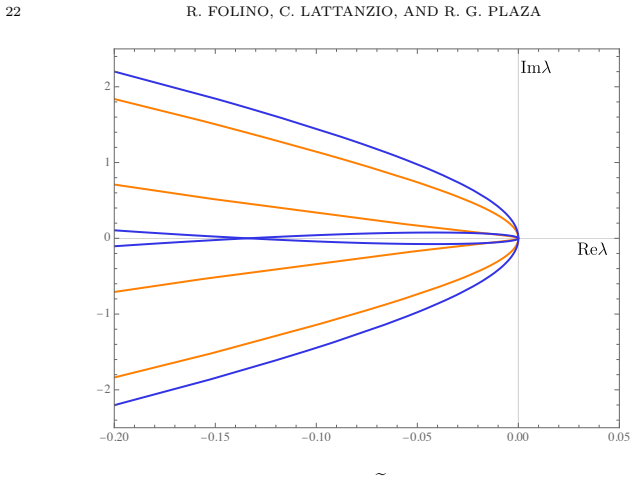
Under very general circumstances the system admits traveling wave solutions connecting two constant states and traveling with a certain speed that satisfy the classical Rankine-Hugoniot and Lax entropy conditions, and hence called viscous-dispersive shock profiles. These traveling wave solutions are unique up to translations and have arbitrary amplitude. The essential spectrum of the linearized operator around the profile (posed on an appropriate energy space) is stable, independently of the shock strength. With the aid of energy estimates, it is also proved that the point spectrum is also stable, provided that the shock amplitude is sufficiently small and a structural condition on the invic
What carries the argument
Viscous-dispersive shock profiles as traveling waves obeying Rankine-Hugoniot and Lax conditions, whose stability is read from the essential and point spectra of the linearized operator on an energy space.
If this is right
- Profiles exist with arbitrary amplitude whenever the Rankine-Hugoniot and Lax conditions can be satisfied.
- Essential-spectrum stability holds uniformly for shocks of any strength.
- Point-spectrum stability follows for all sufficiently small shocks that meet the structural condition.
- Linear stability in the chosen energy space is therefore obtained for those small profiles.
Where Pith is reading between the lines
- If the structural condition can be verified for concrete equations of state, then small-shock linear stability follows immediately from the given estimates.
- The spectral framework may extend to time-dependent or nonlinear orbital stability questions not addressed here.
- Analogous traveling-wave constructions and spectrum arguments could apply to other dispersive regularizations of hyperbolic conservation laws.
Load-bearing premise
A structural condition on the inviscid shock holds so that energy estimates can control the point spectrum for small-amplitude profiles.
What would settle it
A concrete computation of the linearized spectrum for a small-amplitude profile in a case where the structural condition on the inviscid shock fails, revealing an eigenvalue with positive real part.
Figures



read the original abstract
The system describing the dynamics of a compressible isentropic fluid exhibiting viscosity and internal capillarity in one space dimension and in Lagrangian coordinates, is considered. It is assumed that the viscosity and the capillarity coefficients are nonlinear smooth, positive functions of the specific volume, making the system the most general case possible. It is shown, under very general circumstances, that the system admits traveling wave solutions connecting two constant states and traveling with a certain speed that satisfy the classical Rankine-Hugoniot and Lax entropy conditions, and hence called viscous-dispersive shock profiles. These traveling wave solutions are unique up to translations and have arbitrary amplitude. The spectral stability of such viscous-dispersive profiles is also considered. It is shown that the essential spectrum of the linearized operator around the profile (posed on an appropriate energy space) is stable, independently of the shock strength. With the aid of energy estimates, it is also proved that the point spectrum is also stable, provided that the shock amplitude is sufficiently small and a structural condition on the inviscid shock is fulfilled.
Editorial analysis
A structured set of objections, weighed in public.
Referee Report
Summary. The manuscript proves existence of traveling-wave viscous-dispersive shock profiles for the one-dimensional isentropic compressible Korteweg-type system with nonlinear smooth positive viscosity and capillarity coefficients depending on specific volume. These profiles connect constant states, satisfy the classical Rankine-Hugoniot and Lax entropy conditions, are unique up to translation, and exist for arbitrary amplitudes. It further establishes spectral stability of the linearized operator on a suitable energy space: the essential spectrum is stable independently of shock strength, while the point spectrum is stable for sufficiently small amplitudes provided a structural condition on the underlying inviscid shock holds.
Significance. If the derivations hold, the work extends shock-profile theory to the most general nonlinear positive coefficients, separating essential-spectrum stability (which holds unconditionally) from point-spectrum stability (which requires small amplitude and the structural condition). This separation, together with the arbitrary-amplitude existence result under only RH and Lax conditions, strengthens the technical contribution to viscous-dispersive fluid dynamics.
major comments (1)
- [Abstract and stability analysis] Abstract and stability theorem: the structural condition on the inviscid shock required for point-spectrum stability of small-amplitude profiles is invoked but never formulated explicitly, nor is it shown to follow from the general assumptions of nonlinear positive viscosity and capillarity. Because the existence result holds for arbitrary amplitudes without this condition, the small-amplitude stability claim does not automatically inherit from the existence theorem; if the condition fails for some admissible shocks, the energy estimates do not close.
Simulated Author's Rebuttal
We thank the referee for the careful reading and constructive comments on our manuscript. We appreciate the positive evaluation of the significance of the existence and spectral stability results for viscous-dispersive shock profiles in the general nonlinear setting. We address the major comment below and will incorporate the suggested clarifications in the revised version.
read point-by-point responses
-
Referee: [Abstract and stability analysis] Abstract and stability theorem: the structural condition on the inviscid shock required for point-spectrum stability of small-amplitude profiles is invoked but never formulated explicitly, nor is it shown to follow from the general assumptions of nonlinear positive viscosity and capillarity. Because the existence result holds for arbitrary amplitudes without this condition, the small-amplitude stability claim does not automatically inherit from the existence theorem; if the condition fails for some admissible shocks, the energy estimates do not close.
Authors: We agree that the structural condition should be stated explicitly for clarity. In the revised manuscript we will add its precise formulation (the sign condition on the derivative of the pressure function evaluated along the inviscid Hugoniot locus that guarantees the linearized inviscid operator has no unstable eigenvalues) directly into the statement of the small-amplitude point-spectrum stability theorem and into the abstract. We will also insert a short remark in the stability section explaining that this condition is independent of the nonlinear viscosity and capillarity assumptions (which are used only for existence and for the essential-spectrum analysis) and is needed to close the energy estimates for the point spectrum when the shock amplitude is small. The existence theorem itself remains unchanged, as it relies solely on the Rankine-Hugoniot and Lax conditions. revision: yes
Circularity Check
No circularity; existence and stability rest on direct construction and energy estimates
full rationale
The derivation constructs viscous-dispersive shock profiles satisfying classical Rankine-Hugoniot and Lax conditions for arbitrary amplitude, then establishes essential spectrum stability independently of strength and point-spectrum stability for small amplitudes under an explicit additional structural assumption on the inviscid shock. These steps rely on direct ODE analysis and energy estimates rather than any self-definitional reduction, fitted-input prediction, or load-bearing self-citation. The structural condition is stated as a separate hypothesis and does not collapse the central claims to the paper's own inputs by construction.
Axiom & Free-Parameter Ledger
axioms (2)
- domain assumption Viscosity and capillarity coefficients are smooth positive functions of specific volume.
- standard math Traveling waves must satisfy Rankine-Hugoniot jump conditions and Lax entropy conditions.
Lean theorems connected to this paper
-
IndisputableMonolith/Foundation/RealityFromDistinction.leanreality_from_one_distinction unclear?
unclearRelation between the paper passage and the cited Recognition theorem.
It is shown, under very general circumstances, that the system admits traveling wave solutions connecting two constant states ... satisfy the classical Rankine–Hugoniot and Lax entropy conditions ... unique up to translations and have arbitrary amplitude.
-
IndisputableMonolith/Cost/FunctionalEquation.leanwashburn_uniqueness_aczel unclear?
unclearRelation between the paper passage and the cited Recognition theorem.
the essential spectrum of the linearized operator around the profile ... is stable, independently of the shock strength ... point spectrum is also stable, provided that the shock amplitude is sufficiently small and a structural condition on the inviscid shock is fulfilled.
What do these tags mean?
- matches
- The paper's claim is directly supported by a theorem in the formal canon.
- supports
- The theorem supports part of the paper's argument, but the paper may add assumptions or extra steps.
- extends
- The paper goes beyond the formal theorem; the theorem is a base layer rather than the whole result.
- uses
- The paper appears to rely on the theorem as machinery.
- contradicts
- The paper's claim conflicts with a theorem or certificate in the canon.
- unclear
- Pith found a possible connection, but the passage is too broad, indirect, or ambiguous to say the theorem truly supports the claim.
Reference graph
Works this paper leans on
- [1]
- [2]
-
[3]
Z. Chen, X. Chai, B. Dong, and H. Zhao, Global classical solutions to the one-dimensional compressible fluid models of Korteweg type with large initial data , J. Differ. Equ. 259 (2015), no. 8, pp. 4376–4411
work page 2015
-
[4]
Z. Chen, L. He, and H. Zhao , Nonlinear stability of traveling wave solutions for the com- pressible fluid models of Korteweg type , J. Math. Anal. Appl. 422 (2015), no. 2, pp. 1213– 1234
work page 2015
-
[5]
Z. Chen, Y. Li, and M. Sheng , Asymptotic stability of viscous shock profiles for the 1D compressible Navier-Stokes-Korteweg system with boundary effect , Dyn. Partial Differ. Equ. 16 (2019), no. 3, pp. 225–251
work page 2019
-
[6]
Z. Chen and H. Zhao , Existence and nonlinear stability of stationary solutions to the full compressible Navier-Stokes-Korteweg system , J. Math. Pures Appl. (9) 101 (2014), no. 3, pp. 330–371
work page 2014
-
[7]
C. M. Dafermos , Hyperbolic conservation laws in continuum physics , vol. 325 of Grundlehren der Mathematischen Wissenschaften, Springer-Verlag, Berlin, fourth ed., 2016
work page 2016
-
[8]
R. Danchin and B. Desjardins , Existence of solutions for compressible fluid models of Korteweg type, Ann. Inst. H. Poincar´ e Anal. Non Lin´ eaire18 (2001), no. 1, pp. 97–133
work page 2001
-
[9]
J. E. Dunn and J. Serrin , On the thermomechanics of interstitial working , Arch. Ration. Mech. Anal. 88 (1985), no. 2, pp. 95–133
work page 1985
- [10]
- [11]
-
[12]
, Spectral stability of weak dispersive shock profiles for quantum hydrodynamics with nonlinear viscosity, J. Differ. Equ. 359 (2023), pp. 330–364
work page 2023
-
[13]
H. Freist ¨uhler and M. Kotschote , Phase-field and Korteweg-type models for the time- dependent flow of compressible two-phase fluids, Arch. Ration. Mech. Anal. 224 (2017), no. 1, pp. 1–20
work page 2017
-
[14]
, Phase-field descriptions of two-phase compressible fluid flow: interstitial working and a reduction to Korteweg theory , Quart. Appl. Math. 77 (2019), no. 3, pp. 489–496
work page 2019
-
[15]
J. Gao, Z. Lyu, and Z.-a. Yao , Lower bound of decay rate for higher-order derivatives of solution to the compressible fluid models of Korteweg type, Z. Angew. Math. Phys. 71 (2020), no. 4, p. 108
work page 2020
-
[16]
R. A. Gardner and K. Zumbrun , The gap lemma and geometric criteria for instability of viscous shock profiles, Comm. Pure Appl. Math. 51 (1998), no. 7, pp. 797–855
work page 1998
-
[17]
J. Giesselmann, C. Lattanzio, and A. E. Tzavaras , Relative energy for the Korteweg theory and related Hamiltonian flows in gas dynamics, Arch. Ration. Mech. Anal.223 (2017), no. 3, pp. 1427–1484
work page 2017
-
[18]
Goodman, Nonlinear asymptotic stability of viscous shock profiles for conservation laws , Arch
J. Goodman, Nonlinear asymptotic stability of viscous shock profiles for conservation laws , Arch. Ration. Mech. Anal. 95 (1986), no. 4, pp. 325–344
work page 1986
-
[19]
Shearer, ed., SIAM, Philadelphia, PA, 1991, pp
, Remarks on the stability of viscous shock waves , in Viscous profiles and numerical methods for shock waves (Raleigh, NC, 1990), M. Shearer, ed., SIAM, Philadelphia, PA, 1991, pp. 66–72
work page 1990
-
[20]
R. Hagan and M. Slemrod, The viscosity-capillarity criterion for shocks and phase transi- tions, Arch. Ration. Mech. Anal. 83 (1983), no. 4, pp. 333–361
work page 1983
- [21]
-
[22]
Haspot, Existence of strong solutions for nonisothermal Korteweg system , Ann
B. Haspot, Existence of strong solutions for nonisothermal Korteweg system , Ann. Math. Blaise Pascal 16 (2009), no. 2, pp. 431–481
work page 2009
-
[23]
, Existence of global weak solution for compressible fluid models of Korteweg type , J. Math. Fluid Mech. 13 (2011), no. 2, pp. 223–249
work page 2011
-
[24]
H. Hattori and D. N. Li , Solutions for two-dimensional system for materials of Korteweg type, SIAM J. Math. Anal. 25 (1994), no. 1, pp. 85–98
work page 1994
-
[25]
, The existence of global solutions to a fluid dynamic model for materials for Korteweg type, J. Partial Differ. Equ. 9 (1996), no. 4, pp. 323–342
work page 1996
-
[26]
, Global solutions of a high-dimensional system for Korteweg materials , J. Math. Anal. Appl. 198 (1996), no. 1, pp. 84–97. EXISTENCE AND STABILITY OF VISCOUS-DISPERSIVE SHOCK PROFILES 33
work page 1996
-
[27]
M. A. Hoefer, Shock waves in dispersive Eulerian fluids , J. Nonlinear Sci. 24 (2014), no. 3, pp. 525–577
work page 2014
-
[28]
M. A. Hoefer and M. J. Ablowitz , Interactions of dispersive shock waves , Phys. D 236 (2007), no. 1, pp. 44–64
work page 2007
-
[29]
P. Howard and K. Zumbrun, Pointwise estimates and stability for dispersive-diffusive shock waves, Arch. Ration. Mech. Anal. 155 (2000), no. 2, pp. 85–169
work page 2000
-
[30]
J. Humpherys, Spectral energy methods and the stability of shock waves, PhD thesis, Indiana University, 2002
work page 2002
-
[31]
, On the shock wave spectrum for isentropic gas dynamics with capillarity , J. Differ. Equ. 246 (2009), no. 7, pp. 2938–2957
work page 2009
-
[32]
C. K. R. T. Jones , Geometric singular perturbation theory , in Dynamical systems (Monte- catini Terme, 1994), R. Johnson, ed., vol. 1609 of Lecture Notes in Math., Springer, Berlin, 1995, pp. 44–118
work page 1994
-
[33]
T. Kapitula and K. Promislow , Spectral and dynamical stability of nonlinear waves , vol. 185 of Applied Mathematical Sciences, Springer-Verlag, New York, 2013
work page 2013
-
[34]
T. Kato , Perturbation Theory for Linear Operators , Classics in Mathematics, Springer- Verlag, New York, Second ed., 1980
work page 1980
-
[35]
M. Khodja, Nonlinear stability of oscillatory traveling waves for some systems of hyperbolic conservation laws, PhD thesis, University of Michigan, 1989
work page 1989
-
[36]
D. J. Korteweg, Sur la forme que prennent les ´ equations du mouvement des fluides si l’on tient compte des forces capillaires caus´ ees par des variations de densit´ e consid´ erables mais continues et sur la th´ eorie de la capillarit´ e dans l’hypoth` ese d’une variation continue de la densit´ e, Arch. N´ eerl. Sci. Exactes Nat. Ser. II6 (1901), pp. 1–24
work page 1901
-
[37]
Kotschote, Strong solutions for a compressible fluid model of Korteweg type , Ann
M. Kotschote, Strong solutions for a compressible fluid model of Korteweg type , Ann. Inst. H. Poincar´ e Anal. Non Lin´ eaire25 (2008), no. 4, pp. 679–696
work page 2008
-
[38]
, Strong well-posedness for a Korteweg-type model for the dynamics of a compressible non-isothermal fluid, J. Math. Fluid Mech. 12 (2010), no. 4, pp. 473–484
work page 2010
-
[39]
C. Lattanzio and D. Zhelyazov, Traveling waves for quantum hydrodynamics with nonlin- ear viscosity, J. Math. Anal. Appl. 493 (2021), no. 1, pp. 124503, 17
work page 2021
-
[40]
Lazard, Quantifier elimination: optimal solution for two classical examples , J
D. Lazard, Quantifier elimination: optimal solution for two classical examples , J. Symbolic Comput. 5 (1988), no. 1-2, pp. 261–266
work page 1988
- [41]
-
[42]
R. L. Pego, Remarks on the stability of shock profiles for conservation laws with dissipation , Trans. Amer. Math. Soc. 291 (1985), no. 1, pp. 353–361
work page 1985
-
[43]
R. G. Plaza and J. M. Valdovinos , Dissipative structure of one-dimensional isothermal compressible fluids of Korteweg type , J. Math. Anal. Appl. 514 (2022), no. 2, p. Paper No. 126336
work page 2022
-
[44]
E. L. Rees , Graphical discussion of the roots of a quartic equation , Amer. Math. Monthly 29 (1922), no. 2, pp. 51–55
work page 1922
-
[45]
Sandstede , Stability of travelling waves , in Handbook of dynamical systems, Vol
B. Sandstede , Stability of travelling waves , in Handbook of dynamical systems, Vol. 2, B. Fiedler, ed., North-Holland, Amsterdam, 2002, pp. 983–1055
work page 2002
-
[46]
Slemrod, Admissibility criteria for propagating phase boundaries in a van der Waals fluid, Arch
M. Slemrod, Admissibility criteria for propagating phase boundaries in a van der Waals fluid, Arch. Ration. Mech. Anal. 81 (1983), no. 4, pp. 301–315
work page 1983
-
[47]
, Dynamic phase transitions in a van der Waals fluid , J. Differ. Equ. 52 (1984), no. 1, pp. 1–23
work page 1984
-
[48]
J. A. Smoller and R. Shapiro , Dispersion and shock-wave structure , J. Differ. Equ. 44 (1982), no. 2, pp. 281–305
work page 1982
- [49]
-
[50]
Teschl , Ordinary differential equations and dynamical systems , vol
G. Teschl , Ordinary differential equations and dynamical systems , vol. 140 of Graduate Studies in Mathematics, American Mathematical Society, Providence, RI, 2012
work page 2012
-
[51]
J. D. van der Waals , Thermodynamische Theorie der Kapillarit¨ at unter Voraussetzung stetiger Dichte¨ anderung, Z. Phys. Chem. 13 (1894), no. 1, pp. 657–725
-
[52]
Wang, A simple proof of Descartes’s rule of signs , Am
X. Wang, A simple proof of Descartes’s rule of signs , Am. Math. Mon. 111 (2004), no. 6, pp. 525–526
work page 2004
-
[53]
Y. Wang and Z. Tan , Optimal decay rates for the compressible fluid models of Korteweg type, J. Math. Anal. Appl. 379 (2011), no. 1, pp. 256–271. 34 R. FOLINO, C. LATTANZIO, AND R. G. PLAZA
work page 2011
-
[54]
H. Weyl, ¨Uber gew¨ ohnliche Differentialgleichungen mit Singularit¨ aten und die zugeh¨ origen Entwicklungen willk¨ urlicher Funktionen, Math. Ann. 68 (1910), no. 2, pp. 220–269
work page 1910
- [55]
-
[56]
K. Zumbrun , Dynamical stability of phase transitions in the p-system with viscosity- capillarity, SIAM J. Appl. Math. 60 (2000), no. 6, pp. 1913–1924
work page 2000
-
[57]
K. Zumbrun and P. Howard , Pointwise semigroup methods and stability of viscous shock waves, Indiana Univ. Math. J. 47 (1998), no. 3, pp. 741–871. (R. Folino) Departamento de Matem´aticas y Mec ´anica, Instituto de Investigaciones en Matem´aticas Aplicadas y en Sistemas, Universidad Nacional Aut ´onoma de M ´exico, Circuito Escolar s/n, Ciudad Universitar...
work page 1998
discussion (0)
Sign in with ORCID, Apple, or X to comment. Anyone can read and Pith papers without signing in.