REVIEW 3 major objections 6 minor 1 cited by
A binary origin of ultra-long period radio pulsars
T0 review · 3 major / 6 minor · reviewed 2026-08-06 · deepseek-v4-flash
Pith's one-line read Wide binaries can make ultra-long-period pulsars
desk verdict Plausible binary channel for ULPPs, but the abstract overstates the spin range and the birthrate rides on an unvaried torque coefficient. read the letter →
The pith
A machine-rendered reading of the paper's core claim, the machinery that carries it, and where it could break.
The reading
What carries the argument
The machinery is the wind-fed accretion spin-evolution model for a neutron star embedded in a massive star's wind, organized by three radii—the magnetospheric radius $R_m$, the light-cylinder radius $R_{lc}$, and the corotation radius $R_{co}$. The neutron star passes through four phases: ejector, propeller, Bondi-Hoyle accretion, and subsonic settling accretion; the propeller torque and the settling-accretion torque are what drive the spin period toward thousands of seconds. The companion's wind mass-loss rate and radius are computed from stellar evolution, and the binary population is weighted by population-synthesis initial conditions; systems with initial orbital periods shorter than about $10^3$ days are discarded because Roche-lobe overflow spins the neutron star back up.
What would settle it
Measure the pulse-period derivative of a long-period X-ray pulsar in a wind-fed high-mass binary with orbital period above 1000 days: if the observed spin-down torque is systematically weaker than the propeller and settling-accretion formulas require, then wide binaries cannot slow neutron stars to $P_s>1000$ s on the companion's lifetime, and the channel fails. A second check: finding an ultra-long-period pulsar still bound to a massive companion would contradict the predicted greater-than-99 percent disruption fraction.
Extended reading notes
Core claim
The paper's central claim is that a neutron star formed in a massive binary can be decelerated by wind-fed accretion from its companion star—through propeller and settling-accretion torques—to spin periods exceeding $10^3$ s, provided the orbital period is longer than roughly $10^3$ days so that the companion's wind is the only mass-transfer agent. The spin-period distribution at the moment of the second supernova ranges from below $0.1$ s to above $10^8$ s, with roughly 20 percent of simulated systems exceeding 1000 s. The companion's supernova then disrupts the binary in over 99 percent of cases, leaving an isolated slow neutron star; the estimated Milky Way birthrate of such stars with $P_s>1000$ s is $1.4\times10^{-6}\,\mathrm{yr}^{-1}$ at solar metallicity and about $1.9\times10^{-6}\,\mathrm{yr}^{-1}$ at sub-solar metallicity, with the result insensitive to the uncertain torque coefficients within the ranges tested. This is offered as a binary-evolution formation channel for the observed population of ultra-long-period radio transients.
Load-bearing premise
The load-bearing premise is that the spin-down torques acting on a neutron star during propeller and settling accretion are as strong as the paper's chosen formulas and coefficients say they are, and stay that way through the whole wide-binary wind-fed phase; if they are weaker, the long spin periods and the $10^{-6}\,\mathrm{yr}^{-1}$ birthrate would not be reached.
Editorial extensions
If this is right
- If this channel operates, isolated ultra-long-period pulsars should exist in or near supernova remnants left by their former companions, because the second supernova occurs in the systems that produced the longest spin periods.
- The predicted birthrate of about $10^{-6}\,\mathrm{yr}^{-1}$ is consistent with a rare population, matching the small observed sample of ultra-long-period radio transients.
- Binary-origin ultra-long-period pulsars should be isolated rather than still bound to a companion, since the second supernova disrupts more than 99 percent of the systems.
- Long-period X-ray pulsars in wind-fed high-mass binaries are the direct observable precursors of this channel, so their spin-down behavior is a testable intermediate stage.
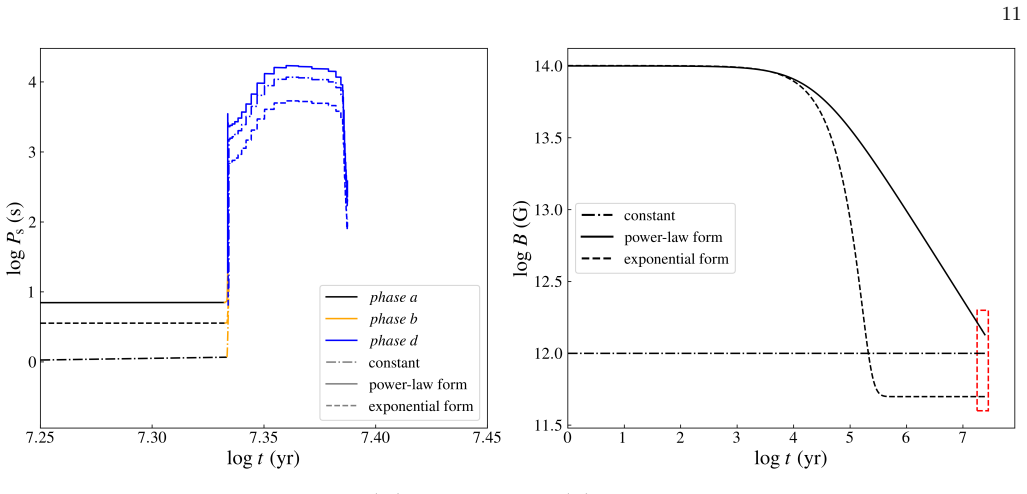
- After magnetic field decay, binary-origin ultra-long-period pulsars should have ordinary neutron-star field strengths near $10^{12}$–$10^{13}$ G rather than magnetar-strength fields at late times.
Reading between the lines
- Editorial extension: because the same wind-fed spin-down model tends to align the spin and magnetic axes, binary-origin ultra-long-period pulsars might show single-pole pulse profiles; a future object with a clear two-pole interpulse would favor a different formation mechanism.
- Editorial extension: the predicted birthrate implies that deeper all-sky radio surveys for isolated pulsars with periods of $10^2$–$10^4$ s should eventually find more such objects, and the number found would directly test the $10^{-6}\,\mathrm{yr}^{-1}$ rate.
- Editorial extension: the channel may also bear on other extremely slow rotating neutron stars, such as the 6.7-hour central compact object in RCW 103, if very wide binaries with weak winds can spin neutron stars down over longer timescales.
- Editorial extension: because the first-born neutron star received its own natal kick at the first supernova, it should be moving relative to the remnant of the second supernova; measuring proper-motion offsets between an ultra-long-period pulsar and its associated remnant could distinguish this channel from magnetar or fallback-disk models.
Editorial analysis
A structured set of objections, weighed in public.
Referee Report
Summary. This paper proposes that ultra-long period pulsars (ULPPs) can form from neutron stars in wide high-mass X-ray binaries: the NS spins down via wind-fed accretion (propeller and settling accretion phases) during the companion's lifetime, and the subsequent supernova disrupts the binary, leaving an isolated slowly rotating NS. The authors combine a semi-empirical torque model (following Lipunov 1992; Shakura et al. 2012) with binary population synthesis (BPS) and MESA stellar evolution to compute spin-period distributions and estimate a Galactic birthrate of about 1.4e-6 yr^-1 for Ps > 1000 s, and about 1.9e-6 yr^-1 at Z = 0.002.
Significance. If the result holds, the paper would provide a quantitative formation channel for ULPPs and long-period radio transients, with a testable prediction (an ULPP associated with a young neutron star in the same supernova remnant). The work is largely reproducible: it uses public codes (MESA, BPS), deposits data on Zenodo, and states model parameters clearly. The central scenario is physically plausible, but the estimated birthrate and period distributions rest on semi-empirical torque coefficients whose uncertainties are only partially explored; the abstract also contains an internal inconsistency with the body of the paper.
major comments (3)
- [Abstract, Section 2.2, Section 3.1] The abstract states that the calculated spin periods range from ≲0.1 s to ≳10^8 s, but Section 2.2 fixes P0 = 0.2 s for all calculations and Section 3.1 reports that "the range of Ps spans from a few ten to more than 10^4 seconds". With P0 = 0.2 s and only spin-down torques, a final period below 0.1 s is impossible; this is a direct internal contradiction. Please reconcile the abstract with the body, or clarify which quantity the abstract refers to.
- [Section 3.2, Eqs. (11)-(13)] The settling-accretion torque Nd contains K1 in both A and B, so the equilibrium spin period is independent of K1, but the timescale to reach that equilibrium scales inversely with K1 (the spin-down term is ∝ K1 Md^3/11 / Ps). The sensitivity study in Section 3.2 randomizes f and Lcrit/L0 only, leaving K1 and ζ fixed at K1 = 40 and ζ = 0.25. Because the companion lifetime is finite, a smaller K1 would slow the spin-down and reduce the fraction of systems reaching Ps > 1000 s, directly lowering the quoted birthrate. Please test the sensitivity of the birthrate to K1 (e.g., K1 = 10, 20, 40) and report the resulting range.
- [Section 3.2] The text says "In our calculations approximately 20% NSs have reached Ps > 1000 s" immediately after describing phase-d systems, but then quotes a total NS binary formation rate of 8e-3 yr^-1 and a ULPP birthrate of 1.4e-6 yr^-1. If 20% of all NSs from binaries were ULPPs, the birthrate would be ~1.6e-3 yr^-1, three orders of magnitude larger. Please specify the exact parent population for the 20% fraction (e.g., systems with Porb > 10^3 d and M2 = 10-25 Msun that avoid Roche-lobe overflow) and show step by step how this fraction enters the birthrate calculation, so that the factor ~0.00018 between the total NS rate and the ULPP rate is transparent.
minor comments (6)
- [Abstract] Typo: "One of the them" should be "One of them."
- [Section 2.2] Typo: "theejector phase" should be "the ejector phase."
- [Section 3.2] Typo: "phase dhave" should be "phase d have."
- [Section 3.2 vs Section 4] The total NS binary formation rate is quoted as 8 × 10^-3 yr^-1 in Section 3.2 but 7.8 × 10^-3 yr^-1 in Section 4; please use a consistent number.
- [Section 3.2, Eq. (16)] The replacement of the semi-major axis a by r = a sqrt(1 - e^2) as the "average distance" for estimating the mean accretion rate is not formally justified; for a Keplerian orbit, the time-averaged capture rate depends on 1/r^2 rather than 1/r, and the relevant eccentricity factors differ. Please provide a derivation or a justification that this approximation does not bias the spin-period distributions.
- [Figure 6] The left panel is described as showing spin evolution for log t (yr) > 7.25, "before this time the NS remains in a slow spin-down phase (phase a)". For a 10 Msun companion the total lifetime is about 20 Myr, so the panel appears to start near the end of the HMXB phase; please clarify the time baseline and whether the pre-HMXB spin evolution is omitted.
Circularity Check
No significant circularity: the ULPP birthrate is a forward binary population synthesis calculation using externally adopted torques; self-cited parameter values are randomized and shown to be non-load-bearing.
full rationale
The paper's central claim — NSs in wide wind-fed HMXBs spin down to Ps > 1000 s and become isolated ULPPs after the companion's supernova — is computed forward from a stated torque model adopted from external literature (Section 2.2: 'as an illustration, we largely follow work described in Lipunov (1992) and Shakura et al. (2012)') applied to a BPS/MESA Galactic binary population, with no fitting to ULPP data. The observed ULPPs enter only post hoc in Figure 4 as comparison points with upper-limit dipole fields, and the paper explicitly declines to calibrate on them: 'the small observational sample inhibits credible constraint on the birthrate of ULPPs.' No equation defines the target quantities (final spin-period distribution, ~20% fraction with Ps > 1000 s, birthrate 1.4 x 10^-6 yr^-1, >99% second-supernova disruption fraction) in terms of the observed ULPPs; these are integrated outputs of Eqs. (4)-(14) plus the BPS kick statistics. Self-citations do exist: f = 0.1 is taken from the authors' Mao & Li (2024), and ECSN kick/remnant inputs come from Deng et al. (2024) and Shao & Li (2018). However, the f value is explicitly varied over 0.05-0.2 in Section 3.2 with the birthrate staying ~10^-6 yr^-1 ('the estimated birthrate of ULPPs remains largely unaffected, staying on the order of ~10^-6 yr^-1'), so the self-calibrated value is not load-bearing; the kick and ECSN mass-range inputs are standard external-distribution choices, not uniqueness claims. The one substantive caveat — K1 = 40 is left fixed in the sensitivity study although the time to reach the long-period equilibrium scales as 1/(K1 Mdot^{3/11}) — is an acknowledged modeling uncertainty ('considerable uncertainties in the torque acting on the NS in different accretion phases'), i.e., a correctness risk rather than a circular reduction. Verdict: no circular step identified; only a minor, non-load-bearing self-citation burden.
Assumptions & free parameters
free parameters (8)
- f (torque averaging factor) =
0.1
- zeta (Bondi torque coefficient) =
0.25
- K1 (settling accretion coefficient) =
40
- Initial NS spin period P0 =
0.2 s
- Log-normal magnetic field mean/std =
12.65 / 0.55
- Wind velocity parameters alpha, beta =
1, 0.8
- Supernova kick velocity dispersion =
265 km/s (CCSNe), 30 km/s (ECSNe)
- Binary initial distributions =
q uniform 0-1, log a uniform 3 to 1e4 R_sun
assumptions (4)
- domain assumption The wind-fed accretion torque model (Lipunov 1992; Shakura et al. 2012) describes NS spin evolution over the full HMXB phase.
- domain assumption The companion's stellar wind is spherically symmetric and follows the Castor et al. (1975) velocity law.
- ad hoc to paper For eccentric binaries, the average distance r = a sqrt(1 - e^2) can be used to compute the mean accretion rate.
- domain assumption The NS magnetic field evolution follows one of three prescribed forms and does not significantly affect the final spin period.
Cite this review
Pith. "Pith review of A binary origin of ultra-long period radio pulsars." pith.science (2026). https://pith.science/paper/2UFVIFVT
@misc{pith2026250700946,
  author       = {Pith},
  title        = {Pith review of: A binary origin of ultra-long period radio pulsars},
  year         = {2026},
  howpublished = {\url{https://pith.science/paper/2UFVIFVT}},
  note         = {Machine review of arXiv:2507.00946}
}
abstract
We propose a possible binary evolution model for the formation of ultra-long period pulsars (ULPPs). The model involves two key stages: first, a neutron star (NS) in wide binaries undergoes an effective spin-down phase through wind-fed accretion from its massive stellar companion; second, the supernova explosion of the companion leads to the disruption of the binary system, and produces two isolated compact stars. One of the them is the first-born, slowly rotating NSs, and our binary and spin evolution calculations show that the spin periods range from $\lesssim 0.1$ s to $\gtrsim 10^8$ s. This offers a possible formation channel for some of the long-period radio transients. We estimate that the formation rate of such systems in the Milky Way is approximately about $10^{-6}$ $\rm yr^{-1}$.
Figures


Figures from the paper (3 more)


Forward citations
Cited by 1 Pith paper
-
Accretion from a Shock-Inflated Companion: Spinning Down Neutron Stars to Hour-Long Periods
Neutron stars kicked through a supernova-inflated companion envelope can form accretion disks and be spun down to hour-long periods by a short propeller phase.
Reference graph
Works this paper leans on
-
[1]
, " * write output.state after.block = add.period write newline
ENTRY address archivePrefix author booktitle chapter doi edition editor eprint howpublished institution journal key month number organization pages publisher school series title misctitle type volume year version url label extra.label sort.label short.list INTEGERS output.state before.all mid.sentence after.sentence after.block FUNCTION init.state.consts ...
-
[2]
write newline
" write newline "" before.all 'output.state := FUNCTION format.url url empty "" new.block "" url * "" * if FUNCTION format.eprint eprint empty "" archivePrefix empty "" archivePrefix "arXiv" = new.block " " eprint * " " * new.block " " eprint * " " * if if if FUNCTION format.doi doi empty "" " " doi * " " * if FUNCTION format.pid doi empty eprint empty ur...
-
[3]
thebibliography [1] 20pt to REFERENCES 6pt =0pt -12pt 10pt plus 3pt =0pt =0pt =1pt plus 1pt =0pt =0pt -12pt =13pt plus 1pt =20pt =13pt plus 1pt \@M =10000 =-1.0em =0pt =0pt 0pt =0pt =1.0em @enumiv\@empty 10000 10000 `\.\@m \@noitemerr \@latex@warning Empty `thebibliography' environment \@ifnextchar \@reference \@latexerr Missing key on reference command E...
arXiv 2021
- [4]
-
[5]
1944, , 104, 273, 10.1093/mnras/104.5.273
Bondi , H., & Hoyle , F. 1944, , 104, 273, 10.1093/mnras/104.5.273
-
[6]
Burrows , A., Wang , T., Vartanyan , D., & Coleman , M. S. B. 2024, , 963, 63, 10.3847/1538-4357/ad2353
-
[7]
Caleb , M., Lenc , E., Kaplan , D. L., et al. 2024, Nature Astronomy, 8, 1159, 10.1038/s41550-024-02277-w
-
[8]
Castor , J. I., Abbott , D. C., & Klein , R. I. 1975, , 195, 157, 10.1086/153315
doi:10.1086/153315 1975
Show all 72 references
-
[9]
1993, , 402, 264, 10.1086/172129
Chen , K., & Ruderman , M. 1993, , 402, 264, 10.1086/172129
1993 doi
-
[10]
Chomiuk , L., & Povich , M. S. 2011, , 142, 197, 10.1088/0004-6256/142/6/197
2011 doi
-
[11]
2000, , 529, L29, 10.1086/312448
Colpi , M., Geppert , U., & Page , D. 2000, , 529, L29, 10.1086/312448
2000 doi
-
[12]
1999, , 511, 351, 10.1086/306652
Contopoulos , I., Kazanas , D., & Fendt , C. 1999, , 511, 351, 10.1086/306652
1999 doi
-
[13]
2006, The Astronomer's Telegram, 797, 1
Corbet , R., Barbier , L., Barthelmy , S., et al. 2006, The Astronomer's Telegram, 797, 1
2006
-
[14]
2001, , 557, 958, 10.1086/321658
Cumming , A., Zweibel , E., & Bildsten , L. 2001, , 557, 958, 10.1086/321658
2001 doi
-
[15]
2012, , 422, 2878, 10.1111/j.1365-2966.2012.20612.x
Dall'Osso , S., Granot , J., & Piran , T. 2012, , 422, 2878, 10.1111/j.1365-2966.2012.20612.x
2012
-
[17]
A., Mereghetti , S., Tiengo , A., & Bignami , G
De Luca , A., Caraveo , P. A., Mereghetti , S., Tiengo , A., & Bignami , G. F. 2006, Science, 313, 814, 10.1126/science.1129185
2006 doi
-
[18]
2024, , 963, 80, 10.3847/1538-4357/ad2357
Deng , Z.-L., Li , X.-D., Shao , Y., & Xu , K. 2024, , 963, 80, 10.3847/1538-4357/ad2357
2024 doi
- [19]
-
[20]
Eggleton , P. P. 1983, , 268, 368, 10.1086/160960
1983 doi
-
[21]
Fabian , A. C. 1975, , 173, 161, 10.1093/mnras/173.1.161
1975 doi
-
[22]
Faucher-Gigu \`e re , C.-A., & Kaspi , V. M. 2006, , 643, 332, 10.1086/501516
2006 doi
-
[23]
P., Belloni , T., & Cassinelli , J
Finley , J. P., Belloni , T., & Cassinelli , J. P. 1992, , 262, L25
1992
-
[24]
2023, , 671, A149, 10.1051/0004-6361/202245236
Fortin , F., Garc \' a , F., Simaz Bunzel , A., & Chaty , S. 2023, , 671, A149, 10.1051/0004-6361/202245236
2023 doi
-
[25]
Goldreich , P., & Julian , W. H. 1969, , 157, 869, 10.1086/150119
1969 doi
-
[26]
E., & Spruit , H
Heger , A., Woosley , S. E., & Spruit , H. C. 2005, , 626, 350, 10.1086/429868
2005 doi
-
[27]
R., Lyne , A
Hobbs , G., Lorimer , D. R., Lyne , A. G., & Kramer , M. 2005, , 360, 974, 10.1111/j.1365-2966.2005.09087.x
2005
-
[28]
R., Pols , O
Hurley , J. R., Pols , O. R., & Tout , C. A. 2000, , 315, 543, 10.1046/j.1365-8711.2000.03426.x
2000
-
[29]
R., Tout , C
Hurley , J. R., Tout , C. A., & Pols , O. R. 2002, , 329, 897, 10.1046/j.1365-8711.2002.05038.x
2002
-
[30]
2022, , 601, 526, 10.1038/s41586-021-04272-x
Hurley-Walker , N., Zhang , X., Bahramian , A., et al. 2022, , 601, 526, 10.1038/s41586-021-04272-x
2022 doi
-
[31]
J., et al
Hurley-Walker , N., Rea , N., McSweeney , S. J., et al. 2023, , 619, 487, 10.1038/s41586-023-06202-5
2023 doi
-
[32]
F., & Sunyaev , R
Illarionov , A. F., & Sunyaev , R. A. 1975, , 39, 185
1975
-
[33]
2012, , 749, 2, 10.1088/0004-637X/749/1/2
Kalapotharakos , C., Kazanas , D., Harding , A., & Contopoulos , I. 2012, , 749, 2, 10.1088/0004-637X/749/1/2
2012 doi
-
[34]
Katz , J. I. 2022, , 367, 108, 10.1007/s10509-022-04146-2
2022 doi
-
[35]
F., & Kramer , M
Keane , E. F., & Kramer , M. 2008, , 391, 2009, 10.1111/j.1365-2966.2008.14045.x
2008
- [36]
-
[37]
A., & Gilmore , G
Kroupa , P., Tout , C. A., & Gilmore , G. 1993, , 262, 545, 10.1093/mnras/262.3.545
1993 doi
-
[38]
K., Pethick , C
Lamb , F. K., Pethick , C. J., & Pines , D. 1973, , 184, 271, 10.1086/152325
1973 doi
-
[39]
2024, arXiv e-prints, arXiv:2411.15739, 10.48550/arXiv.2411.15739
Li , D., Yuan , M., Wu , L., et al. 2024, arXiv e-prints, arXiv:2411.15739, 10.48550/arXiv.2411.15739
2024 doi
- [40]
-
[41]
Lipunov , V. M. 1992, Astrophysics of Neutron Stars (Berlin, Springer-Verlag)
1992
-
[42]
2022, Research Notes of the American Astronomical Society, 6, 27, 10.3847/2515-5172/ac52f1
Loeb , A., & Maoz , D. 2022, Research Notes of the American Astronomical Society, 6, 27, 10.3847/2515-5172/ac52f1
2022 doi
-
[43]
R., Faulkner , A
Lorimer , D. R., Faulkner , A. J., Lyne , A. G., et al. 2006, , 372, 777, 10.1111/j.1365-2966.2006.10887.x
2006
-
[44]
2019, , 488, 4338, 10.1093/mnras/stz2009
Ma , L., & Fuller , J. 2019, , 488, 4338, 10.1093/mnras/stz2009
2019 doi
-
[45]
2001, , 373, 555, 10.1051/0004-6361:20010596
Maeder , A., & Meynet , G. 2001, , 373, 555, 10.1051/0004-6361:20010596
2001 doi
-
[46]
2024, , 533, 386, 10.1093/mnras/stae1802
Mao , Y.-H., & Li , X.-D. 2024, , 533, 386, 10.1093/mnras/stae1802
2024 doi
-
[47]
2025, Science Advances, 11, eadp6351, 10.1126/sciadv.adp6351
Men , Y., McSweeney , S., Hurley-Walker , N., Barr , E., & Stappers , B. 2025, Science Advances, 11, eadp6351, 10.1126/sciadv.adp6351
2025 doi
-
[48]
R., de Koter , A., Vink , J
Mokiem , M. R., de Koter , A., Vink , J. S., et al. 2007, , 473, 603, 10.1051/0004-6361:20077545
2007 doi
-
[49]
2023, , 677, A134, 10.1051/0004-6361/202245728
Neumann , M., Avakyan , A., Doroshenko , V., & Santangelo , A. 2023, , 677, A134, 10.1051/0004-6361/202245728
2023 doi
-
[50]
Parfrey , K., Spitkovsky , A., & Beloborodov , A. M. 2016, , 822, 33, 10.3847/0004-637X/822/1/33
2016 doi
-
[51]
2011, , 192, 3, 10.1088/0067-0049/192/1/3
Paxton , B., Bildsten , L., Dotter , A., et al. 2011, , 192, 3, 10.1088/0067-0049/192/1/3
2011 doi
-
[52]
2013, , 208, 4, 10.1088/0067-0049/208/1/4
Paxton , B., Cantiello , M., Arras , P., et al. 2013, , 208, 4, 10.1088/0067-0049/208/1/4
2013 doi
-
[53]
2015, , 220, 15, 10.1088/0067-0049/220/1/15
Paxton , B., Marchant , P., Schwab , J., et al. 2015, , 220, 15, 10.1088/0067-0049/220/1/15
2015 doi
-
[54]
2019, , 243, 10, 10.3847/1538-4365/ab2241
Paxton , B., Smolec , R., Schwab , J., et al. 2019, , 243, 10, 10.3847/1538-4365/ab2241
2019 doi
-
[55]
A., Spitkovsky , A., & Cerutti , B
Philippov , A. A., Spitkovsky , A., & Cerutti , B. 2015, , 801, L19, 10.1088/2041-8205/801/1/L19
2015 doi
-
[56]
Podsiadlowski , P., Langer , N., Poelarends , A. J. T., et al. 2004, , 612, 1044, 10.1086/421713
2004 doi
- [57]
-
[58]
B., & Turolla , R
Popov , S. B., & Turolla , R. 2012, , 421, L127, 10.1111/j.1745-3933.2012.01220.x
2012
-
[59]
I., Kochetkova , A
Postnov , K., Shakura , N. I., Kochetkova , A. Y., & Hjalmarsdotter , L. 2011, Proceedings of The Extreme and Variable High Energy Sky, 17, 10.22323/1.147.0017
2011 doi
-
[60]
2024, , 961, 214, 10.3847/1538-4357/ad165d
Rea , N., Hurley-Walker , N., Pardo-Araujo , C., et al. 2024, , 961, 214, 10.3847/1538-4357/ad165d
2024 doi
-
[61]
2012, , 420, 216, 10.1111/j.1365-2966.2011.20026.x
Shakura , N., Postnov , K., Kochetkova , A., & Hjalmarsdotter , L. 2012, , 420, 216, 10.1111/j.1365-2966.2011.20026.x
2012
-
[62]
Shakura , N. I. 1975, Soviet Astronomy Letters, 1, 223
1975
-
[63]
2018, , 867, 124, 10.3847/1538-4357/aae648
Shao , Y., & Li , X.-D. 2018, , 867, 124, 10.3847/1538-4357/aae648
2018 doi
- [64]
- [65]
-
[66]
2017, , 608, A57, 10.1051/0004-6361/201731518
Verbunt , F., Igoshev , A., & Cator , E. 2017, , 608, A57, 10.1051/0004-6361/201731518
2017 doi
-
[67]
S., de, K
Vink , J. S., de, K. A., & Lamers , H. J. G. L. M. 2001, , 369, 574, 10.1051/0004-6361:20010127
2001 doi
- [68]
-
[69]
M., & Robnik , M
Wang , Y. M., & Robnik , M. 1982, , 107, 222
1982
-
[70]
Waters , L. B. F. M., & van Kerkwijk , M. H. 1989, , 223, 196
1989
-
[71]
2024, , 970, 2, 10.3847/1538-4357/ad5319
Xu , K., Yang , H.-R., Jiang , L., et al. 2024, , 970, 2, 10.3847/1538-4357/ad5319
2024 doi
-
[72]
Xu , W., & Stone , J. M. 2019, , 488, 5162, 10.1093/mnras/stz2002
2019 doi
-
[73]
2024, , 976, 77, 10.3847/1538-4357/ad83d4
Yang , H.-R., Li , X.-D., Gao , S.-J., & Xu , K. 2024, , 976, 77, 10.3847/1538-4357/ad83d4
2024 doi
Reviewed August 6, 2026 · model on record in the stance chip above.
Discussion (0). Sign in to comment.