REVIEW 3 major objections 3 minor 71 references
Heavy element nucleosynthesis in rotating proto-magnetar winds
T0 review · 3 major / 3 minor · reviewed 2026-08-06 · deepseek-v4-flash
Pith's one-line read Magnetar births produce a robust r-process past the third peak, even at 5e14 G fields.
desk verdict A transparent, genuinely new simulation campaign that does not yet support the headline 'generic third-peak r-process' claim, because the load-bearing entropy comes from unresolved numerical reconnection. read the letter →
The pith
A machine-rendered reading of the paper's core claim, the machinery that carries it, and where it could break.
The reading
What carries the argument
The load-bearing object is the equatorial closed zone of the protoneutron-star magnetosphere, where magnetic tension traps wind material long enough for neutrino heating and magnetic reconnection at the current sheet to raise its entropy before it is ejected as a plasmoid. The argument is carried by the Hoffman criterion, $\zeta = S^3 / (1.28\,Y_e^3\,t_{\rm exp}) \ge 8 \times 10^9\ (k_B\ \mathrm{baryon}^{-1})^3\ \mathrm{s}^{-1}$, evaluated near $T = 0.5$ MeV, where $\alpha$-particles assemble into seed nuclei; because $\zeta$ scales as $S^3$, modest entropy changes decide whether the outflow reaches the third peak. Tracer particles record density, temperature, electron fraction, and heating along each trajectory, and the nuclear network SkyNet turns those trajectories into final abundances.
What would settle it
Resolve the equatorial current sheet in a three-dimensional simulation, or impose a physical resistivity, and compare the entropy histories of equatorial tracers: if the sharp entropy spikes from reconnection disappear or shrink substantially, the Hall-mode yields that carry the robustness claim collapse. A complementary quantitative check is to measure the mass flux satisfying $\zeta \ge \zeta_{\rm crit}$ at $T = 0.5$ MeV in the neutrino-only mode as resolution increases; if it continues to trend to zero, the robust-yield claim depends on the unresolved reconnection entropy.
Extended reading notes
Core claim
On the paper's own terms, the central claim is that a robust r-process extending beyond the third peak is generic to magnetar birth, not a special outcome. Every magnetized wind solution the authors study produces a network abundance distribution that reaches beyond $A \approx 195$, while the non-rotating, non-magnetic baseline reproduces the familiar failure. The mechanism is the periodic buildup and ejection of high-entropy plasmoids from the closed equatorial zone of the PNS magnetosphere: material trapped by magnetic tension is heated by neutrinos and by magnetic reconnection, then expelled with entropy high enough that the Hoffman parameter $\zeta = S^3 / (1.28\,Y_e^3\,t_{\rm exp})$ clears the threshold for a heavy r-process. The paper treats the total-entropy version (Hall mode) as the physical yields and the neutrino-heating-only version (H$\nu$ mode) as a conservative lower bound, and it is the Hall mode that underlies the robustness claim down to $5\times 10^{14}$ G.
Load-bearing premise
The load-bearing premise is that the entropy boost from magnetic reconnection at the current sheet is physical and as large as the simulations show; if that entropy is mostly numerical, the robust third-peak production at weak fields is not established, and in the neutrino-only mode the third-peak yield at $B_0 = 4\times 10^{15}$ G already drops to zero at the highest resolution.
Editorial extensions
If this is right
- A single magnetar with $B_0 \gtrsim 3\times 10^{15}$ G can eject roughly $10^{-5}\,M_\odot$ of mass-number $A > 190$ material in the first ~10 s of cooling if the reconnection entropy is physical.
- If all Galactic magnetars are born at $B_0 \sim 5\times 10^{14}{-}10^{15}$ G, magnetar winds could supply roughly 5--20% of the Galactic heavy r-process budget, rising to ~100% if most are born at $B_0 \gtrsim 3\times 10^{15}$ G.
- Because the yields come with an overproduction of $A \lesssim 120$ elements, any chemical-evolution model built on these yields must also explain where the lighter r-process material goes, for example via convective fallback or a more accurate wind electron fraction.
- Neutron-rich proto-neutron-star winds can produce about 4--40% of the Galactic abundance of $^{92}$Mo, a p-isotope usually associated with proton-rich environments.
Reading between the lines
- If the reconnection-induced entropy is later found to be overestimated, the 'robust down to $5\times 10^{14}$ G' part of the claim would likely fail; the neutrino-heating-only calculations already show third-peak yields that are resolution-sensitive and vanish at high resolution for $B_0 = 4\times 10^{15}$ G.
- The same machinery predicts a testable correlation between the distribution of magnetar birth fields and the scatter of r-process abundances in metal-poor stars: a population with many strong-field magnetars should enrich early and unevenly.
- Because the paper stops before the relativistic wind phase, the total Galactic contribution could exceed the quoted 100% ceiling if the relativistic phase also produces heavy elements, which would force a compensating reduction in the neutron-star-merger contribution.
- A three-dimensional treatment with resolved current sheets and fluid mixing would be the natural stress test, since mixing of tracer trajectories could erase the entropy spikes that currently drive the heavy yields.
Editorial analysis
A structured set of objections, weighed in public.
Referee Report
Summary. The paper post-processes tracer-particle trajectories from axisymmetric MHD simulations of rotating and non-rotating proto-magnetar winds with the nuclear network SkyNet, computing r-process yields as a function of magnetic field, spin period, neutrino luminosity, and electron fraction. The central claim, stated in the abstract and repeated in Section 5, is that a robust r-process extending beyond the third peak is generic to magnetar birth, even at polar fields as weak as ~5e14 G, and that magnetar winds could supply 5-100% of the Galactic r-process inventory. The authors distinguish two entropy-input modes: 'Hall', which uses the total entropy from the MHD simulation at face value, and 'Hnu', which uses only the neutrino-heating contribution as a conservative lower bound. They also report overproduction of A<120 nuclei and significant production of 92Mo in neutron-rich winds.
Significance. If the central claim holds, this paper would establish proto-magnetar winds as a potentially major, possibly dominant, Galactic r-process site, with concrete predictions for abundance patterns and for 92Mo production. The work is methodologically meritorious: it uses a forward MHD-to-network pipeline with tracer particles, a full reaction network, no fitting to the solar r-process pattern, and an explicit separation of the uncertain reconnection-heating channel from the neutrino-heating channel. That honest separation is also the source of the main weakness: the headline 'generic' claim relies on the Hall mode, whose reconnection contribution is explicitly unmodeled, while the conservative Hnu mode shows resolution-dependent yields that can vanish at the highest resolution considered. If the authors can either demonstrate convergence of the neutrino-only channel or clearly re-scope the claims as conditional on the reconnection entropy, the paper will be a valuable contribution to the field.
major comments (3)
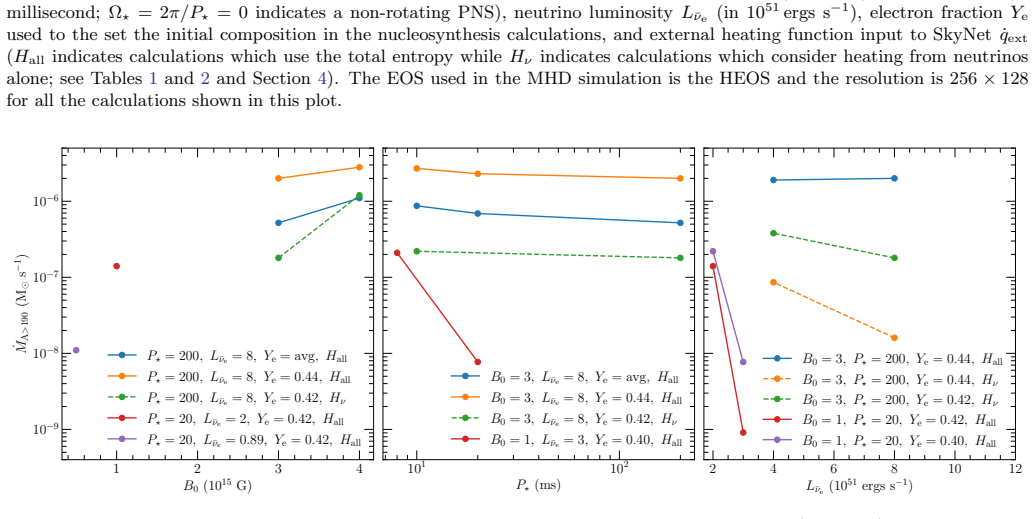
- [§3.3, Eq. (11) and Table 1] The claim that a robust r-process is 'generic to magnetar birth' is carried by the Hall mode, in which the external heating fed to SkyNet is derived from the total entropy of the MHD simulation, including magnetic reconnection. The authors state in §3.3 that they 'do not know how much of this entropy increase is physical, due to lack of a physical model for the current sheet in our MHD simulations.' Since the reconnection heating is numerical resistivity at an unresolved current sheet, and since Eq. (12) gives a third-peak criterion scaling as S^3, a factor-of-order-unity overestimate of this term is sufficient to move a model across the threshold. The B0=5e14 G entry in Table 1 that supports the 'generic' wording is a Hall-mode, LR-only point; no Hnu or HR counterpart is presented for that field strength. The robustness claim therefore needs to be re-scoped to the neutrino-heating-only channel or accompanied by a quantitative uncertainty estimate for the reconnection entropy.
- [§4.1 and Table 2] The conservative Hnu mode is not resolution-converged at the parameter values used for the headline yield estimates. For B0=4e15 G with the QW EOS and Ye set to the average tracer value, Table 2 lists Mdot_A>190 = 1.6e-6 Msun/s at LR in Hall mode, 4.3e-7 at HR in Hall mode, and 0 at HR in Hnu mode, whereas the LR Hnu value is 1.2e-7 Msun/s. Thus the 'conservative lower bound' described in §3.3 switches from nonzero to exactly zero with resolution. The text of §4.1 itself attributes this to a threshold effect, but that does not resolve the problem: a lower bound that is resolution-dependent at the level of switching the third peak on and off is not a lower bound. The manuscript should either present a converged neutrino-only result or explicitly state that the conservative bound is not yet established.
- [§5, Tables 1-2] The Galactic inventory estimates of 5-100% and the statement that magnetars at B0~5e14-1e15 G can account for at least 5-20% of the A>190 budget are computed from LR Hall-mode yields, with the assertion that convergence will follow once the threshold effect is passed. Given the resolution sensitivity documented in §4.1, these numbers should be presented as an upper-envelope scenario tied to the uncertain reconnection heating, not as a robust central prediction. The separate Hnu-based estimate of ~4e-6 Msun of A>190 material in the first ~10 s also uses LR 256x128 values and then applies an ad hoc conservative factor; the formal systematic uncertainty from resolution and current-sheet modeling should be quantified or the claims narrowed.
minor comments (3)
- [Figure 9] The legend in Figure 9 appears as a long run of repeated '256 x 128' labels, making it impossible to distinguish the three resolution cases at a glance; please fix the legend so that each resolution is labeled once and clearly.
- [§5] There is a typo, 'throguhout', in the 92Mo discussion; it should read 'throughout'.
- [§2.4] The description of the electron fraction treatment could be clearer: the MHD simulations evolve Ye with neutrino rates, but the SkyNet initial Ye is sometimes set by hand to values that differ from the tracer-averaged value. The approximation is justified in the text, but a brief statement of the resulting systematic effect on Mdot_A>190 would help the reader interpret Figure 10 and Tables 1-2.
Circularity Check
No significant circularity: the abundances are forward outputs of MHD trajectories plus an independent nuclear network, and the stated caveats are modeling uncertainties rather than input-output equivalences.
full rationale
The derivation chain is a forward post-processing calculation: Athena++ MHD simulations with tracer particles produce thermodynamic trajectories (density, temperature, entropy, electron fraction), and SkyNet independently integrates a nuclear network with an external heating term (Eq. 11) that reproduces the MHD entropy. The yields of A>190 are not fitted to the solar r-process pattern, and no parameter is adjusted to force a third peak. The Hoffman criterion (Eq. 12) is used only as a diagnostic and to interpret threshold behavior; the reported yields come from the network itself. The prior papers cited for the MHD dynamics and neutrino heating (Prasanna et al. 2022, 2023, 2024) are separate forward simulations with stated assumptions that do not include the nucleosynthesis output, so they are dependencies rather than circular inputs. The paper explicitly flags its main uncertainty in Section 3.3 ('we do not know how much of this entropy increase is physical, due to lack of a physical model for the current sheet in our MHD simulations'), and Section 4.1 shows resolution sensitivity, including the vanishing Hnu third-peak yield at B0=4e15 G in the HR run. These are robustness concerns about the physicality and convergence of the reconnection-heated entropy, not circularity: the entropy is an input, but it is not defined in terms of the predicted yields. The Galactic 5-100% estimate is a conditional extrapolation from those yields and external rates, not a renamed fit. No equation reduces to its own input, and no load-bearing argument reduces to a self-citation chain.
Assumptions & free parameters
free parameters (2)
- Initial electron fraction Ye in SkyNet =
varied 0.40-0.54, plus 'avg' along tracer path
- Late-time density extrapolation exponent a =
3
assumptions (5)
- domain assumption 2D axisymmetric MHD with aligned magnetic and rotation axes captures the essential dynamics of proto-magnetar winds
- domain assumption Ye freezes out close to the PNS surface and is constant along the tracer path
- domain assumption Entropy increase from numerical reconnection is physically representative (Hall mode is an upper bound)
- domain assumption Non-relativistic MHD is sufficient for the early cooling phase; later relativistic wind is ignored
- standard math Nuclear reaction network rates and NSE initial composition are correct
Cite this review
Pith. "Pith review of Heavy element nucleosynthesis in rotating proto-magnetar winds." pith.science (2026). https://pith.science/paper/HRKDMZFR
@misc{pith2026250701094,
  author       = {Pith},
  title        = {Pith review of: Heavy element nucleosynthesis in rotating proto-magnetar winds},
  year         = {2026},
  howpublished = {\url{https://pith.science/paper/HRKDMZFR}},
  note         = {Machine review of arXiv:2507.01094}
}
abstract
The astrophysical origin of elements synthesized through the rapid neutron capture process ($r-$process) is a long standing mystery. The hot and dense environments of core-collapse supernovae have been suggested as potential $r-$process sites, particularly the neutrino-driven wind from the newly-born protoneutron star (PNS). Wind models that neglect the potential effects of strong magnetic fields and/or rapid rotation of the PNS typically fail to achieve the necessary conditions for production of the third $r-$process peak, but robustly produce a limited or weak $r-$process for neutron-rich winds. Axisymmetric magnetohydrodynamic simulations of rotating and non-rotating PNS winds with magnetar-strength fields reveal that high entropy material is quasi-periodically ejected from the equatorial closed zone of the PNS magnetosphere. Here, we post-process tracer particle trajectories from these simulations using a nuclear reaction network in order to explore the resulting nucleosynthesis across a range of PNS magnetic field strengths, rotation rates, and neutrino luminosities (cooling phase after core-bounce). We find that a robust $r-$process up to and beyond the third peak is generic to magnetar birth, even for magnetic fields as weak as $\sim 5\times 10^{14}$ G. Depending on the distribution of magnetic field strengths and rotation at birth, we estimate that magnetized PNS winds could account for $\sim 5-100\%$ of the Galactic $r-$process inventory, extending up to the third peak. The robust $r-$process in our calculations is accompanied by overproduction of elements with mass number $\rm A\lesssim 120$ compared to the Solar abundances. We also find that $^{92}\rm Mo$ (a $p-$isotope) is produced in significant quantities in neutron-rich winds.
Figures


Figures from the paper (7 more)



Reference graph
Works this paper leans on
-
[1]
2007, PhR, 450, 97, doi: 10.1016/j.physrep.2007.06.002
Arnould, M., Goriely, S., & Takahashi, K. 2007, PhR, 450, 97, doi: 10.1016/j.physrep.2007.06.002
-
[2]
Baronett, S. A., Yang, C.-C., & Zhu, Z. 2024, MNRAS, 529, 275, doi: 10.1093/mnras/stae272 Barr` ere, P., Guilet, J., Reboul-Salze, A., Raynaud, R., &
-
[3]
Janka, H. T. 2022, A&A, 668, A79, doi: 10.1051/0004-6361/202244172
-
[4]
2019, MNRAS, 487, 1426, doi: 10.1093/mnras/stz1391
Kouveliotou, C. 2019, MNRAS, 487, 1426, doi: 10.1093/mnras/stz1391
-
[6]
Burbidge, E. M., Burbidge, G. R., Fowler, W. A., & Hoyle, F. 1957, Rev. Mod. Phys., 29, 547, doi: 10.1103/RevModPhys.29.547
-
[7]
Burrows, A., Hayes, J., & Fryxell, B. A. 1995, ApJ, 450, 830, doi: 10.1086/176188
doi:10.1086/176188 1995
-
[8]
Burrows, A., & Lattimer, J. M. 1986, ApJ, 307, 178, doi: 10.1086/164405
doi:10.1086/164405 1986
-
[9]
Cehula, J., Thompson, T. A., & Metzger, B. D. 2024, MNRAS, 528, 5323, doi: 10.1093/mnras/stae358
Show all 71 references
-
[10]
Center, O. S. 1987, Ohio Supercomputer Center. http://osc.edu/ark:/19495/f5s1ph73
1987
-
[11]
2015, Monthly Notices of the Royal Astronomical Society, 448, 606, doi: 10.1093/mnras/stv042
Cerutti, B., Philippov, A., Parfrey, K., & Spitkovsky, A. 2015, Monthly Notices of the Royal Astronomical Society, 448, 606, doi: 10.1093/mnras/stv042
2015 doi
-
[12]
Coleman, M. S. B. 2020, ApJS, 248, 7, doi: 10.3847/1538-4365/ab82ff Cˆ ot´ e, B., Fryer, C. L., Belczynski, K., et al. 2018, ApJ, 855, 99, doi: 10.3847/1538-4357/aaad67 Cˆ ot´ e, B., Eichler, M., Arcones, A., et al. 2019, ApJ, 875, 106, doi: 10.3847/1538-4357/ab10db
2020 doi
-
[13]
K., Siegel, D
Desai, D. K., Siegel, D. M., & Metzger, B. D. 2023, ApJ, 954, 192, doi: 10.3847/1538-4357/acea83
2023 doi
-
[14]
C., Shapiro, S
Duncan, R. C., Shapiro, S. L., & Wasserman, I. 1986, ApJ, 309, 141, doi: 10.1086/164587
1986 doi
- [15]
-
[16]
Eichler, D., Livio, M., Piran, T., & Schramm, D. N. 1989, Nature, 340, 126, doi: 10.1038/340126a0
1989 doi
-
[17]
2006, MNRAS, 367, 1323, doi: 10.1111/j.1365-2966.2006.10058.x Fr¨ ohlich, C., Mart ´ ınez-Pinedo, G., Liebend¨ orfer, M., et al
Ferrario, L., & Wickramasinghe, D. 2006, MNRAS, 367, 1323, doi: 10.1111/j.1365-2966.2006.10058.x Fr¨ ohlich, C., Mart ´ ınez-Pinedo, G., Liebend¨ orfer, M., et al. 2006, PhRvL, 96, 142502, doi: 10.1103/PhysRevLett.96.142502
2006
-
[18]
2023, ApJ, 943, 105, doi: 10.3847/1538-4357/acab05
Hakobyan, H., Philippov, A., & Spitkovsky, A. 2023, ApJ, 943, 105, doi: 10.3847/1538-4357/acab05
2023 doi
-
[19]
R., Millman, K
Harris, C. R., Millman, K. J., van der Walt, S. J., et al. 2020, Nature, 585, 357, doi: 10.1038/s41586-020-2649-2 20
2020 doi
-
[20]
W., & Eastwood, J
Hockney, R. W., & Eastwood, J. W. 1981, Computer Simulation Using Particles
1981
-
[21]
D., Woosley, S
Hoffman, R. D., Woosley, S. E., Fuller, G. M., & Meyer, B. S. 1996a, ApJ, 460, 478, doi: 10.1086/176986 —. 1996b, ApJ, 460, 478, doi: 10.1086/176986
-
[22]
D., Woosley, S
Hoffman, R. D., Woosley, S. E., & Qian, Y. Z. 1997, ApJ, 482, 951, doi: 10.1086/304181
1997 doi
-
[23]
Hu, R., & Beloborodov, A. M. 2022, ApJ, 939, 42, doi: 10.3847/1538-4357/ac961d
2022 doi
-
[24]
Hunter, J. D. 2007, Computing in Science & Engineering, 9, 90, doi: 10.1109/MCSE.2007.55
2007 doi
-
[25]
T., & Mueller, E
Janka, H. T., & Mueller, E. 1995, ApJL, 448, L109, doi: 10.1086/309604 —. 1996, A&A, 306, 167
1995 doi
-
[26]
M., & Beloborodov, A
Kaspi, V. M., & Beloborodov, A. M. 2017, ARA&A, 55, 261, doi: 10.1146/annurev-astro-081915-023329
2017 doi
-
[27]
M., & Schramm, D
Lattimer, J. M., & Schramm, D. N. 1974, ApJL, 192, L145, doi: 10.1086/181612
1974 doi
-
[28]
Lippuner, J., & Roberts, L. F. 2017, ApJS, 233, 18, doi: 10.3847/1538-4365/aa94cb
2017 doi
-
[29]
2020, Solar Elemental Abundances, Oxford University Press, doi: 10.1093/acrefore/9780190647926.013.145
Lodders, K. 2020, Solar Elemental Abundances, Oxford University Press, doi: 10.1093/acrefore/9780190647926.013.145
2020
-
[30]
2021, SSRv, 217, 44, doi: 10.1007/s11214-021-00825-8
Lodders, K. 2021, SSRv, 217, 44, doi: 10.1007/s11214-021-00825-8
2021 doi
-
[31]
F., & Papitto, A
Martin, J., Rea, N., Torres, D. F., & Papitto, A. 2014, MNRAS, 444, 2910, doi: 10.1093/mnras/stu1594
2014 doi
-
[32]
D., Thompson, T
Metzger, B. D., Thompson, T. A., & Quataert, E. 2008, ApJ, 676, 1130, doi: 10.1086/526418
2008 doi
-
[33]
S., Krishnan, T
Meyer, B. S., Krishnan, T. D., & Clayton, D. D. 1998, ApJ, 498, 808, doi: 10.1086/305562
1998 doi
-
[34]
S., Mathews, G
Meyer, B. S., Mathews, G. J., Howard, W. M., Woosley, S. E., & Hoffman, R. D. 1992, ApJ, 399, 656, doi: 10.1086/171957
1992 doi
-
[35]
2015, ApJ, 810, 109, doi: 10.1088/0004-637X/810/2/109
Nishimura, N., Takiwaki, T., & Thielemann, F.-K. 2015, ApJ, 810, 109, doi: 10.1088/0004-637X/810/2/109
2015 doi
-
[36]
2000, ApJ, 533, 424, doi: 10.1086/308632
Otsuki, K., Tagoshi, H., Kajino, T., & Wanajo, S.-y. 2000, ApJ, 533, 424, doi: 10.1086/308632
2000 doi
-
[37]
P., Frebel, A., Naidu, R
Ou, X., Ji, A. P., Frebel, A., Naidu, R. P., & Limberg, G. 2024, ApJ, 974, 232, doi: 10.3847/1538-4357/ad6f9b
2024 doi
- [38]
- [39]
-
[40]
K., & Cescutti, G
Perego, A., Thielemann, F. K., & Cescutti, G. 2021, in Handbook of Gravitational Wave Astronomy, ed. C. Bambi, S. Katsanevas, & K. D. Kokkotas, 13, doi: 10.1007/978-981-15-4702-7 13-1
2021 doi
-
[41]
Miralles, J. A. 1999, ApJ, 513, 780, doi: 10.1086/306889
1999 doi
-
[42]
Thompson, T. A. 2022, MNRAS, 517, 3008, doi: 10.1093/mnras/stac2651 —. 2023, MNRAS, 526, 3141, doi: 10.1093/mnras/stad2948
2022 doi
-
[43]
Prasanna, T., Coleman, M. S. B., & Thompson, T. A. 2024, ApJ, 973, 91, doi: 10.3847/1538-4357/ad4d90
2024 doi
-
[44]
2006, ApJ, 644, 1028, doi: 10.1086/503891
Buras, R. 2006, ApJ, 644, 1028, doi: 10.1086/503891
2006 doi
-
[45]
Hoffman, R. D. 2005, ApJ, 623, 325, doi: 10.1086/428281
2005 doi
-
[46]
Qian, Y. Z. 2000, ApJL, 534, L67, doi: 10.1086/312659
2000 doi
-
[47]
Z., & Wasserburg, G
Qian, Y. Z., & Wasserburg, G. J. 2007, PhR, 442, 237, doi: 10.1016/j.physrep.2007.02.006
2007 doi
- [48]
-
[49]
Roberts, L. F. 2012, ApJ, 755, 126, doi: 10.1088/0004-637X/755/2/126
2012 doi
-
[50]
F., Reddy, S., & Shen, G
Roberts, L. F., Reddy, S., & Shen, G. 2012, PhRvC, 86, 065803, doi: 10.1103/PhysRevC.86.065803
2012 doi
-
[51]
M., Barnes, J., & Metzger, B
Siegel, D. M., Barnes, J., & Metzger, B. D. 2019, Nature, 569, 241, doi: 10.1038/s41586-019-1136-0
2019 doi
-
[52]
M., & Metzger, B
Siegel, D. M., & Metzger, B. D. 2018, ApJ, 858, 52, doi: 10.3847/1538-4357/aabaec
2018 doi
-
[53]
D., Brown, T
Simon, J. D., Brown, T. M., Mutlu-Pakdil, B., et al. 2023, ApJ, 944, 43, doi: 10.3847/1538-4357/aca9d1
2023 doi
-
[54]
J., & Gallino, R
Sneden, C., Cowan, J. J., & Gallino, R. 2008, ARA&A, 46, 241, doi: 10.1146/annurev.astro.46.060407.145207
2008
-
[55]
M., Tomida, K., White, C
Stone, J. M., Tomida, K., White, C. J., & Felker, K. G. 2020, ApJS, 249, 4, doi: 10.3847/1538-4365/ab929b
2020 doi
-
[56]
Thompson, C., & Duncan, R. C. 1993, ApJ, 408, 194, doi: 10.1086/172580
1993 doi
-
[57]
Thompson, T. A. 2003, ApJL, 585, L33, doi: 10.1086/374261
2003 doi
-
[58]
A., Burrows, A., & Meyer, B
Thompson, T. A., Burrows, A., & Meyer, B. S. 2001, ApJ, 562, 887, doi: 10.1086/323861
2001 doi
-
[59]
A., & ud-Doula, A
Thompson, T. A., & ud-Doula, A. 2018, MNRAS, 476, 5502, doi: 10.1093/mnras/sty480
2018 doi
- [60]
-
[61]
A., & Spitkovsky, A
Uzdensky, D. A., & Spitkovsky, A. 2014, ApJ, 780, 3, doi: 10.1088/0004-637X/780/1/3 van der Velden, E. 2020, Journal of Open Source Software, 5, 2004, doi: 10.21105/joss.02004
2014 doi
-
[62]
2023, MNRAS, 526, 5900, doi: 10.1093/mnras/stad2887
Vartanyan, D., & Burrows, A. 2023, MNRAS, 526, 5900, doi: 10.1093/mnras/stad2887
2023 doi
-
[63]
2006, MNRAS, 370, L14, doi: 10.1111/j.1745-3933.2006.00178.x 21
Vink, J., & Kuiper, L. 2006, MNRAS, 370, L14, doi: 10.1111/j.1745-3933.2006.00178.x 21
2006
-
[64]
D., Metzger, B
Vlasov, A. D., Metzger, B. D., Lippuner, J., Roberts, L. F., & Thompson, T. A. 2017, MNRAS, 468, 1522, doi: 10.1093/mnras/stx478
2017 doi
-
[65]
D., Metzger, B
Vlasov, A. D., Metzger, B. D., & Thompson, T. A. 2014, MNRAS, 444, 3537, doi: 10.1093/mnras/stu1667
2014 doi
-
[66]
2006, ApJ, 647, 1323, doi: 10.1086/505483
Wanajo, S. 2006, ApJ, 647, 1323, doi: 10.1086/505483
2006 doi
-
[67]
2011, ApJ, 729, 46, doi: 10.1088/0004-637X/729/1/46
Wanajo, S., Janka, H.-T., & Kubono, S. 2011, ApJ, 729, 46, doi: 10.1088/0004-637X/729/1/46
2011 doi
-
[68]
J., & Otsuki, K
Wanajo, S., Kajino, T., Mathews, G. J., & Otsuki, K. 2001, ApJ, 554, 578, doi: 10.1086/321339
2001 doi
-
[69]
J., Burrows, A., Coleman, M
White, C. J., Burrows, A., Coleman, M. S. B., & Vartanyan, D. 2022, ApJ, 926, 111, doi: 10.3847/1538-4357/ac4507
2022 doi
- [70]
-
[71]
E., Wilson, J
Woosley, S. E., Wilson, J. R., Mathews, G. J., Hoffman, R. D., & Meyer, B. S. 1994, ApJ, 433, 229, doi: 10.1086/174638
1994 doi
-
[72]
M., et al
Zevin, M., Kremer, K., Siegel, D. M., et al. 2019, ApJ, 886, 4, doi: 10.3847/1538-4357/ab498b
2019 doi
Reviewed August 6, 2026 · model on record in the stance chip above.
Discussion (0). Continue with ORCID to comment.