REVIEW 2 major objections 6 minor 37 references
Multi-Focus Probes for Context-Preserving Network Exploration and Interaction in Immersive Analytics
T0 review · 2 major / 6 minor · reviewed 2026-08-06 · deepseek-v4-flash
Pith's one-line read By placing multiple focus probes in a VR graph, users can inspect, edit, and deform distant or occluded subgraphs while visual and haptic cues preserve their orientation in the full network.
desk verdict A cleanly specified VR focus+context interaction whose central usability claim is honestly left to future work; worth refereeing, but not yet citable as evidence. read the letter →
The pith
A machine-rendered reading of the paper's core claim, the machinery that carries it, and where it could break.
The reading
What carries the argument
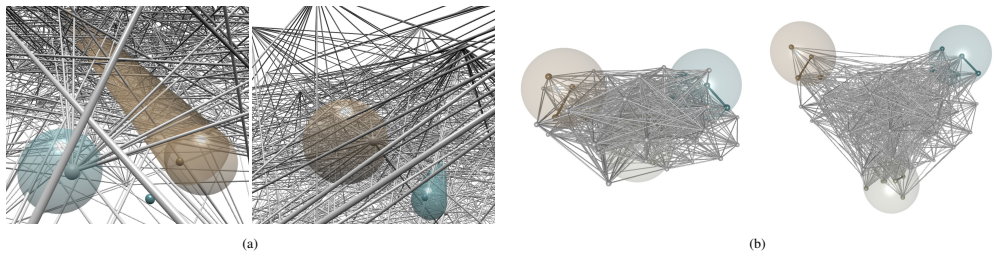
The Multi-Focus Probe: a closed ball $B(r, b)$ in 3-space whose boundary is drawn as a colored 2-sphere and whose interior selects the nodes for the current focus view. The focus content is the induced subgraph on those nodes; the probe stays fixed while its content floats before the user. The argument is carried by two additional mechanisms: guidance cues—the same-colored cone, whose opacity encodes distance, and the tunnel linking probe to content—and the deformation rule in Eq. (1), which moves each node by a weighted average of direction vectors from the displayed content to each active probe, with inverse-distance weights for nodes outside all probes. This formula turns probes into spatial handles that translate the graph, stretch dense regions apart, or pull distant subgraphs into reach.
What would settle it
Run a controlled VR user study in which participants make a series of cross-region edits, such as linking two nodes in two distant probes, under three conditions: probes with full guidance cues, probes without them, and teleportation. If without cues users complete edits no slower and show no greater disorientation, or if with cues users still frequently lose their sense of location in the global graph, the context-preservation claim fails.
Extended reading notes
Core claim
The central claim is that multiple egocentric focus views can be anchored inside a single global graph without severing the user's connection to the whole. A probe is a 3D ball $B(r, b)$, rendered as a semi-transparent colored sphere; its content is the induced subgraph whose nodes lie inside the ball, presented as an interactive panel that moves with the user. The paper claims this content can be edited directly, that edits can be applied across separate probes, and that activating probes lets the user pull the whole graph toward themselves or deform it by moving probe contents. Guidance cues—a colored cone pointing to the probe and a tunnel connecting the probe to its content—are the mechanism the paper relies on to maintain context. The result, if it works as claimed, is that non-local editing and comparison tasks in immersive analytics no longer require the user to travel to each region.
Load-bearing premise
The technique's central benefit depends on the visual and haptic guidance cues being strong enough that a user can inspect and edit multiple distant subgraphs without losing track of where those subgraphs sit in the overall network; the paper does not yet test this assumption.
Editorial extensions
If this is right
- Users can edit distant or occluded graph regions without physically traveling to them, because probe content appears in arm's reach.
- Multiple simultaneously active probes create several independent local views, so comparisons and cross-region edits can be made in one session.
- Probe activation doubles as a navigation and deformation control: one active probe translates the whole graph toward or away from the probe; several probes stretch the layout.
- Haptic vibration during placement gives immediate feedback about whether a probe encloses nodes, which helps depth perception in dense graphs.
- The same probe mechanism is a candidate foundation for collaborative focus sharing, attribute-based placement, and extension to genome-scale networks.
Reading between the lines
- Beyond the paper's own claims, a natural test would compare probe-based editing against teleportation plus ray-casting in a controlled user study, measuring completion time and disorientation after multi-region edits.
- The deformation rule could be extended to use the spatial arrangement of probe contents as additional direction vectors, giving users finer control over the layout; the paper hints at this direction but does not formalize it.
- The same focus+context mechanism transfers to volumetric or molecular data, where a probe plays the role of an endoscopic camera; this is an extension the paper mentions but does not implement.
- Because the technique's value rests on context preservation, a direct pointing-recall or position-estimation after a sequence of edits would test whether the visual and haptic cues actually keep the user oriented in the global graph.
Signed reviews
Editorial analysis
A structured set of objections, weighed in public.
Referee Report
Summary. The paper presents Multi-Focus Probes, an immersive VR interaction technique for graph visualization. Users place colored spherical probes on regions of a large 3D node-link graph; each probe extracts the induced subgraph within its radius and shows it as a movable, interactive focus view in front of the user. The technique supports local editing (node/link creation and removal), navigation toward distant probes, and global graph deformation via a weighted displacement rule (Eq. 1). To preserve awareness of the global context, the system provides haptic feedback during probe placement, directional cones pointing to probe locations, and tunnels connecting each probe to its content. The paper reports a proof-of-concept implementation with examples based on a soccer network, and discusses limitations and future work, explicitly deferring a formal empirical evaluation.
Significance. The multi-focus probe concept is a plausible and interesting addition to immersive network exploration: it combines remote selection, local editing, and focus+context in one mechanism, and the formal definition of a probe as a ball with an induced subgraph is crisp. On the positive side, the deformation model in Eq. (1) is simple, intuitive, and parameter-free; the implementation details are transparent (babylon.js, d3-force-3d, real dataset); and the authors explicitly acknowledge the lack of evaluation. However, the paper's central promised benefit—context preservation and usability—is only asserted, never demonstrated. Without empirical evidence, the technique remains an interesting hypothesis rather than a validated interaction method, and its significance cannot be fully assessed.
major comments (2)
- [Abstract and §5] The abstract states that 'Visual and haptic guidance mechanisms ensure context preservation during multi-scale interaction' and that the paper demonstrates usability. No empirical evidence is provided to support either claim. Section 5 explicitly says 'A key direction for future work is a thorough empirical evaluation to validate usability and effectiveness.' This is a load-bearing gap: if the guidance cues do not actually preserve orientation and context, the central benefit of the technique collapses. The authors should either add a user study measuring disorientation, task performance, and cognitive load, or substantially soften the claims (e.g., 'are intended to support orientation') and clearly label the system a proof-of-concept. The current wording overstates the available evidence.
- [§4 (Results)] The section titled 'Results' contains no measured results—no task completion times, accuracy, user feedback, or quantitative comparisons to existing techniques. It is a description of the prototype and screenshots. For a paper whose stated aim is to 'demonstrate and discuss the usability' of a new interaction technique, a results section with no evaluation is insufficient. At minimum, the authors should add a structured walkthrough of a representative task (e.g., editing two distant regions) with explicit observations, or a heuristic evaluation. Otherwise the section should be renamed 'Implementation' and the paper positioned as a system paper, not a validated interaction study.
minor comments (6)
- [§3, Eq. (1)] The text says that with one active probe the user is 'draw[n] toward or push[ing] away from its position', but Eq. (1) moves the graph nodes, not the user's viewpoint. Please clarify the relationship between graph translation and user navigation in a sentence or two.
- [§3, 'Guidance Cues'] The cone is positioned 'by rotating v toward w by a fixed angle and translating it along the resulting vector.' The value of the fixed angle and the transparency mapping are not specified; a brief explanation of how these parameters were chosen would aid reproducibility.
- [§3, 'Manipulating Probe Content'] Probe content is said to 'move with the user's viewpoint and can also be freely repositioned.' It is unclear how these two modes interact when the user is simultaneously editing and moving. A figure or a short clarifying sentence would help.
- [§4] The dataset is described as 'CL seasons 2017/2018'; please expand 'CL' to Champions League or use a generic description for clarity to non-specialist readers.
- [§2] Several references are cited in batches (e.g., [19] for multiple orientation challenges). Since some of these citations are to very different contexts (e.g., [19] is about multiscale 3D orientation, not specifically network visualization), a sentence explaining the specific relevance of each would strengthen the related-work discussion.
- [Figure 1 and §3] The caption of Figure 1 mentions 'tunnels' and 'cones' but the reader must search the figure to locate them. Consider adding explicit labels (e.g., 'tunnel' and 'cone') to the figure, and also to Figure 2, for clarity.
Circularity Check
No circular reasoning: the technique paper contains no fitted parameters, no prediction derived from its own outputs, and no load-bearing self-citation chain.
full rationale
This is a systems/technique paper whose derivation chain is a designer-specified interaction design plus an implementation, not a fitted model or a predictive claim. The deformation rule in Eq. (1) is a closed-form weighting scheme with uniform weights inside probes and inverse-distance weights outside; it is a stated design choice, not a quantity fitted to data or tuned to reproduce a target result. The probe-content extraction is defined directly as the induced subgraph of nodes whose centers lie inside a probe volume, so there is no quantity being predicted from its own output. The paper contains no empirical evaluation, and Section 5 explicitly defers 'a thorough empirical evaluation to validate usability and effectiveness'; an untested usability hypothesis is a missing validation, not a circular derivation. The only self-citation is reference [4] (Bruckner et al. 2019) in Related Work, used to characterize spatial directness of existing focus+context approaches; it does not carry the load of the proposed technique, and no uniqueness theorem or prior-work ansatz is invoked to make the probe design forced. The context-preservation claim is asserted rather than demonstrated, but assertion without evidence is a correctness/validation gap, not circularity. No step in the paper reduces to its own inputs by construction, and no known result is merely renamed. Score 0.
Assumptions & free parameters
assumptions (2)
- domain assumption Nodes are treated as points, and a node belongs to a probe if its center lies inside the probe ball.
- domain assumption The inverse-distance weighting for nodes outside active probes yields reasonable graph deformation without introducing artifacts.
Cite this review
Pith. "Pith review of Multi-Focus Probes for Context-Preserving Network Exploration and Interaction in Immersive Analytics." pith.science (2026). https://pith.science/paper/R2SJP5OC
@misc{pith2026250701140,
  author       = {Pith},
  title        = {Pith review of: Multi-Focus Probes for Context-Preserving Network Exploration and Interaction in Immersive Analytics},
  year         = {2026},
  howpublished = {\url{https://pith.science/paper/R2SJP5OC}},
  note         = {Machine review of arXiv:2507.01140}
}
read the original abstract
Immersive visualization of network data enables users to physically navigate and interact with complex structures, but managing transitions between detailed local (egocentric) views and global (exocentric) overviews remains a major challenge. We present a multifocus probe technique for immersive environments that allows users to instantiate multiple egocentric subgraph views while maintaining persistent links to the global network context. Each probe acts as a portable local focus, enabling fine-grained inspection and editing of distant or occluded regions. Visual and haptic guidance mechanisms ensure context preservation during multi-scale interaction. We demonstrate and discuss the usability of our technique for the editing of network data.
Figures


Reference graph
Works this paper leans on
-
[1]
F. Argelaguet and C. Andujar. A survey of 3d object selection tech- niques for virtual environments. Computers & Graphics , 37(3):121– 136, 2013. doi: 10.1016/j.cag.2012.12.003 1
-
[2]
J. Bergstr ¨om, T.-S. Dalsgaard, J. Alexander, and K. Hornbæk. How to evaluate object selection and manipulation in vr? guidelines from 20 years of studies. In Proc. ACM CHI, 2021. doi: 10.1145/3411764. 3445193 1
doi:10.1145/3411764 2021
-
[3]
E. Bozgeyikli, A. Raij, S. Katkoori, and R. Dubey. Point & teleport locomotion technique for virtual reality. In Proc. ACM CHI Play, pp. 205–216, 2016. doi: 10.1145/2967934.2968105 2
arXiv 2016
-
[4]
S. Bruckner, T. Isenberg, T. Ropinski, and A. Wiebel. A model of spatial directness in interactive visualization. IEEE Transactions on Visualization and Computer Graphics , 25(8):2514–2528, 2019. doi: 10.1109/TVCG.2018.2848906 2
- [5]
- [6]
-
[7]
S. Dai, Y . Li, B. Ens, L. Besancon, and T. Dwyer. Precise embodied data selection with haptic feedback while retaining room-scale visu- alisation context. IEEE Transactions on Visualization and Computer Graphics, 31(1):602–612, 2025. doi: 10.1109/TVCG.2024.3456399 2
arXiv 2025
-
[8]
A. Drogemuller, A. Cunningham, J. Walsh, B. H. Thomas, M. Cordeil, and W. Ross. Examining virtual reality navigation techniques for 3d network visualisations. Journal of Computer Languages , 56, 2020. doi: 10.1016/j.cola.2019.100937 1, 2
Show all 37 references
-
[9]
Eichner, S
C. Eichner, S. Gladisch, H. Schumann, and C. Tominski. Direct visual editing of node attributes in graphs. Informatics, 3(4), 2016. doi: 10. 3390/informatics3040017 2
2016
-
[10]
Elmqvist, N
N. Elmqvist, N. Henry, Y . Riche, and J.-D. Fekete. Melange: space folding for multi-focus interaction. In Proc. ACM CHI , pp. 1333– 1342, 2008. doi: 10.1145/1357054.1357263 2
2008
- [11]
-
[12]
Gladisch, H
S. Gladisch, H. Schumann, M. Ernst, G. F ¨ullen, and C. Tominski. Semi-automatic editing of graphs with customized layouts. Computer Graphics F orum, 33(3):381–390, 2014. doi: 10.1111/cgf.12394 2
2014 doi
-
[13]
Grogorick and M
S. Grogorick and M. Magnor. Subtle visual attention guidance in VR. In S.-H. A. Magnor M., ed., Real VR – Immersive Digital Real- ity, chap. 11, pp. 272–284. Springer International Publishing, Cham,
-
[14]
D. Han, D. Kim, and I. Cho. Portal: Portal widget for remote target acquisition and control in immersive virtual environments. In Proc. ACM VRST, 2022. doi: 10.1145/3562939.3565639 2
2022
-
[15]
L. Joos, U. Durdu, J. Wieland, H. Reiterer, D. A. Keim, J. Fuchs, and M. T. Fischer. Evaluating node selection techniques for network visualizations in virtual reality. In Proc. ACM SUI , 2024. doi: 10. 1145/3677386.3682102 2
2024
-
[16]
L. Joos, M. T. Fischer, J. Rauscher, D. A. Keim, T. Dwyer, F. Schreiber, and K. Klein. Visual network analysis in immersive envi- ronments: A survey. arXiv Preprint, 2025. doi: 10.48550/arXiv.2501 .08500 1, 2
2025 doi
-
[17]
Kluge, S
S. Kluge, S. Gladisch, U. Freiherr von Lukas, O. Staadt, and C. Tomin- ski. Virtual lenses as embodied tools for immersive analytics. Proc. GI VR/AR Workshop, 2020. doi: 10.18420/vrar2020 8 2
2020 doi
-
[18]
O.-H. Kwon, C. Muelder, K. Lee, and K.-L. Ma. A study of lay- out, rendering, and interaction methods for immersive graph visual- ization. IEEE Transactions on Visualization and Computer Graphics , 22(7):1802–1815, 2016. doi: 10.1109/TVCG.2016.2520921 4
2016
-
[19]
McCrae, M
J. McCrae, M. Glueck, T. Grossman, A. Khan, and K. Singh. Explor- ing the design space of multiscale 3d orientation. In Proc. ACM A VI, pp. 81–88, 2010. doi: 10.1145/1842993.1843008 1, 2, 3
2010
-
[20]
Mehra, V
R. Mehra, V . S. Sharma, V . Kaulgud, and S. Podder. Xrase: To- wards virtually tangible software using augmented reality. In Proc. the IEEE/ACM International Conference on Automated Software En- gineering, pp. 1194–1197, 2019. doi: 10.1109/ASE.2019.00135 2
2019
-
[21]
R. C. R. Mota, A. Rocha, J. D. Silva, U. Alim, and E. Sharlin. 3de interactive lenses for visualization in virtual environments. In Proc. IEEE SciVis, pp. 21–25, 2018. doi: 10.1109/SciVis.2018.8823618 2
2018
-
[22]
Nukarinen, J
T. Nukarinen, J. Kangas, J. Rantala, O. Koskinen, and R. Raisamo. Evaluating ray casting and two gaze-based pointing techniques for object selection in virtual reality. In Proc. ACM VRST , 2018. doi: 10.1145/3281505.3283382 2
2018
-
[23]
Pfeuffer, B
K. Pfeuffer, B. Mayer, D. Mardanbegi, and H. Gellersen. Gaze + pinch interaction in virtual reality. InProc. ACM SUI, pp. 99–108, 2017. doi: 10.1145/3131277.3132180 2
2017
-
[24]
Pirch, F
S. Pirch, F. Mueller, E. Iofinova, J. Pazmandi, C. H ¨utter, M. Chiettini, C. Sin, K. Boztug, I. Podkosova, H. Kaufmann, and J. Menche. The VRNetzer platform enables interactive network analysis in virtual re- ality. Nature Communications, 12, 04 2021. doi: 10.1038/s41467-021 ...
2021 doi
-
[25]
Pivovar, J
J. Pivovar, J. DeGuzman, and E. S. Rosenberg. Virtual reality on a swim: Scalable world in miniature. In Proc. IEEE VR (Abstracts and Workshops), pp. 912–913, 2022. doi: 10.1109/VRW55335.2022. 00307 1, 2
2022
-
[26]
Poupyrev, M
I. Poupyrev, M. Billinghurst, S. Weghorst, and T. Ichikawa. The go- go interaction technique: non-linear mapping for direct manipulation in vr. In Proc. ACM UIST , pp. 79–80, 1996. doi: 10.1145/237091. 237102 2
1996 doi
-
[27]
Reiske, S
G. Reiske, S. In, and Y . Yang. Multi-focus querying of the human genome information on desktop and in virtual reality: an evalua- tion. In Proc. IEEE ISMAR , pp. 1123–1131, 2023. doi: 10.1109/ ISMAR59233.2023.00129 2
2023
-
[28]
K. A. Satriadi, B. Ens, M. Cordeil, T. Czauderna, and B. Jenny. Maps around me: 3d multiview layouts in immersive spaces. Proceedings of the ACM on Human-Computer Interaction , 4(ISS), Nov. 2020. doi: 10.1145/3427329 2, 4
2020 doi
-
[29]
Sorger, A
J. Sorger, A. Arleo, P. K ´an, W. Knecht, and M. Waldner. Egocen- tric network exploration for immersive analytics. Computer Graphics F orum, 40(7):241–252, 2021. doi: 10.1111/cgf.14417 1, 2
2021 doi
-
[30]
Sorger, M
J. Sorger, M. Waldner, W. Knecht, and A. Arleo. Immersive analyt- ics of large dynamic networks via overview and detail navigation. In Proc. IEEE AIVR , pp. 144–1447, 2019. doi: 10.1109/AIVR46125. 2019.00030 2
2019
-
[31]
S. L. Stoev and D. Schmalstieg. Application and taxonomy of through-the-lens techniques. In Proc. ACM VRST , pp. 57–64, 2002. doi: 10.1145/585740.585751 2
2002
-
[32]
Tominski and P
C. Tominski and P. Berger. Show me similar nodes: The similarity lens for multivariate graphs. In Proc. EuroVis (Short Papers), 2024. doi: 10.2312/evs.20241059 2
2024 doi
-
[33]
Y . Wang, Y . Wang, H. Zhang, Y . Sun, C.-W. Fu, M. Sedlmair, B. Chen, and O. Deussen. Structure-aware fisheye views for efficient large graph exploration. IEEE Transactions on Visualization and Computer Graphics, 25(1):566–575, 2019. doi: 10.1109/TVCG.2018.2864911 2
2019
-
[34]
Wu, K.-K
X.-H. Wu, K.-K. Chu, Y .-P. Hung, and Y . Huang. Visual guidance in interactive virtual reality. In Proc. International Conference on Intel- ligent Metaverse Technologies & Applications, pp. 1–8, 2023. doi: 10 .1109/iMETA59369.2023.10294335 2
2023
-
[35]
Y . Yang, T. Dwyer, B. Jenny, K. Marriott, M. Cordeil, and H. Chen. Origin-destination flow maps in immersive environments. IEEE Transactions on Visualization and Computer Graphics , 25(1):693– 703, 2019. doi: 10.1109/TVCG.2018.2865192 4
2019
-
[36]
D. Yu, Q. Zhou, J. Newn, T. Dingler, E. Velloso, and J. Goncalves. Fully-occluded target selection in virtual reality. IEEE Transactions on Visualization and Computer Graphics , 26(12):3402–3413, 2020. doi: 10.1109/TVCG.2020.3023606 2
2020
-
[2020]
doi: 10.1007/978-3-030-41816-8 11 2
Reviewed August 6, 2026 · model on record in the stance chip above.
Discussion (0). Continue with ORCID to comment.