REVIEW 4 major objections 8 minor 19 references
Imitation Learning for Satellite Attitude Control under Unknown Perturbations
T0 review · 4 major / 8 minor · reviewed 2026-08-06 · deepseek-v4-flash
Pith's one-line read This paper claims that a reward-shaped Soft Actor-Critic controller and a GAIL imitation learner can reorient a satellite antenna under unknown torque, alignment, and gyroscope faults, and that imitation reduces training cost.
desk verdict A plausible SAC-vs-DDPG comparison with a genuine imitation-learning application, but the central GAIL sample-complexity claim rests on an invalid reward comparison and needs a rewrite before it can be taken seriously. read the letter →
The pith
A machine-rendered reading of the paper's core claim, the machinery that carries it, and where it could break.
The reading
What carries the argument
The argument runs on three coupled pieces. The first is the SAC update rule, whose entropy-regularized objective and dual critics give a stochastic policy able to keep exploring under perturbations. The second is the shaped reward function in Eq. (15), which combines an exponential attitude-error reward, a control-effort penalty, a regression penalty, a stay bonus inside 5 degrees, and a large terminal penalty for angular velocities above 10 degrees per second. The third is the GAIL discriminator, which assigns the implicit reward $r(s,a)=-\log D_\omega(s,a)$, so the learner is pushed to produce state-action pairs the discriminator cannot separate from the expert. The discriminator-based reward is the mechanism that lets the learner inherit the expert's behavior without accessing the handcrafted reward.
What would settle it
For each perturbation case, count the number of environment interactions the expert and the learner need to reach a fixed attitude accuracy, for instance RMS error below 15 degrees and duty cycle above 0.9; if the learner needs at least as many interactions as the expert, the sample-complexity claim is falsified.
Extended reading notes
Core claim
On the paper's own terms, the central discovery is that a reward-shaped SAC agent is a better expert for the antenna-reorientation task than the prior deterministic-policy controller, and that a second SAC agent trained with GAIL on that expert's trajectories reproduces most of its behavior. The expert is evaluated across fourteen perturbation cases, including single and two-axis torque failures, constant attitude misalignment, torque noise, gyroscope white noise, and gyroscope drift; the learner is trained and evaluated on ten of these cases and improves early-training mean reward in all of them. The paper also reports that replacing the handcrafted reward or switching from SAC back to DDPG degrades performance, supporting reward shaping and the stochastic policy as the carriers of the gain.
Load-bearing premise
The claim that GAIL reduces sample complexity assumes that the learner's mean reward during training can be compared with the expert's mean reward, even though the learner optimizes a different discriminator-based reward than the expert's handcrafted one; if the two reward scales are not comparable, a higher early reward curve does not by itself prove faster learning.
Editorial extensions
If this is right
- A reward-shaped SAC controller can keep a CubeSat-like satellite's antenna within 10 degrees of the target under single-axis and some two-axis torque failures, torque noise with misalignment, and gyroscope noise, across most tested initial states.
- A GAIL learner trained on that expert's trajectories matches or approaches the expert on duty cycle and RMS error in the baseline, torque-noise-plus-misalignment, single-torque-failure, and gyroscope-noise cases.
- The learner inherits the expert's blind spots: cases where the expert itself fails, such as constant gyroscope bias or certain two-axis failures, are excluded from imitation training.
- Ablations imply that both SAC and the refined reward in Eq. (15) are necessary for the expert's advantage; removing either reverts to the earlier controller's failure modes.
Reading between the lines
- A stricter sample-complexity test would report environment steps to a fixed control performance, not early reward; that number is absent from the paper, so the reduction claim is not yet quantified.
- Because a dedicated learner is trained for each perturbation case, the pipeline does not yet demonstrate one policy that generalizes across all fault modes; a single learner trained on mixed expert trajectories would be a natural next test.
- The GAIL implicit reward could be combined with a fraction of the original handcrafted reward to stabilize training in drift and constant-bias cases where the expert's trajectories are sparse or unsuccessful.
Signed reviews
Editorial analysis
A structured set of objections, weighed in public.
Referee Report
Summary. This paper proposes a two-stage learning framework for satellite antenna reorientation under unknown perturbations. A Soft Actor-Critic (SAC) agent is first trained with a handcrafted reward to act as an expert controller, and a second SAC agent is then trained with Generative Adversarial Imitation Learning (GAIL) using the expert's trajectories. Experiments in MuJoCo cover a baseline, single and double torque failures, attitude misalignment, and gyroscope noise, constant error, and drift. The paper claims that the SAC expert outperforms a prior DDPG controller and that the GAIL learner reduces sample complexity while imitating most of the expert's behavior.
Significance. If substantiated, the paper would provide a useful empirical demonstration that reinforcement learning combined with imitation learning can recover satellite attitude control under actuator and sensor perturbations. It includes a clear task formulation, quantitative evaluation metrics, and ablation studies for both the reward function and the learning algorithm. However, the central efficiency claim currently rests on an incommensurable reward comparison, and the imitation claim is only partially supported by the reported tables. The contribution is therefore promising but not yet established at the level claimed.
major comments (4)
- [Performance of the Learner during Training; Figure 9; Eq. (5), Eq. (15)] The claim that GAIL 'dramatically decreases sample complexity' is not supported by the presented evidence. Figure 9 plots the learner's mean discriminator reward r(s,a) = -log D(s,a) (Eq. 5) against the expert's mean handcrafted reward (Eq. 15). These two reward signals are on different scales and are not commensurable, so a higher early curve for the learner does not imply faster task learning. Moreover, no environment-step counts are reported, and mean reward is not a sample-complexity metric. The authors should instead compare the number of environment steps (or episodes) required by the learner and the expert to reach a fixed task-performance level, such as duty cycle above a stated threshold or RMS below a stated threshold, using the same evaluation metric for both.
- [Performance of the Learner in Experiments; Tables 2-6] The quantitative tables only partially support the claim that the learner 'can imitate most of the features' of the expert. In several experiments the learner is substantially worse: in Table 4, Experiment 3 has RMS 19.81 deg versus 6.61 deg and duty cycle 0.930 versus 0.990, and Experiment 4 has RMS 25.82 deg versus 14.21 deg and duty cycle 0.603 versus 0.867; in Table 5, Experiment 6 has RMS 15.08 deg versus 8.54 deg; in Table 6, Experiment 11 has RMS 18.29 deg versus 10.96 deg and duty cycle 0.855 versus 0.973. These are not small discrepancies, and the text's qualitative descriptions such as 'slightly worse' or 'not much different' understate them. Please quantify the fraction of experiments in which the learner meets a specified performance criterion, or revise the imitation claim to acknowledge the cases where imitation clearly degrades performance.
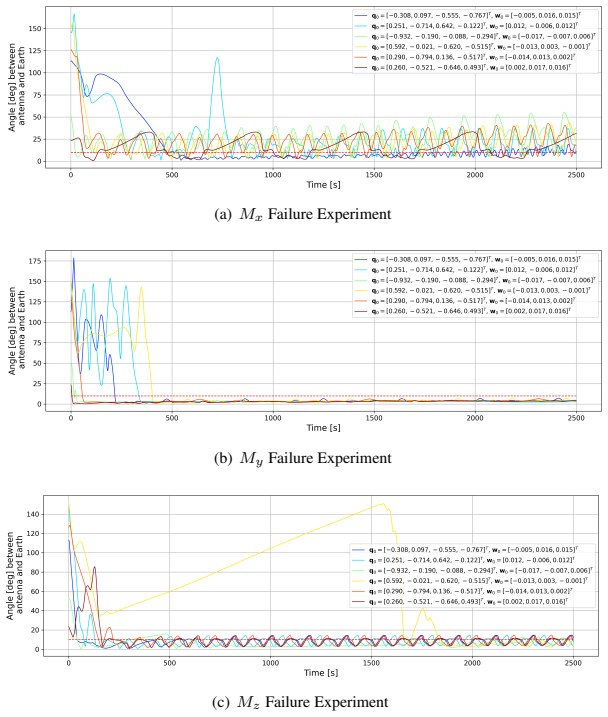
- [Experiments and Results; Appendix B; Contribution 1] The claimed superiority of the SAC expert over Hao et al.'s DDPG controller [9] is established only by visual inspection of figures reprinted from the prior work. Since beating that baseline is contribution 1, the authors should provide quantitative metrics (duty cycle, RMS, max/min error) for the same DDPG baseline under the same evaluation protocol, or re-run the baseline and report its metrics. Without this, the comparison cannot be assessed by the reader and the claim is not falsifiable from the presented data.
- [Formulation of the GAIL algorithm; Eq. (4)-(5), Algorithm 1] The description of the discriminator's meaning is internally inconsistent. The text says D(s,a) is the probability that a pair originated from the learner, but then states that 'if the discriminator perceives a learner-generated pair as expert-like, D(s,a) approaches unity'. Under the stated definition, an expert-like pair should make D close to zero, not one. Also, the sign conventions in Eq. (4), Eq. (5), and Algorithm 1 should be checked for mutual consistency, since the reward signal r(s,a) = -log D(s,a) is central to the GAIL experiments. Please clarify which convention is used (e.g., D high for expert samples versus D high for learner samples) and correct the text accordingly.
minor comments (8)
- [Multiple experiment sections] There are numerical typos in iteration counts: '200,0000', '400,0000', and '100,0000' should presumably be 2,000,000, 4,000,000, and 1,000,000.
- [Figure 9] The axes in Figure 9 are not labeled; specify the x-axis quantity (episodes, environment steps, or iterations) and the exact reward definition used for each curve.
- [Perturbations Parameters, Eq. (9)] The notation for gyroscope noise standard deviation is inconsistent: Eq. (9) uses sigma_omega, while the text later reports sigma_eta = 0.1 deg/s.
- [Performance of the Learner during Training] The text refers to 'Figure 12(b) and Figure 12(b)', which should be 'Figure 12(b) and Figure 12(c)'.
- [SAC Algorithm Configuration, Eq. (15)] Equation (15) uses the symbol phi_t without defining it in the reward section; please define it as the angular difference between the antenna pointing direction and the target direction.
- [Limitation and Future Work] The GAIL hyperparameters are said to vary per experiment, but the per-experiment values are not reported; please include them for reproducibility.
- [Quantitative Evaluation Metrics] The six 'randomly generated initial states' are not specified; please report the distributions or exact initial conditions used so that the results can be reproduced.
- [References] Reference [10] (Maximilian) is incomplete; provide the full publication venue and year.
Circularity Check
No significant circularity: the empirical comparisons are self-contained, and the weak sample-complexity argument is an evidentiary limitation rather than a circular reduction.
full rationale
The paper's load-bearing claims are empirical benchmark results, not derivations from inputs. The SAC expert is trained with the handcrafted reward of Eq. (15) and then tested under the perturbations listed in Table 1; the comparison against Hao et al. [9] is a baseline comparison to a published prior study, and the ablation studies in Appendix C independently vary the algorithm (DDPG vs SAC) and the reward function, so the expert's claimed improvement is not defined in terms of the prior work. The GAIL learner is trained on expert trajectories using the standard discriminator reward of Eq. (5), and its success is then assessed by the same quantitative metrics (duty cycle, RMS, max/min angle error) on the same task; this is an evaluation of a trained policy, not a prediction that is numerically equal to its training signal. The main weakness is the 'sample complexity' conclusion, which is inferred from Figure 9 by comparing the mean rewards of two different reward functions (Eq. 5 vs Eq. 15); that comparison is not a valid sample-complexity measurement, and no environment-step counts are reported. This is a real evidentiary limitation but not a circularity: no equation is equal by construction to another, no fitted parameter is renamed as a prediction, and the cited prior work is externally available and independently reproduced in the ablations. The limitation section's admission that GAIL hyperparameters vary per experiment further weakens generality, but again it does not make the derivation circular.
Assumptions & free parameters
free parameters (2)
- reward scalers s1..s5 =
s1=1, s2=0.5, s3=1, s4=9, s5=500
- per-experiment GAIL hyperparameters =
not fully stated in visible text
assumptions (5)
- standard math Rigid-body quaternion kinematics and Euler dynamics (Eqs. 6-7) describe the satellite motion.
- domain assumption MuJoCo simulates the dynamics with sufficient fidelity, including stable quaternion normalization.
- domain assumption The chosen perturbation models (Gaussian gyro noise, random-walk drift, deterministic torque scaling, fixed Euler-angle misalignment) represent unknown perturbations.
- ad hoc to paper The handcrafted reward in Eq. 15 is an adequate proxy for the goal of orienting and stabilizing the antenna.
- domain assumption The expert's recorded trajectories are sufficiently optimal and diverse to serve as demonstrations for GAIL.
Cite this review
Pith. "Pith review of Imitation Learning for Satellite Attitude Control under Unknown Perturbations." pith.science (2026). https://pith.science/paper/QWEOO2Q4
@misc{pith2026250701161,
  author       = {Pith},
  title        = {Pith review of: Imitation Learning for Satellite Attitude Control under Unknown Perturbations},
  year         = {2026},
  howpublished = {\url{https://pith.science/paper/QWEOO2Q4}},
  note         = {Machine review of arXiv:2507.01161}
}
read the original abstract
This paper presents a novel satellite attitude control framework that integrates Soft Actor-Critic (SAC) reinforcement learning with Generative Adversarial Imitation Learning (GAIL) to achieve robust performance under various unknown perturbations. Traditional control techniques often rely on precise system models and are sensitive to parameter uncertainties and external perturbations. To overcome these limitations, we first develop a SAC-based expert controller that demonstrates improved resilience against actuator failures, sensor noise, and attitude misalignments, outperforming our previous results in several challenging scenarios. We then use GAIL to train a learner policy that imitates the expert's trajectories, thereby reducing training costs and improving generalization through expert demonstrations. Preliminary experiments under single and combined perturbations show that the SAC expert can rotate the antenna to a specified direction and keep the antenna orientation reliably stable in most of the listed perturbations. Additionally, the GAIL learner can imitate most of the features from the trajectories generated by the SAC expert. Comparative evaluations and ablation studies confirm the effectiveness of the SAC algorithm and reward shaping. The integration of GAIL further reduces sample complexity and demonstrates promising imitation capabilities, paving the way for more intelligent and autonomous spacecraft control systems.
Figures


Figures from the paper (25 more)




Reference graph
Works this paper leans on
-
[9]
Reorient Satellite Antenna using Reinforcement Learning under Unknown At- titude Failures,
H. Peng and X. Bai, “Reorient Satellite Antenna using Reinforcement Learning under Unknown At- titude Failures,” AIAA SciTech F orum and Exposition, 2023 , American Institute of Aeronautics and Astronautics Inc, AIAA, 2023
work page 2023
-
[1]
Attitude control of a quadrotor with optimized PID controller,
H. Bolandi, M. Rezaei, R. Mohsenipour, H. Nemati, and S. M. Smailzadeh, “Attitude control of a quadrotor with optimized PID controller,” 2013
work page 2013
-
[2]
New quaternion feedback control for efficient large angle maneuvers,
S. Lim, “New quaternion feedback control for efficient large angle maneuvers,” AIAA Guidance, Navi- gation, and Control Conference and Exhibit , 2001, p. 4211
work page 2001
-
[3]
Dynamic programming based attitude trajectories for underactuated control systems,
V . Vedant and A. Ghosh, “Dynamic programming based attitude trajectories for underactuated control systems,” 41st Annual AAS Rocky Mountain Section Guidance and Control Conference, 2018 , Univelt Inc., 2018, pp. 191–202
work page 2018
-
[4]
Satellite attitude control with deep reinforcement learning,
D. Gao, H. Zhang, C. Li, and X. Gao, “Satellite attitude control with deep reinforcement learning,”2020 Chinese Automation Congress (CAC), IEEE, 2020, pp. 4095–4101
work page 2020
-
[5]
J. Lei, T. Meng, Y . Zhu, K. Wang, and W. Wang, “Adaptive Compatible Performance Control for Spacecraft Attitude Control under Motion Constraints with Guaranteed Accuracy,” 05 2023, 10.48550/arXiv.2305.19627
work page Pith review arXiv doi:10.48550/arxiv.2305.19627 2023
-
[6]
Disturbance observer-based attitude stabilization for rigid spacecraft with input MRCs,
K. Shi, C. Liu, Z. Sun, and X. Yue, “Disturbance observer-based attitude stabilization for rigid spacecraft with input MRCs,” Advances in Space Research, V ol. 66, No. 3, 2020, pp. 689–701. 21 Table 7. List of Hyperparameters used in SAC Expert Algorithm Hyperparameter Value Description learning rate 0.001 − →0.0001 Rate at which the neural network learns...
work page 2020
-
[7]
Reinforcement learning for spacecraft attitude control,
J. T. Vedant, “Reinforcement learning for spacecraft attitude control,” 70th International Astronautical Congress, 2019
work page 2019
Show all 19 references
-
[8]
Bridging reinforcement learning and online learning for space- craft attitude control,
J. G. Elkins, R. Sood, and C. Rumpf, “Bridging reinforcement learning and online learning for space- craft attitude control,” Journal of Aerospace Information Systems , V ol. 19, No. 1, 2022, pp. 62–69
2022
-
[10]
Robust Attitude Control in Active Debris Removal Missions using Reinforcement Learning,
M. Meijkamp, “Robust Attitude Control in Active Debris Removal Missions using Reinforcement Learning,”
-
[11]
End-to-end driving via conditional imitation learning,
F. Codevilla, M. M ¨uller, A. L´opez, V . Koltun, and A. Dosovitskiy, “End-to-end driving via conditional imitation learning,” 2018 IEEE international conference on robotics and automation (ICRA) , IEEE, 2018, pp. 4693–4700
2018
-
[12]
Recent advances in robot learning from demonstration,
H. Ravichandar, A. S. Polydoros, S. Chernova, and A. Billard, “Recent advances in robot learning from demonstration,” Annual review of control, robotics, and autonomous systems , V ol. 3, No. 1, 2020, pp. 297–330
2020
-
[13]
Coordinated multi-agent imitation learning,
H. M. Le, Y . Yue, P. Carr, and P. Lucey, “Coordinated multi-agent imitation learning,” International Conference on Machine Learning, PMLR, 2017, pp. 1995–2003
2017
-
[14]
Generative adversarial imitation learning,
J. Ho and S. Ermon, “Generative adversarial imitation learning,” Advances in neural information pro- cessing systems, V ol. 29, 2016
2016
-
[15]
Reinforcement learning,
M. A. Wiering and M. Van Otterlo, “Reinforcement learning,” Adaptation, learning, and optimization , V ol. 12, No. 3, 2012, p. 729
2012
-
[16]
Soft actor-critic algorithms and applications,
T. Haarnoja, A. Zhou, K. Hartikainen, G. Tucker, S. Ha, J. Tan, V . Kumar, H. Zhu, A. Gupta, P. Abbeel, et al., “Soft actor-critic algorithms and applications,” arXiv preprint arXiv:1812.05905, 2018
2018 arXiv
-
[17]
J. L. Crassidis and J. L. Junkins, Optimal estimation of dynamic systems . Chapman and Hall/CRC, 2004
2004
-
[18]
Cislunar autonomous positioning system technology operations and navigation experi- ment (Capstone),
B. Cheetham, “Cislunar autonomous positioning system technology operations and navigation experi- ment (Capstone),” ASCEND 2021, p. 4128, 2021
2021
-
[19]
A coupled nonlinear spacecraft attitude controller and observer with an unknown constant gyro bias and gyro noise,
J. Thienel and R. M. Sanner, “A coupled nonlinear spacecraft attitude controller and observer with an unknown constant gyro bias and gyro noise,”IEEE transactions on Automatic Control, V ol. 48, No. 11, 2003, pp. 2011–2015. 22 (a) Mx Failure Experiment (b) My Failure Experimen...
2003
Reviewed August 6, 2026 · model on record in the stance chip above.
Discussion (0). Continue with ORCID to comment.