REVIEW 2 major objections 6 minor 117 references
Multi-wavelength variability analysis of the blazar S5 0716+714 during a long-lasting period of low activity
T0 review · 2 major / 6 minor · reviewed 2026-08-06 · deepseek-v4-flash
Pith's one-line read During a low-activity stretch, blazar S5 0716+714 pulsed optically every 43.5 days.
desk verdict A careful low-state campaign with useful empirical results, but the 43.5 d QPO rests on an extrapolated red-noise null and the physical modeling is a fit, not a prediction. read the letter →
The pith
A machine-rendered reading of the paper's core claim, the machinery that carries it, and where it could break.
The reading
What carries the argument
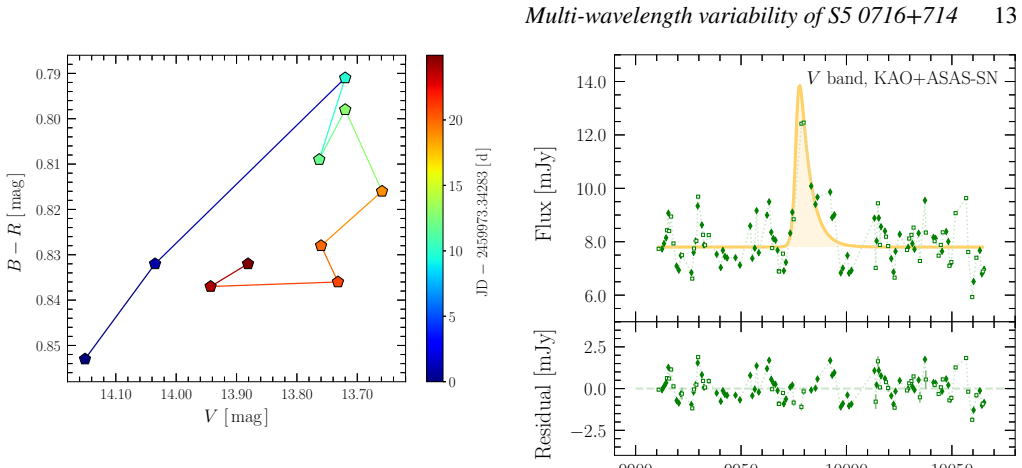
The machine that carries the interpretation is the helical-blob Doppler modulation model: a blob moving with Lorentz factor $\Gamma$ along a helix changes its viewing angle $\theta(t)$ through $\cos\theta(t)=\cos\zeta\,\cos\psi+\sin\zeta\,\sin\psi\,\cos(2\pi t/P+\varphi_0)$, so the Doppler factor $\delta(t)=1/[\Gamma(1-\beta\cos\theta(t))]$ and the observed flux $F(t,\nu)=F'(\nu')\,\delta(t)^{\alpha+3}$ oscillate with the helix period. Fitting two such blobs plus a double-exponential synchrotron flare to the V-band curve yields the geometry and the flare-region limits. Supporting machinery includes the discrete autocorrelation function, the redfit AR1 red-noise test, and the weighted wavelet Z-transform, all of which independently point to $43.5\pm 3.6$ d.
What would settle it
Compute the periodogram of the same combined V-band light curve with a PSD that includes a spectral break, or use a Gaussian-process fit, and re-run the significance test; if the 43.5 d peak drops below the 99 per cent band, the QPO claim fails.
Extended reading notes
Core claim
During the 2022–2023 low-activity state, the V-band light curve of S5 0716+714 varies with a transient quasi-period of $43.5\pm 3.6$ d, matching the $44\pm 6$ d period previously reported for 2017–2018 data. The $BVR$ light curves are strongly correlated with no measurable inter-band lags, show a moderate flatter-when-brighter spectral trend whose strength weakens toward longer wavelengths, and the V-band curve is reproduced by a model of two helically moving blobs viewed at changing Doppler factors. After subtracting that geometric model, the residual around JD 2459980 is fitted as a synchrotron flare with a rise time of about 1 day and a decay of about 4.9 days; deboosting that flare gives an upper limit $R_{\rm max}\simeq 3.3\times 10^{16}$ cm, $B_{\rm min}\simeq 0.3$ G, and $\gamma_{\rm max}\simeq 6300$ for the emitting region. On intranight time-scales the source is unusually quiet, with a duty cycle of roughly 10–20 per cent and no flares, which the paper attributes to a temporarily homogeneous jet flow in which a strong magnetic field suppresses Kelvin–Helmholtz instabilities.
Load-bearing premise
The 43.5-day oscillation is judged real by comparing the data to fake light curves generated from a single power-law noise spectrum whose slope is measured from the same light curve; if the true noise spectrum is curved or the sampling creates aliases, the significance bands could be wrong and the peak could be a red-noise fluctuation.
Editorial extensions
If this is right
- The 43.5 d period is consistent with the $44\pm 6$ d QPO found by Lu et al. (2024) in 2017–2018, suggesting the same helical geometry may persist across low states.
- The derived emission-region radius $R_{\rm max}\simeq 3.3\times 10^{16}$ cm, $B_{\rm min}\simeq 0.3$ G, and $\gamma_{\rm max}\simeq 6300$ provide concrete numbers for SED modelling of the 2022–2023 state.
- A duty cycle of only ~10–20 per cent means that low-activity states can be identified by the absence of intranight flares, not just by lowered flux.
- The simultaneous optical and gamma-ray excess near JD 2459980 supports a single electron population producing both synchrotron and inverse-Compton emission.
- If the QPO is real, it offers a geometric, rather than intrinsic, origin for optical quasi-periodicities in blazars.
Reading between the lines
- A natural extension the paper does not pursue: check whether the 43.5 d period reappears at the same phase in the next low-activity season; a stable phase would favour a persistent helical structure, while a random phase would favour transient jet disturbances.
- The same two-blob geometry could be tested in other blazars by searching for simultaneous periodicity and spectral-index modulation, since Doppler modulation should make the spectrum flatter at flux maxima.
- The paper's Kelvin–Helmholtz suppression argument suggests a testable prediction: the intranight flare rate should anti-correlate with the large-scale magnetic-field estimate across different activity states.
- Because the QPO significance is tied to a single power-law PSD, reanalysing the same light curves with a broken power-law or a Gaussian-process model would tell whether the 43.5 d peak is robust to PSD shape.
Editorial analysis
A structured set of objections, weighed in public.
Referee Report
Summary. This paper presents a multi-wavelength monitoring campaign of the BL Lac object S5 0716+714 from 2022 November 26 to 2023 May 28, consisting of 84 epochs of ground-based optical photometry (11 with intranight monitoring), combined with ASAS-SN optical and Fermi-LAT gamma-ray survey data. The authors report a gradual decline of activity since about JD 2459000, strong cross-band correlations with no time lags, moderate flatter-when-brighter spectral behavior whose strength decreases toward longer wavelengths, a transient quasi-periodic oscillation with period 43.5 ± 3.6 d detected by DACF, redfit, and WWZ, and a two-helical-blob plus synchrotron-flare model of the V-band light curve that yields limits on the flare region (R ≲ 3.3×10^16 cm, B ≳ 0.3 G, γ ≲ 6300). The intranight data show smooth variability with a duty cycle of 10–20 per cent, which the authors interpret as evidence for a homogeneous jet flow.
Significance. If the 43.5 d QPO is genuine, the paper is a valuable addition: it corroborates the independent 44 ± 6 d period of Lu et al. (2024), extends QPO studies to a low-activity state, and provides a concrete geometric interpretation. The strengths are the careful multi-telescope data reduction, the use of three periodicity estimators with Monte Carlo uncertainty bands, the multi-band consistency checks, and the honest labeling of speculative elements (e.g., the VLBA ejection episodes and the Kelvin–Helmholtz argument). The principal weakness is that the significance of the QPO is calibrated with a red-noise model fitted only at lags below 12 d and then extrapolated to the 43.5 d period, so the quantitative support for the headline claim is not yet fully established. The physical parameters of the flare and the blob geometry are contingent on the QPO interpretation.
major comments (2)
- [§5.3.2–5.3.4, Table 6, Eq. (7)] The QPO significance is calibrated with a red-noise null whose parameters are fitted only at lags below the structure-function turn-off δt_to ≈ 12 d. The single-power-law fit of Eq. (7) is restricted to δt < δt_to, the PSD slope κ ≈ 2 is inferred via κ − ρ ≈ 1, and this κ is then used in 2500 Timmer–König simulations for both the WWZ significance (Sect. 5.3.4) and the DCCF significance (Sect. 5.3.3), while redfit uses an AR1 null with a decorrelation time of about 12 d. The claimed period of 43.5 d is thus outside the range of lags actually fitted, and the SF itself changes slope at δt_to, so the single-power-law PSD may not describe the low-frequency variability. The DACF peak at τ ≈ 2P and the agreement with the 44 ± 6 d period of Lu et al. (2024) partially mitigate this concern, but neither provides a calibrated significance at the claimed period. Because the QPO is the basis for the helical-blob and flare modelling in Sect. 6.2, I request a sensitivity analysis: re-run the WWZ and redfit significance tests with steeper PSD slopes (e.g., κ ≈ 2.5), with broken power-law PSDs whose break is at about 12 d, and with an empirical PSD estimated directly from the observed light curve, and report whether the 43.5 d peak remains above the 99 per cent band.
- [§6.2.2, Table 9, Eqs. (15)–(17)] The limits on the emission-region radius, magnetic field, and electron Lorentz factor are derived from the rise and decay times of the residual after subtracting the two-blob helical model, but the two-blob model parameters and the period P = 43.5 d are fitted to the same light curve being interpreted, so these constraints are not independent of the QPO detection. The quoted values (R_max ≈ 3.3×10^16 cm, B_min ≈ 0.3 G, γ_max ≈ 6300) are given without propagating the flare-timescale uncertainties (Tr = 1.01 ± 0.09 d, Td = 4.91 ± 0.67 d; Table 9) and with fixed δ = 15.6 and q = 0.3. Since Eq. (15) scales linearly in δ and Eqs. (16)–(17) scale as δ^{-1/3} and q^{-2/3}, I recommend adding a small sensitivity table showing how the three limits vary over plausible ranges of δ and q, along with a statement of how the flare interpretation would be affected if the QPO significance were compromised by the red-noise issue raised in Major Comment 1.
minor comments (6)
- [§5.3.4, Fig. 11] The folded light curve in Fig. 11 covers only about 4.2 cycles of the 43.5 d period; a brief statement of the number of cycles and the goodness of the sine fit would help the reader assess the coherence of the QPO visually.
- [§5.3.2] The conversion κ − ρ ≃ 1 between PSD and SF slopes holds only for a restricted lag range (1/f_max ≪ δt ≪ 1/f_min); stating this condition explicitly, and noting that the SF slope is measured only for δt < 12 d, would make the extrapolation to the QPO frequency transparent.
- [§5.3.4, Fig. 10] The transient nature of the QPO is inferred from the WWZ time-frequency map (Fig. 10), but the quoted 95 and 99 per cent bands apply to the time-averaged power; a time-resolved significance estimate would better support the word 'transient' in the abstract.
- [Data availability] The light curves are the core product of the campaign and are needed to reproduce the periodicity analysis; I encourage the authors to deposit the nightly and intranight photometry in a public archive (e.g., CDS or Zenodo) in addition to the statement on request.
- [Throughout] The object designation is rendered as 'S50716+714' in most of the body text; please verify that the correct designation S5 0716+714 is used consistently in the final version.
- [§5.3.1, Table 5] The claim that the spectral-index–flux anti-correlation weakens toward longer wavelengths rests on slopes of −0.035 ± 0.005 (B) and −0.021 ± 0.004 (R), which differ by about 2.3σ; a direct test of slope equality or a joint fit of the slope–wavelength trend would place this statement on firmer ground.
Circularity Check
No significant circularity: the 43.5 d QPO is a measured feature, and the helical-blob and flare parameters are presented as in-sample model fits rather than as independent predictions.
full rationale
We walked the paper's derivation chain and found no load-bearing step that reduces, by the paper's own equations or by self-citation, to its own inputs. The QPO period is measured directly from the light curve using DACF, redfit, and WWZ (Sect. 5.3.4, Table 7), and the significance procedure uses standard null models (AR1 and power-law PSD) fitted to the same data; this is a standard goodness-of-fit calibration, not a prediction derived from the fitted values. The helical-blob model (Sect. 6.2.1) sets P = 43.5 d as an input and fits angles to the same V-band light curve; the resulting parameters are explicitly called a model fit, not an independent prediction. The synchrotron flare parameters (Sect. 6.2.2) are likewise fitted to the residual after subtracting the model, and the limits on R, B, and gamma follow from those fitted timescales plus external assumed values (delta = 15.6, q = 0.3). No quantity claimed as a result is equivalent by construction to an input; no self-citation is load-bearing; and the comparison with Lu et al. (2024) is an external consistency check. Therefore we find no circularity.
Assumptions & free parameters
free parameters (4)
- QPO period P =
43.5 ± 3.6 d
- Helical blob angles =
zeta=2.2 deg, psi1=2.4 deg, phi0,1=32.6 deg, psi2=0.15 deg, phi0,2=134.9 deg
- Flare parameters =
F0=4.79 mJy, Tr=1.01 d, omega=4.86, t0=9976.44 JD
- Spectral index alpha =
1.139 ± 0.004
assumptions (6)
- domain assumption The aperiodic optical variability is described by a first-order autoregressive / single power-law red-noise process; Monte Carlo light curves from Timmer-König with this PSD and observed sampling give valid QPO significance.
- domain assumption Helical motion of blobs Doppler-boosts the synchrotron emission according to Eqs. (9)-(13) with exponent s=3 for resolved blobs.
- ad hoc to paper The residual after subtracting the two-blob model is an isolated synchrotron flare whose rise and decay times map to source radius, magnetic field, and electron Lorentz factor via Eqs. (15)-(17).
- domain assumption The source redshift is 0.2304, the group-mean redshift of Pichel et al. (2023), and the bulk Lorentz factor / Doppler factor are taken from literature weighted means (Gamma=14, delta=15.6).
- domain assumption Kelvin-Helmholtz instability suppression by magnetic field B > Bcrit explains the absence of intranight flares (Eq. 18), with electron density taken from Ouyang et al. (2025).
- standard math Standard statistical tools (DCCF, structure function, redfit, WWZ) are valid for unevenly sampled time series.
invented entities (1)
-
Two helically moving blobs (blob #1 and #2)
Cite this review
Pith. "Pith review of Multi-wavelength variability analysis of the blazar S5 0716+714 during a long-lasting period of low activity." pith.science (2026). https://pith.science/paper/UI2UQ5CW
@misc{pith2026250701184,
  author       = {Pith},
  title        = {Pith review of: Multi-wavelength variability analysis of the blazar S5 0716+714 during a long-lasting period of low activity},
  year         = {2026},
  howpublished = {\url{https://pith.science/paper/UI2UQ5CW}},
  note         = {Machine review of arXiv:2507.01184}
}
read the original abstract
We conducted a multi-wavelength monitoring campaign of the blazar S5 0716+714 from 2022 November 26 to 2023 May 28 using optical telescopes in Egypt and Bulgaria. Data were taken during 84 nights in 11 of which intranight monitoring was performed. We also use optical and gamma-ray survey data. On long-term time-scales, we find a gradual decrease of the S5 0716+714 activity since the beginning of 2020 in both optical and gamma-rays. On short-term time-scales, the individual optical light curves are strongly correlated among each other with no time lags observed. The V-band percentage variability amplitude equals 97.59 +/- 0.02 per cent. We find moderate flatter-when-brighter spectral behaviour with the strength of the 'spectral index - flux' anti-correlation decreasing towards the longer wavelengths. The main feature of the short-term light curves is a transient quasi-periodic oscillation with a period of 43.5 +/- 3.6 d. The V-band light curve is modelled with two helically moving blobs and a synchrotron flare. We estimate the resulting parameters, as well as limits on the radius, magnetic field strength, and electron Lorentz factor of the region responsible for the flare. On intranight time-scales, we find smooth flux variations with no flares and derive a duty cycle in the range ~10-20 per cent. The lack of flares on intranight time-scales could result from a temporarily homogeneous jet flow without formation of turbulent cells in terms of prevented Kelvin-Helmholtz instability. The analysis of the data reveals a low activity of S5 0716+714 on all time-scales during the observation period.
Figures


Figures from the paper (9 more)


Reference graph
Works this paper leans on
-
[1]
Abdo A. A., et al., 2010a, @doi [ ] 10.1088/0004-637X/716/1/30 , https://ui.adsabs.harvard.edu/abs/2010ApJ...716...30A 716, 30
-
[2]
Abdo A. A., et al., 2010b, @doi [ ] 10.1088/0004-637X/721/2/1425 , https://ui.adsabs.harvard.edu/abs/2010ApJ...721.1425A 721, 1425
-
[3]
Abdo A. A., et al., 2010c, @doi [ ] 10.1088/0004-637X/722/1/520 , https://ui.adsabs.harvard.edu/abs/2010ApJ...722..520A 722, 520
-
[4]
Abdollahi S., et al., 2023, @doi [ ] 10.3847/1538-4365/acbb6a , https://ui.adsabs.harvard.edu/abs/2023ApJS..265...31A 265, 31
-
[5]
Abe H., et al., 2023, @doi [ ] 10.3847/1538-4365/acc181 , https://ui.adsabs.harvard.edu/abs/2023ApJS..266...37A 266, 37
-
[6]
Agarwal A., et al., 2016, @doi [ ] 10.1093/mnras/stv2345 , https://ui.adsabs.harvard.edu/abs/2016MNRAS.455..680A 455, 680
-
[7]
Agarwal A., et al., 2023, @doi [ ] 10.3847/1538-4365/acbcbd , https://ui.adsabs.harvard.edu/abs/2023ApJS..265...51A 265, 51
-
[8]
Angel J. R. P., Stockman H. S., 1980, @doi [ ] 10.1146/annurev.aa.18.090180.001541 , https://ui.adsabs.harvard.edu/abs/1980ARA&A..18..321A 18, 321
arXiv 1980
Show all 117 references
-
[9]
E., 2017, eaydin/WWZ: First release, @doi 10.5281/zenodo.375648 , https://doi.org/10.5281/zenodo.375648
Aydin M. E., 2017, eaydin/WWZ: First release, @doi 10.5281/zenodo.375648 , https://doi.org/10.5281/zenodo.375648
2017 doi
-
[10]
A., et al., 2022, @doi [Experimental Astronomy] 10.1007/s10686-021-09802-z , https://ui.adsabs.harvard.edu/abs/2022ExA....53...45A 53, 45
Azzam Y. A., et al., 2022, @doi [Experimental Astronomy] 10.1007/s10686-021-09802-z , https://ui.adsabs.harvard.edu/abs/2022ExA....53...45A 53, 45
2022 doi
-
[11]
Bachev R., 2018, Bulgarian Astronomical Journal, https://ui.adsabs.harvard.edu/abs/2018BlgAJ..28...22B 28, 22
2018
-
[12]
Bachev R., Strigachev A., Kurtenkov A., Spassov B., Nikolov Y., Boeva S., Semkov E., 2021, Bulgarian Astronomical Journal, https://ui.adsabs.harvard.edu/abs/2021BlgAJ..34...79B 34, 79
2021
-
[13]
D., Bhatt N., 2024, @doi [ ] 10.1017/pasa.2024.106 , https://ui.adsabs.harvard.edu/abs/2024PASA...41..103B 41, e103
Baheeja C., Thekkoth A., Sahayanathan S., Ravikumar C. D., Bhatt N., 2024, @doi [ ] 10.1017/pasa.2024.106 , https://ui.adsabs.harvard.edu/abs/2024PASA...41..103B 41, e103
2024 doi
- [14]
-
[15]
S., Castelli F., Plez B., 1998, , https://ui.adsabs.harvard.edu/abs/1998A&A...333..231B 333, 231
Bessell M. S., Castelli F., Plez B., 1998, , https://ui.adsabs.harvard.edu/abs/1998A&A...333..231B 333, 231
1998
-
[16]
Bhatta G., et al., 2013, @doi [ ] 10.1051/0004-6361/201220236 , https://ui.adsabs.harvard.edu/abs/2013A&A...558A..92B 558, A92
2013 doi
-
[17]
T., Rogers J
Boggs P. T., Rogers J. E., 1990, Contemporary Mathematics, 112, 183
1990
-
[18]
B \"o ttcher M., Reimer A., Sweeney K., Prakash A., 2013, @doi [ ] 10.1088/0004-637X/768/1/54 , https://ui.adsabs.harvard.edu/abs/2013ApJ...768...54B 768, 54
2013 doi
-
[19]
Bradley L., et al., 2022, astropy/photutils: 1.5.0, @doi 10.5281/zenodo.6825092 , https://doi.org/10.5281/zenodo.6825092
2022 doi
-
[20]
G., 2008, @doi [Dendrochronologia] 10.1016/j.dendro.2008.01.002 , https://ui.adsabs.harvard.edu/abs/2008Dendr..26..115B 26, 115
Bunn A. G., 2008, @doi [Dendrochronologia] 10.1016/j.dendro.2008.01.002 , https://ui.adsabs.harvard.edu/abs/2008Dendr..26..115B 26, 115
2008 doi
-
[21]
F., Hogg D
Calistro Rivera G., Lusso E., Hennawi J. F., Hogg D. W., 2016, @doi [ ] 10.3847/1538-4357/833/1/98 , https://ui.adsabs.harvard.edu/abs/2016ApJ...833...98C 833, 98
2016 doi
-
[22]
Chen J., Yi T., Gong Y., Yang X., Chen Z., Chang X., Mao L., 2022, @doi [ ] 10.3847/1538-4357/ac91c3 , https://ui.adsabs.harvard.edu/abs/2022ApJ...938....8C 938, 8
2022 doi
-
[23]
H., Lister M
Cohen M. H., Lister M. L., Homan D. C., Kadler M., Kellermann K. I., Kovalev Y. Y., Vermeulen R. C., 2007, @doi [ ] 10.1086/511063 , https://ui.adsabs.harvard.edu/abs/2007ApJ...658..232C 658, 232
2007 doi
-
[24]
Covino S., et al., 2015, @doi [ ] 10.1051/0004-6361/201525674 , https://ui.adsabs.harvard.edu/abs/2015A&A...578A..68C 578, A68
2015 doi
-
[25]
Craig M., et al., 2017, astropy/ccdproc: v1.3.0.post1, @doi 10.5281/zenodo.1069648 , https://doi.org/10.5281/zenodo.1069648
2017 doi
-
[26]
Dai B.-z., et al., 2015, @doi [ ] 10.1088/0067-0049/218/2/18 , https://ui.adsabs.harvard.edu/abs/2015ApJS..218...18D 218, 18
2015 doi
-
[27]
W., Nalewajko K., France K., Keeney B
Danforth C. W., Nalewajko K., France K., Keeney B. A., 2013, @doi [ ] 10.1088/0004-637X/764/1/57 , https://ui.adsabs.harvard.edu/abs/2013ApJ...764...57D 764, 57
2013 doi
-
[28]
A., 2010, @doi [ ] 10.1088/0004-6256/139/3/1269 , https://ui.adsabs.harvard.edu/abs/2010AJ....139.1269D 139, 1269
Diego De de Diego J. A., 2010, @doi [ ] 10.1088/0004-6256/139/3/1269 , https://ui.adsabs.harvard.edu/abs/2010AJ....139.1269D 139, 1269
2010 doi
-
[29]
G., 2001, @doi [ ] 10.1086/323894 , https://ui.adsabs.harvard.edu/abs/2001PASP..113.1420V 113, 1420
Dokkum Van van Dokkum P. G., 2001, @doi [ ] 10.1086/323894 , https://ui.adsabs.harvard.edu/abs/2001PASP..113.1420V 113, 1420
2001 doi
-
[30]
G., Bloom J., Tewes M., 2012, L.A.Cosmic: Laplacian Cosmic Ray Identification , Astrophysics Source Code Library, record ascl:1207.005 ( @eprint ascl 1207.005 )
Dokkum Van van Dokkum P. G., Bloom J., Tewes M., 2012, L.A.Cosmic: Laplacian Cosmic Ray Identification , Astrophysics Source Code Library, record ascl:1207.005 ( @eprint ascl 1207.005 )
2012
-
[31]
A., Krolik J
Edelson R. A., Krolik J. H., 1988, @doi [ ] 10.1086/166773 , https://ui.adsabs.harvard.edu/abs/1988ApJ...333..646E 333, 646
1988 doi
-
[32]
Ege E., \"O zd \"o nmez A., Agarwal A., Ak T., 2024, @doi [ ] 10.3847/1538-4357/ad5cef , https://ui.adsabs.harvard.edu/abs/2024ApJ...971...74E 971, 74
2024 doi
-
[34]
M., Papadakis I
Emmanoulopoulos D., McHardy I. M., Papadakis I. E., 2013, @doi [ ] 10.1093/mnras/stt764 , https://ui.adsabs.harvard.edu/abs/2013MNRAS.433..907E 433, 907
2013 doi
-
[35]
H., et al., 2016, @doi [ ] 10.3847/0067-0049/226/2/20 , https://ui.adsabs.harvard.edu/abs/2016ApJS..226...20F 226, 20
Fan J. H., et al., 2016, @doi [ ] 10.3847/0067-0049/226/2/20 , https://ui.adsabs.harvard.edu/abs/2016ApJS..226...20F 226, 20
2016 doi
-
[36]
Fan X.-L., Yan D.-H., Wu Q.-W., Chen X., 2021, @doi [Research in Astronomy and Astrophysics] 10.1088/1674-4527/ac299e , https://ui.adsabs.harvard.edu/abs/2021RAA....21..302F 21, 302
2021 doi
-
[37]
Feng H.-C., et al., 2020, @doi [ ] 10.3847/1538-4357/abb366 , https://ui.adsabs.harvard.edu/abs/2020ApJ...902...42F 902, 42
2020 doi
-
[38]
Foster G., 1996, @doi [ ] 10.1086/118137 , https://ui.adsabs.harvard.edu/abs/1996AJ....112.1709F 112, 1709
1996 doi
- [39]
-
[40]
N., Kidger M
Gonz \'a lez-P \'e rez J. N., Kidger M. R., Mart \' n-Luis F., 2001, @doi [ ] 10.1086/322129 , https://ui.adsabs.harvard.edu/abs/2001AJ....122.2055G 122, 2055
2001 doi
-
[41]
A., Butuzova M
Gorbachev M. A., Butuzova M. S., Sergeev S. G., Nazarov S. V., Zhovtan A. V., 2022, @doi [ ] 10.3847/1538-4357/ac4fc3 , https://ui.adsabs.harvard.edu/abs/2022ApJ...928...86G 928, 86
2022 doi
-
[42]
Haiyan Y., Xiefei S., Xiaopan L., Na J., Haitao Y., Yuhui L., Li Z., Yan C., 2023, @doi [ ] 10.1007/s10509-023-04247-6 , https://ui.adsabs.harvard.edu/abs/2023Ap&SS.368...88H 368, 88
2023 doi
-
[43]
J., 1996, , https://ui.adsabs.harvard.edu/abs/1996A&A...305...42H 305, 42
Heidt J., Wagner S. J., 1996, , https://ui.adsabs.harvard.edu/abs/1996A&A...305...42H 305, 42
1996
-
[44]
Hong S., Xiong D., Bai J., 2018, @doi [ ] 10.3847/1538-3881/aa9d89 , https://ui.adsabs.harvard.edu/abs/2018AJ....155...31H 155, 31
2018 doi
-
[45]
B., Mitchell K
Howell S. B., Mitchell K. J., Warnock A. I., 1988, @doi [ ] 10.1086/114634 , https://ui.adsabs.harvard.edu/abs/1988AJ.....95..247H 95, 247
1988 doi
-
[46]
M., Chen X., Guo D
Hu S. M., Chen X., Guo D. F., Jiang Y. G., Li K., 2014, @doi [ ] 10.1093/mnras/stu1373 , https://ui.adsabs.harvard.edu/abs/2014MNRAS.443.2940H 443, 2940
2014 doi
-
[47]
Jaeger De de Jaeger T., et al., 2023, @doi [ ] 10.1093/mnras/stad060 , https://ui.adsabs.harvard.edu/abs/2023MNRAS.519.6349D 519, 6349
2023 doi
-
[48]
R., 1997, @doi [ ] 10.1086/118493 , https://ui.adsabs.harvard.edu/abs/1997AJ....114..565J 114, 565
Jang M., Miller H. R., 1997, @doi [ ] 10.1086/118493 , https://ui.adsabs.harvard.edu/abs/1997AJ....114..565J 114, 565
1997 doi
-
[49]
Jester S., et al., 2005, @doi [ ] 10.1086/432466 , https://ui.adsabs.harvard.edu/abs/2005AJ....130..873J 130, 873
2005 doi
-
[50]
Jockers K., et al., 2000, Kinematika i Fizika Nebesnykh Tel Supplement, https://ui.adsabs.harvard.edu/abs/2000KFNTS...3...13J 3, 13
2000
-
[51]
Jorstad S., Marscher A., 2016, @doi [Galaxies] 10.3390/galaxies4040047 , https://ui.adsabs.harvard.edu/abs/2016Galax...4...47J 4, 47
2016 doi
-
[52]
G., et al., 2017, @doi [ ] 10.3847/1538-4357/aa8407 , https://ui.adsabs.harvard.edu/abs/2017ApJ...846...98J 846, 98
Jorstad S. G., et al., 2017, @doi [ ] 10.3847/1538-4357/aa8407 , https://ui.adsabs.harvard.edu/abs/2017ApJ...846...98J 846, 98
2017 doi
-
[53]
G., et al., 2022, @doi [ ] 10.1038/s41586-022-05038-9 , https://ui.adsabs.harvard.edu/abs/2022Natur.609..265J 609, 265
Jorstad S. G., et al., 2022, @doi [ ] 10.1038/s41586-022-05038-9 , https://ui.adsabs.harvard.edu/abs/2022Natur.609..265J 609, 265
2022 doi
-
[54]
C., Wiita P
Joshi R., Chand H., Gupta A. C., Wiita P. J., 2011, @doi [ ] 10.1111/j.1365-2966.2010.18099.x , https://ui.adsabs.harvard.edu/abs/2011MNRAS.412.2717J 412, 2717
2011
-
[55]
P., Vogeley M
Kasliwal V. P., Vogeley M. S., Richards G. T., 2015, @doi [ ] 10.1093/mnras/stv1230 , https://ui.adsabs.harvard.edu/abs/2015MNRAS.451.4328K 451, 4328
2015 doi
-
[56]
S., Chandra S., Sameer Ganesh S., 2018, @doi [ ] 10.3847/1538-3881/aac5e4 , https://ui.adsabs.harvard.edu/abs/2018AJ....156...36K 156, 36
Kaur N., Baliyan K. S., Chandra S., Sameer Ganesh S., 2018, @doi [ ] 10.3847/1538-3881/aac5e4 , https://ui.adsabs.harvard.edu/abs/2018AJ....156...36K 156, 36
2018 doi
-
[57]
L., 1998, @doi [ ] 10.1086/306105 , https://ui.adsabs.harvard.edu/abs/1998ApJ...504..671K 504, 671
Kawaguchi T., Mineshige S., Umemura M., Turner E. L., 1998, @doi [ ] 10.1086/306105 , https://ui.adsabs.harvard.edu/abs/1998ApJ...504..671K 504, 671
1998 doi
-
[58]
Kim D.-W., et al., 2022, @doi [ ] 10.3847/1538-4357/ac31b4 , https://ui.adsabs.harvard.edu/abs/2022ApJ...925...64K 925, 64
2022 doi
-
[59]
G., Rieger F
Kirk J. G., Rieger F. M., Mastichiadis A., 1999, in Takalo L. O., Sillanp \"a \"a A., eds, Astronomical Society of the Pacific Conference Series Vol. 159, BL Lac Phenomenon. p. 325
1999
-
[60]
S., et al., 2017, @doi [ ] 10.1088/1538-3873/aa80d9 , https://ui.adsabs.harvard.edu/abs/2017PASP..129j4502K 129, 104502
Kochanek C. S., et al., 2017, @doi [ ] 10.1088/1538-3873/aa80d9 , https://ui.adsabs.harvard.edu/abs/2017PASP..129j4502K 129, 104502
2017 doi
-
[61]
W., Mierle K., Blanton M., Roweis S., 2010, @doi [ ] 10.1088/0004-6256/139/5/1782 , https://ui.adsabs.harvard.edu/abs/2010AJ....139.1782L 139, 1782
Lang D., Hogg D. W., Mierle K., Blanton M., Roweis S., 2010, @doi [ ] 10.1088/0004-6256/139/5/1782 , https://ui.adsabs.harvard.edu/abs/2010AJ....139.1782L 139, 1782
2010 doi
-
[62]
Li X.-P., Luo Y.-H., Yang H.-Y., Yang C., Cai Y., Yang H.-T., Zhou L., Shan Y.-Q., 2018, @doi [ ] 10.1007/s10509-018-3391-1 , https://ui.adsabs.harvard.edu/abs/2018Ap&SS.363..169L 363, 169
2018 doi
-
[63]
Li X.-P., et al., 2023, @doi [ ] 10.3847/1538-4357/acae8c , https://ui.adsabs.harvard.edu/abs/2023ApJ...943..157L 943, 157
2023 doi
-
[64]
Li H.-Z., et al., 2025, @doi [ ] 10.3847/1538-4365/adaeb6 , https://ui.adsabs.harvard.edu/abs/2025ApJS..277...18L 277, 18
2025 doi
-
[65]
H., Bai J
Liao N. H., Bai J. M., Liu H. T., Weng S. S., Chen L., Li F., 2014, @doi [ ] 10.1088/0004-637X/783/2/83 , https://ui.adsabs.harvard.edu/abs/2014ApJ...783...83L 783, 83
2014 doi
-
[66]
Liu X.-L., Yuan Y.-H., Huang H.-R., 2021, @doi [Research in Astronomy and Astrophysics] 10.1088/1674-4527/21/4/102 , https://ui.adsabs.harvard.edu/abs/2021RAA....21..102L 21, 102
2021 doi
-
[67]
Lu L., Sun B., Fang Z.-X., Wan M., Gong Y., 2024, @doi [ ] 10.3847/1538-4357/ad07db , https://ui.adsabs.harvard.edu/abs/2024ApJ...961..180L 961, 180
2024 doi
-
[68]
MAGIC Collaboration et al., 2018, @doi [ ] 10.1051/0004-6361/201832677 , https://ui.adsabs.harvard.edu/abs/2018A&A...619A..45M 619, A45
2018 doi
-
[69]
M., 2017, @doi [ ] 10.3847/1538-4357/aa6fef , https://ui.adsabs.harvard.edu/abs/2017ApJ...841..113M 841, 113
Mao P., Urry C. M., 2017, @doi [ ] 10.3847/1538-4357/aa6fef , https://ui.adsabs.harvard.edu/abs/2017ApJ...841..113M 841, 113
2017 doi
-
[70]
Maoz D., Netzer H., 1989, @doi [ ] 10.1093/mnras/236.1.21 , https://ui.adsabs.harvard.edu/abs/1989MNRAS.236...21M 236, 21
1989 doi
-
[71]
Marcha M. J. M., Browne I. W. A., Impey C. D., Smith P. S., 1996, @doi [ ] 10.1093/mnras/281.2.425 , https://ui.adsabs.harvard.edu/abs/1996MNRAS.281..425M 281, 425
1996 doi
-
[72]
Mudelsee M., 2002, @doi [Computers and Geosciences] 10.1016/S0098-3004(01)00041-3 , https://ui.adsabs.harvard.edu/abs/2002CG.....28...69M 28, 69
2002 doi
-
[73]
Otero-Santos J., et al., 2020, @doi [ ] 10.1093/mnras/staa134 , https://ui.adsabs.harvard.edu/abs/2020MNRAS.492.5524O 492, 5524
2020 doi
-
[74]
Ouyang Z., et al., 2025, @doi [ ] 10.3847/1538-4357/ada3bc , https://ui.adsabs.harvard.edu/abs/2025ApJ...980...19O 980, 19
2025 doi
-
[75]
M., Wanders I., Horne K., Collier S., Alexander T., Kaspi S., Maoz D., 1998, @doi [ ] 10.1086/316177 , https://ui.adsabs.harvard.edu/abs/1998PASP..110..660P 110, 660
Peterson B. M., Wanders I., Horne K., Collier S., Alexander T., Kaspi S., Maoz D., 1998, @doi [ ] 10.1086/316177 , https://ui.adsabs.harvard.edu/abs/1998PASP..110..660P 110, 660
1998 doi
-
[76]
M., et al., 2004, @doi [ ] 10.1086/423269 , https://ui.adsabs.harvard.edu/abs/2004ApJ...613..682P 613, 682
Peterson B. M., et al., 2004, @doi [ ] 10.1086/423269 , https://ui.adsabs.harvard.edu/abs/2004ApJ...613..682P 613, 682
2004 doi
-
[77]
Pichel A., et al., 2023, @doi [ ] 10.1051/0004-6361/202245574 , https://ui.adsabs.harvard.edu/abs/2023A&A...680A..52P 680, A52
2023 doi
-
[78]
H., Fu J
Poon H., Fan J. H., Fu J. N., 2009, @doi [ ] 10.1088/0067-0049/185/2/511 , https://ui.adsabs.harvard.edu/abs/2009ApJS..185..511P 185, 511
2009 doi
-
[79]
M., et al., 2017, @doi [ ] 10.1038/nature24623 , https://ui.adsabs.harvard.edu/abs/2017Natur.552..374R 552, 374
Raiteri C. M., et al., 2017, @doi [ ] 10.1038/nature24623 , https://ui.adsabs.harvard.edu/abs/2017Natur.552..374R 552, 374
2017 doi
-
[80]
M., et al., 2021, @doi [ ] 10.1093/mnras/staa3561 , https://ui.adsabs.harvard.edu/abs/2021MNRAS.501.1100R 501, 1100
Raiteri C. M., et al., 2021, @doi [ ] 10.1093/mnras/staa3561 , https://ui.adsabs.harvard.edu/abs/2021MNRAS.501.1100R 501, 1100
2021 doi
-
[81]
C., Joshi U
Rani B., Gupta A. C., Joshi U. C., Ganesh S., Wiita P. J., 2010, @doi [ ] 10.1088/2041-8205/719/2/L153 , https://ui.adsabs.harvard.edu/abs/2010ApJ...719L.153R 719, L153
2010 doi
-
[82]
Robertson D. R. S., Gallo L. C., Zoghbi A., Fabian A. C., 2015, @doi [ ] 10.1093/mnras/stv1575 , https://ui.adsabs.harvard.edu/abs/2015MNRAS.453.3455R 453, 3455
2015 doi
-
[83]
E., 1995, @doi [ ] 10.1007/BF00627281 , https://ui.adsabs.harvard.edu/abs/1995Ap&SS.234...49R 234, 49
Romero G. E., 1995, @doi [ ] 10.1007/BF00627281 , https://ui.adsabs.harvard.edu/abs/1995Ap&SS.234...49R 234, 49
1995 doi
-
[84]
E., Cellone S
Romero G. E., Cellone S. A., Combi J. A., 1999, @doi [ ] 10.1051/aas:1999184 , https://ui.adsabs.harvard.edu/abs/1999A&AS..135..477R 135, 477
1999 doi
-
[85]
F., Finkbeiner D
Schlafly E. F., Finkbeiner D. P., 2011, @doi [ ] 10.1088/0004-637X/737/2/103 , https://ui.adsabs.harvard.edu/abs/2011ApJ...737..103S 737, 103
2011 doi
-
[86]
J., Finkbeiner D
Schlegel D. J., Finkbeiner D. P., Davis M., 1998, @doi [ ] 10.1086/305772 , https://ui.adsabs.harvard.edu/abs/1998ApJ...500..525S 500, 525
1998 doi
-
[87]
Schleicher B., et al., 2019, @doi [Galaxies] 10.3390/galaxies7020062 , https://ui.adsabs.harvard.edu/abs/2019Galax...7...62S 7, 62
2019 doi
-
[88]
J., et al., 1993, , https://ui.adsabs.harvard.edu/abs/1993A&A...278..391S 278, 391
Schramm K. J., et al., 1993, , https://ui.adsabs.harvard.edu/abs/1993A&A...278..391S 278, 391
1993
-
[89]
Schulz M., Mudelsee M., 2002, @doi [Computers and Geosciences] 10.1016/S0098-3004(01)00044-9 , https://ui.adsabs.harvard.edu/abs/2002CG.....28..421S 28, 421
2002 doi
-
[90]
J., Naylor T., Littlefair S
Sergison D. J., Naylor T., Littlefair S. P., Bell C. P. M., Williams C. D. H., 2020, @doi [ ] 10.1093/mnras/stz3398 , https://ui.adsabs.harvard.edu/abs/2020MNRAS.491.5035S 491, 5035
2020 doi
-
[91]
J., et al., 2014, @doi [ ] 10.1088/0004-637X/788/1/48 , https://ui.adsabs.harvard.edu/abs/2014ApJ...788...48S 788, 48
Shappee B. J., et al., 2014, @doi [ ] 10.1088/0004-637X/788/1/48 , https://ui.adsabs.harvard.edu/abs/2014ApJ...788...48S 788, 48
2014 doi
-
[92]
H., Cordes J
Simonetti J. H., Cordes J. M., Heeschen D. S., 1985, @doi [ ] 10.1086/163418 , https://ui.adsabs.harvard.edu/abs/1985ApJ...296...46S 296, 46
1985 doi
-
[93]
K., Meintjes P
Singh K. K., Meintjes P. J., 2020, @doi [Astronomische Nachrichten] 10.1002/asna.202013731 , https://ui.adsabs.harvard.edu/abs/2020AN....341..713S 341, 713
2020 doi
-
[94]
B., 1987, @doi [ ] 10.1086/131977 , https://ui.adsabs.harvard.edu/abs/1987PASP...99..191S 99, 191
Stetson P. B., 1987, @doi [ ] 10.1086/131977 , https://ui.adsabs.harvard.edu/abs/1987PASP...99..191S 99, 191
1987 doi
-
[95]
W., Kuehr H., 1993, , https://ui.adsabs.harvard.edu/abs/1993A&AS...98..393S 98, 393
Stickel M., Fried J. W., Kuehr H., 1993, , https://ui.adsabs.harvard.edu/abs/1993A&AS...98..393S 98, 393
1993
-
[96]
Timmer J., K\" o nig M., 1995, , https://ui.adsabs.harvard.edu/abs/1995A&A...300..707T 300, 707
1995
-
[97]
P., 1998, @doi [Bulletin of the American Meteorological Society] 10.1175/1520-0477(1998)079<0061:APGTWA>2.0.CO;2 , https://ui.adsabs.harvard.edu/abs/1998BAMS...79...61T 79, 61
Torrence C., Compo G. P., 1998, @doi [Bulletin of the American Meteorological Society] 10.1175/1520-0477(1998)079<0061:APGTWA>2.0.CO;2 , https://ui.adsabs.harvard.edu/abs/1998BAMS...79...61T 79, 61
1998 doi
-
[98]
Tripathi T., et al., 2024, @doi [ ] 10.1093/mnras/stad3574 , https://ui.adsabs.harvard.edu/abs/2024MNRAS.527.5220T 527, 5220
2024 doi
-
[99]
M., Lanteri L., Sobrito G., Cavallone M., 1998, @doi [ ] 10.1051/aas:1998415 , https://ui.adsabs.harvard.edu/abs/1998A&AS..130..305V 130, 305
Villata M., Raiteri C. M., Lanteri L., Sobrito G., Cavallone M., 1998, @doi [ ] 10.1051/aas:1998415 , https://ui.adsabs.harvard.edu/abs/1998A&AS..130..305V 130, 305
1998 doi
-
[100]
Villata M., et al., 2002, @doi [ ] 10.1051/0004-6361:20020662 , https://ui.adsabs.harvard.edu/abs/2002A&A...390..407V 390, 407
2002 doi
-
[101]
Villata M., et al., 2004, @doi [ ] 10.1051/0004-6361:20035895 , https://ui.adsabs.harvard.edu/abs/2004A&A...421..103V 421, 103
2004 doi
-
[102]
Villata M., et al., 2006, @doi [ ] 10.1051/0004-6361:20064817 , https://ui.adsabs.harvard.edu/abs/2006A&A...453..817V 453, 817
2006 doi
-
[103]
J., Witzel A., 1995, @doi [ ] 10.1146/annurev.aa.33.090195.001115 , https://ui.adsabs.harvard.edu/abs/1995ARA&A..33..163W 33, 163
Wagner S. J., Witzel A., 1995, @doi [ ] 10.1146/annurev.aa.33.090195.001115 , https://ui.adsabs.harvard.edu/abs/1995ARA&A..33..163W 33, 163
1995
-
[104]
Wang C.-J., Xiong D.-R., Bai J.-M., 2019, @doi [ ] 10.1007/s10509-019-3569-1 , https://ui.adsabs.harvard.edu/abs/2019Ap&SS.364...83W 364, 83
2019 doi
-
[105]
R., et al., 2022, @doi [ ] 10.3847/1538-4365/ac589c , https://ui.adsabs.harvard.edu/abs/2022ApJS..260...12W 260, 12
Weaver Z. R., et al., 2022, @doi [ ] 10.3847/1538-4365/ac589c , https://ui.adsabs.harvard.edu/abs/2022ApJS..260...12W 260, 12
2022 doi
-
[106]
R., 2016, @doi [Galaxies] 10.3390/galaxies4030015 , https://ui.adsabs.harvard.edu/abs/2016Galax...4...15W 4, 15
Webb J. R., 2016, @doi [Galaxies] 10.3390/galaxies4030015 , https://ui.adsabs.harvard.edu/abs/2016Galax...4...15W 4, 15
2016 doi
-
[107]
R., Eikenberry S., Dalliar Y., Meng N., Laurence D
Webb J. R., Eikenberry S., Dalliar Y., Meng N., Laurence D. H., 2017, @doi [Galaxies] 10.3390/galaxies5040077 , https://ui.adsabs.harvard.edu/abs/2017Galax...5...77W 5, 77
2017 doi
-
[108]
R., et al., 2021, @doi [Galaxies] 10.3390/galaxies9040114 , https://ui.adsabs.harvard.edu/abs/2021Galax...9..114W 9, 114
Webb J. R., et al., 2021, @doi [Galaxies] 10.3390/galaxies9040114 , https://ui.adsabs.harvard.edu/abs/2021Galax...9..114W 9, 114
2021 doi
-
[109]
E., et al., 2014, @doi [ ] 10.1088/0004-637X/789/2/135 , https://ui.adsabs.harvard.edu/abs/2014ApJ...789..135W 789, 135
Williamson K. E., et al., 2014, @doi [ ] 10.1088/0004-637X/789/2/135 , https://ui.adsabs.harvard.edu/abs/2014ApJ...789..135W 789, 135
2014 doi
-
[110]
Xiong D., et al., 2020, @doi [ ] 10.3847/1538-4365/ab789b , https://ui.adsabs.harvard.edu/abs/2020ApJS..247...49X 247, 49
2020 doi
-
[111]
R., Bhatta G., Jiang Y., Chen X., Alexeeva S., Li Y., 2019, @doi [ ] 10.3847/1538-4357/ab3e50 , https://ui.adsabs.harvard.edu/abs/2019ApJ...884...92X 884, 92
Xu J., Hu S., Webb J. R., Bhatta G., Jiang Y., Chen X., Alexeeva S., Li Y., 2019, @doi [ ] 10.3847/1538-4357/ab3e50 , https://ui.adsabs.harvard.edu/abs/2019ApJ...884...92X 884, 92
2019 doi
-
[112]
H., et al., 2022, @doi [ ] 10.3847/1538-4365/ac7deb , https://ui.adsabs.harvard.edu/abs/2022ApJS..262...18Y 262, 18
Yang J. H., et al., 2022, @doi [ ] 10.3847/1538-4365/ac7deb , https://ui.adsabs.harvard.edu/abs/2022ApJS..262...18Y 262, 18
2022 doi
-
[113]
Yuan Y.-H., Fan J.-h., Tao J., Qian B.-C., Costantin D., Xiao H.-B., Pei Z.-Y., Lin C., 2017, @doi [ ] 10.1051/0004-6361/201630338 , https://ui.adsabs.harvard.edu/abs/2017A&A...605A..43Y 605, A43
2017 doi
-
[114]
Zhang B.-K., Zhao X.-Y., Wu Q., 2022, @doi [ ] 10.3847/1538-4365/ac5a52 , https://ui.adsabs.harvard.edu/abs/2022ApJS..259...49Z 259, 49
2022 doi
-
[115]
J., Vadakkumthani J., Morrell N., Zhang P., Zhang J., 2018, @doi [Nature Communications] 10.1038/s41467-018-07103-2 , https://ui.adsabs.harvard.edu/abs/2018NatCo...9.4599Z 9, 4599
Zhou J., Wang Z., Chen L., Wiita P. J., Vadakkumthani J., Morrell N., Zhang P., Zhang J., 2018, @doi [Nature Communications] 10.1038/s41467-018-07103-2 , https://ui.adsabs.harvard.edu/abs/2018NatCo...9.4599Z 9, 4599
2018 doi
-
[116]
A., Carpintero D
Zibecchi L., Andruchow I., Cellone S. A., Carpintero D. D., Romero G. E., Combi J. A., 2017, @doi [ ] 10.1093/mnras/stx054 , https://ui.adsabs.harvard.edu/abs/2017MNRAS.467..340Z 467, 340
2017 doi
-
[117]
A., Carpintero D
Zibecchi L., Andruchow I., Cellone S. A., Carpintero D. D., 2020, @doi [ ] 10.1093/mnras/staa2544 , https://ui.adsabs.harvard.edu/abs/2020MNRAS.498.3013Z 498, 3013
2020 doi
-
[118]
write newline
" write newline "" before.all 'output.state := FUNCTION fin.entry write newline FUNCTION new.block output.state before.all = 'skip after.block 'output.state := if FUNCTION new.sentence output.state after.block = 'skip output.state before.all = 'skip after.sentence 'output.stat...
Reviewed August 6, 2026 · model on record in the stance chip above.
Discussion (0). Continue with ORCID to comment.