REVIEW 4 major objections 4 minor 23 references
2024 NASA SUITS Report: LLM-Driven Immersive Augmented Reality User Interface for Robotics and Space Exploration
T0 review · 4 major / 4 minor · reviewed 2026-08-06 · deepseek-v4-flash
Pith's one-line read URSA shows that an astronaut can control and monitor a rover through an AR headset using voice commands and external depth tracking, with no ground-truth sensors on the robot.
desk verdict Honest student project report with a new small dataset, but the abstract's real-time robustness claim is contradicted by the paper's own limitations section and unsupported by the sparse evaluation. read the letter →
The pith
A machine-rendered reading of the paper's core claim, the machinery that carries it, and where it could break.
The reading
What carries the argument
The load-bearing object is DTTDNet, a transformer-based RGB-D pose estimator that takes a cropped RGB image and a segmented depth map, converts depth pixels into point clouds, fuses RGB and point features point-wise, and passes them through an attention-based two-stage fusion before predicting rotation and translation. Its depth robustness comes from a Chamfer Distance Loss that compares decoded point sets with reference point sets and a Geometric Feature Filtering module that uses fast Fourier transforms to suppress non-Gaussian depth noise. Supporting machinery includes YOLOv8 for detection, the DTTD3 dataset with OptiTrack motion-capture ground truth and ARUCO-calibrated ZED2 frames, and Gorilla, the LLM that converts voice commands into API calls such as open_map().
What would settle it
Run URSA outdoors with a ZED2 camera and a Leo Rover on uneven terrain under changing sunlight and partial occlusions, compare each estimated pose to motion-capture ground truth, and measure the spoken-command-to-overlay latency; if the ADD-S AUC falls below the reported 62.66/38.73 values or the overlay jitters or lags beyond interactive tolerance, the no-ground-truth real-time claim fails.
Extended reading notes
Core claim
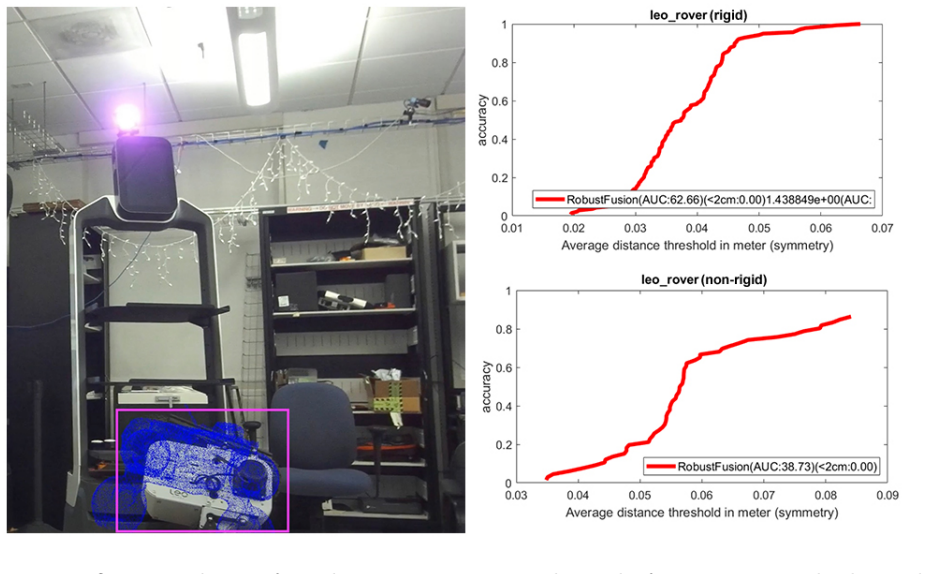
URSA is a complete end-to-end system for human-robot interaction in space. On the input side, an astronaut speaks to a HoloLens; the headset transcribes the speech and passes it to Gorilla, a large language model that maps the words to predefined functions such as opening a map, and the HoloLens runs the resulting call in its interface. On the perception side, a ZED2 RGB-D camera observes the Leo Rover from an external viewpoint, YOLOv8 detects the rover, and DTTDNet estimates its full 6-degree-of-freedom pose from fused color and depth features; that pose is rendered as an AR overlay on the headset. The authors' central claim is that this loop supports real-time robot control and monitoring even when the robot has no ground-truth sensors, because the ground truth is supplied by the external digital-twin tracking pipeline rather than by hardware on the rover. The experimental support is the DTTD3 dataset, 18 real scenes of about 5,000 labeled frames plus 30,000 synthetic frames, and the reported ADD-S AUC values of 62.66 and 38.73, which show the model tracks a rigid-body scene better than a non-rigid-body scene but handles both.
Load-bearing premise
The whole real-time, no-ground-truth claim rests on the assumption that the DTTD3 dataset, collected in a laboratory with a single Leo Rover under controlled lighting, represents the dynamic, occluded, and noisy conditions of real space operations closely enough that the offline accuracy numbers transfer to a live AR loop.
Editorial extensions
If this is right
- Rovers can be supervised from an AR headset using only an external camera, removing the need for onboard localization hardware.
- The DTTD3 dataset gives the 6D pose estimation community a robot-specific benchmark with both rigid and non-rigid test scenes, so future trackers can be compared on the same rover.
- Voice control through LLM function calling provides astronauts a hands-free interaction channel that works inside a bulky spacesuit.
- The gap between the 62.66 and 38.73 ADD-S AUC scores quantifies how much harder movable parts make pose estimation, pointing research toward articulated or part-aware models.
- The same external-camera tracking and AR overlay loop can be reused for mission consoles like the LMCC, giving ground crews a shared live view of rover state.
Reading between the lines
- A testable extension would be measuring end-to-end latency from spoken command to AR update in the field; the paper reports offline accuracy but not a live latency number, so the real-time part of the claim remains unquantified.
- The method's dependence on a closed-set, robot-specific tracker means it will likely transfer to other robots only after fine-tuning on new CAD models and data; the paper's own Section 6.3 notes unstable tracking in real competition videos, so the domain gap is the main risk to scale-up.
- LLM hallucination in function-call parameters suggests a production system should add a validation layer that checks returned arguments against the known function schema before execution.
- If external-camera tracking matures, the same digital-twin overlay could be pointed at human crew members or multiple robots, turning a single AR headset into a shared mission-awareness display.
Editorial analysis
A structured set of objections, weighed in public.
Referee Report
Summary. The paper reports URSA, an augmented-reality user interface developed for the NASA SUITS challenge, combining a HoloLens 2 head-mounted display, LLM-based voice control, a local mission control console, and a 6DoF robot pose-estimation pipeline built on the authors' DTTD3 dataset and DTTDNet model. The abstract's central claim is that the system enables real-time robot control and monitoring through an AR interface even in the absence of ground-truth sensors. The quantitative support consists of two ADD-S AUC values (62.66 for a rigid-body scene and 38.73 for a non-rigid-body scene) reported in Section 5.3.3. The paper also describes the DTTD3 data collection pipeline, the DTTDNet architecture, and the system integration, and it concludes with a limitations section acknowledging data noise, limited diversity, and unstable tracking during actual NASA SUITS usage.
Significance. If the central claims were validated, the work would offer a useful integration of LLM-driven voice interaction, AR visualization, and robot pose estimation for space-operations human-robot interaction, and the DTTD3 dataset would address a genuine gap in RGB-D datasets for non-rigid robotic bodies. The paper should be credited for presenting a complete system, for describing the data collection and annotation pipeline in detail, and for transparently acknowledging limitations in Sections 6.1-6.4. However, the evidence presented does not establish the central claim: the quantitative evaluation is extremely thin, is based entirely on the authors' own dataset and model, and is directly contradicted by the paper's own statement in Section 6.3 that the tracking was unstably jittery in real competition use. As such, the significance of the contribution cannot be assessed from the current manuscript.
major comments (4)
- [Abstract and §5.3.3] The abstract states that URSA 'enables real-time robot control and monitoring via an AR interface, even in the absence of ground-truth sensors,' but the reported experiments do not measure real-time performance. The only quantitative results are two ADD-S AUC values (62.66 rigid, 38.73 non-rigid) from offline evaluation on held-out lab scenes. No inference time, end-to-end latency, HoloLens 2 frame rate, or comparison against any baseline is reported, so the central claim is unsupported by the evidence in Section 5.3.3.
- [§6.3] The paper's own limitations section states that the initial DTTD dataset 'yielded unstable and jittery tracking results' during actual NASA SUITS usage. This directly contradicts the abstract's claim that the system enables real-time monitoring without ground-truth sensors. The later addition of 8,000 competition-video frames used only for 2D labeling is not shown to resolve the 6D pose instability, so the contradiction is not addressed anywhere in the manuscript.
- [§5.1, §6.1, §6.2] The evaluation is conducted entirely on the authors' own DTTD3 dataset with the authors' own DTTDNet pose estimator, with no independent dataset or external baseline. The manuscript itself concedes noisy motion-capture ground truth (Section 6.1) and limited dataset diversity causing suboptimal performance in complex scenes (Section 6.2). These concessions, together with the lack of a released dataset or code, mean that the two reported AUC values cannot support the generalizable robustness claim made in the abstract.
- [§5.3] The experimental protocol is under-specified. The text says 'we run two experiments by separating our dataset differently and training the pose estimation pipeline ... independently for 2 times,' yet only one pair of ADD-S AUC values is reported, with no per-experiment breakdown, error bars, or measure of variability. This makes it impossible to assess the stability or statistical significance of the reported results.
minor comments (4)
- [Throughout] The manuscript contains numerous typos and formatting inconsistencies, including 'V oice' in the Section 3 heading, 'T wo' in Section 5.2.2, 'an local' in Section 1, 'FTT' instead of FFT in Section 5.2.2, and 'contributers' in the author list.
- [§5.2.1] The contribution boundary between this work and the authors' prior DTTDNet paper [13] is unclear; Section 5.2.1 largely restates the DTTDNet architecture without specifying which modifications, if any, are new to the present system.
- [§5.3.3] The ADD-S AUC values would be easier to interpret if the paper reported standard errors, per-scene breakdowns, or a comparison with results on established datasets such as YCB-Video, since the two numbers alone do not indicate how the method performs relative to the field.
- [§6.3] The statement that 8,000 additional frames from competition videos were used for '2D labeling' is vague; the paper should clarify whether these frames were used only for detection training or also for pose estimation, and how they affected the metrics reported in Section 5.3.3.
Circularity Check
No circular derivation: the pose-estimation numbers come from a held-out scene split, the cited DTTDNet is prior published work, and the main weakness is an unsubstantiated real-time claim, not a circular one.
full rationale
The paper's derivation chain is not circular. The only quantitative evaluation in Section 5.3.3 reports ADD-S AUC values of 62.66 and 38.73 on rigid-body and non-rigid-body testing scenes; Section 5.3 states that each experiment trained on 17 of 18 real-world scenes plus 30,000 synthetic frames, leaving the evaluated scene out of training. Thus the reported accuracy is a held-out test, not a fit to the test data. The model DTTDNet is explicitly attributed to prior work by Huang et al. [13], which is a separately published, externally reviewed CVPR workshop paper; adopting that architecture via citation is transparent and does not smuggle in an unverified ansatz, nor does the paper invoke any uniqueness theorem from the same authors. The in-house DTTD3 dataset is used for both training and testing, but that is standard supervised evaluation and does not make the prediction equivalent to its input by construction. The paper's own limitations sections do, however, undercut the abstract's 'real-time ... even in the absence of ground-truth sensors' claim as an evidentiary matter: Section 6.3 states 'Our initial DTTD dataset ... yielded unstable and jittery tracking results,' and Sections 6.1 and 6.2 concede noisy motion-capture ground truth and limited dataset diversity. Those are gaps between claim and evidence, not circular steps in the derivation. No equation, metric, or prediction reduces to its own input. Therefore the circularity score is 0, while the correctness or supportability of the real-time claim would be a separate concern.
Assumptions & free parameters
assumptions (6)
- domain assumption The OptiTrack motion capture system provides accurate 6D ground truth for the rover poses used to label the dataset.
- domain assumption The ARUCO marker calibration accurately aligns the ZED2 camera frame with the OptiTrack frame.
- domain assumption The synthetic images generated from 3D models improve real-world pose estimation despite domain differences.
- domain assumption A single Leo Rover in 18 scenes is representative enough to validate robot tracking for the NASA SUITS scenario.
- domain assumption Gorilla, with temperature set to zero, is reliable enough for voice command execution.
- standard math The ADD-S metric is an accepted measure of 6DoF pose estimation quality.
Cite this review
Pith. "Pith review of 2024 NASA SUITS Report: LLM-Driven Immersive Augmented Reality User Interface for Robotics and Space Exploration." pith.science (2026). https://pith.science/paper/7VFOYYVK
@misc{pith2026250701206,
  author       = {Pith},
  title        = {Pith review of: 2024 NASA SUITS Report: LLM-Driven Immersive Augmented Reality User Interface for Robotics and Space Exploration},
  year         = {2026},
  howpublished = {\url{https://pith.science/paper/7VFOYYVK}},
  note         = {Machine review of arXiv:2507.01206}
}
read the original abstract
As modern computing advances, new interaction paradigms have emerged, particularly in Augmented Reality (AR), which overlays virtual interfaces onto physical objects. This evolution poses challenges in machine perception, especially for tasks like 3D object pose estimation in complex, dynamic environments. Our project addresses critical issues in human-robot interaction within mobile AR, focusing on non-intrusive, spatially aware interfaces. We present URSA, an LLM-driven immersive AR system developed for NASA's 2023-2024 SUITS challenge, targeting future spaceflight needs such as the Artemis missions. URSA integrates three core technologies: a head-mounted AR device (e.g., HoloLens) for intuitive visual feedback, voice control powered by large language models for hands-free interaction, and robot tracking algorithms that enable accurate 3D localization in dynamic settings. To enhance precision, we leverage digital twin localization technologies, using datasets like DTTD-Mobile and specialized hardware such as the ZED2 camera for real-world tracking under noise and occlusion. Our system enables real-time robot control and monitoring via an AR interface, even in the absence of ground-truth sensors--vital for hazardous or remote operations. Key contributions include: (1) a non-intrusive AR interface with LLM-based voice input; (2) a ZED2-based dataset tailored for non-rigid robotic bodies; (3) a Local Mission Control Console (LMCC) for mission visualization; (4) a transformer-based 6DoF pose estimator (DTTDNet) optimized for depth fusion and real-time tracking; and (5) end-to-end integration for astronaut mission support. This work advances digital twin applications in robotics, offering scalable solutions for both aerospace and industrial domains.
Figures


Figures from the paper (7 more)


Reference graph
Works this paper leans on
-
[13]
Robust 6DoF Pose Estimation Against Depth Noise and a Comprehen- sive Evaluation on a Mobile Dataset
Zixun Huang et al. “Robust 6DoF Pose Estimation Against Depth Noise and a Comprehen- sive Evaluation on a Mobile Dataset”. In:Proceedings of the Computer Vision and Pattern Recognition Conference (CVPR) Workshops. June 2025, pp. 1848–1857
work page 2025
-
[1]
url: https://www.nasa.gov/learning-resources/spacesuit-user-interface-technologies- for-students/
-
[2]
url: https://www.microsoft.com/en-us/hololens
-
[3]
url: https://www.vive.com/us/product/vive-xr-elite/overview/
-
[4]
url: https://kth.diva-portal.org/smash/get/diva2:1801210/FULLTEXT01.pdf
-
[5]
ImageNet: A large-scale hierarchical image database
Jia Deng et al. “ImageNet: A large-scale hierarchical image database”. en. In: 2009 IEEE Conference on Computer Vision and Pattern Recognition. Miami, FL: IEEE, June 2009, pp. 248–255. isbn: 978-1-4244-3992-8. doi: 10 . 1109 / CVPR . 2009 . 5206848. url: https : //ieeexplore.ieee.org/document/5206848/
arXiv 2009
-
[6]
Weiyu Feng et al. “Digital Twin Tracking Dataset (DTTD): A New RGBD 3D Dataset for Longer-Range Object Tracking Applications”. en. In:2023 IEEE/CVF Conference on Com- puter Vision and Pattern Recognition Workshops (CVPRW). Vancouver, BC, Canada: IEEE, June 2023, pp. 3289–3298. isbn: 9798350302493. doi: 10 . 1109 / CVPRW59228 . 2023 . 00331. url: https://i...
-
[7]
AutomaticGazeAnalysis:ASurveyofDeepLearningbasedApproaches
ShreyaGhoshetal.“AutomaticGazeAnalysis:ASurveyofDeepLearningbasedApproaches”. In: CoRR abs/2108.05479 (2021). arXiv:2108.05479. url: https://arxiv.org/abs/2108. 05479
arXiv 2021
Show all 23 references
-
[8]
Google glasses
Joe Gvora. Google glasses. Apr. 2023.url: https://screenrant.com/google-glass-smart- glasses-what-happened-explained/. 19
2023
-
[9]
arXiv:2103.02242 [cs]
Yisheng He et al.FFB6D: A Full Flow Bidirectional Fusion Network for 6D Pose Estimation. arXiv:2103.02242 [cs]. Mar. 2021.url: http://arxiv.org/abs/2103.02242
2021 arXiv
-
[10]
FS6D: Few-Shot 6D Pose Estimation of Novel Objects
Yisheng He et al. “FS6D: Few-Shot 6D Pose Estimation of Novel Objects”. en. In: 2022 IEEE/CVF Conference on Computer Vision and Pattern Recognition (CVPR). New Or- leans, LA, USA: IEEE, June 2022, pp. 6804–6814.isbn: 978-1-66546-946-3. doi: 10.1109/ CVPR52688.2022.00669. url: ...
2022
-
[11]
PVN3D: A Deep Point-Wise 3D Keypoints Voting Network for 6DoF Pose Estimation
Yisheng He et al. “PVN3D: A Deep Point-Wise 3D Keypoints Voting Network for 6DoF Pose Estimation”.en.In: 2020 IEEE/CVF Conference on Computer Vision and Pattern Recognition (CVPR). Seattle, WA, USA: IEEE, June 2020, pp. 11629–11638.isbn: 978-1-72817-168-5. doi: 10.1109/CVPR426...
2020
-
[12]
Model Based Training, Detection and Pose Estimation of Texture- Less 3D Objects in Heavily Cluttered Scenes
Stefan Hinterstoisser et al. “Model Based Training, Detection and Pose Estimation of Texture- Less 3D Objects in Heavily Cluttered Scenes”. en. In: Computer Vision – ACCV 2012. Vol. 7724. Berlin, Heidelberg: Springer Berlin Heidelberg, 2013, pp. 548–562.isbn: 978-3- 642-37330-...
2012 doi
-
[14]
HomebrewedDB: RGB-D Dataset for 6D Pose Estimation of 3D Ob- jects
Roman Kaskman et al. HomebrewedDB: RGB-D Dataset for 6D Pose Estimation of 3D Ob- jects. en. arXiv:1904.03167 [cs]. Sept. 2019.url: http://arxiv.org/abs/1904.03167
1904 arXiv
-
[15]
YOLO Algorithm for Object Detection Explained
Kundu. YOLO Algorithm for Object Detection Explained. url: https://www.v7labs.com/ blog/yolo-object-detection
-
[16]
Microsoft COCO: Common Objects in Context
Tsung-Yi Lin et al. Microsoft COCO: Common Objects in Context. en. arXiv:1405.0312 [cs]. Feb. 2015.url: http://arxiv.org/abs/1405.0312
2015 arXiv
-
[17]
Xingyu Liu et al.KeyPose: Multi-View 3D Labeling and Keypoint Estimation for Transparent Objects. en. arXiv:1912.02805 [cs]. May 2020.url: http://arxiv.org/abs/1912.02805. 20
1912 arXiv
-
[18]
HGR: Hand-Gesture- Recognition Based Text Input Method for AR/VR Wearable Devices
Nooruddin Nooruddin, Rahool Dembani, and Nizamuddin Maitlo. “HGR: Hand-Gesture- Recognition Based Text Input Method for AR/VR Wearable Devices”. In:2020 IEEE In- ternational Conference on Systems, Man, and Cybernetics (SMC). 2020, pp. 744–751. doi: 10.1109/SMC42975.2020.9283348
2020
-
[19]
Patil et al
Shishir G. Patil et al. Gorilla: Large Language Model Connected with Massive APIs. 2023. arXiv: 2305.15334 [cs.CL]
2023 arXiv
-
[20]
Fine-tuning yolov8 for image segmentation with Comet
Haziqa Sajid. Fine-tuning yolov8 for image segmentation with Comet. July 2023.url: https: //www.comet.com/site/blog/fine- tuning- yolov8- for- image- segmentation- with- comet / # : ~ : text = Fine % 2Dtuning % 20is % 20performed % 20by , all % 20your % 20machine % 20learning%20runs
2023
-
[21]
Jonathan Tremblay, Thang To, and Stan Birchfield.Falling Things: A Synthetic Dataset for 3D Object Detection and Pose Estimation. en. arXiv:1804.06534 [cs]. July 2018.url: http: //arxiv.org/abs/1804.06534
2018 arXiv
-
[22]
DenseFusion: 6D Object Pose Estimation by Iterative Dense Fusion
Chen Wang et al. DenseFusion: 6D Object Pose Estimation by Iterative Dense Fusion. en. arXiv:1901.04780 [cs]. Jan. 2019. url: http : / / arxiv . org / abs / 1901 . 04780(visited on 09/26/2023)
1901 arXiv
-
[23]
Yu Xiang et al.PoseCNN: A Convolutional Neural Network for 6D Object Pose Estimation in Cluttered Scenes. en. arXiv:1711.00199 [cs]. May 2018.url: http://arxiv.org/abs/1711. 00199. 21
2018 arXiv
Reviewed August 6, 2026 · model on record in the stance chip above.
Discussion (0). Continue with ORCID to comment.