REVIEW 2 major objections 4 minor 1 cited by
Conjugator length of locally compact groups of Euclidean isometries
T0 review · 2 major / 4 minor · reviewed 2026-08-06 · deepseek-v4-flash
Pith's one-line read Every split locally compact subgroup of Euclidean isometries has conjugator length growing at most linearly.
desk verdict The main theorem is false: in Isom(R^2), pairs of rotations with word lengths summing to ≤ 3 have conjugators of arbitrarily large translation length, and the proof's uniform pseudoinverse bound fails for O(2). read the letter →
The pith
A machine-rendered reading of the paper's core claim, the machinery that carries it, and where it could break.
The reading
What carries the argument
The carrying object is the coconjugation set $C_H(h,h')$, the set of all elements of $H$ that conjugate $h$ to $h'$. Theorem 2.4, restated from a prior result, describes it as a disjoint union, over spherical parts $u$, of affine subspaces of the form $t_{\eta_u + (\operatorname{Fix}(h'_0)\cap L_H)}\,u$, where $\eta_u$ is any solution of the linear system $\lambda' - u\lambda = (I - h'_0)\eta$. To minimize the Euclidean norm of $\eta_u$, the paper takes the Moore–Penrose pseudoinverse $A^+$ of $A = I - h'_0$, whose value $A^+(\lambda' - u\lambda)$ is the minimum-norm real solution; the bounded covolume of the translation lattice $L_H$ then permits passage to a nearby lattice element. The proof of linearity combines a uniform bound on the norms of these pseudoinverses with the quasi-isometry between word length and translation norm from Lemma 3.1.
What would settle it
Calculate the operator norm of $(I - R_\theta)^+$ for $R_\theta \in \mathrm{SO}(2)$ a rotation by angle $\theta$; it equals $1/(2\sin(\theta/2))$ and tends to infinity as $\theta \to 0$. Hence the boundedness claim used to produce $k_1$ is false for the compact spherical subgroup $\mathrm{SO}(2)$, so a proof of linear conjugator length for $L \rtimes \mathrm{SO}(2)$ would need another argument, and any superlinear lower bound for such a group would disprove Theorem 1.1.
Extended reading notes
Core claim
The paper's central claim is Theorem 1.1: if $H = T_H \rtimes H_0$ is a split, locally compact subgroup of the Euclidean isometry group $\operatorname{Isom}(\mathbb{E}^n)$, then its conjugator length function $\mathrm{CL}_H\colon \mathbb{N} \to \mathbb{Z}_{\ge 0}$ grows at most linearly. The proof first compares word length with the Euclidean norm of the translation part of an element, via the quasi-isometric embedding of the translation subgroup $T_H$ into $\mathbb{R}^n$. It then shows that the shortest possible translation vector of a conjugator is bounded by an affine function of the two translation vectors being conjugated. This is achieved by describing all possible conjugators as solutions of a linear system and using the Moore–Penrose pseudoinverse to locate the minimum-norm solution, combined with compactness of the spherical part $H_0$ and the bounded covolume of the translation lattice $L_H$. Corollary 1.2 records that affine Coxeter groups and split crystallographic groups consequently have linear conjugator length.
Load-bearing premise
The proof needs a single constant $k_1$ bounding the matrix norm of the Moore–Penrose pseudoinverse of $I - h'_0$ for every spherical part $h'_0 \in H_0$; this uniform bound fails when $H_0$ contains rotations by angles arbitrarily close to zero, such as $H_0 = \mathrm{O}(2)$, so the linear estimate in Proposition 3.7 does not cover that case.
Editorial extensions
If this is right
- Every split locally compact subgroup of $\operatorname{Isom}(\mathbb{E}^n)$ has conjugator length $O(n)$, including the full isometry group itself.
- Affine Coxeter groups and split crystallographic groups have linearly growing conjugator length, as stated in Corollary 1.2.
- For nonconstant cases, the minimal conjugator's Euclidean translation norm is bounded by an affine function of the combined translation norms of the two conjugate elements, and this bound is the mechanism behind the word-length bound.
- The growth rate of the conjugator length function is independent of the chosen compact generating set for $H$, because any two compact word metrics on a locally compact group are quasi-isometric.
Reading between the lines
- The uniform pseudoinverse bound is the delicate point: for a spherical part such as $H_0 = \mathrm{SO}(2)$, containing rotations arbitrarily close to the identity, the norms of $(I - h'_0)^+$ are unbounded, so the proof's constant $k_1$ cannot be chosen; the theorem for such groups would require a proof that avoids that uniform bound.
- If the linear bound survives in the case of a lattice acting by $\mathrm{SO}(2)$, the same argument template may extend to any semidirect product $L \rtimes K$ with $K$ a compact linear group, replacing the uniform pseudoinverse bound by a spectral-gap or discreteness condition on $K$.
- A concrete testable consequence of the theorem's mechanism is that in split crystallographic groups the shortest conjugator between two elements of translation length at most $R$ should have translation length $O(R)$, with constants depending only on the coroot lattice and the spherical group; one could compute these constants explicitly in the type $\widetilde{A}_2$ example.
Editorial analysis
A structured set of objections, weighed in public.
Referee Report
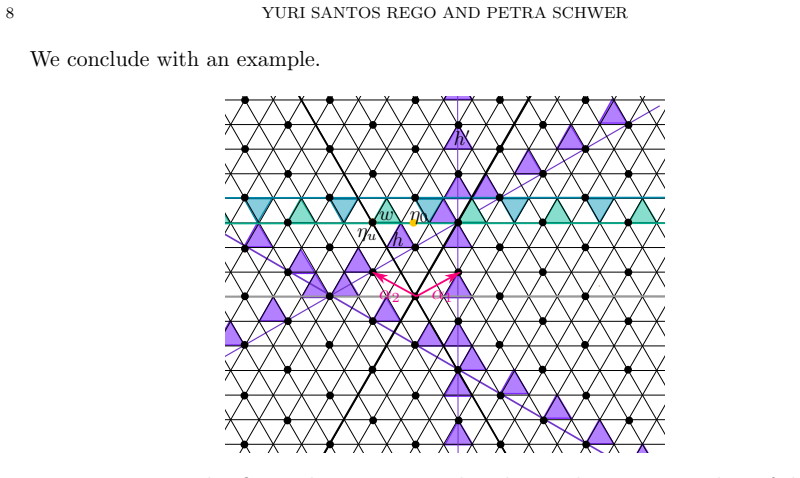
Summary. The paper defines a conjugator length function for compactly generated locally compact groups and studies split subgroups H = T_H ⋊ H_0 of the full Euclidean isometry group Isom(E^n). Its main result, Theorem 1.1, claims that for every such split locally compact subgroup the conjugator length function CL(n) grows at most linearly. The proof strategy is to reduce CL to a conjugator translation norm CT via quasi-isometry (Lemma 3.1 and Corollaries 3.3–3.4), then to bound the translation part of a shortest conjugator using the coconjugation set description from [MST24] and Moore–Penrose pseudoinverse estimates (Proposition 3.7). The paper also states consequences for affine Coxeter groups and split crystallographic groups, and includes a worked example for the affine Coxeter group of type eA2.
Significance. If Theorem 1.1 were true, it would be a clean and useful extension of known linear conjugator length results to continuous families such as Isom(E^n) itself, and it would recover linear growth for affine Coxeter and split crystallographic groups. The definition of conjugator length for locally compact groups is natural, and the use of the coconjugation description from [MST24] is methodologically appropriate; relying on that prior structural theorem as a black box is not the source of the difficulty. However, the central estimate in Proposition 3.7 is false, and Theorem 1.1 is contradicted by an elementary example in Isom(R^2). The paper therefore does not establish its main claim, and the error is load-bearing rather than a local gap.
major comments (2)
- [Proposition 3.7 (paragraph before Eq. (3.3))] The asserted uniform bound on {|B^+| : B ∈ I − H_0} is false. For H_0 = O(2) and B_θ = I − R_θ with 0 < θ small, B_θ is invertible, so B_θ^+ = B_θ^{-1}. Its operator norm is 1/(2 sin(θ/2)), which tends to infinity as θ → 0. Hence no uniform constant k_1 exists. The attempted justification via Proposition 2.7 bounds the columns of B_1 and B_2, but it does not bound B_2^{-1}; as B approaches a singular matrix, B_2^{-1} becomes unbounded. Since k_1 enters the final estimate M_H(x) = k_1 k_3 x + k_0, this invalidates the claimed linear bound in Proposition 3.7.
- [Theorem 1.1 (counterexample)] The failure is not merely a proof gap: the conclusion of Theorem 1.1 is false. Take G = Isom(R^2) and S = {t_v : ∥v∥ ≤ 1} ∪ {R_φ : |φ| ≤ 1}. For every M, set ε = 1/M, p = M e_1, h = R_ε, and h' = t_p R_ε t_p^{-1} = t_{(I−R_ε)p} R_ε. Then ℓ_S(h) = ε ≤ 1 and ℓ_S(h') ≤ ⌈∥(I−R_ε)p∥⌉ + 1 ≤ 2 for all M ≥ 1, since ∥(I−R_ε)p∥ = 2M sin(1/(2M)) ≤ 1. Thus ℓ_S(h) + ℓ_S(h') ≤ 3. Any conjugator from h to h' has translation part p: the equation t_v R_φ R_ε R_φ^{-1} t_v^{-1} = h' forces (I − R_ε)v = (I − R_ε)p, and since I − R_ε is invertible for ε not a multiple of 2π, v = p. Because the word metric on G with this compact generating set is quasi-isometric to the displacement of the origin, any element with translation part p has word length at least c∥p∥ = cM for a fixed c > 0. Hence CL(3) ≥ cM for arbitrarily large M, so CL is not linearly bounded and Theorem 1.1 is contradicted.
minor comments (4)
- [Abstract and Introduction] The manuscript contains two different abstracts: the article's own abstract says 'grows linearly', while the summary text says 'either has zero growth, grows linearly, or is unbounded'. These are logically incompatible statements, and the wording should be unified.
- [Proposition 3.7 and Theorem 1.1] The hypothesis 'nonconstant' in Proposition 3.7 is confusing: Theorem 1.1 claims at most linear growth, and the proof separates constant cases; if CL were unbounded, the proposition would still assert linear growth. The logical structure should be clarified.
- [Proof of Lemma 3.1] The quasi-isometry between T_H and H used in Lemma 3.1 is cited to [CdlH16, Proposition 4.C.11]; it would help the reader if the dependence of the constants on the compact set H_0 were made explicit, since the subsequent proof relies heavily on uniformity over H_0.
- [Figure 1] The caption refers to yellow and turquoise elements, which may not be distinguishable in black-and-white printing; consider adding shading or labels.
Circularity Check
No significant circularity: the proof uses an independent structural theorem, and the contentious pseudoinverse bound is a correctness issue, not a circular one.
full rationale
The paper is a pure proof and contains no empirical fits or predictions. The derivation chain is: (1) define CL and CT and show via Lemma 3.1 and Lemma 3.6 that they are quasi-equivalent using standard quasi-isometry arguments; (2) invoke Theorem 2.4 from [MST24] to describe all conjugators as translations along an affine subspace given by Equation (2.3); (3) use Moore-Penrose pseudoinverses to choose the shortest translation vector and bound its norm. No step defines its output in terms of its input: CL is not assumed in bounding CT, and CT is not used to prove Theorem 2.4. The only self-citation is [MST24], a prior structural theorem by one of the present coauthors; it is parameter-free, its assumptions do not include the target linear growth conclusion, and it is used as a black-box structural input rather than being derived from the present claim. The skeptical concern about the uniform boundedness of { |B^+| : B in I-H0 } just before Equation (3.4) is a substantive correctness issue: for H0 = O(2), |(I - R_theta)^+| = 1/(2 sin(theta/2)) is unbounded as theta tends to 0, so the constant k1 may fail to exist. However, that is a mathematical error, not a circularity: the asserted bound does not follow from the inputs by construction, and no fitted parameter is renamed as a prediction. Hence the finding is no significant circularity, with the minor caveat that the central structural input is a same-group citation that is nonetheless independent support under the stated rules.
Assumptions & free parameters
assumptions (4)
- domain assumption The spherical subgroup H0 is compact and the translation lattice L_H is isomorphic to R^a × Z^b with bounded covolume.
- domain assumption The action of H0 preserves L_H, i.e., u L_H = L_H for all u in H0.
- ad hoc to paper The Moore-Penrose pseudoinverse norm is uniformly bounded over I - H0.
- domain assumption The maximum defining CL(n) is finite.
Cite this review
Pith. "Pith review of Conjugator length of locally compact groups of Euclidean isometries." pith.science (2026). https://pith.science/paper/QT3M7ATA
@misc{pith2026250701268,
  author       = {Pith},
  title        = {Pith review of: Conjugator length of locally compact groups of Euclidean isometries},
  year         = {2026},
  howpublished = {\url{https://pith.science/paper/QT3M7ATA}},
  note         = {Machine review of arXiv:2507.01268}
}
abstract
We consider locally compact subgroups $H$ of the full isometry group $\Isom(\E^n)$ of Euclidean $n$-space which respect the splitting into an orthogonal and a translation subgroup. We prove that the conjugator length function of such groups either has zero growth, grows linearly, or is unbounded --- depending on the topology of the spherical part of $H$. Our theorem shows, in particular, that affine Coxeter groups and split crystallographic groups have linear growth for their conjugator length functions.
Figures
Forward citations
Cited by 1 Pith paper
-
Conjugator length in finitely presented groups
The conjugator length function is quadratic for the integral Heisenberg group and Stallings' group, and cyclic-subgroup distortion can be promoted to conjugator length.
Reference graph
Works this paper leans on
-
[5]
[CdlH16] Yves Cornulier and Pierre de la Harpe
arXiv:2506.01248. [CdlH16] Yves Cornulier and Pierre de la Harpe. Metric geometry of locally compact groups, volume 25 of EMS Tracts in Mathematics. European Mathematical Society (EMS), Z¨ urich, 2016.doi:10.4171/166. [CM09] Stephen L. Campbell and Carl D. Meyer. Generalized inverses of linear transformations , vol- ume 56 of Classics in Applied Mathemati...
arXiv 2016
-
[9]
doi:10.1142/S0218196725500109. [Sal15] Andrew W. Sale. The geometry of the conjugacy problem in wreath products and free solvable groups. J. Group Theory , 18(4):587–621,
-
[1989]
[MST24] Elizabeth Mili´ cevi´ c, Petra Schwer, and Anne Thomas
doi:10.1070/IM1990v035n01ABEH000693. [MST24] Elizabeth Mili´ cevi´ c, Petra Schwer, and Anne Thomas. The geometry of conjugation in Euclidean isometry groups. Preprint,
-
[1995]
doi:10.1007/978-3-642-61701-0 . [BR25] Martin R. Bridson and Timothy R. Riley. The lengths of conjugators in the model filiform groups. Preprint,
-
[2009]
doi:10.1137/1.9780898719048. [Lim11] Elon L. Lima. ´Algebra linear. Cole¸ c˜ ao matem´ atica universit´ aria. IMPA, Rio de Janeiro, 8th edition,
-
[2013]
doi:10.1007/s00039-012-0206-3 . Yuri Santos Rego, University of Lincoln, Charlotte Scott Research Centre for Algebra, Brayford Pool, LN6 7TS Lincoln, UK Email address : ysantosrego@lincoln.ac.uk Petra Schwer, Institute of Mathematics, Heidelberg University, Im Neuenheimer Feld 255, 69120 Heidelberg, Germany Email address : schwer@uni-heidelberg.de
-
[2014]
doi:10.1215/ijm/1446819294. [BH99] Martin R. Bridson and Andr´ e Haefliger. Metric spaces of non-positive curvature , volume 319 of Grundlehren der mathematischen Wissenschaften . Springer-Verlag, Berlin,
-
[2015]
doi:10.1515/jgth-2015-0009 . [Sal16] Andrew W. Sale. Conjugacy length in group extensions. Comm. Algebra, 44(2):873–897,
Show all 12 references
-
[2016]
[Tao13] Jing Tao
doi: 10.1080/00927872.2014.990021. [Tao13] Jing Tao. Linearly bounded conjugator property for mapping class groups. Geom. Funct. Anal. , 23(1):415–466,
2014
-
[2023]
CONJUGATOR LENGTH OF SPLIT EUCLIDEAN ISOMETRY GROUPS 9 [Bou95] Nicolas Bourbaki
doi:10.1112/blms.12757. CONJUGATOR LENGTH OF SPLIT EUCLIDEAN ISOMETRY GROUPS 9 [Bou95] Nicolas Bourbaki. General topology. Chapters 1–4 . Elements of mathematics. Springer-Verlag, Berlin–Heidelberg,
-
[2024]
[MST25] Elizabeth Mili´ cevi´ c, Petra Schwer, and Anne Thomas
arXiv:2407.08078. [MST25] Elizabeth Mili´ cevi´ c, Petra Schwer, and Anne Thomas. The geometry of conjugation in affine coxeter groups. Internat. J. Algebra Comput. , 35(03):403–465,
-
[2025]
[BRS25] Martin R
arXiv:2506.01235. [BRS25] Martin R. Bridson, Timothy R. Riley, and Andrew W. Sale. Conjugacy in a family of free-by-cyclic groups. Preprint,
Reviewed August 6, 2026 · model on record in the stance chip above.
Discussion (0). Continue with ORCID to comment.